Growth Hacking: What It Really Is, Why It's Not Dead, and How to Do It in 2026
Every growth hacking article gives you the same five examples from 2010 and calls it a day. Dropbox referral program. Airbnb Craigslist hack. Hotmail signature. The internet has changed - privacy laws exist, CAC has doubled, and the playbooks that worked when Obama was in his first term don't transfer to a world with GDPR, iOS privacy changes, and AI-generated everything. Here's a guide that actually reflects what growth teams are doing right now: frameworks, modern strategies, a real tool stack, and examples from this decade.
The Short Version
Definition: Growth hacking is rapid, data-driven experimentation across product, marketing, and engineering to find scalable growth levers.
The shift: In 2026, this discipline isn't about clever one-off tricks. It's about building repeatable growth engines - systems that compound over time. The teams winning today run structured experimentation loops, not viral stunts.
Where to start: Pick one stage of the AARRR funnel (Acquisition, Activation, Retention, Revenue, Referral). Run one experiment this week. Measure with real tools. That's it. Everything else is refinement.
What Is Growth Hacking?
Growth hacking is the practice of using rapid experimentation across marketing channels, product development, and engineering to identify the most efficient ways to grow a business. Sean Ellis coined the term in 2010 when he couldn't find a hire who combined marketing instincts with product thinking and technical chops - so he invented a role that demanded all three. He later helped popularize the discipline through Hacking Growth, which remains one of the best structured introductions to growth experimentation.
Ellis noticed that traditional marketers often optimize for brand awareness and campaign metrics. Growth hackers optimize for one thing: growth. The distinction matters. Traditional marketing operates on budgets, timelines, and brand guidelines. Experimentation-driven growth operates on hypotheses, experiments, and speed.
There's a prerequisite most guides skip entirely. Ellis developed the "40% test" for product-market fit: survey your users and ask how they'd feel if they could no longer use your product. If fewer than 40% say "very disappointed," you don't have PMF yet - and no amount of experimentation will save you. You can't hack growth on a product people don't need. This is the single most important filter before you invest in experimentation. Get PMF right first.
Brian Balfour, former VP of Growth at HubSpot, extended this thinking with his "four fits" framework - arguing that product-market fit alone isn't enough without also nailing market-product fit, product-channel fit, and channel-model fit. If your growth experiments keep failing, Balfour's framework is often the diagnostic that reveals why.
A growth hacker might redesign an onboarding flow on Monday, launch a referral incentive on Tuesday, and A/B test pricing page copy on Wednesday. The unifying thread isn't the channel. It's the method: hypothesis, test, measure, iterate.
Three Persistent Myths
A peer-reviewed paper published in Technological Forecasting and Social Change systematically debunked three persistent myths about growth hacking. This is the kind of rigorous analysis that most blog posts skip.
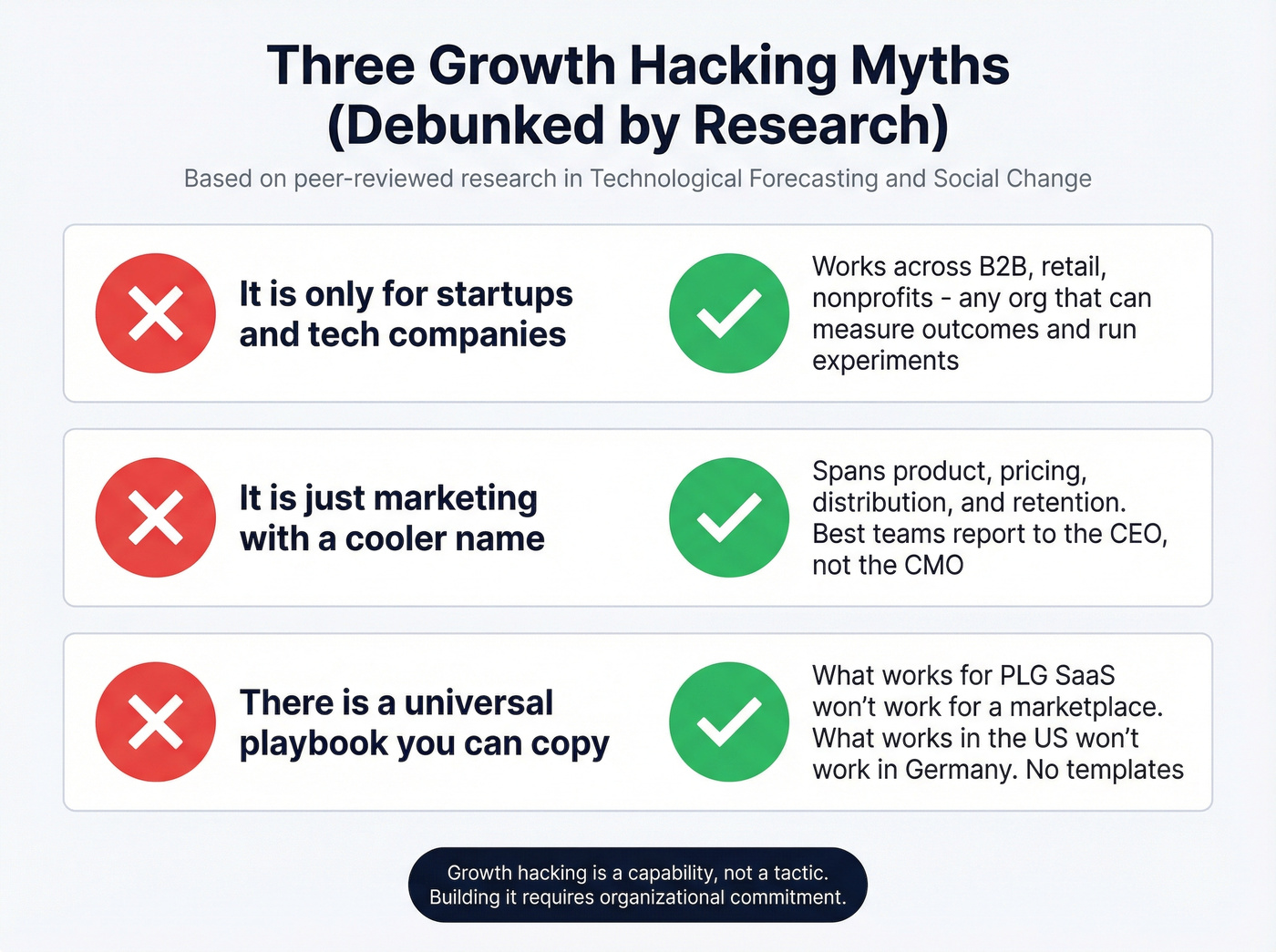
Myth 1: It's only for startups and tech platforms. The experimentation mindset applies to any company facing growth challenges - B2B enterprises, brick-and-mortar retailers, nonprofits. Growth capabilities improve firm performance across industries, not just in Silicon Valley. If you can measure outcomes and run experiments, you can do this.
Myth 2: It's just a marketing strategy. Growth hacking bridges the gap between strategy definition and strategy execution. It touches product, pricing, distribution, and retention - not just top-of-funnel acquisition. Treating it as "marketing with a cooler name" misses the entire point. The best growth teams report to the CEO, not the CMO, because the work spans engineering, product, and go-to-market simultaneously.
Myth 3: It's a predefined, one-size-fits-all process. There's no universal playbook. What works for a PLG SaaS company won't work for a marketplace. What works in the US won't work in Germany (thanks, GDPR). Anyone selling you a template is selling you a shortcut that doesn't exist.
The implication: this is a capability, not a tactic. Building that capability requires organizational commitment, not just a clever marketer with a Canva account.
Growth Hacking vs. Growth Marketing
These terms get used interchangeably, and that's a mistake. The core difference is speed versus sustainability.
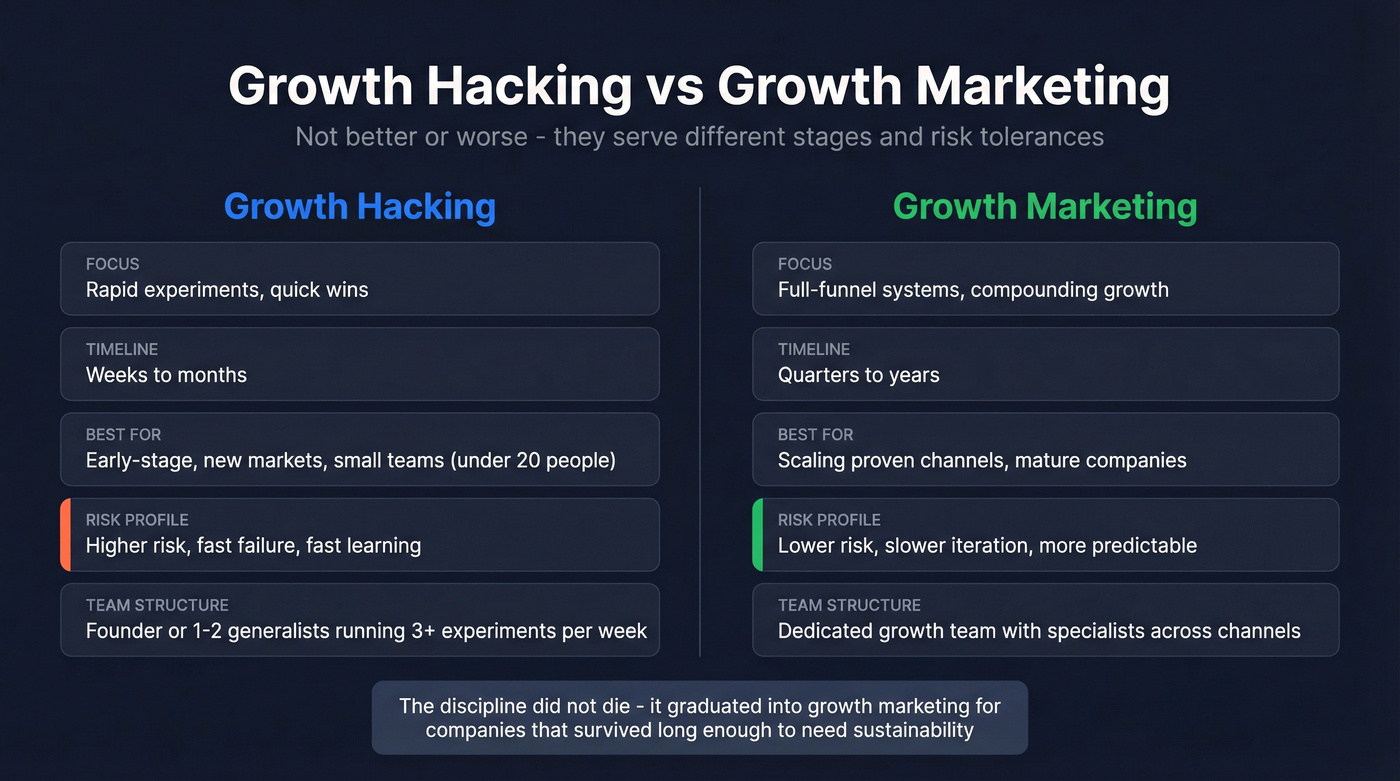
Growth hacking prioritizes rapid experimentation for immediate results - think weeks and months. Growth marketing takes a slower initial pace but builds sustainable, compounding growth across the entire customer lifecycle. One isn't better than the other. They serve different stages and different risk tolerances.
Simon-Kucher's framework breaks it down cleanly into three tiers. Digital marketing is the channel toolbox - SEO, paid ads, social, email. Growth marketing is the full lifecycle strategy tied to business outcomes like revenue, LTV, and churn reduction. Performance marketing is transactional efficiency - cost per lead, ROAS, conversion rates. Growth hacking cuts across all three but with a bias toward speed and experimentation over process and governance.
| Growth Hacking | Growth Marketing | |
|---|---|---|
| Focus | Rapid experiments | Full-funnel systems |
| Timeline | Weeks to months | Quarters to years |
| Best for | Early-stage validation | Scaling proven channels |
| Risk | Higher (fast failure) | Lower (slower iteration) |
Here's the thing: 2026's privacy and regulatory environment increasingly favors growth marketing for mature companies. But rapid experimentation remains essential for early-stage validation, new market entry, and any team that needs to learn fast with limited resources. The discipline didn't die - it graduated into growth marketing for companies that survived long enough to need sustainability.
If your deal size is under $10K and your team is under 20 people, you don't need a "growth marketing engine." You need a founder who runs three experiments a week and isn't afraid to kill ideas that don't move the number. Build the engine later.

Every growth experiment needs a list of real people to test against. Prospeo gives you 300M+ profiles with 98% email accuracy and 30+ filters - buyer intent, technographics, headcount growth - so your acquisition experiments hit real buyers, not dead inboxes.
Stop hacking growth with bad data. Start with contacts that actually connect.
The AARRR Framework
90% of startups fail within their first five years. Most of them fail not because they lacked clever hacks, but because they never built a systematic understanding of where users drop off. That's exactly what the AARRR framework solves.
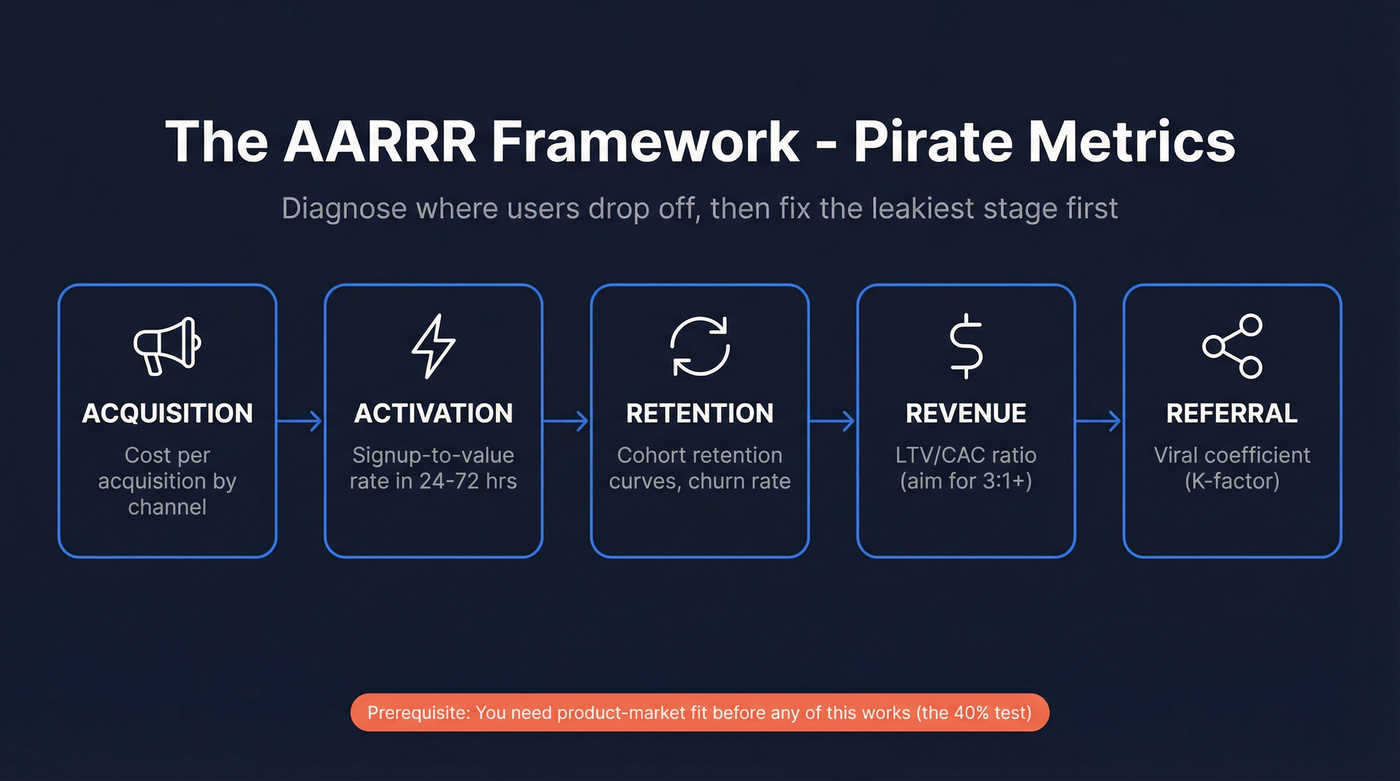
Dave McClure created AARRR (Pirate Metrics) in 2007 to combat vanity metrics - pageviews, downloads, social followers - that look impressive but don't correlate with revenue. The framework forces you to think about five stages of the user journey, each with its own key metric. A related concept worth knowing is the North Star Metric: the single metric that best captures the core value your product delivers to customers. Use the pirate funnel to diagnose where you're leaking, and use your North Star Metric to keep the whole team aligned on what "growth" actually means.
Acquisition
How do users find you? Organic search, paid ads, referrals, partnerships, content. The key metric is cost per acquisition by channel. The mistake most teams make is optimizing for volume instead of quality - a thousand signups from a viral TikTok mean nothing if none of them match your ICP.
Activation
The "aha moment" - when a new user first experiences your product's core value. Duolingo nails this with personalized onboarding that tailors the starting point to each learner's level, so the first lesson feels relevant instead of generic. Runna defines activation as the first completed workout. Your key metric is activation rate: what percentage of signups reach the value moment within 24 to 72 hours?
Retention
This is where most startups bleed out. Calm drives retention through daily meditation sessions that create habitual usage. Apple Fitness+ uses content programming like "Time to Walk" and "Artist Spotlight" to give subscribers a reason to return. Track cohort retention curves and churn rate. If retention is weak, fix this before you spend another dollar on acquisition. We've seen teams pour $50K/month into paid acquisition while losing 60% of users in the first week - that's not a growth problem, it's a product problem.
Revenue
How do you monetize? This stage covers conversion from free to paid, expansion revenue, upsells, and pricing optimization. Key metrics: LTV/CAC ratio (aim for 3:1 or better), average revenue per user, and time to first payment. The experimentation angle here is testing pricing, packaging, and payment friction - not just "charge more." If you're trying to benchmark acquisition efficiency, start with cost per acquisition and work backward from LTV.
Referral
Do users bring other users? The viral coefficient, or K-factor, measures how many new users each existing user generates. Anything above 1.0 means organic viral growth - a true viral loop where the product spreads faster than users churn. Spotify's annual Wrapped campaign is a masterclass in engineered referral: it turns every user into a social media billboard once a year. If you're building this intentionally, a structured referral incentive program beats random “share” buttons.
Six Techniques That Work in 2026
If your growth strategy is still "copy what Dropbox did," you're already behind. Higher CAC, tighter privacy laws, and AI commoditization mean everyone has access to the same optimization tools. The edge now comes from building systems, not finding hacks. These six strategies, adapted from LeanLabs' framework, form a practical modern playbook.
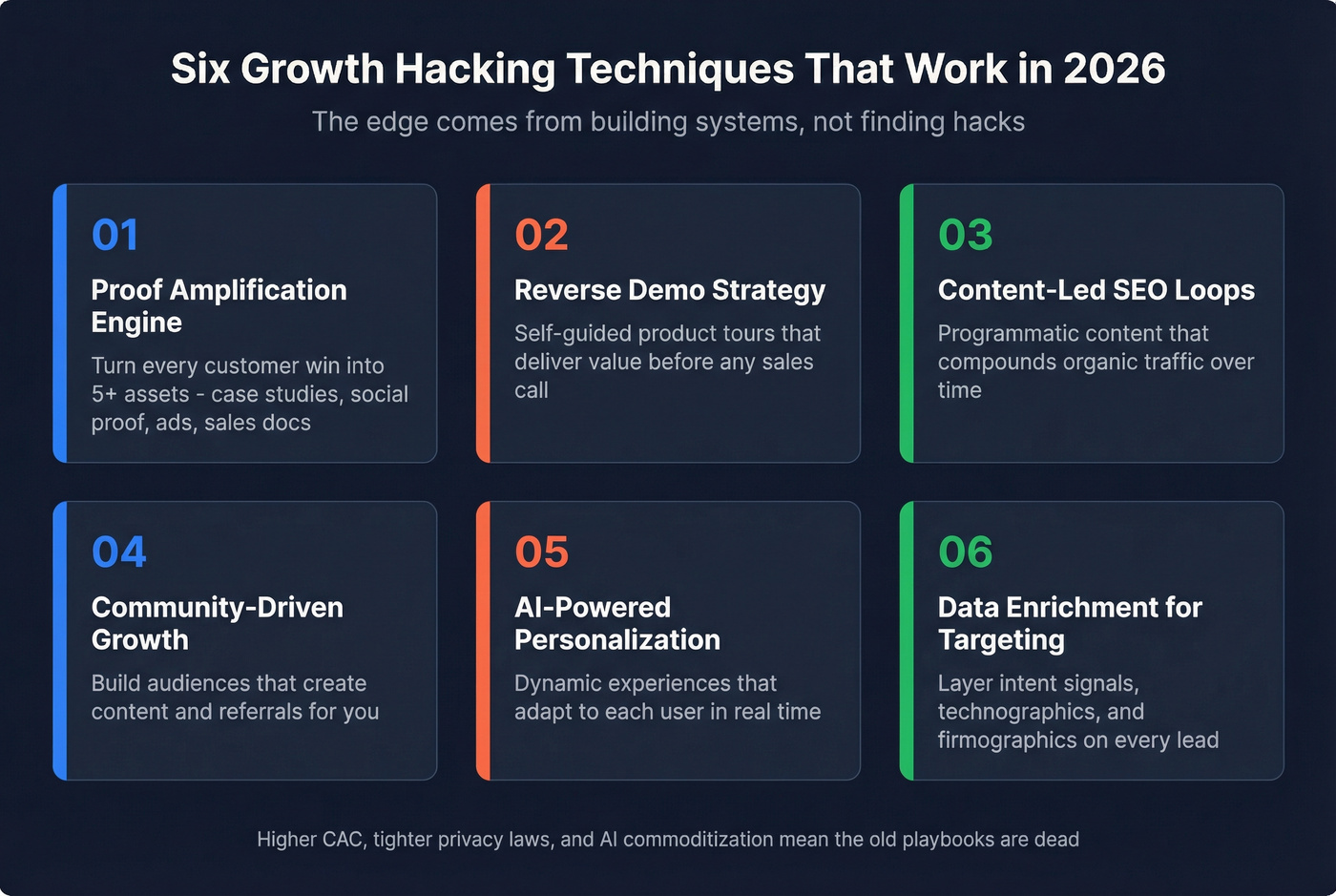
1. Proof Amplification Engine
Most companies collect testimonials and case studies. Almost none systematize the process of capturing measurable customer outcomes and repurposing them across every touchpoint.
Build a system: after every win, document the specific metric improvement - not just "they loved it." Then turn that into a case study, a social proof snippet for your pricing page, a sales enablement one-pager, and a retargeting ad. One customer win should generate five assets minimum. The companies doing this well treat proof like a product: it has a pipeline, a production process, and a distribution strategy.
2. Reverse Demo Strategy
The traditional demo model - fill out a form, wait for a sales call, sit through a screen share - is dying for sub-enterprise deals. Self-guided product tours and interactive experiences let prospects experience value before talking to anyone.
Skip this if your ACV is above $50K and your buyer expects a consultative sales process. But for PLG and mid-market SaaS, self-guided demos drive 2-3x higher demo conversion rates. Build an ungated interactive experience and use engagement signals to identify high-intent leads.
3. Content Multiplication
Create one cornerstone piece of content - a guide, an original research report, a benchmark study - then systematically break it into 10-15 derivative assets across formats and channels. A single research report becomes a blog post, a carousel, a webinar, an email sequence, a podcast episode, and a set of social clips. The key is connected conversion paths: every derivative asset links back to a conversion point. If you need more formats that reliably convert, pull from these lead generation examples.
4. Micro-Testing Engine
Run small, cheap tests across channels before scaling anything. The biggest waste in growth isn't failed experiments - it's scaling experiments that looked like winners based on bad data.
Test messaging with 200-person cohorts before you blast 20,000. Test channels with $500 budgets before you commit $50,000. And critically, verify your test data before you draw conclusions. Bad contact data produces false negatives in outbound experiments - you think the messaging failed when really 30% of your emails never arrived. We learned this the hard way running outbound tests for a client: the "losing" subject line actually outperformed once we cleaned the list and re-ran the test. Verify your list before you test your messaging. If you’re diagnosing deliverability issues, start with hard bounce fundamentals.
5. Value-First Conversion Path
Generic lead magnets - ebooks, whitepapers, "ultimate guides" - are losing effectiveness because everyone has them. Replace them with interactive tools that deliver immediate value: ROI calculators, maturity assessments, benchmarking tools, diagnostic quizzes.
These convert better because the prospect gets something useful in exchange for their information, not a PDF they'll never read. The data you collect from these tools also gives you richer segmentation for follow-up. One B2B SaaS company we know replaced their gated whitepaper with a 3-minute diagnostic quiz and saw lead volume increase 40% while sales-qualified rate doubled. For more options, see these lead magnet ideas.
6. Momentum Optimization
Most growth teams obsess over acquisition and ignore what happens in the first 48 hours after conversion.
Send a personalized onboarding email within 5 minutes. Surface the single most valuable feature within the first session. Trigger a check-in if the user hasn't returned within 72 hours. The goal is to build momentum before the user's attention shifts to the next thing competing for it. Test different onboarding sequences weekly and measure segment-level impact on activation rates - this is where small changes produce outsized results.
Modern Examples Worth Studying
Let's get the classics out of the way. You've seen these before.
| Company | Hack |
|---|---|
| Dropbox | Referral program (free storage) |
| Airbnb | Craigslist cross-posting |
| Hotmail | "Get your free email" signature |
| College-by-college rollout | |
| Uber | Free rides + driver referral bonuses |
These are historically important. They're also from a different internet. Let's talk about what's working now.
Deel built a global HR platform where every international hire a company makes through the platform becomes a distribution node - the new employee, their local contacts, and the hiring company's network all get exposed to Deel. This isn't a referral program bolted on after launch. It's a growth loop engineered into the core product, and it helped Deel reach a ~$12B valuation by 2025.
Duolingo combined gamification with deeply personalized onboarding. New users don't start at "Lesson 1" - they start at a level calibrated to their existing knowledge. This improves activation because the first experience feels relevant, not patronizing. Their retention mechanics - streaks, leaderboards, and well-timed notifications - keep users coming back daily.
Notion turned its user community into an acquisition engine through templates. Users create and share templates, which surface in search and bring new users to the platform organically. Every template is a free product demo that solves a specific problem. It's brilliant because the growth cost is essentially zero - users do the work.
Spotify Wrapped is an annual viral loop disguised as a feature. Every December, Spotify turns user listening data into shareable social content. Users post their Wrapped results voluntarily, generating massive organic reach without Spotify spending a dollar on distribution.
The pattern across all four: growth is engineered into the product, not bolted on as a marketing campaign.
The Growth Hacking Tool Stack
Here's the opinion most guides won't give you: the first tool to set up is analytics. You can't hack what you can't measure. Everything else is secondary until you can track user behavior at the event level.
Analytics
Amplitude is a gold standard for behavioral cohort analysis. You can track how specific user segments move through your funnel over time, identify where they drop off, and measure segment-level experiment impact on retention curves. Free tier available; paid plans scale with usage.
Mixpanel covers similar ground with strong event tracking, flow analysis, and retention cohorts. It's slightly more accessible for smaller teams and integrates well with most experimentation tools. Free tier available.
Google Analytics (GA4) is free and ubiquitous, but it's a website analytics tool, not a product analytics tool. Use it for acquisition channel attribution. Use Amplitude or Mixpanel for everything post-signup.
Experimentation
Optimizely handles web and product experimentation with statistical rigor - feature flags, multivariate testing, and enterprise-grade workflows. Typically priced for larger teams running lots of experiments.
PostHog is the open-source alternative that's gained serious traction. It bundles session recording, feature flags, and A/B testing in one platform, with pricing that scales from free to usage-based. The consensus on r/startups is that PostHog is the best bang-for-buck option for early-stage teams.
PLG & Onboarding
Pendo lets you build in-product guidance, tooltips, and onboarding flows without constant engineering support. If activation is weak, in-app guidance is one of the highest-leverage investments you can make.
Outbound Data & Verification
You can't A/B test messaging if 30% of your emails never arrive. For any growth team running outbound experiments, data quality is the foundation everything else sits on. If you’re building outbound as a channel, use a dedicated outbound B2B lead generation process instead of ad-hoc blasts.
Prospeo covers 300M+ professional profiles with 98% email accuracy and a 7-day data refresh cycle, compared to the 6-week industry average. The email finder lets you search by 30+ filters including buyer intent and technographics, verify in real time, and push directly to your sequencer. Free tier gives you 75 verified emails per month - enough to run your first outbound experiment without spending a dollar. If you’re comparing vendors, start with lead finder tools.

Workflow & Qualitative
Airtable works surprisingly well as an experiment tracking system. Build a base with columns for hypothesis, AARRR stage, ICE score, status, results, and learnings. It becomes your institutional memory for growth experiments.
Hotjar gives you heatmaps, session recordings, and user surveys - the qualitative layer that tells you why users behave the way your analytics tools show.
Run Your First Experiment This Week
The biggest mistake is consuming content about growth hacking instead of running tests. Your CEO just asked why your last three "growth experiments" didn't move the needle. Here's how to make the next one count.
Step 1: Confirm PMF. Run Sean Ellis's 40% test. Survey active users: "How would you feel if you could no longer use [product]?" If fewer than 40% say "very disappointed," stop experimenting on growth and fix your product. No framework saves a product nobody wants.
Step 2: Pick one AARRR stage. Don't try to optimize everything at once. Look at your funnel data and find the biggest drop-off. If 1,000 people sign up but only 150 reach the activation moment, you have an activation problem - not an acquisition problem.
Step 3: Generate hypotheses. Write them in this format: "We believe [change] will [outcome] because [rationale]." Be specific. "We believe adding a progress bar to onboarding will increase activation rate by 15% because users currently don't know how many steps remain."
Step 4: Prioritize with ICE scoring. Rate each hypothesis on Impact (1-10), Confidence (1-10), and Ease (1-10). Multiply the three scores. Run the highest-scoring experiment first. This prevents the common trap of running the experiment that's most fun instead of most impactful. If you want a broader system for pipeline experiments, borrow from an advanced lead generation workflow.
Step 5: Run the experiment. Set a timeframe of 1-3 weeks for most tests, define your success metric before you start, and determine the minimum sample size needed for statistical significance. Don't call a winner after 50 data points.
Step 6: Analyze, document, iterate. Record the result in your experiment tracker regardless of outcome. Failed experiments are data. The value is in velocity of learning, not win rate - roughly 15-25% of experiments produce statistically significant positive results. Early-stage teams should aim for 2-3 experiments per week. Mature growth teams run 10+.
Look, stop reading growth hacking guides. Run an experiment instead. (Yes, we see the irony.)
Running three experiments a week means nothing if your contact data bounces at 35%. Prospeo's 7-day data refresh and 5-step verification keep bounce rates under 4% - so every outbound test you run actually reaches someone. At $0.01 per email, you can experiment at scale without burning budget or domains.
Real growth hackers don't guess at emails. They verify them first.
FAQ
Is growth hacking dead?
No - the buzzword faded, but the discipline matured into what most teams now simply call "growth." Modern growth teams run the same experimentation loops Sean Ellis described in 2010, just with better tools, more rigor, and stricter privacy constraints. Rapid, data-driven experimentation is more relevant in 2026 than ever.
What skills does a growth hacker need?
Analytical thinking, basic coding or no-code proficiency, copywriting ability, and strong product intuition. The best growth hackers are T-shaped: broad marketing knowledge across channels with deep expertise in one area - whether that's conversion optimization, paid acquisition, or product-led growth mechanics.
Do I need a dedicated growth hacker?
Not at first. Start with one person who owns experimentation - often a founder or a marketer with analytical chops. Hire a dedicated role after you've validated product-market fit and established consistent experiment velocity. Premature growth hiring is one of the most common startup mistakes.
What's the best framework to start with?
AARRR (Pirate Metrics) is the best starting framework because it forces full-funnel thinking instead of obsessing over acquisition alone. Pair it with ICE scoring (Impact x Confidence x Ease) to prioritize experiments. Together, they give you strategic direction and tactical prioritization.
What tools do growth teams actually use?
Most teams stack analytics (Amplitude, Mixpanel), experimentation (Optimizely, PostHog), and workflow tools (Airtable, Hotjar). For outbound experiments, tools like Prospeo let you validate messaging without deliverability noise by ensuring your test lists are clean before you draw conclusions. Start with analytics - you can't optimize what you can't measure.