

Advanced Lead Generation: The Systems Playbook for Real Pipeline
The winning vendor is on the buyer's Day One shortlist 95% of the time. If you're not there before formal evaluation starts, you're fighting for the 5% of deals that are still genuinely open. That's the gap between basic outreach and advanced lead generation - and closing it requires a system, not a tactic.
Why "Advanced" Matters Now
The average B2B buying cycle runs 10.1 months. First contact with a vendor doesn't happen until roughly 61% of the way through that journey. By then, 92% of buyers already have at least one vendor in mind, and 41% have a clear favorite before formal evaluation even starts.
The old playbook doesn't work anymore. By the time your SDR reaches out, the buyer has already formed preferences through anonymous research - and the pre-contact favorite wins roughly 80% of deals. If you're still wondering how to reach buyers in this environment, the answer is blunt: you need to be present long before anyone raises their hand.
Advanced lead generation exists because buyers self-educate, form shortlists early, and engage late. Your system needs to influence that shortlist before the first conversation, then execute with enough precision that you don't waste the opportunity when it arrives.
What You Need (Quick Version)
Three things separate advanced lead gen from basic:
- Data quality as the foundation. Your bounce rate needs to be under 2%. Anything above 3-5% degrades sender reputation).
- Intent signals to target in-market buyers. You need to know who's actively researching your category, not just who matches your ICP on paper.
- Deliverability infrastructure that protects your domain. SPF, DKIM, DMARC, warm-up ramps, inbox rotation. Without this, nothing else matters.
Fix data first. Everything downstream depends on it.

This article makes the case that data quality is the foundation of every advanced lead generation system. Prospeo was built for exactly that - 98% verified email accuracy, 7-day data refresh cycles (vs. the 6-week industry average), and a 5-step verification process that includes catch-all handling, spam-trap removal, and honeypot filtering. Teams using Prospeo cut bounce rates from 35%+ to under 4% and tripled pipeline output.
Fix your data foundation first. Everything downstream depends on it.
The Four Pillars of a Lead Generation System
Most guides list 15 tactics and call it "advanced." That's beginner thinking with an advanced label. A real system has four pillars: data quality, intent targeting, multi-channel execution, and measurement. Remove any one and the system breaks.
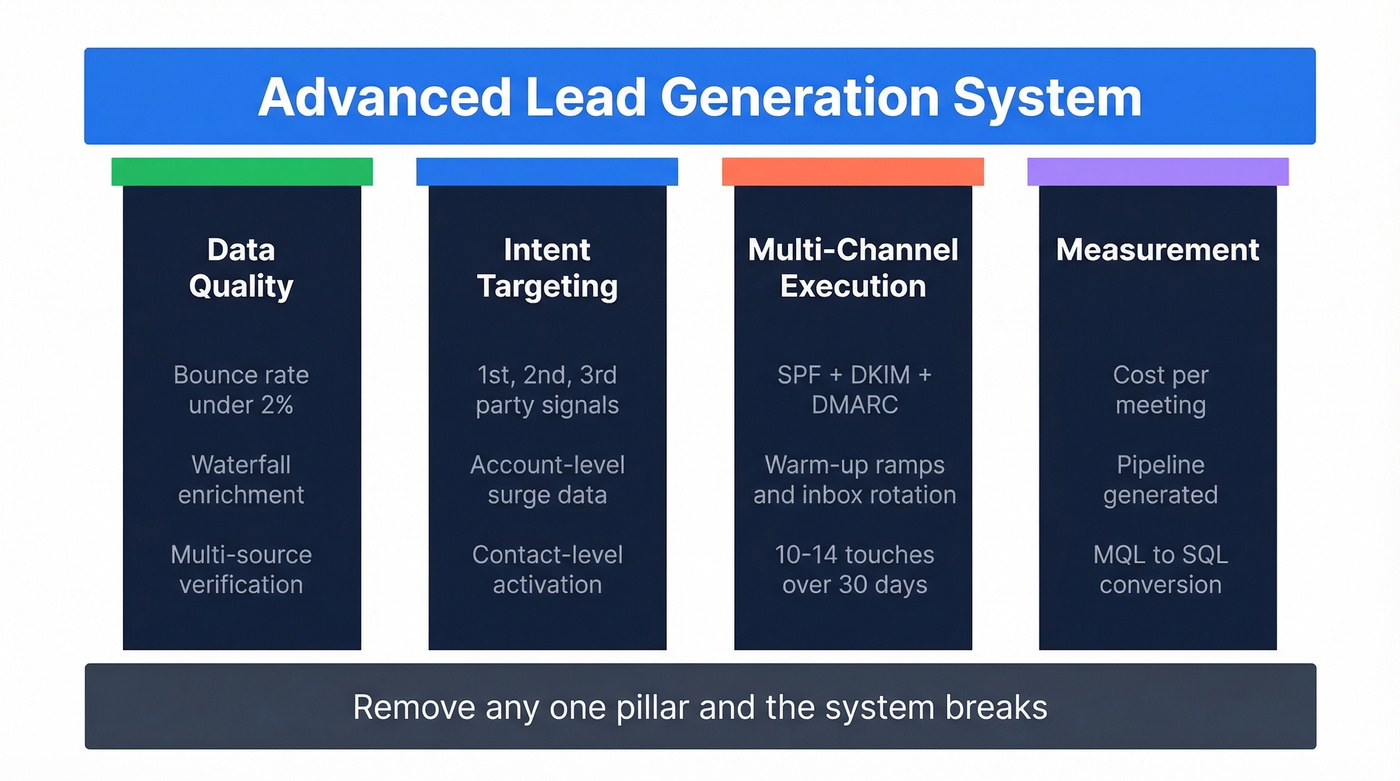
AI agents and copilots now automate the research, enrichment, and personalization steps across all four pillars - but they're infrastructure, not strategy. Sales reps spend only 28% of their time actually selling; a well-designed system gives the rest back. The system still needs to be designed correctly. Here's how.
Data Quality - The Foundation
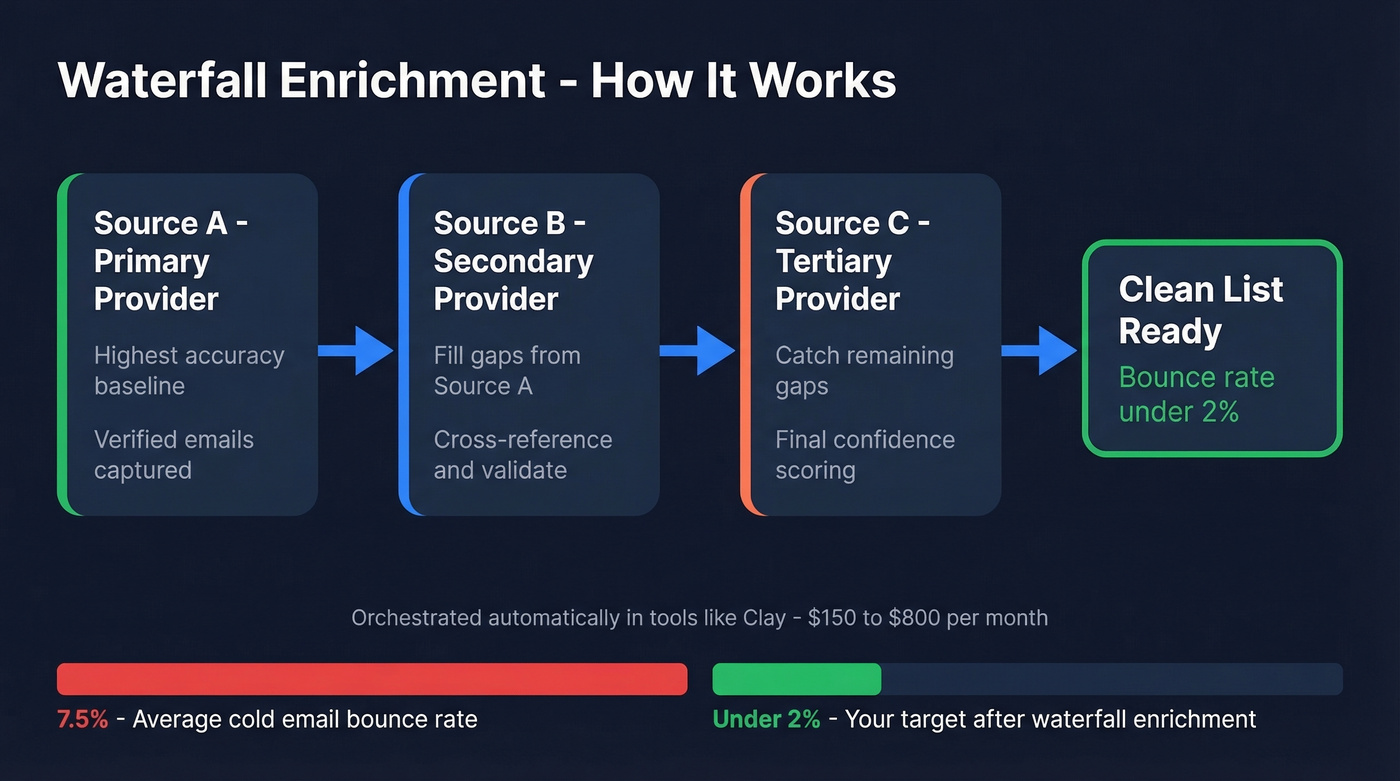
The average cold email bounce rate is 7.5%. Your target is under 2%. That gap is where domains die.
Here's the thing: most teams think their data is "good enough" because they bought it from a recognizable vendor. Then they launch a campaign, hit 8% bounces in the first week, and watch their sender reputation crater. We've seen this pattern destroy outbound programs that took months to build - it's the single biggest reason teams fail when they try to scale.
The fix is waterfall enrichment: running contacts sequentially through multiple data sources, keeping the highest-confidence match at each step. Start with the highest-accuracy source as your baseline, then fill gaps from secondary and tertiary providers. Operationally, that means Source A to Source B to Source C in a tool like Clay (~$150-$800/month depending on credits), which orchestrates the sequence automatically.
After watching outbound programs fail for the same reason over and over, we're convinced: data quality beats copywriting. Every time. If you want high-quality leads, verify every email before it enters your sequencer.
Intent Data - Targeting In-Market Buyers
The B2B intent data market hit $4.49B in 2026 and is growing at 16.6% CAGR. 91% of B2B marketers use intent data to prioritize accounts, but only 24% report exceptional ROI. The gap between "using intent data" and "getting value from it" is activation - and it's the difference between warm targeting and spraying cold emails into the void.
Not all intent is created equal:
| Type | What It Tracks | Examples | Cost Range |
|---|---|---|---|
| First-party | Your site/product signals | Dealfront, Warmly | Included in platform |
| Second-party | Partner/review signals | G2, TrustRadius | $5K-$25K/yr |
| Third-party | Web consumption data | Bombora, Intentsify | $12K-$100K+/yr |
Start with first-party signals - they're the highest-fidelity and the best source for early-stage programs. Layer in third-party when you're ready to scale. Bombora runs $12K-$40K/year for most teams; enterprise platforms like 6sense can reach $300K+/year.
The real unlock is combining intent with contact-level data. Knowing an account is surging is useless if you can't reach the right person there. That combination - intent plus verified contact - is what turns a "surging account" into a booked meeting.
Multi-Channel Execution at Scale
The best data and intent signals in the world don't matter if your emails land in spam. Deliverability is the unglamorous infrastructure that makes everything else work.
The non-negotiables:
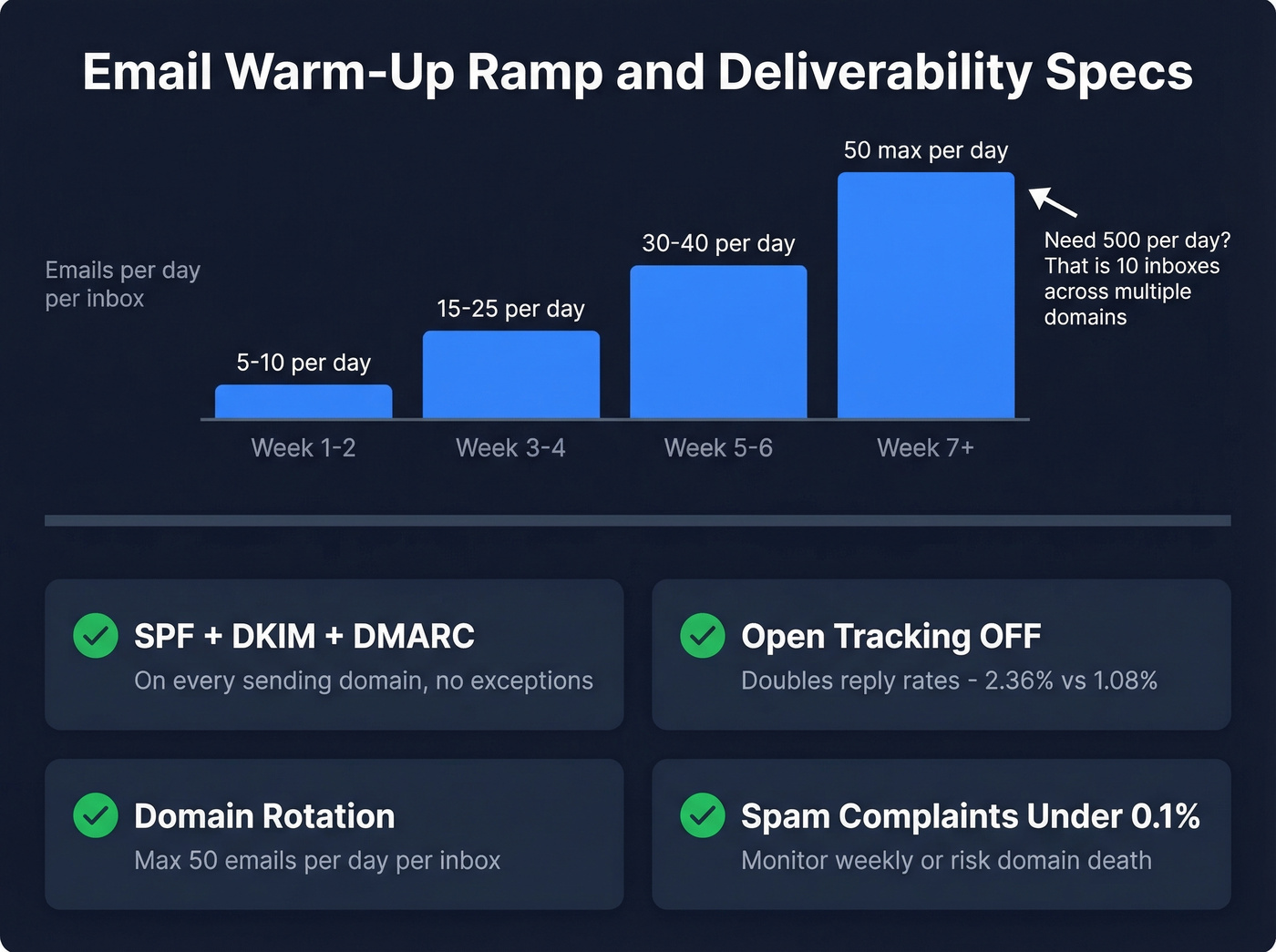
- Authentication: SPF + DKIM + DMARC on every sending domain. No exceptions.
- Warm-up ramp: 5-10 emails/day for weeks 1-2, scaling to a max of 50/day per inbox by week 7+.
- Open tracking off. Disabling open-rate tracking more than doubled reply rates in an analysis of 44M+ emails - 2.36% vs 1.08%. Tracking pixels are a deliverability tax most teams don't realize they're paying.
- Domain rotation for scaling. Max 50 emails/day per inbox. Need 500/day? That's 10 inboxes spread across multiple domains.
For cadence structure, target 10-14 touches over ~30 days across email, phone, and social. A single follow-up email increases replies by nearly 49% - yet most reps stop after one send. Volume comes from disciplined infrastructure, not harder outreach.
Let's be honest about what actually wins at outbound: it isn't better copy. The teams pulling ahead are running cleaner data through better-protected infrastructure with disciplined follow-up. It's boring. It works. If your average deal size is under $10K, you'll usually get more leverage from verified lists and clean deliverability than from an enterprise intent platform.
Measurement That Matters
Stop optimizing for reply rates in isolation. The metrics that matter are cost per meeting and pipeline generated. A 12% reply rate means nothing if those replies are "please remove me from your list."
In our experience, the teams that obsess over reply rates are usually the ones ignoring pipeline velocity. Monitor weekly: reply rate 5%+, bounce rate under 2%, spam complaints under 0.1%. If MQL volume is rising while SQL volume falls, your system has a qualification leak - not a volume problem. Generating fewer leads of higher quality almost always outperforms blasting a massive list with a generic pitch.
Why Advanced Programs Fail
Most programs don't fail because of bad targeting. They fail because of post-capture breakdowns.
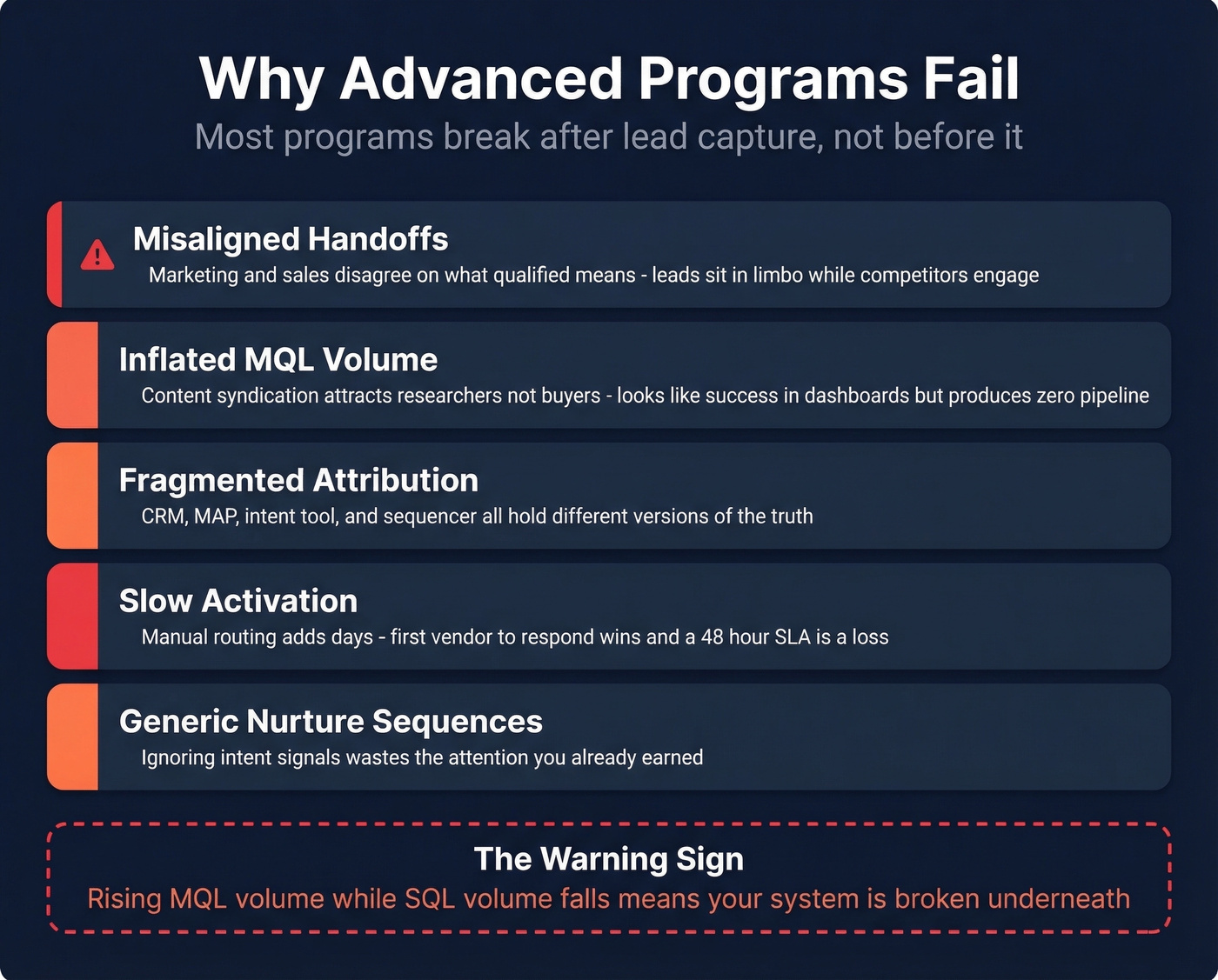
Misaligned handoffs are the most common killer. Marketing and sales don't share a definition of "qualified," so leads sit in limbo while competitors engage. Close behind is inflated MQL volume from content syndication that attracts researchers, not buyers - a problem that looks like success in dashboards but produces nothing in pipeline.
Then there's fragmented attribution, where your CRM, MAP, intent tool, and sequencer all hold different versions of the truth. Slow activation compounds the damage: manual routing adds days, and in a world where the first vendor to respond wins, a 48-hour SLA is a loss. Finally, generic nurture sequences that ignore intent signals entirely waste the attention you've already earned. Evergreen assets like guides, calculators, and benchmark reports should feed nurture tracks that respond to what the prospect actually consumed.
The warning sign is always the same: rising MQL volume while SQL falls. If you see that pattern, stop adding top-of-funnel volume and fix the system underneath it.
Building Scalable Campaigns
Once the four pillars are solid, the question shifts from setup to repeatability across segments, geos, and verticals.
Scalable campaigns are templatized but not generic. Each campaign follows the same infrastructure playbook - waterfall enrichment, intent filtering, authenticated sending - but messaging and targeting are customized per ICP segment. The best programs also create self-generating content loops: outbound data feeds content strategy, and content engagement feeds outbound targeting. That's a flywheel, not a treadmill.
For teams expanding internationally, geo-aware execution matters. You'll need localized sending domains, region-specific data providers, and compliance awareness around GDPR, CASL, and similar regulations. Skip this step and you'll burn domains in new markets before you've booked a single meeting.
Whether you're running campaigns for e-commerce marketplaces or building pipeline for a SaaS company, the system architecture stays the same. The variables are targeting criteria and messaging - not infrastructure.
The article's real unlock - combining intent signals with verified contact data - is exactly what Prospeo delivers. Layer Bombora-powered intent data across 15,000 topics with 143M+ verified emails and 125M+ direct dials, all filterable by 30+ criteria including buyer intent, technographics, and headcount growth. At $0.01 per email, you get enterprise-grade targeting without enterprise pricing.
Turn surging accounts into booked meetings with verified contacts and live intent data.
FAQ
What separates basic from advanced lead generation?
Basic lead generation is single-channel outreach with purchased lists. Advanced lead generation is a coordinated system: verified data, intent-based targeting, multi-channel cadences with deliverability infrastructure, and measurement tied to pipeline - not vanity metrics. The difference is engineering a repeatable process versus hoping individual emails land.
How much does intent data cost?
Entry-level providers like Bombora start at $12K-$40K/year. Enterprise platforms like 6sense can reach $300K+/year. Start with first-party signals from your own website behavior - they're the fastest way to identify warm prospects without a major budget commitment.
What's the fastest way to fix a high bounce rate?
Switch to a provider with real-time verification and frequent data refresh. Teams using Prospeo's 7-day refresh cycle and 5-step verification have driven bounce rates below 4% in live outbound programs, compared to the 7.5% industry average. Waterfall enrichment through multiple sources catches what any single provider misses.
How do I generate leads fast without sacrificing quality?
Speed and quality are both outputs of a well-built system. Use waterfall enrichment to verify contacts at pace, layer intent data to prioritize accounts showing buying signals, and run authenticated multi-channel cadences. Teams that nail this infrastructure generate leads faster because the system removes manual bottlenecks - not because they cut corners on data.
Can these strategies work outside of tech?
Absolutely. The four pillars - data quality, intent, multi-channel execution, and measurement - are industry-agnostic. Whether you're generating leads for logistics, accounting, or manufacturing, what changes is your ICP definition, messaging, and which intent signals matter most. The system architecture stays the same.