

Lead Magnet Ideas: Data-Backed Formats That Actually Convert
A quiz converts at 30-40%. A PDF ebook converts at 3-5%. That's not a small gap - it's a 10x difference sitting right in front of most marketing teams. Worse, only 12% of people who download a whitepaper actually finish reading it. You're fighting for a tiny opt-in rate, and the people who do opt in aren't even consuming what you made.
The playbook has changed dramatically in the last two years. Interactive formats are crushing static downloads, AI has made interactive widgets that used to cost $10,000+ available for under $1,000, and the post-opt-in sequence matters more than the magnet itself. Instead of a bloated list of 50 formats, we're going to focus on the five that actually move the needle - with the numbers to prove it.
The Cheat Sheet
If you're short on time:
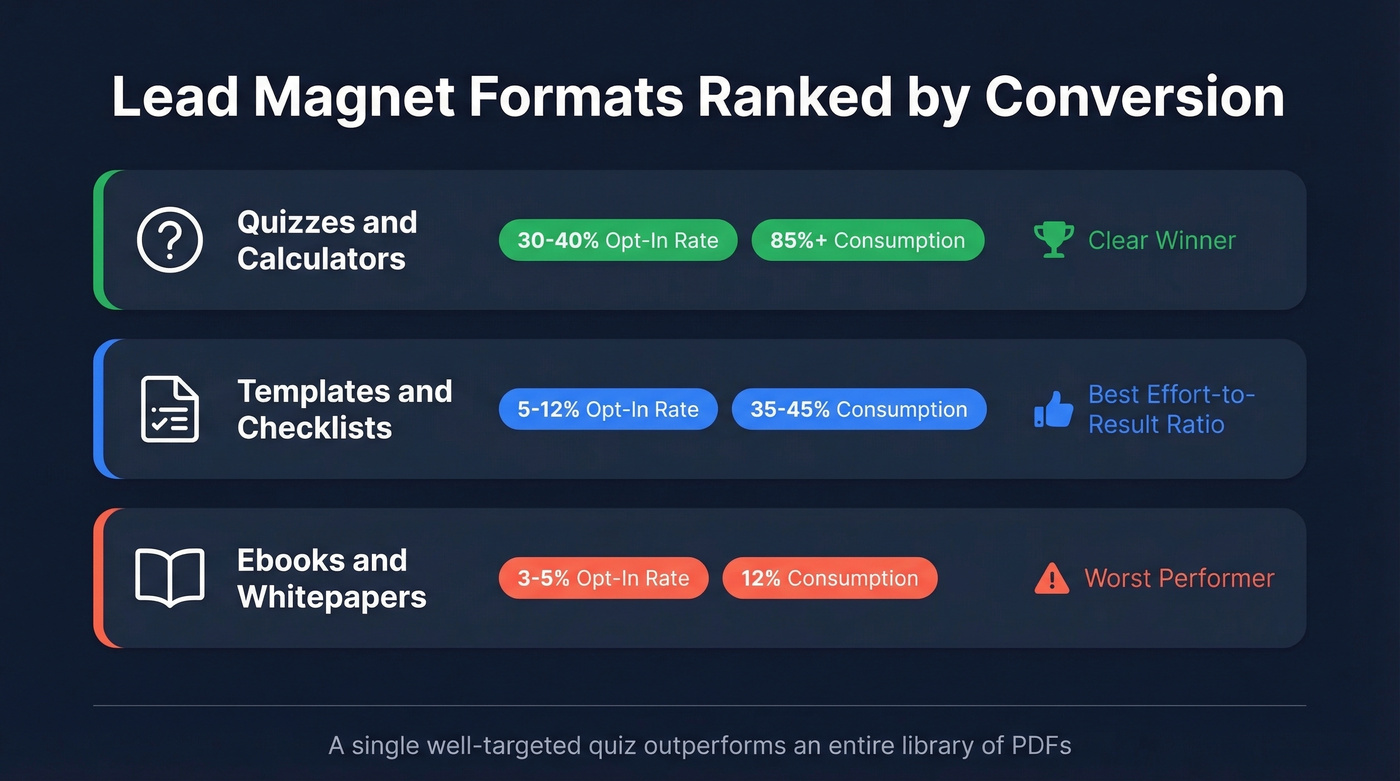
- Quizzes and calculators - 30-40% opt-in rates, 85%+ consumption. The clear winner.
- Templates and checklists - 5-12% opt-in, but fast to build and high consumption. Best effort-to-result ratio.
- Ebooks and whitepapers - 3-5% opt-in, 12% consumption. Still common, but the worst-performing format by almost every metric.
Here's the thing: you need one great lead magnet, not twenty mediocre ones. A single well-targeted quiz will outperform a library of PDFs. Pick one format, nail the targeting, and build a real nurture sequence behind it.
What Makes a Lead Magnet Convert
Three factors separate high-converting magnets from the ones that collect dust.
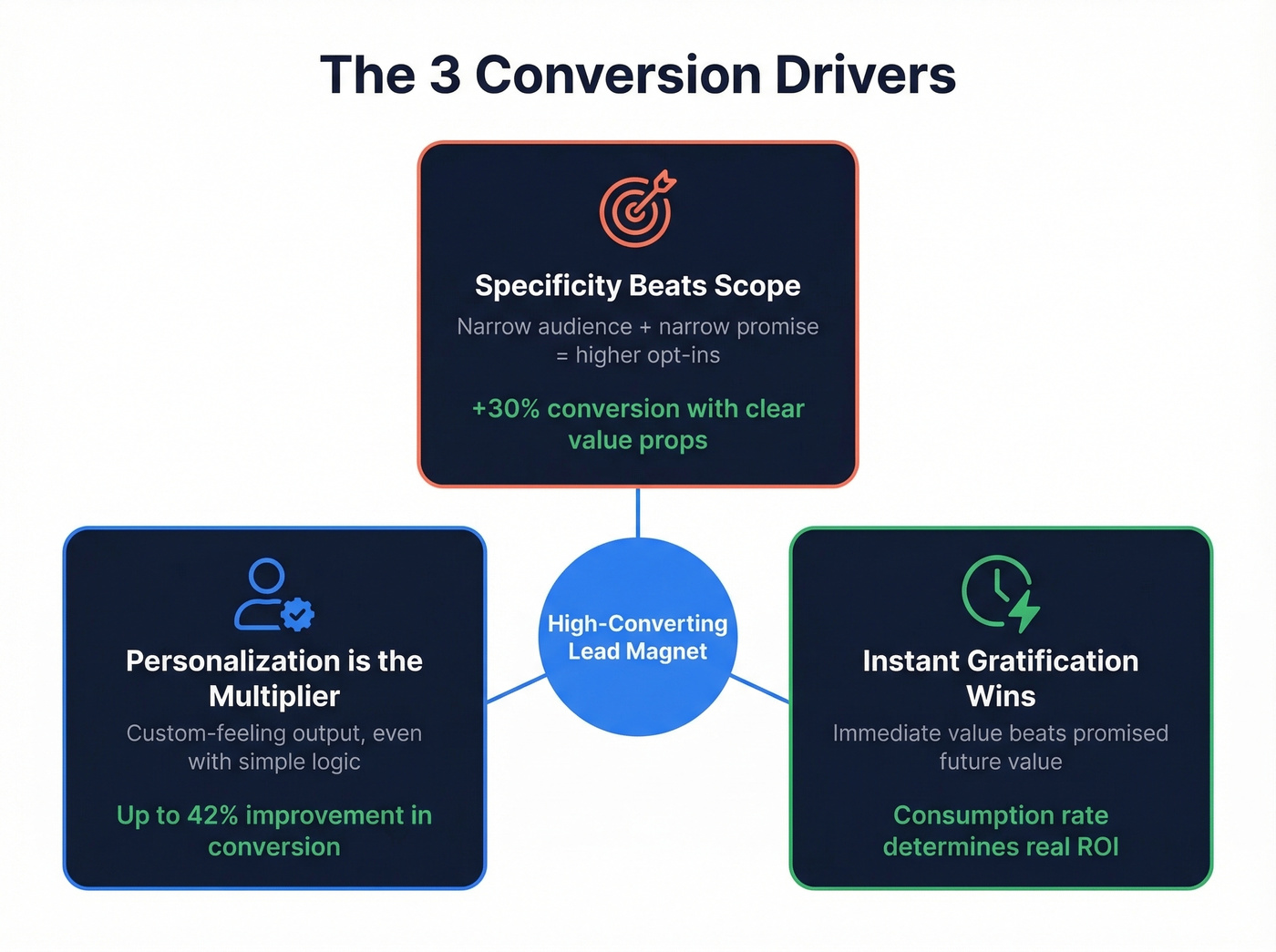
Specificity beats scope. A "Complete Guide to Digital Marketing" converts worse than "The 5-Minute SEO Audit Checklist for Shopify Stores." Narrow your audience, narrow your promise, and watch opt-in rates climb. Lead magnets with clear value propositions convert 30% better than vague ones.
Personalization is the multiplier. Personalized content improves conversion rates by up to 42%. This is why quizzes work so well - the output feels custom, even when the backend logic is simple. The more a magnet feels like it was built for the individual, the higher the opt-in.
Best Lead Magnet Ideas by Format
Interactive Magnets (Highest Conversion)
We've watched teams spend six weeks on an ebook that converts at 2% when a weekend quiz would've pulled 30%. Interactive formats dominate every benchmark we've seen, and it's not close. Quizzes pull 30-40% opt-in rates with 85%+ consumption - meaning people actually finish them. That combination is unmatched.
Quizzes are the workhorse. "What type of [X] are you?" or "How does your [metric] compare?" formats work across B2B and B2C. Tools like Marquiz, Typeform, and LeadQuizzes make these easy to build without custom development.
Calculators convert nearly as well. ROI calculators, savings estimators, and pricing tools give prospects a personalized number they can take to their boss. ProfitWell's CAC calculator is a textbook example - it generates leads while delivering genuine value.
Assessments work beautifully for consultants and agencies. "Score your sales process" or "Rate your marketing maturity" - the prospect gets a benchmark, you get their contact info and a natural segue into a sales conversation.
High-Value Practical Assets
Templates and checklists won't match quiz conversion rates, but they offer the best effort-to-result ratio of any format. You can build a great template in a few hours, and people actually use them - which means they remember you when it's time to buy.
Templates pull 8-12% opt-in rates with 45% consumption. Email templates, spreadsheet models, project plans, proposal frameworks - anything that saves someone an hour of work. The key is making them immediately usable, not aspirational.
Checklists Checklists convert at 5-8% with 35% consumption. They work because they're quick to consume and feel complete. "The Pre-Launch Checklist for Your Next Product" or "10-Point Website Audit Checklist" - simple, actionable, done.
Swipe files are underrated. Curated collections of ad copy, email subject lines, landing page designs, or cold outreach templates. Marketers and salespeople love these because they eliminate the blank-page problem.
Educational Content (Proceed With Caution)
This is where most teams default - and where most teams underperform. The ebook is the lead magnet equivalent of a participation trophy. Everyone has one, nobody reads them.
Ebooks and whitepapers convert at just 3-5%, and only 12% of downloaders finish reading them. If you're going to create long-form content, gate a specific chapter or finding, not the whole thing. When ebooks do work, it's because they contain original research. One marketing agency's digital transformation ebook drove 50% more website traffic in its first quarter - but the key was proprietary data, not recycled advice.
Email courses are a smarter play. A 5-day email course on a specific topic keeps the prospect engaged over time and builds trust before you pitch. Consumption rates are much higher because the content arrives in digestible chunks.
Industry reports work well in B2B when they contain original data. One software firm created a cybersecurity guide that grew their email list 30% in three months - the difference was original research their audience couldn't get elsewhere.
Webinars still convert, especially for complex B2B products. Live formats create urgency; recorded versions extend the shelf life.
Incentive-Based Magnets
Free trials and free tools are the ultimate B2B lead magnet when your product can demonstrate value quickly. No PDF required - just let people use the thing. HubSpot's Marketing Grader is a classic example: it generates leads by giving away a genuinely useful tool that naturally funnels users into its ecosystem.
Discount codes are the B2C default. They convert well but attract deal-seekers, so lead quality suffers. Use them for e-commerce, skip them for B2B.
Free samples and giveaways drive volume in B2C but rarely work for B2B. The leads are high-quantity, low-intent. Fine for building an email list, terrible for pipeline.
AI-Powered Magnets
This is where the market is heading. Interactive tools that used to cost $10,000+ to build are now available for $500-$1,000 using AI coding platforms like Cursor, Replit, and Bolt.
AI-powered calculators and estimators - mortgage calculators, renovation cost estimators, pricing configurators - give prospects a personalized output in exchange for their contact info. They feel premium, they're highly shareable, and they convert like quizzes.
Micro-magnets are the emerging format. Instead of one big offer, you create tiny, hyper-specific tools embedded throughout your site. A "headline analyzer" on your blog post about copywriting. A "subject line scorer" on your email marketing page. Each one captures leads at the moment of highest intent.
Conversion Benchmarks by Format
These ranges come from aggregated benchmark data across thousands of live campaigns:
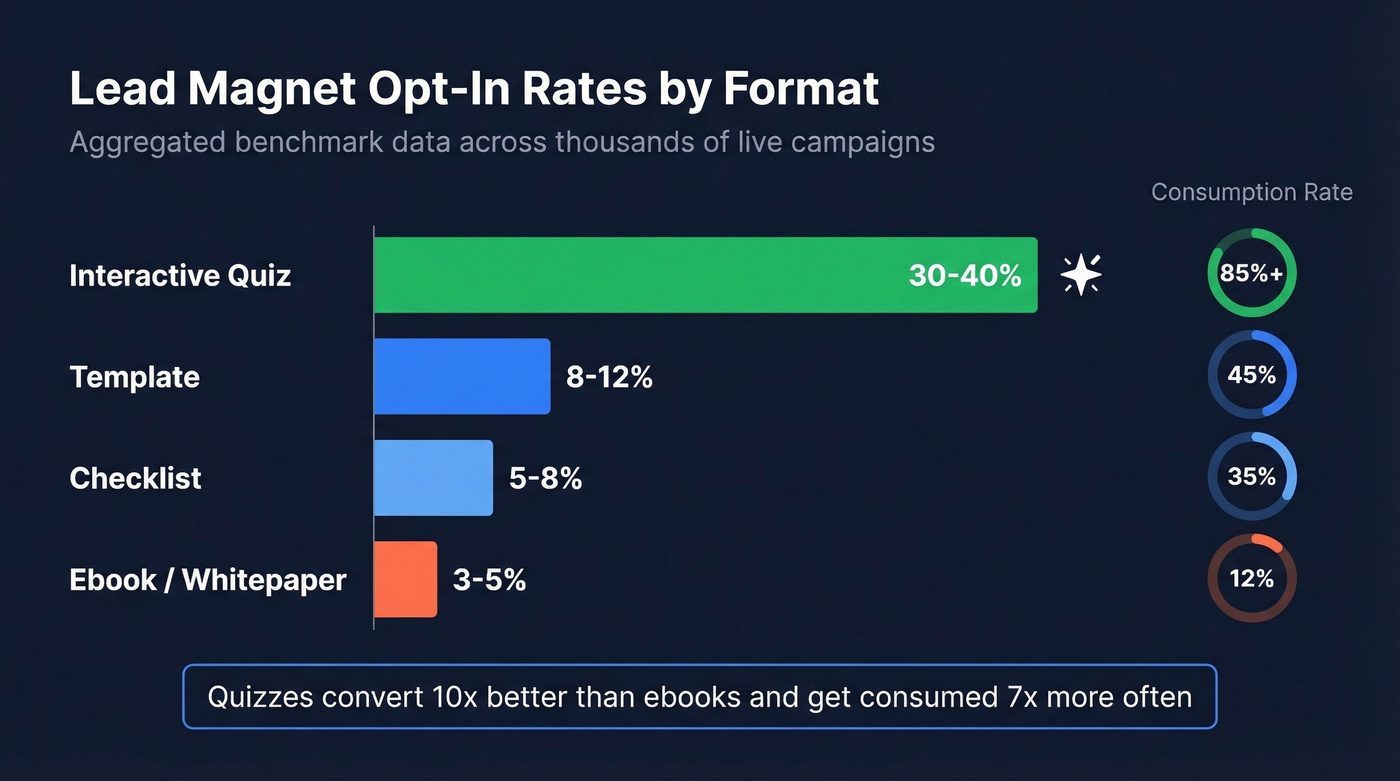
| Format | Opt-In Rate | Consumption Rate | Effort to Build |
|---|---|---|---|
| Ebook / Whitepaper | 3-5% | 12% | High |
| Checklist | 5-8% | 35% | Low |
| Template | 8-12% | 45% | Medium |
| Interactive Quiz | 30-40% | 85%+ | Medium |
Channel matters too. For SaaS B2B, opt-in rates by traffic source break down like this:
| Channel | Opt-In Rate |
|---|---|
| 8.05% | |
| Google Ads | 5.02% |
| 4.52% | |
| Meta Ads | 3.52% |
| SEO | 3.36% |
Email-driven traffic converts roughly 2x better than paid social. If you're promoting a lead magnet, your existing email list is the highest-performing channel you already have.
Keep expectations realistic on the back end too. In SaaS B2B, lead-to-sale conversion averages just 0.67%. Biotech runs higher at 1.60%. Industrial IoT sits at 0.60%. This is exactly why nurture sequences matter more than opt-in volume - and why we'd argue the post-opt-in workflow is where most teams should spend 80% of their effort.

Lead magnets are great for inbound. But while you wait for opt-ins, your competitors are reaching buyers directly. Prospeo gives you 300M+ profiles with 30+ filters - buyer intent, technographics, job changes - so you can build targeted lists in minutes instead of weeks.
Skip the PDF funnel. Reach your ideal buyers today at $0.01 per verified email.
B2B vs B2C: Pick the Right Format
| B2B Winners | B2C Winners |
|---|---|
| ROI calculators | Discount codes |
| Industry reports | Quizzes |
| Free audits | Printable planners |
| Templates | Free samples |
| Consultation calls | Giveaways |
| Whitepapers | Recipe cards / Style guides |
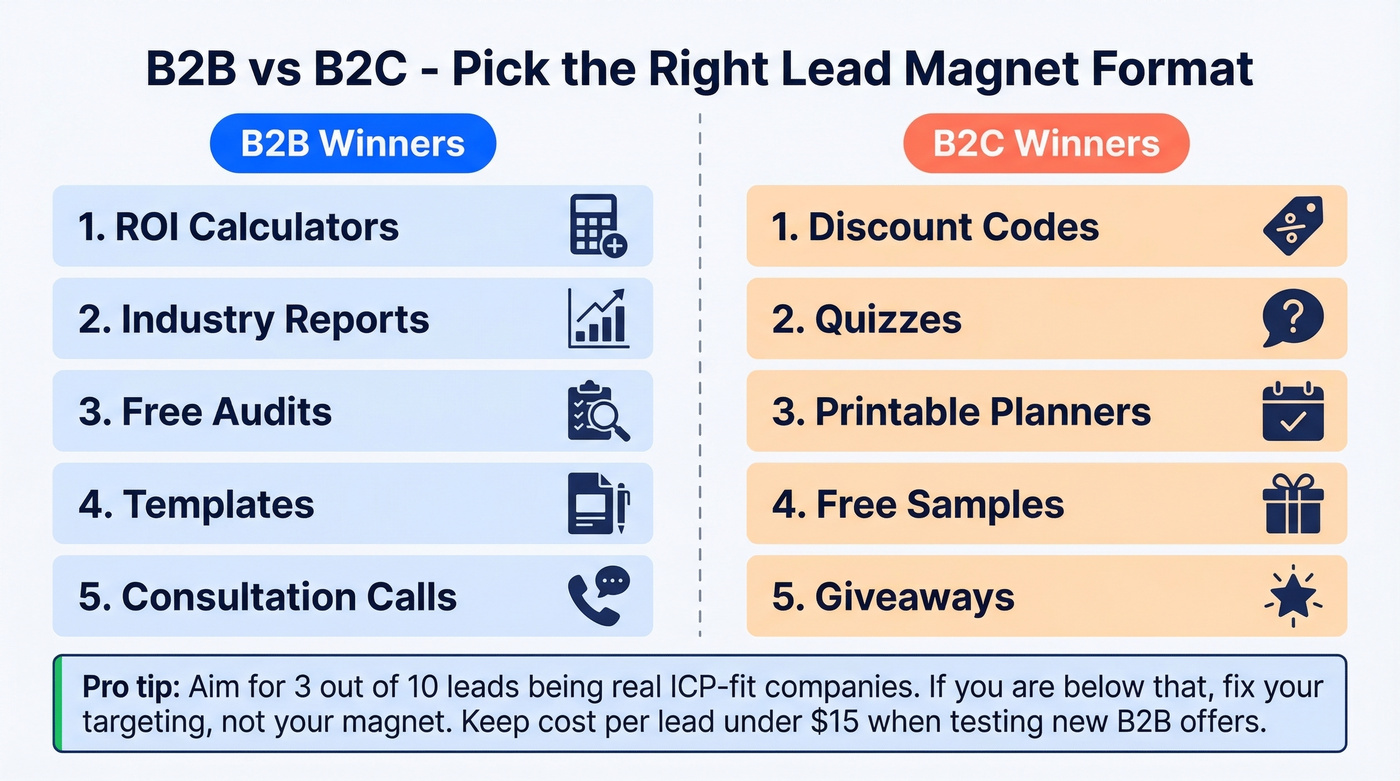
The consensus on r/LeadGeneration is blunt: make your magnet industry-specific and role-specific, solve one painful problem, and don't bait-and-switch. Experienced funnel builders there report that roughly 3 out of 10 leads should be real ICP-fit companies - if you're below that, your targeting is off, not your magnet. When testing a new B2B offer, aim for sub-$15 cost per lead initially. If you're above that after 500 impressions, the targeting or offer needs work.
For B2C, volume matters more than qualification. Quizzes and discount codes drive the highest opt-in rates, and the nurture sequence does the heavy lifting on conversion.
How to Promote Your Lead Magnet
Building a great opt-in offer is half the battle. The other half is getting it in front of the right people, and the most common mistake we see is treating promotion as an afterthought.
Start with your highest-converting channel: email. The benchmark data shows email traffic converts at 8.05% - more than double paid social. Send a dedicated email to your existing list, then add the magnet as a persistent CTA in your newsletter footer.
Next, match the magnet to the content around it. A blog post about cold email strategy should promote a cold email template swipe file, not a generic marketing ebook. Contextual relevance is what turns a passive reader into an opt-in. For paid channels, LinkedIn and Google Ads outperform Meta for B2B - and high-intent formats like ROI calculators and free audits justify higher CPCs because the leads they capture are closer to a buying decision.
Test your landing page relentlessly. Swap headlines, trim form fields, and A/B test your CTA copy. Small changes compound - a 20% lift in opt-in rate on a page that gets 5,000 monthly visitors means 1,000 extra leads per year.
The Post-Opt-In Playbook
Let's be honest: what happens after someone opts in determines your ROI far more than the magnet itself.
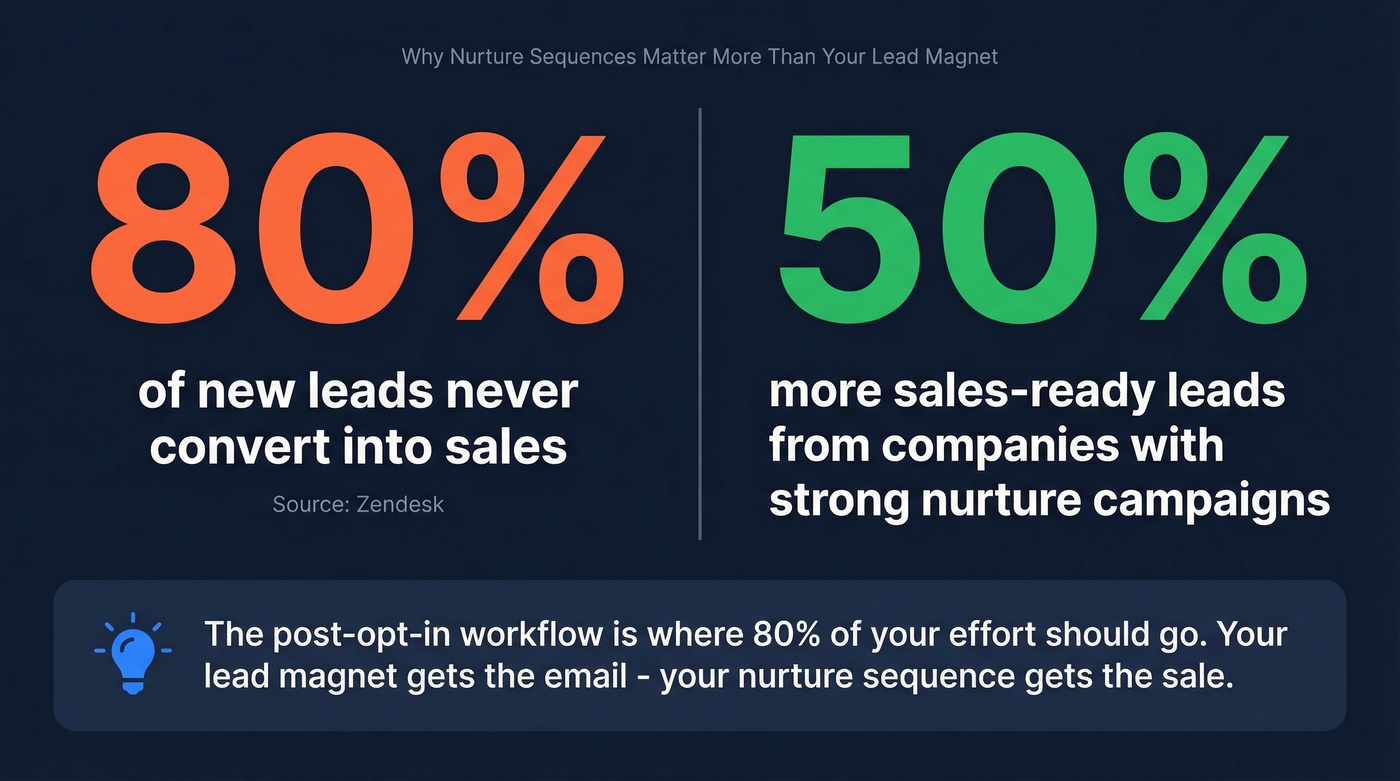
80% of new leads never convert into sales. That's not a lead magnet problem - it's a nurture problem. Companies with strong nurture campaigns generate 50% more sales-ready leads at 33% lower cost.
The sequence that works:
- Day 0 - Deliver the magnet immediately. No delays, no "check your inbox in 24 hours." Include a thank-you page that pushes to a next step: book a call, join a workshop, start a trial.
- Day 2 - Follow up with a related insight or quick win. Not a pitch. Something that makes the magnet more useful.
- Day 5 - Share a case study or social proof. Show what happens when someone acts on the advice from your magnet.
- Day 10 - Make the ask. Demo, consultation, trial, purchase - whatever your conversion event is.
Email marketing returns $36 for every $1 spent. But that ROI depends on actually building the sequence, not just collecting the email.
The enrichment step most teams skip. A raw email address isn't enough for B2B. You captured an opt-in - now you need to know who that person actually is. Prospeo turns a bare email into a full prospect profile with verified contact data, company info, and job title. The free tier gives you 75 email lookups per month, enough to enrich your first few weeks of opt-ins and see the difference it makes in how your sales team prioritizes follow-up.
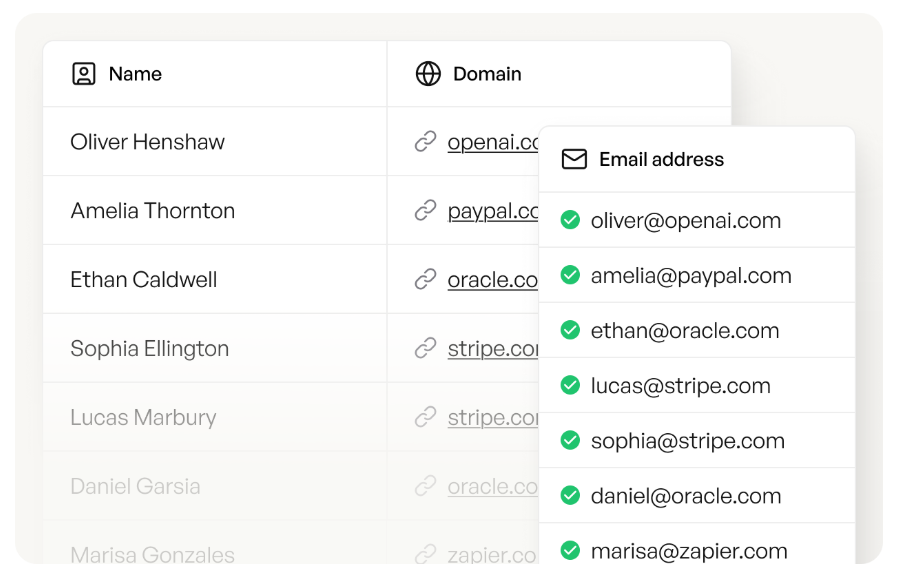
A quiz converts at 30%. Prospeo's enrichment API matches at 92%. Combine both: capture leads with your magnet, then enrich every opt-in with 50+ data points - verified emails, direct dials, company intel - automatically synced to your CRM.
Turn every lead magnet submission into a fully enriched, sales-ready contact.
Five Mistakes That Kill Conversions
1. Too many form fields. Three fields is the threshold. Every field beyond that costs you 40-60% of your conversions. Name and email is enough - enrich the rest.
2. Bait-and-switch delivery. If your magnet promises "5 proven templates" and delivers a 30-page ebook with templates buried on page 22, you've lost trust. Deliver exactly what you promised, immediately.
3. No promotion strategy. Building a lead magnet and putting it on your homepage isn't a strategy. Promote it through email, paid ads, blog CTAs, and social. The magnet is only as good as the traffic you send to it.
4. No nurture sequence. Collecting emails without a follow-up sequence is like filling a bucket with a hole in it. In our experience, the single biggest ROI lever isn't the magnet format - it's the nurture sequence. We've seen teams spend weeks building a magnet and zero hours on the post-opt-in flow. That's backwards.
5. Outdated or generic content. A "2023 Marketing Trends" PDF in 2026 isn't a lead magnet - it's a liability. Keep your magnets current, specific, and genuinely useful. Offers with clear value props convert 30% better than generic ones.
Tools to Build Lead Magnets
You don't need a big budget to build a high-converting opt-in offer. Here are the tools that cover every step, from quiz creation to email nurture to data enrichment.
| Category | Tool | Price | Notes |
|---|---|---|---|
| Quizzes | Marquiz | $0-$249/mo | Best for lead gen quizzes |
| Quizzes | LeadQuizzes | $9-$186/mo | 14-day free trial |
| Quizzes | Typeform | $0-$99/mo | Cleanest UX |
| Design | Canva | Free/freemium | Templates, PDFs, visuals |
| Landing Pages | Kit | Free tier | Built for creators |
| Landing Pages | Leadpages | Paid plans | Conversion-focused |
| AI Build | Cursor / Replit / Bolt | Paid plans | Build interactive tools fast |
| Kit / ActiveCampaign | Paid plans (Kit has a free tier) | Nurture sequences | |
| Data Enrichment | Prospeo | Free tier; ~$0.01/email | Enrich opt-ins with verified emails, phones, and company data |
Skip LeadQuizzes if you're already paying for Typeform - the overlap isn't worth the extra subscription. And if your team has any developer capacity, Cursor or Replit will get you a custom calculator for a fraction of what a no-code quiz platform charges monthly.
If you're comparing vendors, start with a shortlist of data enrichment services and map them to your CRM workflow.
FAQ
What's the highest-converting lead magnet format?
Interactive quizzes convert at 30-40% opt-in rates with 85%+ consumption - no other format comes close. Templates and checklists at 5-12% are the best low-effort alternatives. Ebooks sit at the bottom with 3-5% opt-in and just 12% consumption.
How many form fields should a lead magnet have?
Three or fewer. Research shows exceeding three fields drops conversions by 40-60%. Ask for name and email only, then use progressive profiling and enrichment tools to fill in company data, job titles, and phone numbers automatically after opt-in.
Do lead magnets work for B2B?
Yes, but format matters more than in B2C. B2B buyers respond to ROI calculators, benchmark reports, free audits, and templates. Skip discount codes and giveaways. Expect roughly 20% of leads to opt into a next step like a demo, and plan for a lead-to-sale conversion rate around 0.67% in SaaS - that's normal, which is why the nurture sequence is everything.
What are the best lead magnet ideas for B2B?
ROI calculators and interactive assessments top the list because they deliver a personalized result while revealing the prospect's pain points and budget context. Templates, free audits, and industry reports with original data round out the top tier. The key is solving a specific problem for a specific role - a "CFO's Guide to Reducing SaaS Spend" will always outperform a generic "Guide to Cost Savings."
Can lead magnets replace cold outreach?
They work best as a complement, not a replacement. Inbound magnets build trust and attract prospects who are already problem-aware, while cold outreach reaches people who haven't started looking. The most effective pipeline strategies use both - a lead magnet warms inbound traffic, and enrichment tools arm your outbound team with verified contact data to reach prospects who didn't opt in.