

How to Build a Referral Incentive Program That Actually Works
Your VP of Sales just asked you to "set up a referral program by next quarter." You find 33 examples of Dropbox and T-Mobile and still have no idea how to handle fraud, taxes, or payout timing. This is the referral incentive program playbook those listicles forgot to write.
What Is a Referral Incentive Program?
A referral incentive program rewards people - customers, employees, or partners - for bringing in new business. The referrer gets something valuable (cash, credits, gift cards) when their recommendation converts into a paying customer or a successful hire.
There are two main types. Customer referral programs turn your happiest users into a distribution channel. Employee referral programs turn your workforce into recruiters. Both share the same core mechanics: define a trigger event, attach a reward, track attribution, and pay out.
The best programs are two-sided, meaning both the referrer and the referred person receive something. More than 90% of referral programs are double-sided, and that's not an accident - when both sides have skin in the game, conversion rates climb.
What You Need (Quick Version)
You don't need 33 examples. You need an operational plan:
- Start with two-sided cash incentives. Reward both sides. It works.
- Set a 30-day payout window. Longer delays kill participation. Period.
- Build fraud controls before launch. Not after your first $10K in fake referrals.
- Know the tax rules. Employee bonuses hit W-2s. Customer rewards over $600 trigger 1099s. Skip this and your finance team will hate you.
- Verify your contact data before promoting. A bouncing list kills your launch email.
If you remember nothing else: two-sided cash, fast payouts, fraud controls, tax compliance. Everything else is optimization.
Why Referral Programs Outperform Paid Channels
The numbers aren't even close. Employee referrals convert at 28.2% from application to hire, compared to 2-5% from job boards. On the customer side, GrowSurf reports a 312% average ROI across its platform.
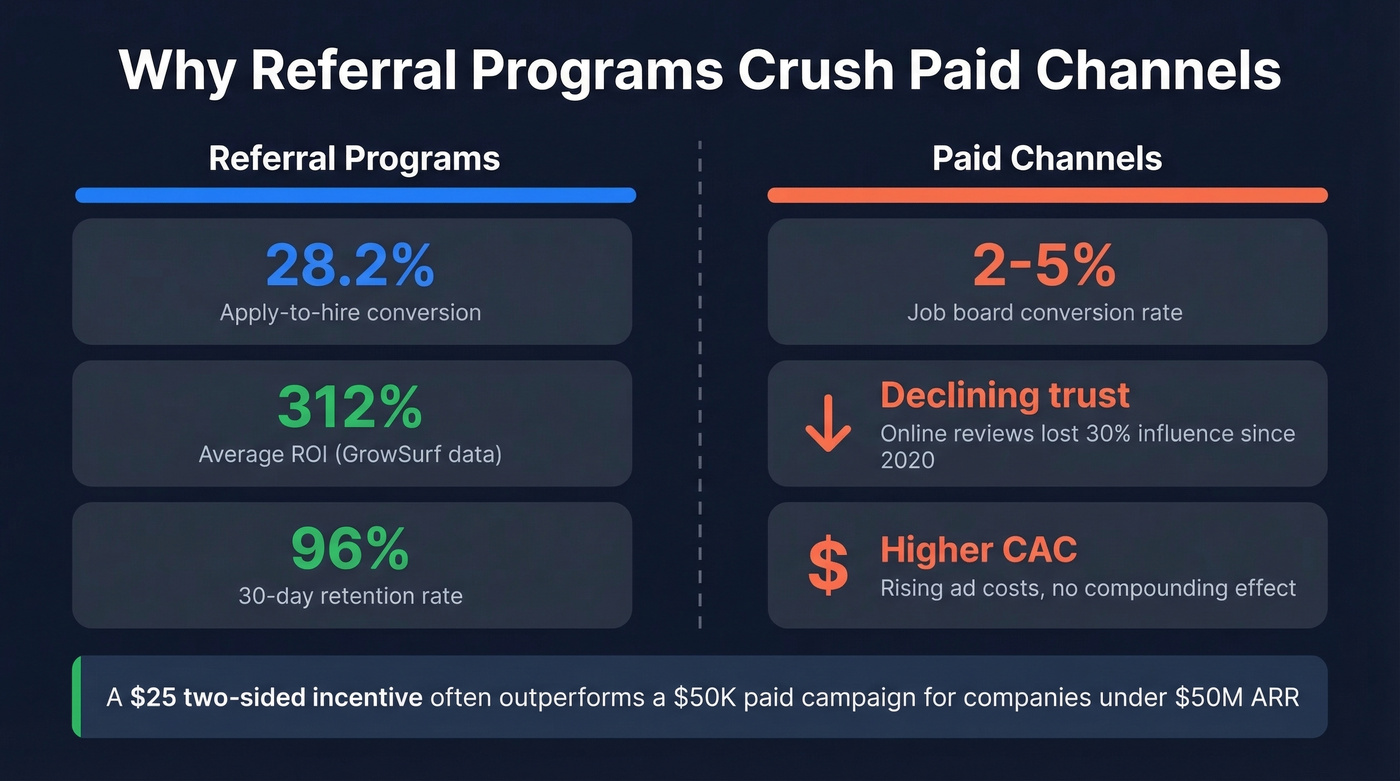
Why the gap? Trust. A recommendation from someone you know carries more weight than any ad. Online reviews lost 30% of their influence on customers between 2020 and 2024, making personal recommendations even more valuable. The referred customer arrives pre-sold, with lower acquisition cost and higher retention. And unlike paid channels, referral programs compound - every new customer becomes a potential referrer.
Here's the thing: most companies don't need a bigger ad budget. They need to stop ignoring the distribution channel sitting inside their existing customer base. We've seen it repeatedly - a program with a $25 two-sided incentive will outperform a $50K paid campaign for the majority of B2B and B2C companies under $50M ARR.
Types of Referral Incentives
Not every incentive works for every audience. Here's what's actually being used, with real dollar amounts.
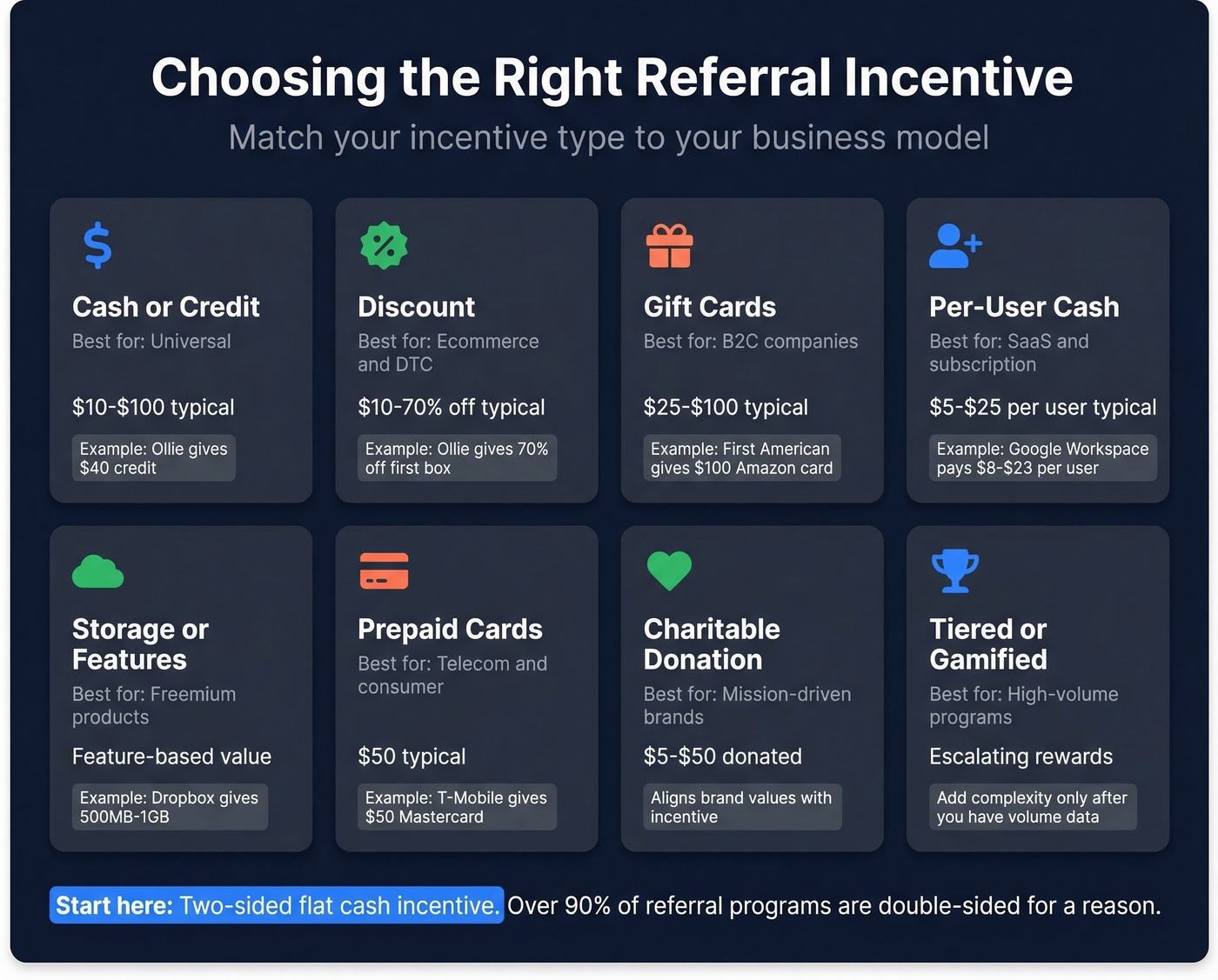
| Incentive Type | Best For | Example Brand | Typical Value |
|---|---|---|---|
| Cash / credit | Universal | Ollie ($40 credit) | $10-$100 |
| Discount | Ecommerce / DTC | Ollie (70% off first box) | 10-70% off |
| Gift cards | B2C | First American ($100 Amazon) | $25-$100 |
| Per-user cash reward | SaaS / subscription | Google Workspace ($8-$23/user) | $5-$25/user |
| Storage / features | Freemium products | Dropbox (500MB-1GB) | Feature-based |
| Prepaid cards | Telecom / consumer | T-Mobile ($50 Mastercard) | $50 |
| Charitable donation | Mission-driven brands | Various | $5-$50 donated |
| Tiered / gamified | High-volume programs | Enterprise SaaS | Escalating rewards |
Cash is king for employee referrals. Gift cards sound creative in the HR meeting, but your engineers want money. For customer programs, credits and discounts work well because they drive repeat purchases - you're paying with margin, not cash.
The one-sided vs. two-sided decision is straightforward. Two-sided programs outperform in almost every scenario we've seen. When the referred person also gets a reward, they're more likely to convert. Ollie nails this: the friend gets 70% off their first box, and the referrer gets $40 in credit. Both sides win.
One exception: employee referral programs are almost always one-sided. That's fine - the "reward" for the new hire is the job itself.

Your referral program launch email is only as good as your contact data. One high-bounce campaign tanks your sender reputation and kills the program before it starts. Prospeo verifies emails at 98% accuracy and enriches every contact with 50+ data points - so you know exactly who to invite and how to segment them.
Clean your list before you launch. It costs $0.01 per email.
How to Build Your Program
Set Goals and KPIs
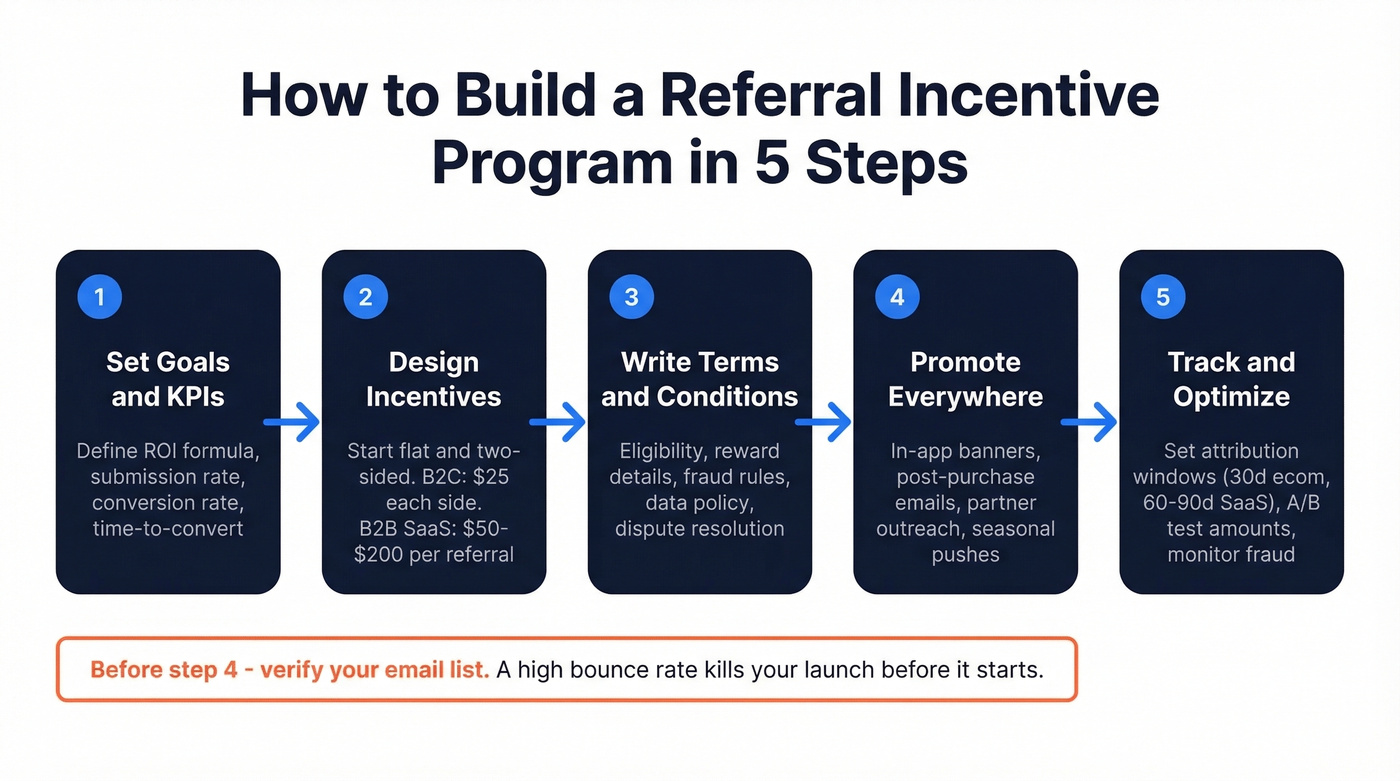
Define what "success" looks like before you pick an incentive amount. The core formula: (revenue from referred customers - program costs) / program costs = ROI. But you also need leading indicators - referral submission rate, conversion rate from referral to customer, and time-to-convert. Without these, you're flying blind and won't know what to optimize.
If you need a clean way to define and report these, use a simple set of funnel metrics so you can see where referrals drop off.
Design the Incentive Structure
Start with a flat, two-sided cash incentive. Don't overthink it.
A $25-to-both-sides offer is a perfectly fine starting point for most B2C programs. For B2B SaaS, $50-$200 per qualified referral is common. You can graduate to tiered or gamified structures later, once you have volume data to justify the complexity. The first version should be dead simple.
For employee referrals, a useful heuristic from Blackhawk Network: set the bonus $500-$1,000 below your average cost-per-hire. If you're spending $5,000 per hire through agencies, a $4,000 referral bonus still saves money and your employees will actually submit names.
Write Your Terms and Conditions
Your T&Cs aren't optional - they're your legal shield. Cover these at minimum: eligibility (who can refer, who can be referred), reward details (amount, form, timing), tracking method, fraud consequences including account cancellation and reward forfeiture, data usage policies, modification rights, dispute resolution, and governing law. This checklist from Viral Loops covers the full framework. Don't skip it.
Promote the Program
A referral program nobody knows about is a referral program that doesn't exist.
Put it in-app with a homepage banner, post-purchase confirmation, and account dashboard placement. Run email campaigns to your existing customer base. Reach out to partners. Consider seasonal pushes - Zipcar ran a $25 driving credit tied to Thanksgiving, which is smart because people are already talking to friends and family. For brick-and-mortar businesses, referral cards with QR codes at checkout still work surprisingly well.
Before you email your customer database about the new program, verify those addresses. A high bounce rate torches your sender reputation. Prospeo's bulk verification handles this - upload a CSV, get 98% email accuracy back, and enrich your CRM list with 50+ data points per contact while you're at it. If you're seeing issues already, start by fixing your email bounce rate.
Track, Attribute, Optimize
Attribution windows matter more than most teams realize. For ecommerce, 30 days is standard - the purchase cycle is short. For B2B SaaS, extend to 60-90 days. Enterprise deals with 6-month sales cycles might need even longer windows. Set this before launch, document it in your T&Cs, and don't change it retroactively.
Once you have data flowing, A/B test incentive amounts. A $50 reward might outperform $25 by 3x - or it might attract more fraud. Monitor for suspicious patterns like same-IP signups, rapid account creation, and immediate refunds. Most modern referral platforms offer AI-powered fraud detection that flags these patterns automatically, and some use machine learning to optimize reward amounts based on conversion data.
The first 90 days are about learning, not perfecting. Treat it like sales process optimization: ship, measure, iterate.
Employee Referral Bonuses
Employee referrals are the highest-quality hiring channel by a wide margin. The Eqo 2026 benchmarks tell the story:
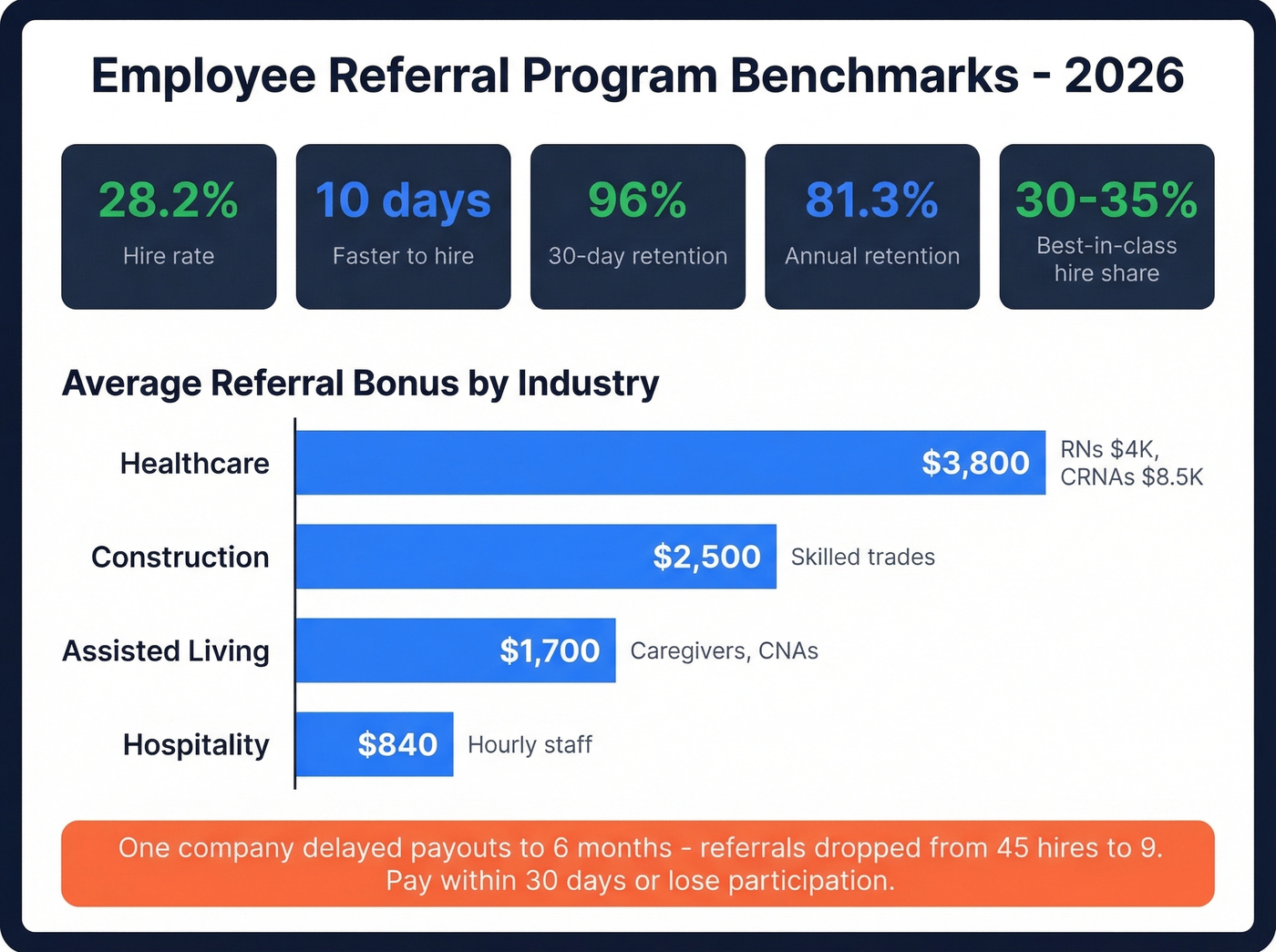
- Apply-to-hire conversion: 28.2%
- Time-to-hire: 10 days faster than other channels
- 30-day retention: 96%
- 90-day retention: 87.7%
- Annualized retention: 81.3%
Best-in-class programs generate 30-35% of external hires from referrals, with 15-20% of the workforce submitting at least one referral per year. If your numbers are below that, the problem is almost certainly program design, not employee willingness.
Bonus amounts vary dramatically by industry:
| Industry | Average Bonus | Notable Roles |
|---|---|---|
| Healthcare | $3,800 | RNs $4K, CRNAs $8.5K |
| Construction | $2,500 | Skilled trades |
| Assisted Living | $1,700 | Caregivers, CNAs |
| Hospitality | $840 | Hourly staff |
For payout structure, 54% of programs split the bonus into two installments, 42% pay it all at once, and 3% use three installments. The split doesn't matter nearly as much as the timing.
A Reddit thread on r/FPandA tells the cautionary tale perfectly. One company switched to a 6-month probation delay for referral payouts. Referrals dropped from 45 hires the previous year to 9 by November. Employees had "outstanding referral bonuses from 18 months ago" they'd forgotten about entirely.
Let's be honest: if your company makes employees wait 6 months for a referral bonus, you deserve the 80% drop in participation. Pay within 30 days - or at most, split it into a 30-day and 90-day installment. Anything longer and you're signaling that the program isn't a priority.
How to Prevent Referral Fraud
The fact that most referral program guides skip fraud prevention entirely is wild. Fraud can drain your budget before you even realize it's happening. Uber lost $50,000+ in ride credits from a single referral code broadcasting incident in 2014 - and that was early days.
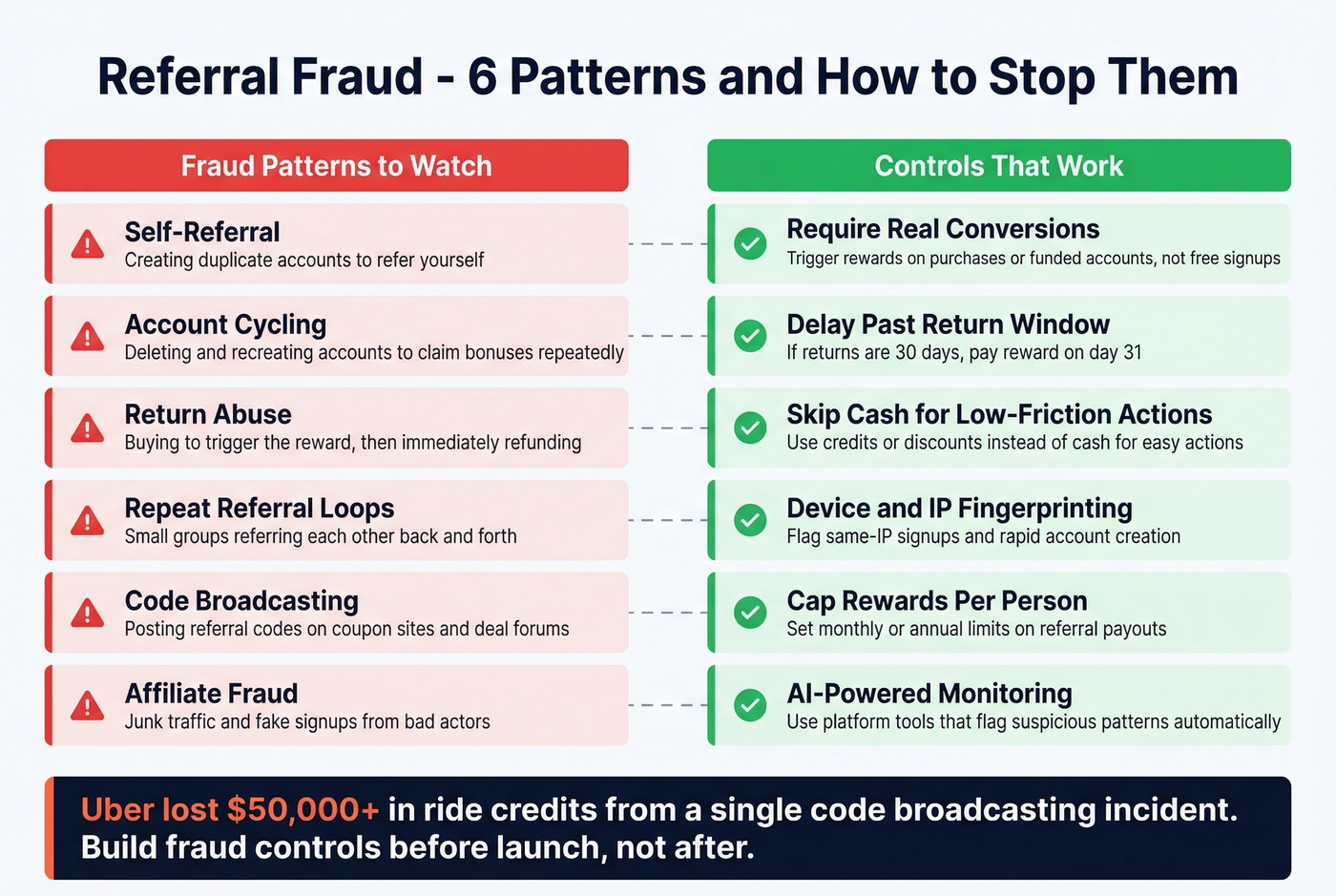
Six abuse patterns you need to watch for: self-referral (creating duplicate accounts to refer yourself), account cycling (deleting and recreating accounts to claim bonuses repeatedly), return abuse (purchasing to trigger the reward then refunding), repeat referral loops between a small group, code broadcasting on coupon sites and deal forums, and affiliate fraud through junk traffic and fake signups.
And here are the controls that actually work:
- Require meaningful conversion events. A purchase or funded account, not just a free signup. Giving $10 cash for a free account creation is begging for exploitation.
- Delay payouts past your return window. If your return policy is 30 days, don't pay the referral reward until day 31.
- Avoid cash rewards for low-friction actions. Credits and discounts are harder to exploit than cash equivalents.
- State fraud consequences explicitly in your T&Cs. Account cancellation, reward forfeiture - spell it out.
- Block unauthorized traffic sources. Redirect visitors from coupon sites to a generic landing page without rewards.
- Cap rewards. Limit the total value or number of referrals per person per period.
- For B2B, reward qualified milestones. A scheduled demo or attended meeting is harder to fake than a form fill.
Skip this section at your own peril. We've talked to teams that burned through $20K in fraudulent payouts in the first month because they launched without a single control in place.
Tax and Legal Compliance
Tax Treatment: Employee vs. Customer Rewards
Most programs get sloppy here, and the IRS doesn't care that you called it a "bonus" or a "gift."
| Recipient | Tax Treatment | Form | Threshold / Rate |
|---|---|---|---|
| Employee | Supplemental wages | W-2 | 22% flat (under $1M) |
| Non-employee | Misc. income | 1099-MISC | $600+/year |
Employee referral bonuses are supplemental wages. They appear on the employee's W-2 and get withheld at a flat 22% if paid separately from regular payroll. The 37% rate kicks in above $1M, but if you're paying million-dollar referral bonuses, you have bigger things to figure out.
Non-employee referral payments - customer rewards, partner commissions - trigger a 1099-MISC once you've paid someone $600 or more in a calendar year. Your finance team needs a process for this before launch, not after you've paid out 500 gift cards with no tracking.
FTC, GDPR, and CAN-SPAM
Referral incentives create what the FTC calls a "material connection" between the referrer and your brand. That connection must be disclosed - clearly, not buried in fine print.
FTC disclosure requires referrers to use visible language like "Referral link - I get a bonus if you sign up!" at the point of sharing. GDPR and CCPA consent rules mean that when a referrer submits a friend's email, you need explicit consent mechanisms with no pre-checked boxes. The referred person didn't opt in - handle that carefully. And CAN-SPAM compliance demands that referral emails sent on behalf of your brand include unsubscribe options and your physical address. Treat them like marketing emails, because legally, they are. If you're operationalizing this, it helps to follow a full email deliverability guide so compliance and inboxing move together.
Referral Program Software
Picking the right platform depends on your size, vertical, and integration needs. For teams with engineering resources, a basic referral system using unique codes and tracking can be built in-house. But fraud detection, A/B testing, and attribution across channels are where dedicated platforms earn their cost.
| Tool | Best For | Differentiator | Pricing |
|---|---|---|---|
| Extole | Enterprise | Attribution + analytics | ~$20K-$50K+/yr |
| ReferralCandy | Ecom SMBs | Shopify-native, simple | From ~$59/mo |
| Friendbuy | Enterprise DTC | A/B testing, APIs | ~$15K-$40K+/yr |
| Talkable | Fraud-heavy verticals | Fraud detection ($100M+ saved) | ~$15K-$30K+/yr |
| Lootly | Loyalty + referrals | Combined platform | $299/mo |
| Referral Factory | No-code teams | 100+ templates | From ~$95/mo |
| Ambassador | B2B SaaS | Partner + customer hybrid | ~$500-$2K/mo |
| GrowSurf | Startups | Dev-friendly, self-serve | From ~$400/mo |
Our quick take: Extole for enterprise, ReferralCandy for ecommerce SMBs, Ambassador for B2B SaaS. If fraud is a major concern with high-value rewards in a consumer-facing program, Talkable's fraud detection is worth the premium. Skip Lootly if you don't need the loyalty component - you're paying for features you won't use.
When evaluating any platform, look beyond the feature list. The integration categories that matter are commerce/billing, CRM/CDP, analytics/BI, email/SMS, tag management, fraud/identity, and support/ticketing. A tool that doesn't connect to your billing system can't verify purchases. A tool that doesn't talk to your CRM can't close the attribution loop. Start with your stack, then pick the platform that fits. If you're cleaning up customer records before you connect everything, start with data enrichment services to fill gaps fast.
The best referral programs target your happiest, highest-value customers first. Prospeo's CRM enrichment fills in missing emails, phone numbers, and firmographic data across your entire customer base - 83% match rate, 7-day refresh cycle. Stop guessing who to invite and start with a complete picture.
Enrich your customer list and launch your referral program with full data.
FAQ
What's the best incentive for a referral program?
Two-sided cash incentives work best for most programs - they motivate both the referrer and the new customer. Start with $25 to both sides for B2C and $50-$200 per qualified referral for B2B SaaS. Graduate to tiered structures only after you have volume data showing where drop-off occurs.
How much should an employee referral bonus be?
Industry averages range from $840 in hospitality to $3,800 in healthcare, with $1,000-$2,500 standard for office and tech roles. Set the bonus $500-$1,000 below your average cost-per-hire. Pay within 30 days - delayed payouts are the number-one killer of employee referral programs.
Are referral bonuses taxable?
Yes. Employee referral bonuses are supplemental wages reported on a W-2 and withheld at a flat 22% when paid separately. Non-employee payments exceeding $600 per year require a 1099-MISC. Loop in your finance team before launch, not after you've issued hundreds of untracked rewards.
How do I prevent fraud in my referral program?
Delay payouts past your return window, require meaningful conversion events like a purchase or funded account, cap rewards per person per period, and state fraud consequences in your T&Cs. Build these controls before launch - Uber lost $50,000+ in credits from a single code-broadcasting incident.
What's the best way to verify contacts before a referral launch?
Use a bulk email verification tool to clean your list before sending the announcement. Prospeo's verification returns 98% accuracy on uploaded CSVs and enriches contacts with 50+ data points - ensuring your launch email reaches inboxes instead of bouncing and torching sender reputation.