

The Outbound B2B Lead Generation Playbook for 2026
Reply rates dropped 12% year-over-year. Open rates are functionally dead as a metric. And yet, outbound B2B lead generation still works - the lead gen software market is on pace to grow from $7.4B to $16.2B by 2034 because the channel keeps producing pipeline when the infrastructure behind it is solid. Meanwhile, 91% of marketers rank lead generation as their top priority, yet 61% call it their biggest challenge. The teams struggling aren't the ones with bad messaging. They're the ones with broken plumbing.
Define Your ICP and Map the Buying Committee
Spray-and-pray is dead. The consensus on r/b2bmarketing is clear: you need a specific reason why each company is interesting, not just a firmographic bucket. That starts with a tight ICP and a mapped buying committee.
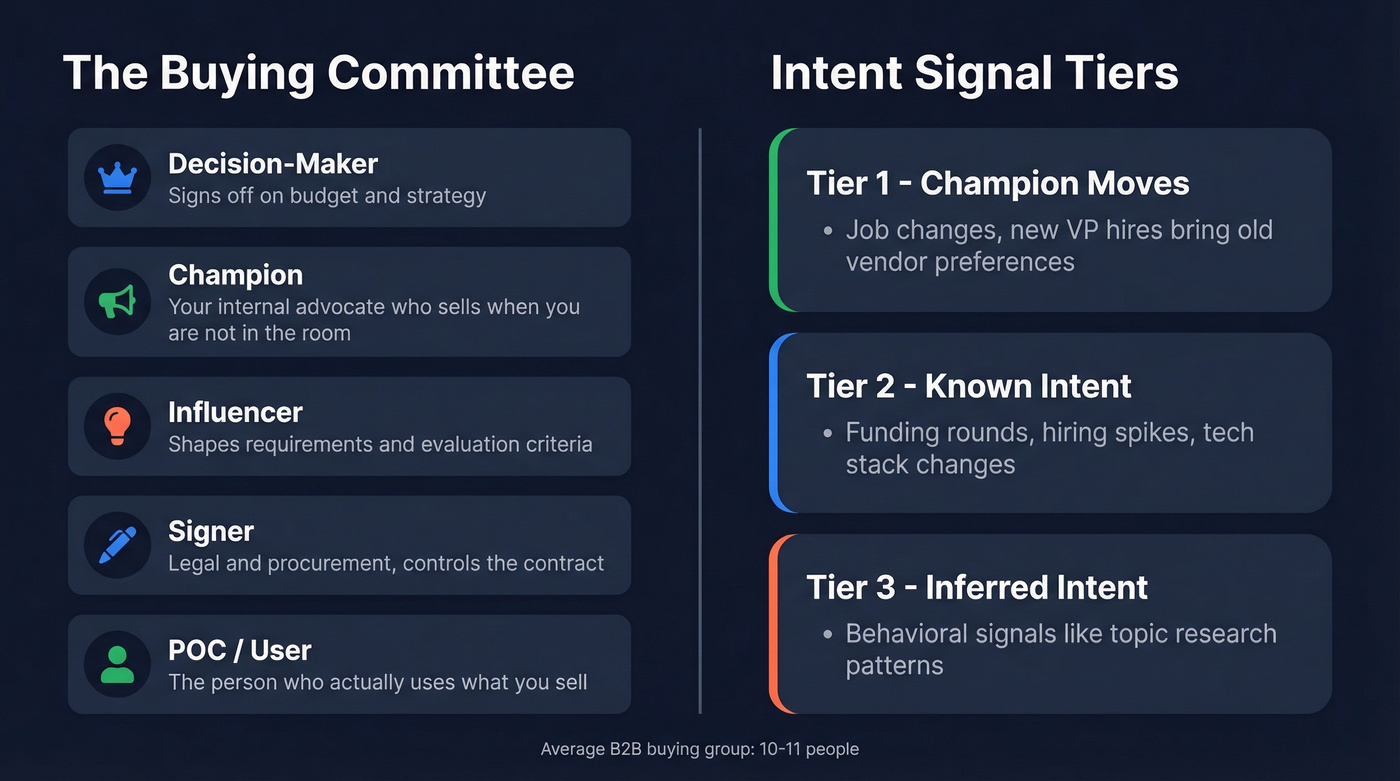
The average B2B buying group is 10-11 people. You're not selling to one person - you're navigating a committee. Map five roles for every target account:
- Decision-maker - signs off on budget and strategic direction
- Champion - your internal advocate who sells when you're not in the room
- Influencer - shapes requirements and evaluation criteria
- Signer - legal/procurement, controls the contract
- POC/User - the person who'll actually use what you sell
Once you've mapped the committee, layer in intent signals using a three-tier model. Tier 1 is champion moves - job changes are the strongest trigger because a new VP brings their old vendor preferences. Tier 2 is known intent: funding rounds, hiring spikes, tech stack changes. Tier 3 is inferred intent: behavioral signals like topic research patterns.
Build Your Data Foundation
Here's the thing: if your bounce rate is above 5%, your data provider is the problem. Not your copy. Not your subject lines. Not your cadence. Every bounced email chips away at your domain reputation, and once that's damaged, even perfect emails land in spam.
We've seen this pattern over and over. A team invests in a sequencing tool, writes sharp copy, builds a solid cadence - and gets 1% reply rates because 30% of their emails never reach an inbox. The fix isn't more volume. It's better data. In any B2B outbound motion, data quality is the single highest-leverage investment you can make.
Prospeo covers 300M+ professional profiles and 143M+ verified emails with 98% email accuracy, verified through a proprietary 5-step process that includes catch-all handling, spam-trap removal, and honeypot filtering. The 7-day data refresh cycle is roughly 6x faster than the industry average of six weeks, which means you're not emailing people who changed jobs two months ago. On the mobile side, 125M+ verified numbers carry a 30% pickup rate across all regions.

The proof points are concrete. Meritt went from a 35% bounce rate to under 4% after switching - and their pipeline tripled from $100K to $300K per week. Snyk's 50-person AE team dropped bounce rates from 35-40% to under 5%, generating 200+ new opportunities per month. Stack Optimize built to $1M ARR with 94%+ deliverability and zero domain flags across all clients. When your agency's reputation depends on client deliverability, data quality isn't a nice-to-have - it's the business model.
Pricing starts free (75 emails/month + 100 Chrome extension credits/month), with paid plans running about $0.01 per email. No contracts, no sales calls required.
Set Up Your Email Infrastructure
This is the section most outbound guides skip, and it's the one that matters most.
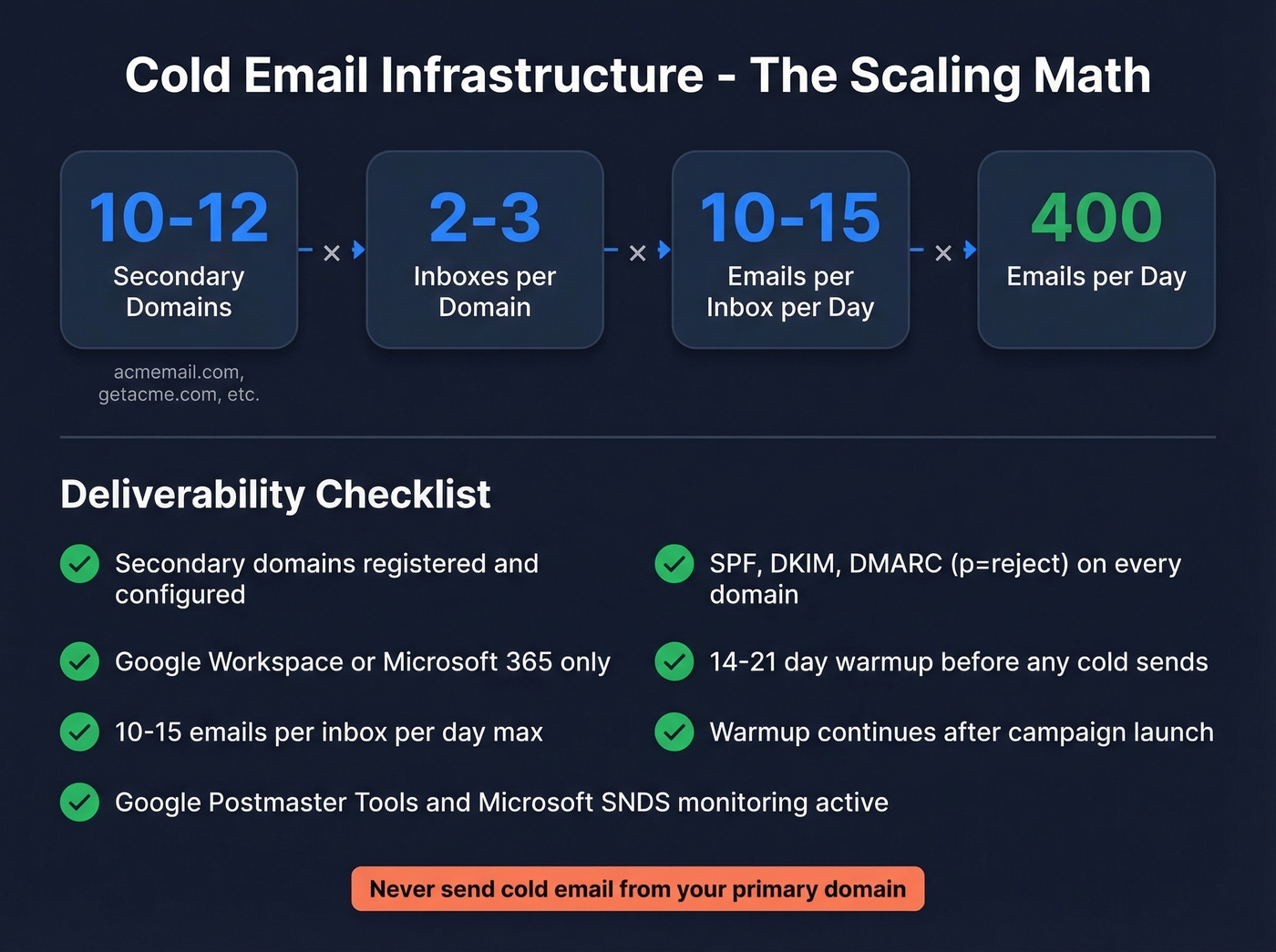
Never send cold email from your primary domain. Use secondary domains - variations of your main domain - to isolate reputation risk. If your company is acme.com, register acmemail.com, getacme.com, and similar variants. The r/coldemail community treats this as non-negotiable hygiene.
Here's the scaling math:
- 2-3 inboxes per domain
- 10-15 emails per inbox per day
- That's ~30-45 emails per domain daily
- To send 400/day, you need 10-12 domains
Use Google Workspace or Microsoft 365 only. Free Gmail and Yahoo accounts will get flagged immediately.
DNS authentication is table stakes. Every domain needs SPF, DKIM, and DMARC configured before you send a single email. DMARC with p=reject is fast becoming the 2026 standard for trustworthy senders - anything weaker is a red flag to inbox providers. If you need a step-by-step, see our guide on SPF, DKIM, and DMARC.
Warmup takes patience. Start at 10-20 emails per day and ramp over 14-21 days minimum. Full ramp to target volume can take 4-8 weeks for brand-new domains. Keep warmup running even after campaigns launch. Monitor reputation through Google Postmaster Tools and Microsoft SNDS - if complaint rates spike, pause and diagnose before you burn the domain.
The deliverability checklist, compressed:
- Secondary domains registered and configured
- SPF, DKIM, DMARC (p=reject) on every domain
- Google Workspace or Microsoft 365 inboxes
- 14-21 day warmup before any cold sends
- 10-15 emails per inbox per day, max
- Warmup continues post-launch
- Google Postmaster Tools + Microsoft SNDS monitoring active
Core Channels for Outbound Prospecting
Cold Email
Cold email remains the backbone of outbound. At scale, a 2-4% reply rate is strong - and anyone showing you double-digit reply rates is cherry-picking a small campaign. Below 1%? Something's broken, and it's usually deliverability, not messaging. If you're troubleshooting, start with email bounce rate benchmarks and fixes.
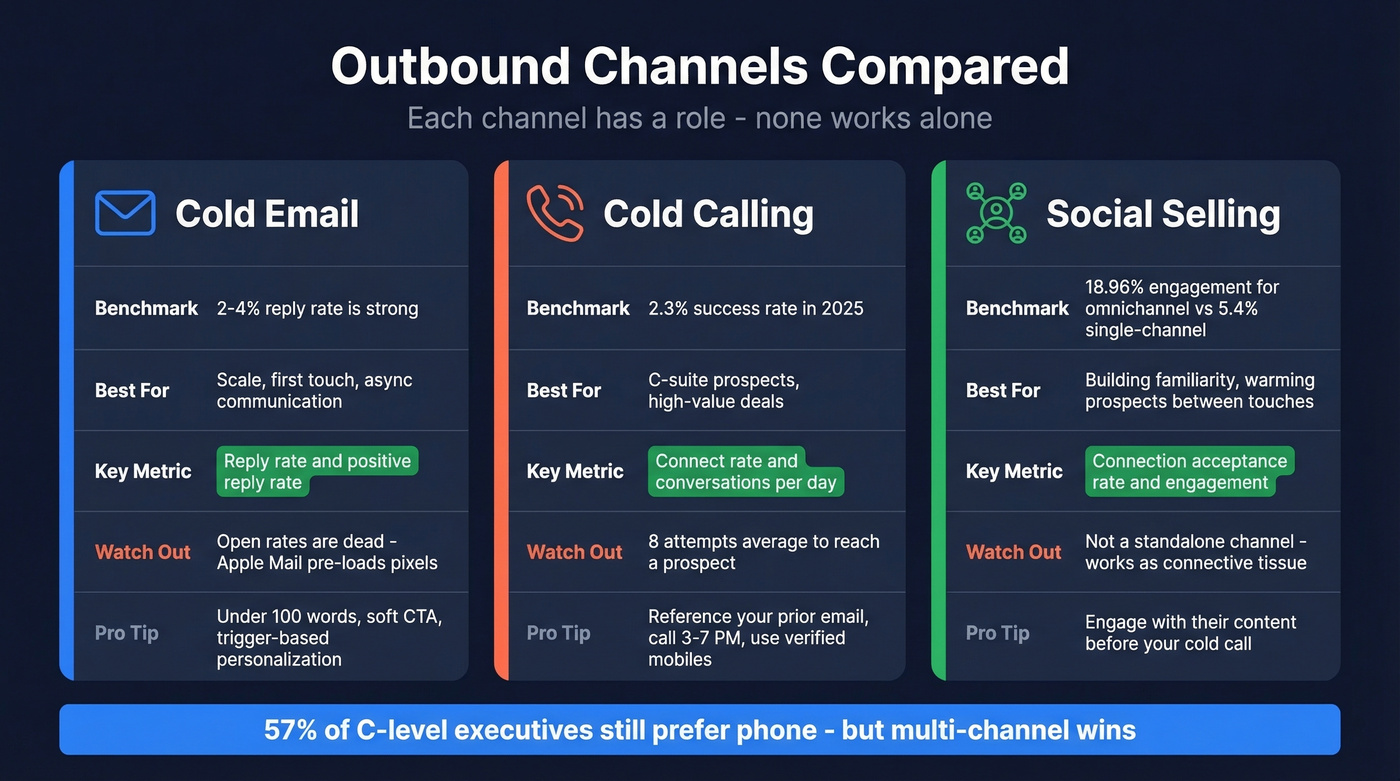
Stop reporting open rates. Apple Mail Privacy Protection pre-loads tracking pixels, which means your 60% open rate is a fiction. Reply rate, positive reply rate, and meetings booked are the only email metrics that matter in 2026.
The best-performing emails are short (under 100 words), personalized to a specific trigger or pain point, and end with a soft CTA. "Worth a 15-minute call?" beats "Let me know if you'd like to schedule a demo at your earliest convenience." AI tools can draft first-line personalization at scale, but the offer strategy and ICP targeting still require human judgment - the technology is good enough for drafts, not for strategy. For more on doing this well, see personalization in lead generation.
Cold Calling
Cold calling's average success rate dropped to 2.3% in 2025 - down from 4.82% in 2024, a steep decline driven by caller ID screening and gatekeeper tools. It takes an average of 8 attempts to reach a prospect. Those numbers look brutal in isolation.
But 57% of C-level executives still prefer phone over other channels. The channel isn't dead - execution is the problem. If you want to tighten scripts and reps’ fundamentals, use this cold caller playbook.
The math works when you combine calling with email and social touches. A cold call that references "the email I sent Tuesday about [specific problem]" converts at a meaningfully higher rate than a blind dial. Pair verified mobile numbers (not switchboard lines) with multi-channel context, and connect rates improve dramatically.
Social Selling
B2B buyers now engage across roughly 10 channels before making a purchase - up from 5 in 2016. Omnichannel engagement strategies produce 18.96% engagement versus 5.4% for single-channel. Social is the connective tissue between email and phone, not a standalone channel. A connection request on Day 2 that references your Day 1 email creates familiarity. Engaging with a prospect's content before your cold call warms the conversation. Some teams add personalized video via Loom or Vidyard as a Day 5 or Day 7 touch - it works best for enterprise deals where the deal size justifies the time investment.

You just read why bounce rates above 5% destroy outbound campaigns. Prospeo's 5-step verification delivers 98% email accuracy with a 7-day refresh cycle - 6x faster than the industry average. Meritt cut their bounce rate from 35% to under 4% and tripled pipeline to $300K/week.
Stop blaming your copy when your data is the problem.
Build Your Multi-Channel Cadence
Why Shorter Sequences Win
Conventional wisdom says 8-12 touches over 17-21 days. Practitioner reality says that's too long. Email #1 drives most replies. Email #2 sometimes contributes. Email #3 is thin ice. Email #4 and beyond is mostly wasted effort.
The better approach: 3-4 emails plus 2-3 calls plus 2 social touches - 7-9 total touches over 10-14 days. If a prospect doesn't engage, don't stack more follow-ups. Relaunch with a completely fresh angle in 60 days. Recycling your TAM every six months with new offers and timing keeps the pipeline alive without burning contacts.
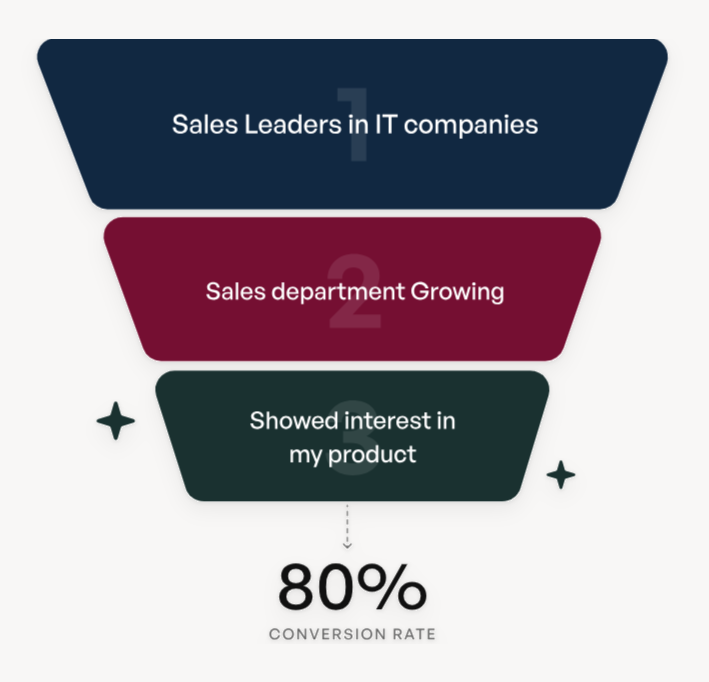
80% of sales require five or more touchpoints, but most reps stop after two or three. The problem isn't sequence length - it's that reps abandon too early and then compensate by adding low-value emails to the back end. Multi-channel solves this by distributing touches across formats that feel different to the prospect. If you want a deeper framework, see our guide to SDR lead generation.
Sample 7-Touch Cadence
| Day | Channel | Action | Notes |
|---|---|---|---|
| 1 | Personalized pitch, under 100 words, soft CTA | Tue-Thu morning | |
| 2 | Social | Connection request referencing email | Keep it brief |
| 3 | Phone | Call + 30-sec voicemail with new value point | Weekday 3-7 PM |
| 5 | New angle - case study or specific pain point | Don't repeat Day 1 | |
| 7 | Social | Engage with their content or share relevant insight | Build familiarity |
| 8 | Phone | Second call attempt, reference prior touches | Repeat callback number twice |
| 10 | Breakup email - clear, respectful close | Leave the door open |
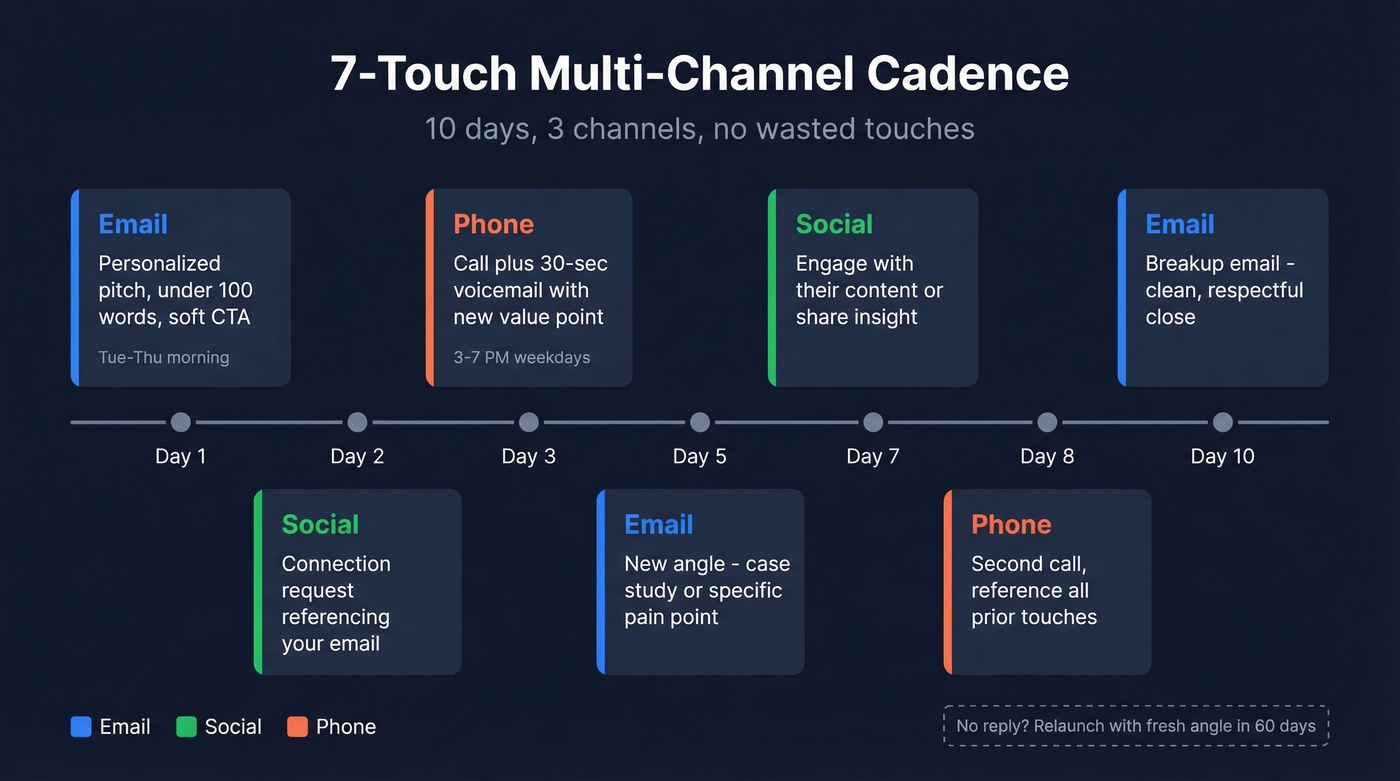
Phone calls convert best on weekday afternoons between 3-7 PM. Emails perform strongest Tuesday through Thursday mornings. The breakup email on Day 10 isn't a guilt trip - it's a clean close that makes relaunching in 60 days feel natural rather than desperate.
The Funnel Math
Let's work through the numbers so you know what to expect before you launch.
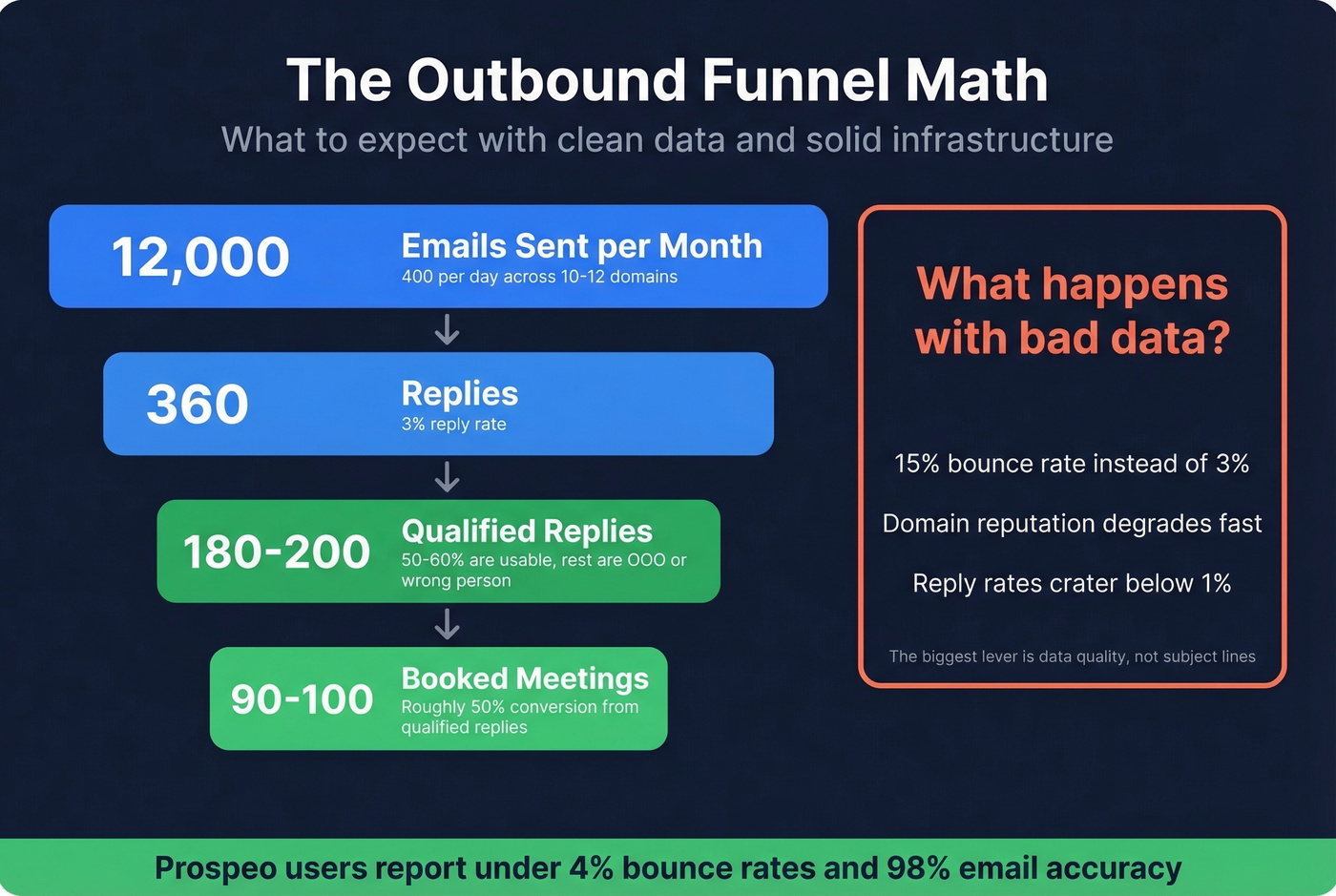
Start with 400 emails per day across your domain infrastructure. That's roughly 12,000 per month. At a 3% reply rate, you're looking at 360 replies. About 50-60% of those will be usable (the rest are out-of-office, not interested, or wrong person), which gives you 180-200 qualified replies. Convert roughly half to booked meetings, and you're at 90-100 meetings per month.
Those numbers assume clean data, solid infrastructure, and a targeted list. If your bounce rate is 15% instead of 3%, the whole funnel collapses - you're sending fewer emails that actually arrive, your domain reputation degrades, and reply rates crater.
Here's our hot take: the biggest lever isn't subject lines, and it isn't even personalization. It's offer testing. Test persona-to-angle fit - does the VP of Sales respond better to "save your reps 5 hours/week" or "we helped [competitor] close 30% more pipeline"? Test pain-first versus case-study-first. Test frictionless CTAs ("want the audit?") versus meeting requests. Most teams obsess over copy when the angle is the variable that actually moves the needle. If you need a structured approach, use this A/B testing framework.
Your Outbound Tech Stack
You don't need 10 tools. You need four that actually work together. If you’re comparing options, start with our roundup of outbound lead generation tools.
| Layer | Tool | What It Does | Pricing |
|---|---|---|---|
| Data (alt) | Apollo.io | 275M+ contacts + built-in sequencing | Free; Pro $49/user/mo |
| Data (enterprise) | ZoomInfo | Largest US database + intent + workflow | ~$15K-$60K/year |
| Data (EU-focused) | Cognism | EU B2B data + phone-verified mobiles | ~$15K-$40K/year |
| Enrichment | Clay | Waterfall enrichment across 75+ sources | From $134/month |
| Sending | Smartlead | Unlimited inboxes, warmup, rotation | From $39/month |
| Sending (alt) | Instantly | Similar to Smartlead, strong UI | ~$30-$100/month |
| Engagement | Outreach / Salesloft | Multi-channel sequences (enterprise) | ~$100-$200+/seat/mo |
| CRM | HubSpot | Free CRM; Sales Hub for automation | Free; from $15/user/mo |
| CRM (alt) | Salesforce | Enterprise CRM standard | From $25/user/mo |
Apollo is the obvious alternative if you want data and sequencing in one platform, though we've found its email accuracy runs noticeably lower - 79% versus 98% with Prospeo. ZoomInfo is the enterprise play with the deepest US database, but a 10-seat contract with intent data and mobile numbers can run $40-60K/year. That's real money for a Series A company. Cognism is worth evaluating if your TAM is heavily European - their phone-verified mobile data in EMEA is strong, though the price tag sits in the same enterprise range.
Skip the enterprise stack if you're closing deals under $15K. A lean setup - accurate data, a sending tool with inbox rotation, and a free CRM - will outperform an expensive stack with bad data every time. If you’re building lists from scratch, follow this lead list guide.
Outbound at scale needs more than emails. Prospeo gives you 300M+ profiles with 30+ filters - buyer intent, job changes, technographics, funding - plus 125M+ verified mobiles with a 30% pickup rate. All starting at $0.01/email, no contracts.
Build your entire outbound data foundation in one platform.
KPIs and Benchmarks
| Metric | Realistic Range | Notes |
|---|---|---|
| Cold email reply rate | 2-5% (2-4% at scale) | Open rate is dead |
| Cold call connect rate | 2.3% | 8 attempts avg to reach |
| Meeting-to-SQL rate | ~20% | Once qualified |
| Omnichannel engagement | 18.96% | vs 5.4% single-channel |
| Bounce rate (healthy) | Under 5% | Above 5% = data problem |
Stop reporting open rates to leadership. Apple Mail Privacy Protection inflates them to meaninglessness, and they've never been a reliable indicator of intent. The metrics that matter: reply rate (are people engaging?), positive reply rate (are they interested?), meetings booked (are you generating pipeline?), and pipeline generated (is the pipeline converting?).
If your bounce rate is above 5%, fix your data before you touch anything else. Reply rate below 1%? Check deliverability before rewriting copy. Strong meetings but weak pipeline means your qualification criteria need work - that's a sales problem, not an outbound problem. The r/coldemail community will tell you the same thing: diagnose the bottleneck before you optimize the wrong layer.
Compliance Checklist
Outbound prospecting is legal in major markets when you follow the rules. But the penalties for getting it wrong are steep enough to deserve a checklist. For a deeper EU/UK breakdown, see our GDPR compliant lead generation playbook.
CAN-SPAM (US): Cold email is legal without prior consent. Requirements: accurate sender info, truthful subject lines, physical mailing address, working opt-out honored within 30 days. Penalties run $51,744-$53,088 per non-compliant message. Per email, not per campaign.
GDPR (EU/UK): B2B cold email is permissible under Article 6(1)(f) legitimate interest. You need a documented Legitimate Interest Assessment covering purpose, necessity, and balancing tests. Keep it on file - regulators ask for it. Maximum penalty: EUR 20 million or 4% of global revenue, whichever is higher.
CASL (Canada): Consent-first jurisdiction. Unsubscribe requests must be honored within 10 business days. Maintain opt-out records for a minimum of 3 years. This is the strictest of the three - if you're prospecting into Canada, get legal sign-off on your approach.
The practical takeaway: include a physical address and one-click unsubscribe in every email. Document your legitimate interest basis for GDPR targets. Honor every opt-out immediately, not at the 30-day deadline. Compliance isn't just legal protection - inbox providers use complaint signals to determine deliverability.
FAQ
Is outbound lead generation still effective in 2026?
Yes - but infrastructure matters more than volume now. Reply rates dropped 12% year-over-year, and single-channel outreach produces just 5.4% engagement versus 18.96% for omnichannel. Teams that nail deliverability and data quality are booking more meetings than ever; the ones blasting generic sequences to unverified lists are the ones calling outbound "dead."
How many cold emails should I send per day?
Cap at 10-15 per inbox to stay safe with inbox providers. To send 400 per day, you need 10-12 secondary domains with 2-3 inboxes each. Never send from your primary domain - one spam complaint can tank your company's email reputation for months. Scale by adding domains, not by pushing more volume through existing inboxes.
What's the best data tool for B2B outbound?
For most teams, Prospeo offers the strongest balance - 98% email accuracy, a 7-day refresh cycle versus the six-week industry average, and a free tier with no contracts. ZoomInfo has the deepest US database but typically runs $15K-$60K/year. Apollo bundles sequencing with data but trades off accuracy at 79%. Pick based on your stage: lean teams need accuracy and price; enterprise teams need depth and workflow integration.
Outbound B2B lead generation works when the plumbing works. Fix your data, fix your infrastructure, and the meetings follow.