

How to Be a Great Cold Caller: The Complete System for 2026
A RevOps Manager we work with ran the numbers last quarter: his team's cold call success rate - conversations that turned into booked meetings - landed at 4.82%. That was 2024. By 2025, Cognism's WHAM data showed that rate had roughly halved to around 2.4%. Everyone obsesses over the script. The script is maybe 20% of the equation. The other 80% is the system around it - data quality, call structure, objection handling, and daily discipline.
Look, if you want to learn how to be a great cold caller, stop hunting for a magic script and start building a machine. Cold calling isn't dead. Lazy cold calling is dead. Jason Bay puts it bluntly: "Only 10% of calls make it past 2 minutes... the first 60 seconds is exactly what you want to nail." The average cold call now lasts about 93 seconds, up from 83 the year before, so you've got roughly a minute to earn the next thirty. And 63% of reps say cold calling is the part of the job they hate most - which means the ones who actually develop their skills face almost no competition. Let's build the system that makes that minute count.
The Four Pillars (Quick Version)
Great cold calling comes down to four things. Miss one and the other three can't compensate.
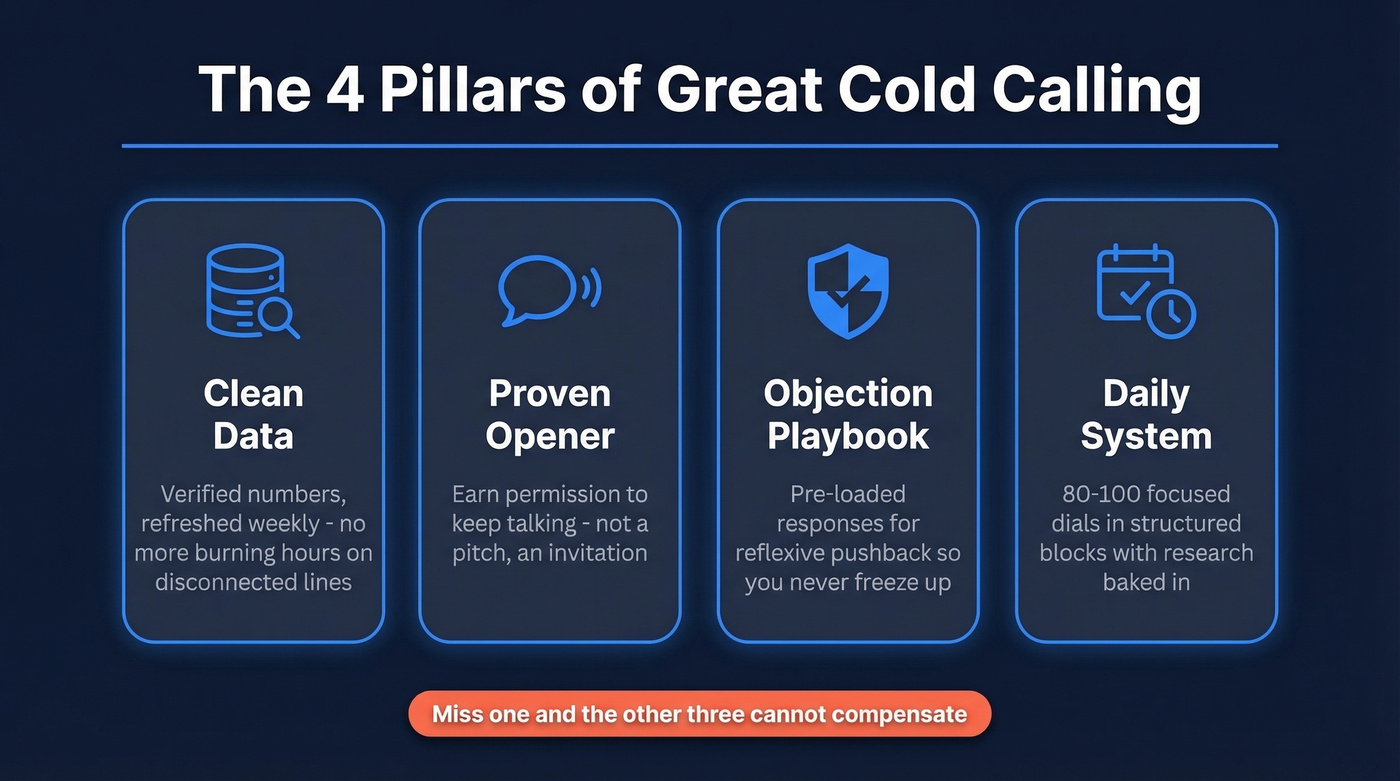
- Clean data. If half your numbers are disconnected, you're burning hours for nothing. Data quality is the silent multiplier. (If you want to go deeper, build a repeatable cold calling system around list quality + execution.)
- A proven opener. Not a pitch. An opener that earns permission to keep talking.
- An objection playbook. Most objections are reflexes, not rejections. You need pre-loaded responses so you don't freeze.
- A daily system. 80-100 focused dials in structured blocks, with research baked in before you pick up the phone.
49% of sales organizations still use cold calling as a primary or secondary channel. The teams that win aren't doing anything magical - they're running a tighter system than everyone else.
Pre-Call Research: The 3x3 Method
The fastest way to separate yourself from every other SDR calling into the same account is three minutes of research before you dial. That's the 3x3 method: spend 3 minutes finding 3 useful facts about the person or company. A recent funding round, a job change, a hiring surge in a specific department, a tech stack signal - anything that turns "cold" into "warm-ish." (This is one of the highest-leverage sales prospecting techniques you can build into your cadence.)
Research-backed calls can lift conversion rates by up to 82% compared to blind dials. That's not a small edge. It's the difference between booking one meeting a day and booking three.
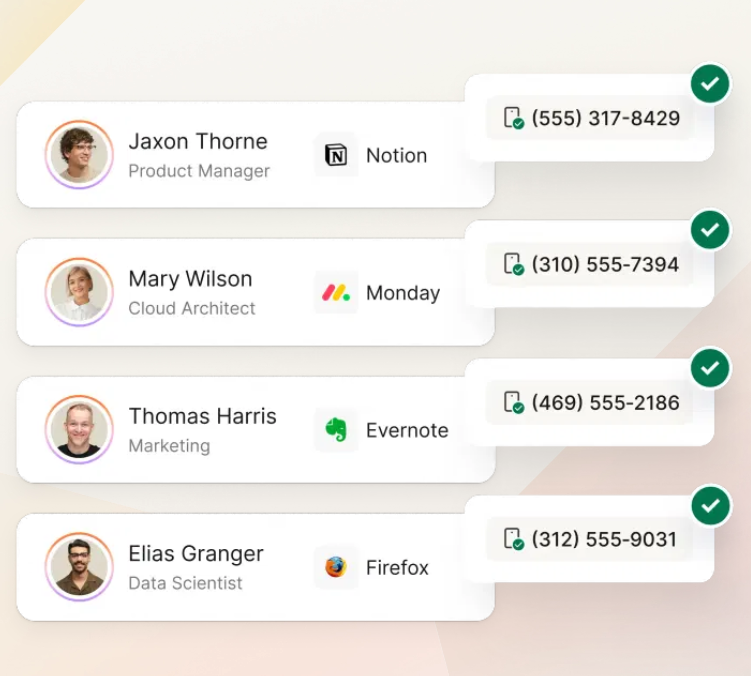
But research only matters if you're calling real numbers. Nothing kills morale faster than burning through a 3-hour call block and realizing half your numbers were disconnected. We've seen teams use Prospeo's mobile finder to source verified numbers before their call blocks - 125M+ verified mobiles with a 30% pickup rate, refreshed every 7 days. When your connect rate jumps from 5% to 20%, the same 100 dials produce four times the conversations.
Your First 60 Seconds
A Gong study found the right opening line can produce a 6.6x improvement in booking rates. The wrong one - like "Did I catch you at a bad time?" - tanks your odds immediately. The first 60 seconds aren't about pitching. They're about earning the next 30.
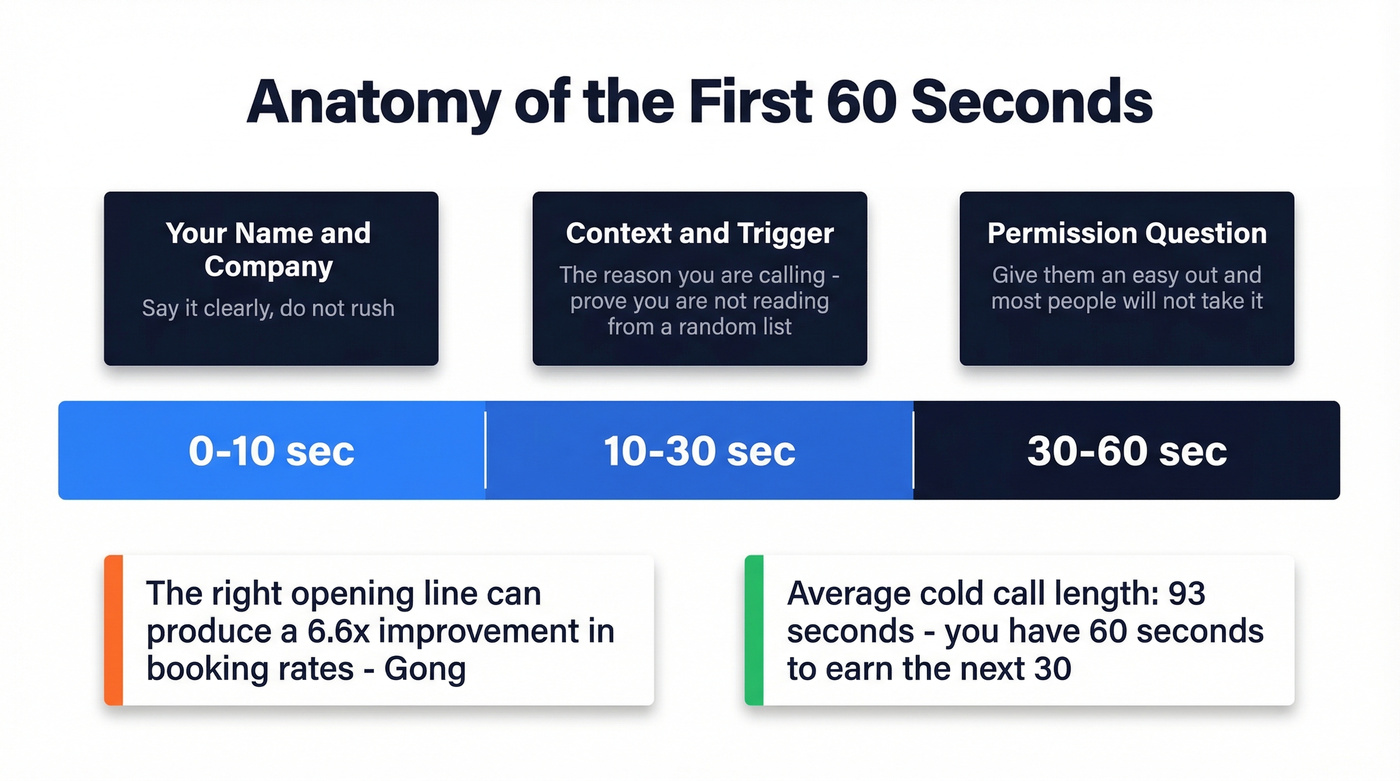
Here's the rough anatomy:
- Seconds 1-10: Your name and company. Say it clearly, don't rush.
- Seconds 10-30: Context - the trigger event, the reason you're calling, the thing that proves you're not reading from a random list.
- Seconds 30-60: The permission question. Give them an easy out, and most people won't take it.
Pick the opener that matches your situation and make it yours.
Permission-Based Opener
"Hey [Name], this is [You] from [Company]. I know I'm calling out of the blue - do you have 30 seconds so I can tell you why, and then you can decide if it's worth continuing?"
Use this when you have no trigger event and you're calling cold into a list. It's honest, it respects their time, and the micro-yes ("30 seconds") lowers resistance.
Pattern Interrupt Opener
"Hey [Name], this is [You] from [Company]. You and I haven't spoken before, and I'm not going to pretend otherwise. I'm calling because [one-sentence reason tied to their role]. Can I ask you a quick question?"
This breaks the pattern prospects expect. They're braced for a pitch. You give them honesty instead. The dissonance buys you a few extra seconds of attention.
Trigger-Based Opener
"Hey [Name], congrats on the [new role / funding round / expansion into EMEA]. I'm calling because when companies hit that stage, they usually run into [specific problem]. Is that on your radar?"
This is the highest-converting opener because it proves you did your homework. Use it when your 3x3 research turned up something real.
Peer Proof Opener
"Hey [Name], this is [You] from [Company]. We just helped [similar company in their space] solve [specific problem], and I noticed you're in a similar situation. Worth a quick conversation?"
This works best when you have a genuine case study in their industry. The peer reference creates instant credibility - they're not the guinea pig, they're the next success story.
Getting Past the Gatekeeper
Gatekeepers aren't obstacles. They're people doing their job.
The best gatekeeper script we've seen comes from Pipedrive's playbook: "I'd feel much better if I knew your name before I asked for a favor. [Pause for name.] Thanks, [Name]. I'm trying to reach [Prospect] about [brief reason]. What's the best way to make that happen?"
This works because it's human. You're asking for help, not demanding access. Most gatekeepers will at least tell you when to call back or give you a direct line. The key is tone - confident but not aggressive, friendly but not sycophantic.
When you hit voicemail (and you will, on most dials): keep it under 30 seconds. Your name, your company, one sentence about why you're calling, and your number. "Hey [Name], it's [You] from [Company]. I'm calling because [one-sentence trigger]. My number is [number]. I'll try you again Thursday." No rambling, no pitch. The goal is name recognition for when you call back, not a callback.

Your cold calling system is only as good as your data. Teams using Prospeo's 125M+ verified mobile numbers see pickup rates hit 30% - while the industry average sits around 5-12%. That means the same 100-dial call block produces 3-4x more live conversations. Numbers refresh every 7 days, so you're never burning reps' time on disconnected lines.
Turn every call block into a pipeline machine - start with numbers that actually connect.
Handling Objections
Here's what most reps get wrong: they treat objections as rejection. Most objections are automatic reactions to interruption, not genuine evaluations of your offer. The prospect hasn't heard your value prop yet - they're just trying to get off the phone because that's what you do when a stranger calls.
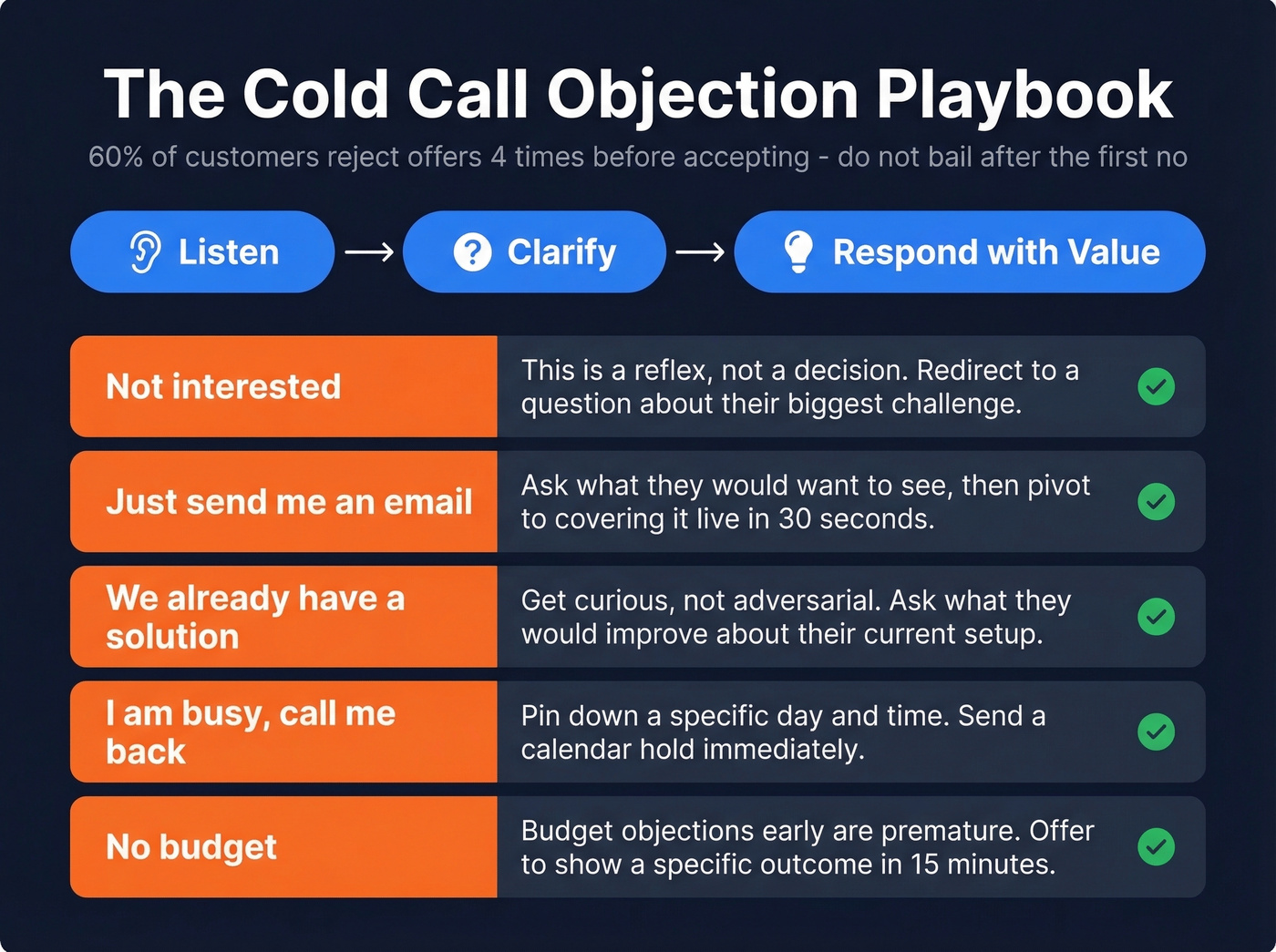
60% of customers reject offers four times before accepting. If you bail after the first "not interested," you're leaving meetings on the table.
Every objection response follows the same structure: listen without interrupting, clarify with a targeted question, then respond with value - short, specific, and tied to their situation. (If this is a recurring issue, build a team-wide sales battle cards library for objections.)
"Not Interested"
This is a reflex, not a decision. They can't be "not interested" in something they haven't heard yet.
Say: "Totally fair - you weren't expecting this call. Can I ask one quick question? If the answer is no, I'll hang up. [Pause.] What's your biggest challenge right now when it comes to [their function]?"
You're not fighting the objection. You're redirecting to a conversation.
"Just Send Me an Email"
This usually means "I want to get off the phone politely." If you just send the email, it'll die in their inbox.
Say: "Happy to. So I don't send you something generic - what specifically would be most useful to see? [Pause.] Actually, that's exactly what I was calling about. Can I take 30 seconds to cover it now?"
"We Already Have a Solution"
This is actually a buying signal. They've already identified the problem - they just solved it with someone else. Get curious instead of going adversarial.
Say: "That's great - most companies in your space do. Out of curiosity, if there were one thing you'd improve about your current setup, what would it be?"
Now you're having a real conversation about pain, not pitching against a competitor.
"I'm Busy / Call Me Back"
Pin down a specific time. Say: "Completely understand. Would Thursday at 2 PM work, or is Friday morning better? I'll send a calendar hold so it doesn't slip."
"No Budget"
Budget objections early in the call are almost always premature. Say: "Makes sense - I wouldn't expect you to have budget for something you haven't evaluated yet. If I could show you how [specific outcome], would 15 minutes be worth it?"
Mistakes That Kill Your Calls
Pitching too early. Your opener should earn permission to continue, not deliver a product demo. Ask a question before you make a statement.
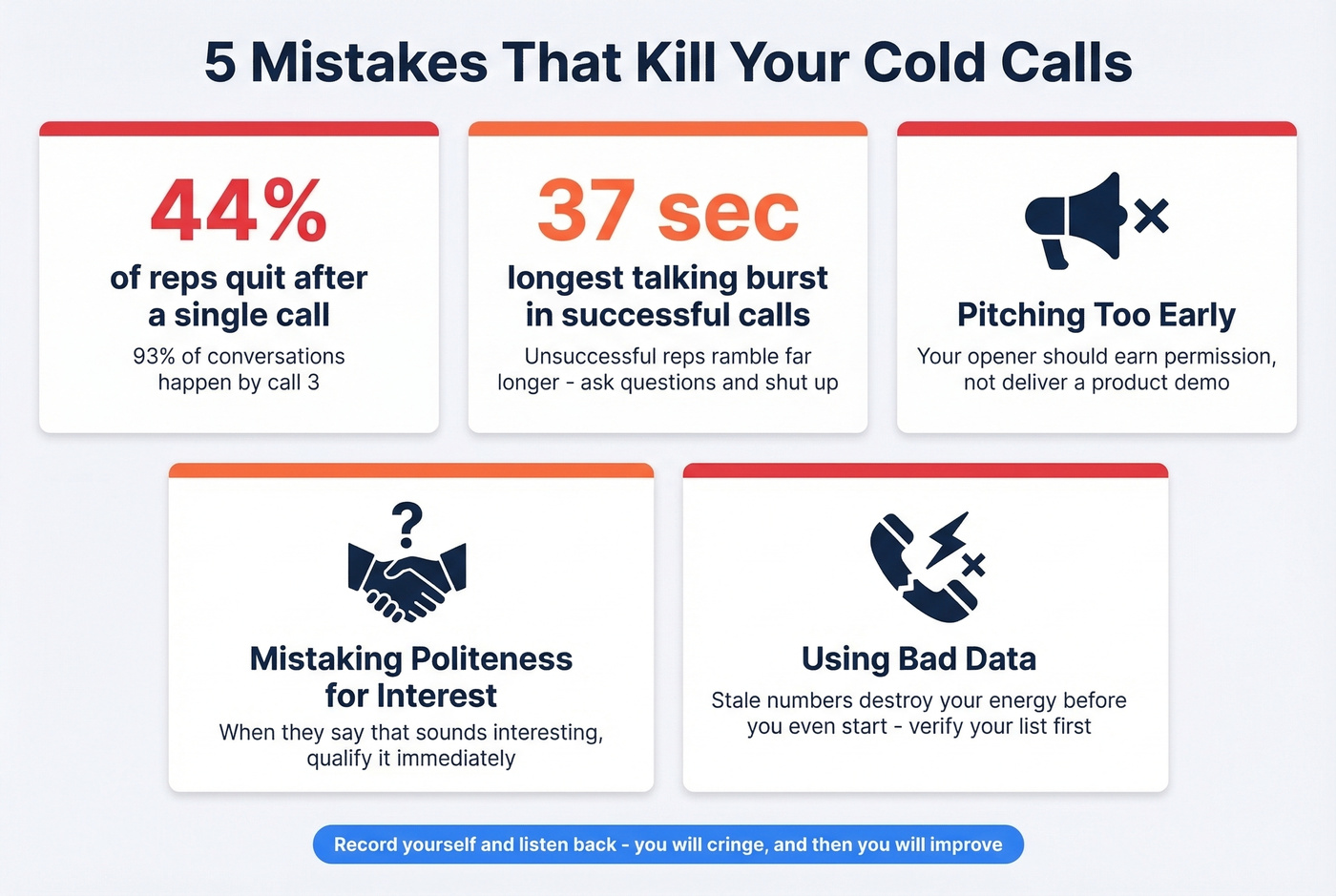
Giving up after one attempt. 44% of reps quit after a single call. Cognism's WHAM data shows 93% of total conversations happen by call three - which is why three attempts is the baseline for most cadences.
Mistaking politeness for interest. When a prospect says "that sounds interesting," qualify it: "When you say interesting, what stood out?" Politeness isn't pipeline.
Talking more than listening. The longest uninterrupted talking burst in successful cold calls is 37 seconds. In unsuccessful ones, reps ramble far longer. Ask open-ended questions and shut up.
Ignoring tone. Tone matters far more than the exact words you use on a phone call. Record yourself and listen back - you'll cringe, and then you'll improve. I'd argue that anyone trying to get better at cold calling should start with recordings before they touch their script.
Using bad data. Calling disconnected numbers, wrong departments, or people who left the company six months ago. Stale data doesn't just waste time - it destroys your energy. Skip this problem entirely by verifying your list before you start dialing. (If you're fixing this at the ops level, start with data enrichment services.)
Your Daily Cold Calling System
It's 8:47 AM on a Tuesday. You've got your coffee, your headset, a quiet spot with minimal background noise, and a list of 100 verified numbers. Here's how the next four hours should look.
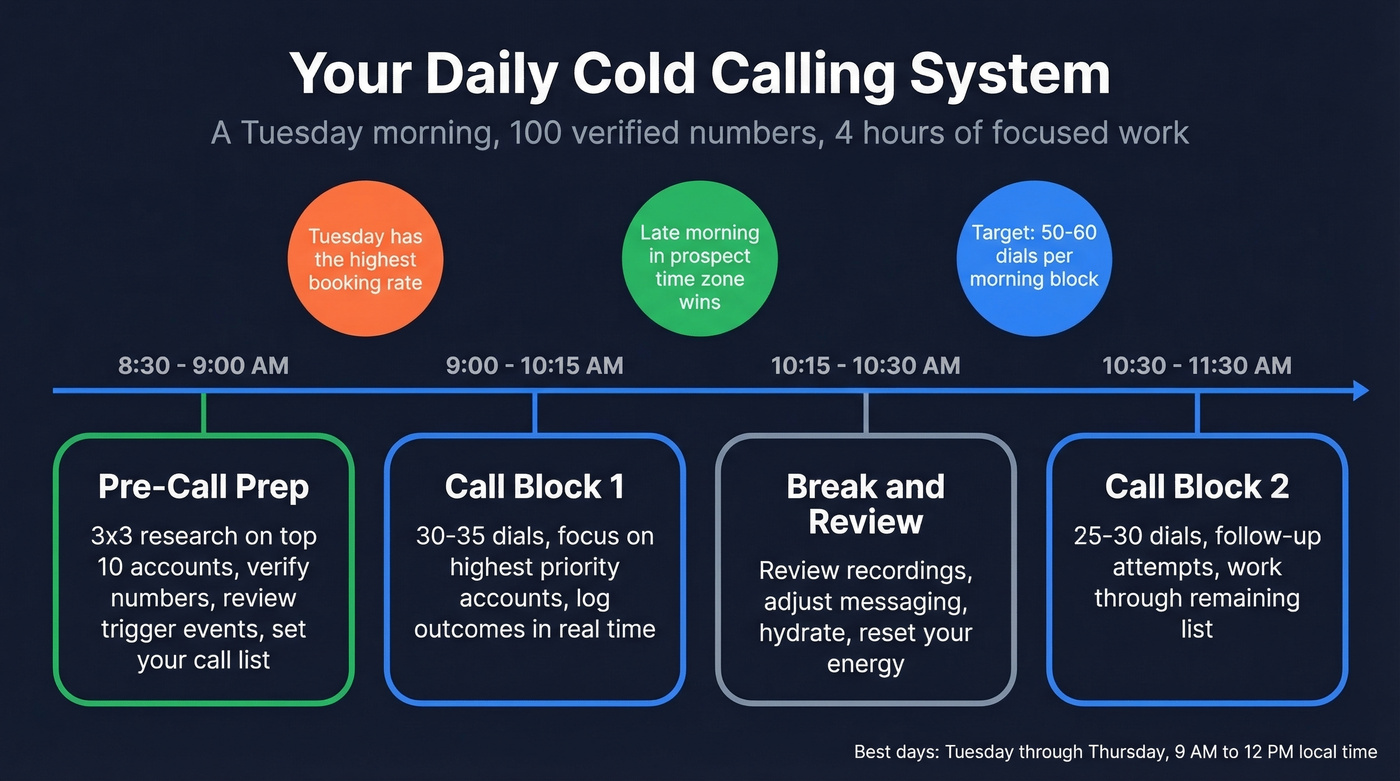
Morning block (9:00-11:30 AM). This is your prime calling window. Tuesday has the highest booking rate across the week, and late morning in the prospect's time zone consistently outperforms other slots. Run 50-60 dials in this block. No email, no Slack, no CRM cleanup. Just calls. Build three attempts per prospect into your cadence - 93% of total conversations happen by call three, so your list should include follow-up dials from previous days.
Midday reset (11:30 AM-1:00 PM). Log notes, update your CRM, eat lunch. Review your morning calls - what worked, what didn't. Score each call 1-10 on execution, not outcome. Record your calls and review 2-3 per day. You'll catch verbal tics and missed opportunities you'd never notice in real time. This self-coaching habit separates reps who plateau from reps who keep improving.
Afternoon block (2:00-4:30 PM). Another 30-40 dials. Late afternoon in the prospect's time zone is your second-best window. Energy dips are real - do a physical reset between blocks. Stand up, walk around, do some breathing. Emotional regulation between calls isn't soft. It's the difference between sounding confident on dial 80 and sounding defeated.
The consensus on r/sales is that 200+ daily dials with a parallel dialer is the gold standard. But here's the thing: if your deal sizes are under $10K, you probably don't need 200 dials a day. You need 60-80 dials to verified numbers with real research behind each one. Volume worship is how SDR teams burn out and churn. For most teams, 80-100 focused dials per day is the right benchmark. Raw volume without data quality is just noise. (If you're building the broader motion, map this into your sales activities.)
Don't Get Flagged as Spam
Carriers are getting aggressive about flagging cold callers. Here's how to stay clean:
Rotate your numbers. Don't blast 200 calls from a single number in one day. Spread volume across 3-5 numbers.
Keep a steady pace. Sudden spikes from new numbers trigger carrier algorithms. Ramp gradually.
Aim for longer conversations. High volume plus lots of ultra-short calls (under 10 seconds) is a common spam-flag pattern.
Use branded caller ID. Services that display your company name instead of an unknown number improve answer rates and reduce spam reports.
Monitor your spam score. Check your numbers weekly. If one gets flagged, retire it and rotate in a fresh one.
Stay compliant. Scrub against the National Do Not Call registry, respect state-level lists, and know the basics of TCPA, GDPR, and CCPA. (If you're adding channels, read up on cold texting compliance and risk.)
Tools That Remove Friction
The right tools don't make you a better caller - they remove the friction that makes good callers underperform.
| Tool | What It Does | Starting Price | Best For |
|---|---|---|---|
| Prospeo | Verified mobiles + emails | Free tier; ~$0.01/email | Data accuracy |
| HubSpot CRM | Call logging + pipeline | Free; paid from ~$20/user/mo | CRM + tracking |
| Orum | Parallel dialer | ~$1,000-2,500/mo | High-volume dialing |
| Apollo | Contact data + sequences | Free tier; ~$49/mo paid | All-in-one prospecting |
The data layer determines whether your 100 dials produce 5 conversations or 20. When Meritt switched to Prospeo, their connect rate 3x'd to 20-25% and pipeline jumped from $100K to $300K per week. That's the kind of difference verified, weekly-refreshed data makes - you're calling numbers that were checked this week, not last quarter.
HubSpot CRM handles call logging and pipeline tracking. The free tier is genuinely useful for small teams; paid tiers add more automation and reporting. Orum is the go-to parallel dialer for teams running 200+ dials daily - it's expensive, but the time savings are real. Apollo works as an all-in-one if you want contact data and email sequences in one platform, though all-in-one tools typically lag dedicated mobile verification on pickup rates. (If you're evaluating your stack, start with a shortlist of SDR tools.)
After the call: When you book a meeting, send a calendar invite within 60 seconds while you're still top of mind. Include a one-line summary of what you discussed and what the next conversation will cover. This small step cuts no-show rates dramatically. (If you need copy, keep a set of sales follow-up templates ready.)
The article says it clearly: research-backed calls lift conversions by 82%. Prospeo gives you 30+ filters - buyer intent, job changes, funding rounds, tech stack - so your 3x3 research takes seconds, not minutes. Layer that with 98% accurate emails and direct dials at $0.01 per lead, and your entire pre-call workflow collapses from hours to minutes.
Do your 3x3 research in 30 seconds instead of 3 minutes.
FAQ
Is cold calling dead in 2026?
No. 49% of sales organizations use cold calling as a primary or secondary channel. What's dead is unresearched, spray-and-pray dialing. Teams with clean data, strong openers, and structured systems are booking more meetings than ever.
How many cold calls should I make per day?
80-100 focused dials is the standard benchmark for most SDRs. High-volume teams using parallel dialers hit 200+. Quality of data matters more than raw volume - 80 calls to verified numbers outperform 200 calls to a stale list every time.
What's a good cold call success rate?
Industry average runs 2-5% for conversation-to-meeting conversion. Top performers with strong scripts and clean data consistently hit 5-8%+. The 2024 WHAM benchmark was 4.82%, with 2025 running at roughly half that.
What's the best day and time to cold call?
Tuesday has the highest booking rate per Cognism's data. Late morning and late afternoon in the prospect's time zone perform best. Avoid Monday mornings and Friday afternoons.
How do I improve my connect rate fast?
Switch to verified mobile numbers instead of office lines. Pair that with number rotation across 3-5 lines and branded caller ID, and most teams see connect rates jump from 5% to 15-25% within the first week.