

SDR Lead Generation: Benchmarks, Cadences, and the Playbook Nobody Else Publishes
Your reps are sending 200+ emails a day, working 600-700 accounts a month, and still missing quota. That's not a people problem - it's an SDR lead generation system problem. One team documented this exact pattern before overhauling their outbound motion and ending the year at 118% of their closed-won goal. The fix wasn't more activity. It was better targeting, cleaner data, and a cadence that actually matched how buyers respond.
Below: benchmarks from 16.5M cold emails and 204K+ cold calls, a day-by-day cadence you can hand to reps tomorrow, and the economics behind hiring humans vs. deploying AI.
The Three Answers You Came For
How many meetings should your SDRs book? Outbound: 12-15 qualified meetings per month is average. Good teams hit 18-20. Top performers push 25+. Inbound SDRs typically book 20-25 because the lead already raised a hand.
What does a working cadence look like? A 12-step, 28-32 day multi-channel sequence mixing email, phone, and social touches. Full breakdown in the playbook section.
What's the single highest-ROI fix? Data quality. If your bounce rate is above 4%, stop tweaking subject lines and fix your contact data first - a tool like Prospeo with 98% email accuracy prevents the bounce problem at the source.
What SDR Lead Generation Means in 2026
An SDR's job is to identify, qualify, and engage prospects at the top of the funnel - bridging marketing's lead lists and the AE's pipeline. They don't close deals. They open doors.
There are two flavors. Inbound SDRs work leads that marketing generated: demo requests, content downloads, webinar attendees. Outbound SDRs build their own lists and initiate contact with cold prospects through email, phone, and social channels. Most teams run both motions, but the skill sets and benchmarks differ significantly. Understanding how to prospect across both inbound and outbound channels is what separates quota-crushers from quota-missers.
The typical org runs an SDR:AE ratio of about 2.6 AEs per SDR. Enterprise teams with $100K+ deals run 1:1, while high-velocity teams selling sub-$15K deals have one SDR feeding four or five AEs. The handoff between SDR and AE is where most pipeline leaks happen.
SDR Benchmarks That Matter
These numbers come from analysis of 16.5M cold emails and 204K+ cold calls, cross-referenced with data from TOPO, Bridge Group, Tenbound, and Operatix.
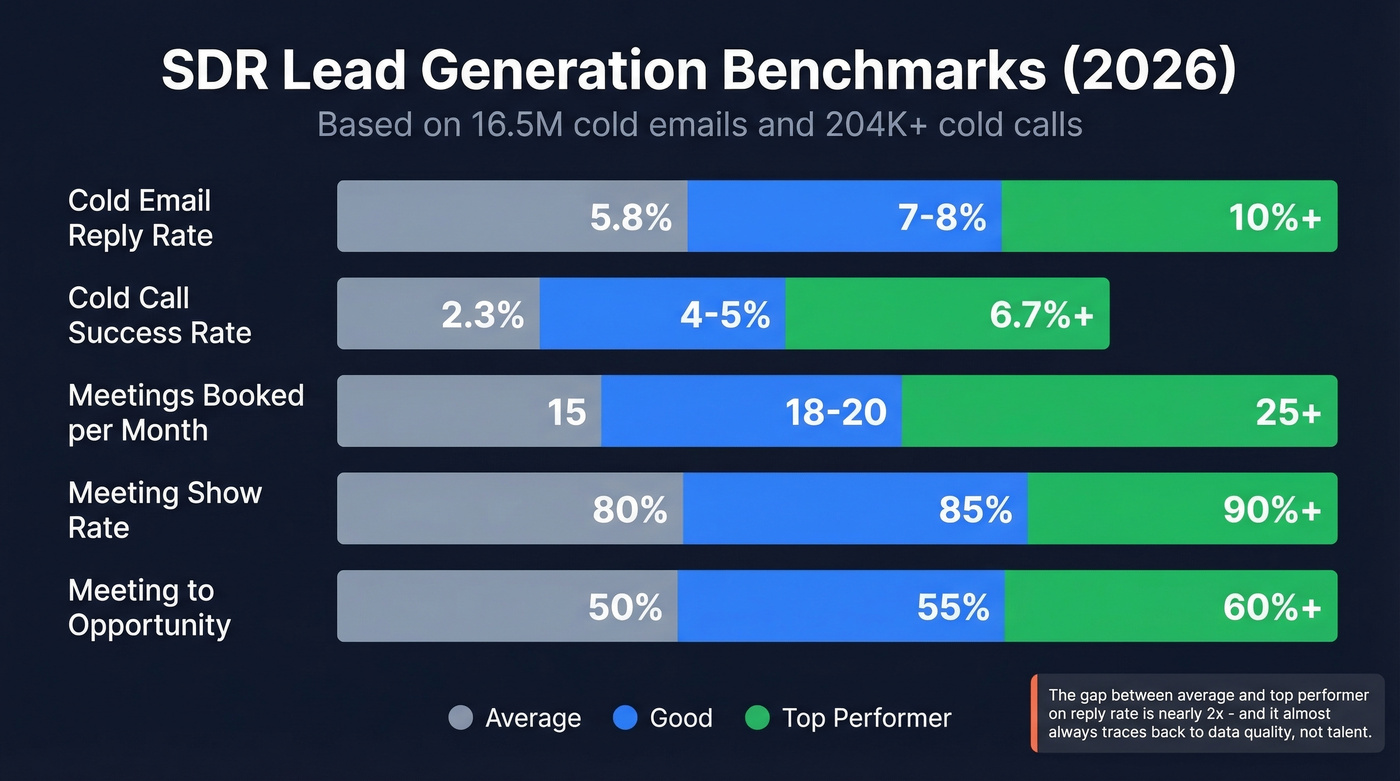
| Metric | Average | Good | Top Performer |
|---|---|---|---|
| Cold email reply rate | 5.8% | 7-8% | 10%+ |
| Cold call success rate | 2.3% | 4-5% | 6.7%+ |
| Meetings booked/month | 15 | 18-20 | 25+ |
| Meeting show rate | 80% | 85% | 90%+ |
| Meeting to opportunity | ~50% | ~55% | 60%+ |
A few things jump out. The gap between average and top performer on reply rate is nearly 2x. In our analysis of outbound teams, that gap almost always traces back to data quality and process, not talent. Show rates matter more than meetings booked, too - an SDR booking 20 meetings at a 70% show rate produces 14 held meetings, while an SDR booking 15 at 90% produces 13.5, nearly identical pipeline from fewer bookings.
The broader funnel numbers are sobering. Only 56-60% of SDRs hit quota in a given quarter. Of the opportunities SDRs source, about 22% close-won. That means roughly half your team is underperforming, and only a fifth of the pipeline they generate converts to revenue. These aren't reasons to kill outbound - they're reasons to optimize every step.
Here's the thing: most teams obsess over reply rates when the real leverage is downstream. A 1% improvement in show rate or meeting-to-opportunity conversion compounds far more than squeezing another half-point out of cold email opens.
The Outbound Playbook
Fix Deliverability First
Nothing else in this playbook matters if your emails land in spam. The non-negotiable checklist:
- SPF, DKIM, and DMARC configured and passing on every sending domain
- Spam complaints under 0.3% - Google and Yahoo enforce this under their current bulk sender rules, and Microsoft has similar requirements
- Bounce rate under 2% - this is where data quality becomes a deliverability issue, not just a sales issue
- One-click unsubscribe via RFC 8058 List-Unsubscribe headers in every outbound email
- Warmup protocol: start new domains at 5-10 emails per day and ramp over 4-6 weeks
- Seed test inbox placement of 80%+ before going live with production sends
Deliverability starts with clean data. Meritt learned this the hard way - their bounce rate was 35% before switching to Prospeo's 5-step email verification. Bounces dropped under 4% and pipeline tripled from $100K to $300K per week. That's a 98% accuracy rate doing the heavy lifting before a single word of copy gets written.
The 12-Step Multi-Channel Cadence
Twelve touches, 28-32 days, three channels. Warmed accounts - those who've opened, clicked, or engaged on social - convert 2-3x better, so prioritize them in your dialing blocks.
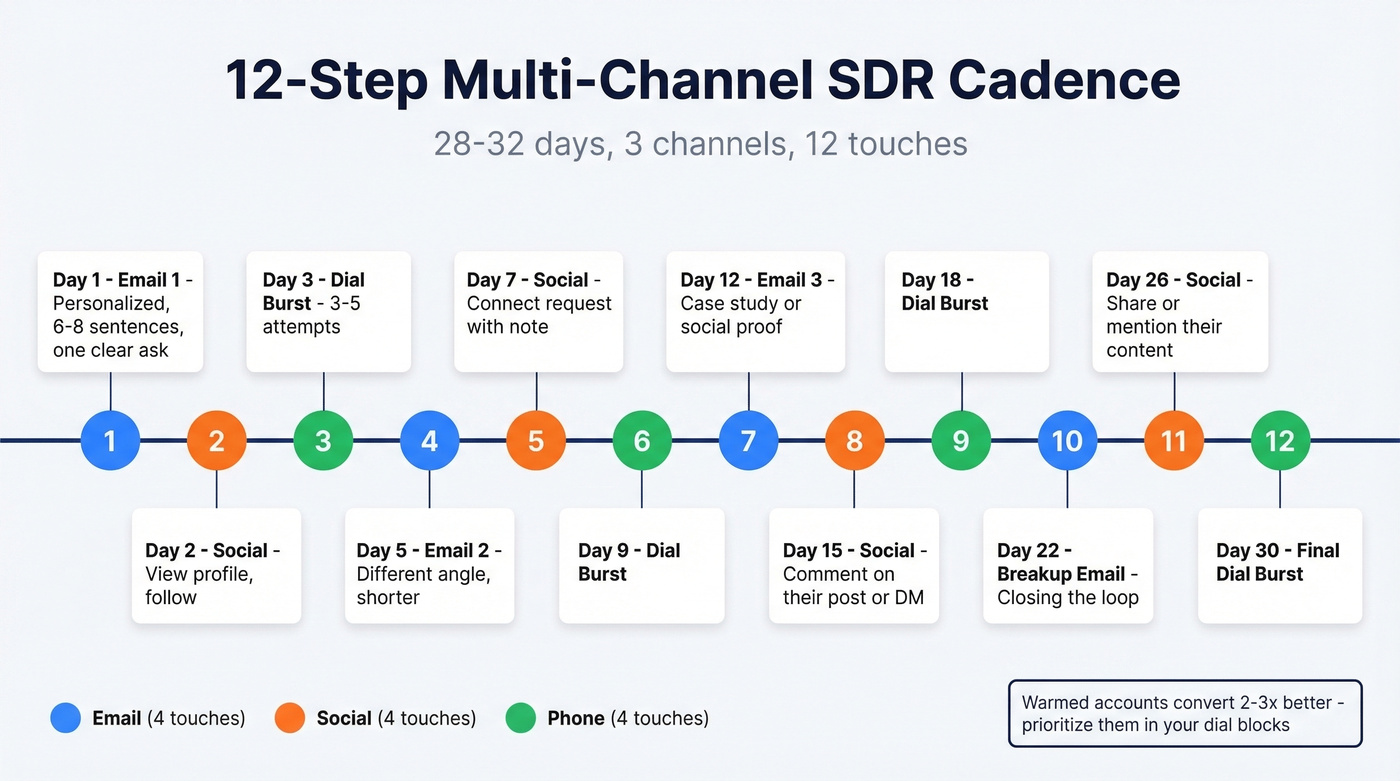
- Day 1 - Email #1: personalized, 6-8 sentences, one clear ask
- Day 2 - Social: view profile, follow
- Day 3 - Dial burst, 3-5 attempts
- Day 5 - Email #2: different angle, shorter
- Day 7 - Social: connect request with note
- Day 9 - Dial burst
- Day 12 - Email #3: case study or social proof
- Day 15 - Social: comment on their post or send a DM
- Day 18 - Dial burst
- Day 22 - Breakup email, "closing the loop"
- Day 26 - Social: share or mention their content
- Day 30 - Final dial burst
The research is clear: 8-12 touches across channels is the standard for productive outbound. Single-channel sequences underperform. And don't skip the phone - Chili Piper's pivot from email-heavy to a hybrid calling approach was a key driver of their 118% closed-won result.
Cold Email: What the Data Says
Emails in the 6-8 sentence range hit a 6.9% reply rate - shorter loses context, longer loses attention. The core message should land in 25-100 words, with the 6-8 sentence count including greeting and sign-off.
Thursday sends outperform every other day at 6.87% reply rate versus Monday's 5.29%. The 8-11 PM send window pulls 6.52%, likely because you're sitting at the top of the inbox when prospects check email before bed or first thing in the morning.
Two counterintuitive findings. Turning off open-tracking pixels lifts response rates by about 3% because tracking pixels trigger spam filters. And contacting 1-2 people per company yields a 7.8% reply rate versus 3.8% when you blast 10+ contacts at the same org. Less really is more.
If you want a deeper breakdown of timing, see our best time to send cold emails data (no guesswork): 8-11 PM send window.
The Daily SDR Rhythm
This is what a productive day looks like - hand this to new reps on day one.
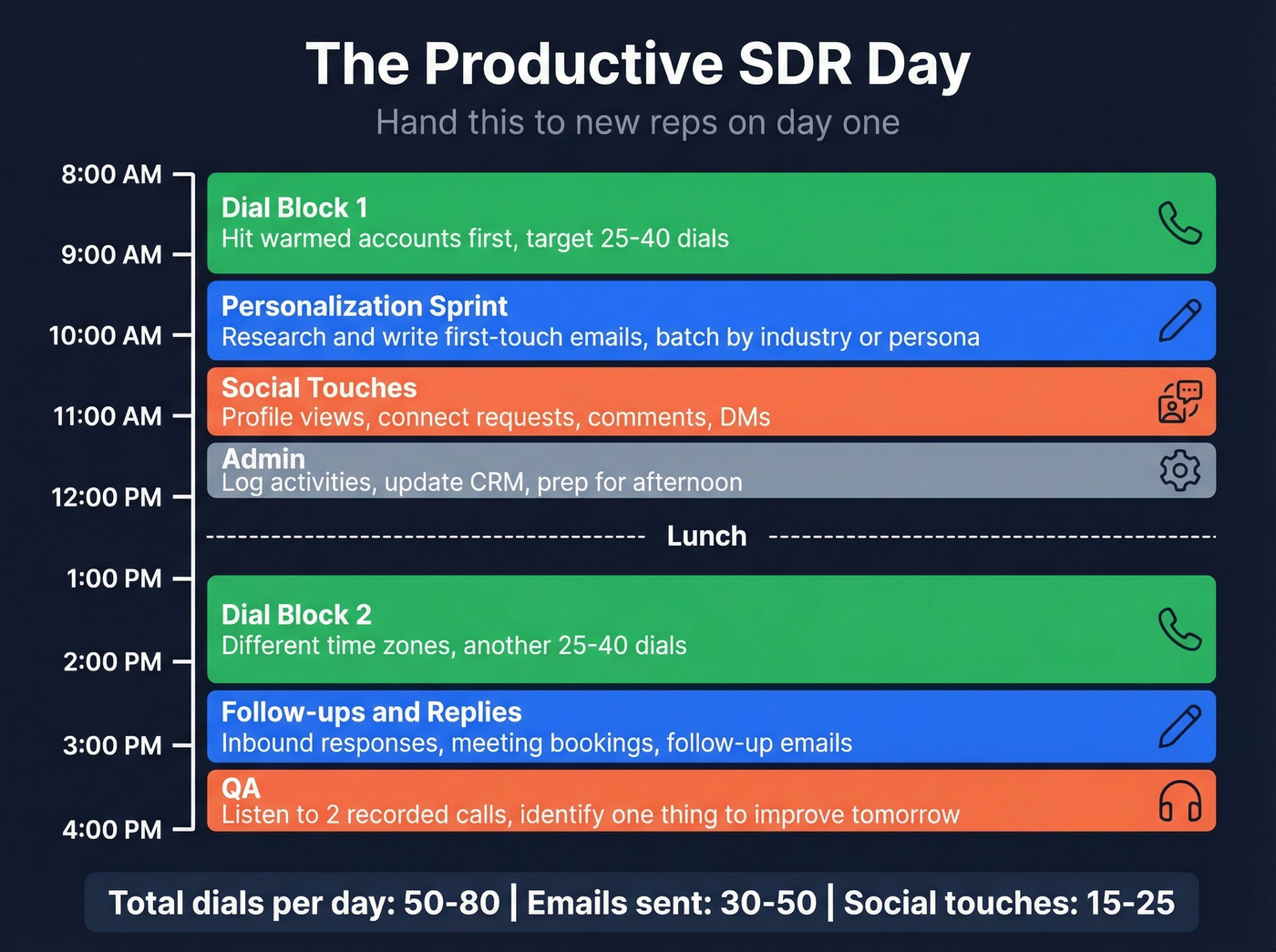
Morning starts with a 90-minute dial block from 8:00 to 9:30 AM, hitting warmed accounts first and targeting 25-40 dials. From 9:30 to 10:30, reps shift to a personalization sprint - researching and writing first-touch emails for new accounts, batched by industry or persona for speed. The next hour goes to social touches: profile views, connect requests, comments, DMs, following the cadence steps for each account. Close out the morning with 30 minutes of admin - logging activities, updating CRM, prepping for the afternoon.
After lunch, a second 90-minute dial block from 1:00 to 2:30 PM covers different time zones with another 25-40 dials. From 2:30 to 3:30, handle follow-ups and replies - inbound responses, meeting bookings, follow-up emails. End the day with 30 minutes of QA: listen to two recorded calls, yours or a teammate's, and identify one thing to improve tomorrow.
If your team needs a tighter calling motion, build a repeatable cold calling system and train reps on cold call rejection patterns before they hit the floor.
The AE Handoff Template
Bad handoffs tank show rates and waste the pipeline your reps fought to create. Every meeting booked should pass this to the AE:
- ICP fit and triggers: why this account, why now
- Pains identified: what the prospect said or implied
- Current stack: what tools they're using today
- Decision group: who else is involved - titles, roles, reporting structure
- Timeline: any urgency signals or stated deadlines
- Goal for next call: what the AE should accomplish in the first meeting
Put this in the calendar invite description. Not in a Slack message. Not in a CRM note the AE won't read. In the calendar invite itself, where it's impossible to miss.
If you want copy you can paste into your workflow, use these handoff email templates.

Meritt's SDRs cut bounce rates from 35% to under 4% and tripled pipeline to $300K/week - same team, same cadence, better data. Prospeo's 5-step verification delivers 98% email accuracy so every touch in your 12-step cadence reaches a real inbox.
Stop optimizing subject lines on emails that never arrive.
SDR Economics: Costs, Attrition, and Speed-to-Lead
A fully loaded human SDR in the US costs $100K-$150K per year - base salary, commissions, benefits, tools, management overhead. Hiring a new rep runs $4K-$10K in recruiting and onboarding. Ramp time is 3-4 months before full productivity.
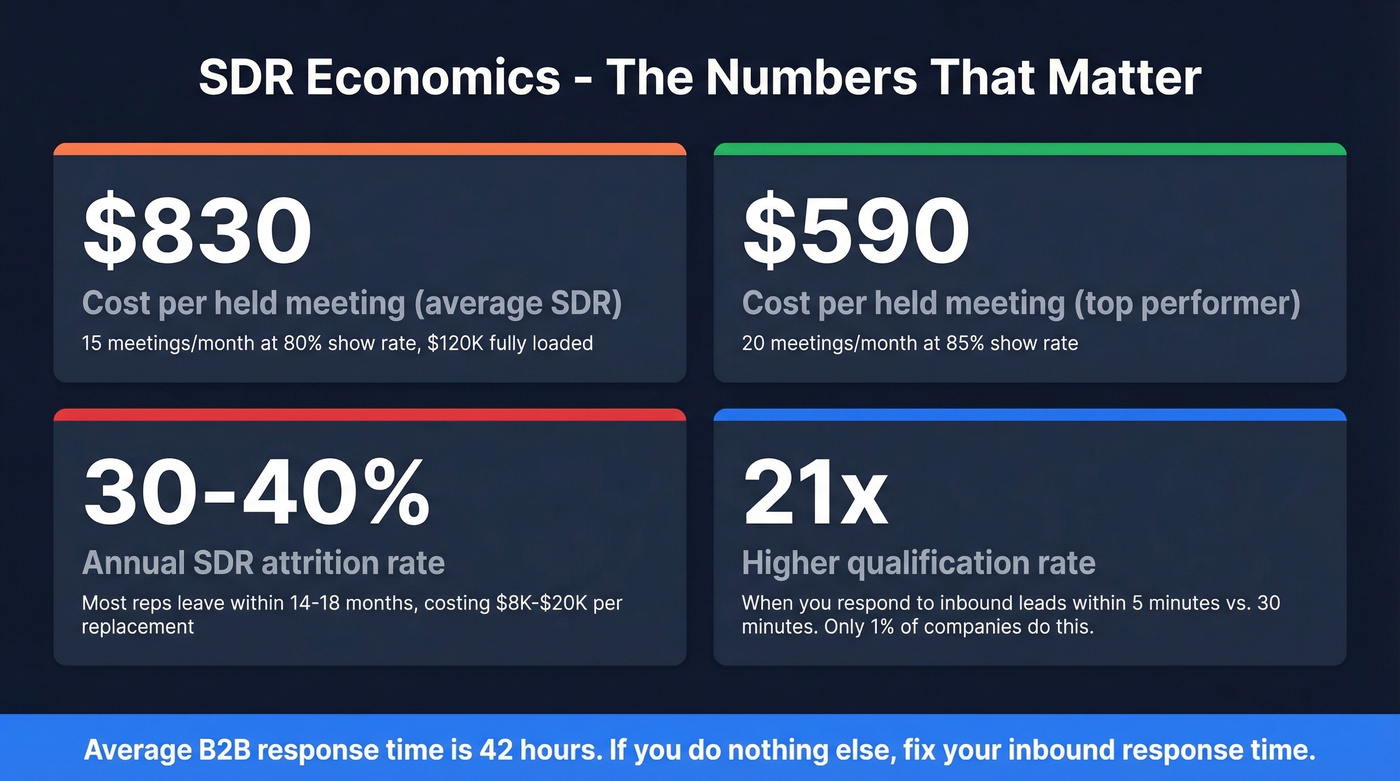
The painful part: SDR attrition averages 30-40% per year. Most reps leave within 14-18 months. For a 5-person team, you're replacing 1-2 reps every year - burning $8K-$20K in hiring costs plus 3-4 months of reduced productivity each time. This is why documented processes, clean data, and proven cadences matter more than any individual hire. Reps leave. Systems stay.
What does this mean per meeting? If an SDR books 15 meetings per month at an 80% show rate, that's 12 held meetings. At $120K fully loaded annual cost, each held meeting runs roughly $830. A top performer booking 20 at 85% show rate brings that down to about $590.
Speed-to-lead changes everything. Responding to an inbound lead within 5 minutes yields a 21x higher qualification rate than waiting 30 minutes. Only 1% of companies respond within 5 minutes. The average B2B response time is 42 hours. If you do nothing else after reading this article, fix your inbound response time.
To pressure-test your funnel math, benchmark against the average B2B lead conversion rate and track the right funnel metrics.
AI SDRs vs. Human SDRs
We've watched this space closely, and the hype outpaces the reality - but the reality is compelling in the right use cases.
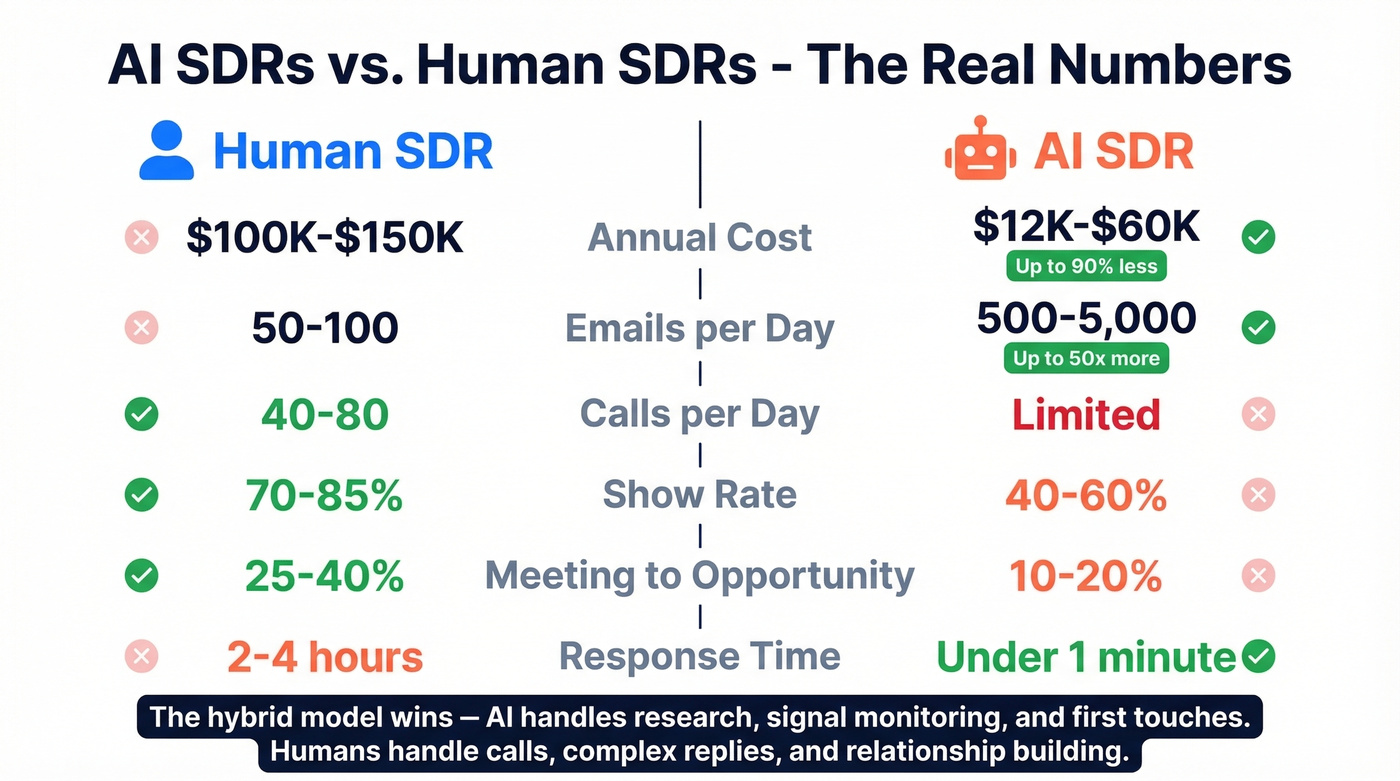
| Dimension | Human SDR | AI SDR |
|---|---|---|
| Annual cost | $100K-$150K | $12K-$60K |
| Emails/day | 50-100 | 500-5,000 |
| Calls/day | 40-80 | Limited |
| Show rate | 70-85% | 40-60% |
| Meeting to opp | 25-40% | 10-20% |
| Response time | 2-4 hours | Under 1 minute |
Look, AI SDRs are overhyped for closing but underhyped for research and enrichment. The volume advantage is real - an AI tool can personalize and send 1,000 emails a day while monitoring intent signals across your entire TAM. But a 40-60% show rate versus 70-85% means you need to book significantly more meetings to produce the same pipeline.
The hybrid model wins. AI handles research aggregation, signal monitoring, personalization at scale, and follow-up consistency. Humans handle calls, complex replies, relationship building, and multi-threading into buying committees. One pattern we see repeatedly: teams that use AI for the first 2-3 touches and then route engaged prospects to human reps get the volume of AI with the conversion rates of humans. Automated prospecting delivers the most value not by replacing reps, but by multiplying their reach.
If your entire outbound motion is email-only, an AI SDR tool at $1K-$5K per month genuinely replaces a headcount. But if phone is a meaningful channel for your buyers - and for most B2B segments it is - you still need humans on the line. AI can't handle the "wait, let me pull in my VP" moment on a cold call.
For more on what actually works (and what gets you flagged), see our AI cold email outreach playbook.
The SDR Tech Stack
The average SDR team uses 12-15 tools daily. Total stack cost typically runs $2,000-$5,000 per SDR per month across best-of-breed categories. Here's what each category costs:
| Category | Cost Range | Example |
|---|---|---|
| CRM | $25-$300/user/mo | HubSpot (free plan available) |
| Prospecting & Data | $50-$500/user/mo | Prospeo (~$0.01/email) |
| Sales Engagement | $25-$150/user/mo | Instantly ($30-$78/mo) |
| Dialer | $50-$350/user/mo | Orum |
| Enrichment | $30-$200/user/mo | Clearbit |
| Scheduling | $10-$30/user/mo | Chili Piper / Calendly |
| Intent / Signals | $500-$5,000/mo | Bombora / 6sense |
| Conversation Intel | $100-$200/user/mo | Gong / Chorus |
For reference, Apollo runs free to $49/user/month, Outreach starts around $100/user/month, and Salesforce CRM begins at $25/user/month.
You don't need all eight categories on day one. The lean stack that gets 80% of the result at 20% of the cost: Prospeo + Instantly (or Apollo) + HubSpot CRM (free) + a basic dialer = $200-$500 per SDR per month. That covers verified contact data, email sequencing, CRM, and phone - a fraction of the $2K-$5K best-of-breed stack. For sales managers building their first team, this configuration lets you prove the motion before scaling spend.
If you're evaluating options, start with a ranked list of SDR tools and compare outbound lead generation tools by use case.

Bad data is what quietly destroys SDR productivity: disconnected numbers, contacts who left months ago, bounced emails that tank deliverability. If your data provider refreshes contacts every 6 weeks, you're guaranteed to waste time on stale records. GreyScout, a sales consultancy that doubled their team from 2 to 5 reps, saw bounce rates drop from 38% to under 4% and rep ramp time cut from 8-10 weeks to 4 after switching to a provider with a 7-day refresh cycle.
If you're fixing list quality at the source, use data enrichment services and a proper email deliverability guide to keep domains healthy.
Your SDRs are running 600+ accounts a month across email, phone, and social. Prospeo gives them 300M+ profiles with 30+ filters - buyer intent, job changes, headcount growth - so they spend dial blocks calling real decision-makers, not dead numbers.
Build SDR lists in minutes that actually connect to buyers.
Common SDR Mistakes
The volume-over-quality trap. Sending 200+ emails per day across 600-700 accounts without proportional pipeline isn't hustle - it's waste. More volume with bad targeting just burns your domain reputation faster. If you're selling deals under $15K, you probably don't need 600 accounts in play at once. Tighten the list, increase personalization, and watch reply rates climb.
Ignoring deliverability. No SPF/DKIM/DMARC, no warmup protocol, 35%+ bounce rates. Your emails are going to spam and you don't even know it. Fix authentication and data quality before you write another subject line.
No handoff process. The SDR books the meeting, the AE walks in blind, the prospect repeats everything they already said, and the show rate craters. Use the handoff template above. Put it in the calendar invite.
Bad data destroying productivity. SDRs waste hours researching contacts who left the company months ago, dialing disconnected numbers, and sending emails that bounce. This is the most expensive problem on this list because it's invisible - it looks like activity. The consensus on r/sales is that bad data is the #1 silent killer of outbound teams, and we'd agree.
Measuring activity instead of outcomes. Track held meetings and pipeline generated, not emails sent or dials made. An SDR who sends 50 emails and books 4 meetings is outperforming the one who sends 200 and books 2. Pipeline dollars, not dials logged, should be the scoreboard.
If you need a better scoreboard, start with lead generation metrics and map the operational fixes in a lead generation workflow.
Tips for Self-Sourcing Pipeline
Even in orgs with dedicated marketing support, the best reps supplement their lists by self-generating opportunities.
Mine closed-lost deals. Accounts that evaluated your product 6-12 months ago and chose a competitor are prime re-engagement targets - circumstances change, contracts expire, champions switch companies. We've seen teams pull 15-20% of their quarterly pipeline from this single tactic.
Track job changes. When a champion from a closed-won account moves to a new company, that's a warm intro into a cold account. Set up alerts so you catch these within the first week of the move, before three other vendors do.
Work the second-degree network. After every closed-won deal, ask the champion: "Who else in your network faces this same problem?" Referral leads convert at 3-5x the rate of cold outbound.
Monitor intent signals. Use Bombora, 6sense, or even Google Alerts to identify accounts actively researching your category. Reaching out when a prospect is already in-market dramatically shortens the sales cycle. Skip this if your ACV is under $10K - the signal-to-noise ratio on intent data usually isn't worth the cost at that deal size.
These tactics turn individual reps into pipeline engines and reduce dependence on marketing-sourced leads.
FAQ
How many meetings should an SDR book per month?
Outbound SDRs should book 12-15 qualified meetings per month as a baseline, with good performers hitting 18-20 and top performers reaching 25+. Inbound SDRs typically book 20-25. Benchmark against held meetings, not just bookings, and adjust targets for deal size and sales cycle length.
What's a good cold email reply rate?
The average across 16.5M analyzed emails is 5.8%. Good performers hit 7-8%, and top performers exceed 10%. If you're below 5%, fix targeting and data quality before optimizing copy - most low reply rates are a list problem, not a messaging problem.
Should I hire SDRs or use AI tools?
Use AI for research, enrichment, signal monitoring, and follow-up at $12K-$60K per year. Use humans for calls, complex conversations, and relationship building at $100K-$150K fully loaded. AI show rates of 40-60% lag human rates of 70-85%, so the hybrid model - AI for initial touches, humans for engaged prospects - produces the best pipeline.
What's the most important tool in an SDR tech stack?
Your data provider. Every other tool - sequencer, dialer, CRM - depends on accurate contact information to function. Get this layer right and everything downstream improves.
Is outbound SDR lead generation dead in 2026?
Lazy outbound is dead - spray-and-pray blasts with bad data and generic templates. Disciplined multi-channel prospecting works. Chili Piper hit 118% of their closed-won goal by pivoting to hybrid calling and fixing account distribution. The channel isn't broken; the execution usually is.