

Personalization in Lead Generation Starts With Data, Not Messaging
Your SDR spends 20 minutes researching a prospect, crafts a hyper-personalized opening line referencing their latest podcast appearance, hits send - and the email bounces. That's not a messaging problem. It's a data problem.
Personalization in lead generation only works when the foundation - verified contacts, tight targeting, accurate timing - is solid. With the average B2B cost per lead sitting at $84 and the lead generation software market projected to reach $16.2B by 2034, every wasted touch hurts more than it used to.
What Actually Moves the Needle
Cold email reply rates dropped roughly 15% year-over-year - from 6.8% to 5.8%. Personalizing harder isn't the fix. Three things are:
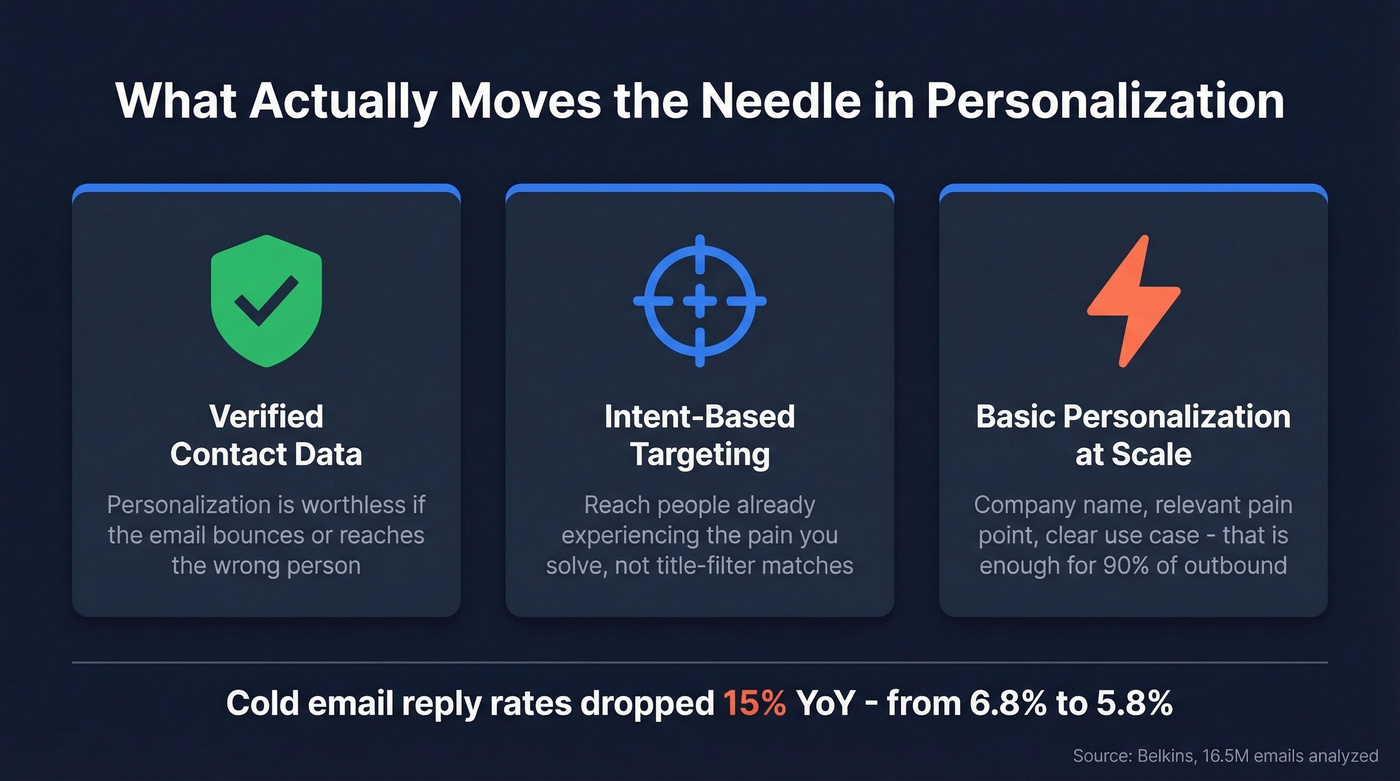
- Verified contact data. Personalization is worthless if the email bounces or reaches the wrong person.
- Intent-based targeting. Reach people already experiencing the pain you solve, not just people who match a title filter.
- Basic personalization at scale. Company name, relevant pain point, clear use case. That's enough for 90% of outbound.
Personalization matters across landing pages, forms, and retargeting too. But email and outbound is where most teams get the data fundamentals catastrophically wrong, so that's where we'll spend our time.
Standard vs. Hyper-Personalization
Most teams don't need hyper-personalization. They need accurate personalization delivered to the right person at the right time.
| Dimension | Standard | Hyper |
|---|---|---|
| Data used | Name, company, title | Real-time behavior, technographics, intent signals |
| Tech required | CRM + email tool | AI/ML + data platform + orchestration |
| Time per lead | Seconds | Minutes to hours |
| Best for | Most outbound teams | Enterprise ABM |
| ROI reality | High - scales easily | High ceiling, but only with clean data + tooling |
When Lifesize partnered with Adobe to segment 300,000 leads into just 7 categories using standard personalization, they saw +57% open rates, +82% response rates, and +31% YoY revenue. That wasn't hyper-personalization. It was smart segmentation with clean data.
The consensus on r/LeadGeneration mirrors this: basic personalization plus better lead sourcing beats spending hours per prospect. Save the deep research for your top 50 accounts, not your top 5,000.
What 16.5M Cold Emails Reveal
Belkins analyzed 16.5 million cold emails across 93 business domains. Here's what the data says for 2026 outbound teams:
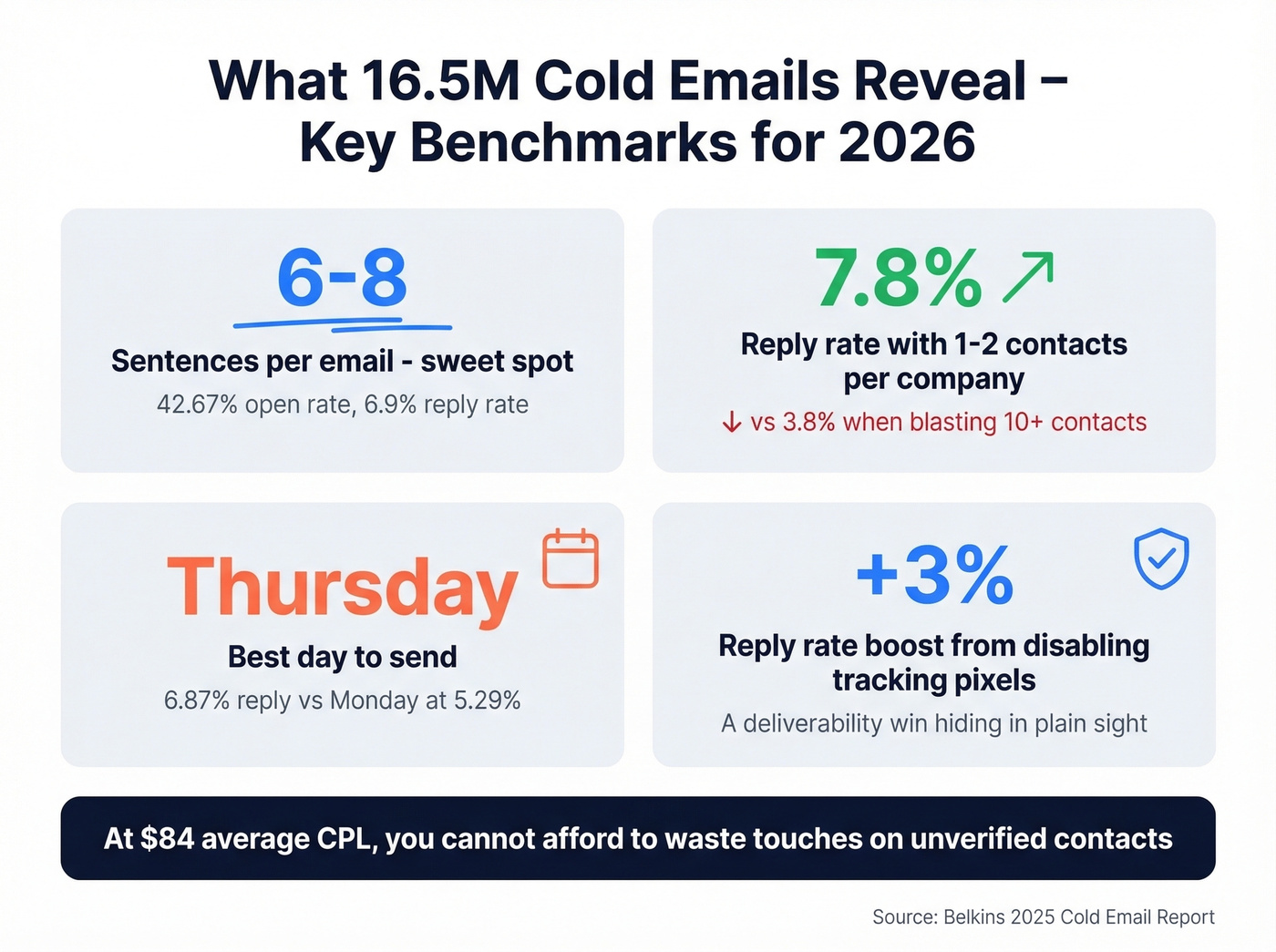
- Sweet spot length: 6-8 sentences produced a 42.67% open rate and 6.9% reply rate
- Narrow targeting wins: emailing 1-2 contacts per company hit a 7.8% reply rate; blasting 10+ contacts dropped it to 3.8%
- Best day to send: Thursday (6.87% reply) vs. Monday (5.29%)
- A single well-targeted email hit 8.4% reply rate, but by follow-up #4, response rates had fallen 55% versus earlier messages
One detail that surprised us: disabling open-rate tracking pixels lifted response rates by 3%. That's a deliverability win hiding in plain sight.
At $84 average CPL - and $110+ on LinkedIn - you can't afford to waste touches on unverified contacts. The math only works when your data is clean and your targeting is tight.

This article makes one thing clear: personalization without verified data is wasted effort. Prospeo's 98% email accuracy and 7-day data refresh mean your carefully personalized outreach actually reaches real inboxes - not bounce logs. Layer in intent data across 15,000 topics to nail the timing too.
Stop personalizing emails that bounce. Verify first, personalize second.
The Playbook
The biggest gains come from deciding who to contact and when, not from crafting bespoke prose for every prospect.
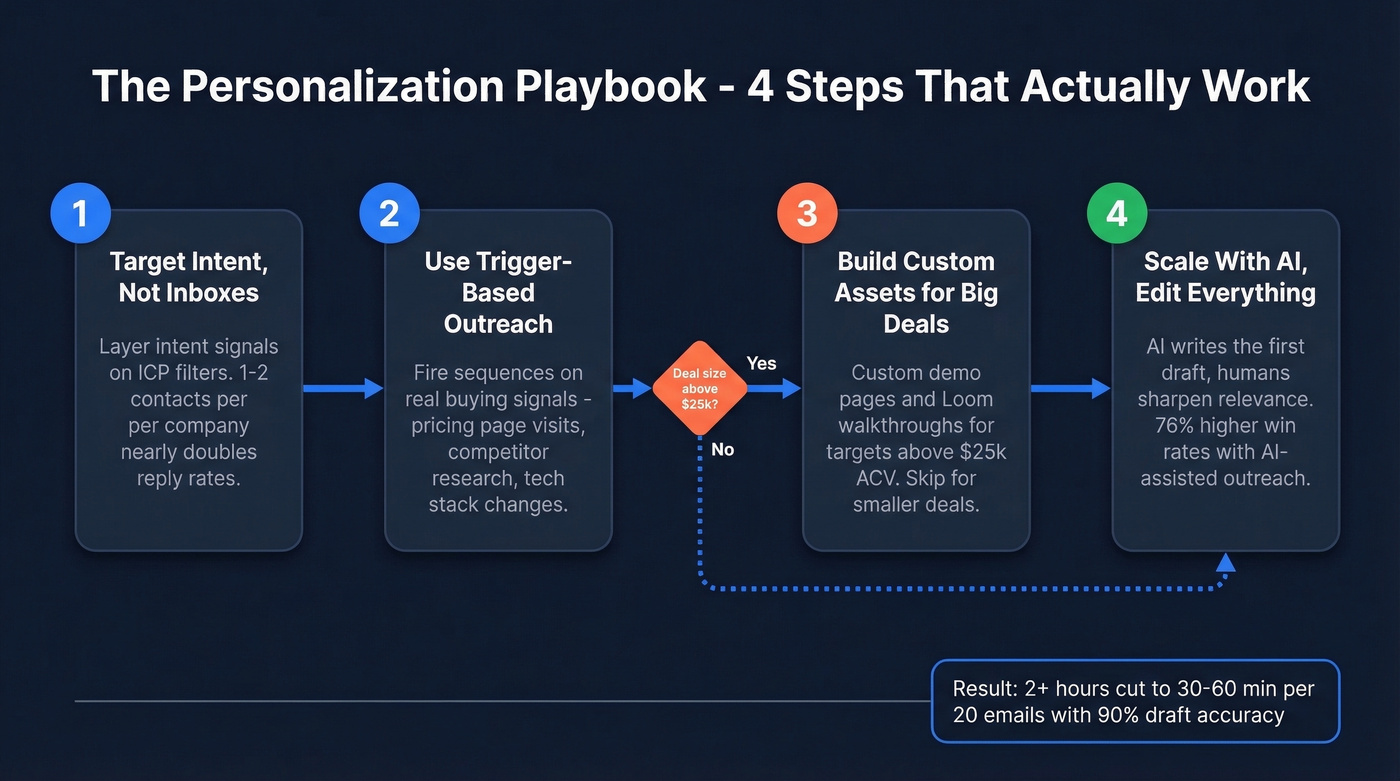
Target Intent, Not Inboxes
Emailing someone actively researching your category converts at multiples of cold outreach to a static list. Layer intent signals - content consumption, tech stack changes, hiring patterns - on top of ICP filters. Remember: narrow targeting (1-2 contacts per company) nearly doubles reply rates versus blasting entire org charts.
Trigger-Based Outreach for SaaS Teams
Here's the thing about trigger-based marketing: it's where timing and personalization intersect. When a prospect downloads a competitor comparison page, hits your pricing page twice in a week, or adds a new tool to their stack, those events should fire a personalized sequence - not sit in a dashboard gathering dust. Mapping outreach to real-time buying signals consistently outperforms calendar-based cadences because you're reaching people during an active evaluation window, not interrupting them during a random Tuesday.
Asset-Based Personalization for High-Value Targets
For enterprise deals, go beyond merge fields. Build a custom demo page tailored to the prospect's use case, or record a 90-second Loom walkthrough referencing their specific pain point. A WhatsApp sequencing tactic that works well: send a text, then a profile link, then a screenshot of the custom demo last, since the final message is the most visible in the notification stack.
Skip this approach for deals under $25k ACV. The time investment doesn't pay off at lower contract values.
Scale With AI (But Edit Everything)
A PE firm used AI-assisted drafting to cut personalized email batches from 2+ hours to 30-60 minutes for every 20 emails, with 90% draft accuracy requiring only light edits. Broader data backs this up: teams using AI in lead generation report 76% higher win rates and 78% shorter deal cycles.
The key is that AI writes the first draft and a human sharpens the relevance. Never send unedited AI output. Hyper-personalized first lines increasingly feel obviously AI-written, and prospects have gotten very good at spotting them.
Mistakes That Kill Conversions
As Forbes puts it, personalization should feel like a service, not surveillance. The five mistakes we see most often all stem from bad data or bad judgment.
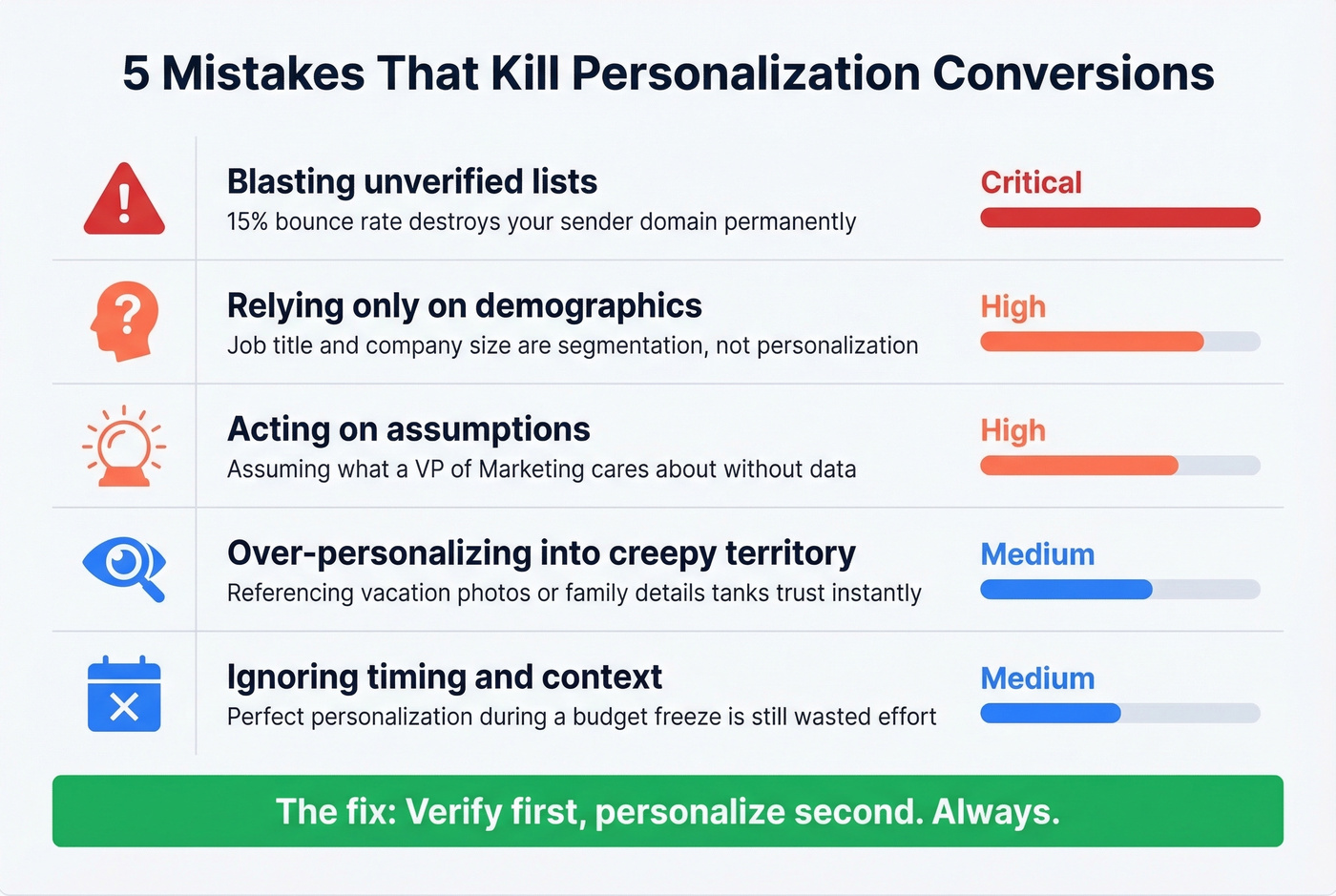
Relying only on demographics is the most common offender. Job title and company size aren't personalization - they're segmentation. Behavioral segmentation, grouping prospects by what they actually do on your site, in your product, or with your content, consistently outperforms static demographic lists because it reflects real buying intent rather than assumed interest.
Acting on assumptions is a close second. Assuming a VP of Marketing cares about brand awareness when they're actually measured on pipeline is a fast way to get ignored. Over-personalizing crosses the line from relevant to creepy - referencing someone's vacation photos or kids' names tanks trust immediately. And sending a perfectly personalized email during a budget freeze is still wasted effort, which is exactly the problem intent data solves.
Let's be honest about the most expensive mistake: blasting 10,000 emails with a 15% bounce rate destroys your sender domain. Verify first, personalize second. Always.
Privacy-First Personalization
GDPR has generated over 2.8 billion euros in fines since 2018. Personalization raises the compliance stakes considerably.
Consent must be freely given, specific, informed, and unambiguous - no pre-checked boxes. Use double opt-in for email lists, include unsubscribe links in every message, and keep consent records with timestamps. CCPA opt-out rights apply for California residents. Collect only the data you need for the personalization you're actually doing, and require Data Processing Agreements from every data vendor. If your enrichment provider can't produce a DPA, walk away.
Tools That Make It Work
Personalization runs on a stack, not a single tool.
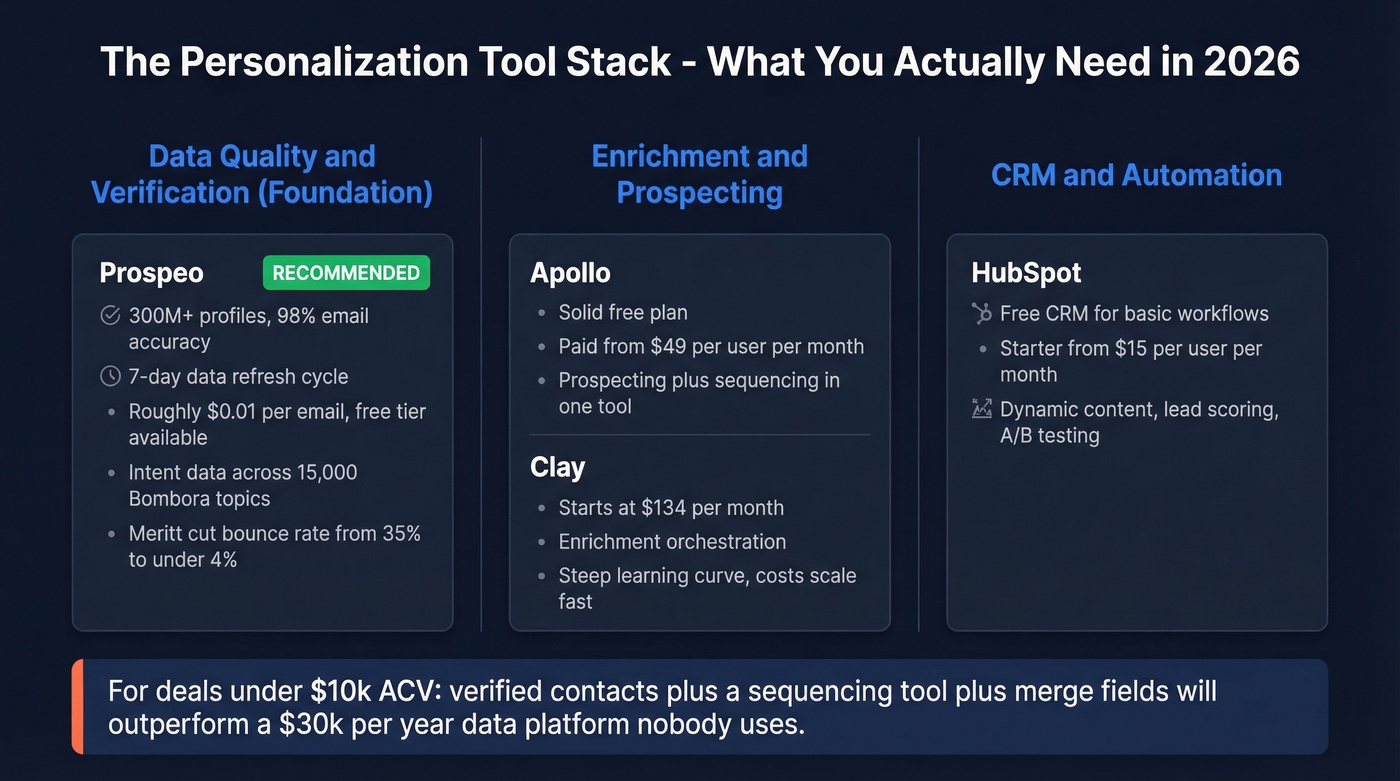
Data quality and verification is the foundation. Prospeo covers 300M+ professional profiles with 98% email accuracy and a 7-day data refresh cycle. At roughly $0.01 per email with a free tier, it's hard to beat on cost - Meritt cut their bounce rate from 35% to under 4% after switching. Intent data across 15,000 Bombora topics lets you layer buying signals directly into targeting without bolting on another vendor.
Enrichment and prospecting. Apollo offers a solid free plan with paid tiers from $49/user/mo, great for teams that want prospecting and sequencing in one tool. Clay handles enrichment orchestration starting at $134/mo, though the learning curve is steep and costs scale fast with usage.
CRM and automation. HubSpot's free CRM handles basic personalization workflows and dynamic content. Paid plans start at $15/user/mo for Starter. Layer in lead scoring and A/B testing as your marketing automation matures.
For teams with deal sizes below $10k, you don't need a $30k/year data platform. A verified contact database, a sequencing tool, and basic merge fields will outperform an overbuilt stack that nobody on your team actually uses.
Narrow targeting (1-2 contacts per company) nearly doubles reply rates. Prospeo's 30+ search filters - intent signals, technographics, job changes, headcount growth - let you find exactly the right person at the right moment. At roughly $0.01 per verified email, the math on personalized outbound finally works.
Target the right person at the right time for a penny per lead.
FAQ
How much personalization is enough for cold email?
Company name, a relevant pain point, and a clear use case outperform hyper-personalized first lines for most outbound teams. Belkins' data shows targeting the right 1-2 contacts per company matters far more than crafting bespoke messages for the wrong ones.
Does personalized outreach actually improve reply rates?
Yes, but only when the underlying data is accurate. A personalized email to a bounced address produces zero return. 71% of consumers expect personalized interactions - that expectation starts with reaching the right person at a verified address.
What's the cheapest way to personalize outreach at scale?
Start with a verified contact database at roughly $0.01/email, use basic merge fields for company and pain point, and reserve asset-based personalization - Loom videos, custom demos - for targets above $25k ACV. This two-tier approach maximizes ROI without burning hours per lead.
How do I avoid crossing the line into creepy personalization?
Stick to professional context: company news, role-specific pain points, and publicly shared business content. Referencing personal social media, family details, or location data tanks trust. If you wouldn't say it in a first handshake at a conference, don't put it in an email.