

GDPR Compliant Lead Generation in 2026: A Playbook
Your SDR team blasted 5,000 cold emails last Tuesday. By Thursday, your domain was blocked - the entire company couldn't send emails to anyone, including customers. That's not a hypothetical. It shows up constantly on r/sales and r/marketing. Cisco's Data Privacy Benchmark found that 94% of organizations say customers won't buy from them if data isn't protected properly. GDPR compliant lead generation isn't about avoiding fines. It's about whether prospects trust you enough to reply.
Here's the framework that works for B2B cold outreach in the EU and UK:
- Legitimate interest is the most common lawful basis for B2B cold email.
- Document a Legitimate Interest Assessment before you send. The ICO publishes a free LIA template.
- Verify every email, disclose your data source, and make opt-out effortless. (If you need a process, start with an email deliverability baseline.)
- Use a data provider that offers DPAs, refreshes data frequently, and enforces opt-outs globally. (Compare options in data enrichment services.)
Legitimate Interest vs. Consent
Every compliance guide says "get consent" without explaining how that works when your job is emailing prospects who've never heard of you. Consent isn't the only option for B2B cold outreach. Article 6(1)(f) legitimate interest is a standard lawful basis, and Recital 47 explicitly recognizes direct marketing as a legitimate interest.
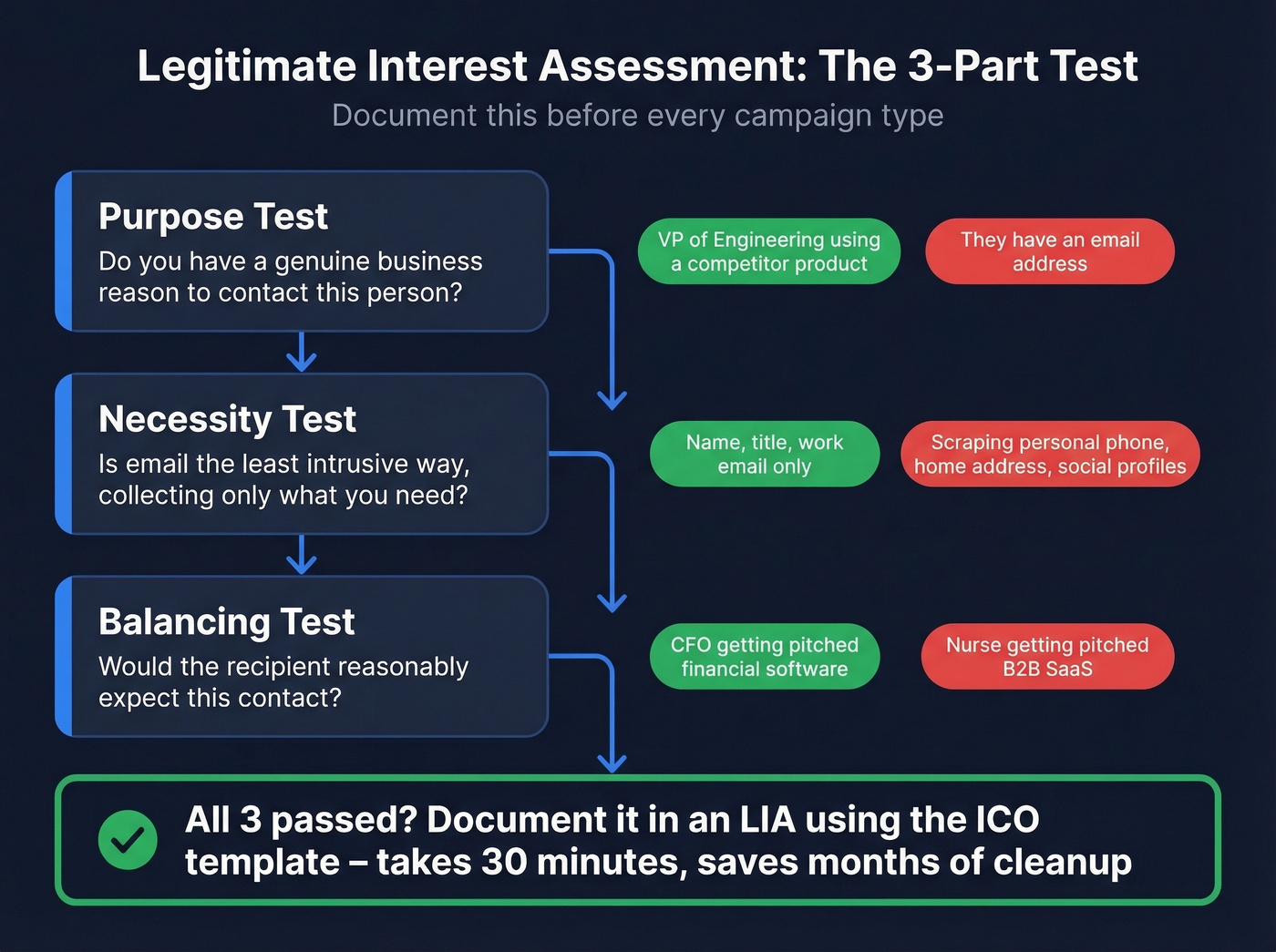
The three-part test you need to pass and document:
- Purpose test: You have a genuine business reason to contact this person. "VP of Engineering at a company using our competitor's product" qualifies. "They have an email address" doesn't.
- Necessity test: Email is the least intrusive channel, and you're only collecting what you need - name, title, work email.
- Balancing test: The recipient would reasonably expect professional contact. A CFO getting pitched financial software? Reasonable. A nurse getting pitched SaaS? Not reasonable.
Document this in a Legitimate Interest Assessment using the ICO's free LIA template. Do it once per campaign type, not once per email. We've found that teams who complete LIAs before launching campaigns avoid most compliance headaches down the line - it takes 30 minutes and saves you months of cleanup.
One UK-specific note: the Data (Use and Access) Act 2025 introduced "recognised legitimate interests" (Article 6(1)(ea) UK GDPR) for certain specified purposes, including preventing crime and fraud, national security, safeguarding vulnerable individuals, emergencies affecting life or health, and democratic engagement.
Country Rules That Trip Teams Up
GDPR is the floor. Individual countries layer on additional rules through ePrivacy implementations. Three that catch teams off guard:
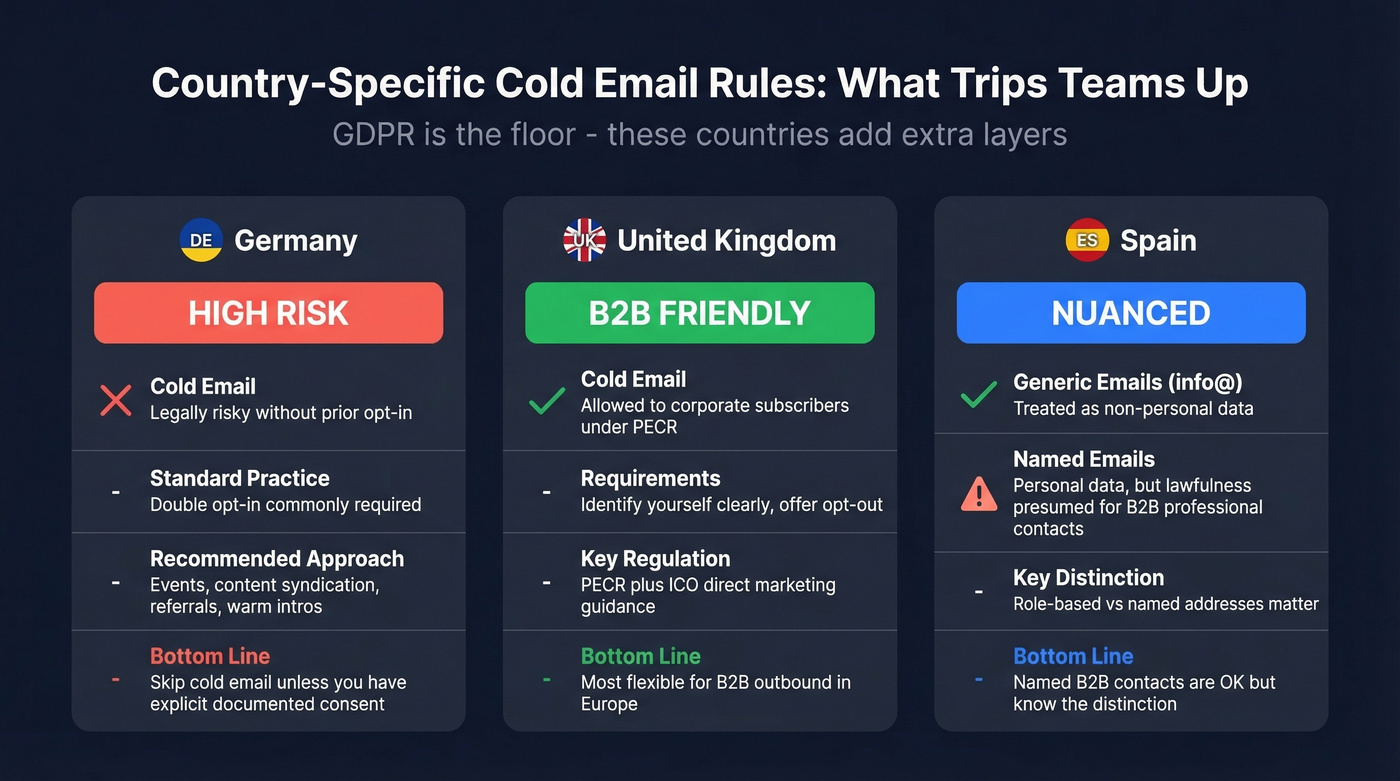
Germany is widely treated as opt-in strict for email marketing. Double opt-in is commonly used to evidence valid consent, which makes pure cold email without prior opt-in legally risky. If Germany is a key market, warm approaches like events, content syndication, and referrals are safer. Skip cold email here unless you've got explicit consent documented. (If you're building a safer outbound motion, use sales prospecting techniques that don't rely on volume.)
The UK gives B2B marketers more flexibility under PECR. You can cold email corporate subscribers without prior consent as long as you identify yourself and offer opt-out. The ICO's direct marketing guidance spells this out clearly.
Spain draws a distinction between generic corporate emails like info@company.es and named addresses. Generic role addresses are generally treated as non-personal; named addresses are personal data, and Spanish law presumes lawfulness for using professional contact data in B2B contexts.
Compliant Cold Email Checklist
Every cold email into the EU or UK should hit these marks:
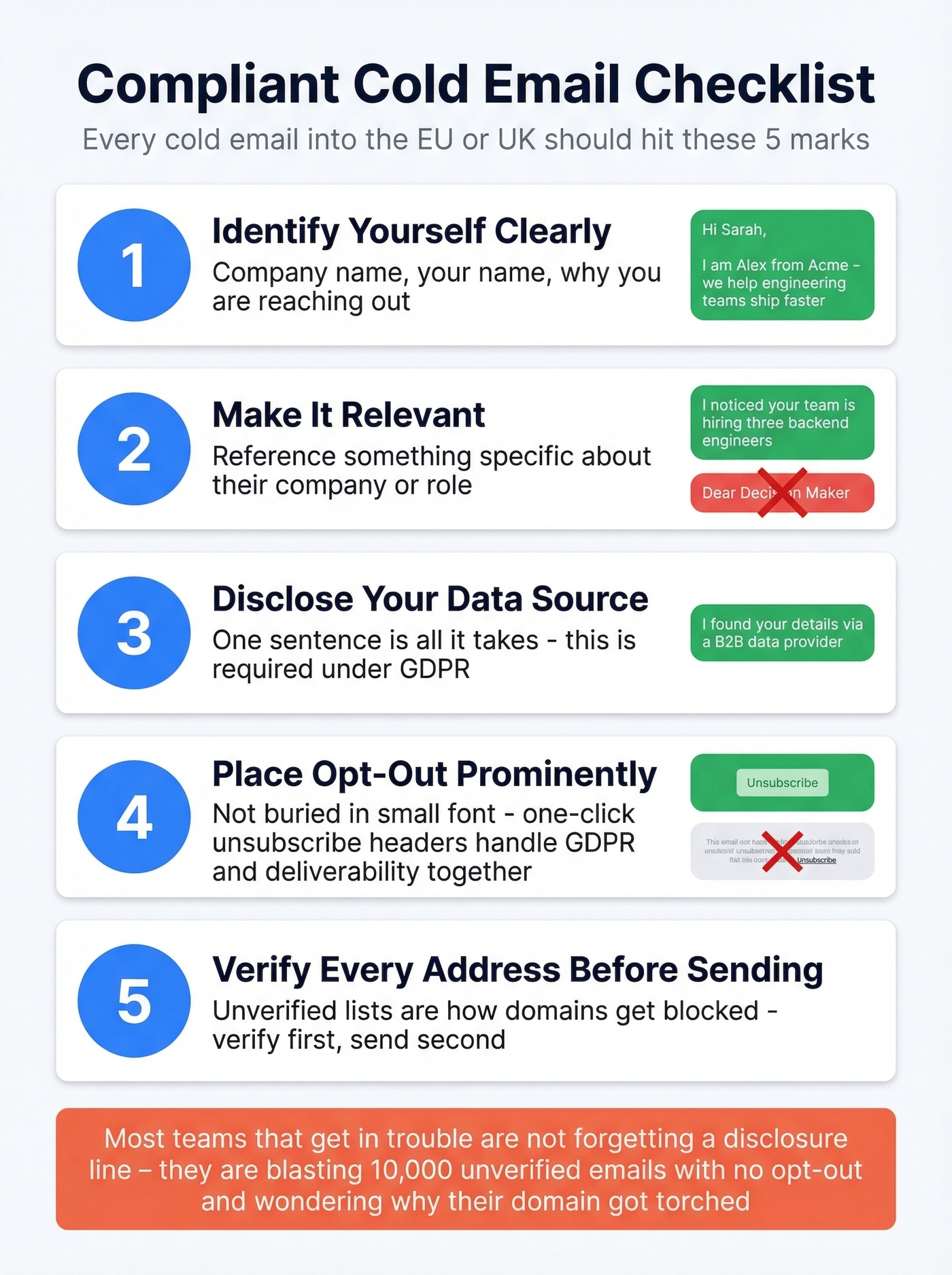
- Identify yourself clearly - company name, your name, why you're reaching out.
- Make it relevant - "I noticed your team is hiring three backend engineers" beats "Dear Decision Maker."
- Disclose your data source - "I found your details via a B2B data provider." One sentence. It's required.
- Place opt-out prominently - not buried in small font. Google and Yahoo's bulk sender requirements mandate one-click unsubscribe headers, so you're handling GDPR and deliverability in one move.
- Verify every address before sending - sending to unverified lists is how domains get blocked. (If you're troubleshooting bounces, see email bounce rate.)
Let's be honest: most of these aren't hard. The teams that get in trouble aren't the ones who forget a disclosure line - they're the ones blasting 10,000 unverified emails with no opt-out link and wondering why their domain got torched. (If you're sending at scale, manage email velocity like an ops metric, not a guess.)

Your cold email checklist demands verified addresses, disclosed data sources, and working opt-outs. Prospeo handles the hardest part: 98% email accuracy through 5-step verification, spam-trap removal, and a 7-day data refresh cycle so you never email stale contacts. DPAs available on request, global opt-out enforcement built in.
Send compliant cold email that actually reaches real inboxes.
The Data Enrichment Problem
This is where most teams get nervous, and rightfully so. Practitioners on r/marketing describe enrichment as a grey area because vendors scrape public data or aggregate from unknown sources. Under GDPR Article 4, any data tied to an identifiable person is personal data - regardless of whether it's publicly available. A job title plus a name plus a company URL is personal data, full stop.
Your enrichment provider's compliance posture is your compliance posture. You're typically the data controller. They're the processor. If they can't tell you where the data came from, you can't document a lawful basis for using it. (If you're evaluating vendors, start with best B2B company data providers.)
What to demand from any provider: data source transparency, a signed Data Processing Agreement, refresh cycles under two weeks so stale data doesn't generate complaints, and global opt-out enforcement so suppression requests propagate everywhere. (This is also why teams standardize lead enrichment rules before scaling.)
Prospeo meets this standard with DPAs available on request, a 7-day data refresh cycle compared to the six-week industry average, and 98% email accuracy through a 5-step verification process that catches spam traps and honeypots before they damage your domain. Every data source is vetted under a zero-trust partner policy, so you can actually document provenance when regulators ask. (If you're cleaning lists, use a dedicated spam trap removal workflow.)

Your enrichment provider's compliance is your compliance. Prospeo gives you full data provenance under a zero-trust partner policy, GDPR-compliant DPAs, and 143M+ verified emails refreshed every 7 days - not the 6-week industry average. Document your lawful basis with confidence because you know exactly where the data came from.
Stop guessing where your prospect data comes from. Know it.
What Happens When You Get It Wrong
Reed Online was hit with a £20,000 fine from the UK ICO after sending 18 million emails with broken unsubscribe links. Not malicious - just sloppy ops. LinkedIn was fined EUR310M by Ireland's DPC in 2024 for profiling and targeted ads without a lawful basis.
Public GDPR fines roundups now list 2,100+ fines totaling EUR4.4B+, and they flag lack of legal basis as the most frequently cited violation. Regulators aren't just going after big tech anymore. Mid-market companies running sloppy outbound are increasingly in the crosshairs, and a single complaint from a prospect can trigger an investigation that costs more in legal fees than the fine itself.
Compliance Improves Results
A Censuswide survey of 250 UK marketers found that databases shrank 23% after GDPR enforcement began - but recovered to 93% of pre-GDPR levels within a year, with higher engagement across the board. Smaller lists, better targeting, fewer spam complaints, stronger domain reputation. (If you want to systematize this, build a B2B cold email sequence around relevance and verification, not volume.)
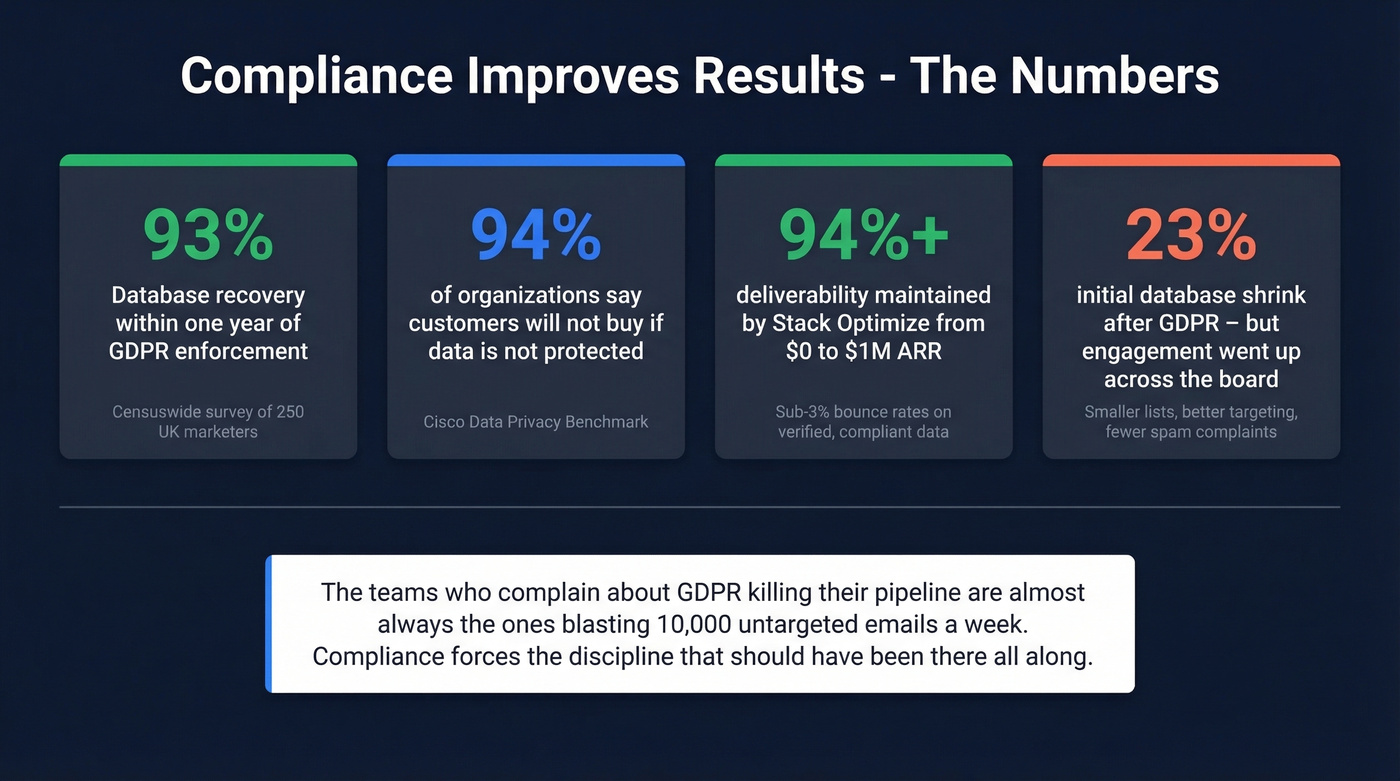
Here's the thing: the teams who complain about GDPR killing their pipeline are almost always the ones blasting 10,000 untargeted emails a week. If your average deal size is under EUR15k and you're sending fewer than 200 highly targeted, verified emails per week, GDPR isn't your problem - your targeting is. We've seen this pattern repeatedly across our customer base. Compliance forces the discipline that should've been there all along, and the numbers back it up. One of our customers, Stack Optimize, built from $0 to $1M ARR while maintaining 94%+ deliverability and sub-3% bounce rates across every client campaign - all on verified, compliant data.
FAQ
Can I cold email B2B prospects in the EU without consent?
Yes, in most EU countries. Article 6(1)(f) legitimate interest is a standard lawful basis, supported by Recital 47. Document a Legitimate Interest Assessment and offer easy opt-out. Germany is the major exception - double opt-in is commonly used to evidence consent there.
Is publicly available data automatically GDPR-compliant?
No. Any data tied to an identifiable person is personal data under GDPR Article 4, regardless of whether it's public. You still need a documented lawful basis and a clear data-source disclosure before processing it.
What should I look for in a compliant data provider?
Demand data source transparency, a signed DPA, refresh cycles under two weeks, and global opt-out enforcement. If a vendor can't explain where their data comes from, walk away - their compliance gap becomes yours.
How does GDPR compliant lead generation affect reply rates?
Teams typically see higher engagement after tightening compliance. Verified lists mean fewer bounces, better domain reputation, and emails that actually land in inboxes. The Censuswide survey showed databases recovered to 93% of pre-GDPR size within a year, with stronger performance metrics across the board.