

The 10 Best Lead Finder Tools in 2026
You send 500 cold emails on Monday. By Wednesday, 140 have bounced, your domain reputation is flagged, and the 360 that did land generated exactly two replies. The problem isn't your copy or your offer - it's the list.
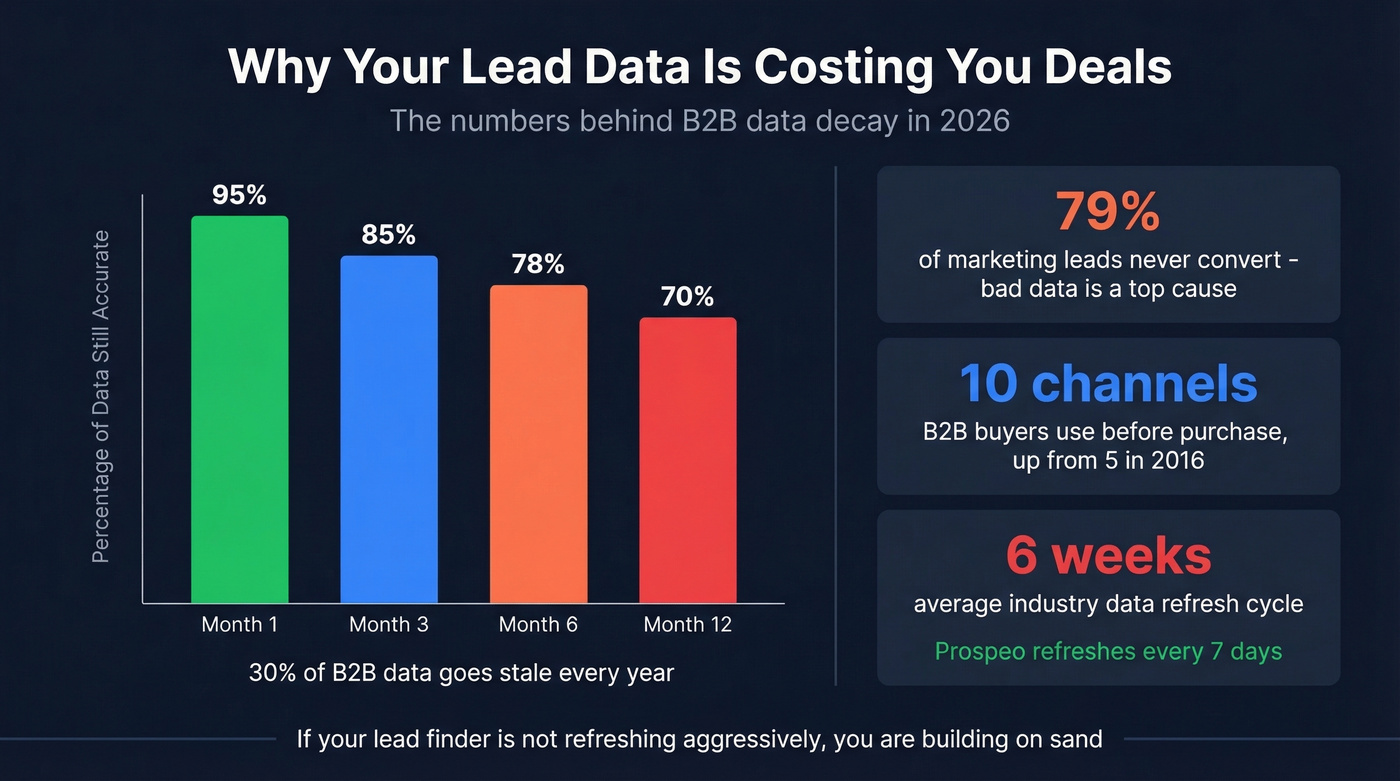
The lead generation software market hit $7.4B in 2025 and is projected to reach $16.2B by 2034. That's a lot of tools competing for your budget, and 79% of marketing leads never convert - bad contact data is a massive contributor. Roughly 30% of B2B data goes stale every year from job changes, company closures, and email migrations. B2B buyers now use an average of 10 channels before purchase, up from 5 in 2016, which means your contact data needs to cover more touchpoints than ever. If your lead finder isn't refreshing aggressively, you're building on sand.
We ran bake-offs across these tools with real prospect lists. Here are the 10 worth your time.
Our Picks (TL;DR)
| Use Case | Pick | Why |
|---|---|---|
| Email accuracy & freshness | Prospeo | 98% accuracy, 7-day refresh, ~$0.01/email |
| All-in-one for growing teams | Apollo.io | 275M+ contacts, free tier, $99/user/mo |
| European direct dials | Cognism | Verified phones, GDPR compliance, Bombora intent |
Most teams need one primary database and one verification layer. Some tools combine both. Let's break down which ones actually deliver.
What a Lead Finder Does (And Doesn't)
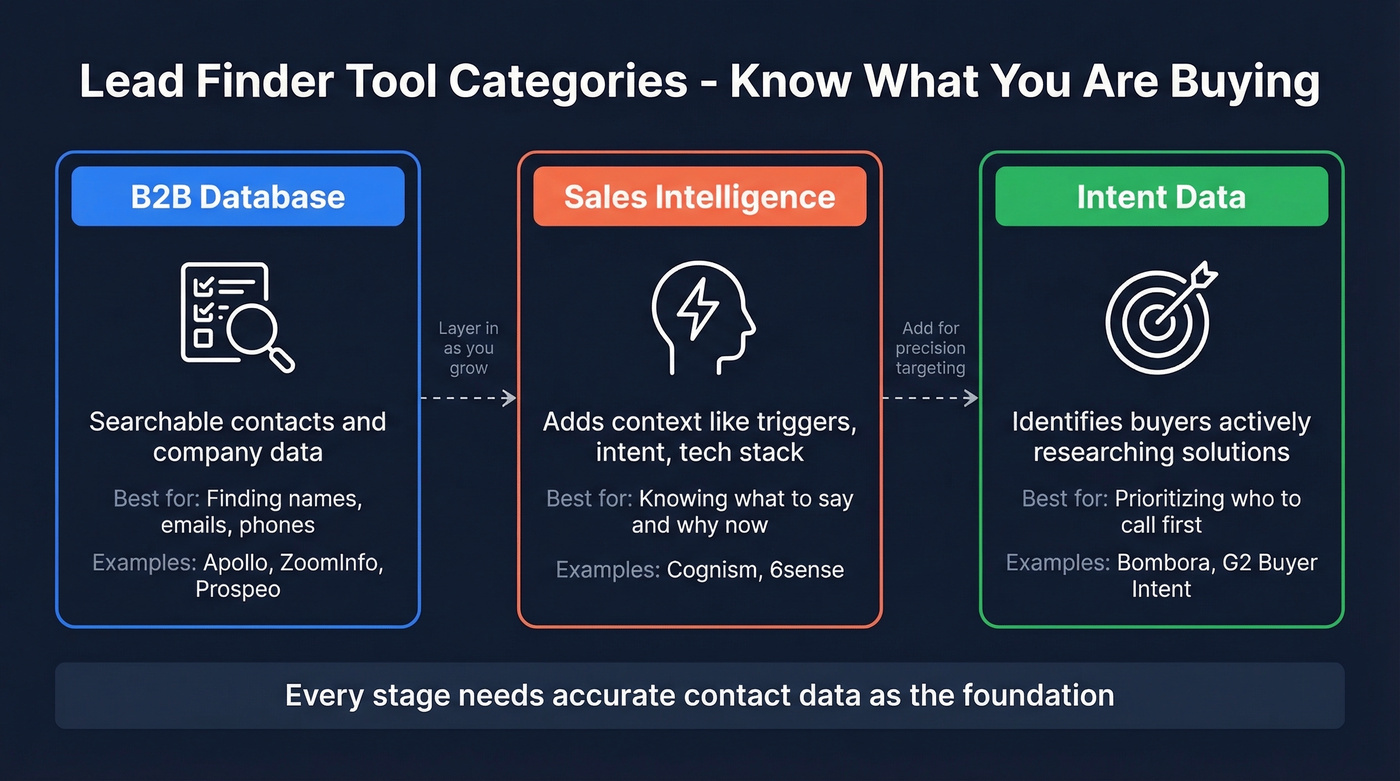
A lead finder answers one question: "Who should we talk to?" It gives you names, emails, phone numbers, and company details based on filters you set. That's it. A sales intelligence platform answers a different question: "What should we say, and why now?"
The confusion between these categories costs teams real money.
| Category | What It Does | Examples |
|---|---|---|
| B2B database | Searchable contact + company database | Apollo, ZoomInfo |
| Sales intelligence | Adds context: triggers, intent, tech stack | Cognism, 6sense |
| Intent data tool | Identifies in-market buyers | Bombora, G2 Buyer Intent |
We're excluding website visitor identification tools (like Warmly or Dealfront) and background enrichment tools - those solve adjacent but different problems.
If you're early-stage, prioritize volume. Get a database with a generous free tier and start prospecting. As you grow, layer in intelligence - intent signals, technographics, hiring triggers. Enterprise teams need dossier-level context before every call. But every stage needs accurate contact data as the foundation.
10 Best Lead Finder Tools Compared
1. Prospeo - Best for Email Accuracy
Prospeo covers 300M+ professional profiles, 143M+ verified emails, and 125M+ verified mobile numbers, all refreshed on a 7-day cycle. The industry average refresh is six weeks. That gap matters when a third of B2B data decays annually.
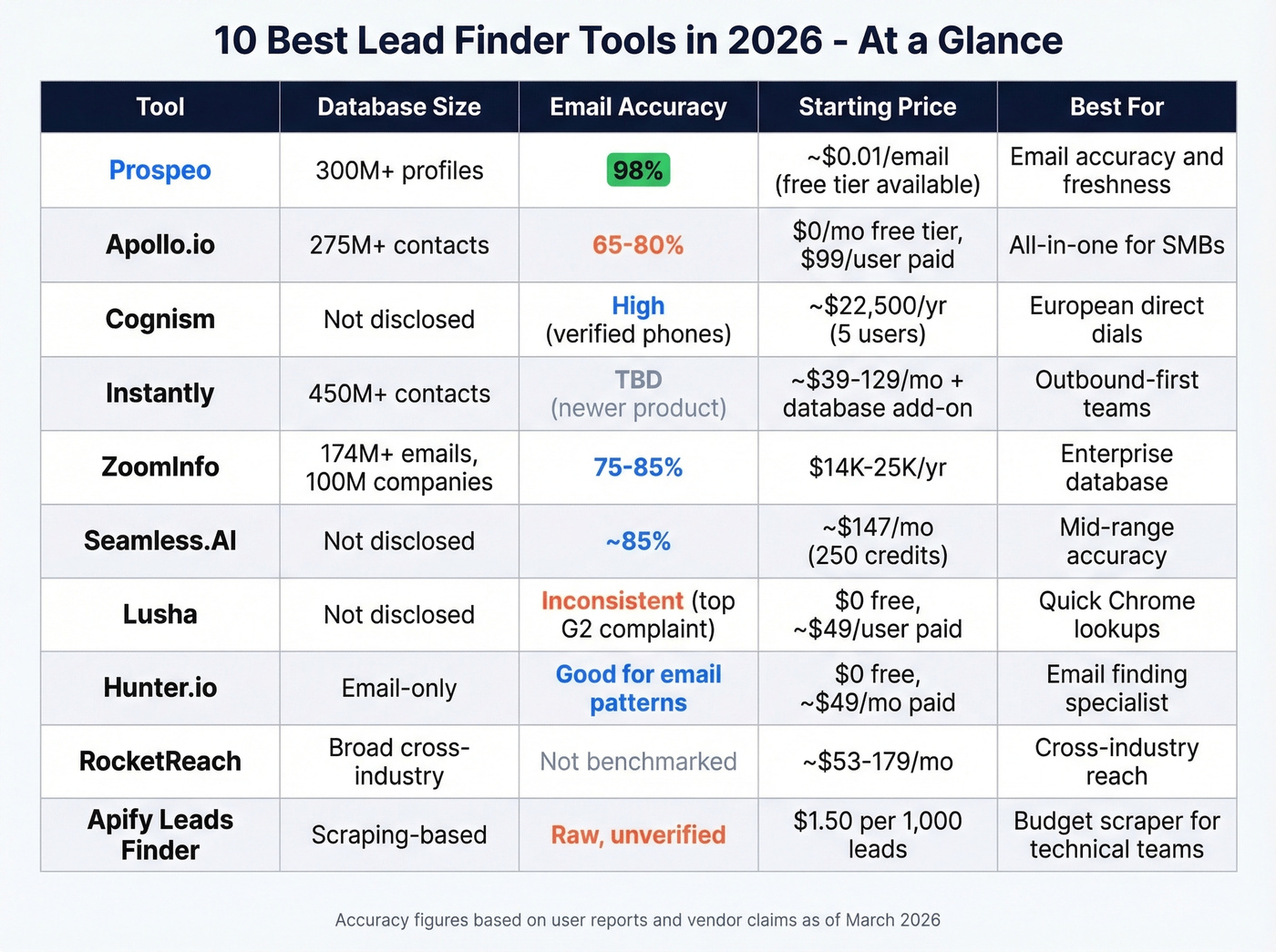
Use it if you care about deliverability above everything else. The 98% email accuracy comes from a proprietary 5-step verification process with catch-all handling, spam-trap removal, and honeypot filtering. Mobile numbers hit a 30% pickup rate across regions. The Chrome extension (40,000+ users) pulls contact data from websites, professional profiles, and supported CRMs, and the enrichment API returns 50+ data points per contact with a 92% match rate.
The 30+ search filters include Bombora-powered intent data across 15,000 topics, plus technographics, job-change signals, and headcount growth - so you're not just finding leads, you're finding ready leads. Snyk rolled it out to 50 AEs and dropped their bounce rate from 35-40% to under 5%, generating 200+ new opportunities per month. GDPR compliant, self-serve, no contracts.
Pricing: ~$0.01 per email. Free tier gives you 75 emails and 100 Chrome extension credits monthly. Integrates natively with Salesforce, HubSpot, Instantly, Lemlist, Clay, and Zapier.


You just read that 30% of B2B data goes stale every year. Prospeo refreshes every 7 days - not 6 weeks like the industry average. That's why teams like Snyk dropped bounce rates from 35-40% to under 5% across 50 AEs.
Stop building outbound on decayed data. Verify your list now.
2. Apollo.io - Best All-in-One for SMBs
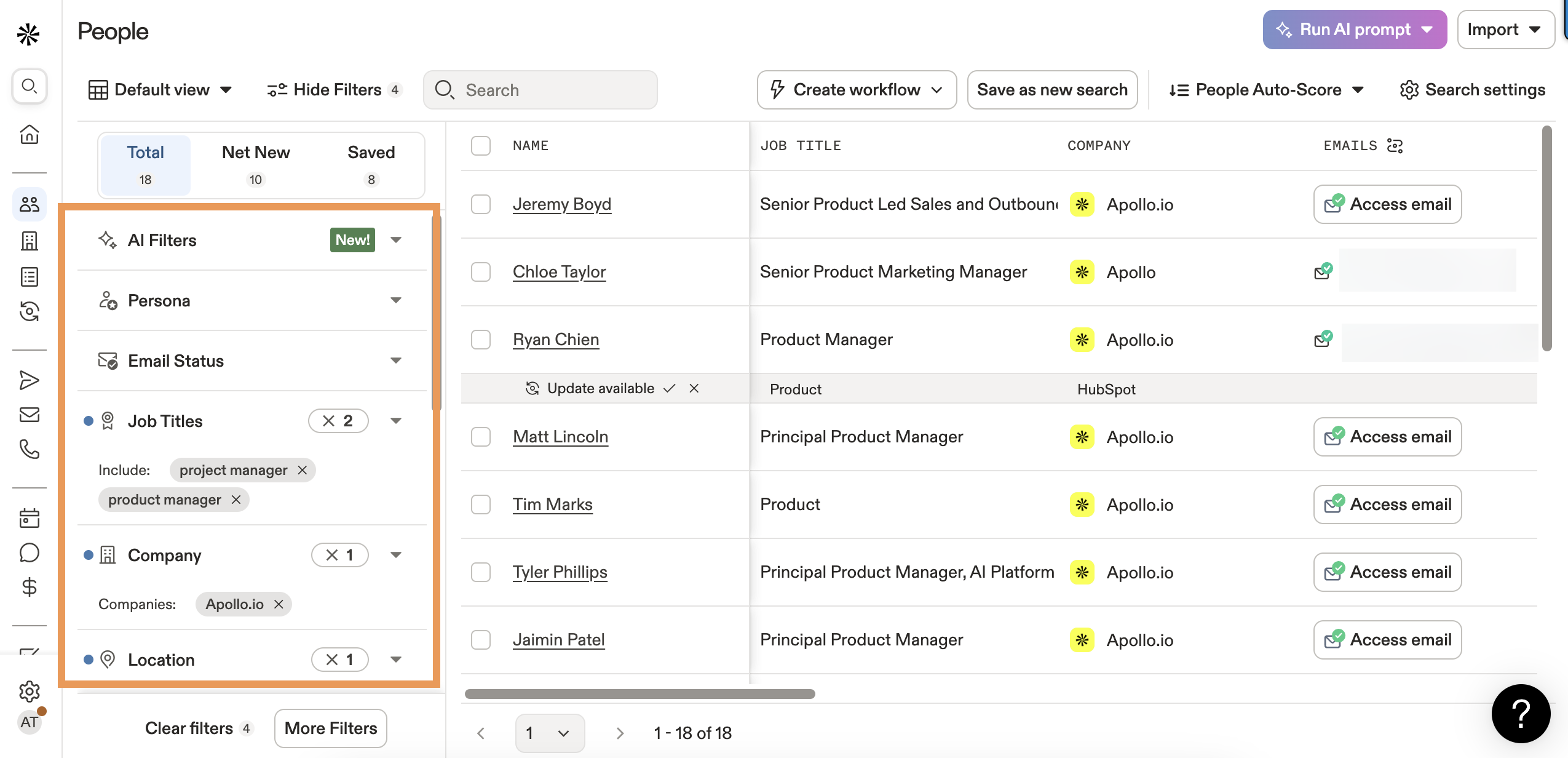
Apollo is the obvious starting point for most teams under 50 reps. It combines a 275M+ contact database with built-in sequencing, a dialer, and deal management - all in one platform. The 65+ search filters and monthly data refresh keep things reasonably current, and the free tier is genuinely generous enough to run a small outbound motion.
Where Apollo shines is the all-in-one value. You don't need to stitch together three tools to go from list to sequence to reply. The Professional plan at $99/user/month and Organization at $149/user/month are transparent and predictable - a refreshing contrast to the "Contact Sales" walls elsewhere. For teams looking to find leads without juggling multiple subscriptions, Apollo is hard to beat.
The tradeoff is accuracy. User-reported email accuracy runs 65-80%, which drops further in niche verticals and non-US markets. We've seen teams pair Apollo for prospecting with a dedicated verification tool to close that gap (see email verification options). G2 rating: 4.7/5.
3. Cognism - Best for European Direct Dials
Use it if you're a mid-market team selling into Europe and need verified direct dials. Cognism's Diamond Data - manually verified phone numbers - is genuinely differentiated. Their GDPR and CCPA compliance is strong, and the Bombora intent data integration means you can prioritize accounts showing buying signals. G2 rating: 4.6/5.
Skip it if you're a small team or budget-conscious. A 5-user Grow plan runs ~$22,500/year, and Elevate jumps to ~$37,500/year. Add $2K-$5K for onboarding and you're looking at a meaningful annual commitment with an annual lock-in. ZoomInfo has deeper US coverage; Cognism wins on EMEA compliance and verified mobiles. For US-only teams, the premium is hard to justify.
4. Instantly - Best for Outbound-First Teams
Instantly's database claims 450M+ contacts - the largest on this list - and their "pay only for verified leads" positioning reduces wasted spend. The real draw is the workflow: find leads, verify them, and send cold email sequences without leaving the platform. The lookalike search (enter a domain, find similar companies) is a nice touch. G2 rating: 4.8/5, the highest here.
Here's the thing, though. The database product is newer and less battle-tested than Apollo or ZoomInfo, and independent accuracy benchmarks haven't caught up yet. Expect ~$39-$129/month for outreach plans, with database access layered on top. If you're already using Instantly for cold email, adding their B2B database is a no-brainer. If you're starting fresh, test the data quality against a more established provider before going all-in.
5. ZoomInfo - Best Enterprise Database
ZoomInfo is one of the deepest US B2B databases available. 174M+ emails, 70M phone numbers, 100M companies. The direct-dial coverage for director-and-above roles in North America is a standout, and the platform's workflow breadth - intent data, chat, form enrichment, ABM orchestration - makes it a genuine operating system for large GTM teams. Accuracy runs 75-85%.
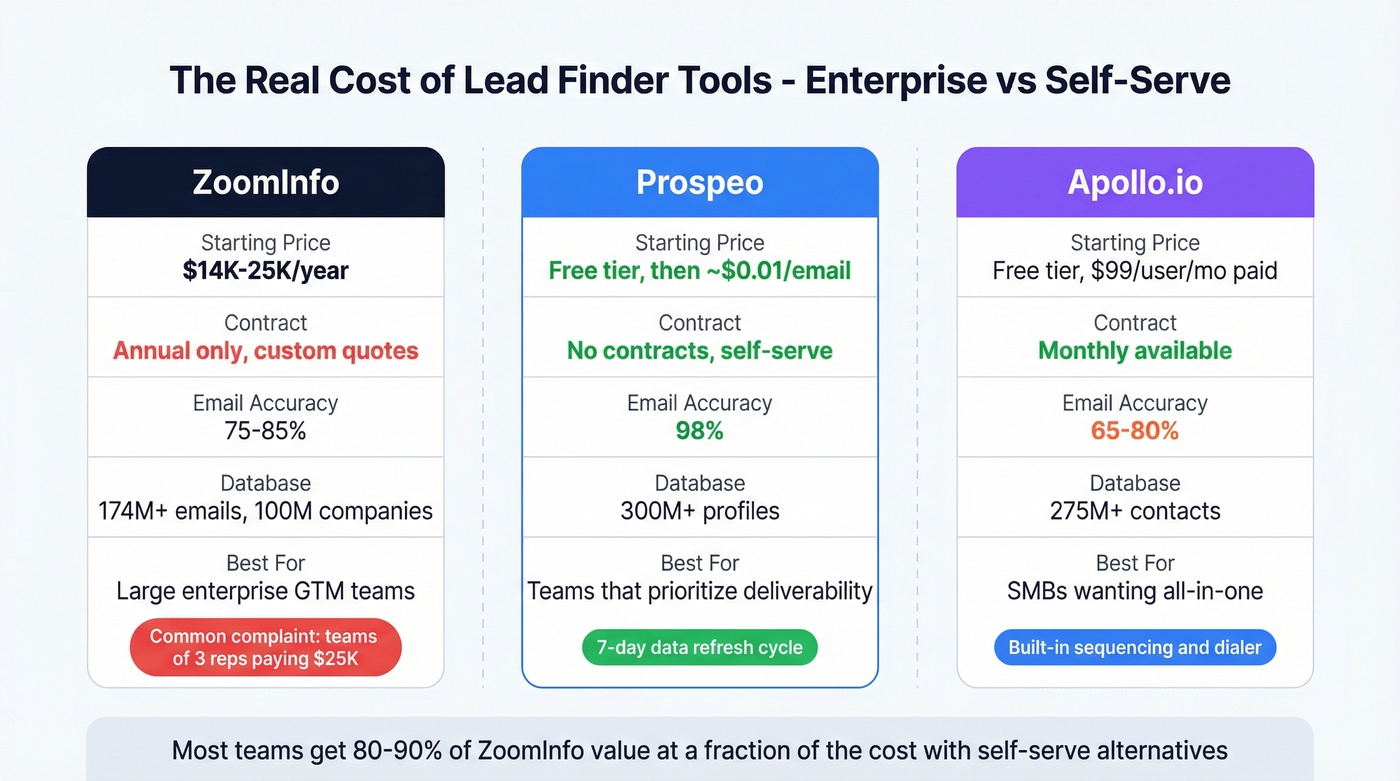
But the cost is brutal. A starting contract runs $14K-$25K/year, and enterprise deals push past $30K easily. Annual contracts only, custom quotes only, and a sales process that feels like buying enterprise software in 2008.
Here's what we hear constantly on r/sales and in Slack communities: "Finance flagged the $25K renewal. Our team of 3 reps uses it twice a week." If that's you, you're overpaying by 10x. The alternatives on this list deliver 80-90% of the value at a fraction of the cost.
6. Seamless.AI - Solid Data, Confusing Pricing
Email accuracy around ~85% (user-reported) is solid for the price tier, and the real-time search with clean CRM integrations works well day-to-day. But the pricing is a maze. The free plan gives you 50 lifetime credits. Basic runs ~$147/month for 250 credits. Pro is $79/user/month for 1,000 credits, and Enterprise runs $149/user/month with a 5-user minimum - but you'll need a sales call to find any of that out.
Credits don't roll over. Phone number accuracy is inconsistent. Reddit users flag slow support response times and the inability to pause subscriptions. The fact that Seamless.AI still requires a sales call for Pro pricing in 2026 is frustrating. Get the total annual cost in writing before you sign.
7. Lusha - Quick Chrome Extension Pulls
Lusha's strength is speed. The Chrome extension pulls contact data fast, and the free tier (40 credits/month) lets you test without commitment. Paid plans start around $49/user/month. G2 rating: 4.3/5 across 1,618 reviews.
The weakness is accuracy. Data inaccuracy is the #1 complaint on G2, which undercuts the speed advantage entirely. Fast bad data is still bad data. Best for quick one-off lookups, not for building campaign-scale lists.
8. Hunter.io - Email Finding Specialist
Hunter does one thing well: finding and verifying email addresses. The domain search feature - enter a company domain, get every email pattern and address associated with it - is genuinely useful for account-based prospecting. G2 rating: 4.4/5 across 634 reviews. Free tier gives you 50 credits/month, paid plans start at ~$49/month.
No phone numbers, no database browsing, no intent signals. If you already have a list of people and companies and just need their emails, Hunter is great. If you need to discover prospects from scratch, you'll need another tool alongside it.
9. RocketReach - Large Database, Premium Price
RocketReach offers a broad contact database with plans from ~$53-$179/month and coverage spanning both sales and recruiting use cases. The database is wide, but the premium pricing feels steep compared to newer alternatives like Apollo that offer similar or larger databases with built-in sequencing at comparable price points. Best for teams already embedded in the RocketReach ecosystem or those who need cross-industry reach beyond typical B2B sales targets.
10. Apify Leads Finder - Budget Scraper Option
Apify's Leads Finder actor runs $1.50 per 1,000 leads with a free plan capping at 100 leads per run. It's not a polished SaaS - it's a scraping tool for technical teams that want raw contact data at the lowest possible cost and don't mind building their own workflows around it. Skip this if you want something you can hand to a non-technical SDR.
Every bounced email chips away at your domain reputation. At 98% email accuracy and ~$0.01 per verified contact, Prospeo gives you 300M+ profiles with 30+ filters - intent data, technographics, job changes - so you find leads who are actually ready to buy.
Run your next lead finder bake-off with Prospeo in the mix.
Pricing Comparison
The cost-per-lead math makes the case for any of these tools: an SDR earning $60K/year costs roughly $37.50/hour. At two prospects researched per hour, that's $18.75 per prospect through manual work. Even the most expensive tool on this list costs a fraction of that per contact.
| Tool | Free Tier | Starting Price | Credits | Contract |
|---|---|---|---|---|
| Apollo.io | Yes (limited) | $99/user/mo | Included | Monthly |
| Cognism | No | ~$22.5K/yr (5 users) | ~2K/mo fair use | Annual |
| Instantly | Limited | ~$39-$129/mo | Verified only | Monthly |
| ZoomInfo | No | ~$14K-$25K/yr | Bundled | Annual |
| Seamless.AI | 50 lifetime | ~$147/mo (Basic) | 250/mo, no rollover | Often annual |
| Lusha | 40/mo | ~$49/user/mo | Credit-based | Monthly |
| Hunter.io | 50/mo | ~$49/mo | Credit-based | Monthly |
| RocketReach | Limited | ~$53/mo | Credit-based | Monthly |
| Apify | 100/run | $1.50/1K leads | Pay per event | None |
Data Accuracy: What the Benchmarks Actually Show
Every lead finder advertises 95%+ accuracy. Independent benchmarks tell a different story.
A Dropcontact benchmark tested 15 tools across 20,000 real contacts with live email delivery - not just SMTP checks, but actual sends to measure hard bounces. The top performers: Dropcontact at 54.9% effective enrichment with a 0.9% hard bounce rate, Findymail at 39.9% enrichment with 1.1% bounce, and Enrow at 40.9% enrichment with a 2.3% bounce rate. The benchmark is vendor-funded, but the methodology - live sending plus manual domain verification - is more rigorous than most.
A critical distinction these benchmarks reveal: "email finding" and "email verification" are different workflows. Finding tests start with a name and company, then try to discover the email from scratch - a cold enrichment task where every tool struggles with coverage gaps. Verification tests start with an email the tool already has in its database and check whether it's still valid. The gap between these two numbers is enormous. A tool can have a 30% find rate on cold lookups but a 98% accuracy rate on its own verified database output. When you're evaluating lead finder tools, the number that matters is the accuracy of the contacts it actually gives you, not its ability to guess emails from thin inputs. (If you want to go deeper, see our guide to data enrichment.)
If your current tool bounces more than 5% of emails, you're damaging your domain reputation with every campaign. That damage compounds over months (more on email bounce rate benchmarks and fixes).
How to Choose the Right Tool
Most teams overcomplicate this. You need one primary database and - if that database doesn't verify aggressively - one verification layer on top. Two tools max for 90% of teams.
Growth stage (5-20 reps): You need a real database with enough volume. Apollo or Seamless.AI at the mid-tier make sense here. For teams selling into Europe, Cognism enters the conversation despite the price tag.
Enterprise (50+ reps): ZoomInfo or Cognism become viable because the per-seat cost amortizes across a large team. But even here, we've seen teams pair a cheaper primary database with a dedicated verification tool and come out ahead on both cost and accuracy (see lead enrichment workflows).
By use case:
- Email-only outbound: Hunter or Prospeo
- Full database search + sequencing: Apollo
- Intent-driven ABM: Cognism with Bombora
- Outbound all-in-one (find + send): Instantly
AI-powered enrichment and search are becoming table stakes in 2026. Most tools on this list now use machine learning for pattern matching, company mapping, and real-time verification. Don't pay a premium for "AI" as a feature label - pay for the accuracy and freshness it should be delivering under the hood.
Red flags to watch for: "Contact Sales" as the only pricing option, credits that expire daily, annual lock-ins with no trial period, and any tool that won't let you test data quality on a free tier before committing. If a vendor won't let you verify 50 contacts for free, they're not confident in their own data (use this sales prospecting checklist to pressure-test your process).
FAQ
What is a lead finder tool?
A lead finder is software that identifies potential customers and provides their contact information - emails, phone numbers, and company details - using filters like job title, industry, and company size. It replaces manual prospecting that costs ~$18.75 per contact. Most tools offer browser extensions for on-the-fly lookups alongside their core database search.
How much does a lead finder cost?
Free tiers exist at several tools, including Apollo, Hunter, and Prospeo. Paid plans range from $0.01/email to $25,000+/year. Most mid-tier options run $49-$149/user/month. Average cost per lead varies wildly by industry, but any dedicated tool is cheaper than manual research at $37.50/hour.
Are the emails from these tools accurate?
Independent benchmarks show effective enrichment rates ranging from 20% to 55% depending on the tool and methodology. Top-tier tools achieve 98% accuracy on verified database output through multi-step verification with catch-all handling and spam-trap removal. Always test a small batch before committing - any tool that won't let you do this isn't worth considering.
How do I find leads online without paying?
Use free tiers from Apollo (limited credits), Hunter (50/month), Lusha (40/month), or Prospeo (75 emails/month) to prospect at scale without upfront cost. Manual alternatives include company websites, industry directories, and Crunchbase, but expect ~30 minutes per qualified prospect versus seconds with a dedicated tool.
What's the difference between a lead finder and a sales intelligence platform?
A lead finder answers "who should we contact?" with names, emails, and phone numbers. A sales intelligence platform answers "what should we say, and why now?" by adding funding rounds, hiring signals, tech stack data, and buying intent. Several tools on this list increasingly bundle intent data into their contact databases, blurring the line between the two categories.