

How to Boost Email Open Rates with Emojis: What the Data Says
Your marketing team is debating whether to add a 🎉 to next Tuesday's campaign subject line. Someone's pulled up a dozen contradictory blog posts. Half say emojis double open rates; the other half say they tank credibility. Here's the thing: data from 6B+ emails and a Moosend analysis of 69,315 subject lines - where 28% already include emojis - settles this. If you want to boost email open rates with emojis, the answer starts with picking the wrong emoji on purpose.
The Short Version
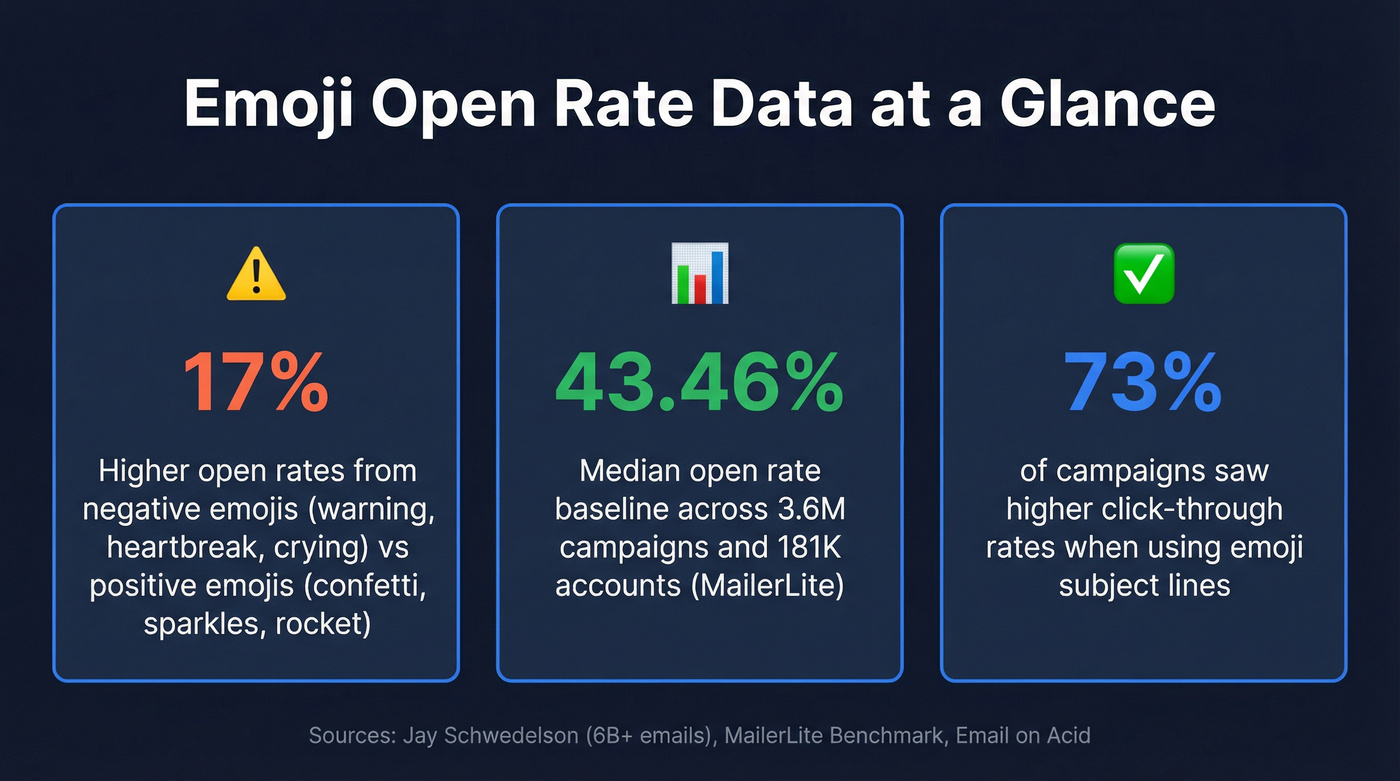
- Negative emojis (⚠️, 💔, 😢) lift open rates by ~17% vs. positive ones. Test those first, not the confetti.
- Limit to 1-2 emojis per subject line. More than that tanks credibility.
- None of this matters if your list is full of dead addresses. A perfectly optimized subject line sent to invalid emails is wasted effort. Clean your list first.
What 6B+ Emails Actually Show
The MailerLite benchmark - covering 3.6M campaigns across 181,000 accounts - puts the median open rate at 43.46%. That's your baseline. Any emoji tactic claiming a "56% lift" (looking at you, Experian stat that floats around with zero published methodology) needs to be measured against that reality.
Jay Schwedelson's agency sends over 6 billion emails a year. Their data shows negative emojis - think 💔, 😢, ⚠️ - lift open rates by roughly 17% on average compared to positive emojis. That's a meaningful gap, and it makes intuitive sense: a warning symbol creates curiosity, while a party popper just blends into the noise.
One caveat: Apple Mail Privacy Protection auto-loads tracking pixels, which inflates open rates across the board. Apple Mail holds an estimated 48-53% global market share, so your "real" open rates are lower than what your ESP reports. This doesn't invalidate emoji testing - everyone's inflated equally - but you should watch click-through rate as a secondary signal. Emoji subject lines had higher CTR in 73% of campaigns tested, which is a more reliable indicator than opens alone.
Emojis are just one lever. Schwedelson's data also shows ultra-short subject lines (3 words or fewer) with no pre-header can lift opens by up to 25%. Stack the tactics - especially if you're also working on how to increase email open rates for sales.
The Negative Emoji Play
Most marketers default to ✨ and 🎉 because they feel safe. That's exactly why they underperform. We've seen this pattern repeatedly in campaigns we've audited: the "safe" choice gets ignored, and the counterintuitive move wins.
Use these:
- ⚠️ Your pipeline has a leak
- 💔 We're losing these deals
- 😢 This metric should worry you
- ⚠️ 3 mistakes killing reply rates
Skip these (overused, low-signal):
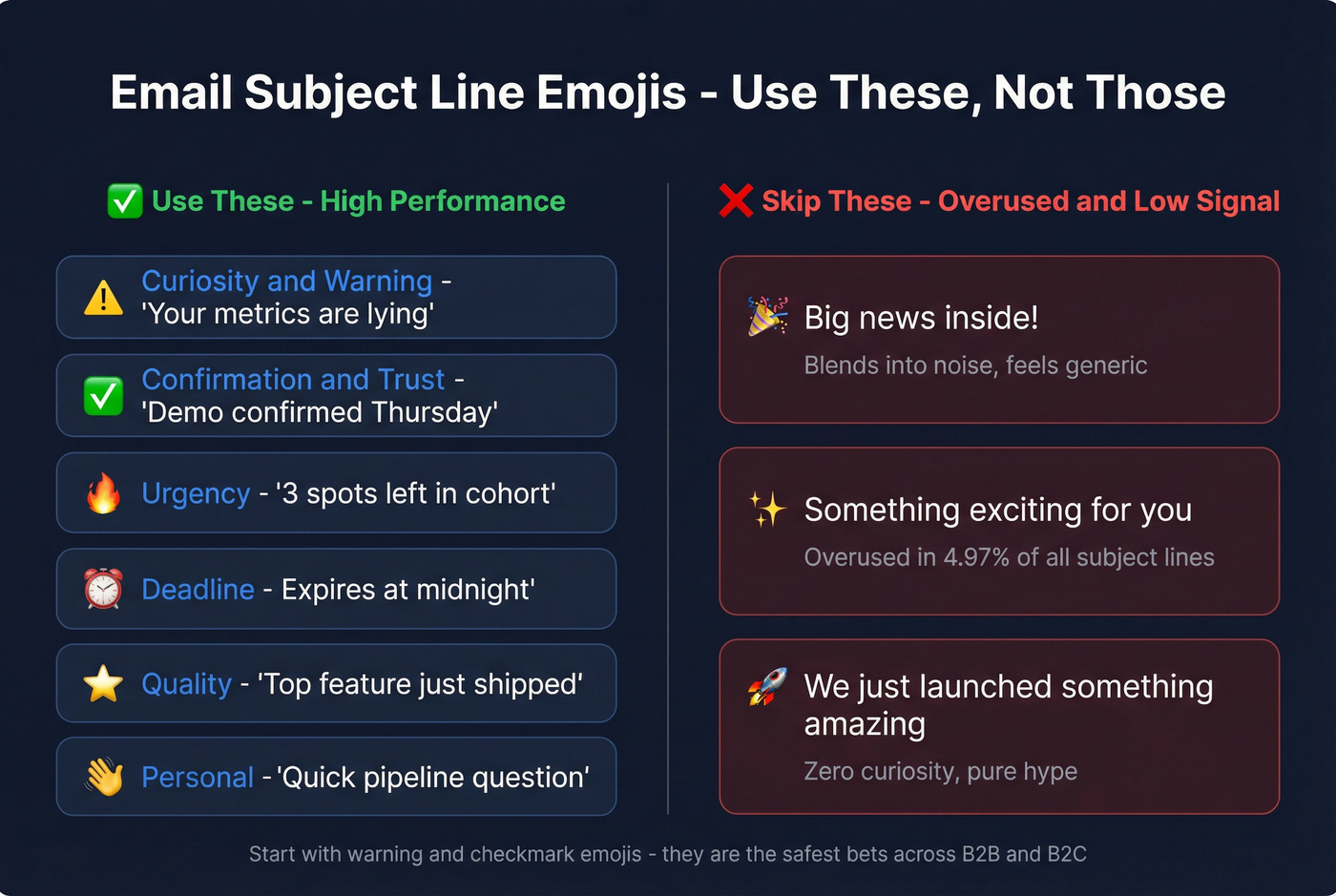
- 🎉 Big news inside!
- ✨ Something exciting for you
- 🚀 We just launched something amazing
The negative framing works because it triggers loss aversion - people open emails that suggest something's wrong faster than emails promising something's great. That's not a marketing trick. It's behavioral economics applied to a subject line. B2B marketers consistently see the same thing: a single ⚠️ or ✅ outperforms decorative emojis, and anything beyond one emoji in B2B feels try-hard - especially in cold email tactics where trust is fragile.
When Emojis Hurt Credibility
This is where B2B teams need to pay attention. Koch et al. (2023) measured how emojis affect perceived credibility and trustworthiness:
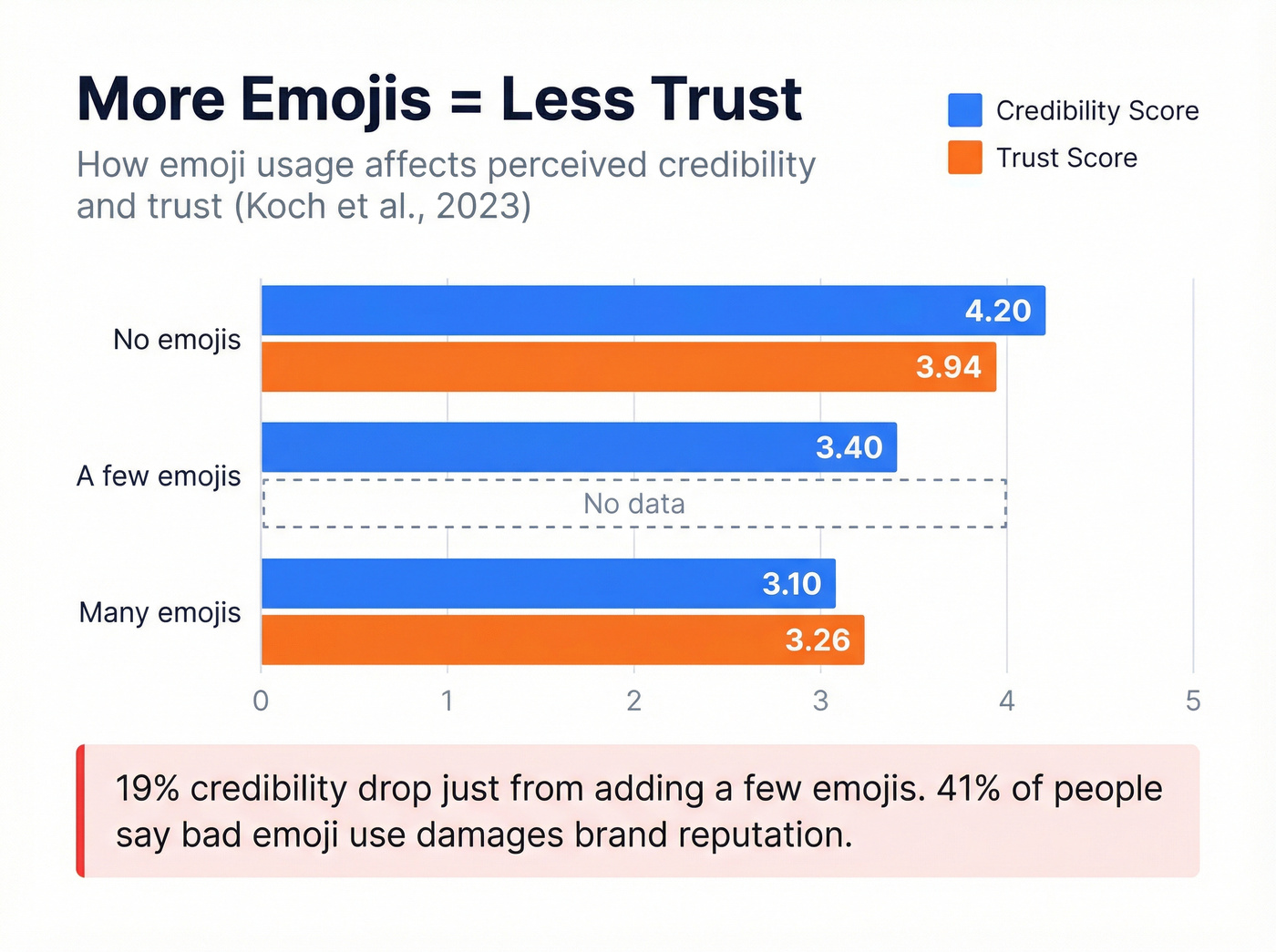
| Emoji Usage | Credibility Score | Trust Score |
|---|---|---|
| None | 4.20 | 3.94 |
| A few | 3.40 | - |
| Many | 3.10 | 3.26 |
That's about a 19% drop in credibility just from adding "a few" emojis. Nielsen's research corroborates this: emojis in subject lines increase negative sentiment by 26%, with recipients describing those emails as "annoying," "boring," or "dull."
The brand damage goes deeper than open rates. In the same research, 41% of respondents said inappropriate emoji use damages brand reputation, and 25% would consider not buying from a brand that misuses them. Another 38% believe brands don't understand cross-cultural emoji meaning - and they're right. A thumbs-up 👍 is positive in the US but offensive in parts of the Middle East. An 🙏 reads as "prayer" to some audiences and "high five" to others. If you're sending to an international list, stick to universally understood symbols like ✅ and ⚠️.
Let's be honest: if you're selling enterprise software to a VP of Engineering, a 🎉 in your subject line actively hurts you. One functional emoji that signals information - not enthusiasm - is the ceiling for B2B. (If you need a broader framework for trust, see how to build credibility in sales.)

A perfectly crafted ⚠️ subject line sent to invalid emails is wasted creativity. Prospeo's 5-step verification delivers 98% email accuracy - so every emoji test hits real inboxes and gives you data you can trust.
Stop A/B testing into the void. Verify your list first.
Which Emojis Perform Best
Frequency doesn't equal performance. Moosend's data shows ✨ appears in 4.97% of subject lines, 🎁 in 4.08%, and ✔ in 2.89% - but that just means they're overused. Here's a starter set weighted toward emojis that create curiosity or signal utility:
| Emoji | Best For | Example |
|---|---|---|
| ⚠️ | Curiosity / warning | ⚠️ Your metrics are lying |
| ✅ | Confirmation / trust | ✅ Demo confirmed Thursday |
| 🔥 | Urgency / heat | 🔥 3 spots left in cohort |
| ⏰ | Deadline | ⏰ Expires at midnight |
| ⭐ | Quality / highlight | ⭐ Top feature just shipped |
| 👋 | Personal / casual | 👋 Quick pipeline question |
Start with ⚠️ and ✅. They're the safest bets across both B2B and B2C. Then test 🔥 and ⏰ for urgency-driven campaigns. The key is testing one emoji against no emoji with identical copy, not swapping three variables at once. If you want more swipeable ideas, pull from re-engagement email subject lines and adapt them.
How to A/B Test Without Fooling Yourself
Most emoji "tests" are garbage because they violate basic experimental design. I've reviewed dozens of these from clients, and the same mistakes show up every time: tiny samples, multiple variables changed at once, results called after two hours. Here's how to do it right.
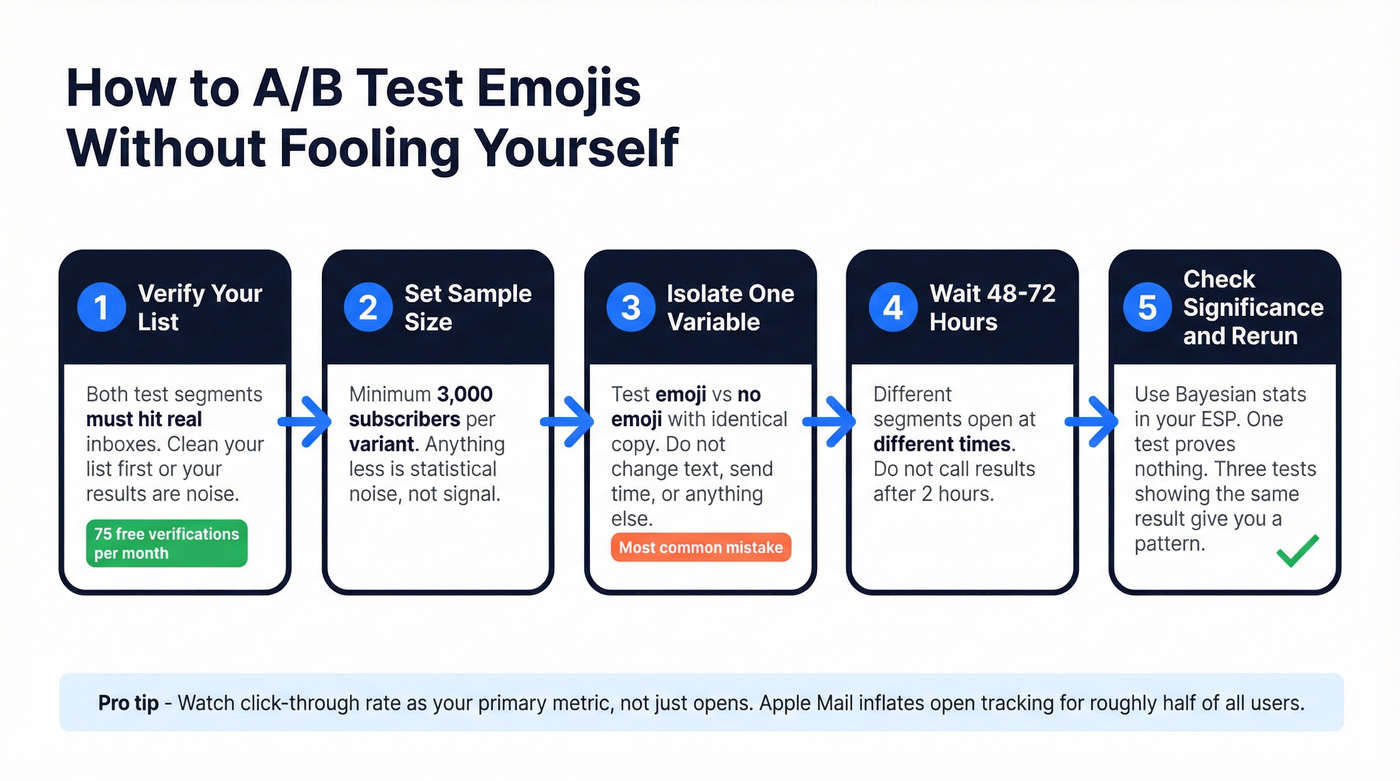
Minimum sample size matters. You need at least 3,000 subscribers per variant. Anything less and your results are statistical noise, not signal.
Isolate the variable. Test emoji vs. no emoji with the same copy. Don't change the emoji AND the subject line text AND the send time. One variable.
Give it time. Don't call it after 2 hours. Different segments open at different times - run for a full 48-72 hour send cycle before drawing conclusions. Then rerun the test. One test proves nothing. Two tests showing the same result start to mean something. Three and you've got a pattern.
Check statistical significance. A Bayesian approach works well here. Most modern ESPs offer this built in. If yours doesn't, you're guessing. (If you need tooling options, see email A/B testing tools.)
Verify your test addresses. Both segments need to send to real, active inboxes - otherwise your results are noise. Prospeo's 5-step verification handles this, and the free tier covers 75 emails per month so you can validate test segments without any commitment. This is also a core part of email verification for outreach.
Rendering and Accessibility
Emojis render differently across email clients, and ignoring this can undermine your subject line strategy entirely.
Gmail (31% global share) sanitizes CSS aggressively but handles emojis well. Apple Mail (48-53% share) renders them natively via WebKit - they'll look clean. Outlook desktop uses the Word rendering engine, so emojis display but look noticeably different: blockier, less polished. Always preview. The classic example: the cookie emoji looks like a chocolate chip cookie on Apple but looked like a cracker on older Samsung devices. These visual differences are subtle but real.
Screen readers read emoji descriptions aloud. A single ⚠️ reads as "warning sign." Three ⚠️⚠️⚠️ reads as "warning sign, warning sign, warning sign" - annoying and inaccessible. Stick to 1-2 emojis max, always include text alongside them, and never use an emoji as the only content in a subject line.
For professional contexts, use default yellow skin-tone emojis. Choosing specific skin tones in marketing emails introduces unnecessary risk with zero upside.
Clean Your List Before Optimizing
Look - a perfectly crafted emoji subject line sent to 30% invalid addresses is a waste of time and a deliverability risk. Your sender reputation takes a hit with every bounce, and once ISPs flag your domain, even the best subject line lands in spam.

Before optimizing subject lines, fix the foundation: SPF, DKIM, and DMARC authentication, plus a clean list. We've watched teams obsess over subject line copy while 35% of their sends bounced - that's the equivalent of rehearsing a speech in an empty room. Meritt dropped their bounce rate from 35% to under 4% after switching to Prospeo's verification, and their pipeline tripled. The free tier verifies 75 emails per month, so you can test it without a credit card. If you want the deeper deliverability checklist, start with SPF, DKIM, DMARC explained and then review invalid emails.
Your emoji strategy only works if your list is alive. Teams using Prospeo cut bounce rates from 35%+ to under 4% - meaning your subject line tests measure real engagement, not deliverability failures. Data refreshed every 7 days, not 6 weeks.
Bad data kills open rates faster than bad emojis ever will.
FAQ
Do emojis trigger spam filters?
No. Emojis themselves don't trigger spam filters. What actually sends you to spam is poor sender reputation, missing authentication (SPF, DKIM, DMARC), and high bounce rates from unverified addresses. Fix your infrastructure and list quality first, then worry about subject line tactics.
How many emojis should I use in a subject line?
One, maybe two. Koch et al.'s research shows credibility drops from 4.20 to 3.10 as emoji count increases. In B2B, one functional emoji like ✅ or ⚠️ is the ceiling. Anything more trades trust for novelty - and it's not a good trade.
Do emojis actually increase open rates?
Yes, with caveats. Emoji subject lines outperform non-emoji lines in CTR 73% of the time, and negative emojis specifically lift opens by ~17% over positive ones. Apple Mail Privacy Protection inflates open tracking for roughly half of all users, so click-through rate is the more reliable metric to watch.
What if my deal sizes are small - should I bother with emoji optimization?
Skip it if your deal sizes are under $15K. Fix your targeting, clean your list, and nail your value prop first. Emojis are a marginal gain on top of a solid foundation, not a substitute for one.