

How to Write a Proposal Email That Gets Opened, Read, and Replied To
You spent three hours crafting the perfect proposal - pricing, scope, timeline, the works. Then you emailed it to a VP who left the company six months ago. The email bounced, and your deal died before it started.
Most people learning how to write a proposal email focus on the copy. But proposal emails don't fail because of bad writing. They fail because of bad targeting, weak subject lines, and zero follow-up. The average B2B conversion rate sits at just 2.9% across 14 industries, and 49.2% of recipients only open a handful of brand emails daily. Your proposal is competing with everything else in that inbox.
Let's make sure it wins.
Pre-Writing Checklist
- Subject line: 2-4 words, personalized, question format. This combination hits a 46% open rate across 5.5M emails.
- Structure: Personalized hook, problem + impact, solution + proof, investment, single CTA. Five parts, no more.
- Verification: Confirm the email address is live and reaches the right person before writing anything.
Verify the Right Contact First
Here's the thing: reps spend hours polishing proposals that bounce because the contact left the company months ago. Or worse, the email lands in a shared inbox nobody checks. Either way, the proposal never reaches a decision-maker, and you've wasted an afternoon.

Verification comes before writing. Prospeo covers 300M+ professional profiles with 98% email accuracy, built on a proprietary 5-step verification process that catches stale addresses, spam traps, and honeypots. Data refreshes every 7 days - not the 6-week industry average. Upload a CSV of your target contacts or search by role, company, and 30+ filters, then export only verified addresses.
If you want to sanity-check your list before sending, use an email accuracy workflow and run a proper email validity check.
Subject Lines That Get Opened
Subject lines are the single highest-leverage element in your proposal email. Get this wrong and nothing else matters.
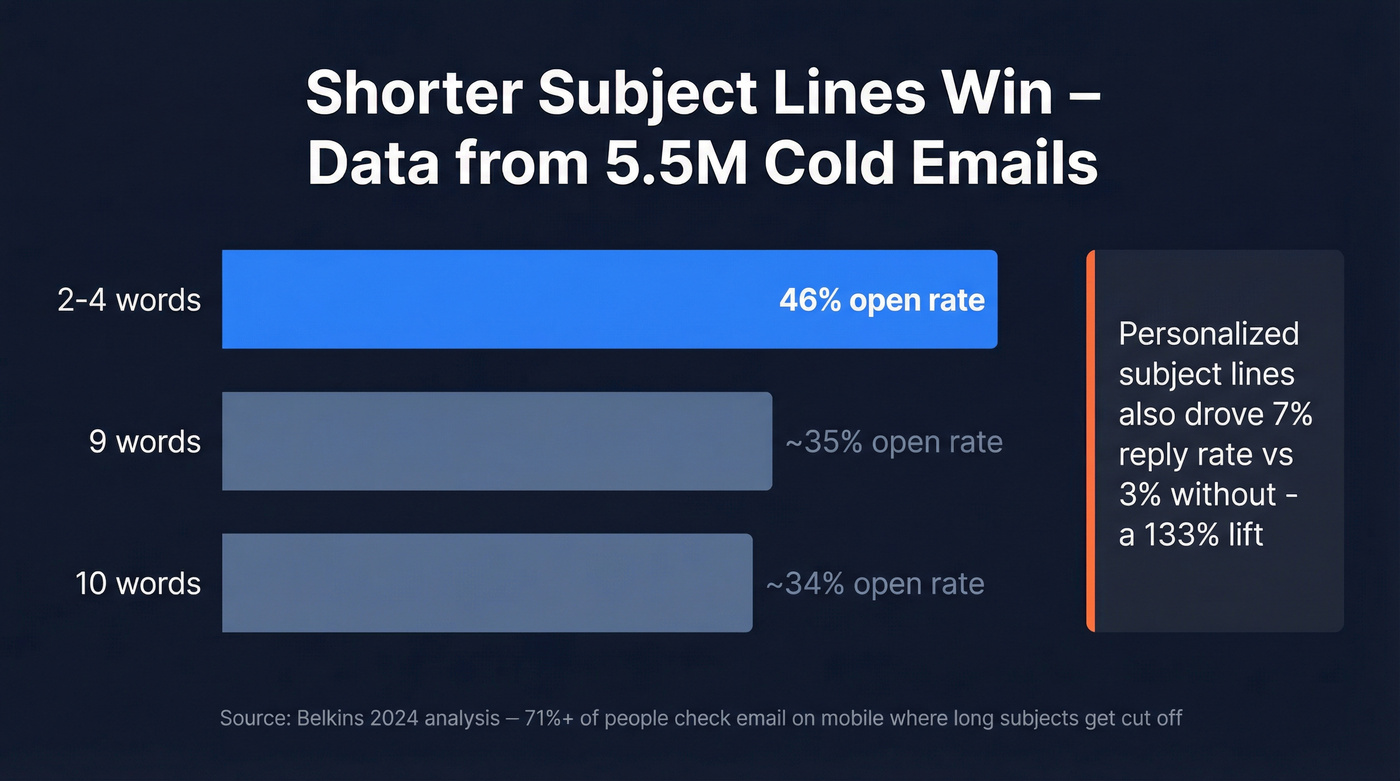
We've seen this play out across hundreds of campaigns, and the data backs it up. Belkins analyzed 5.5M cold emails sent throughout 2024: personalized subject lines hit a 46% open rate versus 35% without - a 31% lift. Question formats matched that 46% ceiling. Hype language ("ASAP," "limited time," "Hello, friend") dragged opens below 36%.
Length matters more than most people think:
| Word Count | Open Rate |
|---|---|
| 2-4 words | 46% |
| 9 words | ~35% |
| 10 words | ~34% |
On mobile - where 71%+ of people check email - anything beyond around 30-50 characters often gets truncated. Your carefully crafted 12-word subject line becomes "Quick question about your Q3 rev..." which tells the reader nothing. Shorter wins.
A few subject lines that work for proposals:
- "Thoughts on [Company]'s pipeline?"
- "[First name], quick scope question"
- "Proposal: [specific project name]"
Don't judge subject lines on opens alone. The real metric is reply rate. Personalized subject lines drove a 7% reply rate versus 3% without - a 133% lift. Test on replies, not vanity opens.
If you need more patterns to test, pull from proven subject lines and avoid common spam triggers.
The 5-Part Proposal Email Structure
Geoffrey James' 7-point proposal email model - gratitude, problem, desired outcome, solution, price, risk reduction, next step - is a solid foundation. But seven sections in an email is too many. I've compressed it into five parts that keep the logic intact while respecting inbox attention spans.
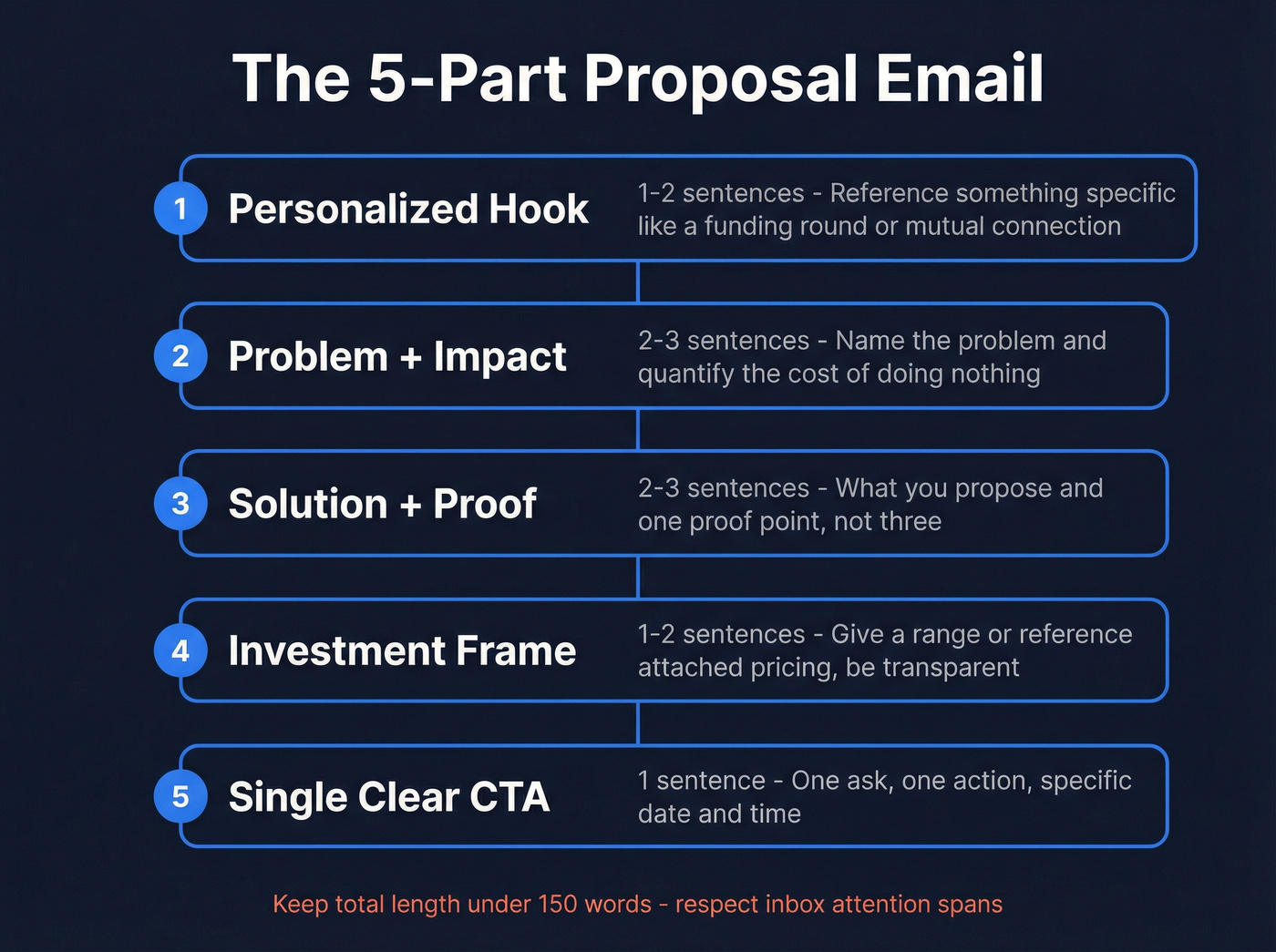
Personalized hook (1-2 sentences). Reference something specific - a recent funding round, a conference conversation, a mutual connection. This proves you're not blasting a template.
Problem + impact (2-3 sentences). Name the problem you're solving and quantify the cost of inaction. "Your team is spending 15 hours/week on manual data entry" hits harder than "we help with efficiency."
Proposed solution + proof (2-3 sentences). What you're proposing and why it works. Include one proof point - a case study, a metric, a client name. One is enough. Three feels desperate.
Investment frame (1-2 sentences). Don't bury pricing. Give a range or reference the attached proposal for detailed pricing. Transparency builds trust; vagueness kills deals.
Single clear CTA (1 sentence). One ask. Not "let me know your thoughts or feel free to book a call or forward to your team." Pick one action. "Are you free Thursday at 2pm for a 20-minute walkthrough?" That's it.
If you want a tighter framework for the body copy, use a proven sales email structure and keep your ask aligned with how to ask for a meeting via email.

You just spent an hour writing the perfect proposal. Don't send it to a dead inbox. Prospeo verifies 300M+ contacts with 98% email accuracy on a 7-day refresh cycle - so your proposal reaches the actual decision-maker, not a bounced address.
Verify your prospect's email before you write a single word.
Personalization Beyond First Name
The average cold email reply rate today hovers around 4-5%. The top 10% of senders hit 10%+. The difference isn't better products or lower prices - it's personalization depth.
Woodpecker's analysis of 20M+ cold emails found that highly personalized messages boost reply rates by up to 142%. Advanced personalization can push reply rates to 18% - nearly 4x the average.
"Hi {first_name}" isn't personalization. It's a merge tag. Actual personalization means referencing trigger events - a recent funding round, a leadership change, a product launch, a new hire in the department you're targeting. A VP of Sales who just joined three weeks ago is spending budget and building processes. A CFO evaluating vendors after a Series B has entirely different priorities than one at a bootstrapped company. Tailor the problem statement to their specific role and situation, and make sure you're reaching the actual decision-maker - not a generic info@ address.
To go deeper, build your outreach around personalization depth and real trigger events.
Proposal Email Templates
Cold Outreach Proposal
Subject: Question about [Company]'s [challenge]
Hi [Name], I noticed [Company] recently [trigger event]. Teams in your space typically struggle with [specific problem], which costs roughly [impact]. We helped [similar company] cut that by [metric] in [timeframe]. I've put together a short proposal - [link]. Worth a look? Happy to walk through it Thursday.
The trigger event proves research, and the single link keeps the email clean.
Warm / Solicited Proposal
Subject: [Project name] proposal
Hi [Name], great speaking with you on [day]. As discussed, here's the proposal covering [scope summary]: [link]. The investment section is on page 3 - I've kept it within the range we discussed. Can we lock in 15 minutes next Tuesday to finalize?
After a conversation, skip the pitch. Go straight to delivery and next steps.
Cold vs. Warm - Key Differences
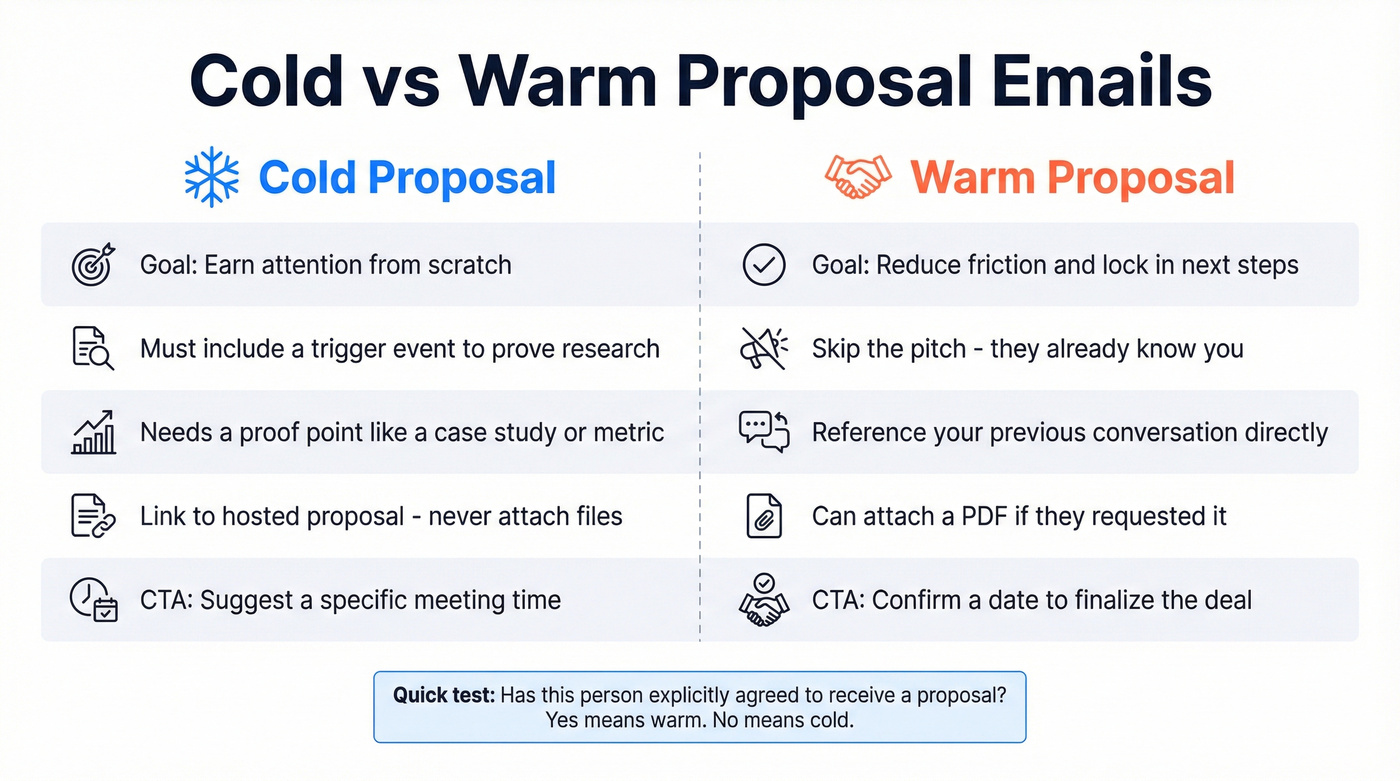
Cold proposals need to earn attention with a trigger event and proof point. Warm proposals already have trust - your job is to reduce friction and lock in next steps. If you're unsure which to send, ask yourself: has this person explicitly agreed to receive a proposal? If yes, warm. If no, cold.
Quotation Follow-Up
Subject: Updated quote for [project]
Hi [Name], attached is the updated quote reflecting [specific change they requested]. The total comes to [amount] with a [timeframe] delivery window. If this looks right, I can send the SOW today. Does that work?
Quotation emails should be transactional - state the number, reference the change, propose the next step.
Internal Project Pitch
Think of this as a before/after. Before: you walk into a standup, ramble for five minutes, and your boss says "send me something in writing." After: you send the email below, and your boss shows up to the meeting already bought in.
Subject: [Project name] - budget request
Hi [Name], I'd like to propose [project] for Q[X]. The problem: [specific internal pain + cost]. The fix: [solution summary] at an estimated [cost range], with [expected ROI or outcome]. Full scope here: [link]. Can I get 10 minutes at Thursday's standup?
Partnership Proposal
Subject: [Your company] + [Their company]
Hi [Name], [Your company] works with [audience overlap]. I think there's a natural fit between [your offering] and [their offering] - specifically around [shared customer pain]. I've drafted a short partnership proposal: [link]. Would you be open to a 15-minute call to explore this?
Partnership emails should lead with mutual benefit, not your needs.
If you're sending this type of outreach, compare against a dedicated business partnership email playbook.
RFP Response Checklist
RFP responses are formal. Instead of a template, run through this before hitting send:
- Subject line includes the RFP name/number and your company name
- Response structure mirrors the RFP's own sections
- Key differentiators appear on pages 2-3, not buried at the end
- You've offered specific availability for follow-up questions
- File format matches what they requested (PDF, not .docx)
Attach It or Link It?
If your deal size is under $10k, you almost certainly don't need a multi-page attached proposal on first touch. A single clean link to a hosted proposal page will outperform an attachment every time.
On first touch, don't attach anything. Unsolicited attachments trigger spam filters - especially macro-enabled files like .docm, .xlsm, or archives like .zip. Even a clean PDF can slow mobile downloads and trigger extra scanning.
Designed proposals convert 82% better than plain text ones, so use a hosted proposal tool that renders beautifully on any device. You also get analytics - you'll know when they opened it, how long they spent on each page, and whether they forwarded it. If the prospect asks for a PDF, send a lightweight 1-2 page version. But on first touch, a single clean link wins.
Sending Without Landing in Spam
A perfect proposal email is worthless if it hits spam. Knowing how to write a proposal email is only half the battle - the other half is making sure it actually lands.
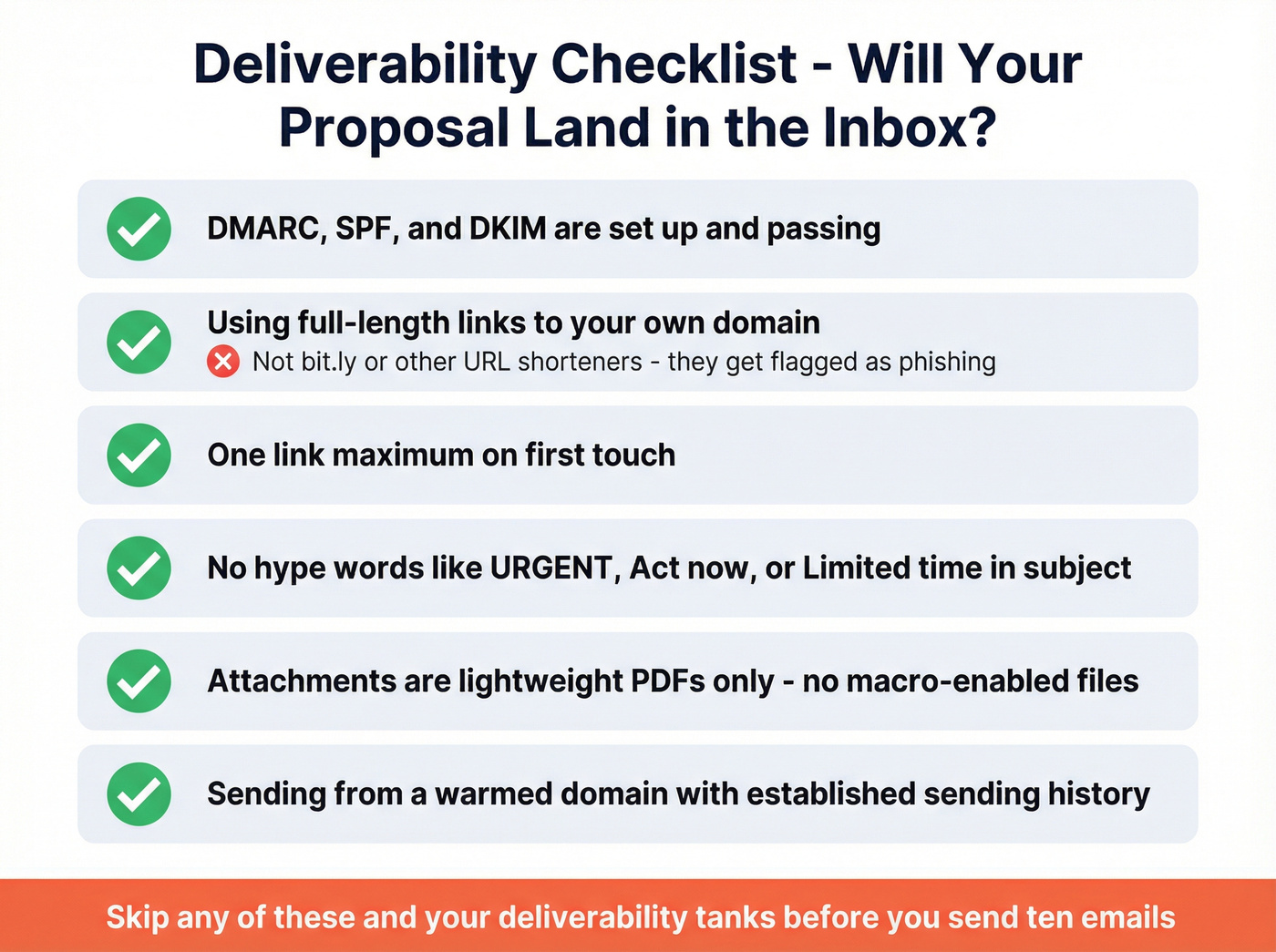
- DMARC, SPF, and DKIM are set up and passing. If you don't know what these are, ask your IT team today - not tomorrow.
- No URL shorteners. Bit.ly and similar services get flagged as phishing vectors. Use a full-length link to your own domain.
- One link maximum on first touch. Multiple links look like marketing blasts.
- No hype language in the subject line. "URGENT," "Act now," "Don't miss this" - all spam triggers.
- No macro-enabled attachments. If you must attach something, a lightweight PDF is the only safe option.
- Send from a warmed domain. New domains with no sending history get filtered aggressively. Skip this step and your deliverability tanks before you've sent ten emails.
For a deeper setup, follow a full email deliverability checklist and make sure your SPF, DKIM, DMARC configuration is correct.
The Follow-Up Sequence
Most deals close between touch 3 and touch 5. Sending one proposal email and waiting is leaving money on the table.
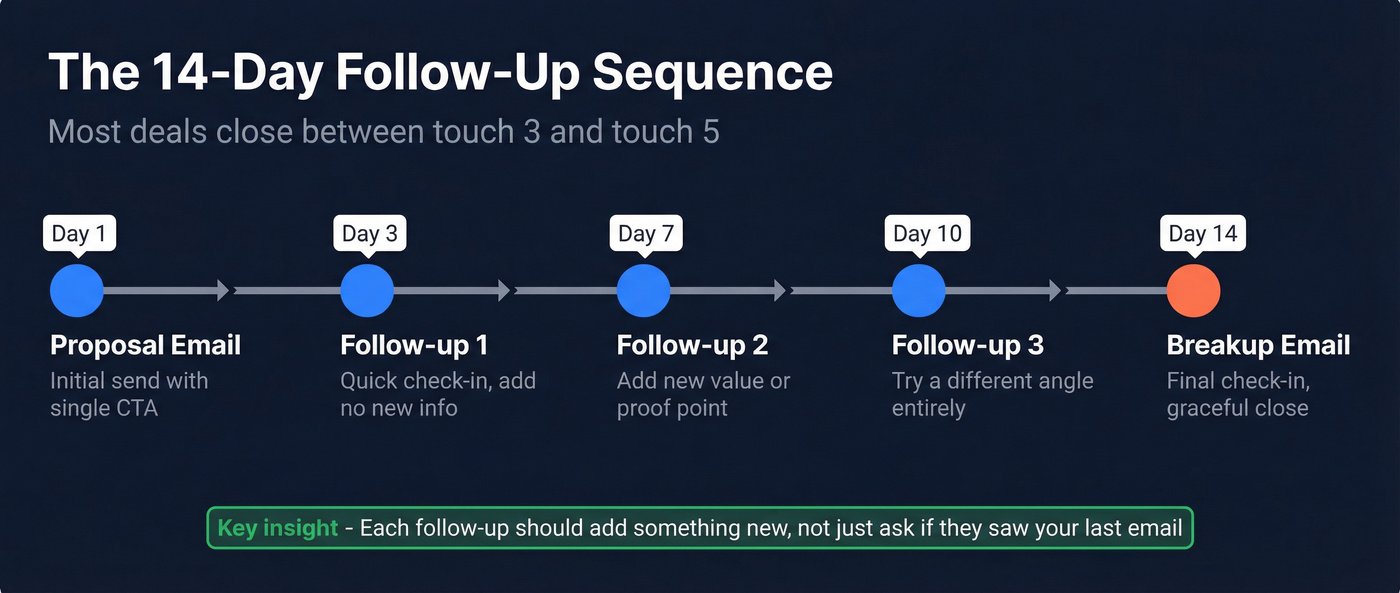
| Day | Touch | Purpose |
|---|---|---|
| 1 | Proposal email | Initial send |
| 3 | Follow-up #1 | Quick check-in |
| 7 | Follow-up #2 | Add new value/proof |
| 10 | Follow-up #3 | Different angle |
| 14 | Breakup email | Final check-in |
Follow-up #1 (Day 3):
Hi [Name], wanted to make sure the proposal landed - I know inboxes get buried. The key number: [headline metric or ROI]. Worth 10 minutes this week? [Specific time suggestion.]
Keep it short. You're not re-pitching. You're making it easy to respond.
Breakup email (Day 14):
Hi [Name], I haven't heard back, so I'll assume the timing isn't right. No hard feelings - I'll close this thread out. If [problem] comes back up, the proposal link still works: [link]. Wishing you a great Q[X].
In our experience, the breakup email pulls the highest reply rate in the sequence. Removing pressure counterintuitively creates urgency. The consensus on r/sales backs this up - breakup emails consistently outperform the "just checking in" messages that most reps default to.
If you want more cadence options, use a proven prospect follow up sequence and benchmark your follow-up email reply rate.
Personalization that drives 142% higher reply rates starts with real data - job changes, funding rounds, department growth. Prospeo gives you 50+ data points per contact and 30+ search filters to find the exact trigger events that make your proposal impossible to ignore.
Stop guessing. Build proposals around verified buyer signals.
FAQ
How long should a proposal email be?
150-200 words max. The detailed proposal - scope, pricing, timeline - belongs in a linked document, not the email body. Your email's job is to provide context, communicate value, and drive one clear action.
What's the best subject line for a proposal email?
Short and personalized. Data from 5.5M emails shows 2-4 word personalized subject lines hit 46% open rates. Try a question format referencing the recipient's company or challenge - something like "Thoughts on [Company]'s pipeline?"
Should I attach my proposal or link to it?
Link on first touch. Attachments trigger spam filters, and 71%+ of people check email on mobile where downloads are slow. Use a hosted proposal page with built-in analytics. Only attach a PDF after the prospect requests one.
How many follow-ups should I send after a proposal?
Send 3-4 follow-ups over 14 days. Space them at days 3, 7, 10, and 14. Each follow-up should add new value - a fresh proof point, a different angle, or a breakup message. Most deals close between touch 3 and touch 5.