

Questions to Ask Prospects in Sales: A Data-Backed Playbook
You don't have a question problem - you have a question volume problem. Gong analyzed 326K sales calls and found that reps who won asked 15-16 questions per call. Reps who lost asked 20 or more. More questions didn't mean more insight. It meant an interrogation.
You don't need 50 generic prompts. You need 15 sharp questions matched to the buyer sitting across from you.
What the Data Says
Gong's 326K-call analysis gives us the clearest benchmarks available. The overall average is 60% rep talk time, but the outcome split matters more: closed-won calls averaged 57% versus 62% on lost calls. That five-point gap holds across a massive sample.
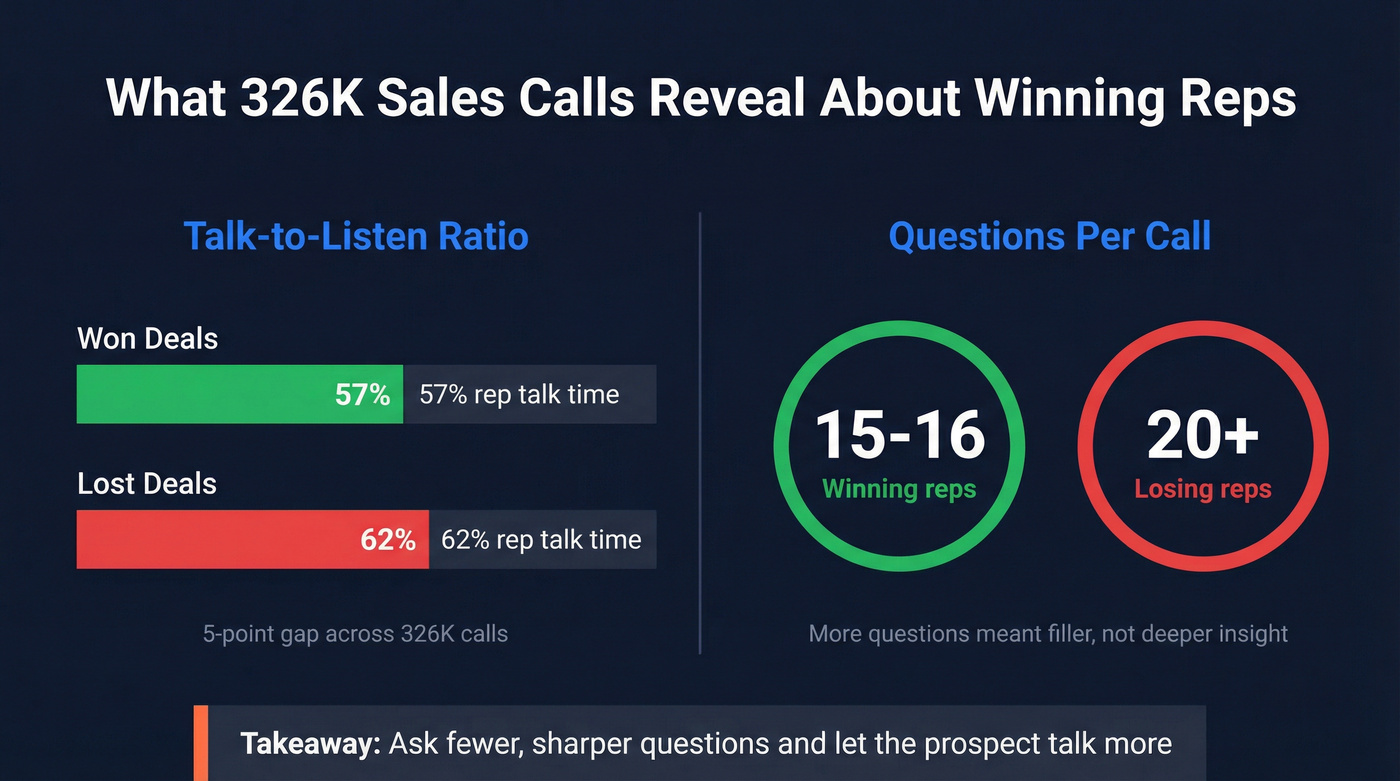
The question count finding is more actionable. Winning reps asked 15-16 questions; losing reps pushed past 20. The extra questions weren't deeper - they were filler from reps who hadn't listened to the answers. One more pattern worth noting: high performers maintained consistent talk-to-listen ratios whether they won or lost, while low performers swung wildly. Consistency signals control, and buyers feel that.
We've watched reps cut their question count by a third and immediately see better engagement from prospects. The best discovery calls feel like conversations, not depositions.
Best Sales Questions by Stage
Opening & Rapport
Skip "How's your day?" and lead with something that proves homework.
If you need stronger first lines, borrow from proven sales pitch opening patterns.
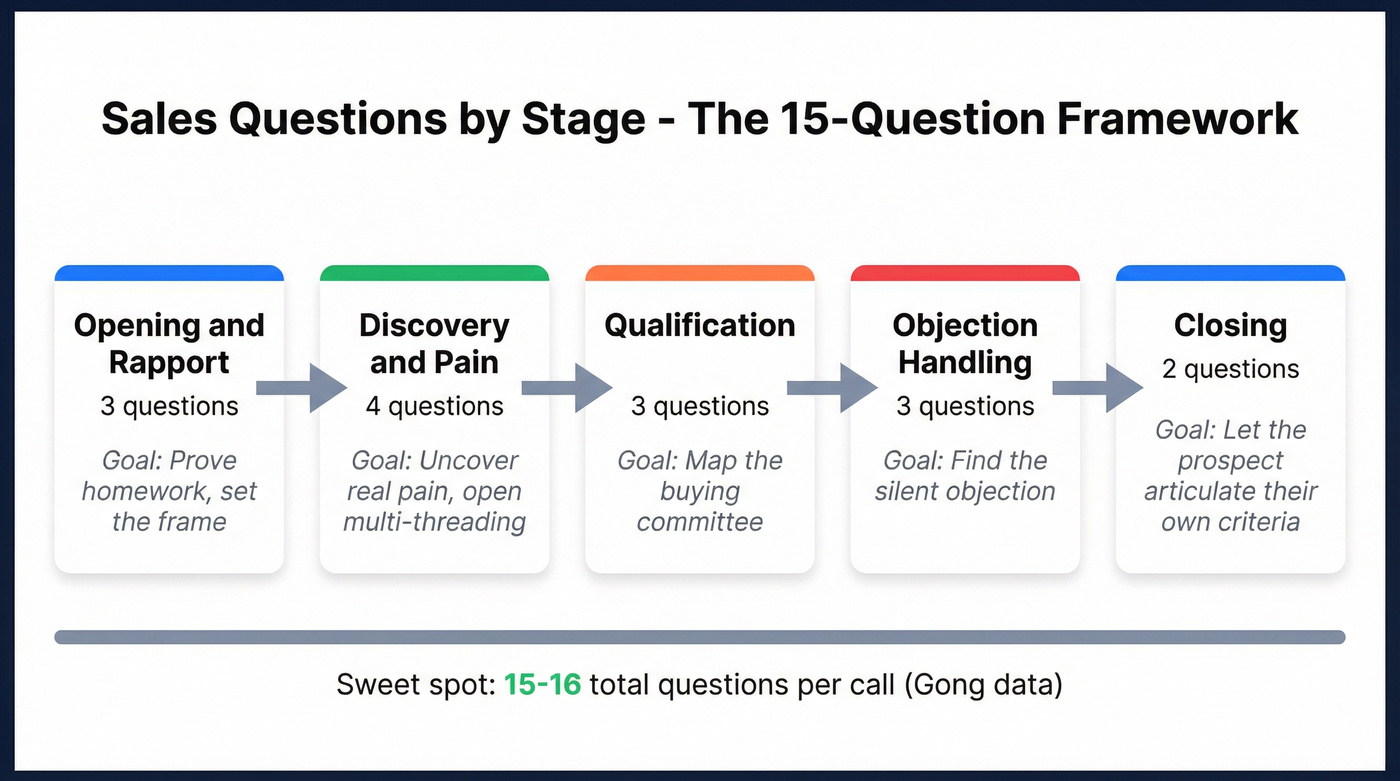
- "What made you take this meeting?" - Forces the prospect to articulate their own motivation immediately.
- "I noticed [specific company event]. How's that affecting your team?" - Proves research and opens a real conversation.
- "I'll keep this tight - what would make this 30 minutes worthwhile for you?" - Respects their time and sets a collaborative frame.
Discovery & Pain
Open-ended questions do the heavy lifting here. Questions starting with "what," "how," or "tell me about" beat yes/no questions because they pull out context you can't get any other way. This stage separates reps who uncover real pain from those who skim the surface.
- "What's the biggest bottleneck in [process] right now?" - Goes straight to pain without assuming you know what it is.
- "How are you solving that today, and what's breaking?" - Surfaces the gap between current state and what they actually need.
- "What happens if this doesn't get fixed next quarter?" - Quantifies urgency. If they can't articulate consequences, it's probably not urgent yet.
- "Who else on your team feels this pain most acutely?" - Opens the door to multi-threading. Gong's analysis of 1.8M opportunities found that multi-threading boosts win rates by 130% in deals over $50K, with strategic enterprise deals averaging 17 contacts.
Qualification & Stakeholders
If you're only talking to one person, you're not qualified - you're hoping. When enterprise reps bring in a sales engineer, win rates jump by up to 30%.
If you want a tighter system for this stage, use an account qualification framework.
- "Besides yourself, who needs to sign off?" - Direct and unapologetic. Don't dance around the buying committee.
- "What does your evaluation process typically look like?" - Reveals timeline, stakeholders, and procurement hurdles in one question.
- "Can I ask a tough question - has your team evaluated something like this before? What happened?" - The permission preface lowers defenses, then you uncover past failures, internal politics, and hidden objections all at once.
Objection Handling
Most objections fall into four buckets: budget, timing, need, and authority. Your job isn't to overcome the objection - it's to understand the real concern underneath.
For a deeper breakdown, see the common types of objections.
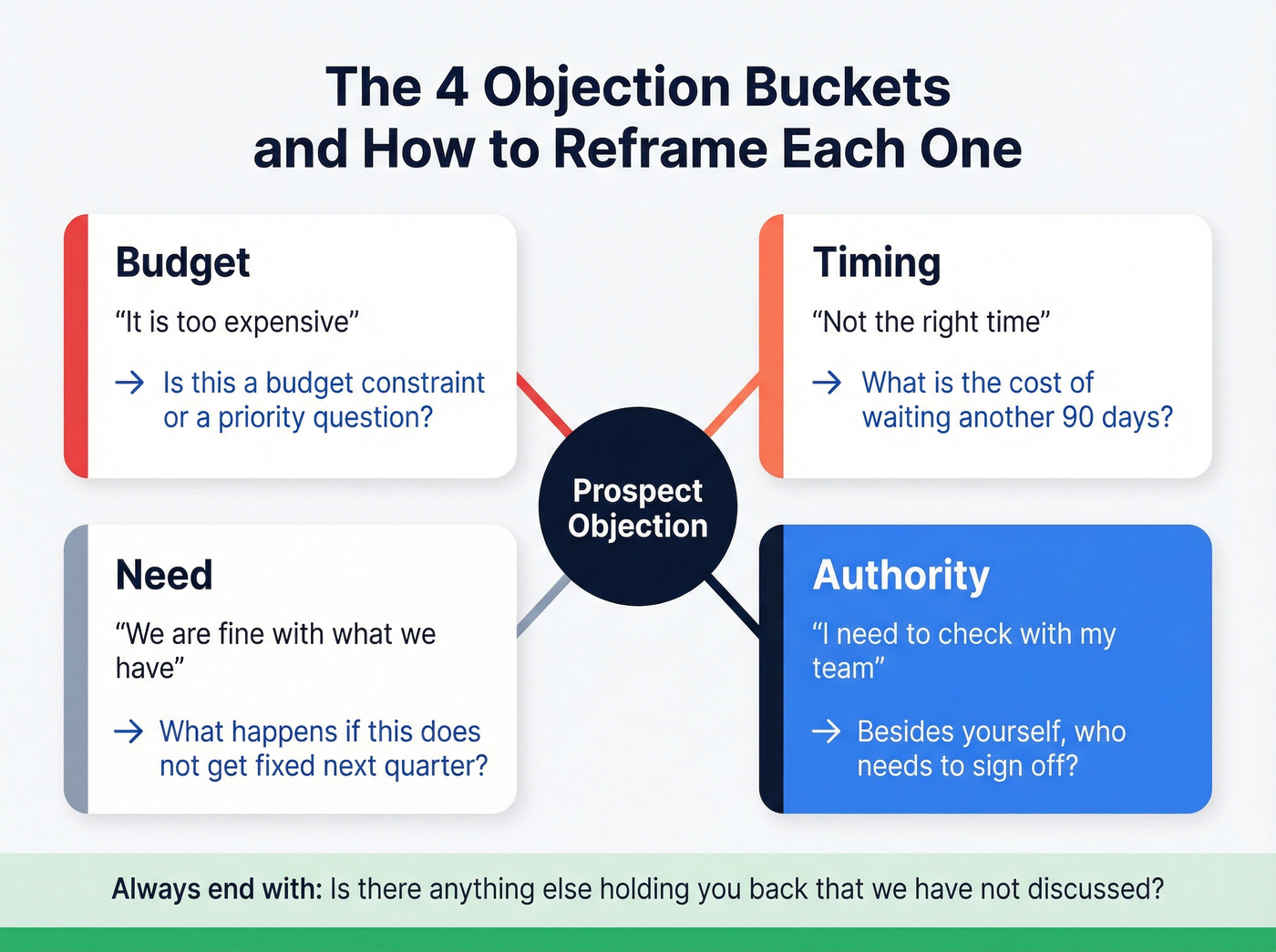
Here's the thing: when a prospect says "it's too expensive," you could defend pricing. Or you could ask "Help me understand - is this a budget constraint or a priority question?" That single question separates "we can't afford it" from "we don't want to afford it." Follow with "What outcomes would make this feel worthwhile despite the cost?" to reframe price as investment. Then always close with "Is there anything else holding you back that we haven't discussed?" The silent objection is the one that kills deals after the call ends.
Closing
Gartner found that 77% of B2B buyers describe their last purchase as extremely complex. Your closing questions need to simplify, not add pressure.
The best close we've seen isn't a close at all - it's a mirror. Ask "Based on everything we've discussed, what would need to be true for you to move forward this quarter?" and let the prospect articulate their own decision criteria. If urgency is missing, follow with "What's the cost of waiting another 90 days?" If they can't answer that, the deal isn't ready. And that's useful information too.
Tailoring Questions by Buyer Persona
A CFO and a CTO care about fundamentally different things. Generic scripts miss both.
| Persona | Priority | Go-To Question |
|---|---|---|
| CFO / Finance | ROI, payback | "What's your expected payback period?" |
| CTO / VP Eng | Integration, security | "What does your security review look like?" |
| CEO / Founder | Growth, competition | "What's the biggest constraint on growth?" |
| VP Operations | Efficiency, process | "How many hours does your team spend on [manual process] weekly?" |
Let's be honest: if your average deal size is under $10K, you probably don't need persona-specific scripts. A strong discovery framework covers it. Persona tailoring pays off when deals are complex enough that the wrong question to the wrong stakeholder stalls the entire buying committee.
If you're mapping roles across the committee, use buying group personas to avoid blind spots.

Multi-threading boosts win rates by 130%, but only if you can actually reach every stakeholder. Prospeo gives you verified emails and direct dials for entire buying committees - 98% email accuracy, 125M+ mobile numbers, refreshed every 7 days.
Stop prepping perfect questions for contacts you can't reach.
Questions to Avoid
Every bad question reveals you didn't prepare. "Is this Bob?" tells the prospect you're cold-dialing from a list. "What does your company do?" tells them you couldn't spend 30 seconds on their website.
Instead, lead with what you already know. Replace "Do you have budget?" with "How does your team typically fund initiatives like this?" The pattern is simple: assume competence, demonstrate preparation. The consensus on r/sales is pretty clear on this - prospects can smell an unprepared rep within the first 15 seconds, and you won't recover from that.
If you're doing this on the phone, keep a simple cold call checklist next to your dialer.
Better Data Means Better Questions
None of these questions matter if you're calling the wrong person. Before you prep a single discovery question, verify you're reaching the right contact with current info. Prospeo gives you verified emails and direct dials refreshed every 7 days with 98% email accuracy, so your discovery prep doesn't go to waste because your data hasn't been updated since last quarter.
If you're seeing bounce spikes or stale records, start with B2B contact data decay and then tighten your CRM hygiene.
Framework Reference
| Framework | Best For | Key Idea |
|---|---|---|
| BANT | Short cycles, 1-3 stakeholders | Budget, Authority, Need, Timeline |
| MEDDIC | Enterprise, 6+ stakeholders | Maps buying committee + decision process |
| SPIN (Neil Rackham) | Any discovery conversation | Situation -> Problem -> Implication -> Need-payoff |
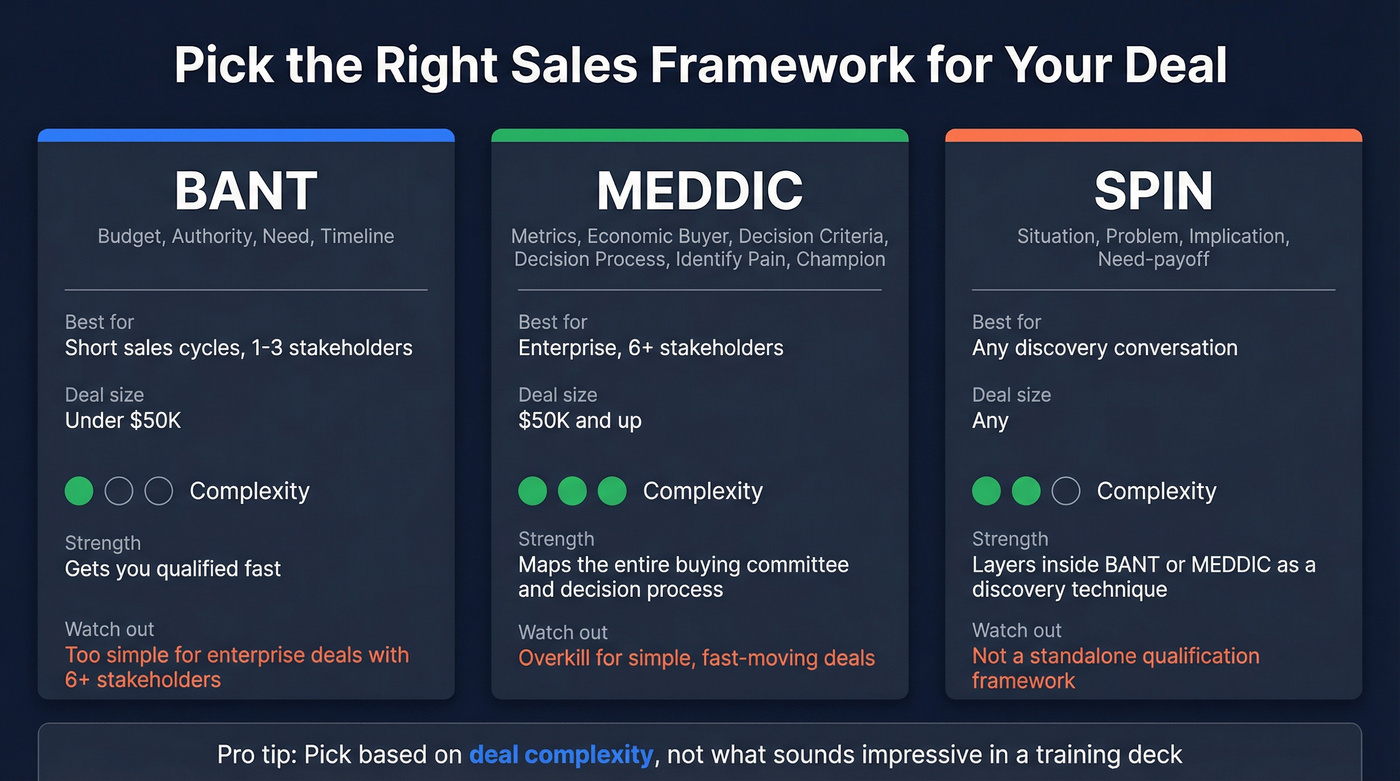
BANT gets you qualified fast. MEDDIC keeps complex deals from stalling. SPIN works inside either framework as a discovery technique - pick based on deal complexity, not what sounds impressive in a training deck. Skip BANT if you're running six-figure enterprise deals with a dozen stakeholders; it wasn't built for that.
If you're selling into longer cycles, align your process to the full SaaS sales cycle.
Your discovery prep is wasted when your data is stale. Prospeo refreshes 300M+ profiles every 7 days - not every 6 weeks - so you walk into every call knowing you have the right person, role, and contact info.
Reach the right buyer before you ask your first question.
FAQ
How many questions should I ask on a discovery call?
Gong's 326K-call study found 15-16 questions correlates with winning deals, while 20+ creates an interrogation dynamic. Aim for fewer, deeper questions and let the prospect talk more than you do. Quality beats quantity every time.
What's the best sales qualification framework?
BANT works for shorter cycles with few stakeholders. MEDDIC handles enterprise deals with 6+ person buying committees. SPIN is a discovery technique that layers inside either framework - pick based on deal complexity.
How do I research a prospect before the first call?
Check the prospect's role, company size, recent funding, and news before dialing. Use a B2B data platform to verify you have the right contact and current direct dial, then tailor your opening questions using the persona-specific examples above.
What open-ended sales questions work best?
Questions starting with "what," "how," or "tell me about" consistently outperform yes/no questions because they pull out context. "What's the biggest bottleneck in [process] right now?" beats "Are you having problems with [process]?" every single time.