

Sales Methodology vs Sales Process: The Difference, How to Choose, and What Makes It Stick
The sales methodology vs sales process confusion isn't a debate - it's a misunderstanding that costs teams months of wasted enablement budget. Here's how it usually plays out: your VP announces the team is adopting MEDDIC. There's a two-day offsite. By week three, half the team is filling CRM fields with placeholder text and running deals the same way they always have.
Meanwhile, reps spend 60% of their time on non-selling tasks and juggle an average of eight tools. A methodology that doesn't plug into that reality is just another slide deck.
The Quick Version
Every guide on this topic tells you "you need both a process and a methodology." True. Also useless.
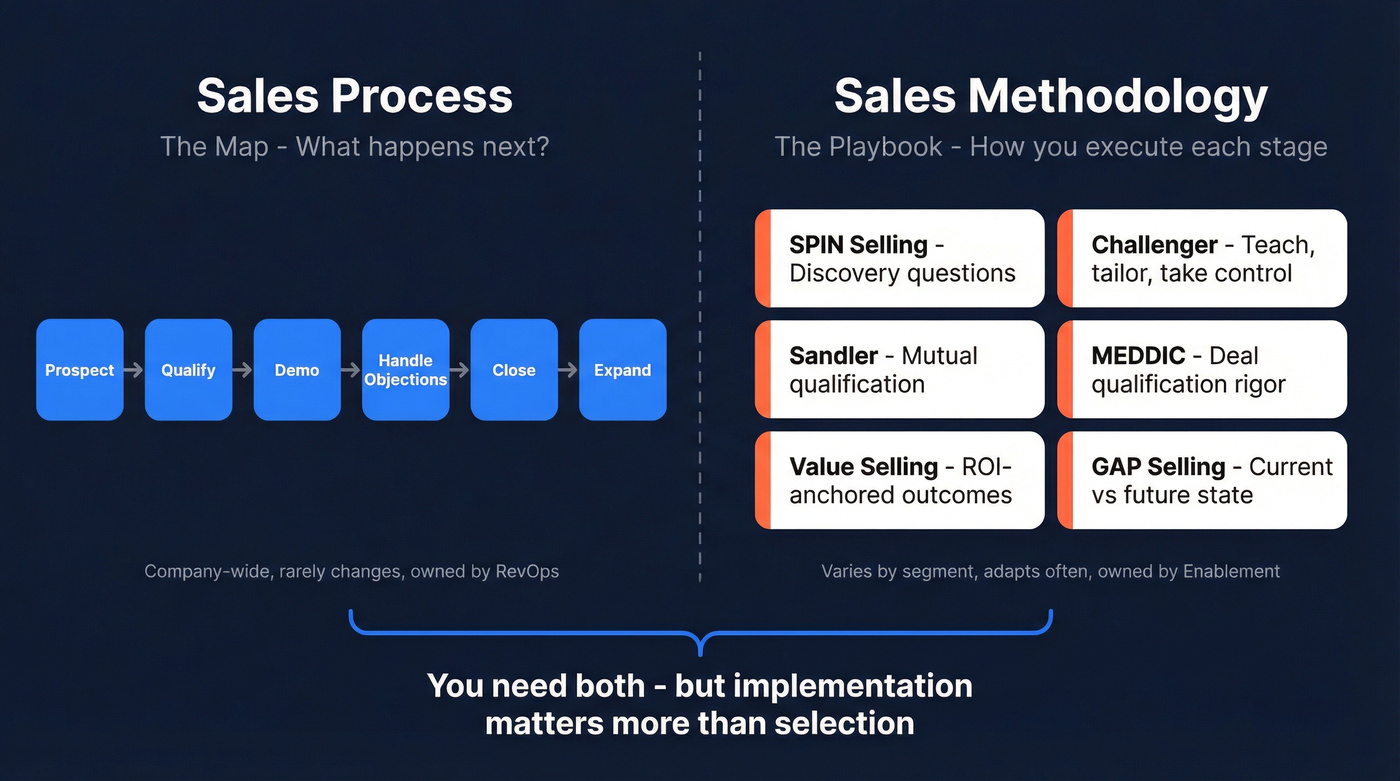
The real question is which methodology fits your deal and whether your team will actually use it. Here's the short answer:
- Sales process = the stages (what happens when). Sales methodology = the playbook (how you execute each stage).
- A 2020 survey of 400 B2B SaaS leaders found little perceived difference in effectiveness across methodologies - implementation was the real variable.
- Match methodology to deal complexity: MEDDIC for $50K+ enterprise, SPIN or Challenger for mid-market, Sandler for deals under $25K.
What Is a Sales Process?
A sales process is the sequence of stages a deal moves through from first touch to closed-won. It's the map. It answers "what happens next?" without telling reps how to navigate each step.
Most B2B teams run some variation of six stages: prospecting, qualifying, presenting/demo, handling objections, closing, and follow-up/expansion. The stages themselves aren't controversial - what matters is whether your team actually follows them consistently, not just when the deal is big enough or the manager is watching. An ATD analysis of Brooks Group's research across hundreds of B2B sales leaders found that overperforming organizations follow a structured process every single time.
What Is a Sales Methodology?
A methodology is how your reps execute within each stage. If the process is the map, the methodology is the driving instructions - when to accelerate, when to brake, how to handle the tricky intersections.
The most common methodologies in B2B today:
- SPIN Selling - structured discovery through Situation, Problem, Implication, Need-Payoff questions
- Challenger - teach, tailor, take control; best when buyers think they already know what they need
- Sandler - mutual qualification where the rep decides if the buyer is worth pursuing, not just the other way around
- MEDDIC / MEDDPICC - rigorous deal qualification for complex enterprise sales (see MEDDIC vs MEDDPICC)
- Value Selling - anchored to quantifiable business outcomes
- GAP Selling - focused on the gap between the buyer's current state and desired future state
Each one shapes how reps have conversations, not which conversations they have. That's the fundamental distinction.

Every methodology - MEDDIC, Challenger, SPIN - fails at stage one if your reps are prospecting with dead data. Prospeo refreshes 300M+ profiles every 7 days and delivers 98% email accuracy, so your process never stalls before the playbook even kicks in.
Fix your prospecting stage first. Everything else follows.
Key Differences at a Glance
| Dimension | Sales Process | Sales Methodology |
|---|---|---|
| Definition | Stages a deal moves through | How reps execute each stage |
| Scope | Company-wide | Can vary by segment or deal type |
| Changes how often | Rarely | Adapts to market and buyer shifts |
| Who owns it | RevOps / Sales leadership | Enablement / frontline managers |
| Example | Prospect -> Qualify -> Close | MEDDIC, Challenger, SPIN |
Understanding this distinction at a practical level is what separates teams that adopt once and stick from teams that retrain every eighteen months.
How to Match Methodology to Your Deal
Most guides list methodologies and say "pick the one that fits." That's useless without a framework for what "fits" actually means. Here's the decision matrix we've found most useful, built around deal complexity and buyer sophistication:
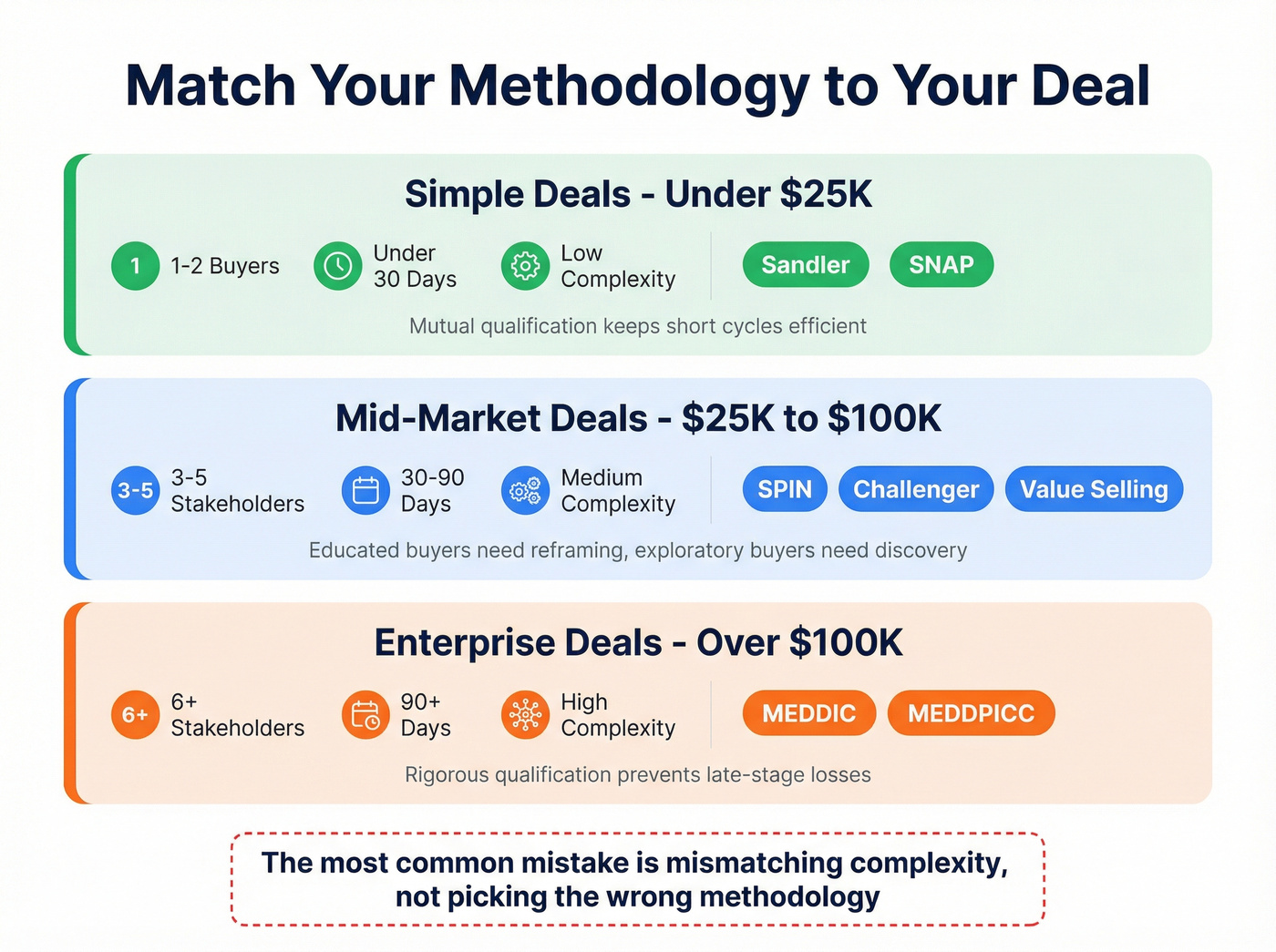
| Deal Profile | Best-Fit Methodology |
|---|---|
| Under $25K, 1-2 buyers, under 30 days | Sandler, SNAP |
| $25K-$100K, 3-5 stakeholders, 30-90 days | SPIN, Challenger, Value Selling |
| Over $100K, 6+ stakeholders, 90+ days | MEDDIC, MEDDPICC |
Deal size alone doesn't tell the whole story, though. Educated buyers who've already done their research respond to Challenger because it reframes what they think they know. Exploratory buyers still defining the problem need SPIN-style discovery to articulate needs they haven't fully formed yet. Mandate-driven buyers with a business case to justify need Value Selling for the ROI ammunition their CFO demands.
Let's be honest: MEDDIC is overkill for a $15K deal. Sandler is underpowered for a $200K enterprise cycle with eight stakeholders and a procurement team breathing down everyone's neck. Mismatching methodology to deal complexity is the single most common mistake we see - and it's more damaging than picking the "wrong" methodology at the right complexity level.
One thing worth flagging: before any methodology kicks in, your prospecting stage needs live contacts. 73% of B2B buyers actively avoid sellers who send irrelevant outreach, and nothing's more irrelevant than an email that bounces. Tools like Prospeo verify emails in real time on a 7-day refresh cycle, keeping bounce rates under 2% so reps aren't burning the first stage of the process on dead data (more on B2B contact data decay and prospect data accuracy).
Why Adoption Matters More Than Selection
That MetaCX survey found something our team keeps coming back to: how you apply a methodology matters more than which one you adopt. There was little perceived difference in effectiveness across methodologies. The gap was in execution.
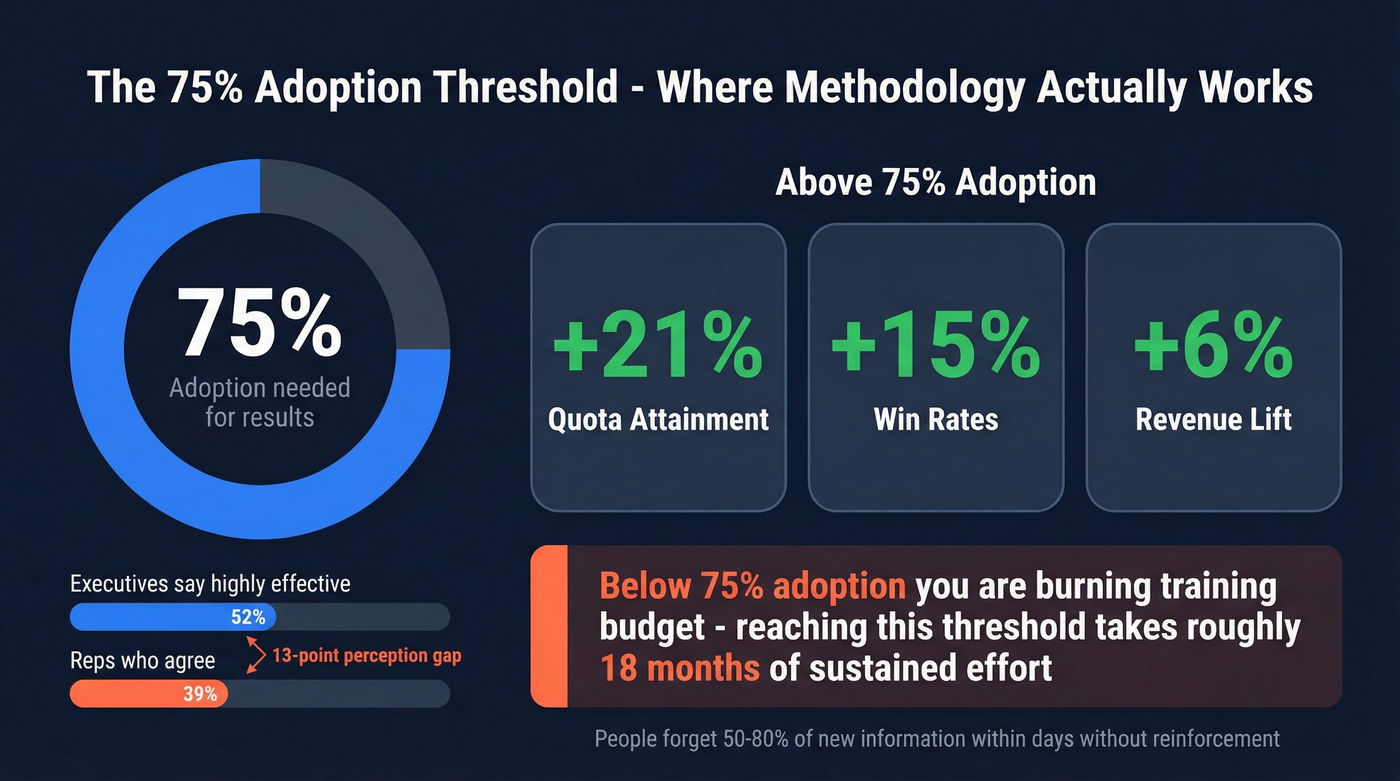
Here's the number that should worry every sales leader: 52% of executives rated their methodology "highly effective," but only 39% of individual contributors agreed. That's a 13-point disconnect between the people who bought the training and the people who are supposed to use it.
People forget 50-80% of new information within days without reinforcement. A two-day workshop followed by nothing is the most expensive way to change nothing. Kunkle's research suggests 75% adoption is the threshold where methodology starts producing results, and Korn Ferry's data backs this up: organizations above that line see +21% quota attainment, +15% win rates, and +6% revenue lift. Below it, you're burning training budget. Reaching 75% adoption in a larger org takes roughly 18 months of sustained effort - there's no shortcut (tie this to sales training KPIs and sales coaching best practices).
How to Make It Stick
MRG's research found only 25% of organizations measure the practices that drive outcomes rather than just measuring outcomes themselves. That tells you everything about why rollouts fail.
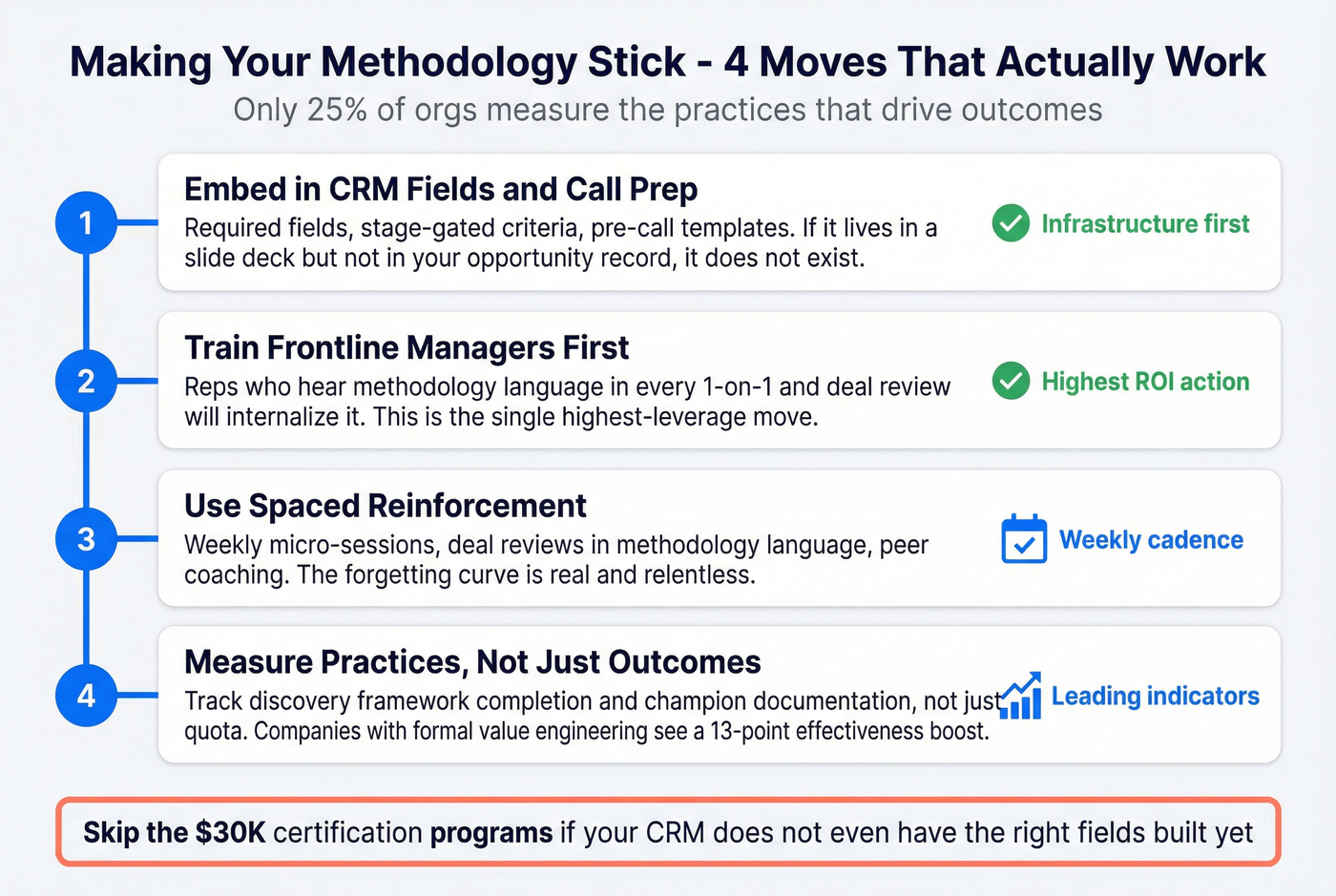
What actually works:
Embed methodology in CRM fields and call prep. If MEDDIC lives in a slide deck but not in your opportunity record, it doesn't exist. Required fields, stage-gated criteria, pre-call templates - all of it needs to live where reps already work (see AI CRM data entry automation and CRM hygiene).
Train frontline managers first. A rep who hears methodology language in every 1:1 and deal review will internalize it. A rep who only heard it at the offsite won't. This is the single highest-leverage move you can make.
Use spaced reinforcement. Weekly micro-sessions, deal reviews using methodology language, peer coaching. The forgetting curve is real and relentless, and no amount of enthusiasm at the offsite changes the neuroscience.
Measure practices, not just outcomes. Track whether reps complete discovery frameworks and document champion relationships - not just whether they hit quota. Companies with a formal value engineering function report a 13-point increase in perceived methodology effectiveness.
Skip the "methodology certification" programs that cost $30K+ per cohort if your CRM doesn't even have the right fields built yet. Fix the infrastructure first.
Adoption breaks when reps waste hours on non-selling tasks. Prospeo's Chrome extension (used by 40,000+ reps) finds verified emails and direct dials in one click - so your team spends time executing the methodology, not hunting for contacts.
Give your reps the contacts. Let the methodology do the rest.
FAQ
Do I need both a methodology and a process?
Yes. The process defines your stages; the methodology defines how reps execute each one. Teams that integrate both see +15% win rates and +21% quota attainment once adoption crosses the 75% threshold.
Can you use multiple methodologies at once?
Many teams use MEDDIC for qualification and Challenger for discovery within the same process. The stages stay consistent; the methodology flexes by stage or deal segment. This is common in orgs selling across SMB and enterprise simultaneously.
What's the difference between a framework and a methodology?
A framework like BANT is a qualification checklist - a narrow tool for one stage. A methodology like Challenger is a broader approach governing how you sell across the entire cycle. Frameworks often live inside methodologies as stage-specific tools.
What's the fastest way to fix a broken prospecting stage?
Map where deals stall, then fix that stage first. If it's prospecting, bad contact data is usually the culprit - bounced emails and wrong numbers kill momentum before any methodology can help. Real-time email verification with a short refresh cycle keeps your pipeline clean from the start.