

Loom vs Vidyard: Which Video Tool Actually Fits Your Workflow?
Your SDR manager just dropped the request: "We need a video tool for outbound." The Loom vs Vidyard debate starts immediately. They look similar on the surface - but they solve fundamentally different problems, and picking the wrong one means you're either overpaying for features you'll never touch or missing the CRM integrations your reps actually need.
30-Second Verdict
Pick Vidyard if your sales team lives in Salesforce or HubSpot and needs CRM-connected video analytics, sequencer integrations, and viewer-level engagement data.
Pick Loom if you need fast, frictionless async video for internal comms, product walkthroughs, support documentation, or engineering handoffs - especially on a budget.
Skip both if your prospect email list bounces above 10%. Neither video platform can save a personalized recording sent to a dead inbox. Fix your data first, then pick your video layer.
Does Video Prospecting Still Work?
Yes, but only if the email actually lands. Vidyard's benchmark data shows 5x higher click-through rates when video is embedded in outbound sequences. Loom customer surveys report 3x more replies on cold sequences. A Salesloft + Forrester study found 42% faster deal cycles when reps used personalized video.
The case studies back it up. Chili Piper's team went from a 6% reply rate to 18% after six weeks of using Loom for prospecting. Snowflake's enterprise team booked technical workshops with 31% of target accounts using Vidyard, accelerating stage-2-to-close by 22%.
Here's the thing, though: all of those numbers assume the email reaches a real person. If you're sending a carefully recorded 90-second walkthrough to an address that bounces, you've wasted the rep's time and hurt your domain reputation. We've seen teams pour hours into personalized videos only to discover half their list was stale. A tool like Prospeo catches bad emails before you burn a personalized video on them - 98% email accuracy on a 7-day refresh cycle, so your list stays clean between campaigns. (If you’re troubleshooting bounces, start with our guide to hard bounce and then work through an email deliverability checklist.)

Feature Breakdown
Both tools record your screen and camera. Both generate shareable links. The divergence starts when you look at what happens after you hit stop.
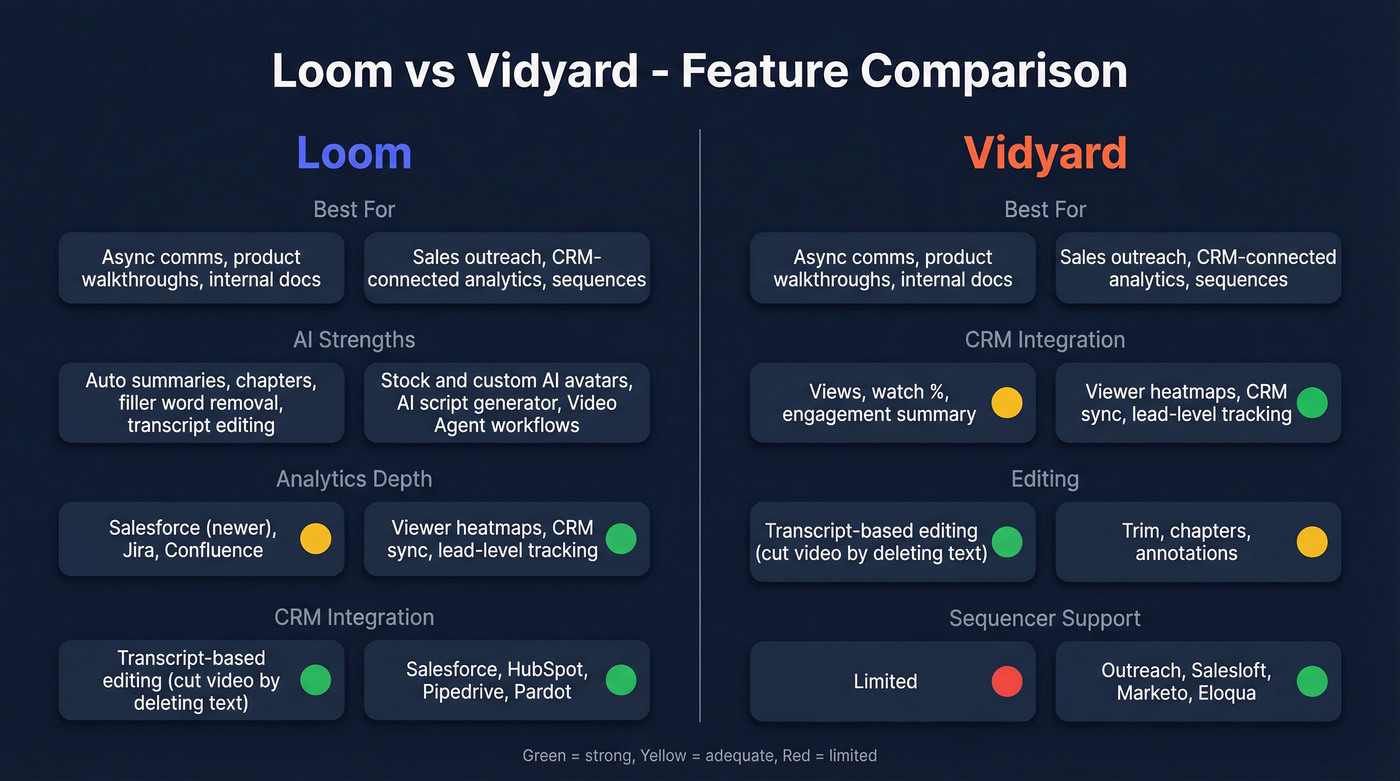
| Feature | Loom | Vidyard |
|---|---|---|
| Recording cap (free) | 5 min (25 videos/person) | 30 min (5 new videos/mo) |
| Video editing | Trim, stitch, transcript edit | Trim, chapters, annotations |
| AI features | Auto titles, summaries, chapters | Stock AI avatars, AI script generator, Video Agent (add-on) |
| Sharing pages | Basic branded pages | Branded pages with customizable CTAs |
| Analytics | Views, watch %, engagement summary | Viewer heatmaps, CRM sync (Teams+) |
| Lead capture | "Request Email to View" | Lead capture forms |

Loom's AI story is about productivity - 38M videos were created with Loom AI in 2024, using auto-summaries, chapter generation, and filler word removal. It turns a rambling screen recording into something polished without manual editing. The editing-by-transcript workflow, where you cut video sections by deleting text, is genuinely brilliant and something Vidyard doesn't match.
Vidyard's AI story is about scale. Stock AI avatars ship on the free plan. Custom AI avatars are available as an add-on on Teams and included on Enterprise. The Video Agent add-on triggers AI-powered video workflows based on buyer actions - integrated with Salesloft, Salesforce, HubSpot, Marketo, and Outreach. For teams running sequences at volume, that's a meaningful differentiator. (If you’re building a broader outbound motion, see our B2B sales stack blueprint.)

Let's be honest: most teams agonize over this decision when the answer usually comes down to one question - do you need CRM-synced video analytics or not? If yes, Vidyard. If no, Loom. Everything else is noise.
Pricing Compared
This is where the decision gets real.
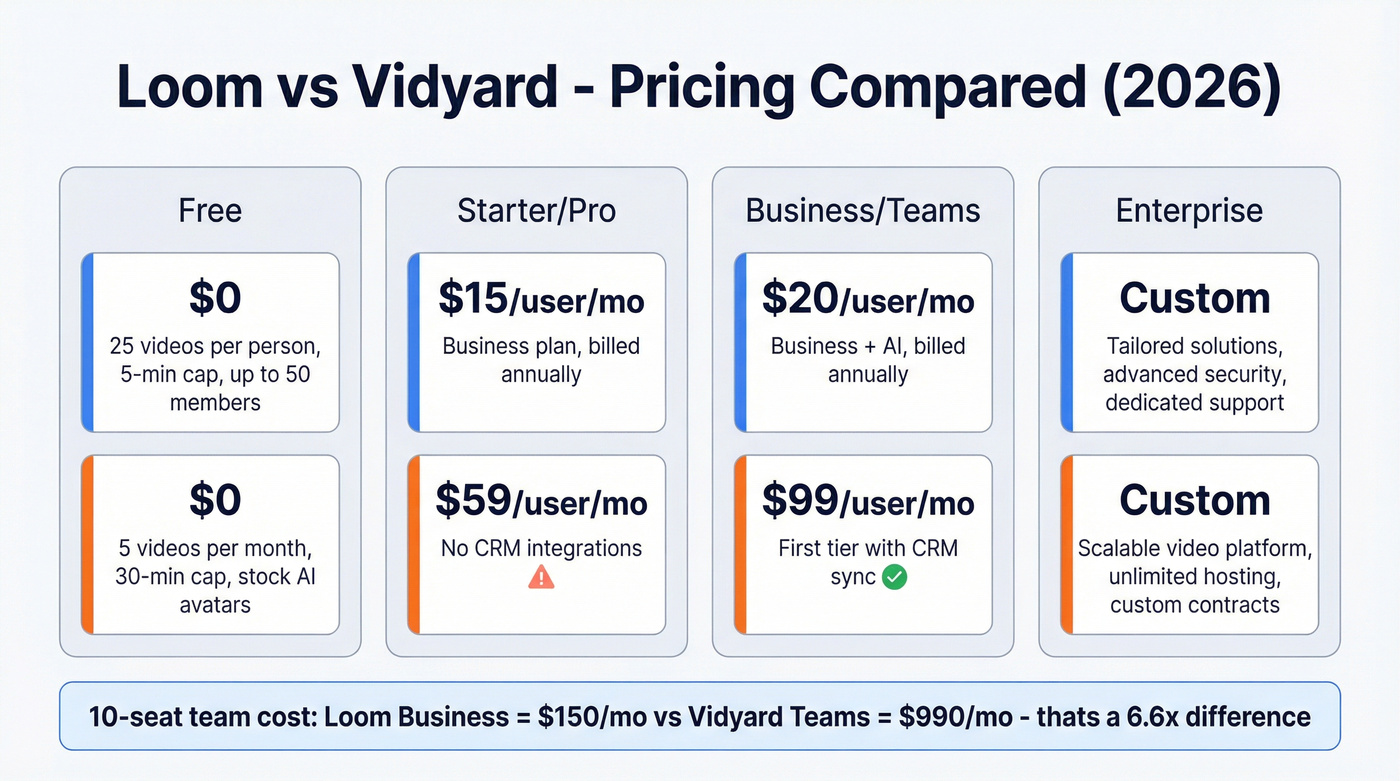
| Tier | Loom | Vidyard |
|---|---|---|
| Free | $0 (25 videos/person, 5-min recordings, up to 50 members) | $0 (5 videos/mo, 30 min, stock AI avatars, AI script generator) |
| Starter/Pro | Business: $15/user/mo (annual) | $59/user/mo (no CRM integrations) |
| Business/Teams | Business + AI: $20/user/mo (annual) | $99/user/mo (CRM integrations) |
| Enterprise | Custom | Custom |
Loom is dramatically cheaper at every tier. A 10-seat Loom Business deployment runs $150/month billed annually. The same team on Vidyard Teams - the first tier that actually includes CRM integrations - costs $990/month. That's roughly a 6x difference.
The Loom pricing trap nobody talks about until it hits: the Atlassian billing migration. One widely cited example shows a workspace jumping from ~$240/year to $24,000/year after Creator Lite seats were converted to paid seats. If you've got a large org where only a handful of people record but dozens view and comment, check your seat count carefully before committing.
Vidyard's trap is different. That $59/user/month Starter plan looks reasonable until you realize it doesn't include CRM integrations. You need Teams at $99/user/month for Salesforce or HubSpot sync. For a sales-focused deployment, the Starter tier is essentially a trial with a price tag.
Integrations and Stack Fit
Vidyard was built for GTM stacks. The integration ecosystem covers the platforms that matter most for sales teams:
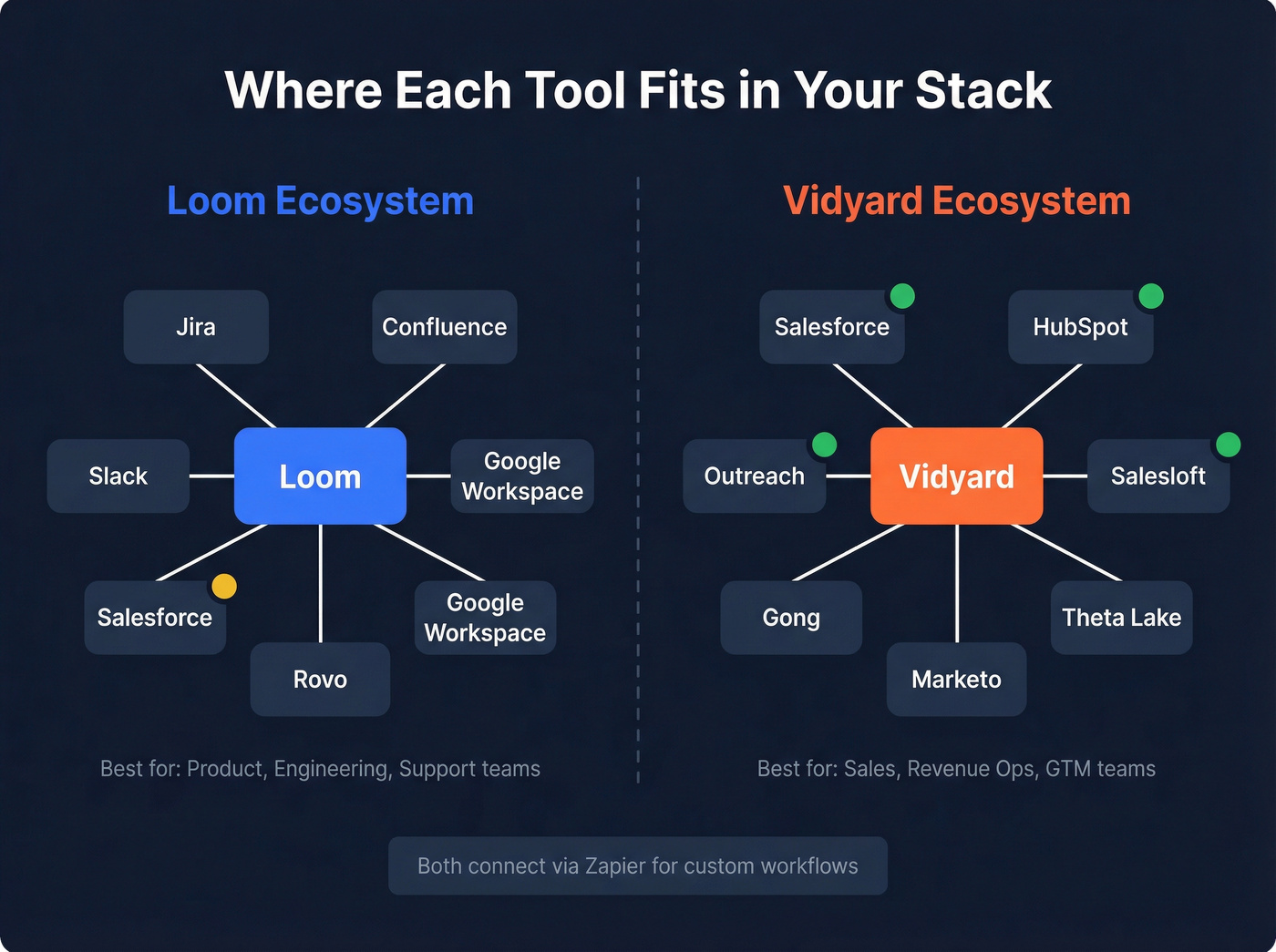
- CRM: Salesforce (Sales Cloud, Service Cloud, Pardot), HubSpot, Pipedrive
- Sequencers: Outreach, Salesloft Rhythm
- Analytics: Gong, Marketo, Oracle Eloqua
- Compliance: Theta Lake for archiving
- Catch-all: Zapier for everything else
Loom's integration story is evolving post-acquisition. The Atlassian angle means deep Jira, Confluence, and Rovo integrations - powerful for product and engineering teams. Loom also added a Salesforce integration that auto-tracks video engagement data, plus solid Slack integration for async workflows. One caveat: new Atlassian integrations are currently only available to customers who sign up through Atlassian.com.
If your sales team's daily workflow is Salesforce to Outreach to Gong, Vidyard fits like a glove. If your team lives in Jira and Slack, Loom's the obvious choice. We've watched teams overthink this - match the tool to the stack you already have. (If you’re evaluating the rest of your outbound tooling, compare cold email marketing tools and sales prospecting platforms.)

You just spent 90 seconds recording a personalized video walkthrough. Don't send it to a dead inbox. Prospeo verifies emails with 98% accuracy on a 7-day refresh cycle - so every Loom or Vidyard video you record actually reaches a real prospect.
Fix your list before you hit record. Start free with 75 verified emails.
What Changed After Atlassian Bought Loom
Atlassian acquired Loom and the product hasn't stood still. In 2024, Loom customers recorded 88M videos and replaced an estimated 202M meetings. AI adoption surged across the platform.
But the acquisition brought friction too. Creator Lite was removed, so light users who previously didn't count toward billing now convert to paid seats after a grace period. Tiered annual billing means you pay for a user tier (say, 100 seats) even if you only have 55 active users. Enterprise migration is expected to wrap up mid-2026, and large orgs are still in transition. At least one Capterra reviewer flagged that Loom dropped its Trainual integration after the ownership change.
The product is getting better, but the billing is getting more complex. That's the tradeoff.
What Users Actually Say
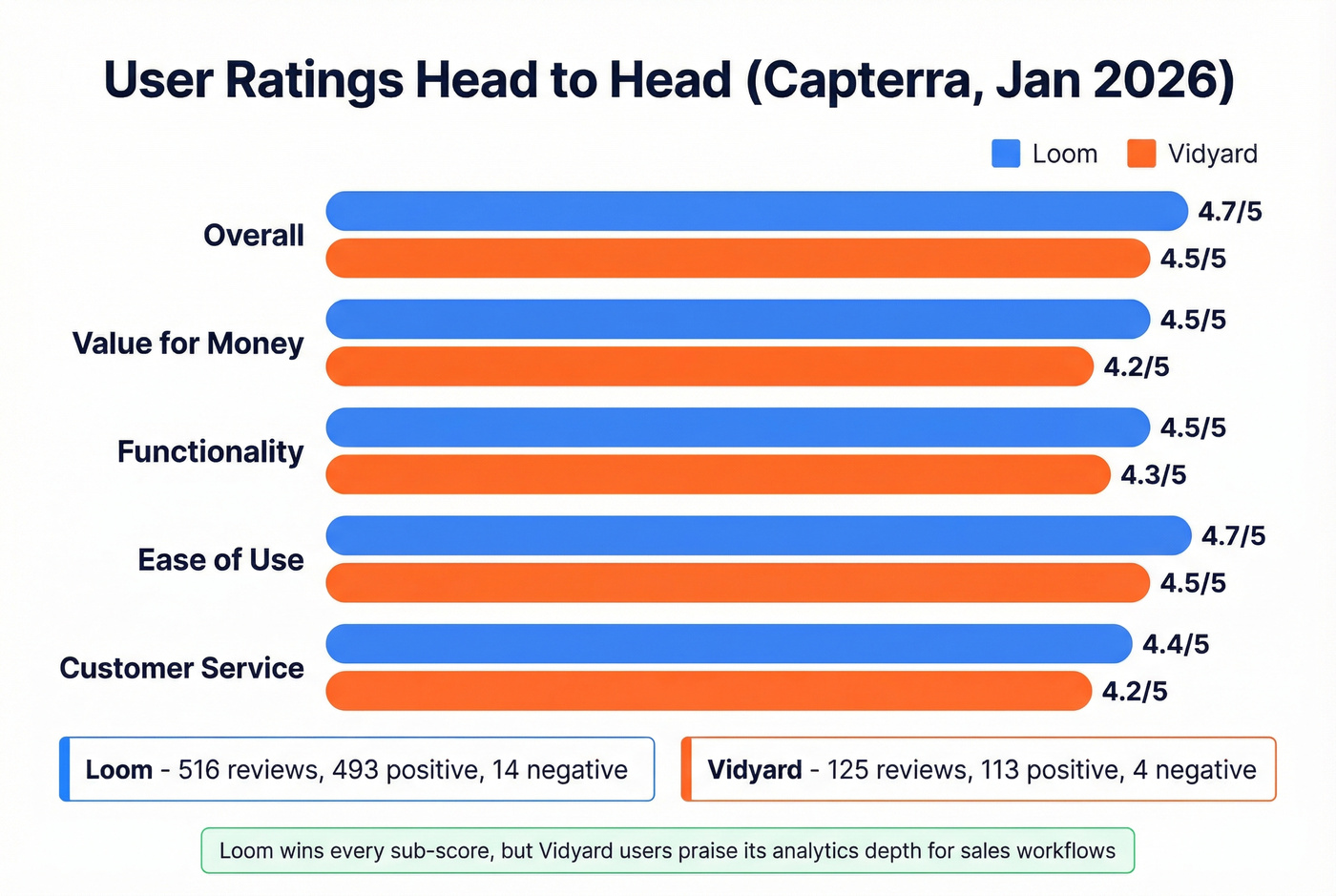
Capterra's head-to-head comparison (updated January 2026) tells a clear story:
| Metric | Loom | Vidyard |
|---|---|---|
| Overall | 4.7/5 (516 reviews) | 4.5/5 (125 reviews) |
| Value for Money | 4.5 | 4.2 |
| Functionality | 4.5 | 4.3 |
| Ease of Use | 4.7 | 4.5 |
| Customer Service | 4.4 | 4.2 |
Loom wins every sub-score. Its sentiment skews heavily positive - 493 positive reviews against 14 negative. Complaints center on reliability issues and Atlassian billing surprises. Vidyard's 125 reviews run 113 positive with only 4 negative, but recurring themes are cost at scale and a steeper learning curve compared to Loom's "hit record and go" simplicity.
The consensus on r/SalesOperations echoes this split: sales-focused teams gravitate toward Vidyard's analytics, while everyone else defaults to Loom for speed. We've seen this pattern play out consistently - teams love Loom for how fast it is to start using, and teams love Vidyard for what it tells them after the video is watched.
The Verdict
Sales team with a CRM-heavy workflow: Vidyard Teams at $99/user/mo. The CRM sync, viewer-level analytics, and sequencer integrations justify the premium. You're not buying a video tool - you're buying pipeline visibility. (If you’re tightening measurement, pair this with CRM analytics for sales.)
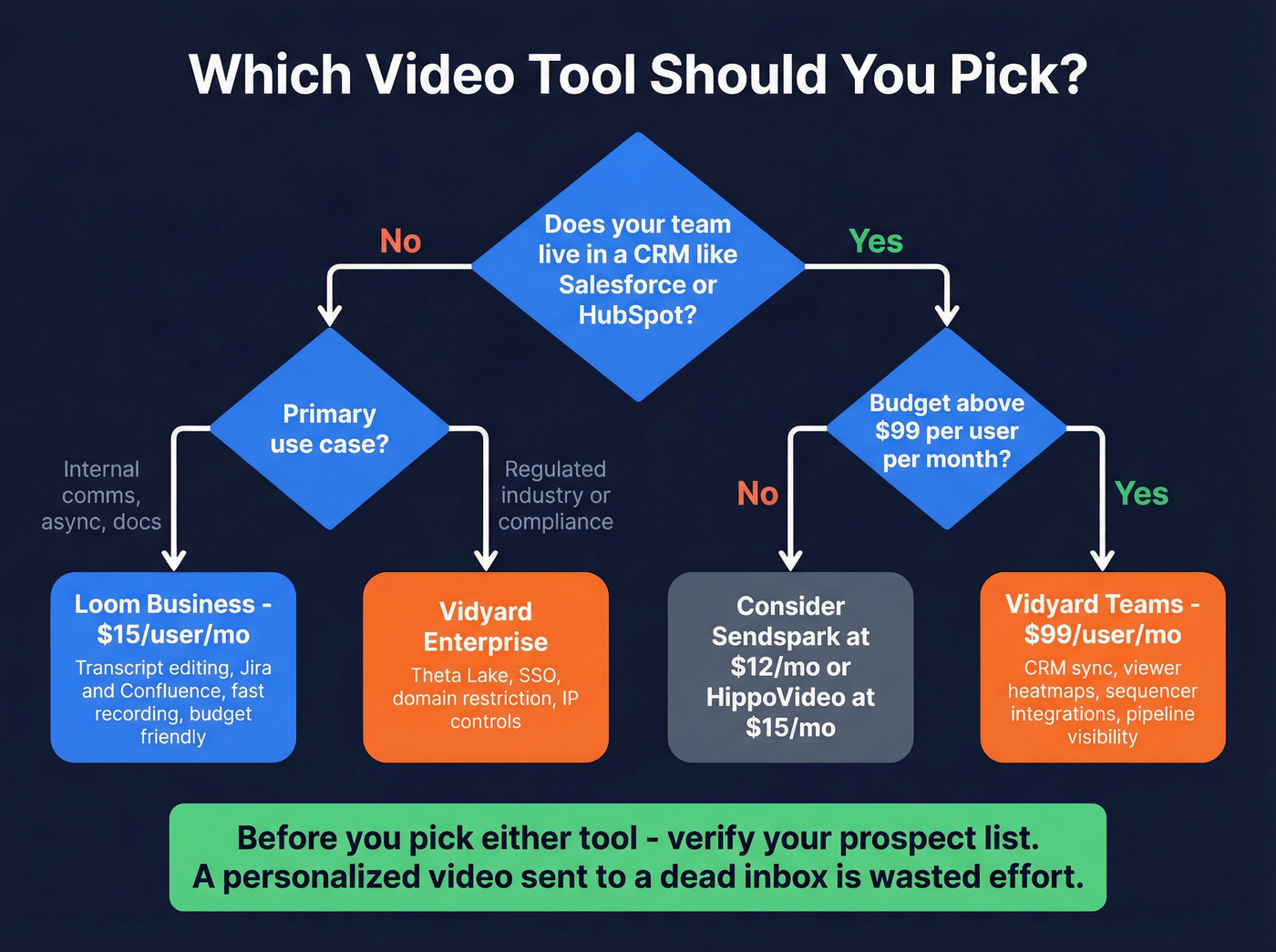
Product, engineering, or support teams doing async: Loom Business at $15/user/mo. Fast recording, transcript-based editing, Jira/Confluence integration, and a price point that doesn't require CFO approval.
Enterprise with compliance requirements: Vidyard Enterprise. Theta Lake integration, SSO, domain restriction, and IP access controls make it the only real option for regulated industries.
Solo founder or SMB on a budget: Loom's free plan. Whichever video tool you choose, neither fixes bad contact data. If your prospect list bounces above 10%, your video open rates suffer regardless of platform. Verify your list first with a tool like Prospeo - free tier of 75 verifications per month - then pick your video layer. (For a deeper dive, see email verification for outreach and the best email ID validator options.)
Neither Loom nor Vidyard can fix bad prospect data. Teams using Prospeo keep bounce rates under 4% - meaning every personalized video lands in a real inbox, not a blackhole that tanks your domain reputation.
Stop wasting video outreach on stale contacts. Verify emails at $0.01 each.
Other Options Worth a Look
Some teams are moving past recorded video entirely toward interactive demos - tools like Arcade or Floik. That's a different category. This comparison focuses on recorded video for async communication and sales outreach.
If neither Loom nor Vidyard fits, two budget alternatives are worth testing.
Sendspark starts at ~$12/month with unlimited uploads and a 4.8/5 rating on G2 across 341 reviews. It's purpose-built for sales video with personalization features that punch above its price point. If your team wants Vidyard-style outbound video without the $99/seat commitment, start here.
HippoVideo runs ~$15/month for unlimited videos, carries a 4.5/5 on G2 with 634 reviews, and leans into video-plus-email integration workflows. It's a credible option for teams that want video embedded directly in outbound sequences on a budget.
FAQ
Can I use Loom for sales prospecting?
Yes - Loom added a Salesforce integration, "Request Email to View" gating, and Variables (beta) for personalization at scale. It's catching up for sales use cases, but Vidyard remains the stronger choice if you need deep GTM integrations and CRM-connected video analytics.
Does Vidyard have a free plan?
Vidyard's free tier includes up to 5 new videos per month with unlimited library storage, a 30-minute recording cap, stock AI avatars, and an AI script generator. The catch: CRM integrations require the Teams plan at $99/user/month.
Which tool has better analytics?
Vidyard, and it isn't close. It tracks viewer-level engagement, heatmaps, and CRM-synced watch data on the Teams plan. Loom's analytics are improving but remain more basic - view counts, watch percentage, and AI-generated engagement summaries.
How do I make sure my video prospecting emails get delivered?
Verify your email list before sending. Bad data silently kills video prospecting - a carefully recorded walkthrough sent to a bounced address wastes rep time and damages sender reputation. Verifying emails before every campaign keeps your bounce rate under control and protects your domain.
Is Loom still independent after the Atlassian acquisition?
Loom operates under Atlassian. Key changes include Creator Lite removal, tiered annual billing, new Jira and Confluence integrations, and an enterprise migration expected to complete mid-2026. The product roadmap now aligns with Atlassian's broader collaboration suite.