Qualified Prospects: The Practitioner's Guide to Finding, Scoring, and Closing Them
If you've ever spent 45 minutes on a discovery call only to learn the prospect has no budget, no authority, and no timeline - just "curiosity" - you know the sting. 79% of marketing leads never convert to sales. That means out of every 10 leads your team works, maybe two are qualified prospects. The rest are expensive distractions.
The fix isn't qualifying harder. It's disqualifying faster.
The Short Version
A qualified prospect meets five criteria: real need, available budget, decision-making authority, a defined timeline, and winnability. Most teams only check the first four. The fastest way to improve close rates isn't adding more questions to your discovery script - it's cutting dead-end conversations sooner. If a prospect fails any of the five gates, move on.
What Makes a Prospect Qualified?
The terms "lead," "prospect," and "opportunity"" get used interchangeably in most sales orgs. That's a problem, because each represents a fundamentally different stage of readiness.
A lead is anyone who enters your funnel - a form fill, a list import, a webinar attendee. They haven't been vetted. A prospect is a lead that's passed through a three-point gate: they fit your ICP, they've shown real interest, and they demonstrate intent to solve a problem you address. An opportunity is a prospect with a deal in motion - problem confirmed, champion identified, budget and timeline known, next meeting scheduled.
The litmus test between prospect and opportunity is concrete: can you attach a dollar amount, a close date, and a defined next step? If not, it's still a prospect, not a pipeline deal.
Qualification also happens at three distinct levels - a model Adobe popularized that's worth internalizing. First, organization-level: does the company fit your ICP by size, industry, and tech stack? Second, opportunity-level: is there a real, funded problem to solve? Third, stakeholder-level: are you talking to the right people? Most reps jump straight to stakeholder conversations without confirming the first two layers, which is how you end up with a champion who loves you inside a company that'll never buy.
Five Traits of Qualified Sales Prospects
Most qualification frameworks boil down to four criteria. Here's the fifth one your team is probably missing.
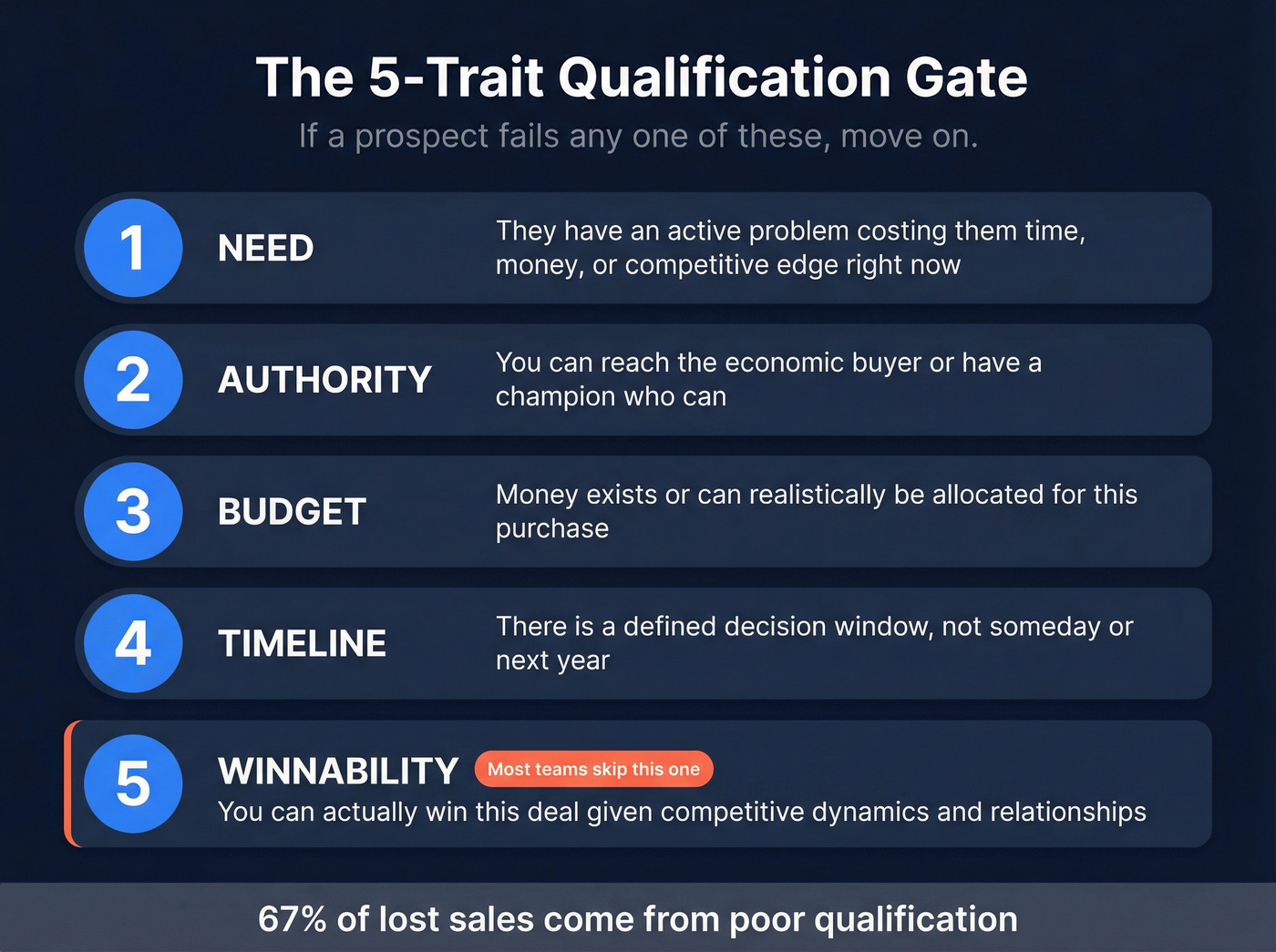
1. Need. The prospect has a problem your product solves. Not a theoretical problem - an active one that's costing them time, money, or competitive position right now.
2. Authority. You're talking to someone who can sign off on the purchase, or who has direct access to the person who can. In B2B deals with ~7 stakeholders involved, "authority" often means you've identified the economic buyer and have a champion who can navigate internal politics.
3. Budget. Money exists or can be allocated for this purchase. This doesn't mean they'll tell you their number on the first call - it means the spend is realistic given their company size and the problem's severity.
4. Timeline. There's a defined window for making a decision. "Sometime next year" isn't a timeline. "We need this solved before Q3 planning" is. A useful mental model: bucket prospects into 7-day, 7-week, and 7-month horizons, then give each bucket a different cadence and level of sales investment.
5. Winnability. This is the one most teams skip. Even if need, authority, budget, and timeline all check out, ask yourself: can we actually win this deal? If the prospect's CEO golfs with your competitor's founder every weekend, your odds are slim regardless of how perfect the fit looks on paper. 67% of lost sales result from poor qualification, and a big chunk of that comes from chasing deals that were never winnable.
Which Framework Should You Use?
IBM invented BANT in the 1950s. It's still the most widely used qualification framework, and it's still fine - for transactional, short-cycle deals. But if you're selling a $50K enterprise contract with a 6-month sales cycle, BANT alone will get you killed.
| Framework | Best For | Cycle Length | Complexity |
|---|---|---|---|
| BANT | High-volume, transactional | Days-weeks | Low |
| CHAMP | Mid-market, consultative | Weeks-months | Medium |
| MEDDIC | Enterprise, multi-stakeholder | Months | High |
| NEAT/FAINT | Need-focused, mid-cycle | Weeks-months | Medium |
| GPCTBA/C&I | Discovery-heavy, inbound | Varies | High |
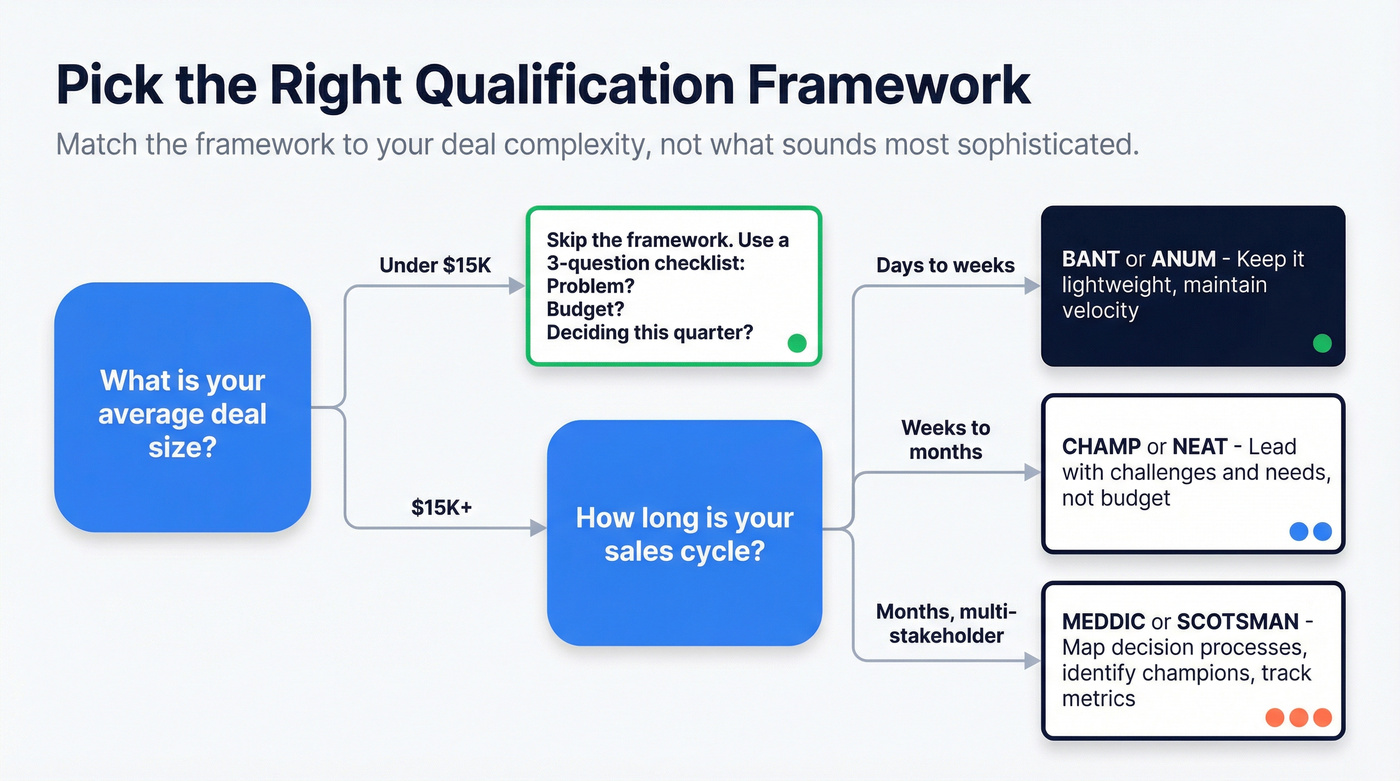
The selection logic is straightforward. Short sales cycles with clear pricing? BANT or ANUM - keep it lightweight so reps maintain velocity. Medium cycles where the prospect needs education? CHAMP or NEAT, which lead with challenges and needs rather than budget. Long, multi-stakeholder enterprise deals? MEDDIC or SCOTSMAN, where you're mapping decision processes, identifying champions, and tracking metrics that justify the purchase.
Here's the thing: we've watched teams try to force MEDDIC on a 2-week SMB sales cycle and seen reps abandon the process entirely because it felt like overkill. Match the framework to the deal complexity, not to what sounds most sophisticated.
If your average contract value is under $15K, you probably don't need a formal qualification framework at all. A simple three-question checklist - do they have the problem, can they pay, and will they decide this quarter - will outperform a 12-field MEDDIC scorecard that nobody fills out.

You just learned that 79% of leads never convert - mostly because they were never qualified to begin with. Prospeo lets you skip the guesswork: filter 300M+ profiles by buyer intent, company funding, headcount growth, and 30+ other signals so every prospect you call already passes the five-trait test.
Start every conversation with a prospect worth qualifying.
Questions That Actually Qualify
About 40% of firms consistently apply qualification criteria. The other 60% wing it. Here are ten questions that cover the five traits without sounding like an interrogation.
Need: "What's the biggest challenge you're trying to solve this quarter?" and "What happens if you don't solve it?"
Authority: "Who else would need to weigh in on a decision like this?" and "Walk me through how your team typically evaluates new tools."
Budget: Don't ask "What's your budget?" - that's a dead end. Instead try: "What are you spending on this problem today?" and "If we could show a 3x ROI, what would the approval process look like?"
Timeline: "Is there a specific event or deadline driving this?" and "When would you need to be live to hit your goals?"
Winnability: "Are you evaluating other solutions right now?" and "What would make you choose us over the alternatives?"
The framing matters as much as the questions themselves. Build rapport first. Use open-ended questions. Position yourself as a trusted guide, not an auditor running through a checklist. And move fast - leads contacted within 5 minutes are 400% more likely to qualify than those left waiting.
How to Score Qualified Prospects
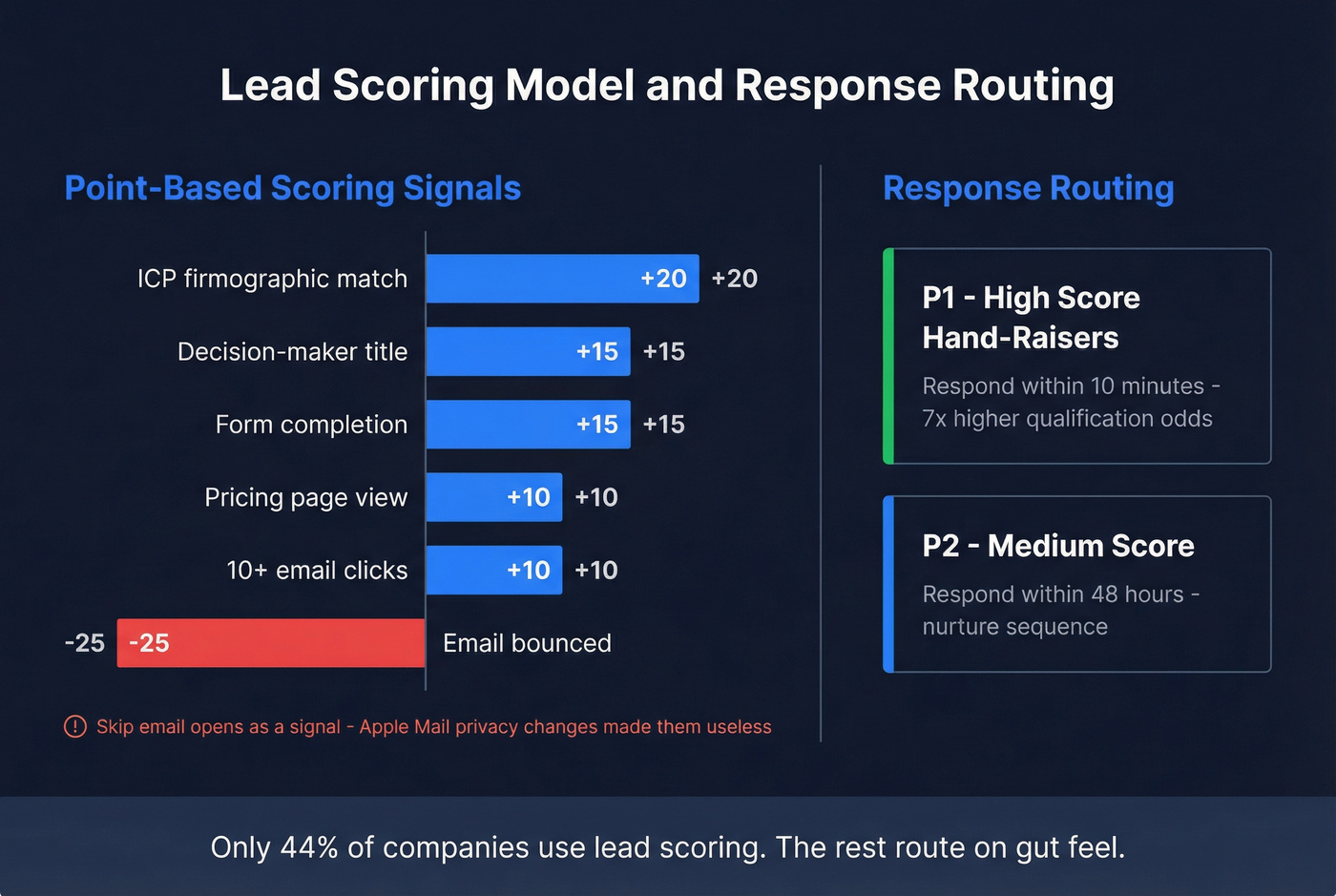
Questions give you qualitative signal; scoring turns it into something your CRM can act on. Only 44% of companies use lead scoring. The rest are routing on gut feel.
There are three tiers of scoring sophistication. Basic uses firmographics - employee count, industry, job title - to bucket leads into low, medium, and high priority. Intermediate layers in behavioral signals like pricing page views, form completions, and email engagement. Advanced uses ML models to predict purchase intent and expected deal value, improving accuracy by roughly 40% over manual methods.
Here's a practical point-based model you can implement in HubSpot or Salesforce today:
| Signal | Points | Category |
|---|---|---|
| Pricing page view | +10 | Behavioral |
| Form completion | +15 | Behavioral |
| 10+ email clicks | +10 | Behavioral |
| ICP firmographic match | +20 | Demographic |
| Email bounced | -25 | Data quality |
| Decision-maker title | +15 | Demographic |
One caveat worth flagging: Apple Mail's privacy changes have made email open rates useless as a scoring signal. In our experience, teams that weight on-site behavior and bottom-funnel actions over email engagement see 2-3x better signal quality.
Once scored, route accordingly. P1 leads - high score, hand-raisers - should get a response within 10 minutes. P2 leads can wait up to 48 hours. That speed-to-lead gap matters: responding within one hour yields 7x higher qualification odds.

None of this works if your contact data is wrong. If a third of your emails bounce, your scoring model is penalizing ghosts - real prospects get buried under noise from dead addresses. Prospeo verifies emails in real time with 98% accuracy, so reps only score and qualify people they can actually reach. Snyk's team saw bounce rates drop from 35-40% to under 5% after switching, which meant their scoring model finally reflected reality instead of data decay.
Build a feedback loop, too. Tag every disqualified prospect with a reason - wrong ICP, no budget, lost to competitor X - and review the patterns quarterly. If 30% of your disqualifications are "lost to Competitor A," that's not a qualification problem. That's a positioning problem.
Benchmarks Worth Knowing
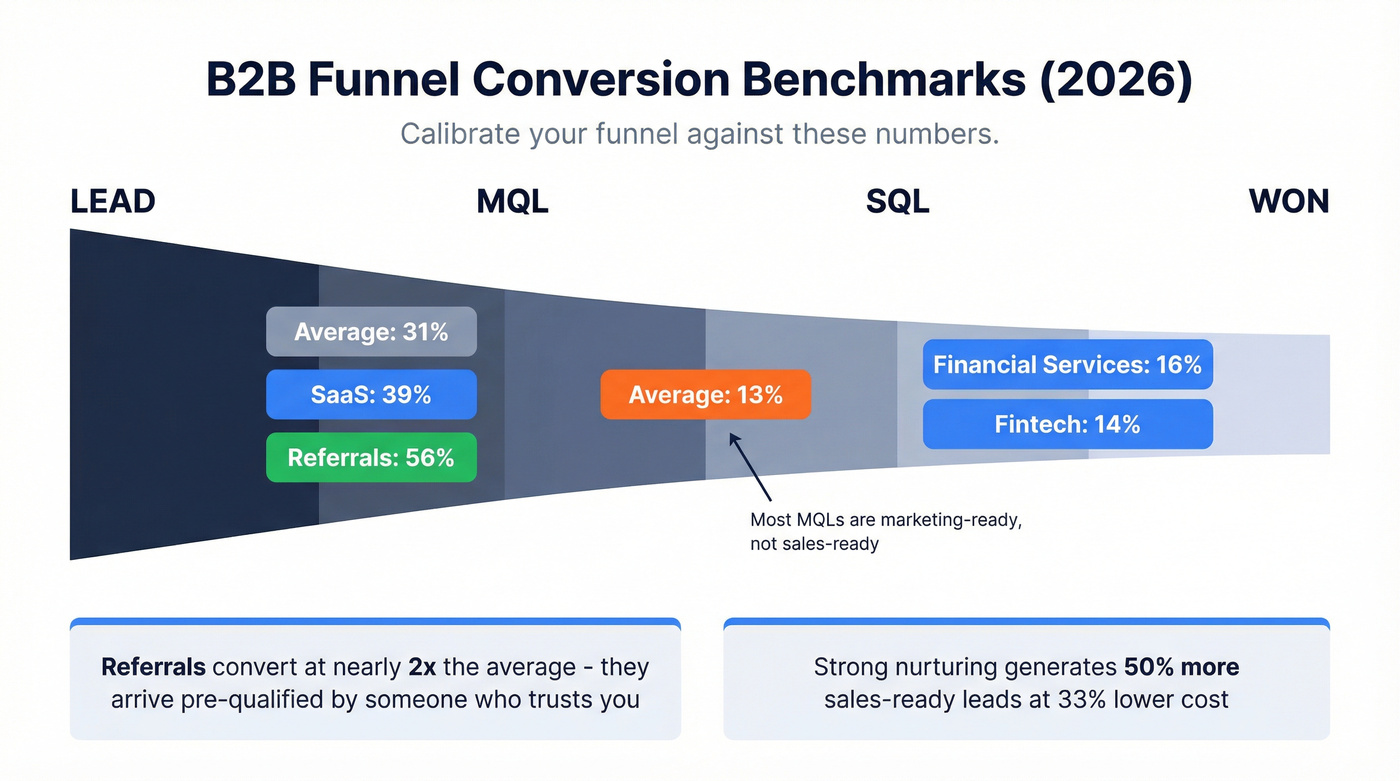
Here are conversion benchmarks to calibrate your funnel against.
| Metric | Average | SaaS | Referrals |
|---|---|---|---|
| Lead to MQL | 31% | 39% | 56% |
| MQL to SQL | 13% | - | - |
| Metric | Financial Svcs | Fintech | Construction |
|---|---|---|---|
| SQL to Won | 16% | 14% | - |
| Lead to MQL | - | - | 17% |
A few things jump out. Referrals convert to MQL at nearly double the average - they arrive pre-qualified by someone who already trusts you. SaaS outperforms construction by more than 2x on lead-to-MQL, largely because digital buying signals are easier to capture. And the MQL-to-SQL drop from 31% down to 13% tells you that most MQLs aren't actually sales-ready. They're marketing-ready, which is a different thing entirely.
Strong lead nurturing generates 50% more sales-ready leads at 33% lower cost. Don't just qualify at the top of the funnel. Build a lead nurturing engine that re-qualifies over time.
Tools That Surface Better Prospects
Qualification isn't just a conversation skill - it's a data problem. The right stack gives reps context before the first call and automates scoring and routing after it. Modern workflows are shifting from "who is this person?" to "what are they actively doing?" - an intent-first approach where behavioral signals like topic research and competitor page visits matter more than job title alone.
Prospeo combines 300M+ professional profiles with intent data across 15,000 Bombora topics, letting you filter prospects by buying signals rather than just firmographics. Free tier includes 75 verified emails/month, paid plans run ~$0.01/email.
For CRM and scoring, HubSpot's free CRM handles basic scoring out of the box, and Sales Hub paid plans start around $20/month per seat with advanced workflows. Skip the paid tier if you have fewer than 3 reps - the free version is genuinely enough.
Apollo is the best combined database-plus-sequencer for teams on a budget. Generous free tier, paid plans from ~$49/mo per user. If you need outbound volume without stitching together five tools, start here.
On the enterprise end, 6sense ($30-100K+/year) is the intent-based qualification platform for large ABM programs. Clearbit (typically $12-24K/year) excels at real-time website visitor enrichment - pair it with your scoring model to auto-qualify anonymous traffic.
For routing, LeanData (~$25K/year) and Chili Piper (~$30/mo per user) handle lead-to-account matching and instant scheduling. If you're serious about that 10-minute P1 SLA, you need one of these. Chili Piper is the better fit for mid-market teams; LeanData scales for enterprise routing complexity.
Scoring prospects means nothing if your contact data bounces. Prospeo delivers 98% email accuracy and 125M+ verified mobile numbers - refreshed every 7 days, not every 6 weeks. Layer in Bombora intent data across 15,000 topics to know which qualified prospects are actively in-market right now.
Reach the right buyers with data that actually connects.
FAQ
What's the difference between a lead and a qualified prospect?
A lead is any contact who enters your funnel - unvetted and unscored. A qualified prospect has been confirmed against specific criteria: ICP fit, genuine interest, and the intent plus ability to buy. Most funnels lose 79% of leads at this handoff, which is why the distinction matters so much operationally.
How many qualification criteria should you use?
Five: need, authority, budget, timeline, and winnability. Fewer than four and you'll waste time on bad-fit deals. More than six and reps will skip the process entirely - simplicity drives adoption.
How does data quality affect prospect qualification?
If 30-40% of your emails bounce, reps are qualifying contacts they can never reach. Scoring effort goes toward ghosts instead of real conversations, and your entire pipeline forecast gets distorted. Clean data isn't a nice-to-have; it's the foundation the whole qualification process sits on.
How do you find more qualified prospects without increasing ad spend?
Tighten your ICP definition, layer intent data into outbound targeting, and build a scoring model that surfaces high-fit leads automatically. Referral programs also help - referred leads convert to MQL at nearly double the average rate, arriving pre-vetted by someone who already trusts you.
The fastest path to better close rates isn't more leads. It's fewer, better-qualified ones.