Outbound Email Campaign Automation: The Data-First Guide for 2026
Your SDR launched a 2,000-email sequence last Tuesday. By Wednesday morning, 12% had bounced and your primary sending domain was flagged. Three months of warmup - gone overnight.
Here's what nobody tells you about outbound email campaign automation: the sequencing is the easy part. Data quality and deliverability are what separate campaigns that book meetings from campaigns that land in spam.
What You Actually Need (Quick Version)
Your outbound automation stack needs three layers. Most campaigns fail at layer one.
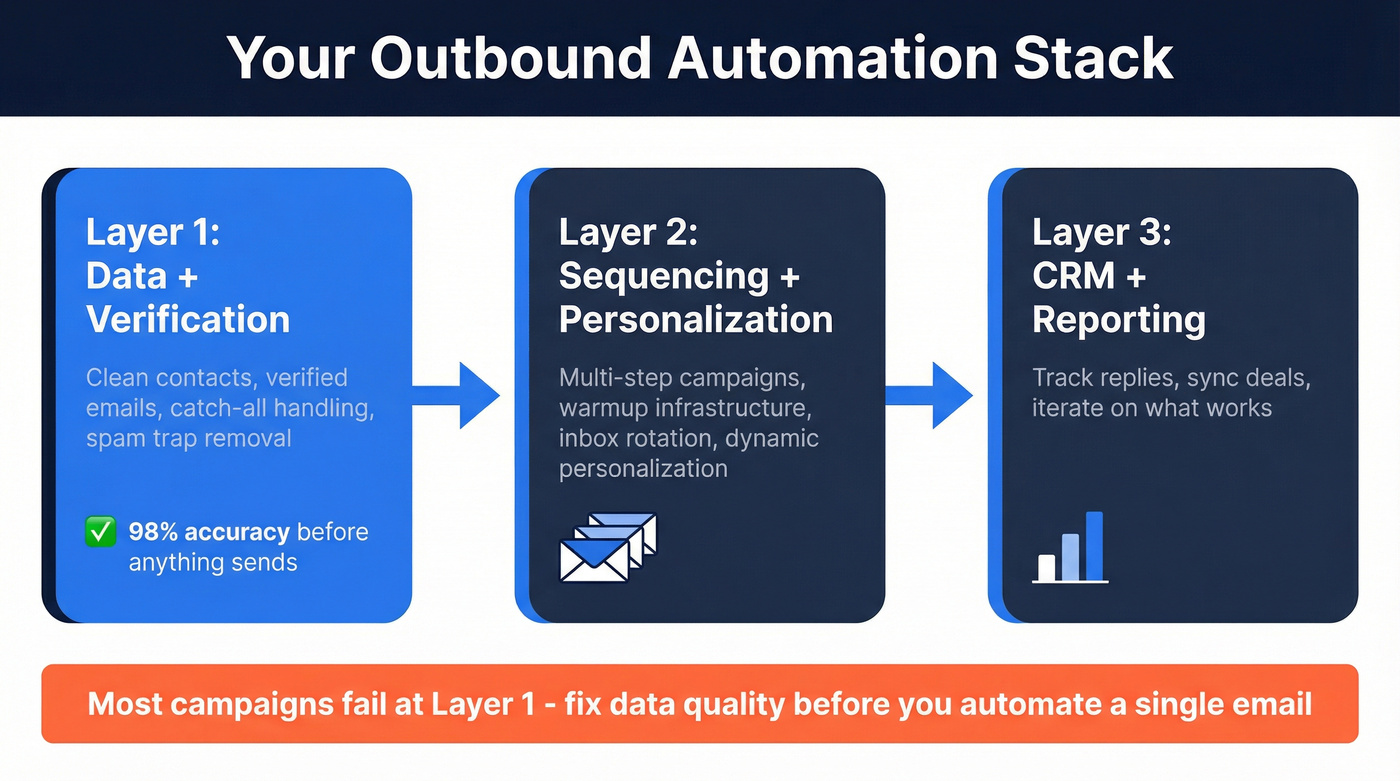
- Data + verification - clean contacts with verified emails before anything sends.
- Sequencing + personalization - multi-step campaigns with warmup infrastructure.
- CRM + reporting - track replies, sync deals, iterate.
Most guides list 17 tools. You need three or four. Get deliverability right before you automate a single email, and verify every address before it touches a sequence.
Why Automate Outbound Campaigns?
Companies using outbound automation tools report 10-20% boosts in sales ROI and up to 15% shorter sales cycles. Reps save roughly five hours per week on manual prospecting, follow-ups, and data entry - enough to add 20-30 meaningful conversations per rep per month.
Here's the thing: automation doesn't fix a broken process. It scales chaos. If your ICP is wrong, your emails are generic, or your data is stale, automation just burns domains faster. The teams that win automate after they've nailed targeting, messaging, and deliverability fundamentals. Everyone else automates their way into the spam folder.
What about AI SDRs? Tools like Artisan's Ava and Reply.io's AI sequences promise end-to-end automation. They work for high-volume, low-ACV plays - think sub-$8K deals with a simple buying process. They break down the moment deals require nuance, multi-threading, or genuine rapport. Use AI for drafting and lead classification, not for driving the entire conversation. The stack we see most often in outbound communities - a data layer for enrichment and verification, a sequencer for sending, and a human for the actual selling - reflects this reality.
Deliverability Setup
Skip this and nothing else in this guide matters.
Authentication (do these before sending a single email):
- SPF + DKIM + DMARC - all three, properly aligned. Missing any of them can drop deliverability by up to 30%. Check your records with MXToolbox or Google Admin before you send anything.
- One-click unsubscribe - RFC 8058 compliant. Google, Yahoo, and Microsoft all enforce this now.
- Custom tracking domain - branded CNAME to isolate your reputation from shared tracking domains. Allow 72 hours for DNS propagation.
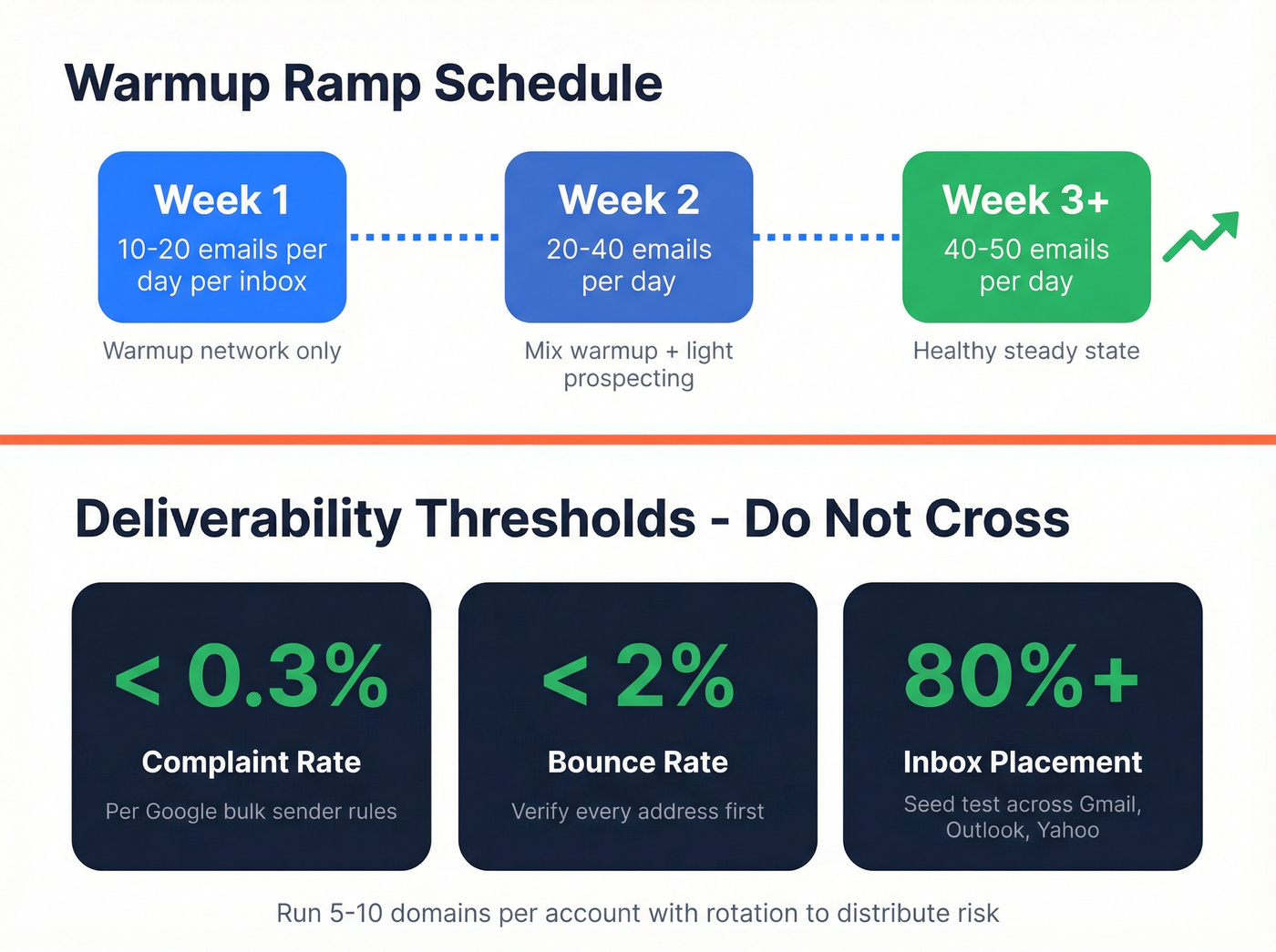
Operational thresholds to live by:
- Complaint rate: under 0.3% per Google's bulk sender guidelines
- Bounce rate: under 2% (see hard bounce triage)
- Inbox placement: 80%+ on seed tests across Gmail, Outlook, and Yahoo
Warmup ramp schedule:
| Week | Emails/Day per Inbox | Notes |
|---|---|---|
| 1 | 10-20 | Engage only with warmup network |
| 2 | 20-40 | Mix warmup + light prospecting |
| 3+ | 40-50 | Healthy steady state |
Run 5-10 domains per account with rotation. This distributes risk so no single domain takes the hit if something spikes.

Your outbound automation is only as good as your data layer. Prospeo's 5-step verification delivers 98% email accuracy across 143M+ verified addresses - with a 7-day refresh cycle that keeps bounce rates under 2%. Native integrations with Instantly, Smartlead, Lemlist, and Clay mean verified contacts flow straight into your sequences.
Stop automating bounces. Start automating meetings at $0.01 per verified email.
Data Quality: The Layer Everyone Skips
Bad data is the #1 campaign killer. Here's the cascade: a batch of stale emails bounces at 8%, your sending domain gets flagged, and every subsequent email from that domain lands in spam - even the ones going to valid addresses. One bad import can tank weeks of warmup.
The numbers back this up. A dataset of 1M+ cold emails showed best-practice followers hitting 96-98% inbox placement. Stack Optimize maintained 94%+ deliverability with bounce rates under 3% and zero domain flags across all clients.
We've tested dozens of verification tools, and the gap between built-in sequencer verification and dedicated verification is wider than most people realize. Built-in checks catch obvious invalids but miss catch-all domains, spam traps, and honeypots - the addresses that do the most damage. Prospeo's 5-step verification process catches these, delivering 98% email accuracy across 143M+ verified emails with a 7-day refresh cycle. At roughly $0.01 per lead, it's a fraction of what you'd spend recovering a burned domain. Native integrations with Instantly, Smartlead, Lemlist, Clay, Zapier, and Make mean verified contacts flow straight into your sequences without CSV gymnastics.
For a deeper breakdown of what to measure and fix, start with data quality and B2B contact data decay.
Cold Email Benchmarks for 2026
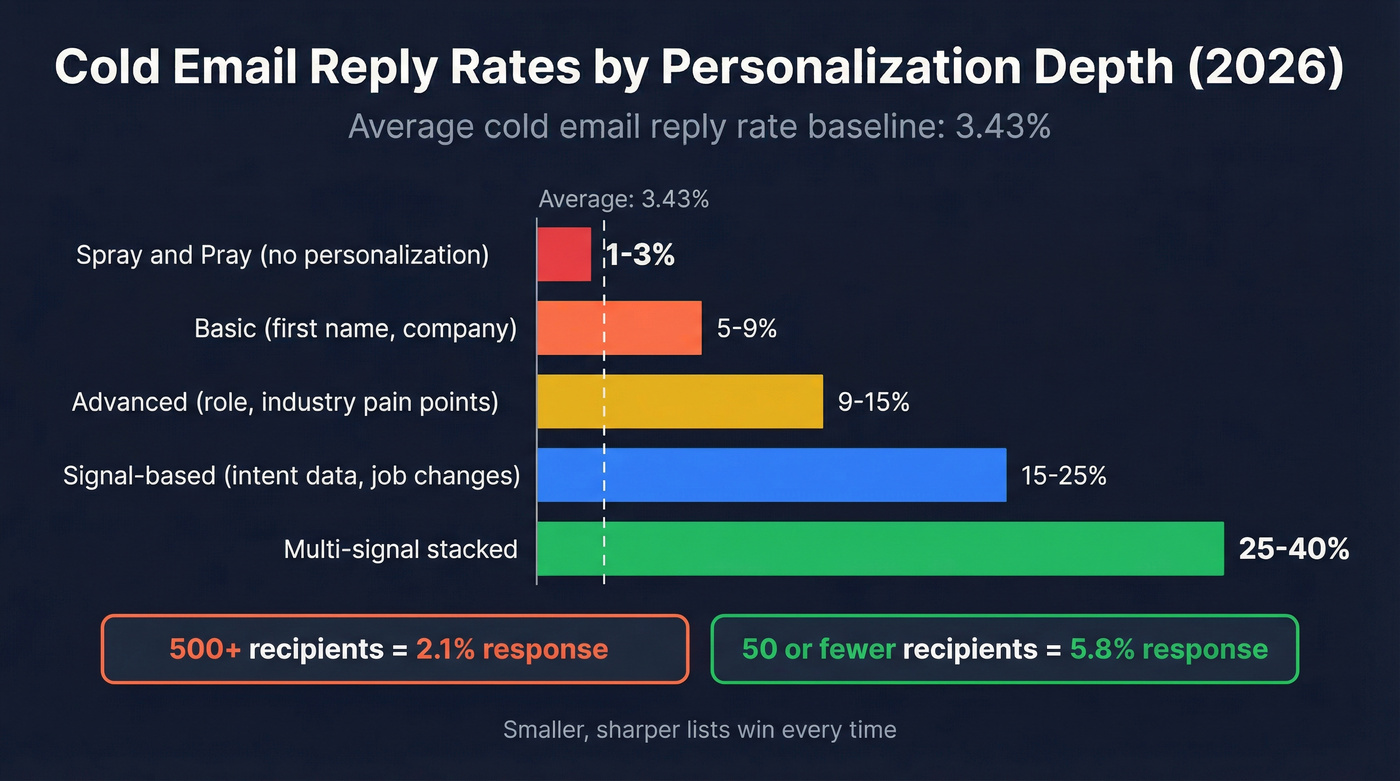
What does good actually look like? The average cold email reply rate is 3.43%. That's the baseline. Here's how personalization depth moves the needle:
| Personalization Tier | Expected Reply Rate |
|---|---|
| None (spray-and-pray) | 1-3% |
| Basic (first name, company) | 5-9% |
| Advanced (role, industry pain) | 9-15% |
| Signal-based (intent, job change) | 15-25% |
| Multi-signal stacked | 25-40% |
Campaign size matters too. Sequences hitting 500+ recipients average around 2.1% response, while tightly targeted batches of 50 or fewer hit 5.8%. Smaller, sharper lists win every time.
One event-driven campaign using Make.com for reply detection and AI classification hit a 27.4% reply rate - proof that signal-based, tightly scoped automation delivers. Let's be honest: most teams aren't there yet, but the gap between spray-and-pray and signal-based is so large that even partial adoption of intent signals moves the needle significantly.
A few more operational benchmarks worth pinning up: 3-5 emails over roughly two weeks doubles reply rates versus single-touch. Best engagement lands Tuesday through Thursday, 9-11am in the recipient's local time. And ignore open rates - Apple Mail Privacy Protection has made them unreliable (more on that in does open tracking hurt cold email).
Getting into the signal-based tier requires intent data and buying signals. Layer buyer intent with job-change and headcount-growth filters to turn a generic list into a timed one.
How to Build a Trigger-Led Sequence
The best framework we've seen breaks automated outbound into four layers: data sourcing and verification, sequencing and personalization, reply handling and CRM sync, reporting and iteration.
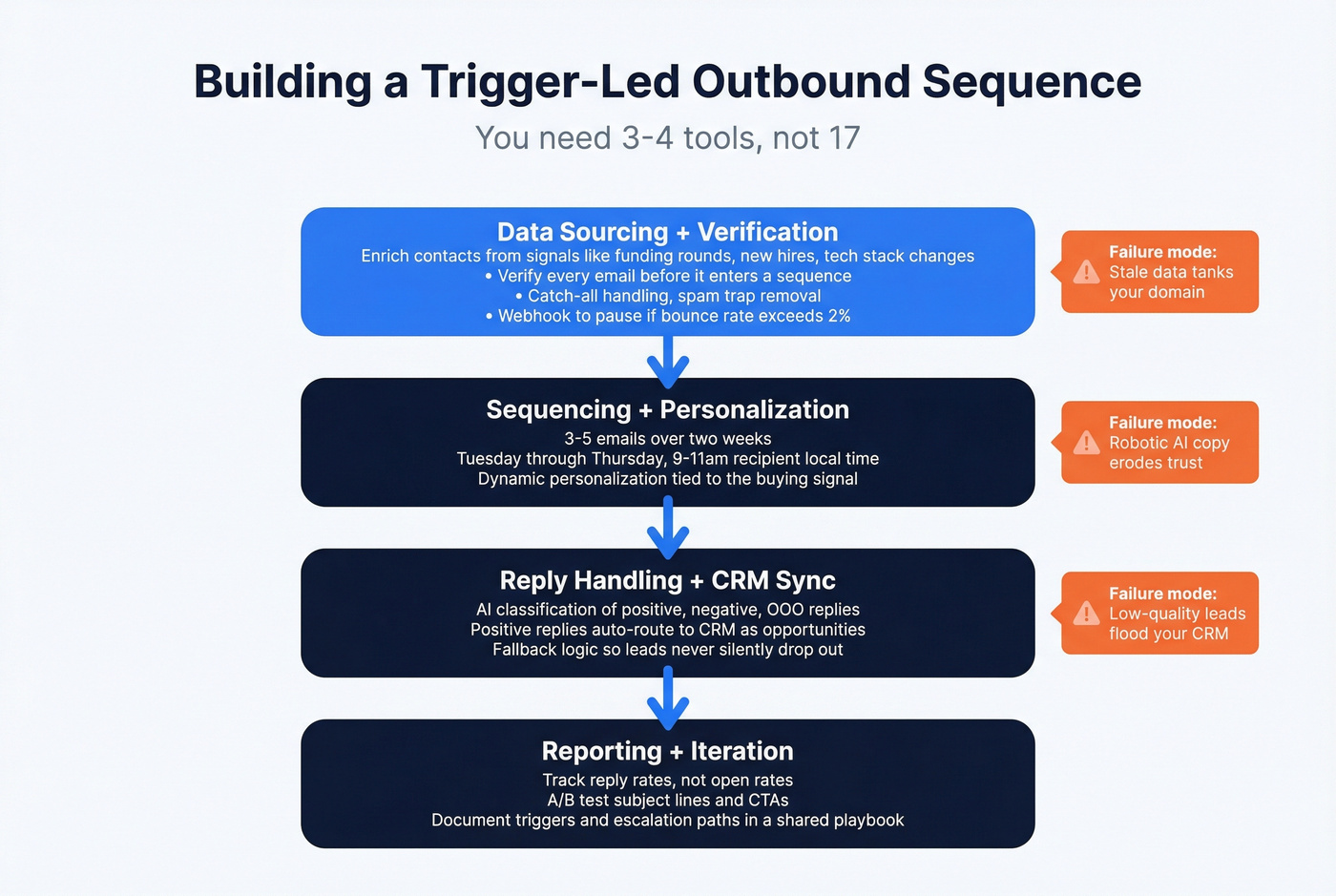
Common failure modes: flooding your CRM with low-quality leads that destroy pipeline visibility, robotic AI copy that erodes trust, and missing fallback logic where leads silently drop out of sequences. You need three or four tools, not 17.
Connect your verification layer to your sequencer via native integration or Zapier. Set up a webhook to pause sequences when bounce rates exceed 2%. Route positive replies to your CRM automatically. And document your automation rules - triggers, A/B protocols, escalation paths - in a shared playbook before you scale. The most effective teams build each trigger-led sequence around a specific buying signal like a funding round, a new hire in a target role, or a tech-stack change, so every touchpoint arrives with context rather than noise. (If you want a full operating model, see signal-based outbound.)
Best Tools for Automated Outbound Email
Look, if your average deal size is under $10K, you don't need a $15K/year data platform. A self-serve verification tool plus a $37/mo sequencer will outperform an enterprise suite that your team only uses at 20% capacity.
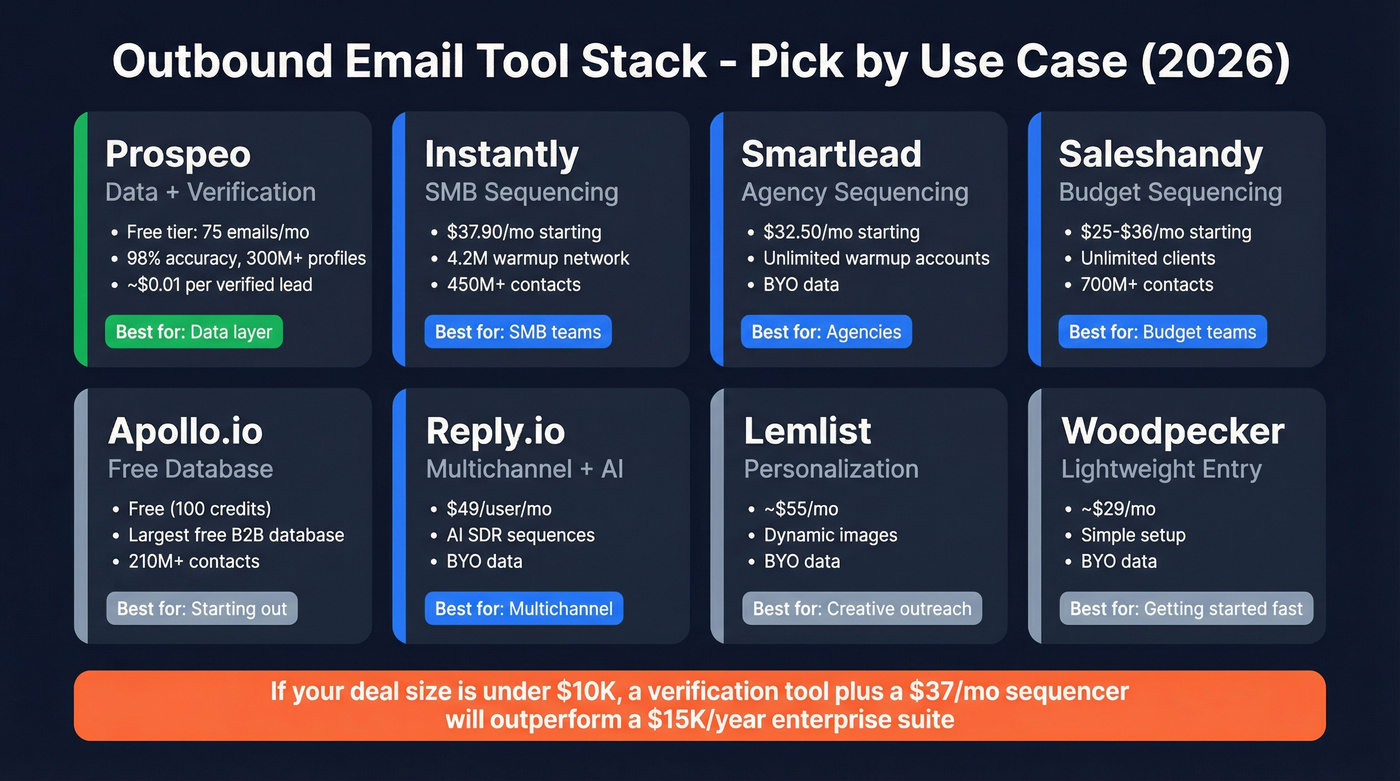
| Tool | Best For | Starting Price | Key Feature | Database |
|---|---|---|---|---|
| Prospeo | Data + verification | Free (75 verified emails/mo) | 98% email accuracy | 300M+ profiles |
| Instantly | SMB sequencing | $37.90/mo | 4.2M warmup network | 450M+ contacts |
| Smartlead | Agency sequencing | $32.50/mo | Unlimited warmup | BYO data |
| Saleshandy | Budget sequencing | $25-$36/mo | Unlimited clients | 700M+ contacts |
| Lemlist | Personalization | ~$55/mo | Dynamic images | BYO data |
| Apollo.io | Free database | Free (100 credits) | Largest free B2B DB | 210M+ contacts |
| Reply.io | Multichannel + AI | $49/user/mo | AI SDR sequences | BYO data |
| Woodpecker | Lightweight entry | ~$29/mo | Simple setup | BYO data |
Prospeo - Data + Verification
Prospeo covers 300M+ professional profiles with 143M+ verified emails and 125M+ verified mobile numbers. The 98% email accuracy comes from a proprietary 5-step verification process that includes catch-all handling, spam-trap removal, and honeypot filtering - the stuff built-in sequencer verification doesn't catch.
The economics are hard to argue with. At ~$0.01 per lead, a team verifying 10,000 contacts per month spends roughly $100. Compare that to roughly $1 per lead on enterprise data platforms. The free tier gives you 75 verified emails per month - enough to test a full sequence before committing.
GreyScout dropped their bounce rate from 38% to under 4% after switching. Stack Optimize built to $1M ARR running it as their data backbone with zero domain flags across all clients. Native integrations with Instantly, Smartlead, Lemlist, Clay, and Make mean verified contacts push directly into your sequencing layer without manual exports.

Instantly - Sequencing for SMB
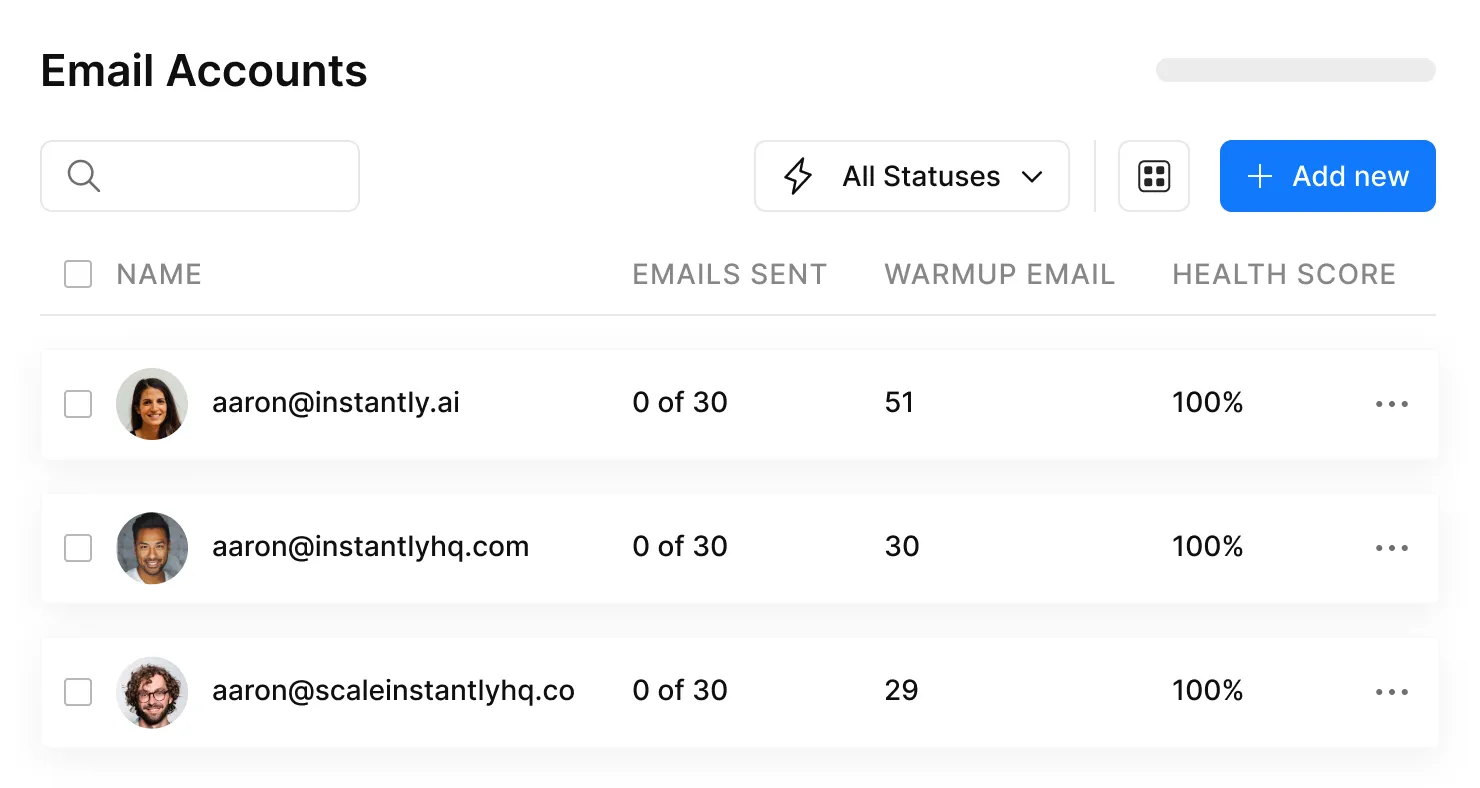
Instantly has built the strongest deliverability infrastructure in the sequencing category. The 4.2M-account warmup network is one of the largest available, and inbox rotation distributes sending across mailboxes automatically. Growth plans start around $37.90/mo on annual billing, Hypergrowth at $197/mo, and Light Speed at $492/mo for high-volume senders.
The 450M+ contact database is a useful starting point, but you'll still want to verify through a dedicated tool before sending at scale. For agencies, the workspace model adds up fast: $77.60/mo per client workspace means 10 clients costs $776/mo just for access. That's where Smartlead or Saleshandy make more sense.
Smartlead - Agency Sequencing
Smartlead starts at $32.50/mo on annual billing and shines for agencies managing multiple client inboxes. Unlimited warmup accounts from the base plan is the headline feature - no per-mailbox charges eating into margins. The interface isn't as polished as Instantly's, but for pure agency economics, it's the better deal.
Saleshandy - The Budget Pick
Skip this if you need advanced multichannel sequences. Choose this if you're an agency watching every dollar. Saleshandy starts around $25-$36/mo and includes unlimited clients from the base plan. Where Instantly charges per workspace, Saleshandy bundles everything. The 700M+ contact database is larger than Instantly's, and AI sequence generation plus multivariate testing come standard.
Lemlist - When Personalization Is the Bottleneck
Lemlist starts around $55/mo on annual billing. The personalization engine is genuinely best-in-class - dynamic images, custom landing pages, and liquid syntax variables that go beyond {{firstName}}. If your reply rates are stuck in the 3-5% range and you've already nailed data quality, Lemlist's personalization features are what push you into the 9-15% tier. Strong multichannel capabilities too, with email and social steps in the same sequence.
Apollo.io - Free Database
Apollo's free tier gives you 100 credits per month and access to a large B2B database. Basic plans run $59/user/mo, Professional at $99/user/mo. It's the obvious starting point for founders and early-stage teams who need contacts without a budget.
Real talk: Apollo's data accuracy drops at scale. We've seen bounce rates climb past 8% on lists pulled without additional verification. Great for getting started, but that accuracy gap will cost you in domain reputation past 100 emails per day. Verify everything through a dedicated tool before loading into sequences.
Reply.io
Email Volume plans start at $49/user/mo, Multichannel at $89/user/mo, and the AI SDR tier at $300/mo. Best for teams wanting AI-generated sequences and multichannel orchestration in one platform without stitching together multiple tools.
Woodpecker
Starts around $29/mo. Lightweight and simple. A/B testing and API access cost extra, so factor that in. Woodpecker cites automation reducing manual prospecting errors by roughly 20%, which matters more than you'd think when you're managing dozens of sequences across multiple clients.
Signal-based sequences hit 15-25% reply rates - but only with the right data. Prospeo combines buyer intent tracking across 15,000 topics with job-change, headcount-growth, and technographic filters so you send the right message at the right moment. Stack Optimize built a $1M agency on this data with zero domain flags.
Layer intent signals on verified contacts and watch reply rates climb.
FAQ
How many emails should I send per day from a new domain?
Start at 5-10 per day and ramp over four to six weeks. Warmed accounts can reach 40-50 per day per inbox. Use 5-10 domains with rotation to scale total volume without burning any single domain's reputation.
What's a good reply rate for cold email in 2026?
The average is 3.43%. Teams using signal-based personalization and verified data consistently hit 10-15%. Anything above 5% means your targeting and messaging are working - iterate on the offer, not the volume.
Do I need a separate tool for email verification?
Yes. Built-in sequencer verification catches obvious invalids but misses catch-all domains, spam traps, and honeypots. Dedicated verification tools deliver 98% accuracy at ~$0.01/lead, while built-in checks from major platforms hover around 79-87%. That gap is the difference between 94% deliverability and a flagged domain.
What tools do I need for outbound email campaign automation?
Three or four: a data and verification tool to source clean contacts, a sequencer with warmup infrastructure to send campaigns, and a CRM to track replies and manage pipeline. This three-layer stack is the pattern top-performing SDR teams run consistently.
How do I keep cold emails out of spam?
Authentication is the foundation: SPF, DKIM, and DMARC properly aligned. Beyond that, keep bounce rates under 2% by verifying every address before it sends, warm new domains for at least three weeks, rotate across 5-10 sending domains, and maintain complaint rates under 0.3%. Monitor inbox placement weekly with seed tests across Gmail, Outlook, and Yahoo.