

ABX Orchestration: The Complete Guide for B2B Teams
A RevOps lead we know ran a pilot ABX program last year with a $90K orchestration platform, a team of eight, and zero shared KPIs between marketing and sales. Six months in, pipeline hadn't moved. The problem wasn't the platform - it was that nobody agreed on what "orchestrated" actually meant.
ABX orchestration is the most powerful GTM motion in B2B right now, but only if you build it as an operating model instead of buying it as software.
What You Need (Quick Version)
This approach requires three things: (1) a scoring model to identify in-market accounts, (2) cross-team playbooks triggered by intent signals, and (3) clean, verified contact data for every member of the buying committee. We'll cover how to build all three - plus the tech stack, scoring framework, and measurement formulas to make it work.
What Is ABX Orchestration?
ABX - account-based experience - uses data, intent, and behavioral insights to deliver relevant, timely interactions from first anonymous visit through renewal and expansion. Not just acquisition. Not just marketing. The entire lifecycle.
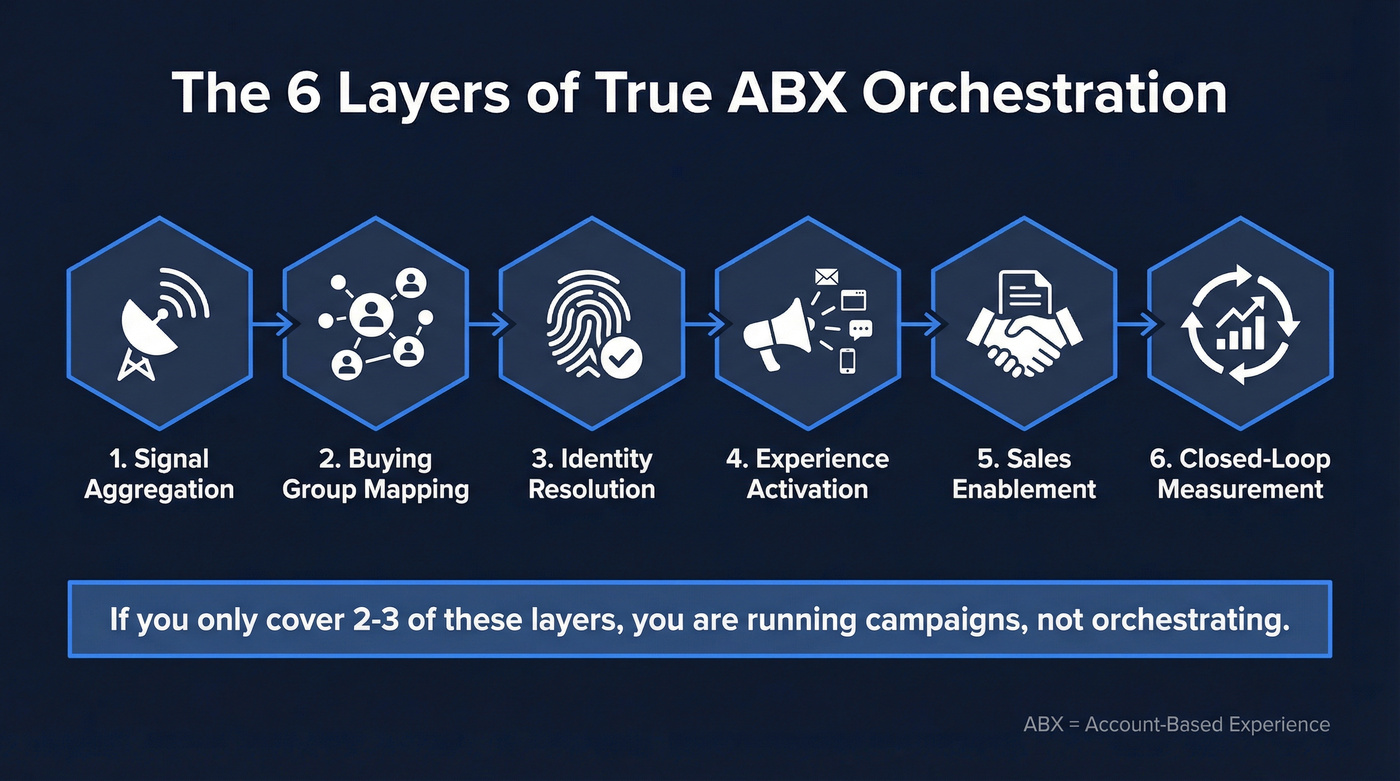
The "orchestration" part is what separates ABX from a slide deck. It's the synchronized execution across marketing, sales, and customer success, triggered by real signals, not calendar-based campaigns. When a target account's VP of Engineering visits your pricing page twice in a week while three other stakeholders download a competitor comparison guide, orchestration is the system that turns those signals into a coordinated, cross-channel response.
The scope is broader than most teams realize. True account-based orchestration spans signal aggregation, buying group mapping, identity resolution, experience activation across channels, sales enablement, and closed-loop measurement. If you're only covering two or three of those layers, you're running campaigns, not orchestrating.
B2B buying committees now run 6-10 stakeholders deep. You can't sequence your way through that with a single SDR cadence. Every team touching the account needs to share context, timing, and intent data in real time.
ABX vs ABM - What Changed
ABM isn't dead. It just got squishy. Too many teams slapped "ABM" on lightly targeted demand gen and called it a strategy. 80% of marketers using account-based approaches say it delivers better ROI than any other program, but that stat hides a lot of poorly executed programs riding the label.
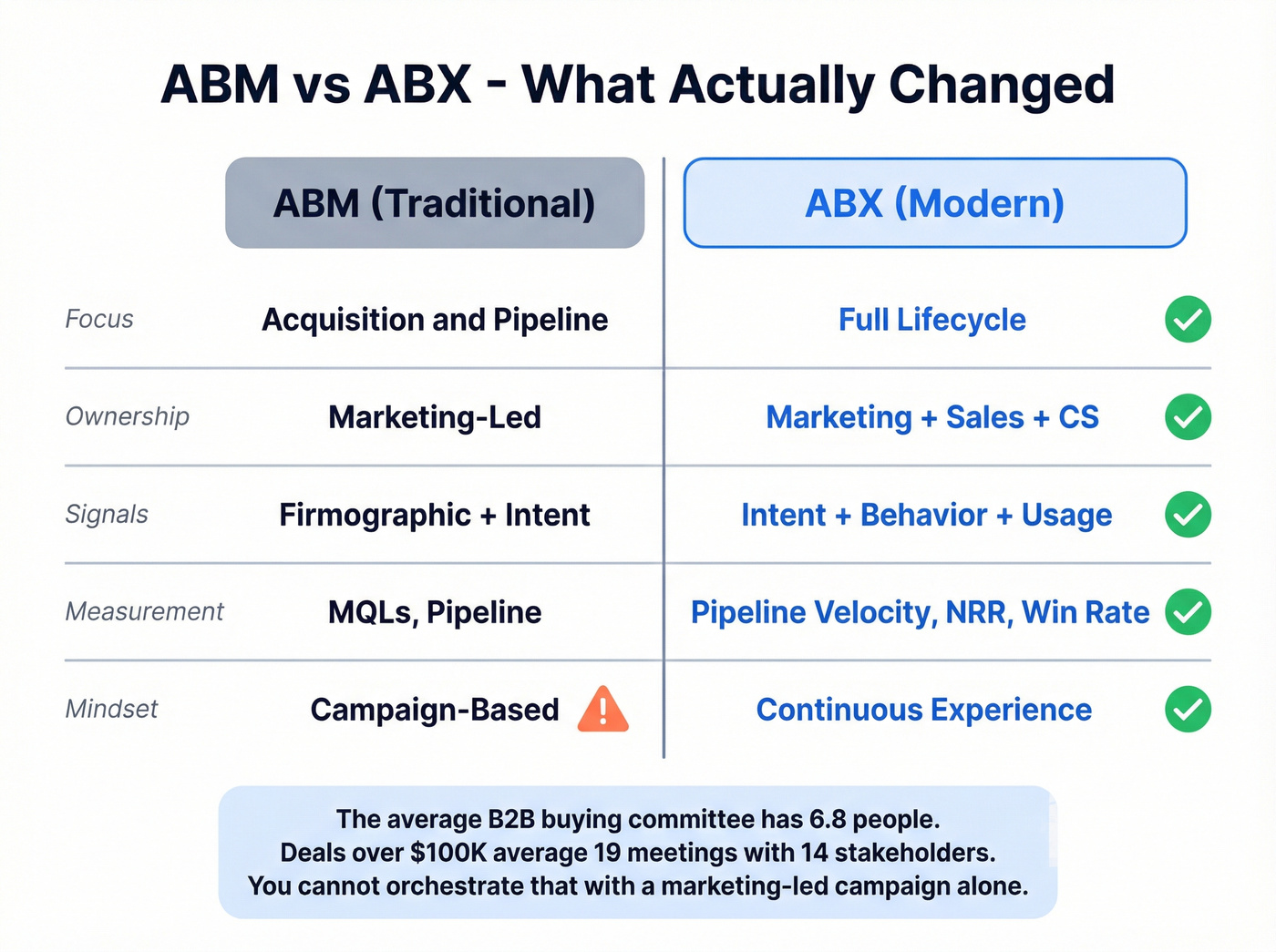
ABX emerged as a corrective. Where ABM focuses on acquisition and pipeline, ABX extends shared ownership across the full lifecycle. Marketing doesn't hand off to sales and disappear. CS doesn't operate in a silo post-close. Everyone owns the account experience.
The average B2B buying committee includes 6.8 people. Deals over $100K average 19 meetings with 14 stakeholders. You can't orchestrate that with a marketing-led campaign and a prayer.
| Dimension | ABM | ABX |
|---|---|---|
| Focus | Acquisition / pipeline | Full lifecycle |
| Ownership | Marketing-led | Marketing + Sales + CS |
| Signals | Firmographic + intent | Intent + behavior + usage |
| Measurement | MQLs, pipeline | Pipeline velocity, NRR, win rate |
| Mindset | Campaign | Continuous experience |
Why Most ABX Programs Fail
Let's be honest: most teams that say they're doing ABX are actually doing demand gen with better targeting. RevOps practitioners consistently flag data quality and team alignment as the two biggest bottlenecks, and the failure modes below confirm it.
1. Campaign mindset instead of experience mindset. Measuring clicks and MQLs instead of account progression and engagement velocity. If your dashboard looks like a demand gen report, you haven't made the shift.
2. Siloed execution. Marketing runs ads. Sales runs sequences. CS runs QBRs. Nobody shares signal data. Only 11% of companies execute sales-to-marketing handoffs effectively - and that number should terrify you.
3. One-size-fits-all content. Sending the same case study to the CFO and the VP of Engineering. Role-specific personalization isn't optional; it's the entire point. Each stakeholder in the buying committee needs messaging that speaks to their priorities, whether that's ROI for the CFO or integration architecture for the technical lead.
4. Short-term focus. Treating ABX as a quarterly initiative instead of a continuous motion. Accounts don't buy on your fiscal calendar.
5. Rebranding demand gen as ABX. This is the most common failure. If you didn't change your team structure, shared KPIs, or signal infrastructure, you didn't adopt account-based experience - you renamed a spreadsheet.
Buyers initiate 79% of engagements on their own terms. Misalignment between teams can add roughly 30% to sales cycles. Fractured funnels don't just feel bad - they cost pipeline.

You can't orchestrate across a 6-10 person buying committee if half your emails bounce. Prospeo's 300M+ profiles with 98% email accuracy and 125M+ verified mobiles mean your ABX plays actually reach every stakeholder - from the CFO to the VP of Engineering.
Stop orchestrating into dead inboxes. Start with data that connects.
How ABX Orchestration Works
Orchestration follows a continuous loop: Trigger -> Action -> Feedback -> Optimization. Every signal feeds the next action, and every action generates data that refines the model.
The Orchestration Loop
It starts with signals. Third-party intent data shows which accounts are researching your category. Here's how that actually works: vendors aggregate browsing behavior across a co-op of B2B publisher sites, then establish a baseline of how much any given company normally engages with a topic - say, "endpoint security" or "revenue operations." When engagement spikes significantly above that baseline, measured by content consumed, time on page, scroll behavior, and frequency, the vendor flags the account as "surging" on that topic. That surge is your trigger.
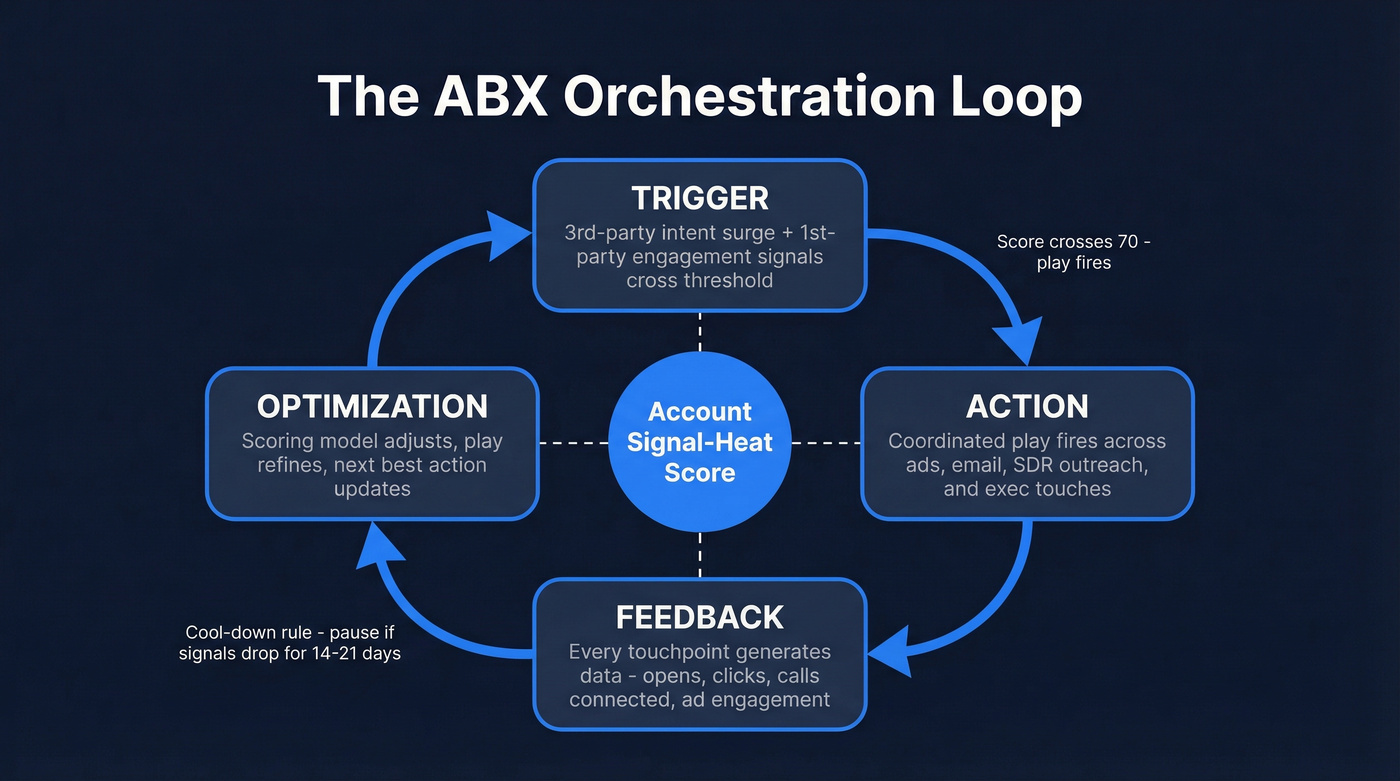
First-party signals layer on top. Website engagement reveals which pages accounts are hitting, email opens track content resonance, ad clicks show channel responsiveness, and CRM activity captures direct interactions. The combination of third-party surge data and first-party engagement gives you a reliable picture of buyer readiness.
When signals cross a threshold - say, three buying signals from the same account in one week, or a CMO engaging with a competitor comparison page - the orchestration engine fires a play. That play coordinates actions across channels and teams simultaneously, not sequentially.
The feedback loop is what makes this different from a static workflow. Every touchpoint generates data: did the SDR connect? Did the email get opened? Did the account engage with the retargeting ad? That feedback adjusts the scoring model, refines the play, and determines the next action. It's a living system, not a set-it-and-forget-it automation.
Running an Orchestrated Play
An account's Signal-Heat Score crosses 70 after their Director of IT visits your pricing page twice and a VP downloads a competitor comparison guide. Here's what a coordinated ABX play looks like when it fires:
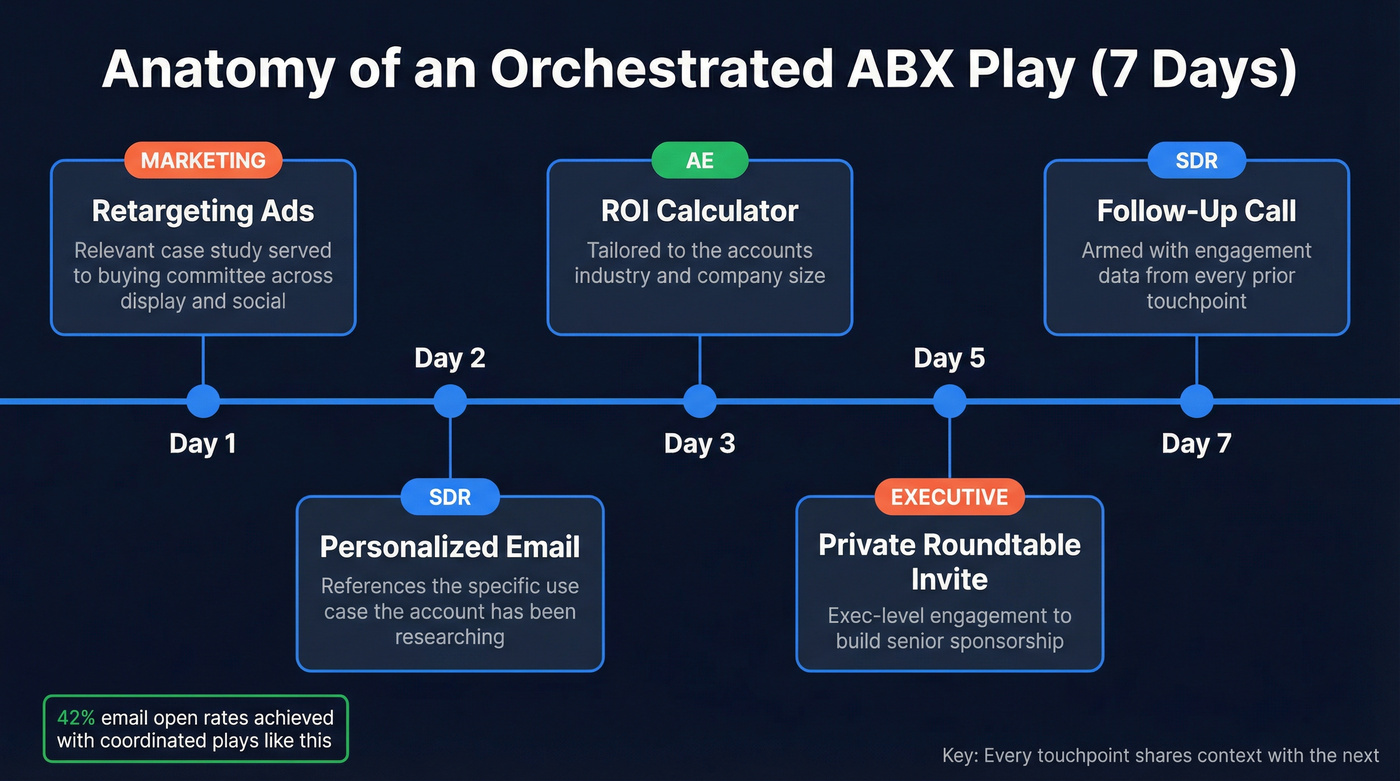
- Day 1 - Retargeting ads serve a relevant case study to the account's buying committee across display and social.
- Day 2 - An SDR sends a personalized email referencing the specific use case the account's been researching.
- Day 3 - An AE follows up with an ROI calculator tailored to the account's industry and company size.
- Day 5 - An exec-level invite goes out for a private roundtable.
- Day 7 - Follow-up call from the SDR, armed with engagement data from every prior touchpoint.
This kind of aligned sequence has driven 42% email open rates in example plays. The key isn't any single touchpoint - it's that every touchpoint shares context with the next.
The Signal-Heat Scoring Model
You need a way to separate noise from signal. The Signal-Heat Score is a 0-100 composite that tells you which accounts are actually in-market and ready for sales engagement.
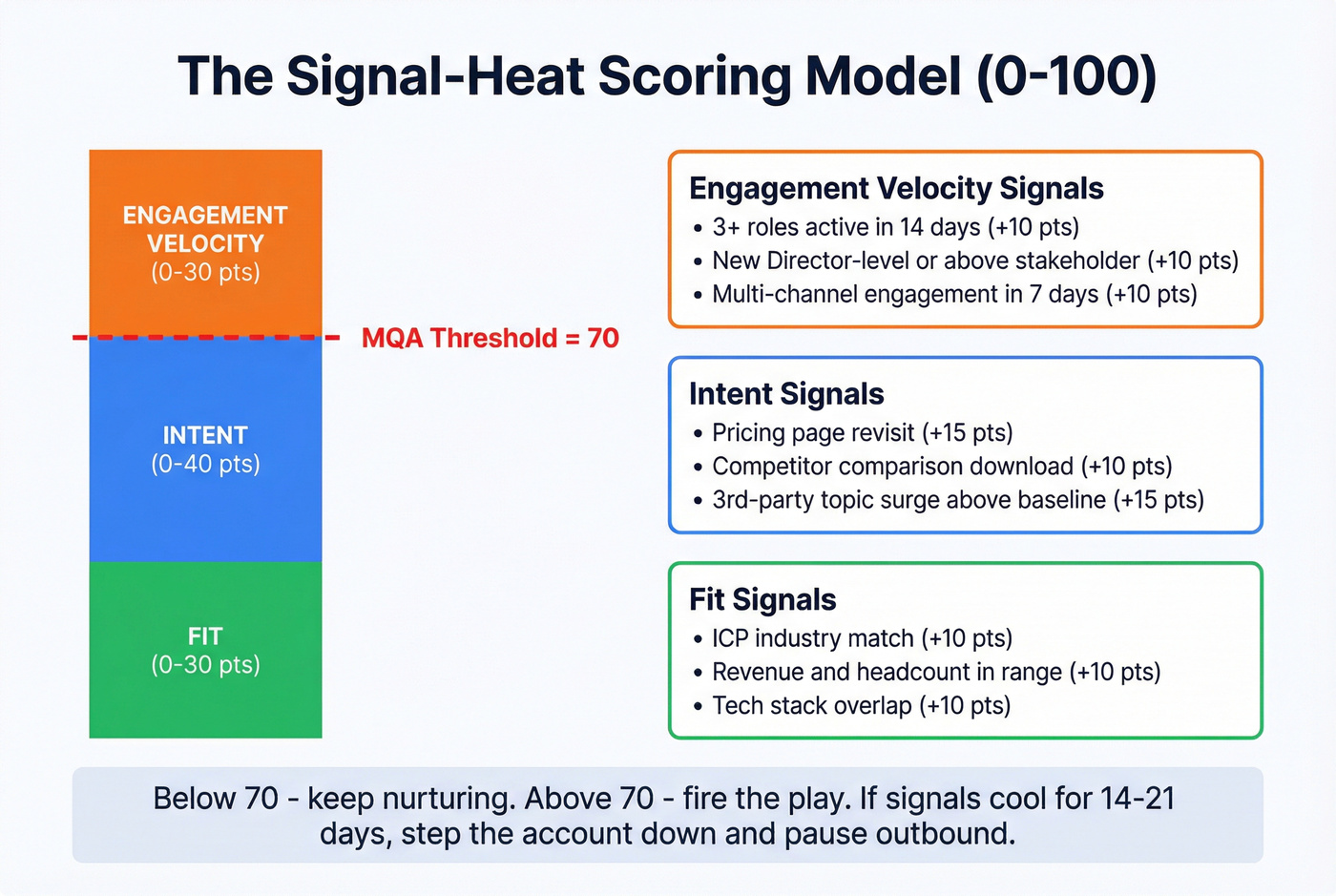
The model weights three categories:
| Signal Category | Weight (0-100) | Example Signals |
|---|---|---|
| Fit (0-30) | ICP match | Industry, revenue, headcount, tech stack |
| Intent (0-40) | In-market behavior | Pricing page revisit (+15), competitor comparison (+10), 3rd-party topic surge |
| Engagement Velocity (0-30) | Multi-stakeholder activity | 3+ roles active in 14 days (+10), new Dir+ stakeholder (+10) |
An account scoring 70 or above crosses the MQA (Marketing Qualified Account) threshold and moves from nurture into sales-assisted engagement. Below 70, keep nurturing. Above 70, fire the play.
The cool-down rule matters just as much as the threshold. If intent signals cool for 14-21 days, step the account down and pause outbound. Chasing accounts that have gone quiet is how you burn rep time and damage relationships. Let the signals lead.
Orchestration by Journey Stage
Each stage of the account journey requires different actions from different teams:
| Stage | Marketing | Sales | CS |
|---|---|---|---|
| Attract | Topic-led content, dynamic site modules | - | - |
| Engage | Stakeholder maps, role-specific nurtures | Role-based demos, multi-threading | - |
| Close | Proof-of-value content, security pack | Mini-pilot, exec alignment | Onboarding preview |
| Grow | Advocacy plays, expansion content | Upsell signals | 30-60-90 adoption, QBR dashboards |
CS involvement starts before the deal closes. That onboarding preview during the Close stage isn't a nice-to-have - it's how you reduce time-to-value and set up expansion revenue from day one.
The ABX Tech Stack
G2 maintains a dedicated category for account-based orchestration platforms, which tells you this is a real, recognized software layer - not a marketing buzzword.
Look, if your average deal size is under $25K and your team has fewer than 20 reps, you probably don't need a six-figure orchestration platform. A CRM, a strong data layer, and disciplined playbooks will get you 80% of the way there. The platforms below matter when you're scaling past that.
Platforms
Demandbase is the enterprise standard - full-stack account intelligence, advertising, and sales activation in one platform. Expect $20K-$150K+/year depending on modules and ad spend. 6sense leads on predictive intent and anonymous account identification, typically landing in a similar range. Both are serious investments that make sense for companies with 50+ reps and dedicated ABM teams.
Terminus (typically $20K-$100K/year) is a well-known mid-market option. If you're evaluating it, pressure-test the product roadmap before signing a multi-year deal.
Skip all three if you're under 20 reps. Seriously.
Intent Data
Bombora is the market standard for third-party intent data, typically $20K-$60K/year as a standalone feed. It aggregates research behavior across a co-op of B2B publisher sites and flags when accounts surge above baseline on specific topics.
For teams that don't want to manage a standalone intent vendor and its separate contract, Prospeo bundles Bombora-powered intent data across 15,000 topics directly into its contact data platform - giving you surge signals and verified contacts in one place.
Contact Data & Enrichment
Your orchestration ceiling is your data quality floor. Every play, every sequence, every synchronized touchpoint dies at activation if your emails bounce and your dials are dead. In our experience, this is the layer to build on first.
We've tested dozens of data providers over the years, and the gap between "good enough" and "actually verified" is enormous when you're running multi-threaded plays against buying committees of 6-10 people. One bad email in a coordinated sequence doesn't just bounce - it breaks the entire play's timing and makes your team look uncoordinated, which is the opposite of what you're going for.
Prospeo covers 300M+ professional profiles with 143M+ verified emails at 98% accuracy and 125M+ verified mobile numbers delivering a 30% pickup rate. The 7-day data refresh cycle means you're not running plays against stale records.

Apollo (from $49/mo) works for smaller teams on a budget. It combines a solid database with built-in sequencing, though email accuracy and mobile coverage run thinner than dedicated data platforms.
Engagement & Sales Activation
HubSpot (from $800/mo for Marketing Hub) has been building out ABM features - company-level reporting, target account dashboards, and buying-group workflows. It's not a dedicated orchestration platform, but for teams already on HubSpot, it's a pragmatic starting point. Pair it with a strong data layer and you can run meaningful ABX without a six-figure platform investment.
| Stack Layer | Tool | Starting Price | Best For |
|---|---|---|---|
| Platform | Demandbase | ~$20K-$150K+/yr | Enterprise ABX |
| Platform | 6sense | ~$20K-$150K+/yr | Intent-driven ABX |
| Platform | Terminus | ~$20K-$100K/yr | Mid-market ABM |
| Intent | Bombora | ~$20K-$60K/yr | Standalone intent feeds |
| Contact Data | Prospeo | ~$0.01/email (free tier available) | Emails + mobiles + intent |
| Enrichment | Apollo | From $49/mo | Budget enrichment + sequencing |
| Engagement | HubSpot | From $800/mo | ABM within MAP |
ABX orchestration requires clean, role-specific contact data refreshed faster than your competitors move. Prospeo's 7-day data refresh cycle and 30+ filters - including buyer intent, job changes, and department headcount - let you build and maintain accurate buying group maps at scale.
Real orchestration starts with contacts verified this week, not last quarter.
Measuring ABX Performance
Three formulas matter. Everything else is a vanity metric until these are moving in the right direction.
Pipeline Velocity = (# Qualified Opps x Avg Deal Size x Win Rate) / Avg Sales Cycle. This is your north star. If orchestration is working, velocity increases because you're engaging the right accounts at the right time with the right people.
Net Revenue Retention (NRR) = (Start ARR + Expansion - Contraction - Churn) / Start ARR. ABX isn't just about new logos. If your Grow stage is working, NRR should climb as CS and sales coordinate expansion plays.
Win Rate = Closed-Won / (Closed-Won + Closed-Lost). Simple, but it's the most honest measure of whether your coordinated plays are actually helping deals close.
Companies with aligned audiences see 3x more pipeline influenced by marketing compared to those with broken handoffs. Directional benchmarks from account-based programs show up to 171% increases in deal value and 40% shorter sales cycles - but those numbers depend entirely on execution quality. The formulas above tell you whether your execution is working.
FAQ
Is ABX just rebranded ABM?
No. ABM focuses on acquisition - marketing identifies target accounts, runs campaigns, and hands off to sales. ABX extends shared ownership across the full lifecycle, with marketing, sales, and CS all accountable for account health from first touch through renewal and expansion. The distinction changes who owns the account, how success is measured, and whether post-sale revenue gets the same strategic attention as new pipeline.
What's the minimum tech stack to start?
A CRM, a contact data provider with verified emails and direct dials, and an intent signal source. You don't need a $100K platform to begin - start with a spreadsheet-based scoring model and 10 target accounts. Prospeo's free tier paired with HubSpot or Salesforce covers the essentials for early-stage programs.
How long before results show up?
Expect 60-90 days for early engagement signals - MQA volume, engagement velocity across the buying committee, and signal-to-meeting conversion rates. Pipeline and revenue impact typically take 2-3 quarters because you're influencing complex, multi-stakeholder deals. Use the cool-down rule to avoid chasing noise during the early stages.
ABX orchestration is an operating model, not a software purchase. Get the scoring model right, align your teams on shared KPIs, and build on a foundation of clean, verified data - the platforms can come later.