

Go-to-Market Transformation: The Operator's Playbook for 2026
Your pipeline looks fine on the dashboard. Win rates are sliding, cycles are stretching, and reps are working twice as hard to close deals that used to close themselves. Up to 95% of the buyer journey now happens without a single sales conversation - and most revenue orgs are still built for a world where buyers pick up the phone.
That gap between how you sell and how buyers actually buy is exactly what go-to-market transformation addresses.
Start Here, Not With a Funnel Diagram
This kind of systemic rebuild isn't a new slide deck. It's a controlled overhaul of your revenue operating system. Start with three things: ICP and account list truth, routing and handoffs, data quality and verification. Everything else compounds after that.
Here's the contrarian take most consultants won't give you: stop starting with a new funnel diagram. Start with one accountable weekly operating meeting and a single source of truth for accounts and contacts. The strategy decks can wait. The operating rhythm can't.
GTM Strategy vs. GTM Transformation
A GTM strategy is a plan - who you sell to, what you say, which channels you use, how you price. Every company has one, even if it's scribbled on a whiteboard.
A go-to-market transformation is something different entirely. It's a controlled rebuild of the revenue operating system: new motions, new org structures, new data foundations, new governance for how revenue gets created. Fewer than 33% of companies have a formal GTM playbook, yet those that do see 3x revenue growth and 10% higher product launch success rates. B2B buying groups now involve 6-10 decision-makers per deal. You can't navigate that complexity with a slide deck - you need a RevOps model that coordinates marketing, sales, and CS around shared accounts, shared data, and shared accountability.
Why Now - What Changed
Three forces converged in 2025-2026 that make incremental optimization feel insufficient. We've watched this play out across dozens of teams we work with, and treating the problem as a systemic rebuild rather than a series of tweaks is the prerequisite for keeping pace.
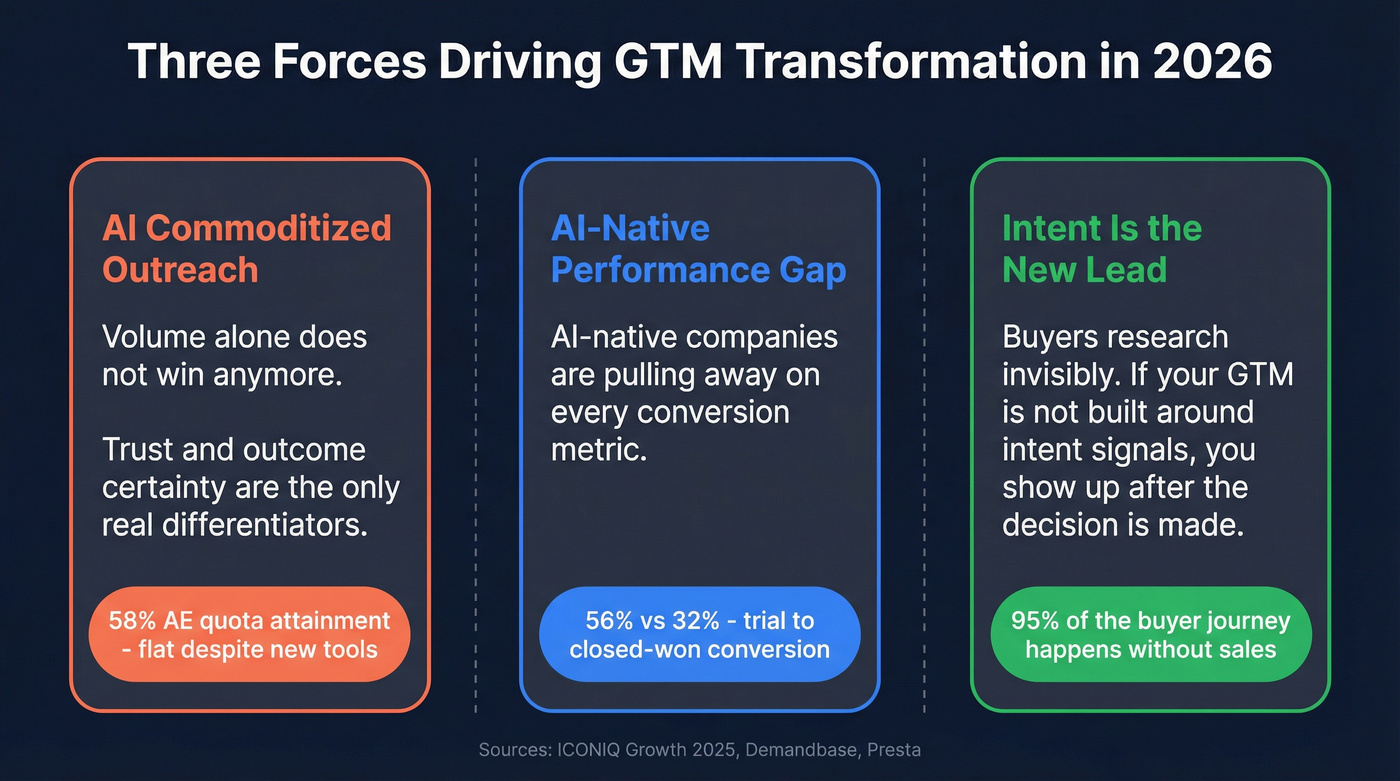
AI commoditized outreach. When SDRs can generate personalized sequences in seconds, trust and outcome certainty become the only real differentiators. The shift is from selling products to selling outcomes - where customers buy verified results, not features. Volume alone doesn't win anymore.
The performance gap between AI-native and non-AI-native companies is widening fast. ICONIQ's 2025 benchmarks show AI-native firms at $100M+ ARR converting free trials and POCs to closed-won at 56% vs. 32% for non-AI-native peers. AE quota attainment is flat at 58% - reps aren't getting more productive despite all the new tools. Roughly 70% of companies report moderate or full AI adoption in GTM workflows. The companies that haven't started are falling behind on multiple axes simultaneously.
Intent is the new lead. Buyers raise their hands late, and most of their research activity is invisible to your sales team. If your GTM isn't built around intent signals and digital buying behavior, you're showing up after the decision is already made.
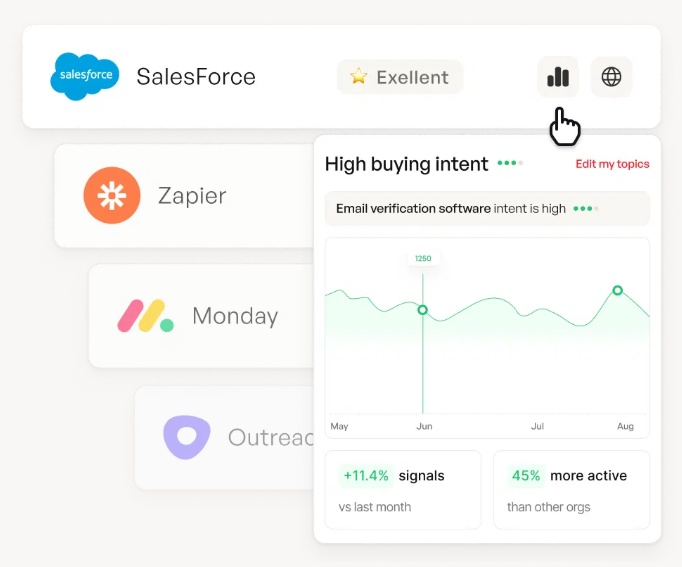

Phase 1 of any GTM transformation is a data audit - and most teams fail it. Stale contacts, bounced emails, and wrong numbers kill new motions before they launch. Prospeo's 7-day refresh cycle, 98% email accuracy, and 125M+ verified mobiles give your rebuilt revenue engine the foundation it actually needs.
Stop rebuilding your GTM on a data layer that expires every six weeks.
Five Capability Pillars
Deloitte's GTM transformation framework breaks the work into five capability areas. Here's how it actually gets done:
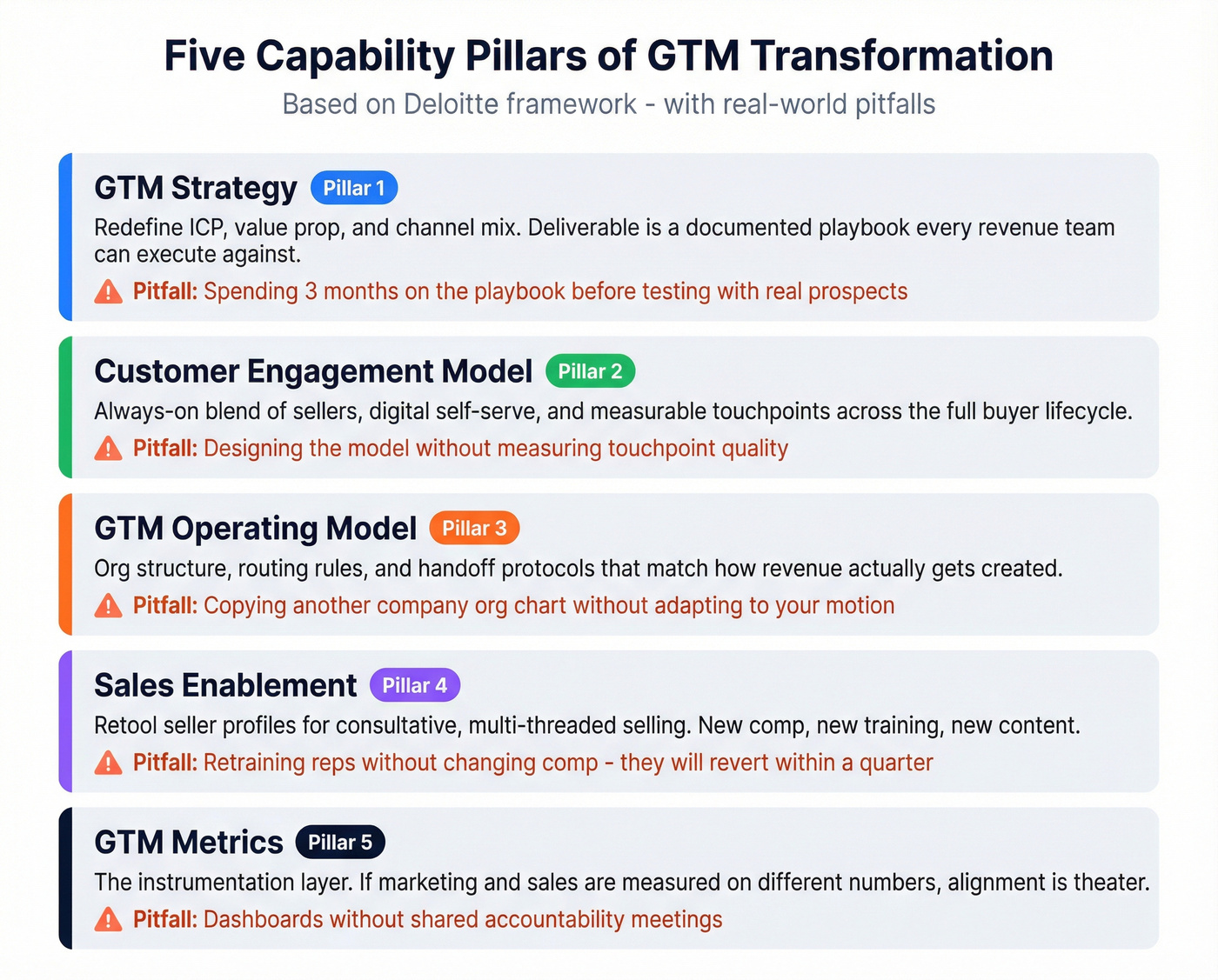
GTM Strategy means redefining ICP, value prop, and channel mix. The deliverable is a documented playbook every revenue team can execute against - not a strategy deck that lives in Google Drive. The pitfall: spending three months on the playbook before testing any of it with real prospects.
Customer Engagement Model is the always-on blend of sellers, digital self-serve, and measurable touchpoints across the full buyer lifecycle. The pitfall: designing the model without measuring touchpoint quality. You end up with more channels but no signal on which ones matter.
GTM Operating Model is the org structure, routing rules, and handoff protocols. Cisco's shift to 53% of revenue from software and services in FY21 shows the kind of business model pressure that forces operating model redesign.
Sales Enablement means retooling seller profiles for consultative, multi-threaded selling. New comp plans, new training, new content. Pitfall: retraining reps without changing comp - they'll revert within a quarter.
GTM Metrics is the instrumentation layer. If marketing and sales are measured on different numbers, alignment is theater.
The Phased Roadmap
This work isn't a single project with a launch date. It's a phased rebuild that takes 6-18 months for the full scope, with initial operating-model changes landing in 3-9 months. BCG's concept of self-funding transformation is the right mental model - near-term victories fund longer-term capability building. BCG found revenue growth drives roughly 75% of long-term TSR for top-quartile S&P 500 companies. Rebuilding how you go to market is how you capture that growth.
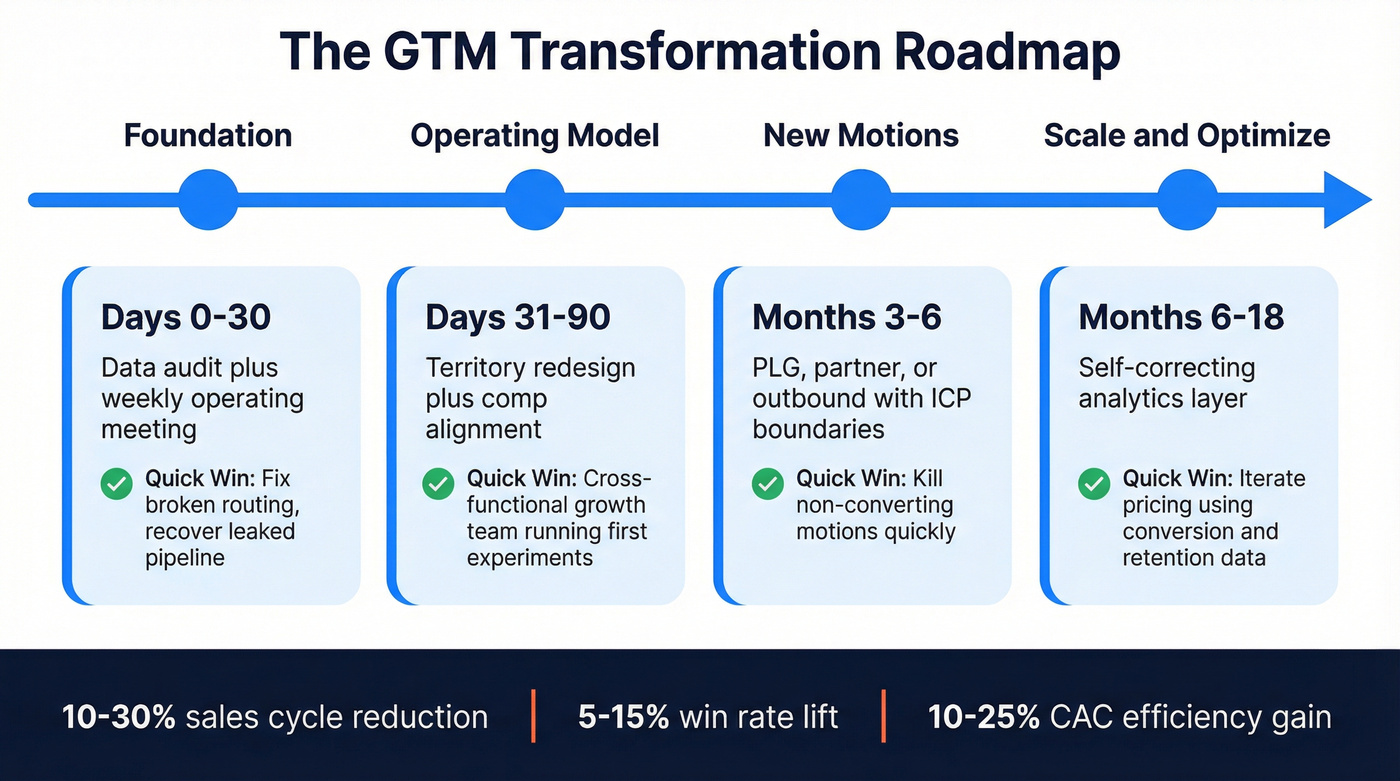
| Phase | Timeline | Key Deliverable | Quick Win |
|---|---|---|---|
| Foundation | 0-30 days | Data audit + weekly operating meeting | Fix broken routing - recover pipeline leaking through missed follow-up and misroutes |
| Operating Model | 31-90 days | Territory redesign + comp alignment | Cross-functional growth team running first experiments |
| New Motions | 3-6 months | PLG, partner, or outbound with ICP boundaries | Kill non-converting motions quickly |
| Scale & Optimize | 6-18 months | Self-correcting analytics layer | Iterate pricing using conversion and retention data |
In practice, comp misalignment and stale data are the two fastest ways to stall the effort in the first 90 days. Phase 1 exists to surface those problems before you've committed budget to new motions.
Typical outcome ranges: 10-30% sales cycle reduction, 5-15% win-rate lift, and 10-25% CAC efficiency improvement when the work is done well. IDC estimates over 10% of revenue is lost in the GTM phase - these aren't abstract numbers, they're the cost of running without accountability.
Adding PLG Without Killing Sales
Here's a pattern we've seen kill PLG before it starts: a company launches self-serve, reps see it as a threat to their pipeline, and the whole thing dies in 60 days because comp and territory rules made reps fight it instead of embrace it.
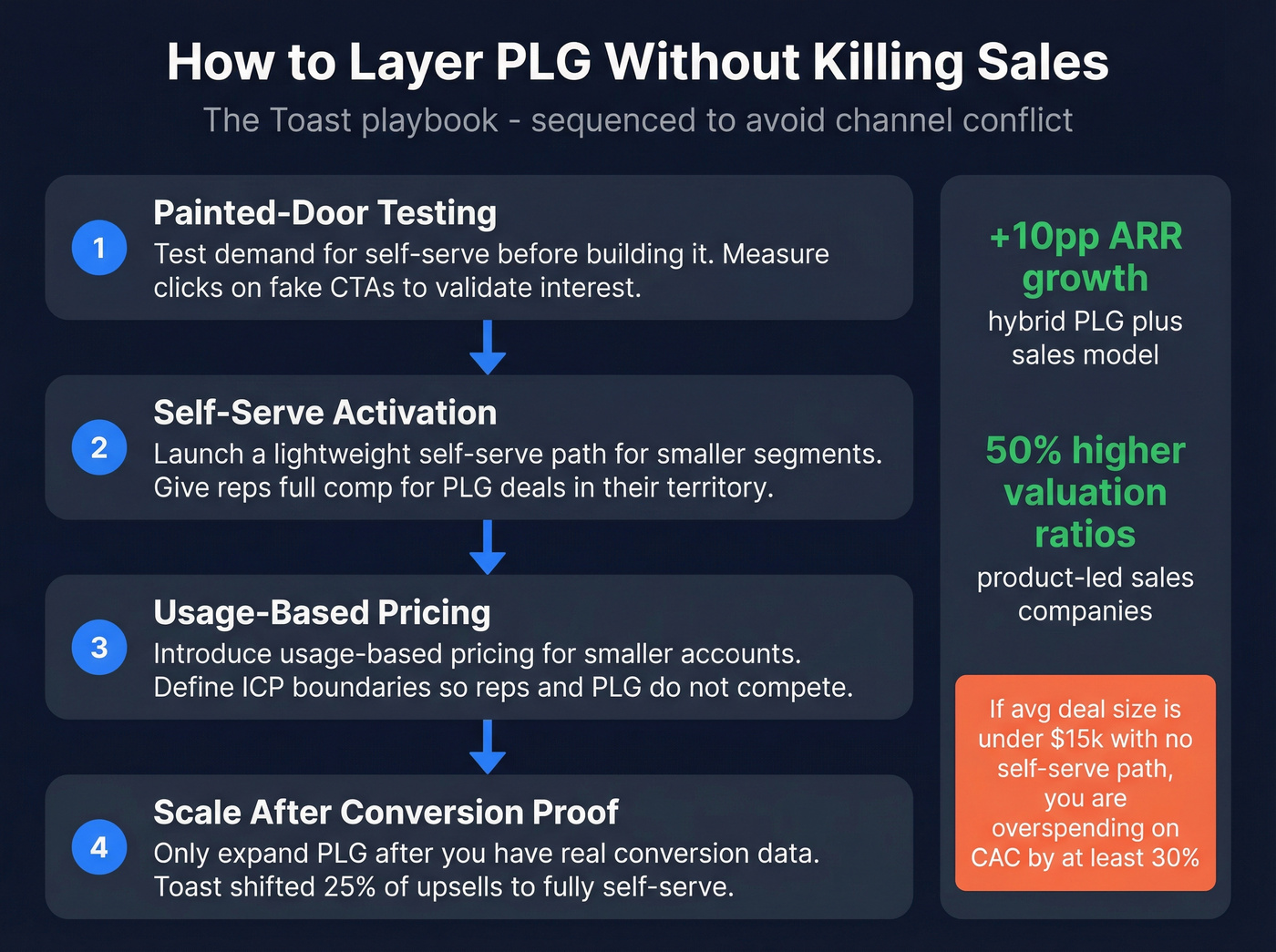
Toast's transformation is the counter-example worth studying. They layered PLG onto a field-sales engine, eventually shifting 25% of upsell transactions to fully self-serve and lifting small restaurant bookings by 10%. The sequencing mattered: painted-door testing first, then self-serve activation, then usage-based pricing for smaller segments, and only scale after conversion proof. Toast defined ICP boundaries to avoid channel conflict and initially gave reps full comp for PLG deals in their territory.
PLG alone doesn't produce outsize performance. McKinsey's research confirms the hybrid product-led sales model delivers +10 percentage points more ARR growth and roughly 50% higher valuation ratios. This is where RevOps innovation matters most - designing comp, routing, and attribution so that self-serve and sales-assisted motions reinforce each other instead of competing.
Look, if your average deal size is under $15k and you're still running a pure outbound motion with no self-serve path, you're overspending on CAC by at least 30%. PLG isn't optional at that price point.
The Data Foundation
Let's be honest about something most transformation playbooks skip: if your data isn't fresh and verified, you're just scaling noise. Every play you design, every routing rule you build, every intent signal you act on - all of it runs on contact data. Bad data doesn't just create bounces. It erodes rep trust, poisons your domain reputation, and makes every metric unreliable.
Fix this first, skip the rest until you do. You need verified contact data with fast refresh cycles and enrichment that returns actionable fields. Don't buy a massive database and hope coverage equals quality. The biggest database often produces the worst connect rates because half the records are stale - the consensus on r/sales threads about data providers backs this up consistently.
When you're ready to operationalize the new ICP, you need a data layer that keeps up. Prospeo gives you 98% verified emails refreshed on a 7-day cycle - compared to the 6-week industry average - with intent signals across 15,000 topics so your plays run on current data. The CRM enrichment returns 50+ data points per contact at a 92% API match rate, which means routing and segmentation rules actually work on day one.
Skip Prospeo if you're only doing account-level research with no outbound or enrichment needs. But for teams running outbound plays or enriching CRM data as part of a transformation, it's the fastest way to get clean data into the system without enterprise contracts or six-figure commitments.

Intent is the new lead, but intent signals are worthless if your contact data bounces. Prospeo tracks 15,000 buyer intent topics via Bombora and pairs them with 300M+ verified profiles - so when you detect in-market accounts, you reach real decision-makers at $0.01 per email.
Turn intent signals into booked meetings instead of bounced emails.
FAQ
How long does a GTM transformation take?
Initial operating-model changes - data quality, routing, handoff redesign - land in 3-9 months. Full transformation including new motions, org design, and instrumented metrics typically runs 6-18 months depending on company size. Phase the work so early wins self-fund later stages.
What's the difference between GTM optimization and transformation?
Optimization improves what exists: better conversion rates, faster sequences, tighter targeting. Transformation rebuilds the operating model - new motions, new org structures, new data foundations, new governance. It changes how revenue gets created, not just how fast the current system runs.
What tools do you need for a GTM rebuild?
At minimum: a CRM as the system of record, a data platform for verified contacts and intent signals, and a revenue intelligence layer for pipeline visibility. Start with data quality - everything else compounds after that.
Can small teams run a go-to-market transformation?
Yes. A 5-person revenue team can complete Phase 1 - data audit, routing fix, weekly operating cadence - in under 30 days. The key is sequencing: fix data and handoffs before investing in new motions or tooling. We've seen teams this size triple pipeline within a quarter just by getting the foundation right.