

Kintone vs Salesforce: The Comparison Neither Vendor Gives You
You're a 12-person team. You saw Kintone's $24/month per user and thought, "that's manageable." Then a Salesforce rep quoted you Enterprise at $175/user/month, and you realized these aren't even the same category of product. The Kintone vs Salesforce decision isn't a CRM-vs-CRM call - it's a "what kind of company are you?" call.
30-Second Verdict
Pick Kintone if you're under 20 people, don't have a Salesforce admin, and need something running by Friday. It's a no-code app platform you shape into a CRM - not a CRM out of the box.
Pick Salesforce if you're a multi-department sales org that needs AI-powered automation, deep integrations, and enterprise forecasting. You'll pay for it, but you'll get a full GTM stack.
Here's the thing: most teams agonizing over this comparison should probably pick neither. If you're in the 20-100 person range and want CRM plus marketing automation without building from scratch, HubSpot's free CRM tier is the obvious middle ground.
Pricing - What You'll Actually Pay
Salesforce's pricing page is designed to get you on a call, not give you a straight answer. Let's break it down.
Kintone: One plan. $24/user/month. Minimum five users ($120/month floor). Every feature included. No tier-gating.
Salesforce - the full tier ladder:
| Tier | Price/user/mo |
|---|---|
| Free (Starter) | $0 (max 2 users) |
| Starter Suite | $25 |
| Pro Suite | $100 |
| Enterprise | $175 |
| Unlimited | $350 |
| Agentforce 1 Sales | $550 |
Most teams land on Pro ($100) or Enterprise ($175). Independent estimates put Salesforce's true cost at 2.5x to 4x the license fee once you factor in implementation, training, and ongoing admin. One TrustRadius reviewer put it bluntly: onboarding "took far greater [time] than we realized" - and they were told to buy additional onboarding support after their budget was already maxed.
For a 10-person team over year one, Kintone runs about $2,880. Salesforce Enterprise runs roughly $52,500-$84,000 with implementation. That's not a rounding error. It's a different budget category entirely.
What Each Platform Actually Does
Kintone: The Build-Your-Own Approach
In our testing, Kintone's drag-and-drop builder had a working app tracking deals in under an hour. Custom workflows, collaboration threads on records, and a genuinely intuitive interface. But here's what you won't get out of the box: pipeline management, sales forecasting, or marketing automation. You're building your own CRM on a no-code platform - powerful if you want that flexibility, but not a turnkey sales tool.
Salesforce: The Enterprise Machine
Salesforce ships a full sales stack: pipeline management, forecasting, territory planning, CPQ, and autonomous AI agents via Agentforce. The Agentforce setup uses natural-language configuration and includes a Testing Center to validate agent behavior before deployment, which is a meaningful step toward making AI agents practical rather than just a buzzword. On the Sales Cloud pricing page, Enterprise includes Agentforce, and AI can be added to Enterprise and above.
Skip this if you're a small team tracking deals and contacts. You'll pay for a platform built for 500-person sales orgs, and most features will sit untouched.
Ease of Use and Admin Burden
G2's sub-scores tell a clear story:
| Metric (G2, /10) | Kintone (267 reviews) | Salesforce (25,444 reviews) |
|---|---|---|
| Ease of Setup | 8.7 | 7.8 |
| Ease of Admin | 9.0 | 7.9 |
| Quality of Support | 9.3 | 8.1 |
Kintone wins every usability category. The review count gap matters - Salesforce's scores span everything from 5-person shops to Fortune 500 deployments - but the pattern holds across the board.
The LEAGLE case study is telling: even simple Salesforce customizations required an outside partner and took weeks. After switching to Kintone, they cut costs to one-tenth and saved 400 hours per year. We've seen this pattern repeatedly - teams paying for Salesforce admin hours that exceed their actual license costs.

Kintone saves you money. Salesforce gives you scale. Neither gives you clean data. Prospeo pushes 98% accurate emails into both - natively into Salesforce, via Zapier into Kintone - so your CRM investment doesn't get wasted on bounced emails and dead numbers.
Start free with 75 verified emails. No contracts, no sales calls.
Integrations and Ecosystem
Salesforce pulls away decisively here. The AppExchange hosts roughly 6,000 apps, plus native enterprise integrations through MuleSoft and Tableau. If you need to connect to an ERP, CPQ tool, or marketing platform, Salesforce almost certainly has a connector.
Kintone's ecosystem is smaller. For anything outside its plug-in library, you're relying on Zapier, which polls every 15 minutes on free plans. Kintone offers solid API access at 50,000 calls/day, but as one TrustRadius reviewer noted, "other apps/APIs are not necessarily easy to connect." If your stack is complex and you don't have a developer on staff, Salesforce's ecosystem is in a different league.
Scalability and Technical Limits
Kintone doesn't impose a fixed maximum on records, and its admin documentation notes there shouldn't be issues creating and viewing records with around one million records in an app under simple conditions. It does have hard per-app limits: 500 fields, 20 plug-ins, and CSV imports capped at 100,000 lines. For a 15-person team, that's plenty. For a 200-person org with complex data models, you'll hit walls fast.
Salesforce scales to enterprise without question. The G2 market segment data reflects the split: 73.7% of Kintone reviews come from small businesses, while 46% of Salesforce reviews come from mid-market and enterprise.
When to Pick Each
Pick Kintone when your team is under 20, your budget is under $5K/year, you don't want to hire an admin, and you need something live this week.
Pick Salesforce when you have 50+ users across departments, need AI agents and territory management, have complex integration requirements, and have budget for a real implementation.
For teams in between - say 20-50 people who've outgrown spreadsheets but don't need Salesforce's full weight - look at HubSpot or Pipedrive first. Both offer structured CRM features without the build-it-yourself tradeoff of Kintone or the cost of Salesforce.
The Missing Piece: CRM Data Quality
Neither platform solves data quality. You can pick the perfect CRM and still fill it with bounced emails and disconnected numbers - we've watched teams spend months on CRM selection only to load garbage data on day one. Prospeo integrates natively with Salesforce and connects to Kintone via Zapier, pushing verified contacts directly into your pipeline. With 98% email accuracy and a 7-day data refresh cycle, it's the data layer both platforms need. Starts free at 75 emails/month, roughly $0.01/email on paid plans, no contracts.
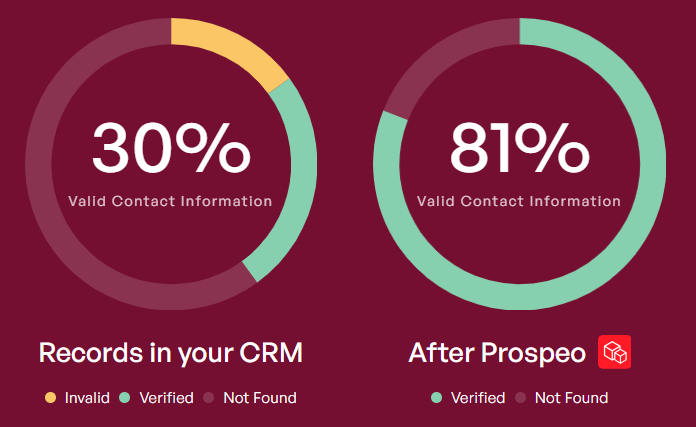
Teams spend months choosing between Kintone and Salesforce, then load day-one data that bounces at 35%. Prospeo refreshes every 7 days - not 6 weeks - and delivers contacts at $0.01/email with 98% accuracy. That's the data layer your CRM selection actually depends on.
Stop debating CRMs and start fixing the data inside them.
FAQ
Is Kintone a real CRM?
Kintone is a no-code app platform you can configure as a CRM, but it lacks native pipeline management and forecasting. Think customizable business database with collaboration features, not a turnkey sales tool like Salesforce or HubSpot.
Why is Salesforce so much more expensive than advertised?
The $25/month Starter tier lacks features most teams need. Realistic deployments run $100-$175/user, and total cost hits 2.5-4x license fees after implementation, training, and ongoing admin - often $50K+ in year one for a 10-person team.
Can I keep my CRM data accurate in either platform?
Yes. Prospeo offers a native Salesforce integration and connects to Kintone via Zapier, enriching records with 98%-accurate emails and verified mobile numbers on a 7-day refresh cycle. The free tier includes 75 emails/month - enough to test data quality before committing.
Which is better for a team under 20 people?
Kintone, in most cases. At $24/user/month with no tier-gating, it costs roughly one-fifth of Salesforce Enterprise. You lose advanced forecasting and AI agents, but gain a faster setup and zero admin overhead.