

Cold Email Follow-Up Best Practices: What 16.5M Emails Reveal
Most cold email follow-up advice tells you to send more. Five emails. Seven emails. Twelve touchpoints. The data says the opposite. Belkins analyzed 16.5M cold emails across 93 business domains from Jan-Dec 2024, and the highest reply rate - 8.4% - came from Step 1 (the first email). Every additional follow-up pulled that number down. Instantly's 2026 benchmark report across billions of interactions shows 58% of all replies come from the first touch. Follow-ups capture the remaining 42%, but only if you're disciplined about how many you send, how you write them, and whether your list is clean enough to survive the sequence.
You've probably read a dozen guides that say "follow up 5-12 times" without citing a single study. Meanwhile, your domain reputation is tanking. Let's fix that.
The Playbook (Quick Version)
If you're short on time, here's the rundown:
- 2-3 follow-ups max. Four or more emails total (initial + follow-ups) more than triples spam complaints and unsubscribes.
- Under 80 words per email. Every email, including follow-ups.
- Wednesday is your best send day. Tuesday is second.
- Space touches 3-4 days apart. Use a 3-7-7 cadence (Day 1, Day 4, Day 11, Day 18).
- Same thread, not new subject lines (if you need ideas, pull from subject lines).
- Verify your list before anything fires. One bad batch can flag your domain for weeks.
- Kill "just checking in." Add new value or don't send (here are better options for just checking in).
That's the short version. Now let's look at what's behind each of these.
What the Data Actually Says
The instinct to keep following up feels right. More touches, more chances. But the numbers tell a different story.
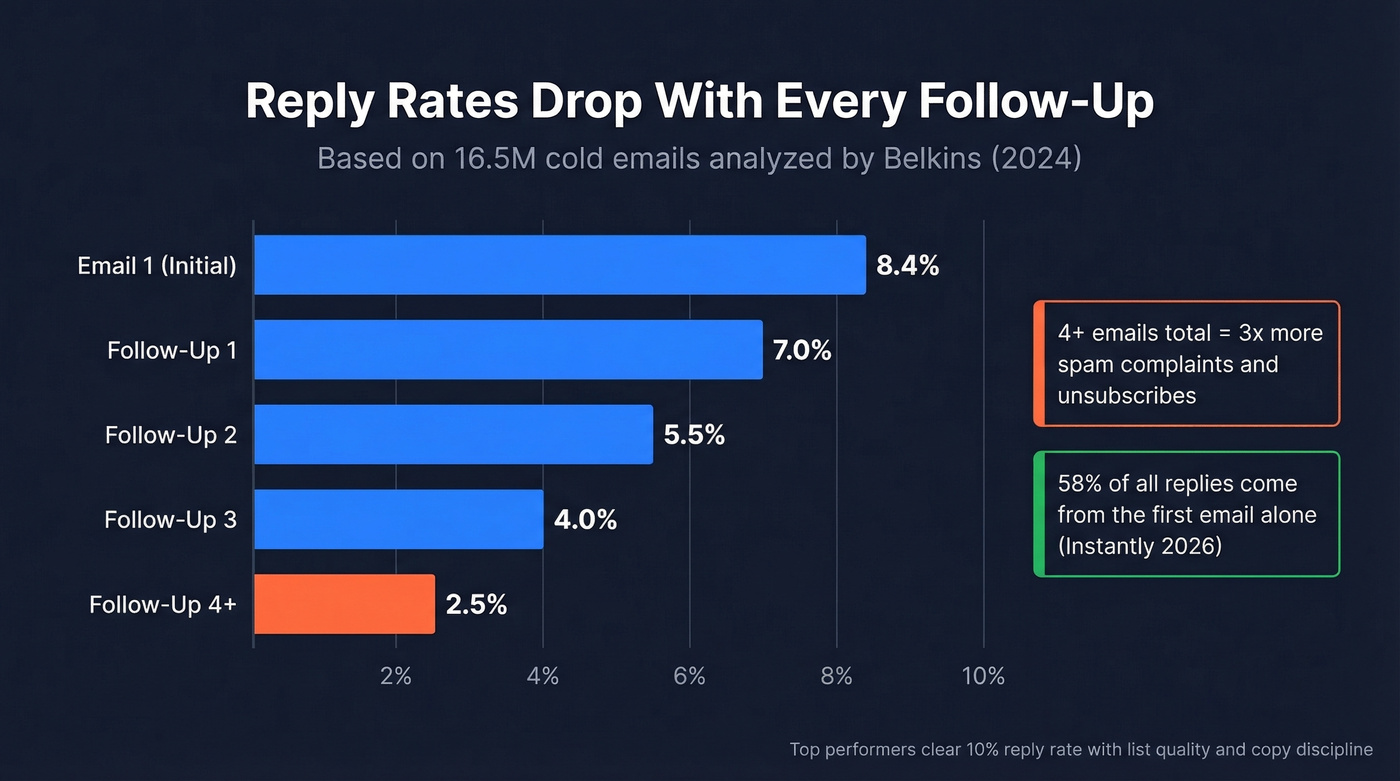
The 16.5M-email dataset shows reply rates declining with each additional email after Step 1. The first email pulls 8.4%. Once your sequence hits 4+ emails total, you more than triple your unsubscribe and spam complaint rates. You're not just getting diminishing returns - you're actively damaging your sender reputation (more on improving sender reputation).
The 2026 benchmark puts the average cold email reply rate at 3.43%, with top performers clearing 10%. That gap isn't about volume. It's about list quality and copy discipline (see email copywriting).
An EmailToolTester survey of 1,800 consumers adds the receiving end's perspective: 50.9% of people don't engage with cold emails at all, and 10.3% mark them as junk. Every unnecessary follow-up increases your odds of landing in that second bucket.
Reply Rates by Persona and Segment
Not every prospect reacts the same way to follow-ups. Founders and C-suite contacts hold relatively flat through the first follow-up (6.64% to 6.66%), peak on the second at 6.94%, then drop hard to 3.01% by the fourth email. That second follow-up is your window - don't waste it on "just circling back."
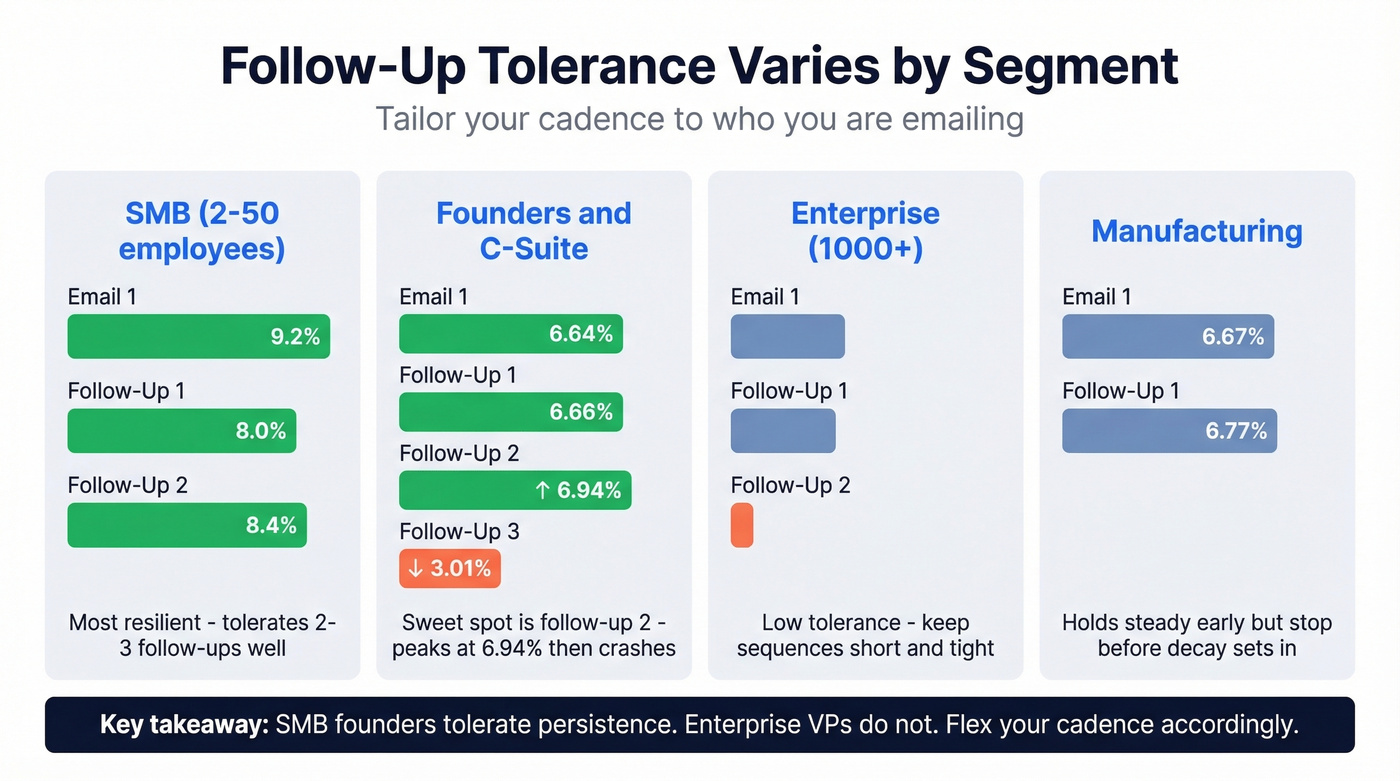
Company size matters too. Small businesses (2-50 employees) start at 9.2% and stay resilient through two follow-ups (8.0% after the first follow-up, then 8.4% on the second). Enterprise accounts are far less tolerant of persistence, so your sequence should be shorter and tighter (especially in enterprise B2B sales).
| Segment | Email 1 | Follow-Up 1 | Follow-Up 2 | Follow-Up 3+ |
|---|---|---|---|---|
| Overall avg | 8.4% | Declines each step | Declines each step | 3x unsub/spam complaints |
| Founder/C-suite | 6.64% | 6.66% | 6.94% | 3.01% (by email 4) |
| SMB (2-50) | 9.2% | 8.0% | 8.4% | Falls off after |
| Enterprise (1K+) | Lower tolerance | Keep it short | Keep it short | Stop early |
| Manufacturing | 6.67% | 6.77% | Holds better early | Stop before decay |
Your cadence should flex based on who you're emailing, not follow a one-size-fits-all template. SMB founders tolerate persistence. Enterprise VPs don't.
The Right Cadence and Timing
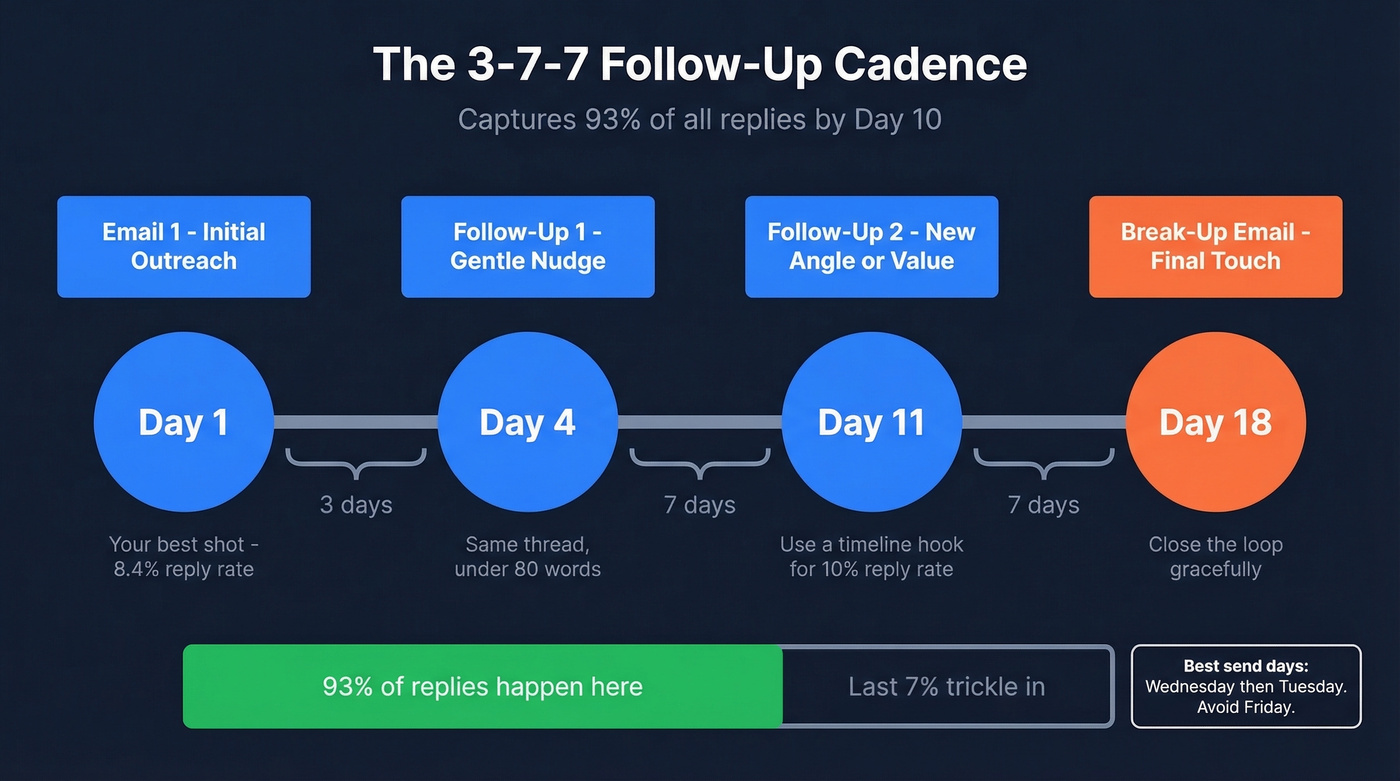
The 3-7-7 cadence from Digital Bloom's analysis captures 93% of all replies by Day 10. Here's what that looks like in practice:
| Touch | Day | Purpose |
|---|---|---|
| Email 1 | Day 1 | Initial outreach |
| Follow-up 1 | Day 4 | Gentle nudge |
| Follow-up 2 | Day 11 | New angle or value |
| Break-up | Day 18 | Final touch |
That cadence gives you a clean exit point while still collecting the last chunk of replies that come after Day 10.
Wednesday produces the highest reply rates, followed by Tuesday. Monday works as a launch day, but Friday is a dead zone - you'll get auto-replies, not conversations. Space your touches 3-4 days apart minimum. Anything tighter feels aggressive. Anything wider loses momentum (for more data, see best time to send cold emails).
The four-email sequence is the ceiling for most campaigns. If you haven't gotten a reply by Day 18, the answer is no - or you need a different channel, not a fifth email.
Here's a hot take we stand behind: if your average deal size is under $10k, you probably don't need more than two follow-ups. The math doesn't work. The time your SDR spends crafting touches three and four for a $5k deal is better spent finding 10 new prospects who actually fit your ICP (use an ideal customer profile to tighten targeting).
Writing Follow-Ups That Get Replies
The 2026 benchmark data is clear: the best-performing campaigns keep every email under 80 words. That includes follow-ups. Practitioners on r/copywriting push even shorter - 40-60 words - and focus on making the offer do the heavy lifting, not the personalization. An absurdly short email with a compelling offer beats a personalized novel every time.
Woodpecker's data shows that adding follow-ups matters: even one follow-up can increase reply rate by 22%. Sending follow-ups in the same thread keeps context intact and avoids the subject-line lottery. Your prospect doesn't have to remember who you are - the thread does that work for you.
Here's the thing: "just checking in" and "just wanted to follow up" are dead phrases. Every SDR on the planet uses them. If your follow-up doesn't add something new - a case study, a relevant stat, a different angle - don't send it (more examples in cold email follow-up templates).
Hook Types That Work
Digital Bloom's benchmark data breaks down reply rates by hook type, and the differences are dramatic:
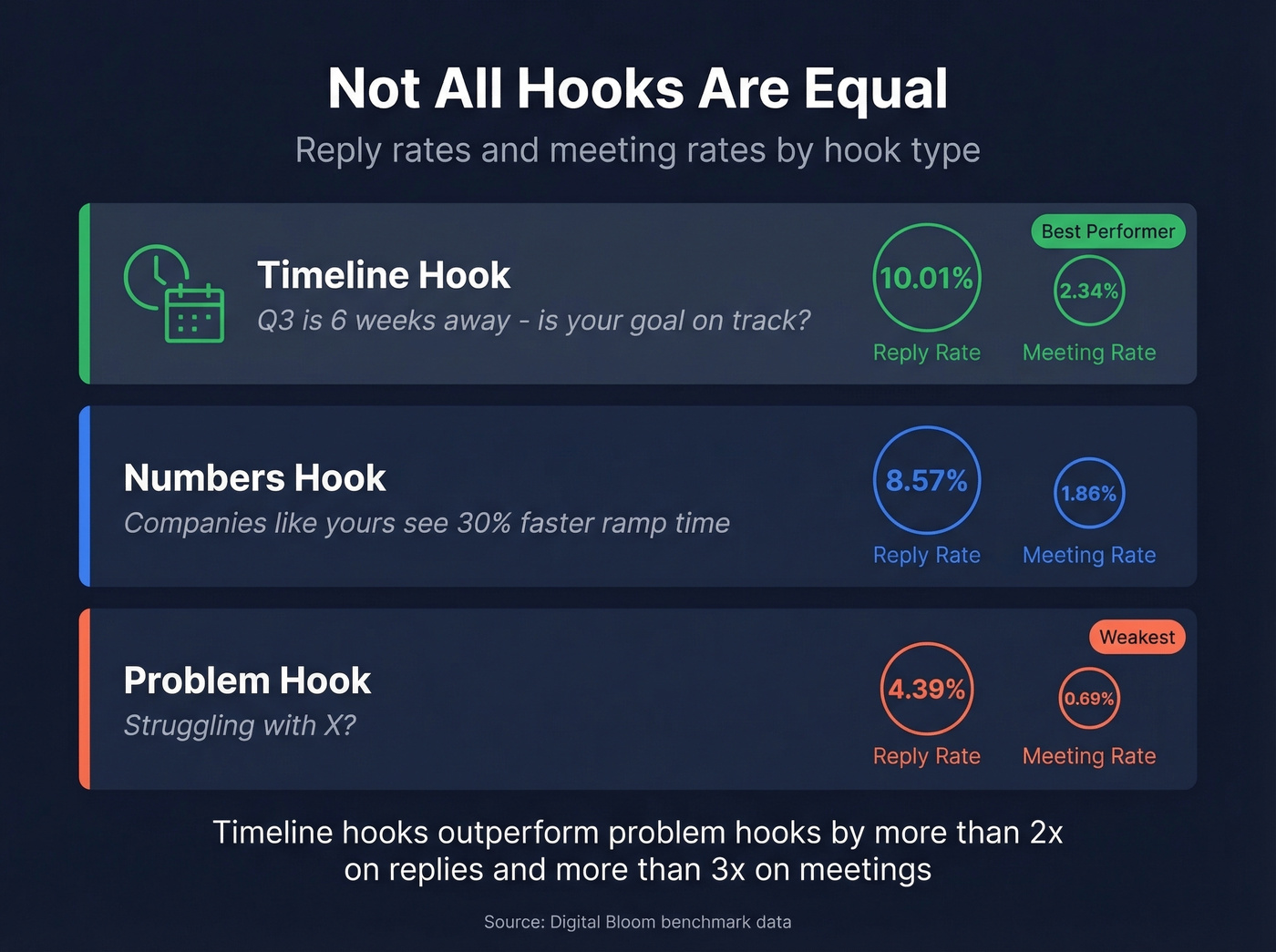
- Timeline hooks ("Q3 is 6 weeks away - is [goal] on track?"): 10.01% reply rate, 2.34% meeting rate
- Numbers hooks ("Companies like yours are seeing 30% faster ramp time"): 8.57% reply, 1.86% meeting
- Problem hooks ("Struggling with X?"): 4.39% reply, 0.69% meeting
Timeline hooks outperform problem hooks by more than 2x. They create urgency without being pushy. Use them in follow-up two or three when you need a fresh angle.
Soft CTAs Beat Hard Asks
The Reddit consensus and Gong's research both point the same direction: soft CTAs crush hard meeting asks in cold outreach. "Worth a conversation?" or "Interested?" outperforms "Can we book 15 minutes Tuesday at 2pm?" The hard ask creates friction. The soft ask creates a reply (more on email call to action).
Low-friction offers work even better. Instead of asking for a meeting, offer something: "I'll audit your top 3 landing pages and send a Loom with fixes - no call needed." That's a value exchange, not a time request. AI sequencing tools can adjust timing based on engagement signals, but the fundamentals - short copy, new value, clean data - still drive the results.

One bad batch can flag your domain for weeks - the data above proves it. Prospeo's 5-step verification delivers 98% email accuracy, so your 3-email sequence lands in inboxes, not spam folders. Meritt cut their bounce rate from 35% to under 4% and tripled pipeline.
Stop burning your domain on unverified lists.
Follow-Up Templates You Can Steal
Every template below is under 80 words. We practice what we preach.
Gentle Nudge (Day 4)
Subject: (same thread - no new subject)
Hey {{first_name}}, wanted to make sure this didn't get buried. We helped {{similar company}} cut their {{metric}} by {{result}} in {{timeframe}}. If that's relevant to what you're working on, happy to share how. Worth a quick look?
New Angle (Day 11)
Subject: (same thread)
{{first_name}} - different angle. {{Industry}} teams heading into Q3 are prioritizing {{specific goal}}. We just published a breakdown of what's working for {{persona}} at companies your size. Want me to send it over?
Social Proof Hook (Day 11 Alternative)
Use this instead of the new-angle template when you have a strong case study. Lead with the result, not the setup.
{{first_name}}, quick data point: {{customer name}} was dealing with {{problem}} and hit {{specific result}} within {{timeframe}} after switching their approach. Their setup is similar to yours. Interested in seeing how they did it?
The specificity of the result does the selling. Vague "we help companies grow" claims get deleted. A concrete number ("cut ramp time from 8 weeks to 4") earns a reply.
Break-Up Email (Day 18)
{{first_name}}, I'll keep this short. I've reached out a few times about {{value prop}} - sounds like the timing isn't right. No hard feelings. If {{trigger event}} comes up down the road, I'm here. Closing this one out for now.
What happens next: Wait 60-90 days, then re-engage only if you have a genuine trigger - a job change, a funding round, a new product launch.
The Deliverability Checklist
With 376 billion emails sent daily, inbox providers are ruthless about filtering. None of your follow-ups matter if they land in spam.
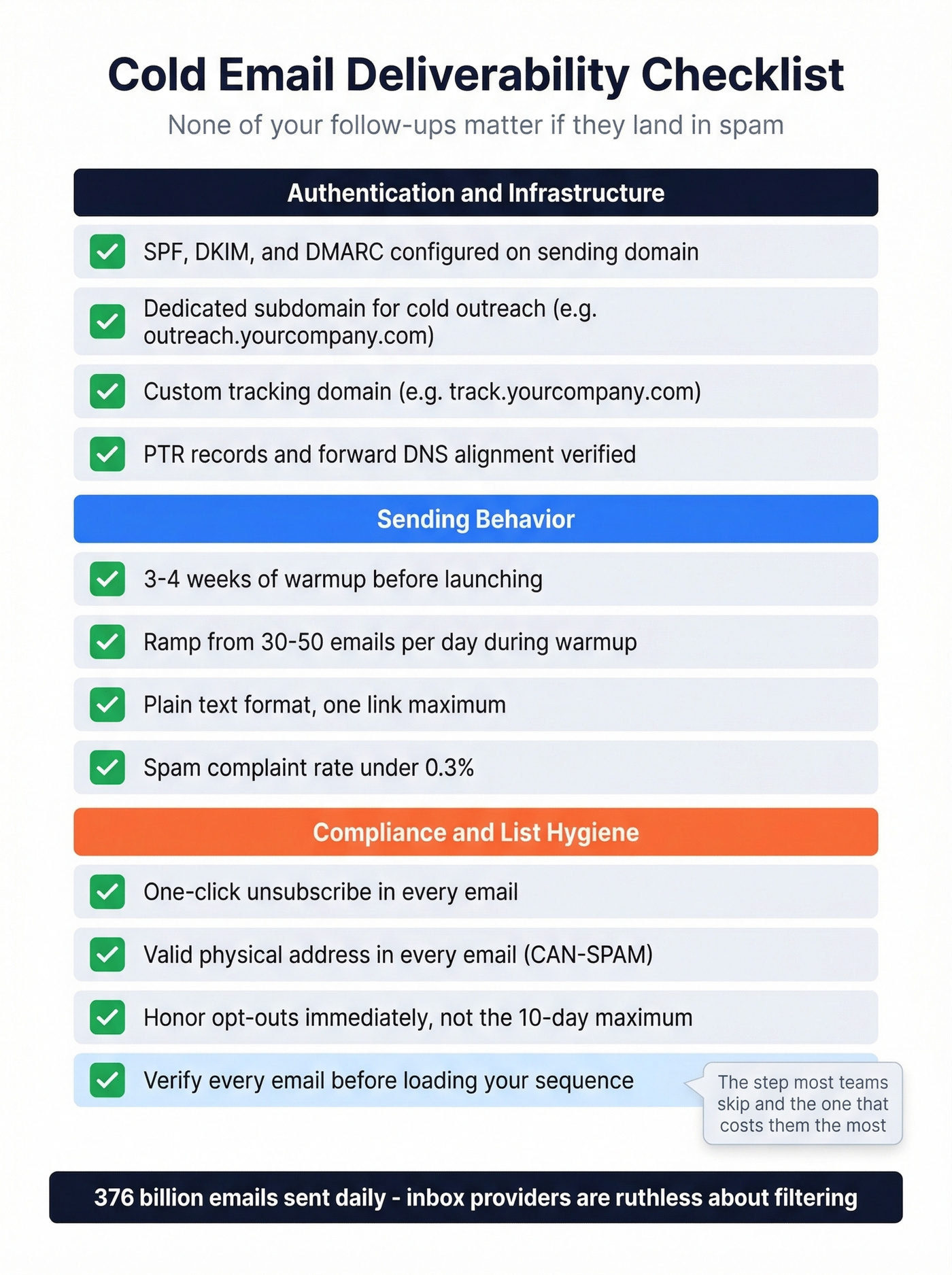
- SPF, DKIM, and DMARC configured on your sending domain. Non-negotiable (deep dive: email deliverability).
- Dedicated subdomain for cold outreach (e.g.,
outreach.yourcompany.com). Protects your primary domain if something goes wrong. - Custom tracking domain (e.g.,
track.yourcompany.com). Shared tracking domains tank your reputation by association (see tracking domain). - 3-4 weeks of warmup before launching any campaign. Ramp from 30-50 emails/day during warmup.
- Plain text format, one link max. Heavy HTML and multiple links are spam triggers.
- Spam complaint rate under 0.3%. Gmail blocks roughly 100M spam emails per day. Don't contribute to that number.
- One-click unsubscribe in every email. It's not just best practice - it's a sender requirement.
- Valid physical address in every email. CAN-SPAM requires it, and skipping it is a fast path to blocklists.
- Honor opt-outs immediately. The law gives you 10 business days, but process them in real time if you want to keep your reputation intact.
- Ensure PTR records and forward DNS alignment on your sending IP. Most ESP dashboards handle this, but verify if you're on dedicated infrastructure.
- Verify every email before loading your sequence. Prospeo's email finder runs a 5-step verification process - catching invalid addresses, spam traps, and honeypots before they bounce and damage your sender score. This is the step most teams skip, and it's the one that costs them the most.
Bad Data: The Hidden Follow-Up Killer
Your SDR loads a 500-contact list into a four-email sequence. By email three, bounce rates are climbing. By email four, the sending domain gets flagged. Now every email from that domain - including follow-ups to prospects who actually want to hear from you - lands in spam. The sequence didn't fail because the copy was bad. It failed because the data was bad.
We've seen this pattern destroy campaigns that were otherwise well-built. Stack Optimize grew their agency to $1M ARR running client campaigns with 94%+ deliverability and under 3% bounce rates - because they verify every address before anything sends. Snyk's sales team cut their bounce rate from 35-40% down to under 5% after switching their data source.
Look, your follow-up cadence, your templates, your timing - none of it matters if 15% of your list bounces on the first send. Fix the data first. Everything else follows (start with email bounce rate benchmarks and fixes).
You only get 2-3 follow-ups before spam complaints triple. Every email has to reach a real person. Prospeo refreshes 300M+ profiles every 7 days - not every 6 weeks - so your Day 4 and Day 11 touches hit active, valid addresses at $0.01 per email.
Make every follow-up count with data refreshed weekly.
When to Stop Following Up
The hard stop signal is clear: four or more emails total more than triples spam complaints. That's not a guideline - it's a cliff. After three follow-ups with no response, stop emailing.
Stopping doesn't mean giving up. The same dataset shows a message + visit combo pulls an 11.87% reply rate - higher than most email sequences. Direct dials are another strong option, especially for enterprise contacts who ignore email but pick up the phone. The channel switch itself signals something different, and different gets attention.
When you're restarting a campaign, think smaller. Digital Bloom's data shows cohorts of 50 contacts or fewer produce 2.76x higher reply rates than larger blasts. Fifty well-researched contacts will outperform 500 scraped ones every time. The best way to send a follow-up after a long gap is with a genuine trigger - a funding round, a leadership change, a new product launch - not a recycled template (see how to track sales triggers).
Skip the re-engagement entirely if you don't have a real trigger. Sending "just wanted to reconnect" three months later is the same dead phrase with a longer gap. It doesn't work the first time, and it won't work the second.
FAQ
How many follow-up emails should I send?
Two to three. The 16.5M-email study shows 4+ emails total more than triple spam complaints and unsubscribes. After three follow-ups with no response, switch to a different channel like phone or a message + visit combo, which pulls an 11.87% reply rate.
What's the best day to send a follow-up?
Wednesday produces the highest reply rates, followed by Tuesday. The 2026 benchmark across billions of interactions confirms this. Avoid Friday - it's an auto-reply graveyard where your carefully crafted message goes to die.
How long should a follow-up email be?
Under 80 words. The 2026 benchmark shows the best-performing campaigns keep every email below that threshold. Reddit practitioners push 40-60 words, letting the offer do the heavy lifting instead of filler personalization.
Should I send follow-ups in the same thread?
Yes. Same-thread follow-ups keep context intact and avoid the subject-line lottery. Your prospect sees the full conversation without searching their inbox, and Woodpecker's data shows this approach can boost reply rates by 22%.
How do I prevent follow-ups from landing in spam?
Verify your entire list before sending - invalid addresses and spam traps will bounce and destroy your sender reputation. Beyond that, configure SPF, DKIM, and DMARC on a dedicated subdomain and keep complaints under 0.3%.