

Subject Lines That Get Opened (And the 90% Nobody Talks About)
A practitioner on r/b2bmarketing tested 20+ subject lines, sent 1,000+ cold emails across three warmed domains, capped volume at 25 sends per day per account - and still landed a 2% open rate. The subject lines weren't the problem. The infrastructure was.
Most advice about subject lines that get opened skips the 90% of the equation that happens before anyone reads your copy.
What You Need (Quick Version)
- If your open rate is below 20%, the problem is almost certainly deliverability or data quality - not your subject line.
- Put your core message in the first 33 characters. That's the safest truncation target across major mobile inboxes.
- Test frameworks, not random word swaps. Curiosity gap, specific value prop, and pattern interrupt cover 90% of top-performing email subject lines.
Your Subject Line Isn't the Problem (Yet)
Average email deliverability sits around 83%. That means roughly 17% of your emails never reach an inbox - they bounce, hit spam, or vanish into the void. No subject line, no matter how clever, can save an email that doesn't arrive.
The Reddit case study above is a pattern we see constantly. Teams burn weeks iterating on email titles when the real issue is upstream: stale contact data, unverified emails, and the domain reputation damage that follows. Gmail and Yahoo's authentication requirements enforced since early 2024 - SPF, DKIM, DMARC, spam complaints below 0.3% - made this worse. One bad list import can tank your sender reputation fast.
This is where data quality becomes the actual open-rate lever. Prospeo's 5-step verification with catch-all handling, spam-trap removal, and honeypot filtering delivers 98% email accuracy across 143M+ verified addresses on a 7-day refresh cycle. Snyk's outbound team saw their bounce rate drop from 35-40% to under 5% after switching - directly translating to better inbox placement and more opens.

Open Rates in 2026: What the Numbers Mean
Reported average open rates hover around 42-43%, but that number is inflated. Apple Mail Privacy Protection - active since September 2021 and accounting for a huge share of tracked opens - generates phantom opens by pre-loading tracking pixels. So your "open rate" can look healthy even when fewer real people are actually reading.
The better metric is click-to-open rate (CTOR), which sits around 6.8%, a 21% year-over-year increase suggesting the people who do open are engaging more deeply. Track 30-90 day rolling trends, not individual sends. A single campaign's open rate isn't very useful on its own.
The 33-Character Rule
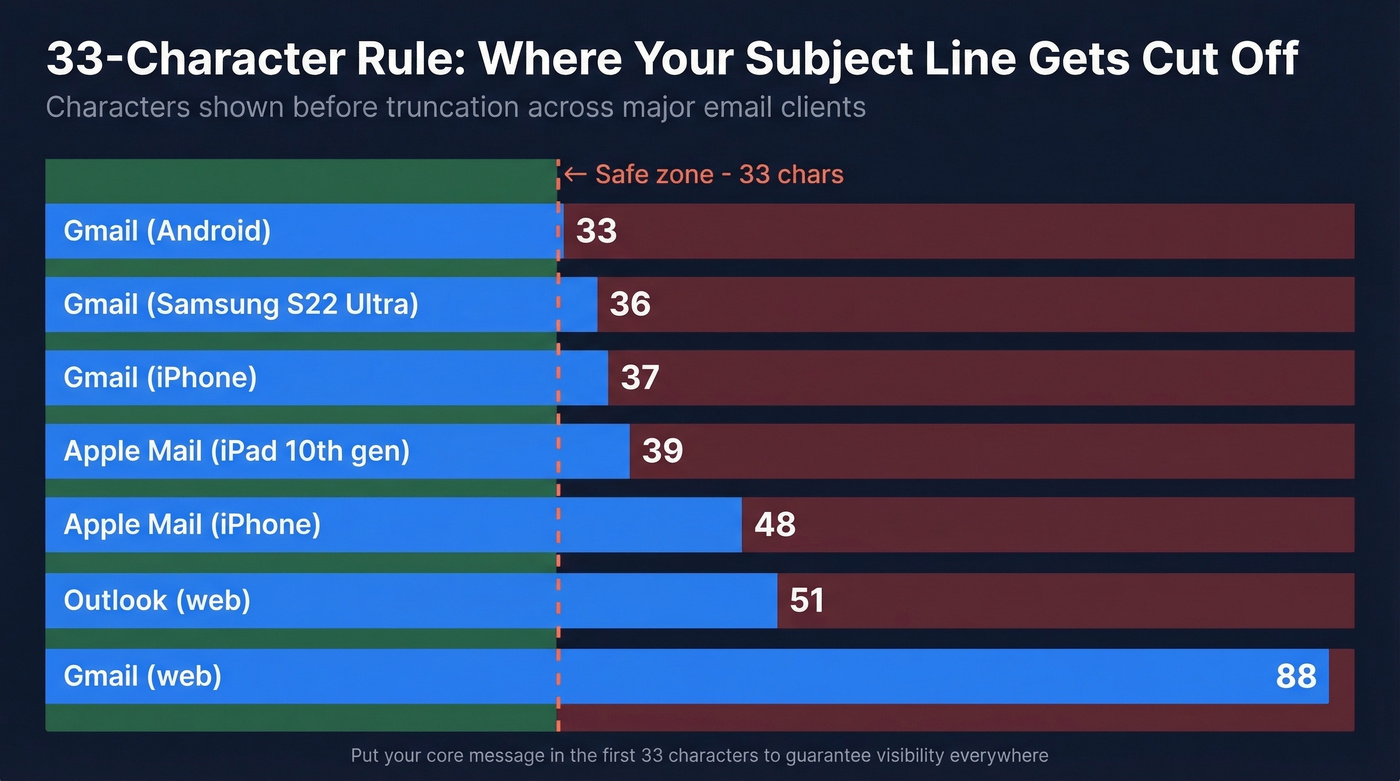
EmailToolTester ran hands-on truncation tests across major devices. Here's what actually displays:
| Client | Characters Shown |
|---|---|
| Gmail (Android) | 33 |
| Gmail (iPhone) | 37 |
| Gmail (Samsung S22 Ultra) | 36 |
| Apple Mail (iPhone) | 48 |
| Apple Mail (iPad 10th gen) | 39 |
| Gmail (web) | ~88 |
| Outlook (web) | ~51 |
Your core message goes in the first 33 characters. Don't exceed 50 total. Everything after that is bonus text most of your audience won't see.
"Quick idea for {{company}}" fits. "I noticed a potential opportunity to improve your UX conversion rates" doesn't - the reader sees "I noticed a potential opportu..." and moves on.

Your subject line can't get opened if your email never reaches the inbox. Prospeo's 5-step verification delivers 98% email accuracy with spam-trap removal and catch-all handling - on a 7-day refresh cycle. Snyk cut their bounce rate from 35% to under 5% and saw opens climb immediately.
Stop optimizing subject lines for emails that bounce.
Frameworks for High Open Rates
Frameworks beat random creativity. Here's a counterintuitive finding worth internalizing: in a 40M-email dataset, straightforward "boring" subject lines outperformed clever ones - more evidence that what happens before the inbox matters more than the words themselves. That said, these categories cover the psychology behind what makes people click.
If you want more swipeable options, start with our subject line examples and then narrow down to prospecting email subject lines for outbound.
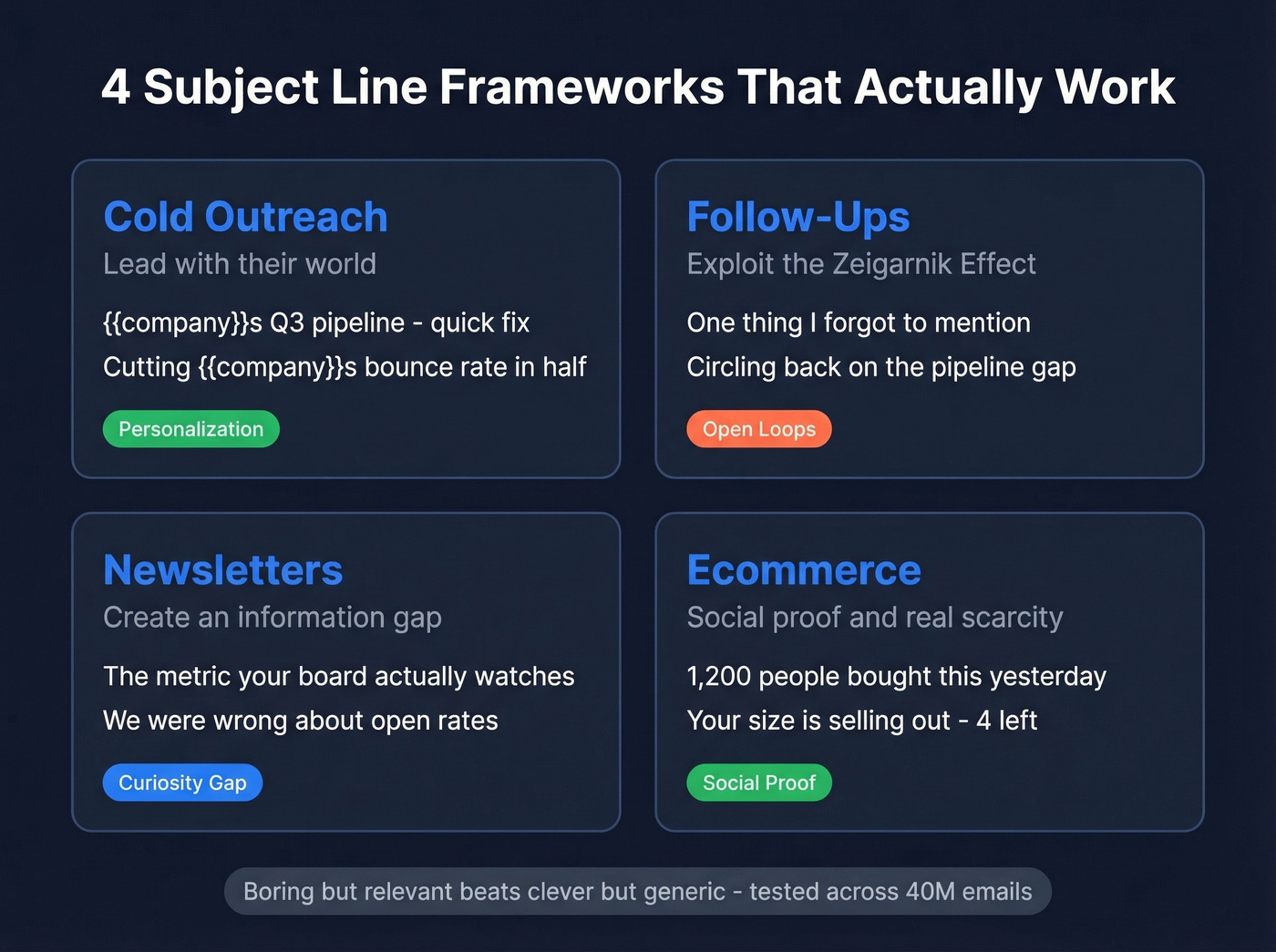
Cold Outreach - Lead With Their World
- "{{company}}'s Q3 pipeline - quick fix"
- "Cutting {{company}}'s bounce rate in half"
- "3 accounts your team is missing"
- "Idea for {{company}}'s onboarding"
Follow-Ups - Exploit the Zeigarnik Effect
The brain hates unfinished loops. Reference something incomplete.
- "Still thinking about [Product Name]?"
- "You left something behind"
- "One thing I forgot to mention"
- "Circling back on the pipeline gap"
Browse-abandonment triggers are commonly sent 6-24 hours after the session - long enough to feel natural, short enough to stay relevant.
Newsletters - Create an Information Gap
- "The metric your board actually watches"
- "Why your best rep just quit"
- "We were wrong about open rates"
Ecommerce - Social Proof and Scarcity (When Real)
With ~70% cart abandonment rates, these target the largest revenue leak in ecommerce:
- "1,200 people bought this yesterday"
- "Back in stock (not for long)"
- "Your size is selling out - 4 left"
- "The restock you asked for"
Words and Formatting That Kill Opens
Spam filters don't just scan for individual words - they evaluate context, engagement history, and frequency. But certain patterns consistently raise flags.
If you're diagnosing inboxing issues, pair copy changes with an email spam checker and a proper email deliverability guide so you’re not guessing.
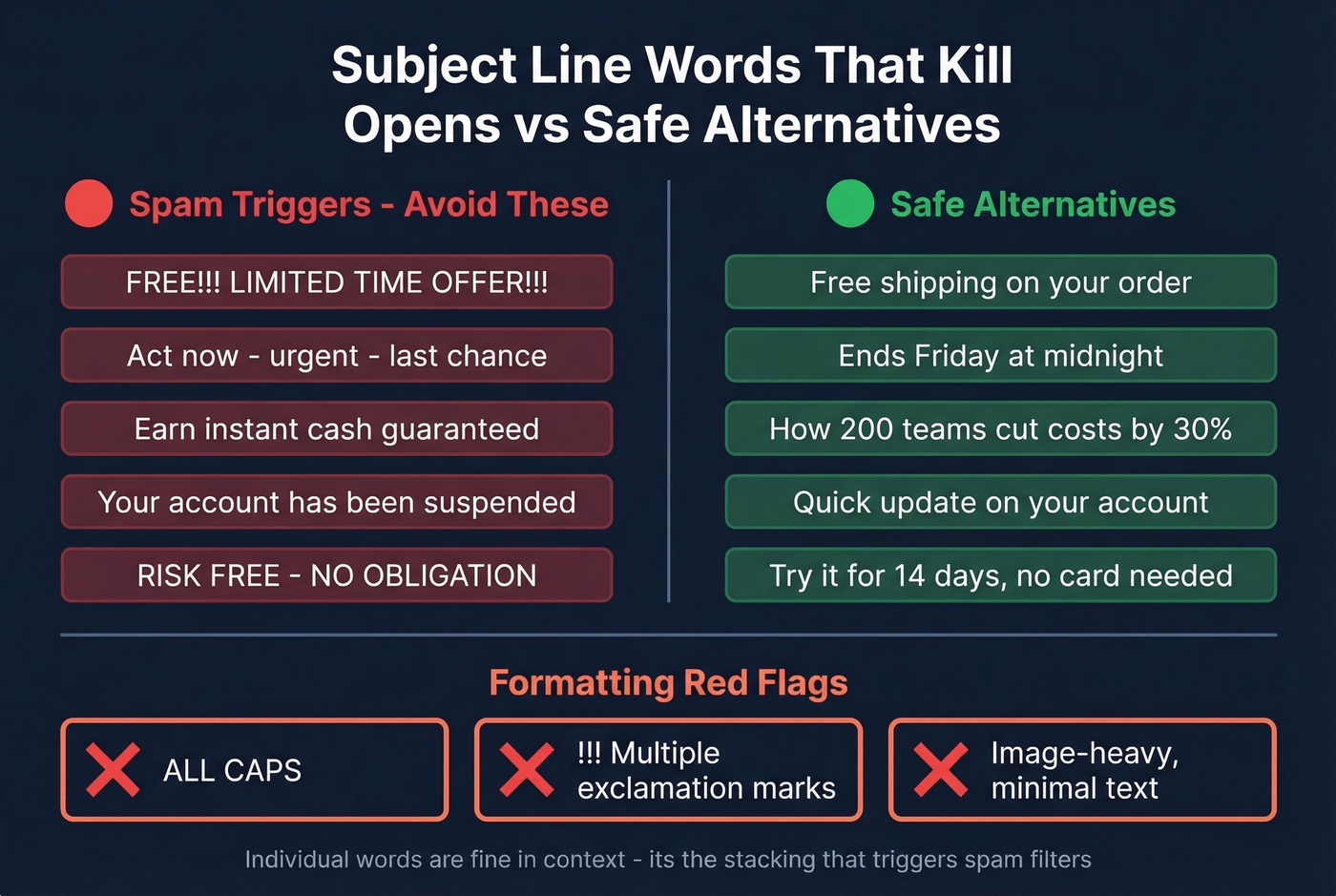
Financial promises like "earn," "income," and "instant cash" are among the most reliable spam triggers. Urgency and pressure language - "act now," "urgent," "limited time," "last chance" - follows close behind. Too-good-to-be-true phrasing such as "free," "guaranteed," and "risk-free" also causes problems, as do fake security threats like "account suspended" or "verify now."
Formatting matters too. ALL CAPS, multiple exclamation marks, and image-heavy emails with minimal text all increase spam risk. A subject line reading "FREE!!! LIMITED TIME OFFER!!!" hits three triggers simultaneously. "Free shipping on your order" is fine in context - it's the stacking that kills you.
How to A/B Test Subject Lines
Run tests with a 20% sample size, wait 1-2 hours before selecting a winner, and use a minimum of 1,000 recipients per variant for statistical accuracy.
What to test beyond "short vs long":
- CTA personalized by job function outperforms generic CTAs by 22%
- Industry context can improve CTR by 19%
- Confirmation-status re-engagement framing boosts opens of unengaged contacts by 30% vs traditional win-back language
Don't sleep on timing either. B2B email click-through rates are 62% higher on weekends - test send timing, not just subject line copy. If you want a tighter playbook, use our best time to send cold emails guide and keep an eye on email velocity so you don’t spike volume and hurt reputation. In our experience, teams that fix data quality first see 2-3x the lift from any subject line test they run afterward. That's the difference between chasing opens and actually achieving them.
Personalization Beyond First Name
Everyone uses first-name tokens. They're the bare minimum. Segmented campaigns generate 30% more opens and 50% more click-throughs than unsegmented blasts. Here's what actually moves the needle:
- Behavior-based: "Still thinking about [Product Name]?" triggered by browse or cart activity
- Purchase history: Replenishment timing, cross-sell based on last order
- Geo/weather: "Chicago's chill is coming..." with city-specific product recs
- Lifecycle stage: VIP gets exclusivity language; lapsed gets curiosity hooks; new gets social proof
For cold outreach specifically, we've found that layering company-level signals - recent funding rounds, headcount growth, tech stack changes - into subject lines outperforms any first-name merge tag. That kind of signal-based personalization requires clean, current data, which circles back to the infrastructure point we keep hammering. (If you’re building this into outbound, see our guide to personalized outreach.)
Triggered Emails Beat Perfect Copy
Here's the thing: if your average deal size is under $50k and you're spending more time on subject line copy than on your automation triggers and data hygiene, you've got your priorities backwards.
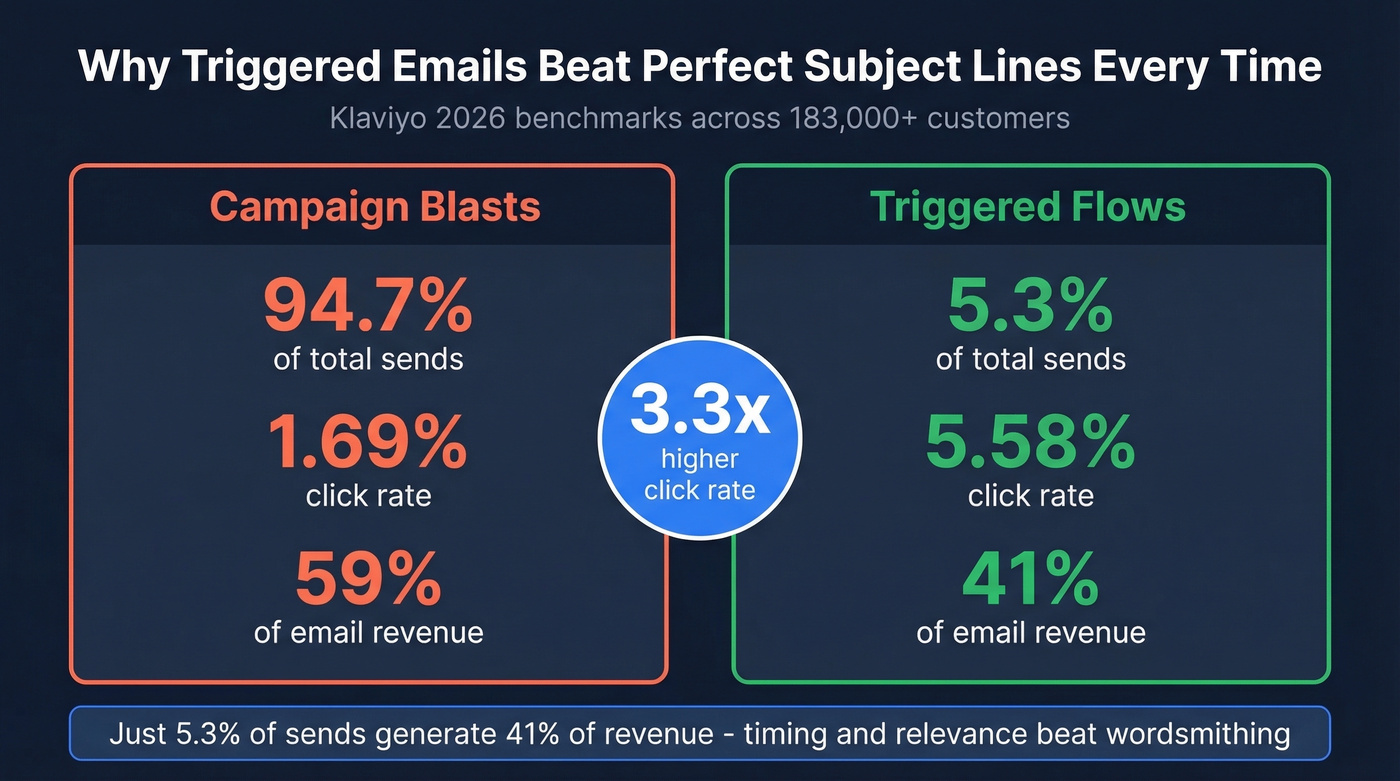
A mediocre subject line on a perfectly-timed trigger email outperforms a brilliant subject line on a batch blast every time. Klaviyo's 2026 benchmarks across 183,000+ customers prove it - flows represent just 5.3% of total sends but generate 41% of email revenue. Flow click rates hit 5.58% versus 1.69% for campaigns. That's a 3.3x difference driven entirely by timing and relevance, not wordsmithing.
The lesson isn't to stop writing good subject lines. It's to stop treating them as the primary lever when your automation, data quality, and segmentation are doing the heavy lifting.
A/B testing subject lines on stale data is like rearranging deck chairs. Teams using Prospeo's 143M+ verified emails see 2-3x more lift from every test because the emails actually land. At $0.01 per email, fixing the 90% costs less than one more brainstorm session.
Clean data turns every subject line test into a real experiment.
FAQ
How long should a subject line be?
Keep your core message within 33 characters for universal mobile visibility - Gmail on Android truncates there. Don't exceed 50 characters total. Apple Mail on iPhone is more generous at 48, but designing for the smallest viewport protects your message everywhere.
Do emojis help email open rates?
Emojis can lift opens by 2-5% by adding visual contrast in a text-heavy inbox, but overuse triggers spam filters. Test a single emoji against a plain version - results vary sharply by audience and industry. Check Emojipedia for rendering across devices before committing.
What's a good open rate in 2026?
Reported averages sit around 42-43%, but Apple Mail Privacy Protection inflates these with phantom opens. Focus on click-to-open rate instead - 6.8% is the current benchmark. Track 30-90 day rolling trends rather than individual sends for a reliable signal.
Why is my open rate low even after testing subject lines?
The problem is almost always deliverability, not copy. Stale contact data causes bounces, which damage sender reputation and push future emails to spam. Verify your list first - Prospeo's free tier includes 75 email verifications at 98% accuracy - before investing more time in copywriting tweaks.