

Sales Email Subject Lines: What the Data Actually Says in 2026
You sent 500 cold emails last week. Your tool says 230 opened. Your reply count? Eleven. The problem isn't your sales email subject lines - it's that most of those "opens" were Apple Mail auto-firing tracking pixels, and 17% of your emails never hit an inbox at all.
Here's the thing: we've read the same subject line listicles you have. They all say "personalize!" and "create urgency!" and then hand you 50 templates with zero data behind them. Every recommendation in this piece is backed by send-level data, device testing, or real practitioner results - and we'll spend as much time on the stuff that happens before the subject line as the subject line itself. List quality and deliverability matter more than any five words you'll write. That's the uncomfortable truth nobody wants to lead with.
The Short Version
- Length: 2-4 words outperform everything else. Front-load the important stuff in the first 33 characters - that's all most phones show.
- Tone: Sound like a colleague, not a marketer. "Quick question about [company]" crushes "Partnership opportunity."
- Metric: Stop tracking open rate. It's inflated by ~18 points thanks to Apple Mail Privacy Protection. Reply rate is the only number that matters for cold email.
- Foundation: Your subject line is the second most important variable. A 98% accurate list with a mediocre subject line beats a clever subject line sent to a list bouncing at 11%.
Cold Email Benchmarks for 2026
Before you test a single subject line, you need to know what "normal" looks like. Cold email and warm email live in different universes, and mixing their benchmarks is how teams set impossible targets.
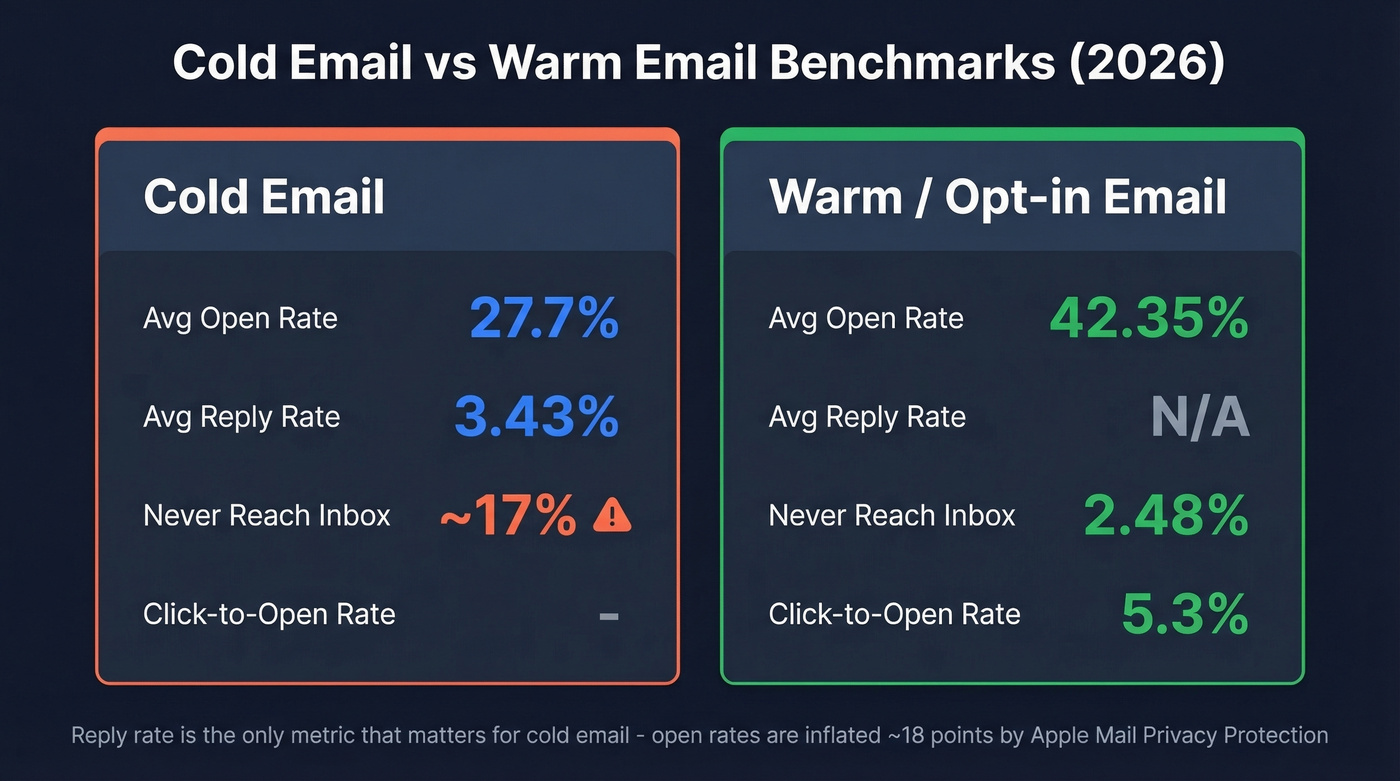
| Metric | Cold Email | Warm/Opt-in |
|---|---|---|
| Avg open rate | 27.7% | 42.35% |
| Avg reply rate | 3.43% | N/A |
| Never reach inbox | ~17% | 2.48% (bounce) |
| CTOR | - | 5.3% |
That 27.7% cold open rate is down from ~36% in 2023. The decline isn't because subject lines got worse - it's because inbox providers got smarter and Apple's privacy changes made the metric unreliable. The 3.43% reply rate is the real benchmark. Anything above 5% means you're doing something right.
33% of recipients decide to open or delete based on the subject line alone. But 69-70% report emails as spam based on the subject line too. Your subject line is simultaneously your best shot at a reply and your biggest deliverability liability.
Rules That Actually Work
Keep It Brutally Short
Twilio SendGrid's data from large-scale sends shows 2-4 word subject lines outperform longer alternatives. Instantly's dataset shows 6-10 word subjects hit about 21% opens, while 21-25 words perform at less than half that rate.
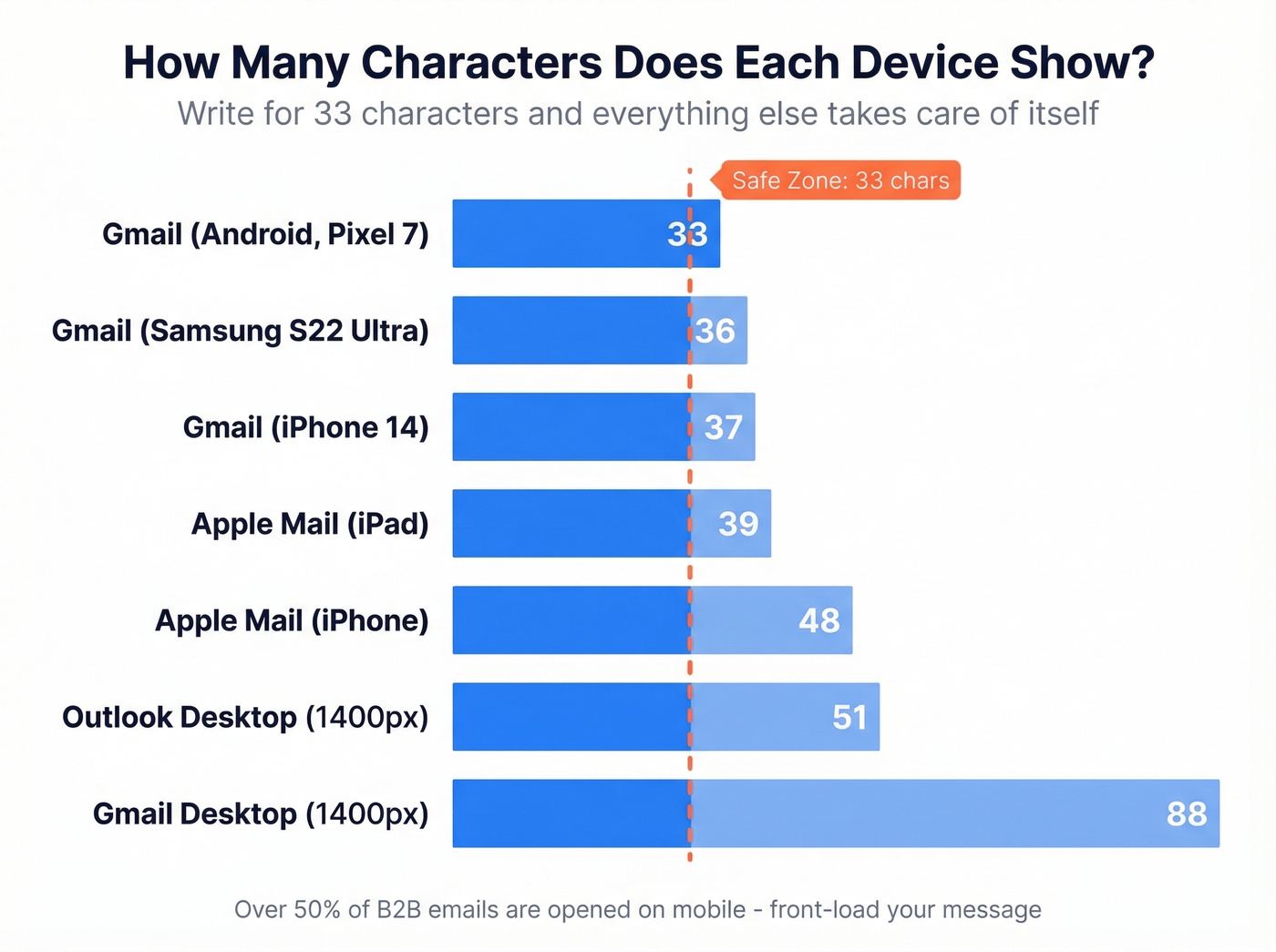
Length isn't just about performance, though - it's about visibility. Over 50% of B2B emails are opened on mobile devices, and every device cuts your subject line at a different point.
| Device / Client | Max Visible Chars |
|---|---|
| Gmail (Android, Pixel 7) | 33 |
| Gmail (iPhone 14) | 37 |
| Gmail (Samsung S22 Ultra) | 36 |
| Apple Mail (iPhone) | 48 |
| Apple Mail (iPad) | 39 |
| Outlook desktop (1400px) | ~51 |
| Gmail desktop (1400px) | ~88 |
The safe zone is 33 characters. That's the hard cutoff in Gmail Android testing. Write for 33 characters and everything else takes care of itself.
Sound Human, Not Scripted
The best data point on this comes from a practitioner who rebuilt their entire cold email program and tracked subject line performance across thousands of sends:
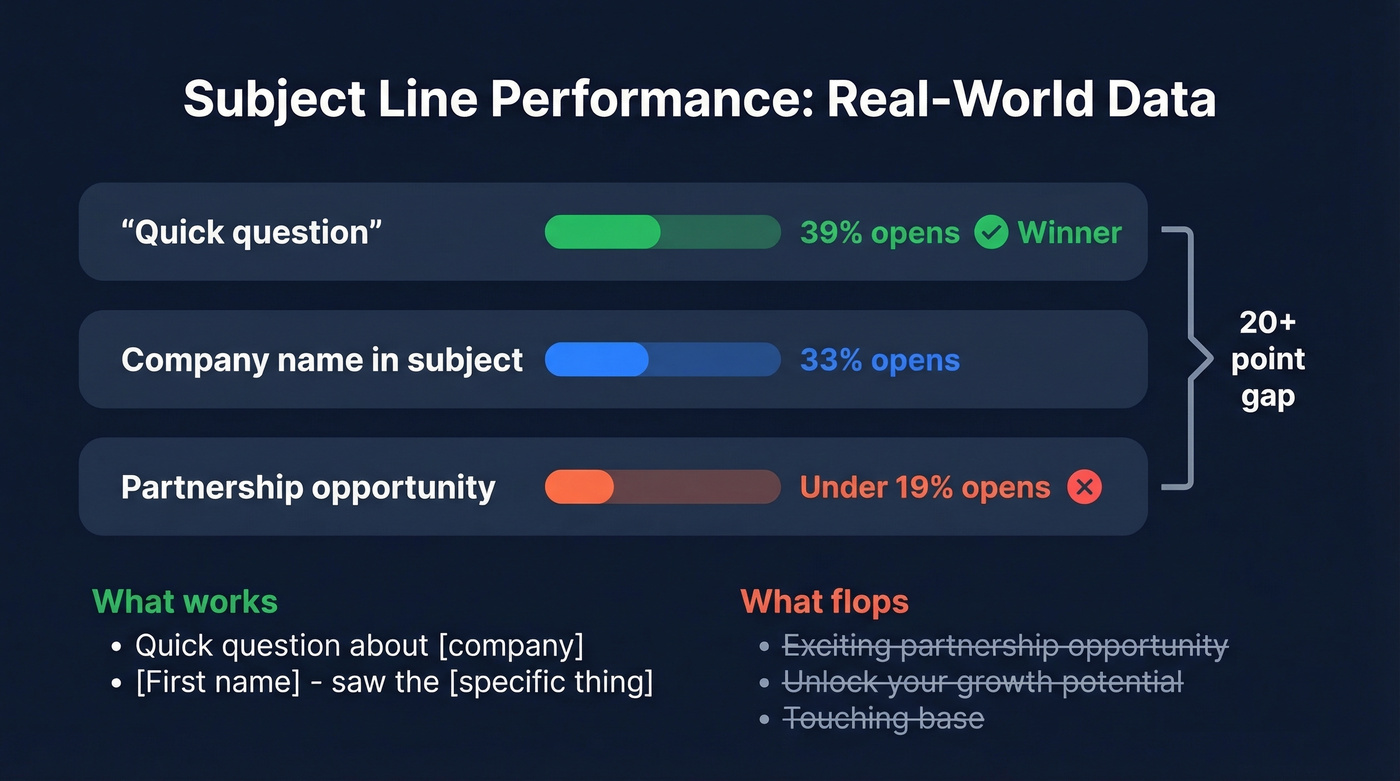
- "Quick question" - 39% opens
- Company name in subject - 33% opens
- "Partnership opportunity" - under 19% opens
That's a 20+ point gap between the best and worst performer. Not marginal - it's the difference between a campaign that works and one that doesn't.
Personalized subject lines get 50% higher open rates than generic ones, but personalization doesn't mean stuffing in a first name. It means relevance - a company name, a specific pain point, a recent event. Those signal "I wrote this for you," not "my sequencer merged your field." Questions in subject lines lift opens by ~21%, and including numbers boosts them even more.
Try these: "Quick question about [company]," "[First name] - saw the [specific thing]"
Skip these: "Exciting partnership opportunity," "Unlock your growth potential," "Touching base"
Front-Load Everything
If 33 characters is all you get on most phones, then the first 33 characters are your subject line. Everything after is bonus text for desktop readers.
- Bad: "I wanted to reach out about your team's approach to outbound hiring"
- Good: "[Company]'s outbound hiring"
The second version delivers the entire message in 26 characters. The first wastes 40 characters before getting to the point. On a Pixel 7, the reader sees "I wanted to reach out about" - and that's it. That's a delete.
Paste every subject line into a character counter before you send. If the core message doesn't land in the first 33 characters, rewrite it.
Always A/B Test
A/B testing subject lines improves open rates by up to 49%. Run at least two variants per campaign - one curiosity-driven, one direct - and let the data pick the winner after 200+ sends. Most cold email platforms support this natively. There's no reason to guess.
Examples by Scenario
Cold Outreach (First Touch)
Non-salesy, short, and specific. The goal is curiosity without clickbait.
- "Quick question about [company]"
- "[Company]'s [specific process]"
- "[Mutual connection] mentioned you"
- "Saw [company]'s [recent event]"
- "[First name] - quick thought"
- "[Specific metric] at [company]?"
- "Idea for [company]'s [department]"
- "[Company] + [your company] fit?"
"Quick question about [company]" is the workhorse. It's under 33 characters with most company names, it's human, and it pulled 39% opens in real-world testing. Don't overthink the first touch.
If you want more variations, pull from our subject line examples and adapt them to your ICP.
Follow-Ups
42% of all campaign replies come from follow-ups, yet 48% of reps never send a second email. Let that sink in: almost half your potential replies are sitting in unsent follow-ups. The r/Entrepreneur practitioner who doubled their reply rate ran a 4-7 email sequence.
Keep follow-up subjects even shorter than first touches. The recipient already saw your name once - now you just need a reason to open.
- "Following up on [specific thing]"
- "Forgot to mention"
- "One more thought on [topic]"
- "Still relevant, [first name]?"
- "Bumping this - [1 line of value]"
- "The [metric] I mentioned"
For plug-and-play sequences, use these sales follow-up templates.
Meeting Requests
Specificity and brevity win here. Vague asks get ignored; time-anchored asks get responses.
- "15 min this week?"
- "Coffee chat - [topic]?"
- "[Day] at [time] work?"
- "Quick call re: [company initiative]"
If you’re struggling with the body copy, pair these with a tighter email call to action.
Referral or Warm Intro
Mutual connections are a high-trust pattern. Lead with the name every time.
- "[Referrer name] said to reach out"
- "Via [referrer] - quick intro"
- "[Referrer] thought we should connect"
- "Intro from [referrer] re: [topic]"
Re-Engagement (Gone Cold)
The prospect went silent. You need a pattern interrupt - something that breaks the delete-without-reading reflex.
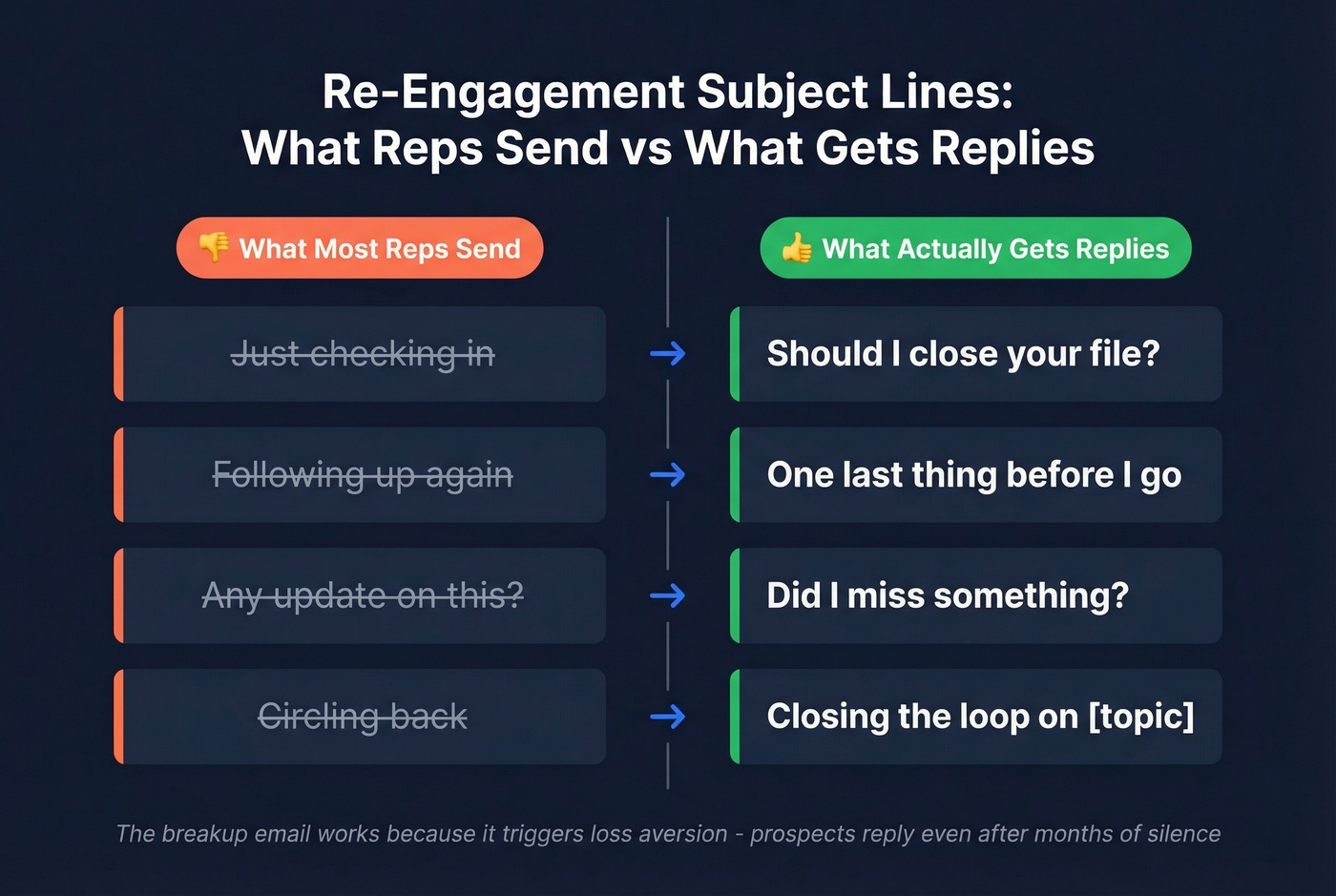
| What most reps send | What actually gets replies |
|---|---|
| "Just checking in" | "Should I close your file?" |
| "Following up again" | "One last thing before I go" |
| "Any update on this?" | "Did I miss something?" |
| "Circling back" | "Closing the loop on [topic]" |
The "should I close your file?" breakup email is a cliche at this point, but it still works because it triggers loss aversion. We've seen it pull replies from prospects who'd been silent for months.
If you need alternatives to “checking in,” see how to say just checking in professionally.

The article says it plainly: a 98% accurate list with a mediocre subject line beats a clever subject line sent to a list bouncing at 11%. Prospeo's 5-step email verification delivers 98% accuracy with a 7-day refresh cycle - so your carefully crafted subject lines actually reach real inboxes.
Stop perfecting subject lines for emails that never arrive.
Why Open Rates Lie
Let's run the math. You sent 500 cold emails. Your tool reports 230 opens - a 46% open rate. Looks great, right?
Apple Mail accounts for 46% of email clients. A study of 80,000+ email marketing accounts found open rates jumped 18 points in the six months after Apple launched Mail Privacy Protection. That feature pre-fetches tracking pixels for every email, whether the recipient reads it or not.
So a big chunk of those 230 "opens" are Apple Mail auto-firing pixels. And that's before accounting for the ~17% that never reached an inbox.
Reply rate strips away all this noise. A reply is a reply - no pixel trickery, no privacy proxy inflation. For cold email in 2026, 3.43% is the platform-wide average reply rate. Anything above 5% is strong. Stop optimizing for a metric that Apple broke two years ago.
If you’re still diagnosing inbox placement, start with an email deliverability guide and a basic email spam checker.
The Real Case Study: 3% to 6%
One of the most detailed cold email breakdowns we've found came from a practitioner on r/Entrepreneur who documented their entire rebuild. Their reply rate had dropped from 8% to 3% over 18 months.
| Change | Before | After |
|---|---|---|
| Sending domains | 3 | 7 (max 26 emails/day each) |
| Bounce rate | 11% | Under 2% (manual verification) |
| Email length | 141 words | Under 56 words |
| Timing | Random | Tue-Thu, 8-11 AM recipient TZ (+16% opens) |
| Subject line | "Partnership opportunity" (under 19%) | "Quick question" (39% opens) |
| Monthly cost | - | ~$420/month total |
| Result | 3% reply rate | 6% reply rate, 16 qualified leads/month |
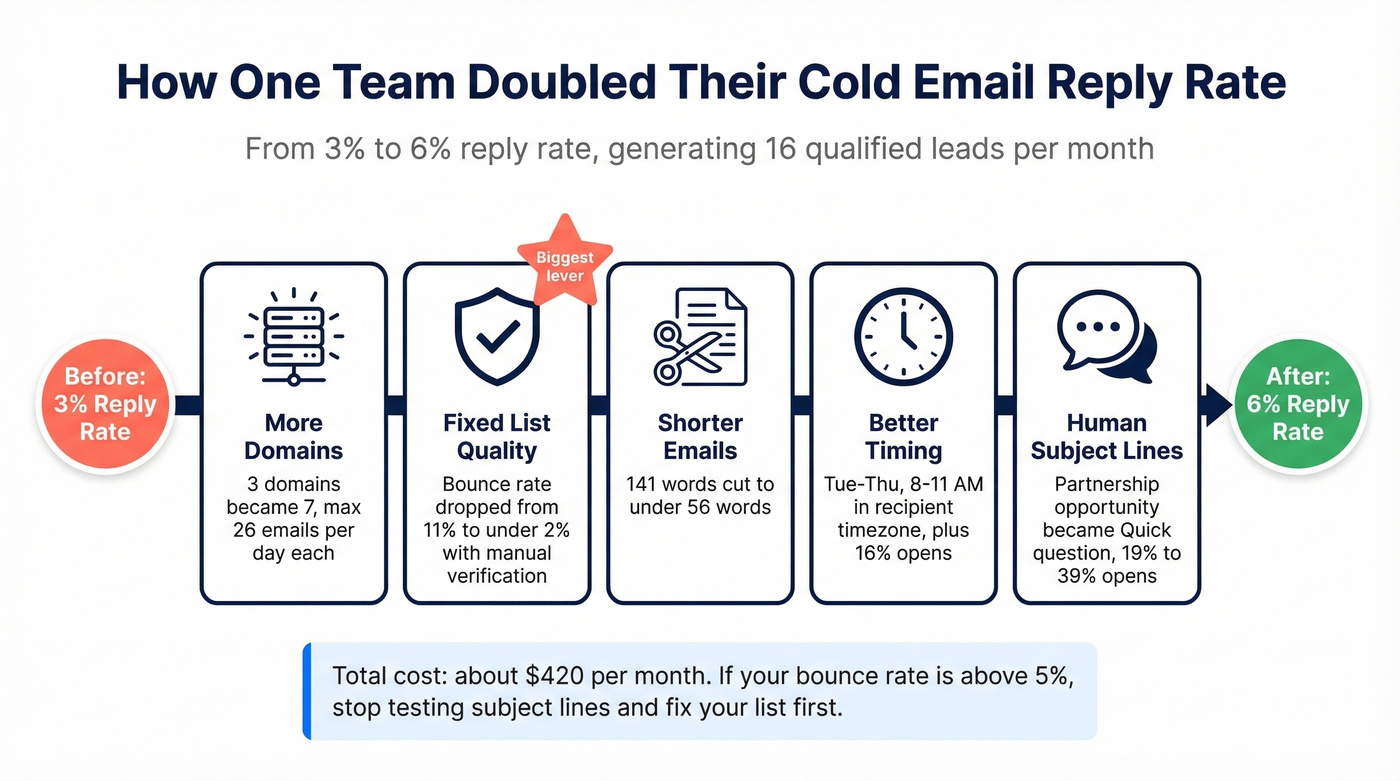
The subject line change mattered, but it wasn't the biggest lever. Cutting bounce rate from 11% to under 2% was. Every bounced email damages your sender reputation, which makes every future email - regardless of subject line - more likely to land in spam.
If your deal size is under $15k and your bounce rate is above 5%, stop testing subject lines entirely. Fix your list first. You'll get more replies from a boring subject line hitting real inboxes than from a brilliant one landing in spam. (If you’re not sure what “good” looks like, start with email bounce rate benchmarks.)
What to Avoid
Some subject line mistakes tank your open rate. Others tank your deliverability for weeks. Know the difference.
| Instead of... | Write... |
|---|---|
| FREE OFFER!!! | Complimentary resource for [company] |
| URGENT: Act Now | Quick question about [topic] |
| Re: Our conversation | Following up on [specific thing] |
| Fwd: Check this out | [Name] suggested I reach out |
| $$$ Save Money $$$ | Cut [specific cost] by [%] |
ALL CAPS combined with excessive punctuation increases spam scores by 40-60%. Fake "Re:" and "Fwd:" prefixes aren't just sleazy - they're a CAN-SPAM violation for misleading subject headings.
What about emojis? ReturnPath's analysis found a 3-4% open rate lift but 2-4x higher spam complaints. In B2B cold email, emojis are neutral-to-negative unless your brand voice is already casual. The tiny open lift isn't worth the complaint risk when Gmail's spam threshold sits at just 0.1%.
List Quality Matters More Than Subject Lines
The best sales email subject lines can't save a bad list. That Reddit practitioner who doubled their reply rate? The single biggest change was cutting bounce rate from 11% to under 2%. Not the subject line. Not the email copy. The list.
When 17% of cold emails never reach the inbox, you're not just wasting sends - you're actively damaging your domain reputation. Every bounce and spam trap hit tells inbox providers your sending practices are sloppy, which pushes future emails into spam regardless of how good your subject line is. ESPs use engagement signals to decide future inbox placement. A bad list doesn't just kill one campaign; it trains the algorithm to deprioritize everything you send next.
In our experience, verification is the single highest-ROI step in any outbound workflow. Prospeo's 5-step verification process catches invalid addresses, spam traps, and honeypots before you send, running at 98% accuracy with data refreshed every 7 days. Stack Optimize, an outbound agency, scaled from $0 to $1M ARR while keeping client bounce rates under 3% and deliverability above 94% on verified data.
If you’re building lists from scratch, follow a repeatable lead generation workflow and tighten targeting with an ideal customer profile.
You just read that 42% of replies come from follow-ups - but follow-ups to bad addresses destroy your sender reputation. Prospeo gives you 143M+ verified emails at ~$0.01 each, with catch-all handling and spam-trap removal built in. Your sequences stay clean from send one through send seven.
Protect your domain reputation before you hit send.
FAQ
How long should a sales email subject line be?
Two to four words, or under 33 characters for full mobile visibility. Twilio SendGrid data shows 2-4 words outperform longer alternatives across large-scale sends. EmailToolTester's device testing confirms 33 characters is the safe cutoff across major mobile clients. Front-load your key message within that window.
What are the top subject lines for sales in 2026?
Data-backed winners include "Quick question about [company]" (39% opens), company name references (33% opens), and short question-based lines that create a curiosity gap. The common thread is brevity, relevance, and a human tone - they sound like a colleague, not a sequencer.
What's a good open rate for cold emails?
The current cold email average is 27.7%, but open rates are inflated by Apple Mail Privacy Protection - which added roughly 18 points of phantom opens across 80,000+ accounts studied. Track reply rate instead: 3.43% is the platform-wide average, and anything above 5% is strong.
Do emojis help email subject lines?
Marginally, and with risk. ReturnPath found a 3-4% open rate lift but 2-4x higher spam complaints. Gmail's spam complaint threshold is 0.1%, so even a small uptick can hurt deliverability. Skip them in B2B unless you've tested with your specific audience and monitored complaint rates closely.
How can I improve deliverability before testing subject lines?
Verify every email address before sending - tools like Prospeo catch spam traps and invalid addresses at 98% accuracy. Keep bounce rates under 3%, warm new domains gradually, and cap sends at 25-30 per inbox per day. The case study above shows that cutting bounce rate alone doubled reply rates before any subject line changes were made.