

List Quality: The Data-Backed Guide to Measuring and Fixing It
Nearly one in five email addresses across a billion analyzed records is problematic - invalid, risky, or outright dangerous (spam traps, disposable inboxes, honeypots). That means your 10,000-contact list has roughly 2,000 addresses that'll never reach a human being. Growth teams on Reddit put it bluntly: actual reach is 20-30% lower than list size once you account for bounces, inactives, and traps.
That gap is the list quality problem. It's where pipeline goes to die.
If you're looking for Amazon listing quality or software QA metrics, wrong article. This covers B2B email and contact lists - the kind sales and marketing teams build, buy, or inherit, and the kind that quietly rot without maintenance.
The Short Version
Track three numbers: hard bounce rate under 2%, spam complaints under 0.1%, and 90-day engagement rate trending above your industry median. The workflow is straightforward - clean your list, verify leads at every stage, segment by recent activity, then send. We'll break down each step below, including the tools and benchmarks you need.
What Is List Quality?
List quality measures how likely your contact list is to reach real people who might respond. It's not a single metric. It's the intersection of four things: deliverability (will the email arrive?), engagement (will anyone open it?), data accuracy (is the contact info correct?), and compliance (are you legally allowed to send?).
Why It Matters for Revenue
Bad data costs the average organization $12.9M annually. Companies lose roughly 15% of revenue due to inaccurate contact information. Reps burn 500 hours per year validating and correcting contact data - that's 62 working days spent on janitorial work instead of selling.
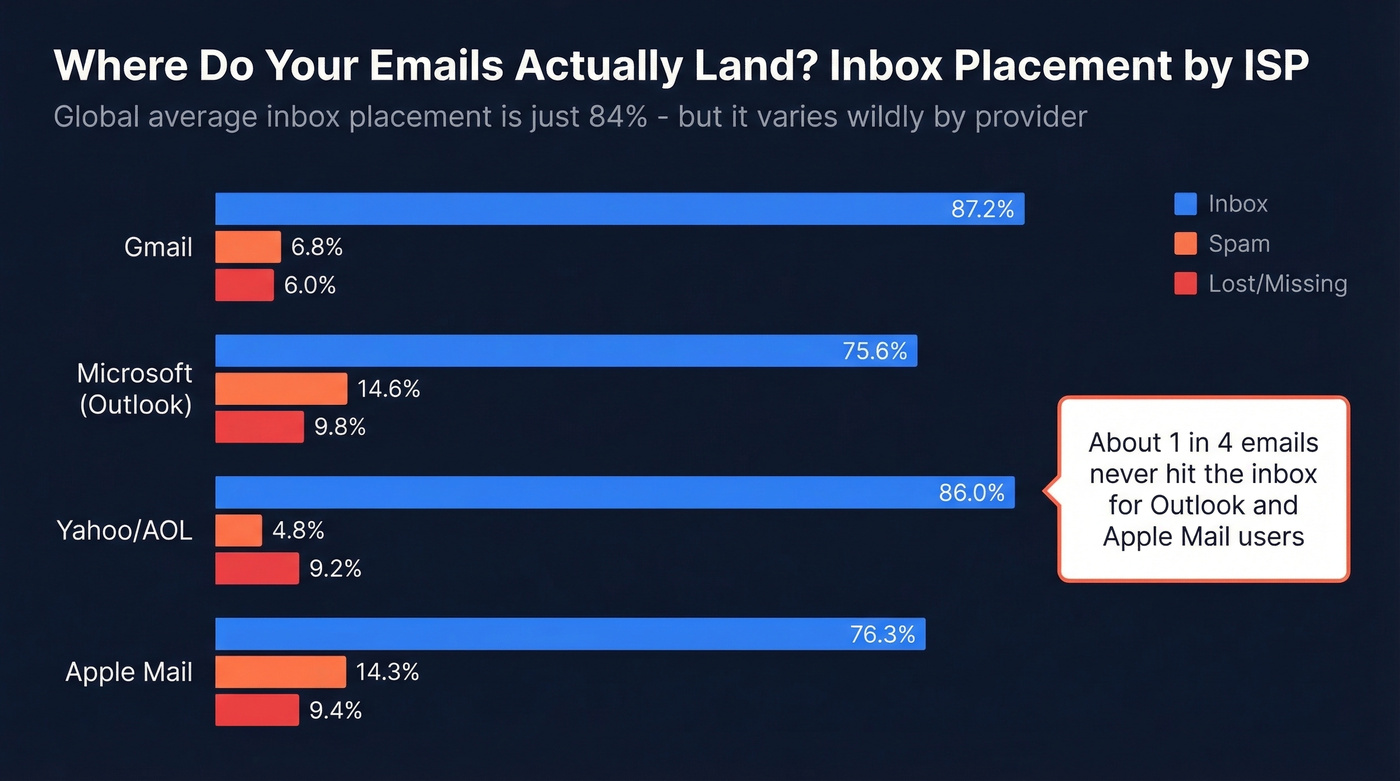
Global inbox placement averages just 84%, meaning roughly one in six emails never reaches the inbox. Where those emails land depends heavily on which ISP your prospect uses:
| ISP | Inbox | Spam | Lost/Missing |
|---|---|---|---|
| Gmail | 87.2% | 6.8% | 6.0% |
| Microsoft (Outlook) | 75.6% | 14.6% | 9.8% |
| Yahoo/AOL | 86.0% | 4.8% | 9.2% |
| Apple Mail | 76.3% | 14.3% | 9.4% |
Microsoft and Apple Mail are noticeably harsher - about one in four emails never hits the inbox. If your prospect list skews toward corporate Outlook domains, bounce rate and data hygiene become metrics you can't afford to ignore.
Then there's compliance. GDPR penalties run up to EUR20M or 4% of global revenue. CCPA fines hit $7,500 per intentional violation. CAN-SPAM carries penalties up to $50,120 per email. These aren't theoretical - they're statutory. And teams with verified contact data report sales cycles 25% shorter, because they're reaching the right people on the first attempt instead of chasing dead addresses.
How to Measure List Quality
Three Numbers That Matter
You don't need a composite score. You need three numbers, checked weekly:
| Metric | Target | Danger Zone |
|---|---|---|
| Hard bounce rate | < 2% | > 3% |
| Spam complaints | < 0.1% | > 0.3% |
| Unsubscribe rate | < 0.5% | > 1% |
These thresholds come from the Email Almanac's list hygiene benchmarks. If your hard bounces cross 3%, ISPs start throttling or blocking you outright. Spam complaints above 0.3% trigger Gmail's engagement filters. These are the tripwires - everything else is secondary.
If you want a deeper breakdown of bounce types, codes, and remediation, start with our bounce rate guide.
2026 Benchmarks
MailerLite's dataset - 3.6M campaigns across 181,000+ accounts - gives us the most recent medians:
| Segment | Open Rate | Click Rate | CTOR | Unsub |
|---|---|---|---|---|
| All industries | 43.46% | 2.09% | 6.81% | 0.22% |
| E-commerce | 32.67% | 1.07% | - | - |
| Software/SaaS | 39.31% | 1.15% | - | - |
| Nonprofits | 52.38% | 2.90% | - | - |
Apple Mail Privacy Protection inflates open rates across the board. Everyone's affected equally, so the benchmarks still work for relative comparison - just don't treat a 43% open rate as gospel.
If you're trying to sanity-check your own numbers, compare against a standard email open rate and the latest guidance on what is a good email open rate.
Building a Scoring Framework
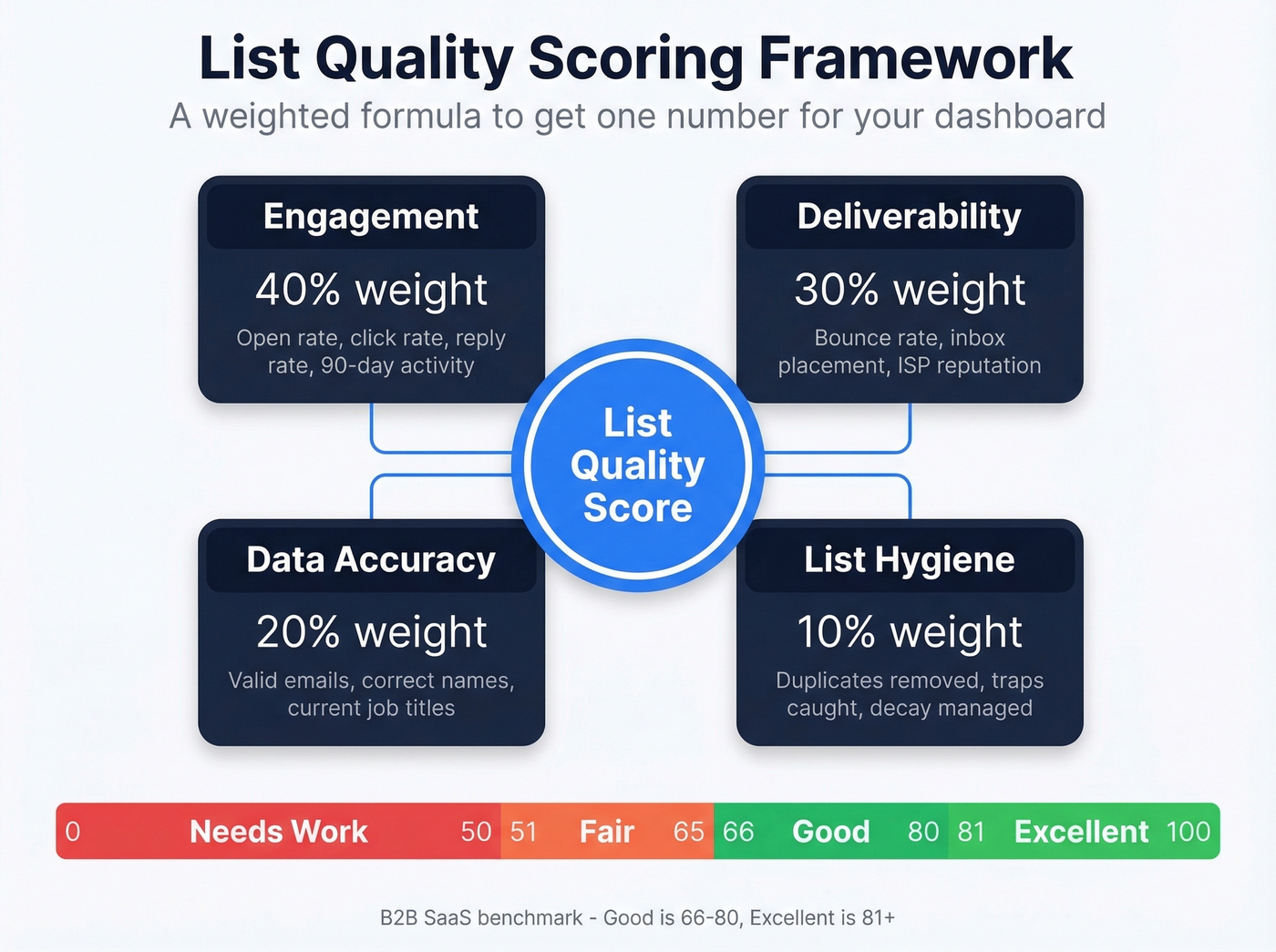
Count.co proposes a weighted formula: (Engagement x 0.4 + Deliverability x 0.3 + Data Accuracy x 0.2 + List Hygiene x 0.1) x 100. Their benchmark ranges by business type:
| Segment | Good | Excellent |
|---|---|---|
| B2B SaaS | 66-80 | 81+ |
| Enterprise B2B | 71-85 | 86+ |
| B2C E-commerce | 51-70 | 71+ |
Here's the thing: the three-number approach above is simpler and more actionable for most teams. If you're a data-driven RevOps org that wants a single dashboard metric, the composite score works. For everyone else, just watch your bounces, complaints, and engagement.
If you're building a RevOps dashboard, you may also want to track pipeline health alongside list quality so you can see downstream impact.

Bad list quality costs $12.9M per year on average. Prospeo's 5-step verification - syntax, DNS, SMTP, disposable detection, and spam-trap removal - delivers 98% email accuracy out of the box. Snyk cut bounce rates from 35% to under 5% and grew AE-sourced pipeline 180%.
Stop auditing dead addresses. Start with data that's already verified.
The Right Verification Workflow
Six Steps, in Order
The order matters. We've seen teams skip straight to sending because their list "looks clean." It never is. Here's the verification sequence, adapted from the Bouncebuster framework:
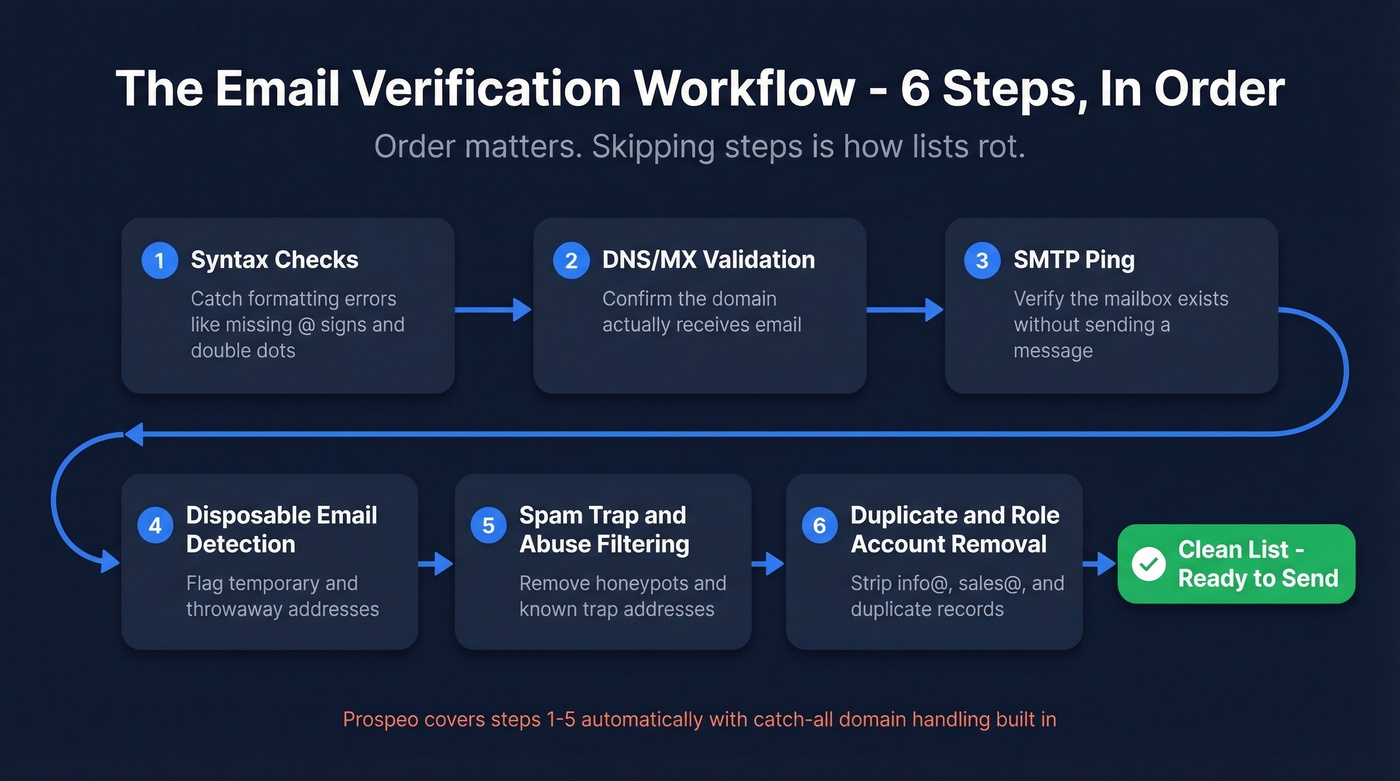
- Syntax checks - catch formatting errors (missing @, double dots)
- DNS/MX validation - confirm the domain actually receives email
- SMTP ping - verify the mailbox exists without sending
- Disposable email detection - flag temporary addresses
- Spam trap and abuse filtering - remove honeypots and known traps
- Duplicate and role account removal - strip info@, sales@, and duplicates
The Reddit consensus backs this up: clean first, remove invalids, segment by recent activity, then build your campaign. Copy optimization is pointless if half your list is dead weight.
If you need a remediation playbook for traps specifically, see our guide to spam trap removal.
Prospeo's 5-step verification infrastructure covers syntax, DNS, SMTP, disposable detection, and spam-trap/honeypot removal - with catch-all domain handling built in. Snyk's team saw bounce rates drop from 35-40% to under 5% after switching, with AE-sourced pipeline up 180%.
How Often to Clean
B2B contact data decays at 2.1% per month - roughly 22.5% annually. Email addresses specifically churn at 23-30% per year as people change jobs, companies rebrand, and domains expire. A list that's 95% accurate today drops below 80% in about six months without maintenance.
Quarterly cleaning isn't enough for active outbound lists. Monthly is the minimum. If you're running high-volume sequences, biweekly is better.
The gold standard is proactive rather than reactive - re-verifying records weekly rather than waiting for bounces to tell you something broke. That's the difference between catching a job change in January and bouncing emails until March.
If you're scaling outbound, pair list hygiene with a broader email deliverability guide so you don't fix data while ignoring infrastructure.
Common Mistakes That Destroy Your Data
Let's be honest: if your average deal size is under $15K and you're sending to fewer than 5,000 contacts a month, you don't need a complex data stack. You need one good verification tool and the discipline to use it before every send. Most data hygiene problems aren't technology problems - they're laziness problems.
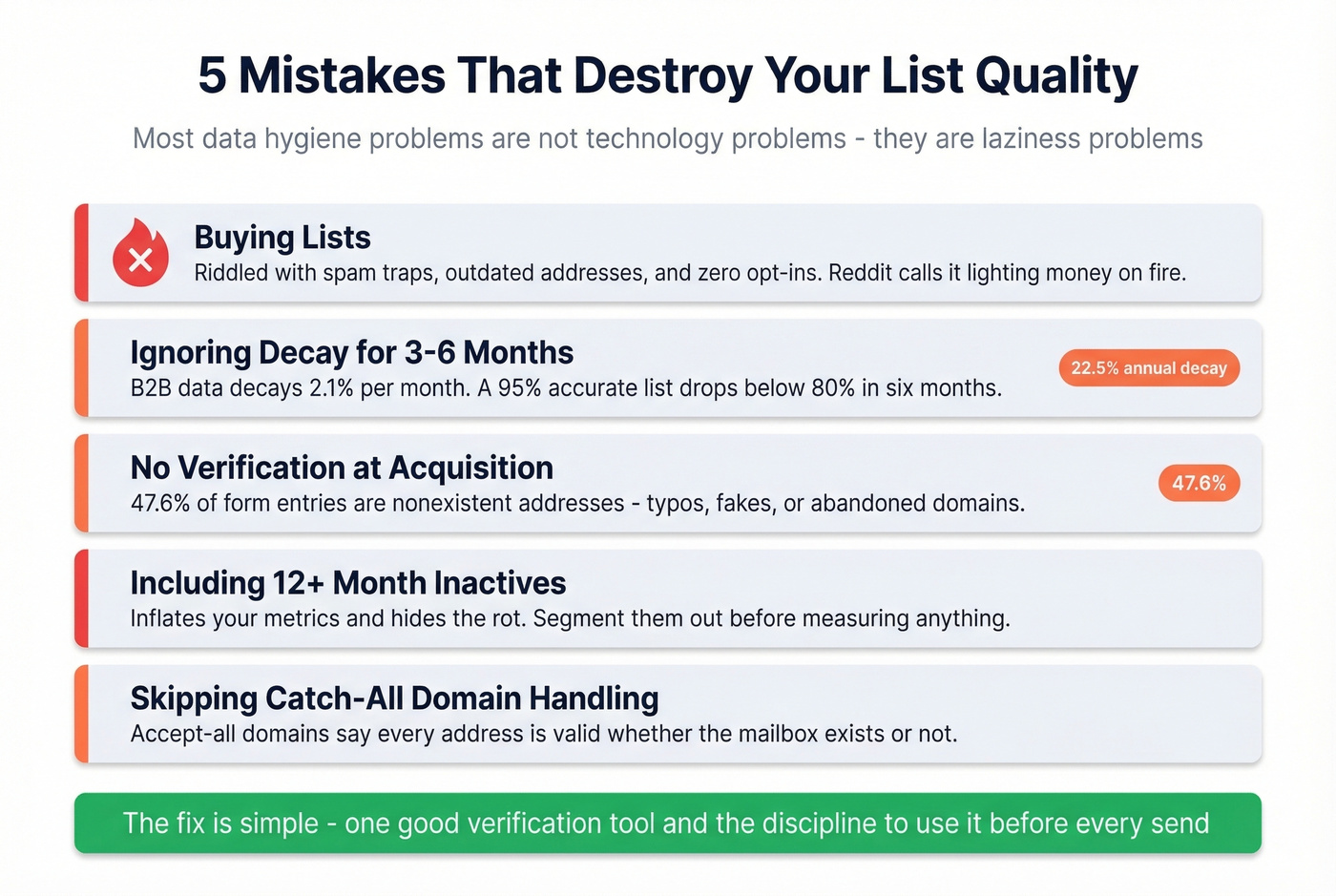
Buying lists. Reddit's r/coldemail community calls this "lighting money on fire." Purchased lists are riddled with spam traps, outdated addresses, and people who never opted in. Your sender reputation takes the hit. Skip this entirely. (If you want the legal angle, read is it illegal to buy email lists.)
Ignoring decay for 3-6 months. This is the silent killer. Everything looks fine until bounce rates spike and your domain gets flagged. By then, the damage compounds - ISPs have long memories, and recovering a burned domain takes weeks of careful warm-up and volume throttling that could've been avoided with a monthly cleaning cadence.
No verification at acquisition. 47.6% of email addresses entered through lead-capture forms are nonexistent - typos, fake addresses, or abandoned domains. Real-time verification at the point of entry catches these before they ever hit your list. This is the single highest-ROI hygiene step you can implement. If you're implementing checks, our guide on how to check if an email exists covers practical methods.
Including 12+ month inactives in engagement calculations. This inflates your metrics and hides the rot. Segment inactives out before measuring performance. If you want a system for this, use churn analysis thinking to define “inactive” by cohort and time window.
Skipping catch-all domain handling. Accept-all domains return a "valid" response for any address, whether the mailbox exists or not. You need a tool that handles them strategically rather than marking them all as valid.
Email Verification Tools Compared
| Tool | Accuracy | Cost/10K | Catch-All | Best For | Free Tier |
|---|---|---|---|---|---|
| Prospeo | 98% | ~$100 | Yes (built-in) | Accuracy + catch-alls | 75 emails/mo |
| Clearout | 98.4% | ~$40 | Varies | Budget-conscious teams | Yes |
| Bouncer | 97.8% | ~$49 | Varies | Simple, reliable checks | Yes |
| NeverBounce | 99.1% | ~$80 | Varies | High-volume SMB lists | Yes |
| ZeroBounce | 96.5% | ~$80 | Varies | Verification + analytics | 100/mo |
| Kickbox | 97.0% | ~$70 | Varies | Mid-market teams | Yes |
| Emailable | 97.2% | ~$69 | Straightforward bulk | Straightforward bulk | 250/mo |
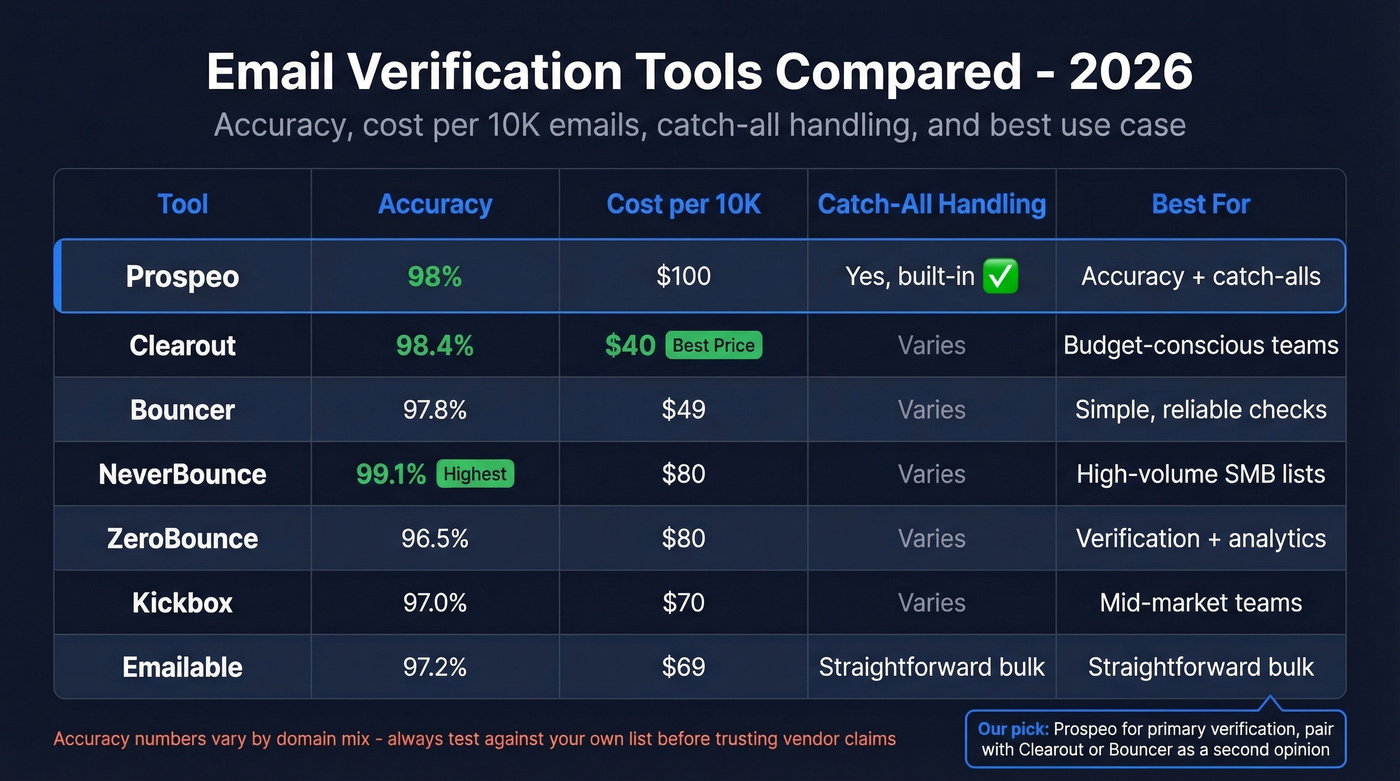
Clearout and Bouncer are strong budget alternatives. Clearout at $40 per 10K emails is the cheapest option with solid accuracy and works well as a second-opinion tool. NeverBounce, ZeroBounce, Kickbox, and Emailable all handle basic verification reliably - pick whichever integrates best with your existing stack.
If you're evaluating vendors, it helps to understand the broader market of email list providers and where verification fits versus sourcing.
One caveat we've learned the hard way: accuracy numbers vary dramatically depending on the domain mix you test against. Mid-market and enterprise domains with strict server configs produce more "unknown" results, dragging down measured accuracy for every tool. Test against your own list before trusting any vendor's claimed number.
For teams that want a single tool, Prospeo gives you 98% accuracy with catch-all handling at $0.01 per email. For a second opinion, pair it with Clearout or Bouncer.
Quick Action Plan
Prevention. Add real-time verification at every acquisition point. Forms, imports, manual entry - verify before the address touches your database. With 47.6% of form entries being nonexistent addresses, this single step eliminates nearly half your future hygiene problems.
Maintenance. Clean active outbound lists monthly at minimum. Opt-in marketing lists can stretch to quarterly if churn is low, but monitor bounce rates weekly to catch decay early. Remove 12+ month inactives from active segments entirely.
Monitoring. Check your three core numbers every week: hard bounces, spam complaints, and unsubscribe rate. If any metric crosses its danger threshold, pause sending and run a full verification pass before your next campaign. Set up automated alerts so you catch problems the day they start, not the week after.
If you're sending at scale, also monitor email velocity so list quality improvements don’t get negated by unsafe volume.
Monthly cleaning isn't enough when your data provider refreshes every 6 weeks. Prospeo re-verifies all 300M+ records on a 7-day cycle with catch-all handling, honeypot filtering, and automatic duplicate removal - so your list stays clean between sends.
Replace your cleanup workflow with data that never goes stale.
FAQ
How often should I clean my email list?
Monthly minimum for active outbound lists. At 2.1% monthly decay, waiting a quarter means roughly 6% of your list has gone stale - enough to push bounce rates past the 2% danger threshold. For opt-in marketing lists, quarterly works if you're monitoring bounce rates weekly.
What's a good bounce rate for email?
Keep hard bounces under 2%. Above 3% and ISPs start throttling or blocking your sends entirely. If you're consistently above 2%, stop sending and run your full list through a verification tool before the next campaign.
What does list quality mean?
It measures how likely your contact list is to reach real, responsive people. It combines deliverability, engagement, data accuracy, and compliance into an overall picture of list health. High-quality lists mean low bounces, strong engagement, and no compliance risk.
How do I check email list validity?
Run your list through a multi-step verification process: syntax checks, DNS/MX validation, SMTP pings, disposable email detection, and spam-trap filtering. Most verification tools automate all five steps and flag catch-all domains, giving you a clear picture of which addresses are safe to send to and which should be removed.