

What Is a Good Email Open Rate in 2026?
A good email open rate in 2026 is 30-40% reported - but your real human open rate is closer to 20-28% after you account for Apple Mail Privacy Protection. Apple MPP accounts for 49.29% of tracked email opens, driven by Apple's proxy preloading tracking pixels rather than humans reading your email. If you want one metric to actually optimize, shift to click-to-open rate and aim for 10-15%.
The Quick Answer
You can find open rate benchmarks ranging from 17% to 43% depending on which page you land on. They're all technically correct - and they're all misleading without context.
Here's the thing: your open rate's only remaining job is as a deliverability canary. A trend line that tells you whether emails are landing in inboxes. The moment you treat it as a success metric, you're optimizing for a signal that's been half-broken since 2021.
Why Every Benchmark Differs
Every benchmark study uses a different dataset, time window, and methodology. Here's how the major ones stack up:
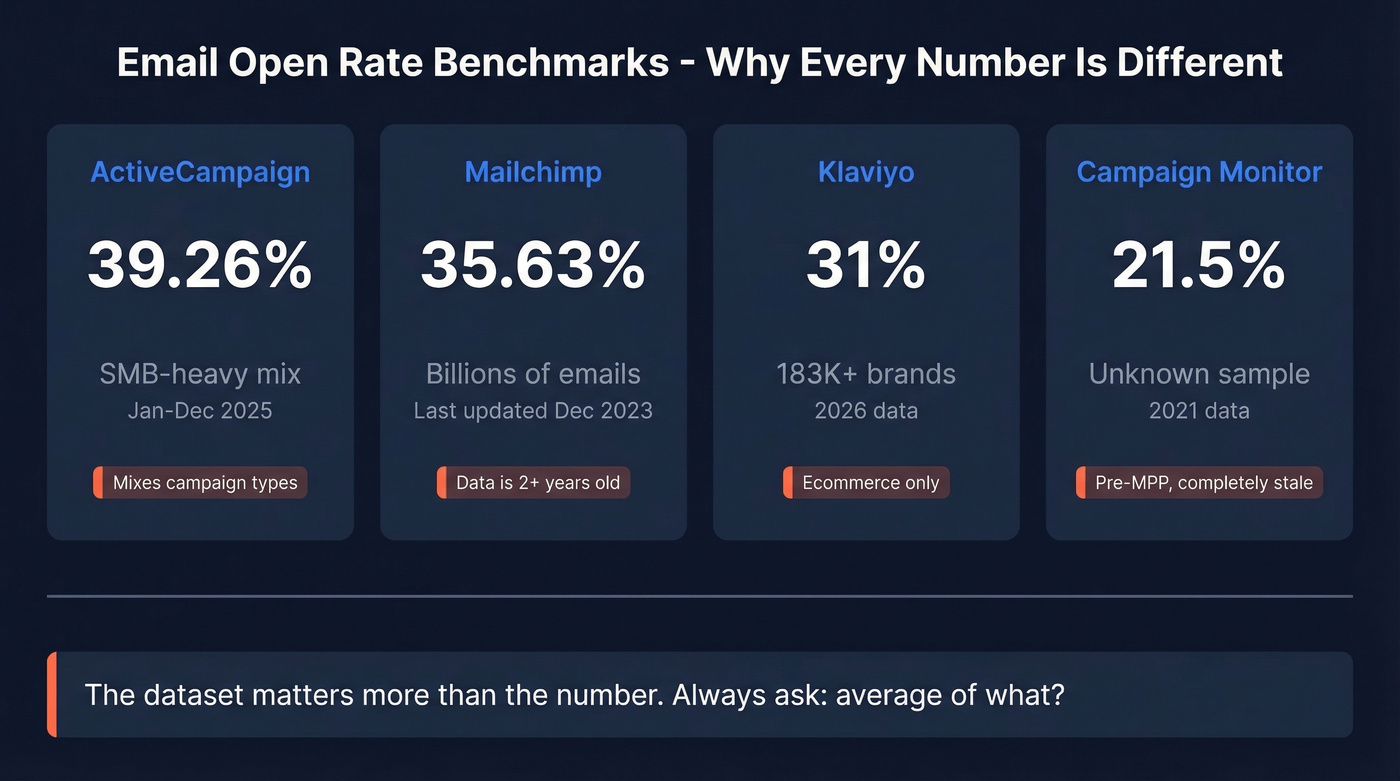
| Source | Sample | Time Period | Avg Open Rate | Method Note |
|---|---|---|---|---|
| ActiveCampaign | SMB-heavy mix | Jan 1-Dec 10, 2025 | 39.26% | Mix of campaign types |
| Mailchimp | Billions of emails | Last updated Dec 2023 | 35.63% | 1K+ subs only |
| Klaviyo | 183K+ brands | 2026 | 31% (campaigns) | Ecom only |
| Campaign Monitor | - | 2021 (in 2022 report) | 21.5% | Pre-MPP, stale data |
ActiveCampaign's 39.26% looks great until you realize it includes multiple email types, not just one-off marketing campaigns. Mailchimp's data is from 2023 - ancient in email marketing terms. Klaviyo only tracks ecommerce brands. And Campaign Monitor's 21.5% is from 2021, before Apple MPP inflated everyone's dashboards. It still ranks on page one of Google, and people still cite it as if it's current.
The dataset composition matters more than the number. When someone tells you "the average open rate is X%," your first question should be: average of what?
The Apple MPP Problem
Apple Mail Privacy Protection is the single biggest reason your open rate dashboard lies to you.
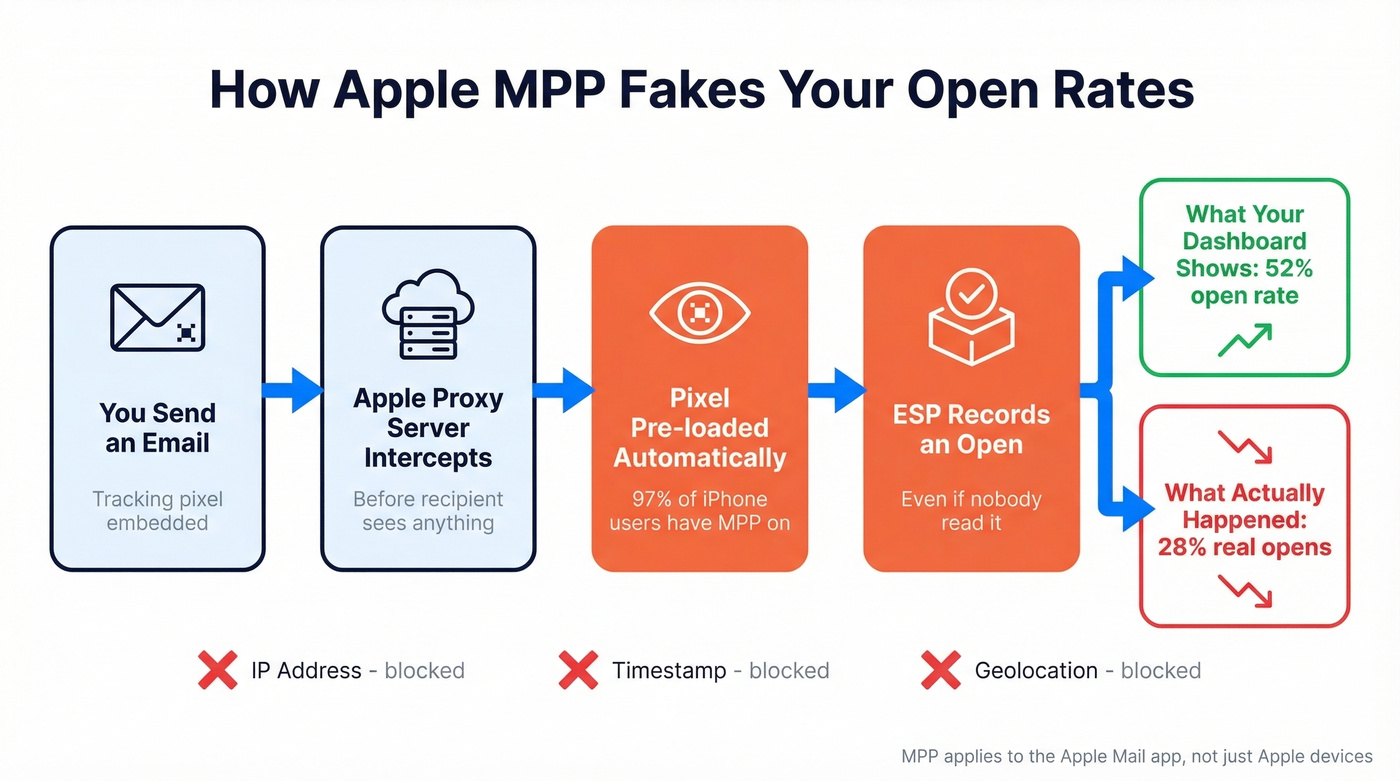
MPP works by routing emails through Apple's proxy servers, which preload tracking pixels before the recipient ever sees the message. Every email sent to an Apple Mail user with MPP enabled registers as "opened" - whether they read it, glanced at it, or never scrolled past it. About 97% of iPhone users have MPP enabled, and it now accounts for nearly half of all tracked opens. That's not a rounding error. It's half your data.

We've seen campaigns that tracked 28% open rates pre-MPP jump to 52% with zero change in actual engagement. In Apple-heavy audience segments, up to 75% of reported opens are artificial. MPP doesn't just fake opens either - it blocks IP addresses, timestamps, geolocation, and device data, gutting your ability to segment by engagement behavior.
One critical nuance most people miss: MPP applies to the Apple Mail app, not just Apple devices. If someone uses Gmail as their provider but reads through Apple Mail on their iPhone, MPP still fires. Your "Gmail" segment might be inflated too.
Open Rates by Industry
With the MPP caveat firmly in mind, here are the most current industry benchmarks, synthesized from ActiveCampaign's 2025 data and Klaviyo's 2026 ecommerce numbers:
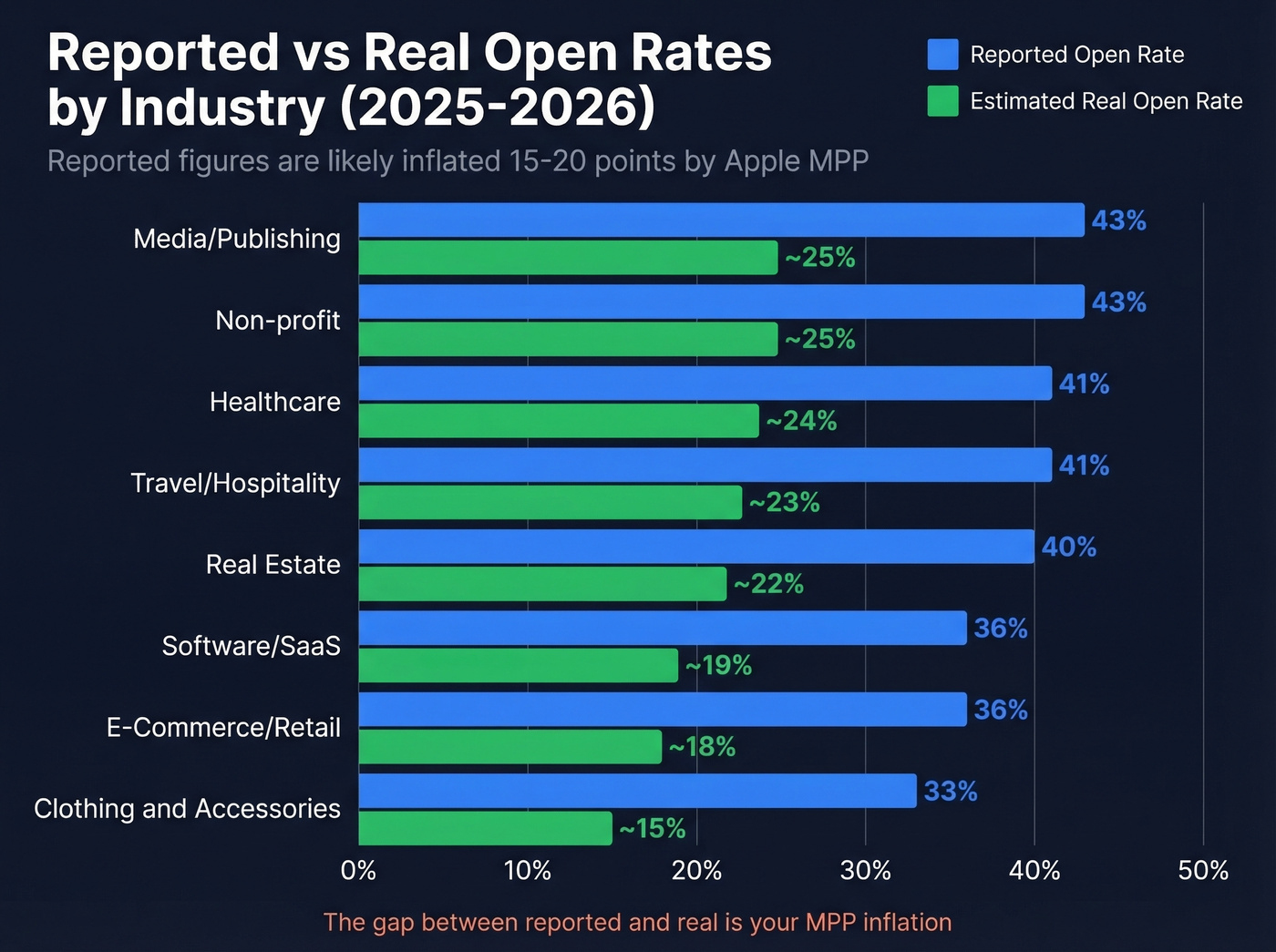
| Industry | Reported Open Rate | Estimated Real Range* |
|---|---|---|
| Media / Publishing | 43.16% | 23-28% |
| Non-profit | 42.68% | 22-28% |
| Healthcare | 41.48% | 21-27% |
| Travel / Hospitality | 40.87% | 21-26% |
| Real Estate | 39.87% | 20-25% |
| Software / SaaS | 36.20% | 16-22% |
| E-Commerce / Retail | 35.66% | 16-21% |
| Clothing & Accessories | 33.1% | 13-18% |
All reported figures likely inflated 15-20 points by Apple MPP. "Estimated Real Range" adjusts for typical MPP audience share.
Practitioner-reported ranges span even wider - SaaS teams report anywhere from 15-45% depending on list quality and audience composition. A 36% reported rate in SaaS doesn't mean you're underperforming at 32%. The real question is whether your rate is trending up or down, and whether your clicks follow the same trajectory.

You just read that bounce rates above 3% tank sender reputation, crater inbox placement, and drag open rates down with them. That's a data quality problem, not a subject line problem. Prospeo's 5-step email verification delivers 98% accuracy - spam traps removed, honeypots filtered, catch-all domains handled. At $0.01 per email, cleaning your pipeline costs less than one bad send.
Stop diagnosing open rates when the real problem is your contact data.
Rates by Email Type and Region
Not all emails are created equal. Comparing across types or geographies will mislead you fast.
By email type: Klaviyo's 2026 data shows marketing campaigns averaging 31% opens with a 1.69% click rate. Automated flows like welcome sequences and abandoned carts crush campaigns on clicks - 5.58% average, with the top 10% hitting 10.48%. Transactional emails often sit at 80-85% opens because people actively expect them. Comparing your newsletter open rate to a transactional benchmark is like comparing your cold-call close rate to your inbound close rate. Fundamentally different motions.
By region: GetResponse's analysis of 4.4 billion messages found Europe averaging 43.25% opens versus North America at 23.53% - a ~20-point gap. Part of it is list hygiene culture, part is GDPR forcing opt-in quality, and part is different MPP adoption rates. If you're a US-based team benchmarking against a European average, you'll always feel like you're losing.
Let's be honest: if your average deal size is under $15K and you're spending more than 30 minutes a week analyzing open rates, you're optimizing the wrong thing. Ship better content, clean your list, and watch the clicks.
Is Your Open Rate Actually Good?
Stop comparing to industry averages. Run through this diagnostic instead:
- What percentage of your list uses Apple Mail? Above 40% means your reported open rate is inflated by at least 15 points. Many ESPs now offer MPP filtering - turn it on.
- Campaigns, flows, or transactional? Each has a completely different baseline. Don't blend them.
- B2B or B2C? B2B lists are smaller, more targeted, and typically show higher engagement per send.
- What region is your audience? European lists consistently outperform North American ones by ~20 points in large benchmark datasets.
- How old is your list? Lists degrade at roughly 2-3% per month. Six months without cleaning means you're sending to dead addresses.
- What's your bounce rate? Above 3% and your open rate problem is actually a deliverability problem.
That last point is the one most people miss. A high bounce rate tanks sender reputation, which drops inbox placement, which craters open rate. The open rate isn't the disease - it's the symptom.
Why Open Rates Drop
When open rates decline, most teams immediately A/B test subject lines. That's the wrong first move.
Fix deliverability first. Bad data - invalid emails, spam traps, honeypots - causes bounces. Bounces damage sender reputation. Damaged reputation means ISPs route you to spam. This cascade happens faster than most teams realize, and it compounds with every send. Before you rewrite a single subject line, verify your list. Snyk's team went from a 35-40% bounce rate to under 5% after switching to Prospeo's verification, which runs a 5-step process with catch-all handling and spam-trap removal at 98% accuracy. If your bounce rate is above 3%, start there.
Authenticate your domain. SPF, DKIM, and DMARC are table stakes. If you haven't set these up, your emails are getting flagged before anyone sees the subject line. (If you want a quick check, use this DKIM verification guide.)
Watch for Gmail clipping. Emails over 102KB get clipped by Gmail, and if your tracking pixel sits below the clip, the "open" never registers. This is one of the most under-discussed reasons for artificially low open rates - keep emails under 102KB. (More on how pixels work: email tracking pixels.)
Sunset unengaged contacts. Subscribers who haven't opened in 90 days drag down your metrics and your reputation. Run a re-engagement sequence or cut them. Continuing to mail unengaged contacts is the email equivalent of shouting into a void, and ISPs notice.
What to Track Instead
Open rate had its moment. Here's what deserves your attention now:
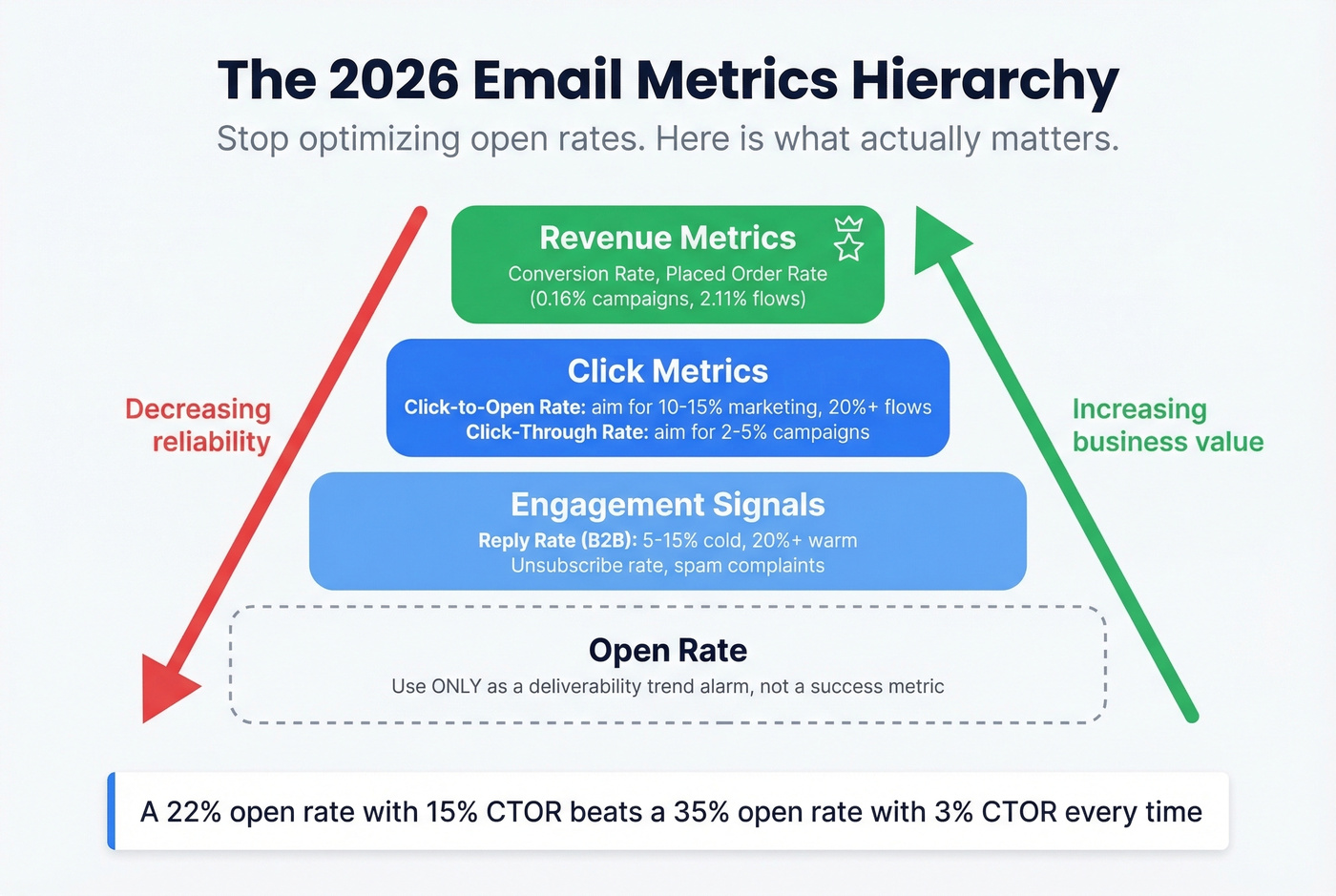
| Metric | Formula | 2026 Target |
|---|---|---|
| Click-through rate | Unique clicks / delivered x 100 | 2-5% campaigns |
| Click-to-open rate | Unique clicks / unique opens x 100 | 10-15% marketing, 20%+ flows |
| Conversion rate | Conversions / delivered x 100 | Varies by goal |
| Placed order rate | Orders / delivered x 100 | 0.16% campaigns, 2.11% flows |
| Reply rate (B2B) | Replies / delivered x 100 | 5-15% cold, 20%+ warm |
Click-to-open rate should replace open rate as your primary engagement signal. It measures content relevance - of the people who opened, how many cared enough to click? A 35% open rate with a 3% CTOR means your subject lines work but your content doesn't. A 22% open rate with a 15% CTOR means your content is strong but deliverability or list quality needs work.
If you want to standardize your reporting, use a consistent click rate formula and keep it the same across tools.
Open rate still has one job: trend monitoring. If it drops 10+ points over two weeks, something broke. Use it as an alarm, not a scoreboard.
What to Tell Your Boss
Your boss sees a 32% open rate and thinks two-thirds of the list is ignoring you. Here's how to reframe that conversation.
First, report open rate as a trend line, not an absolute number. "Open rate is stable at 33%, up 2 points from last quarter" is infinitely more useful than "our open rate is 33%." Trends reveal health. Snapshots reveal nothing.
Second, lead with click-based metrics. "Our click-to-open rate is 14%, which means one in seven readers takes action" is a story executives understand. It connects to revenue in a way open rate never will. Email is still the channel 73% of consumers prefer - the metric is broken, not the medium.
Third, explain MPP in one sentence: "About half of reported 'opens' are Apple's servers pre-loading images, not humans - our real engagement shows up in the clicks." Don't over-explain. Neutralize the confusion and move on to the metrics that matter.
Lists degrade 2-3% per month. Six months without refreshing means you're emailing ghosts and spam traps. Prospeo refreshes all 300M+ records every 7 days - not the 6-week industry average - so the emails you pull today are verified today. Teams using Prospeo data consistently hold bounce rates under 4% at scale.
Your open rate is only as good as the data behind it. Start with verified contacts.
FAQ
What is a good email open rate in 2026?
A good email open rate is 20-28% after filtering out Apple MPP inflation. Reported dashboards typically show 30-40%, but real human engagement sits lower. Focus on whether your rate trends upward alongside healthy click-to-open metrics above 10%.
Is a 20% email open rate bad?
No. A 20% rate with strong click-through is far healthier than a 40% reported rate with zero clicks. If you've filtered MPP-inflated opens, 20% signals genuine engagement. Context and trend direction beat the raw number every time.
How does Apple MPP affect open rates?
Apple preloads tracking pixels for roughly 97% of iPhone users, creating fake "opens" without human interaction. This inflates reported rates by 15-20 points. Nearly 49.29% of all tracked opens are now MPP-generated, making raw open rate unreliable as a success metric.
How can I improve my email open rate?
Start with deliverability: clean your list with a verification tool, authenticate your domain with SPF/DKIM/DMARC, and keep bounce rates under 3%. Then optimize subject lines, send timing, and segmentation. Skip this if your bounce rate is healthy and your CTOR is already above 10% - you're probably fine.
What's a good click-to-open rate?
Aim for 10-15% on marketing campaigns and 20%+ on automated flows. CTOR measures content relevance among actual openers, making it far more reliable than open rate as an engagement signal in the post-MPP era.