

Bump Email Templates That Actually Get Replies
It's Thursday morning. You sent a sharp, personalized cold email on Monday - custom opener, relevant pain point, clear CTA. Radio silence. That email is now buried under 47 unread messages, and your pipeline number hasn't moved.
Here's the thing: 42% of cold email replies come from follow-ups. The bump is where deals start, and the right bump email template makes the difference between a dead thread and a booked meeting.
What Is a Bump Email?
A bump email (also called a bumper email) is a one- or two-sentence reply to your own original message. You're not writing a new pitch. You're not adding a case study or a fresh angle. You're literally replying to your own thread to push it back to the top of your prospect's inbox, resurfacing everything you already said.
This is different from a follow-up, and the distinction matters:
| Bump | Follow-Up | |
|---|---|---|
| Length | 1-2 sentences | Full email |
| Thread | Same thread, reply | Often new thread |
| New value | None or minimal | New angle, data, CTA |
| Goal | Resurface original | Re-engage with fresh pitch |
| Typical lines | "Any thoughts?" | New subject, new hook |
Lines like "Wanted to bump this up in your inbox" or "Did you get a chance to review?" are classic bumper emails. They work because they're low-friction - the prospect doesn't need to parse a new pitch, just scroll down and re-read the original.
Do Bump Emails Work? The Data
A study across 26,000 prospects tracked reply rates at each stage of a sequence. The initial email pulled a 2.5% reply rate. The first bump raised that by 5.2%. The second bump generated 3.7%. Total reply rate after two bumps: 11.4%.
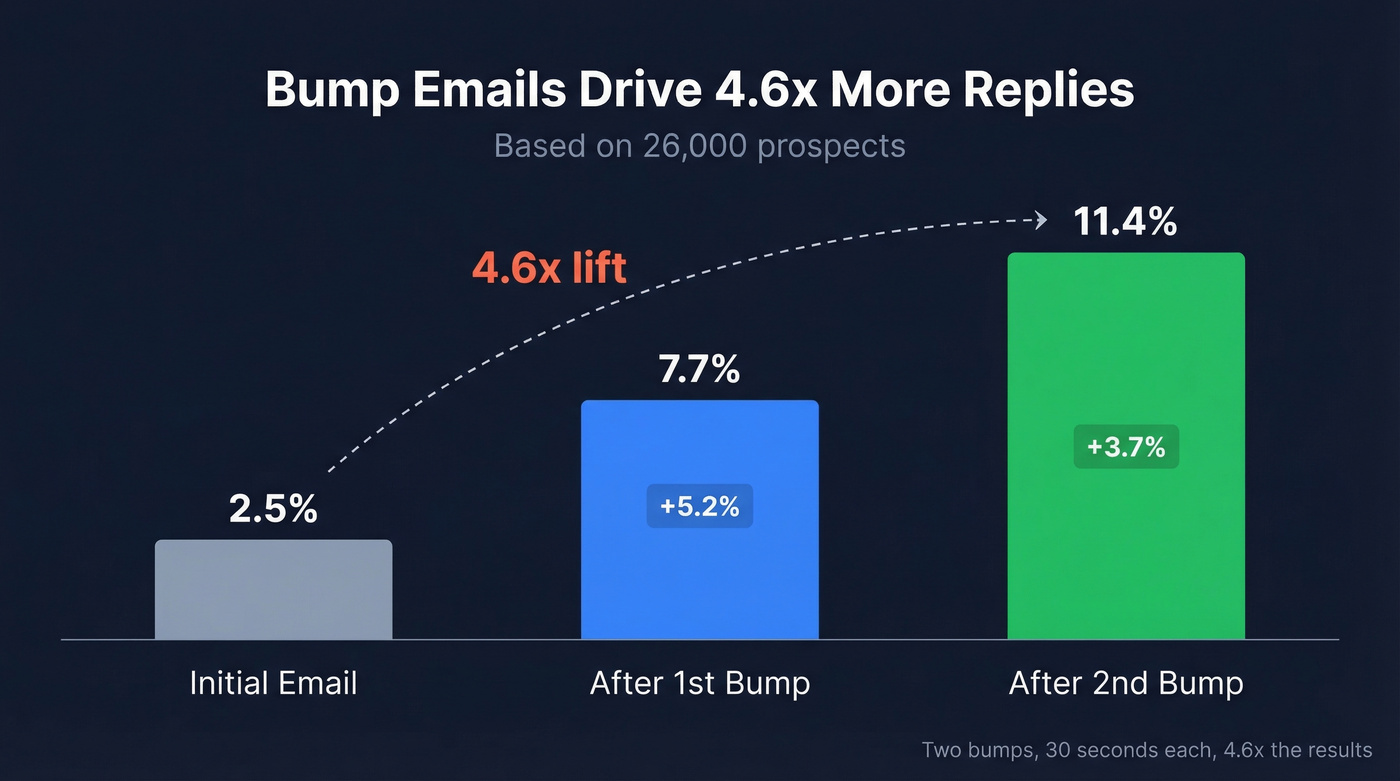
That's roughly a 4.6x lift from two short messages that took maybe 30 seconds each to write. In our experience, those numbers hold up - bumps one and two consistently deliver the biggest gains, and everything after that hits diminishing returns fast. For most deal sizes, two touches is the ceiling before you start annoying people.
Not all bumps perform equally, though:
| Template Type | Reply Rate | Notes |
|---|---|---|
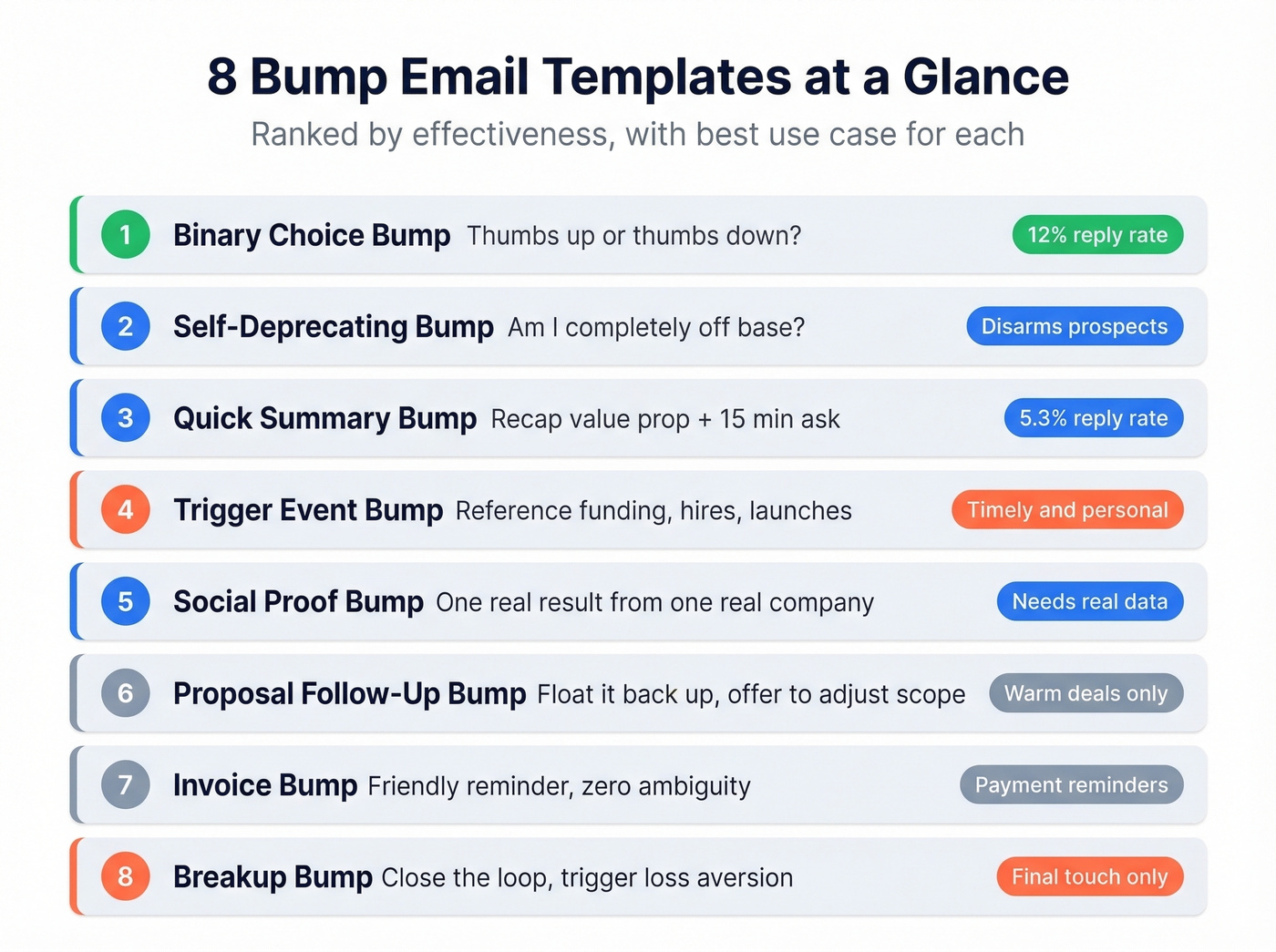
| Binary CTA bump | 12% | "Thumbs up or thumbs down" |
| Social sell bump | 6% | Profile view + ask |
| Quick summary bump | 5.3% | Recap + meeting ask |
| Short reminder bump | 5.3% | Three sentences max |
The binary CTA bump outperformed everything else by about 2x. The pattern is clear: the easier you make it to reply, the more replies you get.
8 Copy-Paste Bump Email Templates
One caveat before you copy these: a bump only resurfaces what's already there. If your original email was weak - no clear pain point, no relevant hook - bumping it won't help. Fix the foundation first.
1. The Binary Choice Bump
Hey {{first_name}} - thumbs up or thumbs down on this? Either way, just want to make sure it landed.
This pulled a 12% reply rate in the 26,000-prospect study. Binary choices reduce cognitive load to almost zero. The prospect doesn't need to think about scheduling or objections - just a quick reaction. It's the single best-performing bump email template we've seen in any dataset.
2. The Self-Deprecating Bump
A practitioner on r/sales shared a single line that dramatically improved their reply rates:
Any merit around my messaging or am I completely off base?
It disarms the prospect by inviting criticism instead of asking for a meeting. People love telling you you're wrong - and once they reply, you have a conversation. This is a masterclass in how to bump an email politely: you're giving the prospect an easy out while still opening a door.
3. The Quick Summary Bump
Quick recap: {{one-sentence value prop}}. Worth 15 minutes this week?
When to use this: Your prospect skimmed the original and didn't scroll far enough to hit your CTA. This re-anchors the value and pairs it with a low-commitment ask. Pulled 5.3% in the same study.
4. The Trigger Event Bump
Saw {{company}} just {{raised a round / hired a new VP Sales / launched X}}. Makes my original note even more relevant - want me to show you why?
Adding a timely trigger event turns a generic bumper reply into something personalized and current. It's the minimum viable "new value" you can add without writing a full follow-up.
5. The Social Proof Bump
Since I sent this, we helped {{similar company}} cut {{metric}} by {{number}}. Thought that might be relevant.
Skip this if you don't have a real, specific result to cite. "We help companies grow revenue" isn't social proof. One concrete number from one real company beats three paragraphs of features every time.
6. The Proposal Follow-Up Bump
Hi {{first_name}} - just floating this back up. Happy to jump on a quick call if any questions came up on the proposal, or adjust scope if needed.
This isn't cold outreach - it's nudging a decision on something already in motion. The "adjust scope" language signals flexibility without desperation. Think of it less as "just following up on the below email" and more as offering a clear next step.
7. The Invoice Bump
Hi {{first_name}} - friendly reminder that invoice #{{number}} is still outstanding (due {{date}}). Let me know if there's anything holding this up on your end.
Direct, professional, zero ambiguity. For payment reminders, clarity beats cleverness every time. Don't overthink this one.
8. The Breakup Bump
{{first_name}} - I'll assume the timing isn't right and close the loop on my end. If anything changes, I'm here.
Loss aversion is real. Telling someone you're walking away often triggers a response when nothing else did. This is your final touch - use it as such.

A 12% reply rate means nothing if 35% of your emails bounce before they're ever seen. Prospeo's 98% email accuracy and 7-day data refresh ensure every bump you send actually reaches a real inbox - not a dead address.
Fix the foundation before you bump. Start with emails that actually deliver.
When to Send Your Bumps
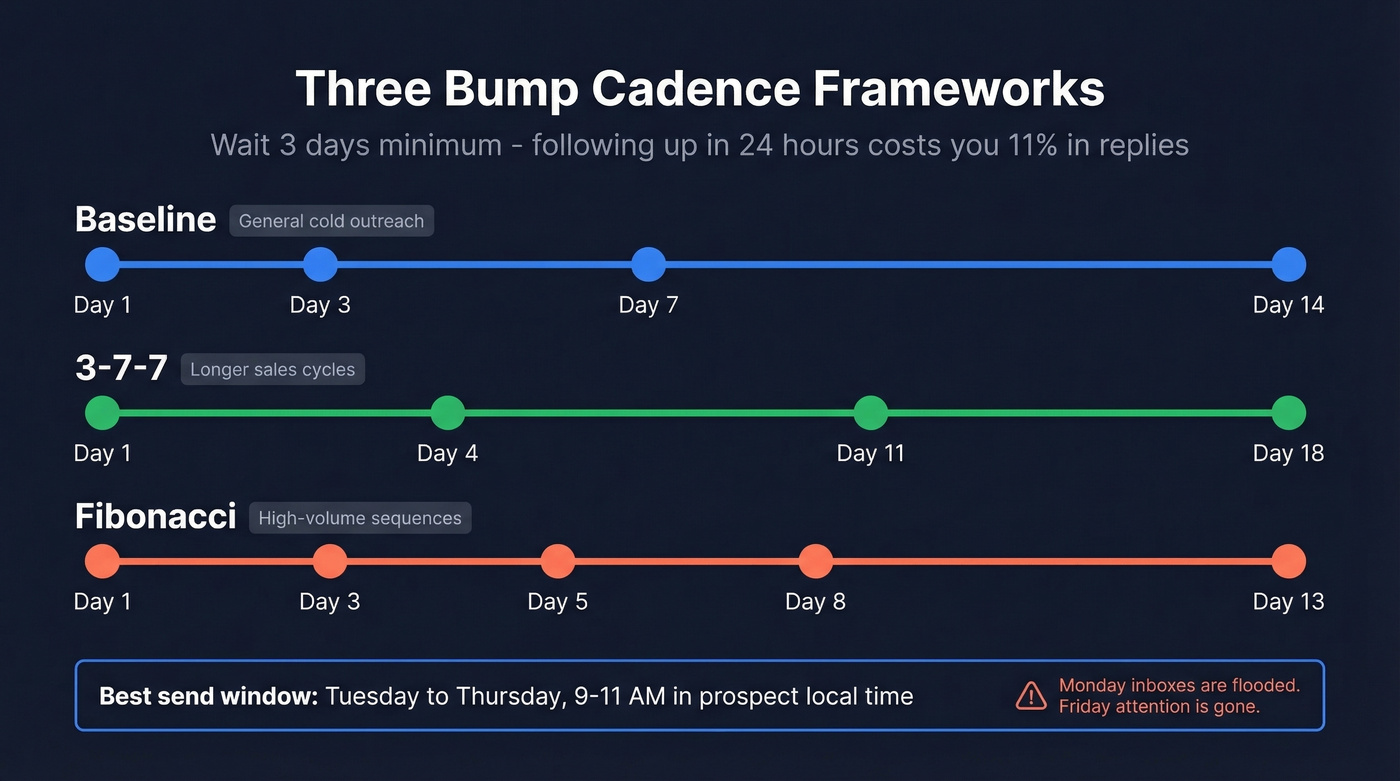
Timing matters more than most reps think. Following up within 24 hours of your initial email reduces replies by 11%. Waiting three days increases replies by 31%.
The instinct to bump immediately is exactly wrong.
Three cadence frameworks worth testing:
| Framework | Spacing | Best For |
|---|---|---|
| Baseline | Day 1 / 3 / 7 / 14 | General cold outreach |
| 3-7-7 | Day 1 / 4 / 11 / 18 | Longer sales cycles |
| Fibonacci | Day 1 / 3 / 5 / 8 / 13 | High-volume sequences |
For day and time, Tuesday through Thursday, 9-11 AM in the prospect's local time zone is a strong default. Monday inboxes are flooded. Friday attention is gone.
Hot take: If your average deal is under $5K, two bumps and a breakup email is your entire sequence. Don't build an 11-step cadence for a deal that doesn't justify the effort. Save the elaborate multi-touch sequences for accounts that actually move the needle.
Same Thread or New Thread?
This is one of the most debated questions in outbound, and the answer depends on what your open data tells you.
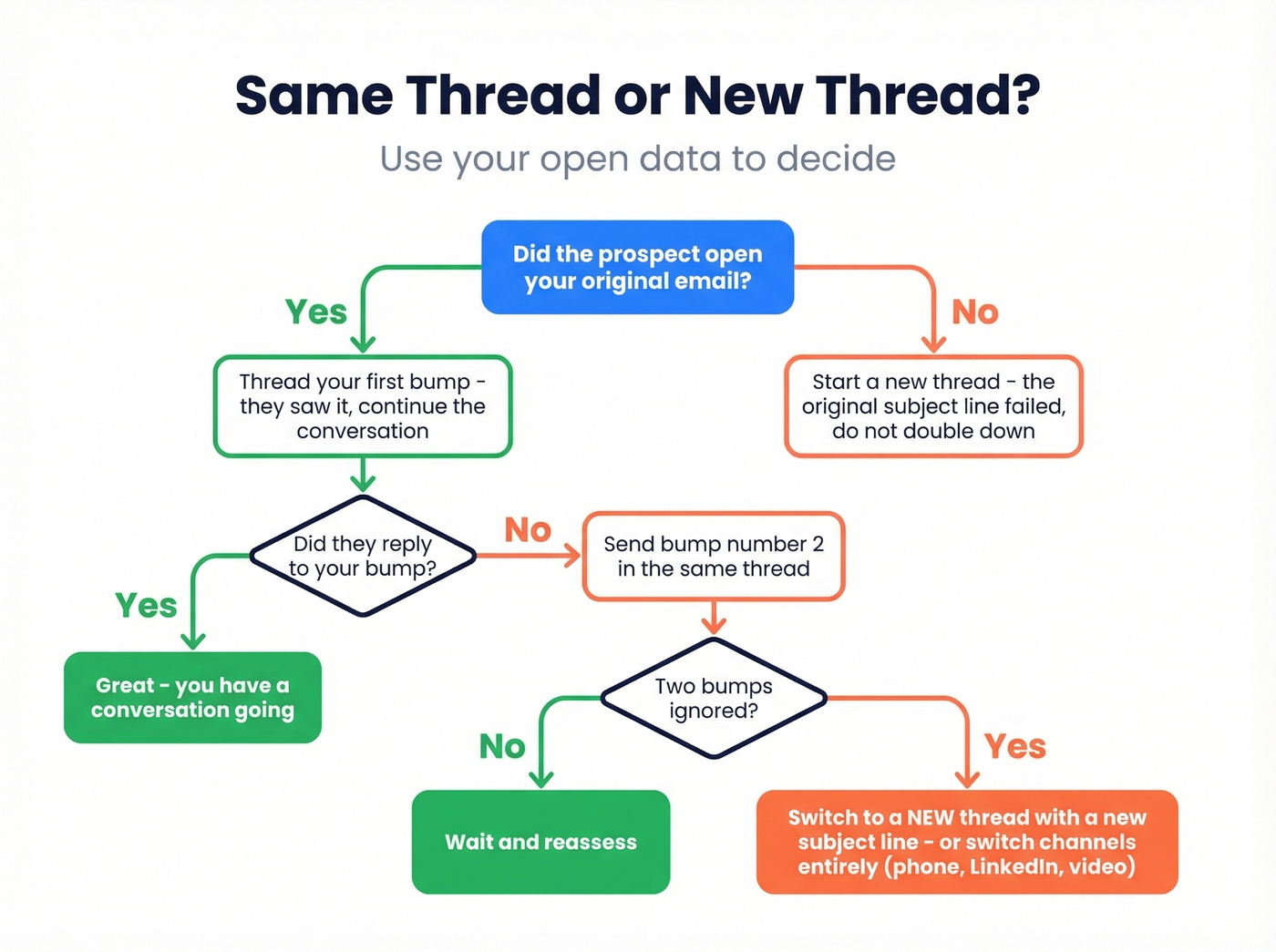
Prospect opened your original email: Thread your first bump. They saw it - you're continuing a conversation.
Prospect never opened: Start a new thread with a different subject line. The original subject failed. Don't double down on it.
Two ignored bumps in the same thread: Always switch to a new thread. Three messages stacking up under the same subject line starts to feel like harassment.
We've seen this hold up consistently across campaigns. After two ignored bumps, the smartest move is often switching channels entirely. A real practitioner sequence from r/GrowthHacking runs Email -> Thread Bump -> Thread Bump -> connect request -> 2nd email -> Bump -> message -> 3rd email -> Bump -> breakout email. That multi-channel approach keeps you visible without carpet-bombing one inbox.
Some teams also experiment with third-party bumps - having a colleague or manager reply to the thread instead of the original sender. This resets the social dynamic and can pull a reply when your own bumps have stalled.
5 Mistakes That Kill Your Bumps
1. "Just checking in" with zero value. This is the most common bumper reply mistake and the easiest to fix. Even a bump should give the prospect a reason to re-engage - a binary choice, a self-deprecating question, anything with a hook. "Just checking in" is the email equivalent of a shrug.
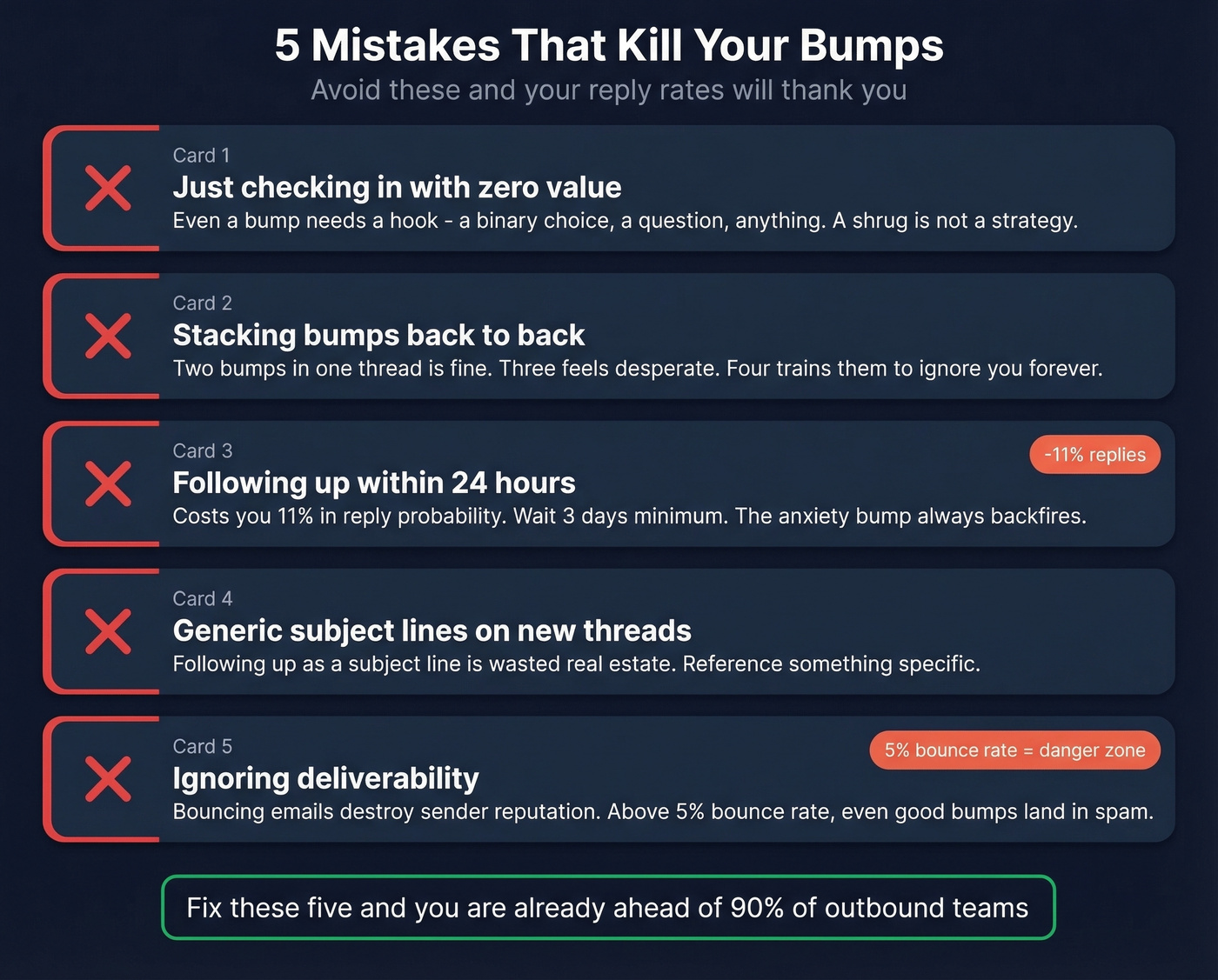
2. Stacking bumps back-to-back. Two bumps in the same thread is fine. Three starts to feel desperate. Four and you're training the prospect to ignore you permanently.
3. Following up too fast. That 24-hour bump you fired off because you were anxious? It cost you 11% in reply probability. Wait three days minimum. We've tested dozens of cadences and the three-day floor holds every time.
4. Generic subject lines when switching threads. If you're starting a new thread after failed bumps, "Following up" as your subject line is wasted real estate. Reference something specific - a trigger event, a mutual connection, a result.
5. Ignoring deliverability. Look, nobody talks about this one: if your emails are bouncing, your bumps aren't just failing - they're actively destroying your sender reputation. Every bounce tells email providers you're sending to bad addresses, which pushes your valid bumps into spam too. Your data might be the real problem, not your copy.
Why Your Bumps Aren't Landing
Picture this: you send 200 bump emails. 38 bounce. That's a 19% bounce rate, and it's a death sentence for your domain. Anything above 5% is a serious deliverability problem, and once you're flagged, even your perfectly crafted bumps to verified addresses start landing in spam.
The fix isn't better copy. It's better data.
Prospeo runs every email through a 5-step verification process - catching spam traps, honeypots, and catch-all domains before they ever hit your sequence. The result is 98% email accuracy that translates to real-world deliverability. Stack Optimize built their agency to $1M ARR using Prospeo's data, maintaining 94%+ deliverability, bounce rates under 3%, and zero domain flags across all their clients.

Your bump email template doesn't matter if 15% of your list is dead addresses. Verify first, sequence second.
Trigger event bumps only work when you can find the right contact fast. Prospeo's 30+ filters - including job changes, funding rounds, and headcount growth - surface the exact prospects worth bumping, with verified emails at $0.01 each.
Stop bumping dead leads. Build lists worth following up on.
FAQ
How many bump emails should I send?
Two bumps is the sweet spot for most outbound sequences. The study data shows bumps one and two deliver the vast majority of the reply-rate lift - after that, switch channels to phone, video, or a connect request. Serial bumping damages both your prospect relationship and your sender reputation.
What's the difference between a bump and a follow-up?
A bump is a one- or two-sentence reply in the same thread that resurfaces your original message with little or no new information. A follow-up is a separate message bringing fresh value - a different angle, new data, or an alternative CTA. Both belong in your sequence, but they serve different purposes.
Should I bump in the same thread?
Thread your first bump if the prospect opened the original - they've seen the subject line, so continuing makes sense. If they never opened, start a new thread with a different subject line. After two ignored bumps in the same thread, always switch to a fresh thread or a different channel entirely.
What if they open but don't reply?
An open without a reply means your subject line worked but your message didn't compel action. Don't just bump with "any thoughts?" - try a binary-choice CTA or reference a trigger event that makes your original pitch more timely. The goal is to change the equation, not repeat the ask.