Sales Execution Platform vs CRM: What's Actually Different?
Sales reps spend 60% of their time on non-selling tasks. The average seller juggles eight tools to close a deal. And somewhere between the CRM your VP of Sales insisted on and the sales execution platform your SDR team loves, nobody can explain which tool does what - or why you're paying for both.
Let's fix that.
What You Need (Quick Version)
- Inbound-only, fewer than 5 reps? Your CRM's built-in sequences are enough.
- Running outbound at scale? You need a sales execution platform alongside your CRM. One stores data, the other acts on it.
- Either way: verify contact data before it touches any tool. Bad data breaks everything downstream.
Untangling the Terms
"Sales execution platform," "sales engagement platform," and "sales enablement platform" get tossed around interchangeably. They shouldn't. They describe different layers of the stack, and the simplest way to separate them is by when each operates:
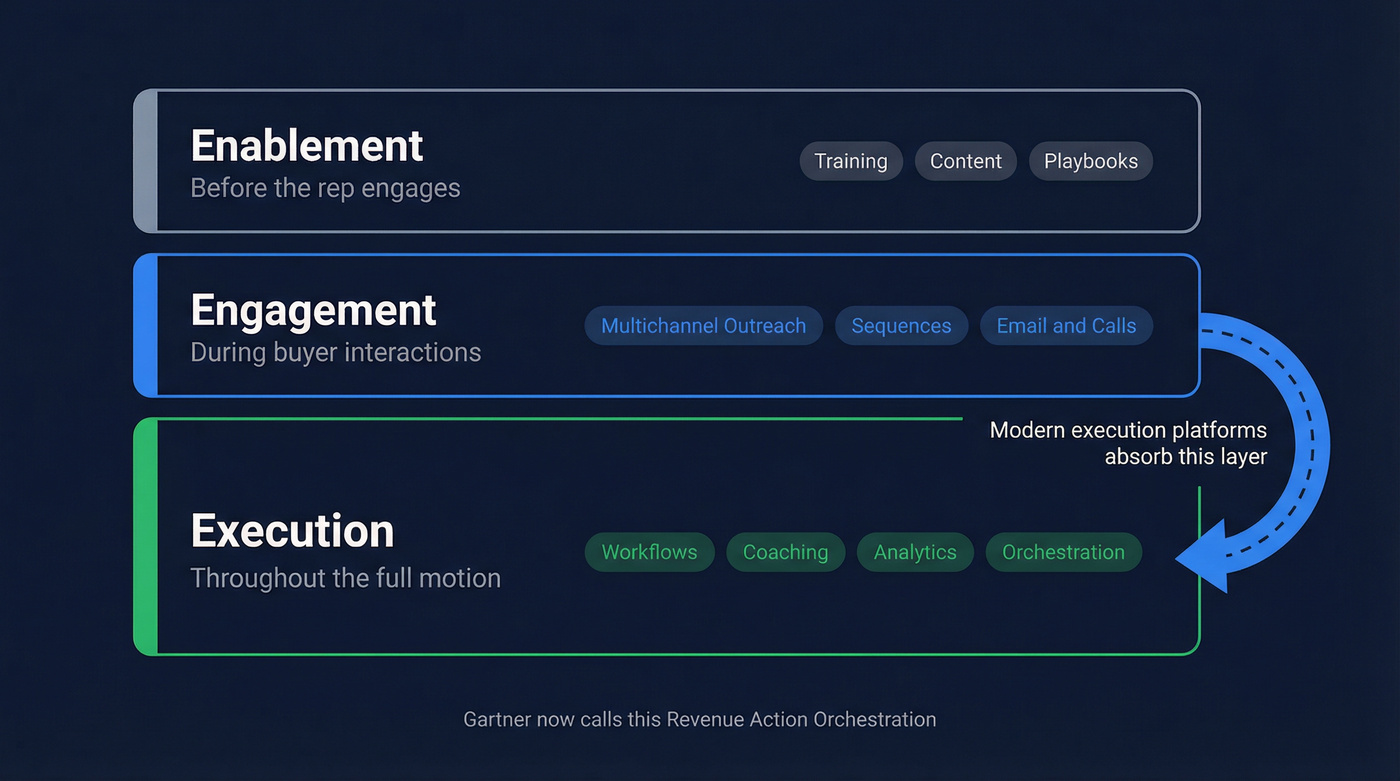
| Layer | When It Operates | What It Does |
|---|---|---|
| Enablement | Before the rep engages | Training, content, playbooks |
| Engagement | During buyer interactions | Multichannel outreach, sequences |
| Execution | Throughout the motion | Workflows, coaching, analytics |
Enablement is prep. Engagement is communication. Execution turns both into consistent, repeatable action.
In practice, most modern execution platforms absorb the engagement layer entirely - which is why the terms blur. Gartner's already acknowledged this convergence by transitioning the Sales Engagement Applications category toward "Revenue Action Orchestration." That tells you where the market is heading: one platform orchestrating the full revenue motion, not three separate tools duct-taped together.
What a CRM Actually Does
A CRM is your system of record. It stores contacts, tracks deals through pipeline stages, logs activities, and generates the reports leadership uses for revenue strategy. Salesforce, HubSpot, Pipedrive - they all do this core job.
91% of businesses with 10+ employees rely on a CRM, yet Spotio pegs CRM adoption across field sales teams at around 26%. That gap exists because CRMs are built to store and analyze - not to guide reps through their day. Gartner describes SFA platforms as AI-enhanced with next-best-action capabilities, but most teams still experience their CRM as a place to log calls after the fact, not a tool that tells you what to do next.
Use your CRM for pipeline visibility, forecasting, and reporting. Skip it as your primary outbound tool once you're past five reps.
What an Execution Platform Does
If the CRM is the system of record, the SEP is the system of action. It's where reps actually work - running multichannel sequences, getting AI-driven coaching, and following structured workflows that replicate what your best reps do naturally.
SEPs generally fall into three types:
| SEP Type | Strength | Tradeoff |
|---|---|---|
| CRM-based | Extends existing CRM | Can feel clunky, manual |
| Task-first | Deep in one area (calls, forecasting) | Fragments workflows |
| Workflow-first | Integrated, guided execution | Higher implementation cost |
The sales engagement market hit $9.2B in 2026, projected to reach $26.6B by 2033 at a 16.4% CAGR. On Gartner Peer Insights, Outreach holds a 4.5 rating across 184 reviews and Salesloft a 4.4 across 284 reviews - both strong, with Salesloft slightly favored for ease of use and Outreach for enterprise-scale orchestration.

Your SEP sequences and CRM workflows collapse when 30% of emails bounce. Prospeo's 143M+ verified emails at 98% accuracy and 7-day refresh cycle ensure every contact hitting Outreach, Salesloft, or HubSpot is real - before your domain reputation pays the price.
Stop debugging your sales stack when the real problem is bad data.
Side-by-Side Comparison
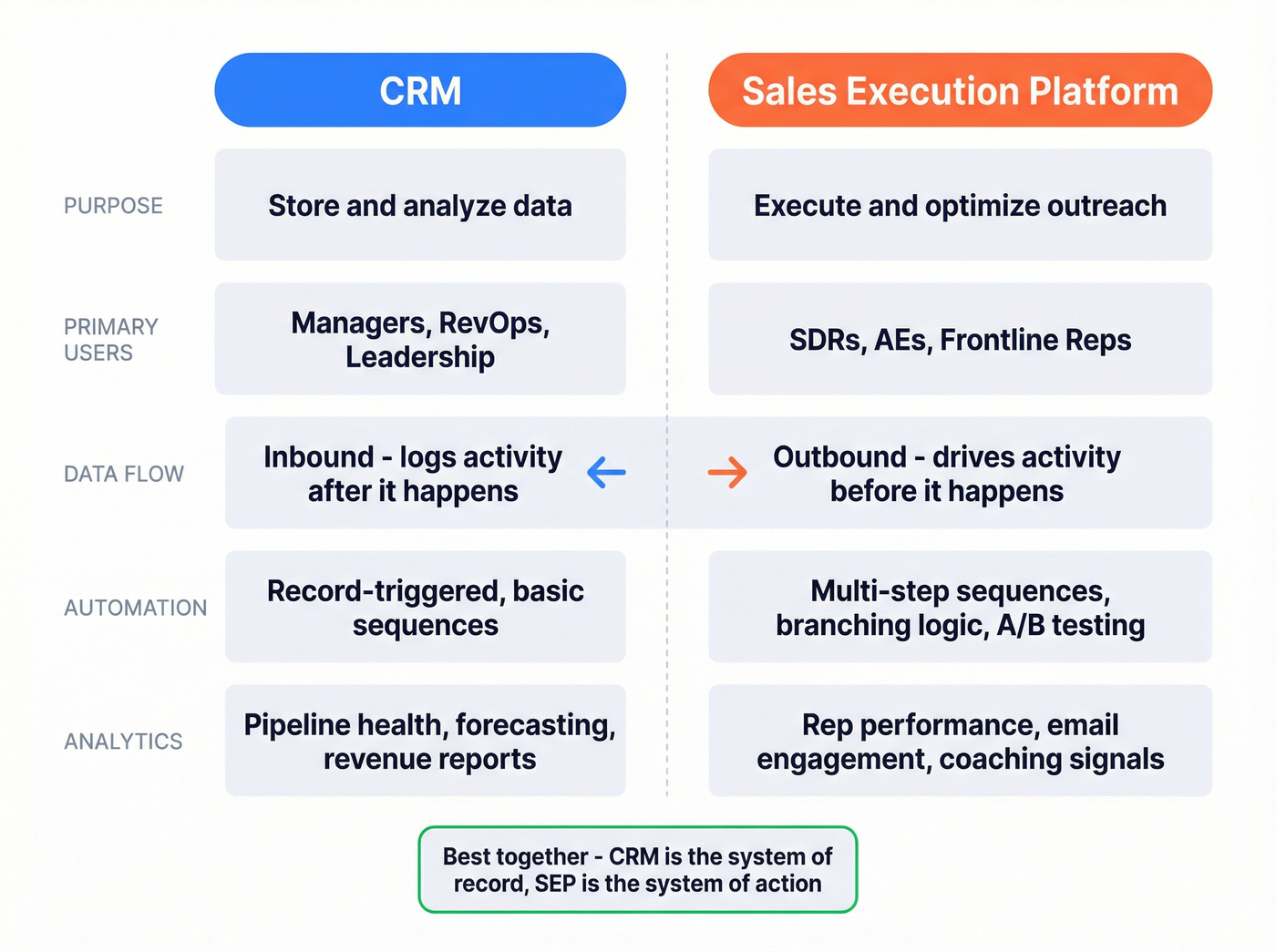
| Dimension | CRM | SEP | Edge |
|---|---|---|---|
| Purpose | Store and analyze | Execute and optimize | SEP for reps, CRM for managers |
| Primary users | Managers, RevOps | Reps, SDRs | Depends on role |
| Data flow | Inbound (logs activity) | Outbound (drives activity) | SEP for outbound teams |
| Automation | Record-triggered | Sequence/workflow-triggered | SEP - far more flexible |
| Analytics | Pipeline, forecast | Rep performance, engagement | CRM for forecasting, SEP for coaching |
And here's what it costs:
| Tool | Type | Typical Price |
|---|---|---|
| Salesforce | CRM | ~$25-$330/user/mo |
| HubSpot | CRM | Free-~$150/user/mo |
| Pipedrive | CRM | ~$14-$99/user/mo |
| Outreach | SEP | ~$100-$165/user/mo |
| Salesloft | SEP | ~$100-$175/user/mo |
| Apollo | Hybrid | $49-$149/user/mo |
| Clari | Revenue platform | ~$50-$125/user/mo |
| Sybill | AI note-taker/coach | ~$29-$59/user/mo |
For most teams, Salesforce or HubSpot as CRM paired with Outreach or Salesloft as SEP is the proven stack. Apollo works as a budget hybrid for teams under five. Sybill adds AI call coaching if your SEP doesn't include it natively.
Here's the thing: a 10-rep team running Salesforce Enterprise plus Outreach is looking at roughly $1,250-$4,950/month in seat costs alone, before data tools. That math matters when you're also paying for intent data, conversation intelligence, and the contact verification layer that keeps the whole thing from falling apart.
When You Need Both (and When You Don't)
Most teams under five reps don't need a dedicated SEP. Most teams over twenty can't survive without one. The messy middle is where we see companies waste the most money.
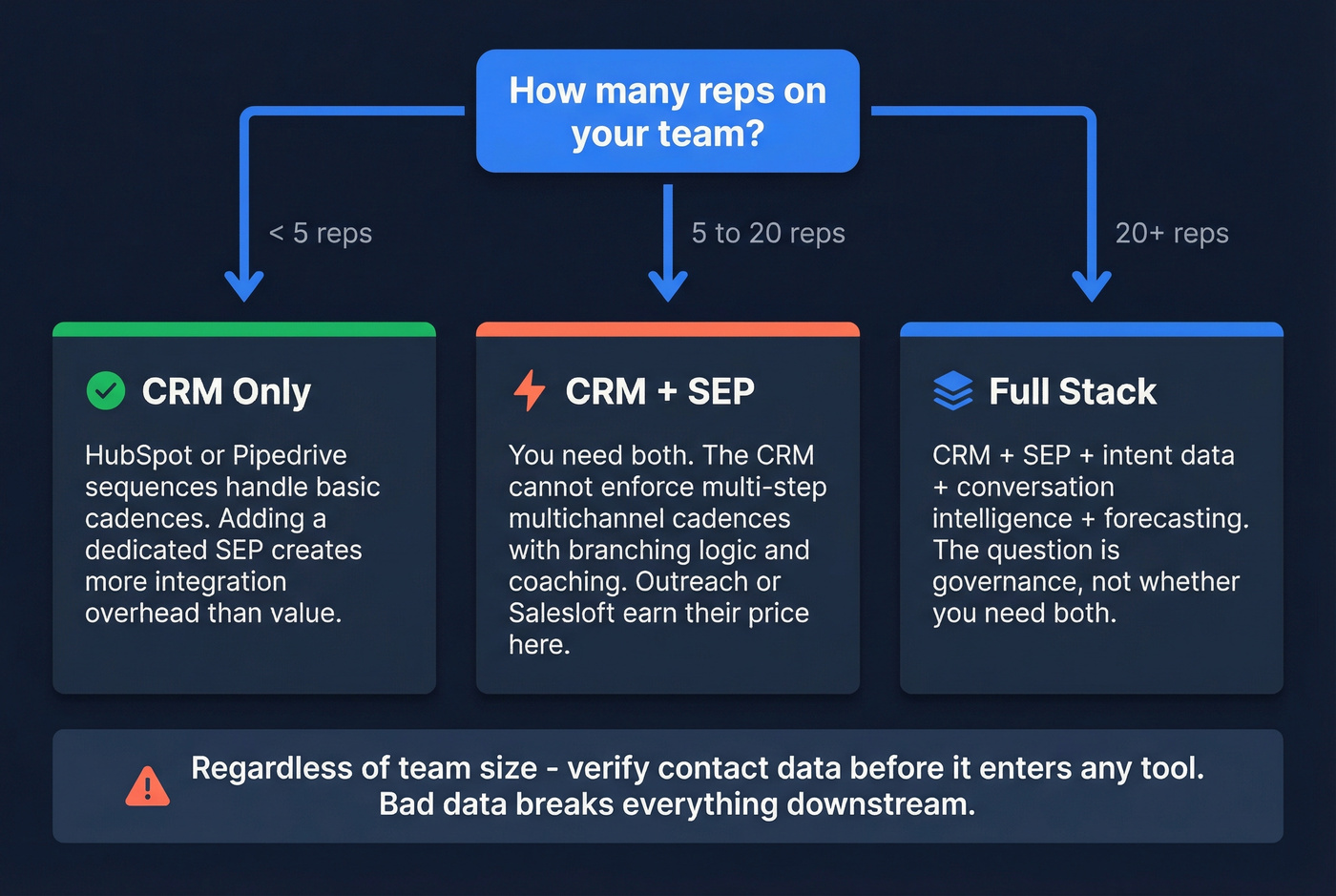
Under 5 reps, mostly inbound: Your CRM's built-in sequences handle basic cadences. HubSpot sequences are good enough. Adding a dedicated SEP creates more integration overhead than value.
5-20 reps, outbound-heavy: You need both. The CRM can't enforce multi-step, multichannel cadences with branching logic, A/B testing, and rep coaching. This is where Outreach and Salesloft earn their price tag. In our experience, the breakpoint is around five reps - that's when process enforcement starts mattering more than individual hustle. Some early-stage teams use Apollo as both CRM and SEP here; it works short-term but gets painful as you scale past ten.
Enterprise, 20+ reps: You're running both, plus intent data, conversation intelligence, and forecasting. The question isn't whether you need both - it's how to keep them from creating a data mess.
The Data Layer Everyone Forgets
We've watched this play out dozens of times: a team spends weeks evaluating CRMs and SEPs, picks the right tools, builds beautiful sequences - then loads 5,000 prospects and watches 30% bounce on the first send. Domain reputation tanks. The SEP looks broken. But the real problem was the data.
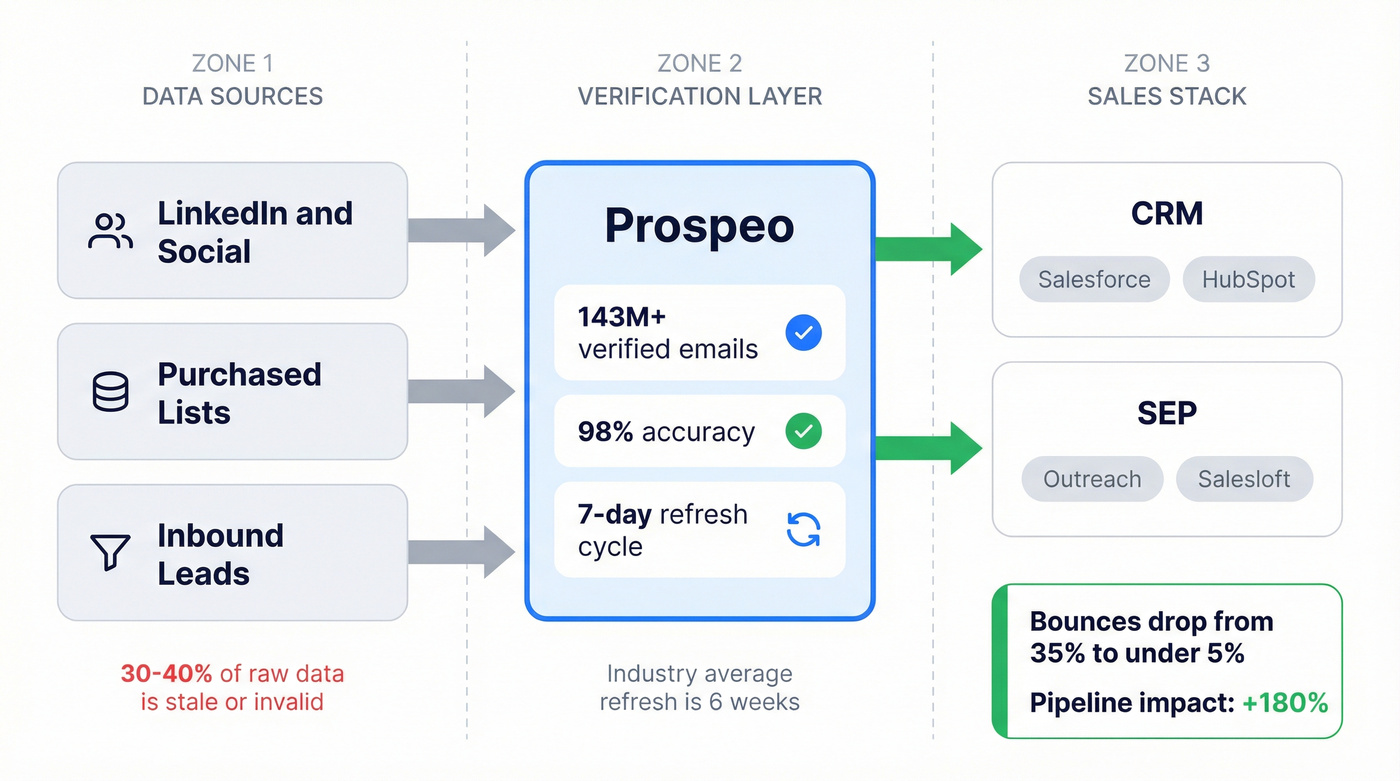
This is where Prospeo fits. With 143M+ verified emails at 98% accuracy and a 7-day data refresh cycle (the industry average is six weeks), it operates as the verification layer between your data sources and your CRM/SEP stack. It integrates natively with Salesforce, HubSpot, Outreach, and Salesloft, so it slots into the exact workflow we've been discussing without adding another tab for reps to ignore.
Real numbers from a team that fixed this: Snyk's 50 AEs were running bounce rates of 35-40%. After cleaning their data layer, bounces dropped under 5%, AE-sourced pipeline jumped 180%, and they generated 200+ new opportunities per month. That's not marginal. That's the difference between a working outbound motion and a broken one.
A 10-rep team already spends $1,250-$4,950/month on CRM and SEP seats. Don't waste those seats on unverified contacts. Prospeo integrates natively with Salesforce, HubSpot, Outreach, and Salesloft - adding 98% email accuracy at $0.01 per lead.
Feed your execution stack verified data for a penny per email.
Integration Without the Data Mess
Once you're running both a CRM and SEP, governance is everything. These rules work consistently:
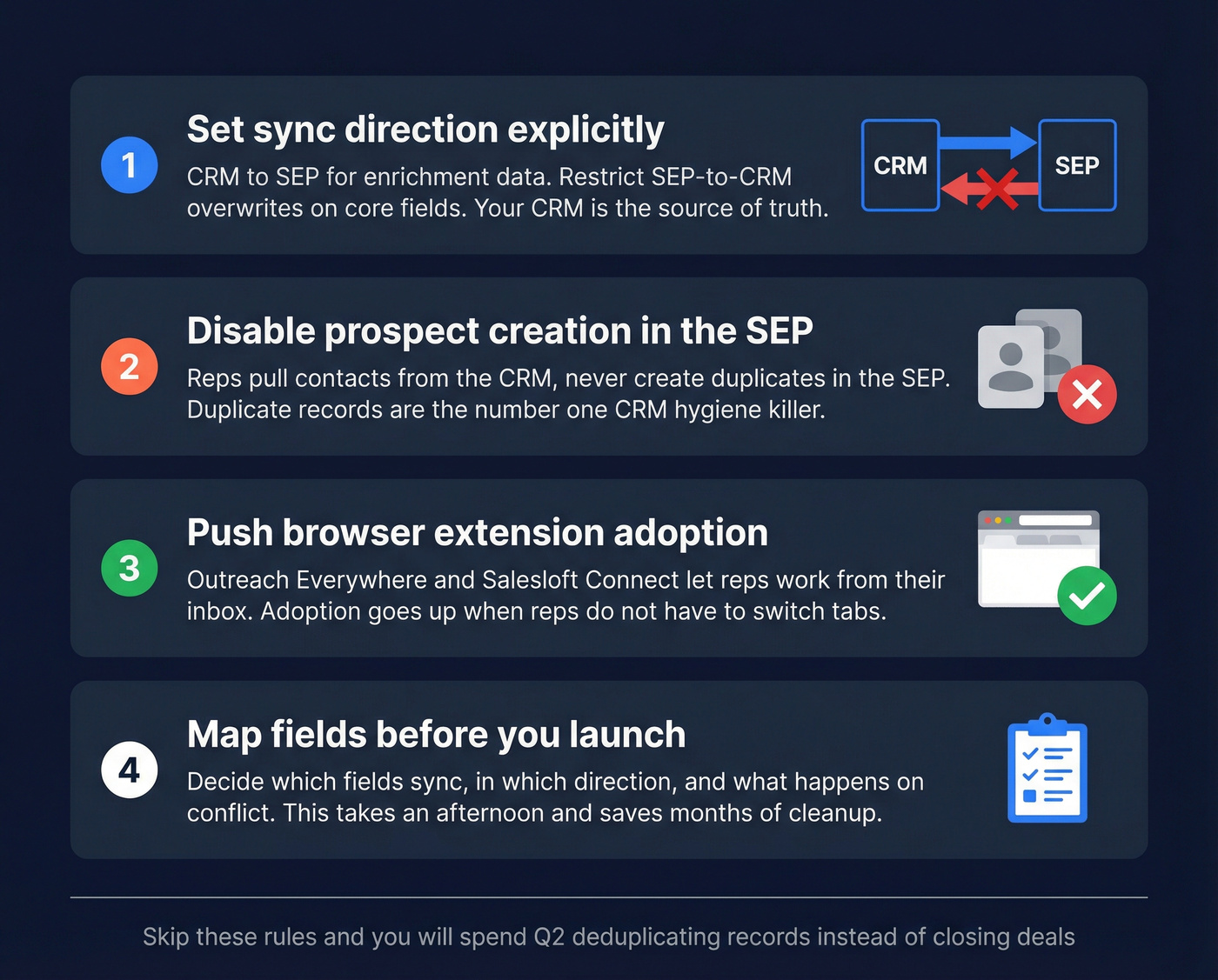
Set sync direction explicitly. CRM to SEP for enrichment data. Restrict SEP-to-CRM overwrites on core fields. Your CRM is the source of truth - protect it.
Disable prospect creation in the SEP for default users. Reps should pull contacts from the CRM, not create duplicates that never sync back. The consensus on r/salesoperations is that duplicate records are the single biggest CRM hygiene killer, and most of them come from reps creating contacts directly in the SEP.
Push browser extension adoption. Outreach Everywhere and Salesloft Connect let reps work from their inbox while the SEP manages tasks behind the scenes. Adoption goes up when reps don't have to switch tabs.
Map fields before you launch. Decide which fields sync, in which direction, and what happens on conflict. This takes an afternoon and saves months of cleanup. Skip this step and you'll spend Q2 deduplicating records instead of closing deals.
FAQ
Can a CRM replace a sales execution platform?
For small inbound teams under five reps, yes - HubSpot and Salesforce offer basic sequences that handle simple cadences. Once you're running multi-step outbound with branching logic, A/B testing, and rep coaching, a dedicated execution platform pays for itself in pipeline velocity alone.
Is a sales execution platform the same as a sales engagement platform?
They overlap heavily. Gartner is transitioning the category toward "Revenue Action Orchestration," reflecting how execution platforms now absorb engagement features. Focus on whether a tool covers sequences, coaching, and analytics - not the label on the box.
How do I keep data accurate across both tools?
Verify contacts before they enter either system, set sync rules so the CRM stays the source of truth, and audit records quarterly. Stale data wrecks domain reputation and inflates bounce rates past the 5% threshold that triggers deliverability penalties from major ESPs.
What does a CRM + SEP stack cost for a mid-market team?
A 10-rep team on Salesforce Enterprise plus Outreach typically pays $1,250-$4,950/month in seat costs before data tools. Budget-conscious teams can start with HubSpot's free CRM tier and Apollo's hybrid plan for under $500/month total, then upgrade as outbound volume grows.