The Best Email Management Tools for Sales Teams (2026)
Most "best sales email tools" lists are email marketing lists in disguise. They push tools like Mailchimp and Brevo - great for newsletters, useless for booking meetings. Every email management tool for sales covered here is built for one-to-one outbound: sequencing, tracking, CRM sync, and getting replies from prospects who've never heard of you.
A RevOps lead we work with ran her first campaign on a new sequencer last quarter. Beautiful templates, perfect cadence logic, solid Salesforce integration. Then the bounce report came back: 18% invalid. Her domain reputation cratered in a week. The sequencer wasn't the problem. The data was. That distinction - tool vs. data - runs through everything below.
Our Picks
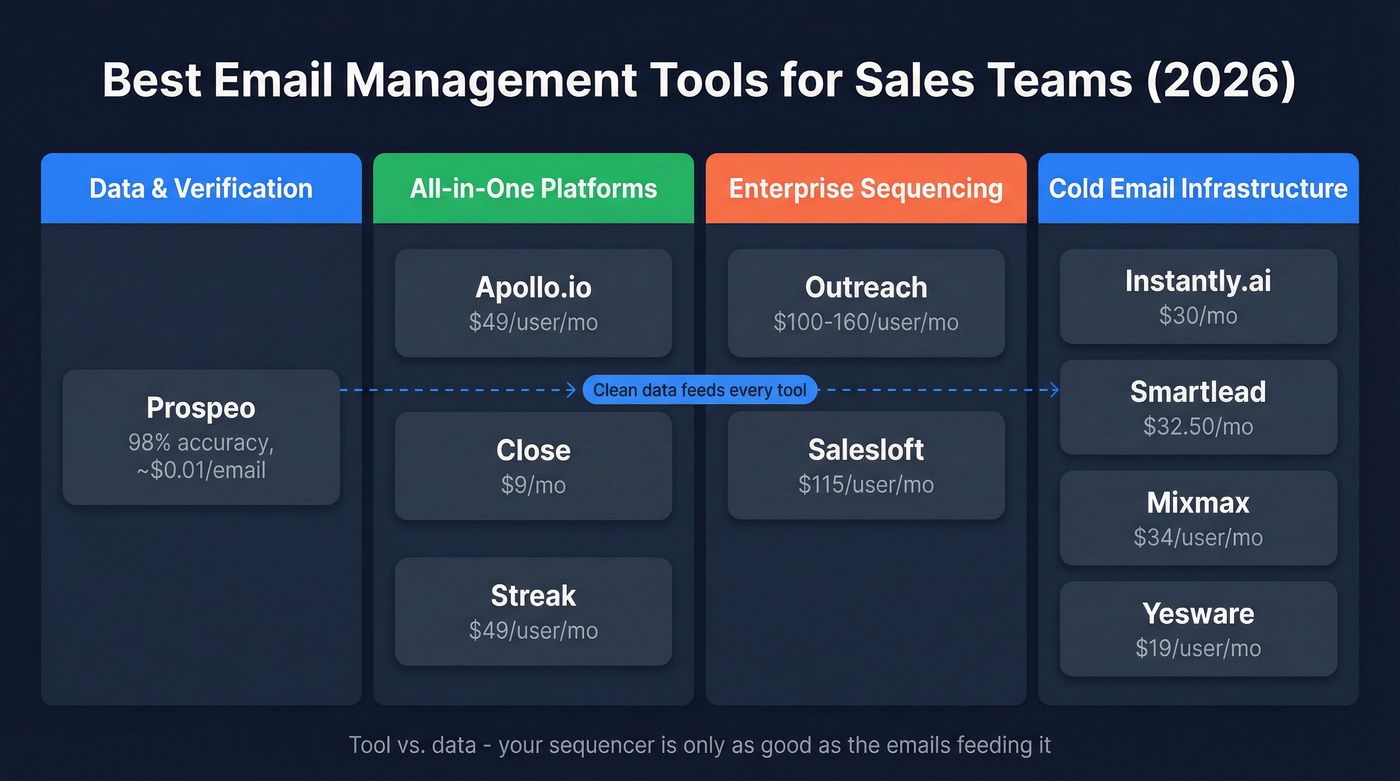
| Tool | Best For | Starting Price | Free Tier | Key Strength |
|---|---|---|---|---|
| Prospeo | Email accuracy & clean data | ~$0.01/email | 75 emails/mo | 98% email accuracy |
| Apollo.io | All-in-one SMB | $49/user/mo | Yes | Database + sequencing |
| Streak | Gmail-native simplicity | $49/user/mo (annual) | Yes (tracking) | Gmail-native CRM + outreach |
| Mixmax | Gmail sequences | $34/user/mo | Yes | Templates + scheduling |
| Outreach | Enterprise engagement | ~$100-$160/user/mo | No | Multi-channel orchestration |
| Salesloft | Enterprise (Outreach alt) | ~$115/user/mo | No | Workflow automation |
| Close | Solo reps / founders | $9/mo | No | CRM + outreach combined |
| Instantly.ai | High-volume cold email | $30/mo | No | Inbox rotation + warm-up |
| Smartlead | Cold email infrastructure | $32.50/mo | No | Deliverability focus |
| Yesware | Lightweight tracking | $19/user/mo | No | Opens, clicks, timeline |
What to Look For in Sales Email Software
Five things separate a stack that books meetings from one that burns domains.
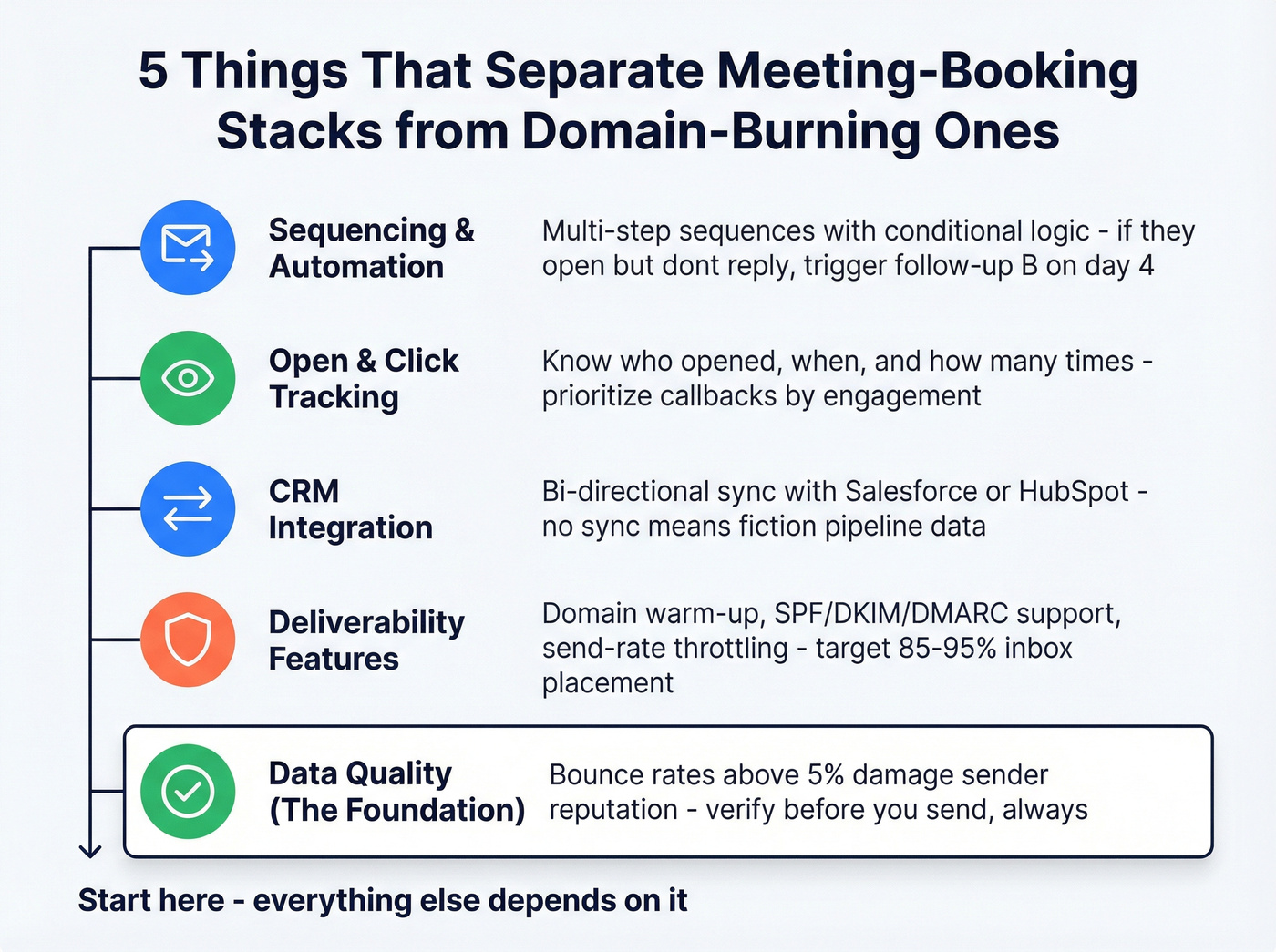
Sequencing and automation. You need multi-step sequences with conditional logic - if they open but don't reply, send follow-up B on day 4. Manual follow-ups don't scale past 50 prospects. (If you want proven frameworks, start with sales sequences.)
Open and click tracking. Knowing who opened, when, and how many times lets you prioritize callbacks. Every tool on this list offers some version of this, but accuracy varies widely. The best options turn your inbox into a command center where sequencing, tracking, and CRM data are all visible without switching tabs. (More on what to measure in real-time email tracking.)
CRM integration. Bi-directional sync with Salesforce or HubSpot isn't optional. If your sequencer creates activities that don't flow back to the CRM, your pipeline data is fiction. This is also where CRM hygiene makes or breaks reporting.
Deliverability features. Domain warm-up, SPF/DKIM/DMARC authentication support, and send-rate throttling keep you out of spam folders. Industry-leading platforms maintain 85-95% inbox placement rates - but only when fed clean data. For the full playbook, use an email deliverability checklist.
Data quality. This is the foundation. Your sequencer is only as good as the data feeding it. Bounce rates above 5% damage sender reputation, and recovery takes weeks. Verifying emails before they enter your sequence is cheaper than rebuilding a burned domain. Always. (If you need a shortlist, see the best email ID validators.)

Top Email Management Tools for Sales Teams
Prospeo
Prospeo isn't a sequencer - it's the data accuracy layer that makes every other tool on this list actually work. Think of it as the prerequisite.
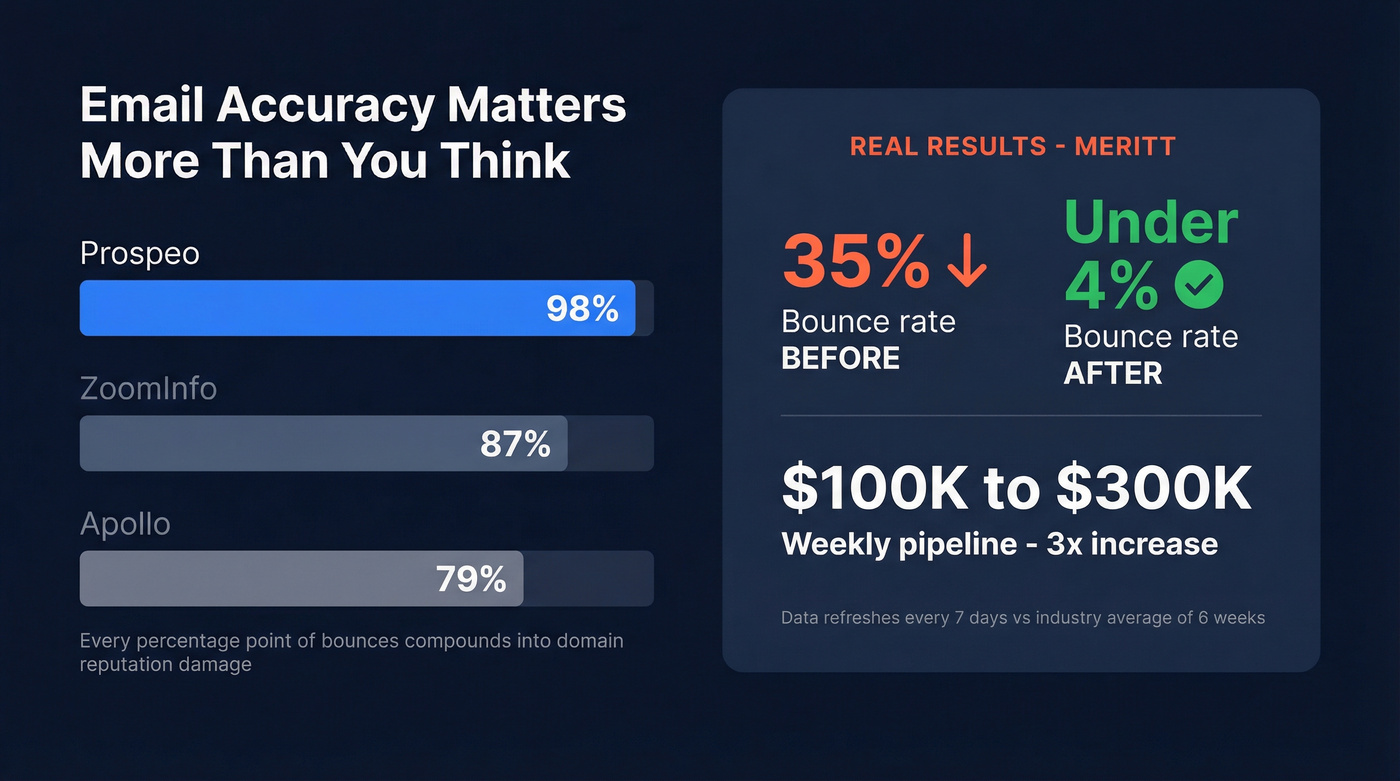
The platform covers 300M+ professional profiles with 143M+ verified emails and 125M+ verified mobile numbers. The headline number: 98% email accuracy, compared to 87% at ZoomInfo and 79% at Apollo. That gap matters more than most people realize. When your data is accurate, even a simple sequencer beats a "bigger" platform that's sending to dead addresses.
We've seen the results firsthand. Meritt was running a 35% bounce rate before switching their data layer to Prospeo. After the switch, bounces dropped under 4% and their pipeline tripled from $100K to $300K per week. That's not a marginal improvement - it's a different business.
Data refreshes every 7 days, where the industry average is 6 weeks. The Chrome extension with 40,000+ users lets you pull verified contact info from any website or CRM in one click. Native integrations with Salesforce, HubSpot, Instantly, Lemlist, Smartlead, and Clay mean your data flows directly into whatever sequencer you're already using.
Pricing is credit-based at roughly $0.01 per email. There's a free tier with 75 verified emails per month - enough to test whether your current list is actually reaching real inboxes. No contracts, no sales calls required.
Apollo.io
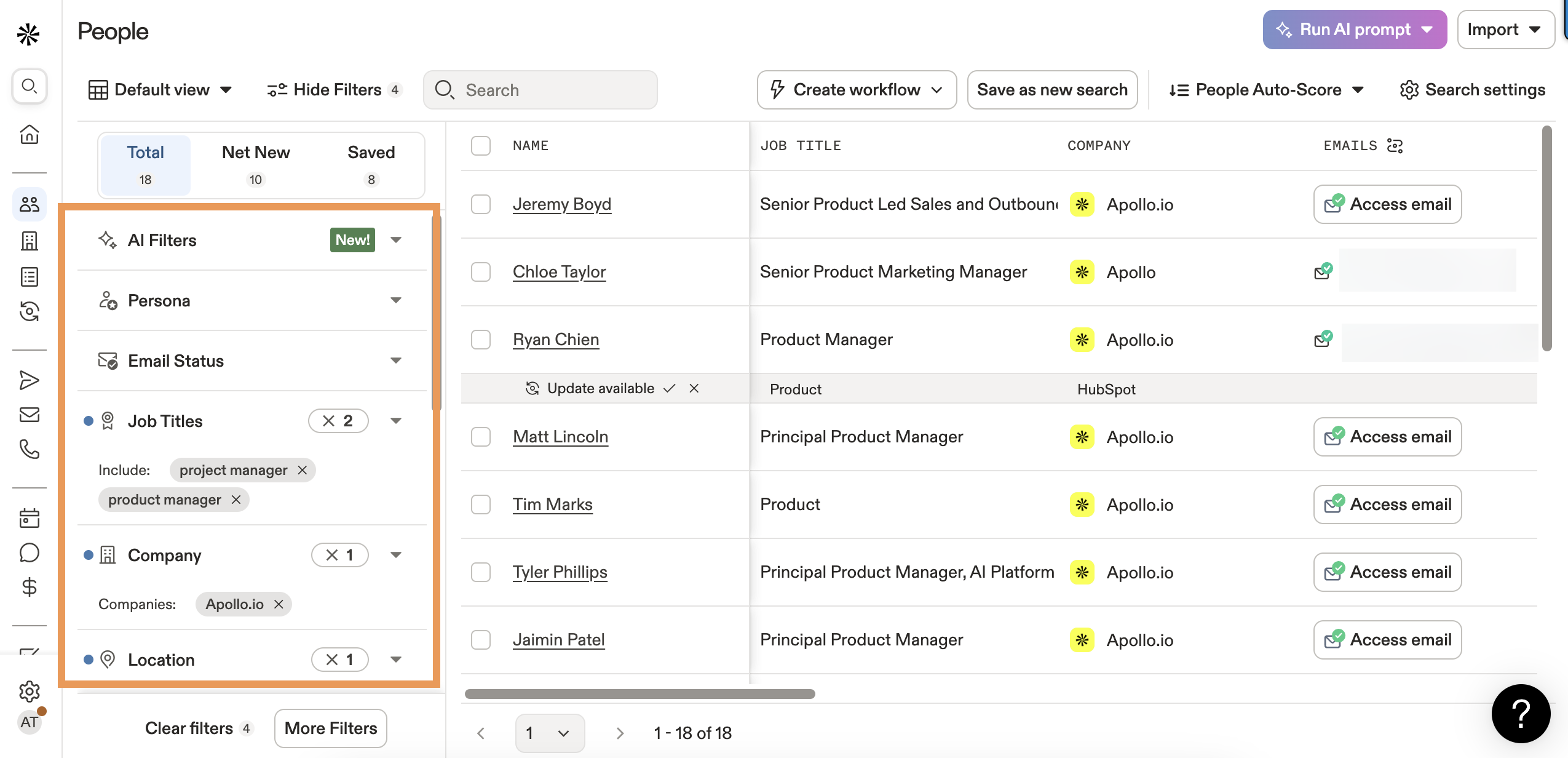
Apollo is the obvious starting point for most SMB teams, and for good reason. It packs a 210M+ contact database, email sequencing, and a built-in dialer into one platform. The free tier is genuinely generous, and paid plans run $49 (Basic), $79 (Professional), and $119 (Organization) per user per month on annual billing.
Apollo appears in 1,130 G2 reports - more than almost any other sales tool. It's feature-rich. But the trade-off is data quality: at around 79% email accuracy, a meaningful chunk of your list will bounce, and that compounds fast once you scale outbound volume. For teams sending under 200 emails a week, Apollo alone works fine. Past that threshold, pair it with a dedicated verification layer (or follow a CRM verify workflow).
Mixmax
Use this if: your team lives in Gmail and you want sequences, templates, and scheduling without leaving your inbox.
Skip this if: deliverability is your top concern or you need a mobile workflow.
Pricing runs Free, SMB at $34, Growth at $65, and Growth + CRM at $89 per user per month, with a Meeting Copilot add-on at $39. The Gmail integration is smooth - templates, send-later, and round-robin scheduling all work well inside the inbox.
The most consistent complaints on Reddit and G2 are deliverability issues tied to tracking pixels, slow support response times, and no dedicated mobile app. Great for Gmail-centric teams that don't need a database. Watch your deliverability closely. (If you're comparing inbox-native options, see Mixmax vs Streak.)
Streak
Streak lives entirely inside Gmail. No separate app to learn, no new tab to keep open. Your pipeline, deal tracking, mail merge, and email tracking all happen in the same interface where you're already writing emails.
Pricing is straightforward: Pro at $49/user/month on annual billing, Pro+ at $69, Enterprise at $129. The free tier includes email tracking, link tracking, snippets, and 50 mail merges per day - enough for a solo founder testing outbound.

Each tier includes AI credits at 10, 50, and 500 per user per month. The trade-off is ecosystem lock-in: Streak only works with Gmail. If anyone on your team uses Outlook, or if you're planning to migrate, it's a non-starter. For Gmail-only teams who want CRM functionality without another login, nothing else comes close.
Outreach
Here's the thing about Outreach: it's genuinely powerful. Multi-channel orchestration across email, calls, and tasks. Deep analytics. Enterprise-grade workflow automation. The Engage, Call, and Meet tiers are designed for serious sales orgs. (If you're building cadences, these Outreach email templates help.)
But if a vendor won't publish pricing in 2026, they're optimizing for their sales team, not yours. Industry estimates put Outreach at $100-$160/user/month with implementation fees of $1,000-$8,000. For a 5-rep team, budget $10,000-$15,000+ annually. Setup takes 20-40 hours, plus 5-10 hours per month of ongoing admin. Deliverability management alone - warmup monitoring, reputation checks, throttling adjustments - is a real operational burden on top of those admin hours.
That's overkill for 80% of sales teams. If you're running a 50-person SDR org with complex multi-touch cadences and need granular analytics by sequence step, Outreach earns its price. A 5-person team? You're paying enterprise tax for features you'll never configure.
SalesLoft
Outreach's main competitor, with similar power and similar cost. Starting around $115/user/month, a 5-rep team should budget $6,000-$8,000+ annually minimum on an annual contract. The admin overhead mirrors Outreach - expect the same 20-40 hour setup and monthly optimization cycles.
Let's be honest: if you're evaluating Outreach, get a Salesloft quote too. The feature sets are converging, and the pricing negotiation leverage alone is worth the extra demo.
Close
Close combines CRM and cold email outreach in one platform, and the Solo plan starts at just $9/month on annual billing. For founders and solo reps who don't want to stitch together a CRM, a sequencer, and a data tool, Close is the fastest path to sending.
The built-in power dialer and SMS are nice bonuses. The trade-off: it doesn't scale gracefully past 10-15 reps, and the database is limited compared to dedicated prospecting tools. If you're a team of one to five, it's hard to beat the simplicity. (If you're weighing CRMs, compare Close vs Salesforce.)
Instantly.ai
Built for high-volume cold email with inbox rotation and automated warm-up. Starting at $30/month, Instantly is the go-to for agencies and teams sending thousands of emails per week across multiple domains. Its strength is sending infrastructure - managing dozens of inboxes, rotating sends, and keeping deliverability high across all of them.
Pair it with a dedicated data provider for verified contacts. Instantly handles the pipes, not the data. (For scaling safely, follow cold email volume best practices.)
Smartlead
Smartlead occupies similar territory to Instantly but differentiates on integrations. At $32.50/month on annual billing, you get inbox rotation, warm-up, and deliverability optimization. Where Smartlead pulls ahead is its native integration ecosystem - it connects directly with verification tools and CRMs, so clean data flows into campaigns without manual CSV exports. The consensus on r/coldemail is that Smartlead edges Instantly for tighter integrations, while Instantly wins on raw multi-domain scale.
Yesware
Lightweight email tracking starting at $19/user/month. Opens, clicks, engagement timelines. Best for sales reps who need visibility into prospect engagement without committing to a full sequencing platform. Not a replacement for the tools above - more of a supplement for teams that already have a CRM and just want tracking layered on top.

Every email management tool on this list performs better when fed clean data. Prospeo delivers 98% email accuracy with a 7-day refresh cycle - so your sequences reach real inboxes, not dead addresses. At ~$0.01 per email, fixing your data costs less than one bounced campaign.
Stop burning domains. Start with verified data.
Annual Cost by Team Size
The right stack depends on how many reps you're running. Here's what you'll actually pay annually.
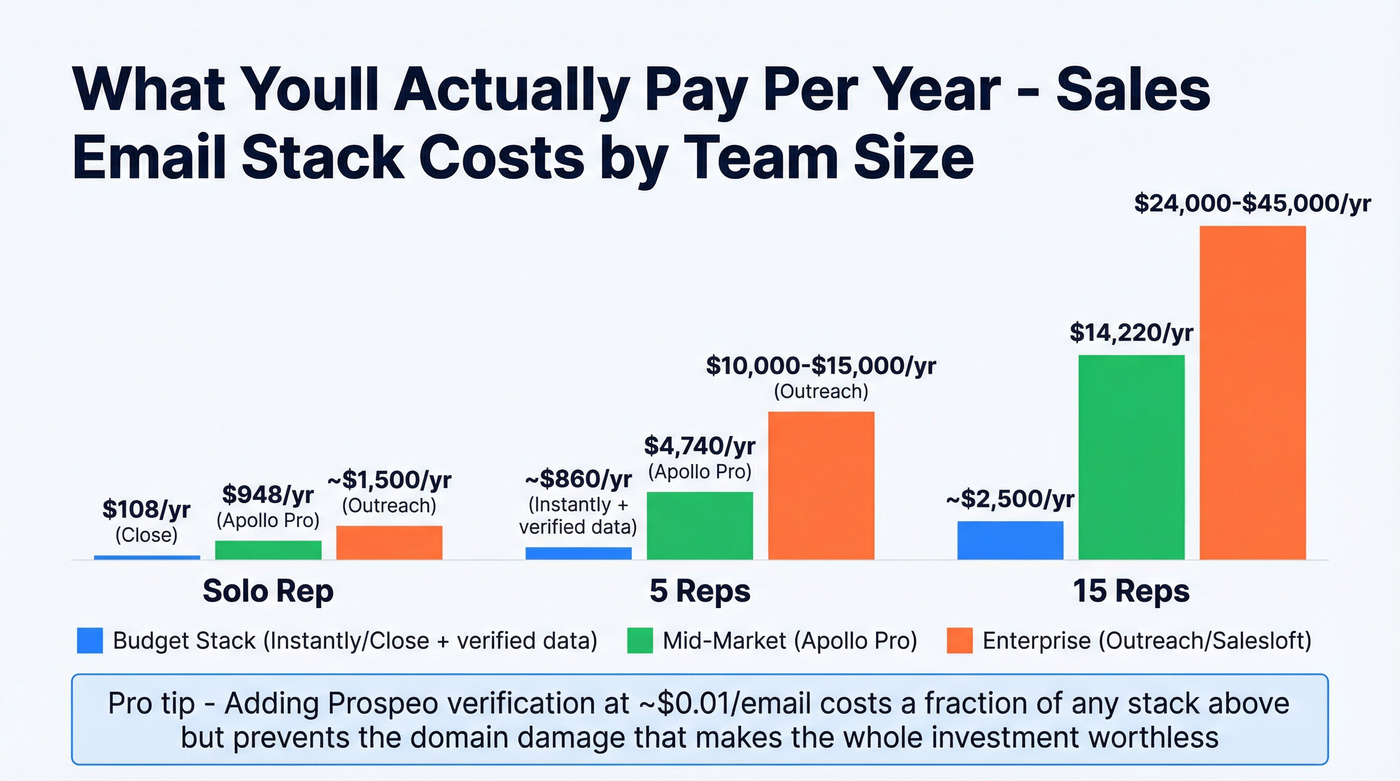
| Team Size | Budget Stack | Mid-Market Stack | Enterprise Stack |
|---|---|---|---|
| Solo | Close $108/yr + free data tier | Apollo Pro $948/yr | Outreach ~$1,500/yr |
| 5 reps | Instantly $360/yr + verified data ~$500/yr | Apollo Pro $4,740/yr | Outreach $10,000-$15,000/yr |
| 15 reps | Instantly $360/yr + verified data ~$1,500/yr | Apollo Pro $14,220/yr | Outreach $18,000-$28,800/yr |
If your average deal size is under five figures, you almost certainly don't need Outreach or Salesloft. We've seen teams close six figures in pipeline running Close or Instantly with verified data underneath. You don't need enterprise money to run enterprise-quality outbound.
Why Data Quality Breaks Most Stacks
Every email management tool for sales assumes you're feeding it clean data. Most teams aren't.
Bounce rates above 5% damage sender reputation. Once your domain gets flagged, even perfectly written emails land in spam. The recovery process takes weeks of careful warm-up, and during that time, your pipeline dries up. This is the hidden cost nobody budgets for. (If you want the deeper mechanics, read B2B contact data decay.)
Snyk's 50-person AE team saw bounce rates fall from 35-40% to under 5% after switching their data layer, generating 200+ new opportunities per month. Before you spend $50-$150/user/month on a sequencer, verify your data. A burned domain costs more than any tool subscription.
Meritt cut their bounce rate from 35% to under 4% and tripled pipeline to $300K/week - same team, same sequencer, better data. Prospeo integrates natively with Instantly, Smartlead, Lemlist, and every major sales email tool on this list.
Plug 98% accurate data into your existing email stack today.
Deliverability Basics
Even with clean data, poor sending practices will tank your results.
Authenticate your domain. SPF, DKIM, and DMARC records are table stakes. If you haven't set these up, stop reading and do it now.
Warm up new inboxes gradually. Don't send 500 emails from a fresh domain on day one. Tools like Instantly and Smartlead automate warm-up, but you still need to monitor reputation scores during the first two to four weeks.
Space your follow-ups. Aim for 7-10 days between touches. Don't exceed 3-4 attempts per prospect.
Clean your list before every campaign. Not after bounces - before sends. This single habit prevents more deliverability damage than any other.
Go multichannel. Coordinated email and phone sequences drive 3.5x higher response rates versus email-only. Your outbound tool should be one channel, not the only channel.
FAQ
What separates sales email tools from marketing platforms?
Sales email tools manage one-to-one outbound workflows - sequencing, tracking, CRM sync, and reply management for SDRs booking meetings. Marketing platforms like Mailchimp handle one-to-many campaigns: newsletters, drip sequences, and subscriber management. If you're prospecting, you need sales-focused software.
Do I need a separate data provider alongside my sequencer?
Yes, if accuracy matters at your volume. Built-in databases like Apollo's hover around 79% email accuracy - workable for small campaigns, risky at scale. For teams sending 500+ emails per week, pairing your sequencer with a dedicated verification provider prevents the domain damage that compounds fast with bad data.
How do I keep sales emails out of spam?
Authenticate your domain with SPF, DKIM, and DMARC. Warm up new inboxes gradually over 2-4 weeks. Verify every email address before sending to keep bounce rates under 5%. Space follow-ups 7-10 days apart and cap sequences at 3-4 touches.
What's the best free option for outbound sales email?
Apollo.io offers the most generous free tier - database access plus basic sequencing at no cost. Streak's free plan covers email tracking and 50 daily mail merges inside Gmail. For data verification, Prospeo's free tier provides 75 verified emails per month, enough to audit whether your current contacts are reaching real inboxes.
Should small teams use all-in-one platforms or specialized tools?
Teams under 10 reps typically do best with an all-in-one like Apollo or Close - fewer tools to manage, lower total cost, faster onboarding. Larger orgs get better results pairing a dedicated sequencer with a specialized data provider, because each layer can be optimized independently. Start simple and add tools only when you hit a clear bottleneck.