The Sales Coaching Template Your Reps Will Actually Thank You For
90% of sales leaders believe they coach their reps at least monthly. Only 38% of reps agree. That gap isn't a communication problem - it's a template problem. Most "coaching" sessions devolve into pipeline reviews where the manager asks "so what's happening with the Acme deal?" for 30 minutes straight.
With 27% of reps hitting quota and average spans of control hitting 12+ direct reports, managers have less time per rep than ever - and they're spending it wrong. A solid sales coaching template fixes that.
Below you'll find the full template broken into three phases (pre-session, during, post-session), a 10-question bank, two plug-in frameworks, KPIs that prove it's working, and a quota-miss escalation plan. Everything's right here on the page.
Three Phases of an Effective Coaching Session
The biggest mistake managers make is winging it. A rep walks in, the manager opens Salesforce, and suddenly it's a deal inspection meeting. Teams using a consistent coaching framework see a 27.9% improvement in win rates. Structure isn't bureaucracy - it's what separates coaching from pipeline review.
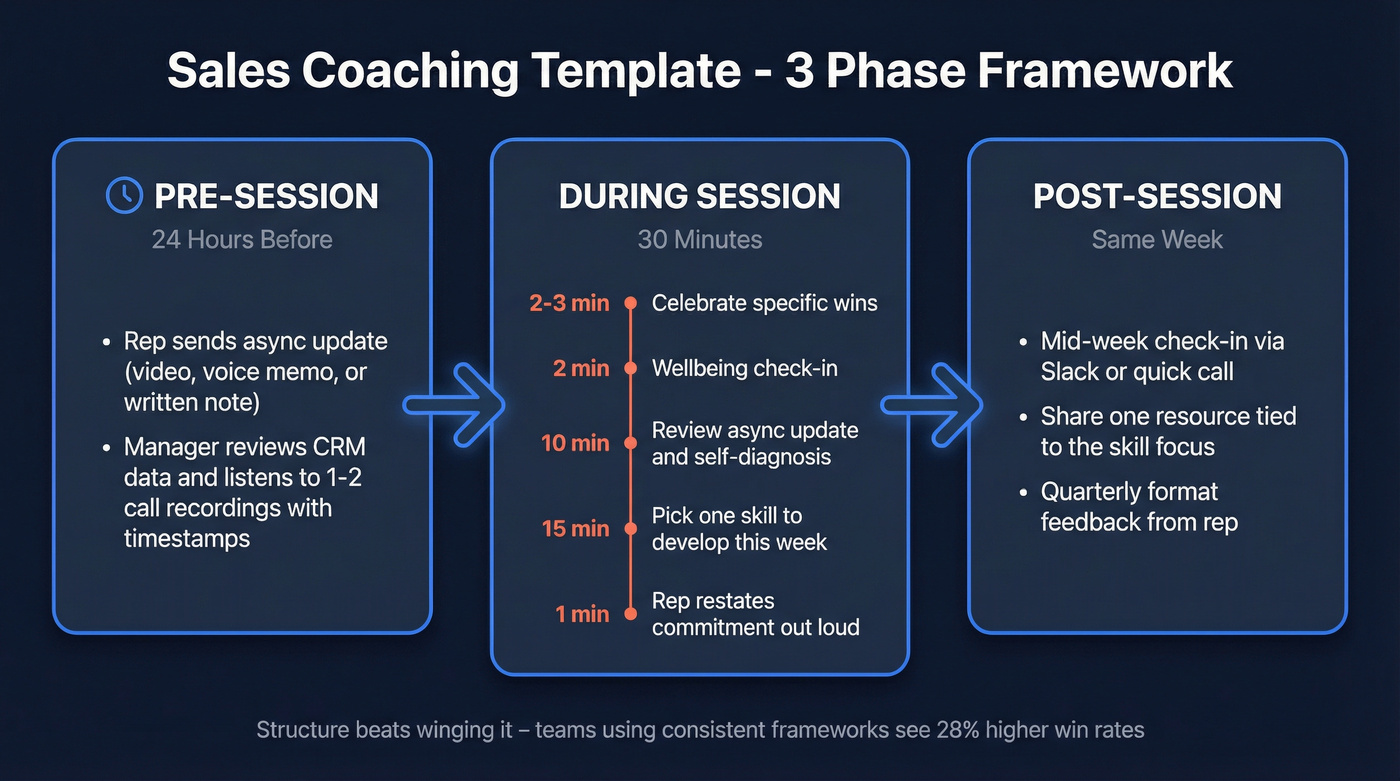
Pre-Session (24 Hours Before)
Rep sends an async update - video, voice memo, or written note covering wins, misses, and new tactics tried. This eliminates the "so what have you been up to?" trap that eats roughly 30 minutes of a typical session.
Manager reviews CRM data for pipeline movement and stage conversion patterns, then listens to 1-2 call recordings - one strong, one that needs work - with specific timestamps ready. We've found that walking into a session with a timestamped moment to discuss changes the entire dynamic. You're no longer guessing; you're coaching off evidence.
During the Session (30 Minutes)
Start with wins (2-3 minutes). Name specific behaviors, not just outcomes. "You handled that pricing objection on the Acme call at 14:22 really well" hits different than "nice job this week."
Then do a quick wellbeing check-in (2 minutes). Keep it simple: energy level, stress level, anything blocking focus.
Spend 10 minutes reviewing the async update. Dig into the "why" behind misses and let the rep self-diagnose before you offer your take. The remaining 15 minutes are the core: pick one skill to develop this week and assign a specific action. Something like "Run your next three discoveries using SPIN and record them - we'll review together." Close by having the rep restate their commitment out loud, because saying it creates accountability in a way that nodding along doesn't.
Post-Session Follow-Up
Send a mid-week check-in - a quick Slack message or 5-minute call asking how the assigned practice went. This signals you care about the development plan, not just the meeting. Share one resource tied to what you discussed, and gather quick feedback quarterly on whether the format's working.
Question Bank for Every Session
Bill Bartlett's coaching bank from Sandler is the best resource we've found for this. Pick 3-5 per session covering one or two areas.
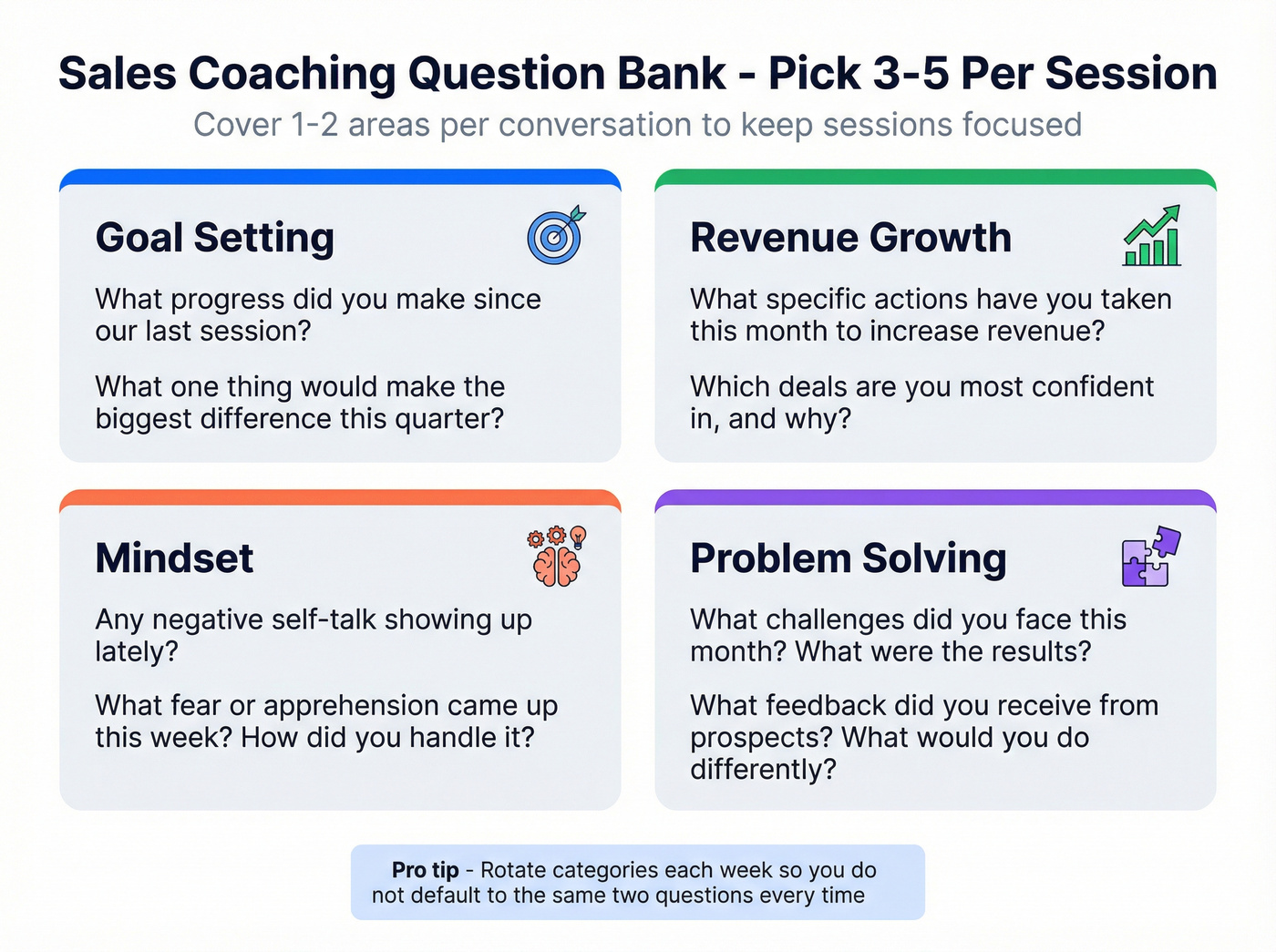
Goal Setting
- "What progress did you make since our last session?"
- "What's the one thing that would make the biggest difference this quarter?"
Revenue Growth
- "What specific actions have you taken this month to increase revenue?"
- "Which deals are you most confident in, and why?"
Mindset
- "Any negative self-talk showing up lately?"
- "What fear or apprehension came up this week? How did you handle it?"
Problem Solving
- "What challenges did you face this month? What were the results?"
- "What feedback did you receive from prospects? What would you do differently?"
The mindset questions feel awkward at first. Ask them anyway. Treating this list as a sales coaching checklist - running through it before each session to select the right questions - keeps conversations focused and prevents you from defaulting to the same two prompts every week.
Pick a Framework
| Framework | Structure | Best For |
|---|---|---|
| GROW | Goal - Reality - Options - Way Forward | Most teams (intuitive) |
| OSKAR | Outcome - Scale - Keep - Address - Request | Strength-based coaching |
| Situational Leadership | Directing - Coaching - Supporting - Delegating | Mixed-tenure teams |
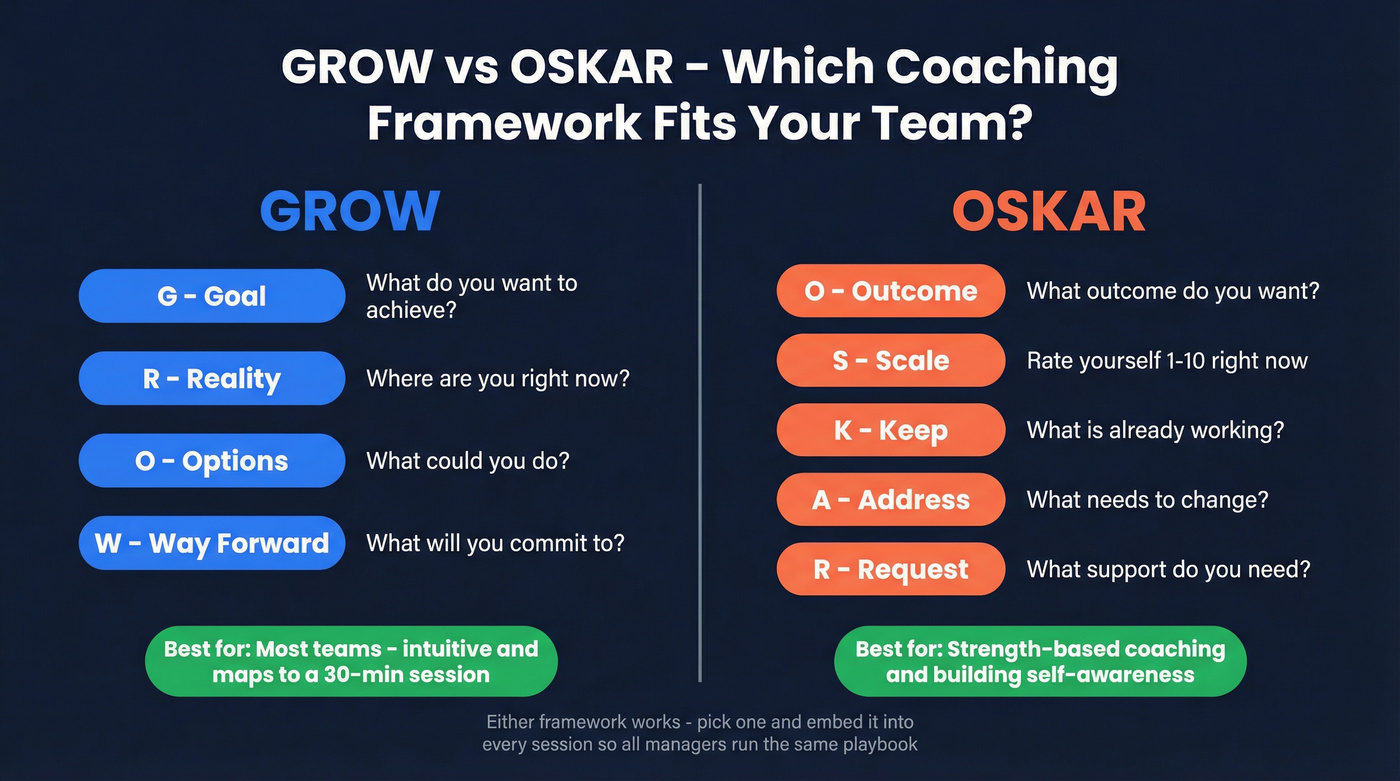
[GROW](https://en.wikipedia.org/wiki/GROW_model) is a strong default for most managers. It maps cleanly to a 30-minute session and reps grasp it immediately. In our experience, it's the one framework that doesn't require a training session just to explain the framework itself.
OSKAR works well when you want strength-based coaching and self-assessment. The "Scale" step - rate yourself 1-10 - is a simple way to build self-awareness fast. CLEAR and FASTER are also popular, but for most teams, GROW or OSKAR is plenty. Whichever you choose, embed it directly into your coaching templates so every manager on the team runs the same playbook.

Your coaching template is only as good as the data underneath it. When reps work stale lists with 30%+ bounce rates, every KPI you track - attainment, pipeline coverage, time to productivity - is distorted. Prospeo's 98% email accuracy and 7-day data refresh cycle eliminate the noise so your coaching sessions diagnose real skill gaps, not data problems.
Clean data turns coaching from guesswork into a growth engine.
KPIs That Make Coaching Stick
| KPI | Definition | Cadence |
|---|---|---|
| Attainment | Net revenue / quota | Daily refresh, weekly review |
| Time to Productivity | Weeks to reach ~80% attainment | Track per new hire |
| Pipeline Coverage | Pipeline value / remaining quota | Weekly |
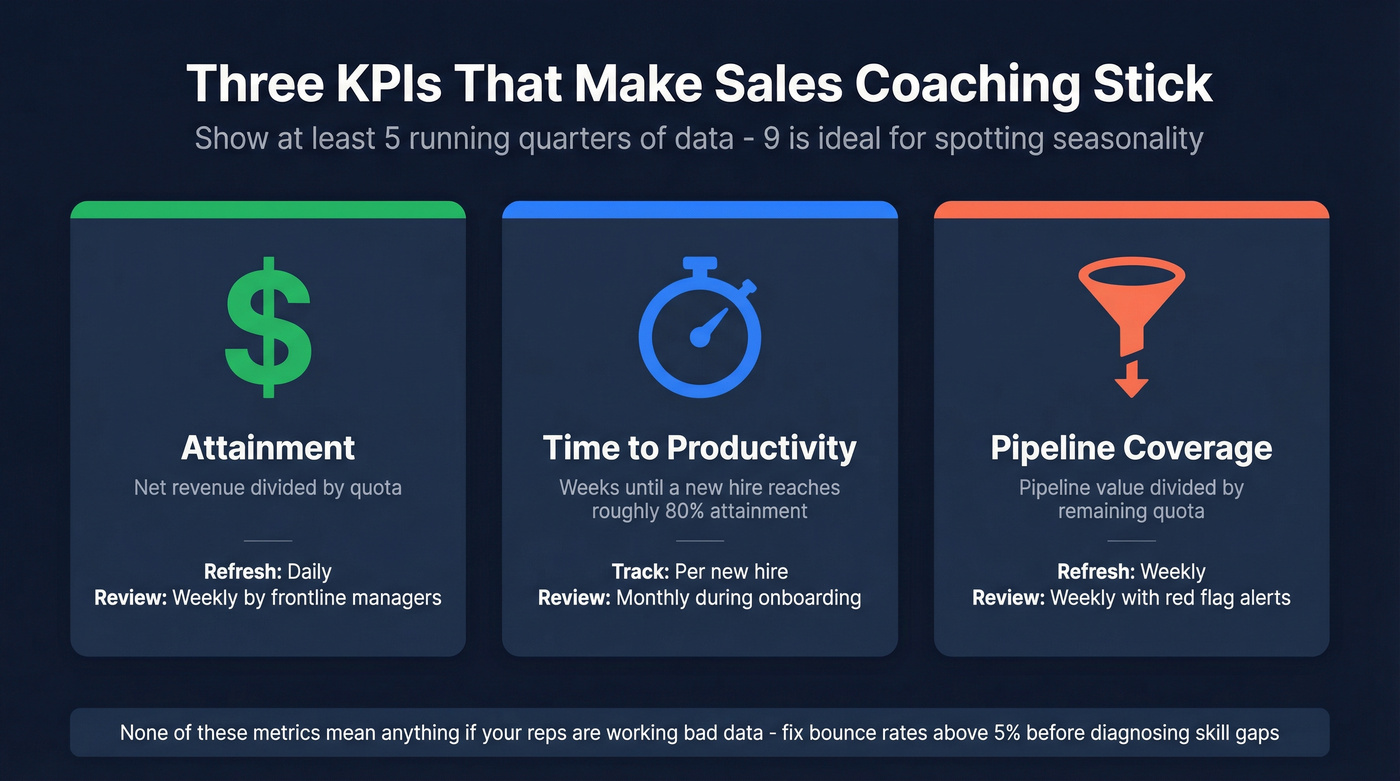
Show at least 5 running quarters of data - 9 is ideal for spotting seasonality. Reports should refresh daily, with frontline managers reviewing red flags weekly and leadership getting updates biweekly.
Here's the thing: none of these metrics mean anything if your reps are working bad data. If a rep's email bounce rate is above ~5%, the problem isn't their messaging - it's their list. We've seen teams waste entire coaching cycles diagnosing "messaging issues" when the real culprit was a 30%+ bounce rate from stale contact records. Tools like Prospeo, with 98% email accuracy and a 7-day data refresh cycle, eliminate that noise so coaching conversations focus on actual skill gaps instead of phantom problems.
If you want a tighter definition of what to track (and how to interpret it), align these with your broader sales operations KPIs and your team's B2B sales KPIs.

Quota-Miss Escalation Plan
Not every coaching conversation is about development. Sometimes a rep is missing quota and you need a structured response. This progression works.
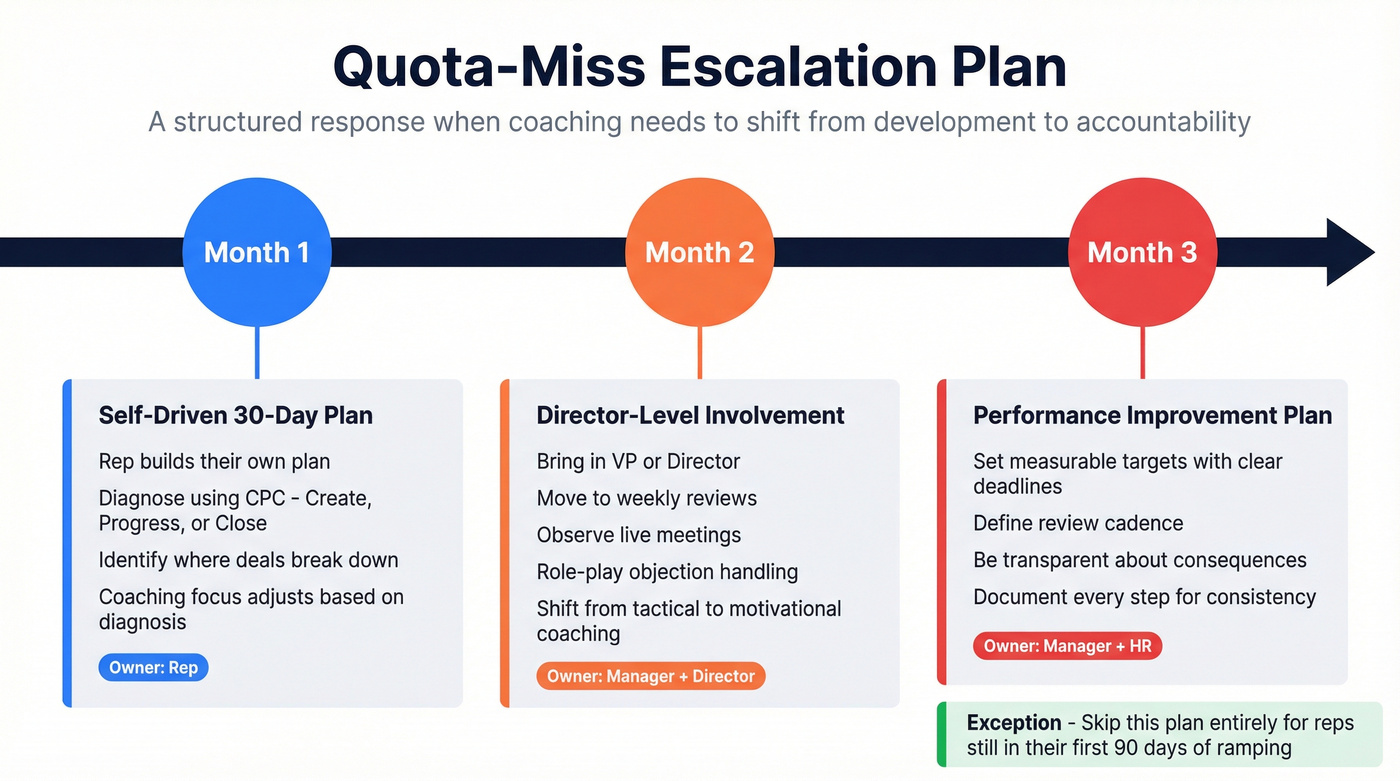
Month 1 miss: The rep builds a self-driven 30-day plan. Diagnose using CPC - Create, Progress, Close - to pinpoint where deals break down. Is the rep not generating enough pipeline? Stalling in mid-funnel? Losing at the finish line? Each diagnosis leads to a completely different coaching focus.
Month 2 miss: Bring in your director or VP. Move to weekly reviews, observe live meetings, and role-play objection handling. This is where self-doubt creeps in and coaching shifts from tactical to motivational.
Month 3 miss: A performance improvement plan becomes the last resort. Set measurable targets, define a review cadence, and be transparent about what happens if things don't improve. Document each step in your coaching plan so escalation criteria stay consistent across the org.
Skip the escalation plan entirely if the rep is new and still ramping. Applying quota-miss pressure to someone in their first 90 days is a fast way to lose good talent. If you need a clearer policy baseline, tie this to your quota management rules and a consistent sales accountability system.
Tools That Support Coaching
Let's be honest: you don't need coaching software to coach well. A spreadsheet, call recordings, and a consistent template beat an expensive platform used inconsistently. A question bank and CRM data are enough for 80% of teams.
But if you want to layer in call intelligence or structured enablement, here's what's worth evaluating:
| Tool | Starting Price | Best For |
|---|---|---|
| Gong | ~$12,300/yr | Conversation intelligence |
| Saleshood | $45/user/mo | Enablement programs |
| Mindtickle | ~$5,900/yr | AI-powered readiness |
| Forecastio | $149/mo | Pipeline analytics |
If your average deal size is under $10K, you probably don't need any of these. Async practice tools do drive 55% faster ramp times for new reps, but a well-run 30-minute session using the template above will outperform any platform used inconsistently. If you're comparing options, start with a shortlist of sales enablement tools, sales readiness tools, or dedicated sales coaching apps.
You just built a coaching framework that diagnoses where deals break down - Create, Progress, or Close. But if your reps can't reach the right buyers, the diagnosis is wrong before it starts. Prospeo gives your team 300M+ verified contacts with 30+ filters so pipeline problems stay pipeline problems, not data problems.
Give your reps contacts that connect - starting at $0.01 per email.
FAQ
What's the difference between sales coaching and sales training?
Training teaches skills to a group in a structured curriculum. Coaching develops an individual rep through ongoing 1:1 conversations tied to their specific deals, behaviors, and call recordings. Most high-performing teams run both in parallel.
How often should coaching sessions happen?
Weekly or biweekly 30-minute sessions work best. Reps who rate coaching as "excellent" are 50% more likely to hit quota. Consistency matters more than length - a focused 30 minutes beats an unfocused hour every time.
How do I coach reps who are working bad data?
Fix the data first. If emails bounce above 5% and phone numbers are dead, coaching on "activity volume" misdiagnoses the problem entirely. Verified-data platforms with frequent refresh cycles eliminate this noise so coaching focuses on actual skill gaps rather than list quality.
Do I need separate templates for different rep levels?
The core structure - pre-session prep, a focused 30-minute conversation, and post-session follow-up - works across experience levels. What changes is the emphasis: newer reps need more skill development and a tighter checklist, while senior reps benefit from strategic deal reviews and self-directed goal setting.