

6sense vs Clay: Which One Do You Actually Need?
Your VP of Marketing is raving about intent signals. Your SDRs are bouncing 30% of their emails. Both teams think a new tool will fix everything - but here's the thing: 6sense vs Clay is a fundamentally misleading comparison. They solve different problems, and picking the wrong one wastes months and budget.
30-Second Verdict
6sense is the play for enterprise ABM teams with $50K+ budgets who need account-level intent signals to prioritize where marketing and sales focus.
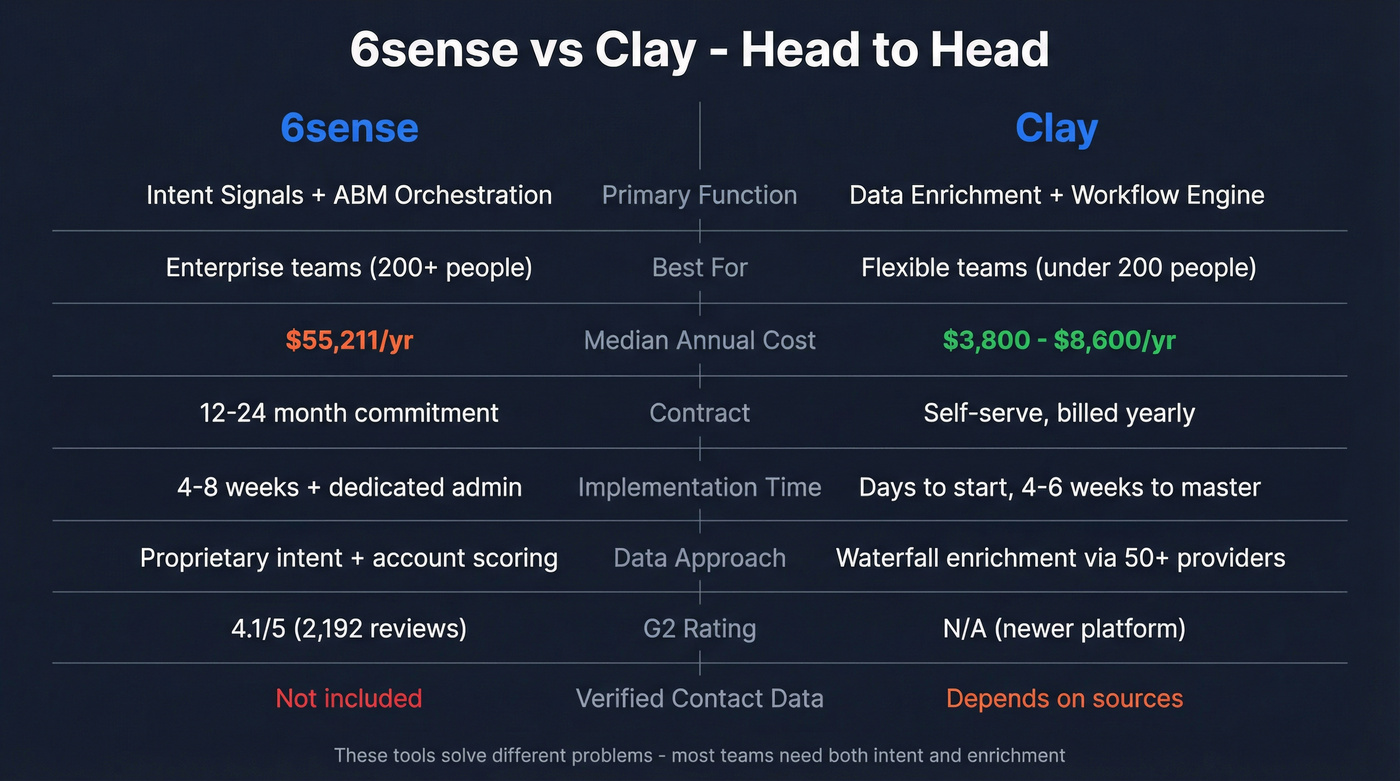
Clay is the play for flexible enrichment workflows - smaller teams who want pay-as-you-go pricing and API-first control over their data stack.
Skip both if you just need verified emails and direct dials to start booking meetings. Prospeo gives you 98% accurate contact data at ~$0.01/email, no contract, no six-figure commitment.
What Each Tool Actually Does
6sense is an intent and ABM orchestration platform. It deanonymizes web traffic, scores accounts by buying stage, and feeds those signals into marketing and sales workflows - predictive scoring, audience building, ad activation, all tied to account-level buying behavior. It's built for large revenue teams running coordinated plays across Salesforce and Marketo.
Clay is something else entirely. It's a data enrichment and workflow engine that connects to dozens of third-party data providers through waterfall enrichment, letting you build custom prospecting workflows without writing code. It's API-first, modular, and designed for teams that want to assemble their own stack rather than buy a monolith.
These two tools aren't direct competitors. They're solving adjacent problems. And that distinction matters more than most comparison articles admit.
Pricing Breakdown
| 6sense | Clay | |
|---|---|---|
| Free tier | $0 (50 data credits/mo) | $0 (1,200 credits/yr) |
| Entry paid | ~$30K-$50K/yr | $134/mo ($1,608/yr) |
| Mid-tier | ~$50K-$80K/yr | $314/mo ($3,768/yr) |
| Full platform | $100K-$200K+/yr | $720/mo ($8,640/yr) |
| Contract | 12-24 months | Billed yearly, self-serve |
| Implementation | $5K-$50K extra | Self-serve |
| Median annual cost | ~$55,211 | ~$3,800-$8,600 |
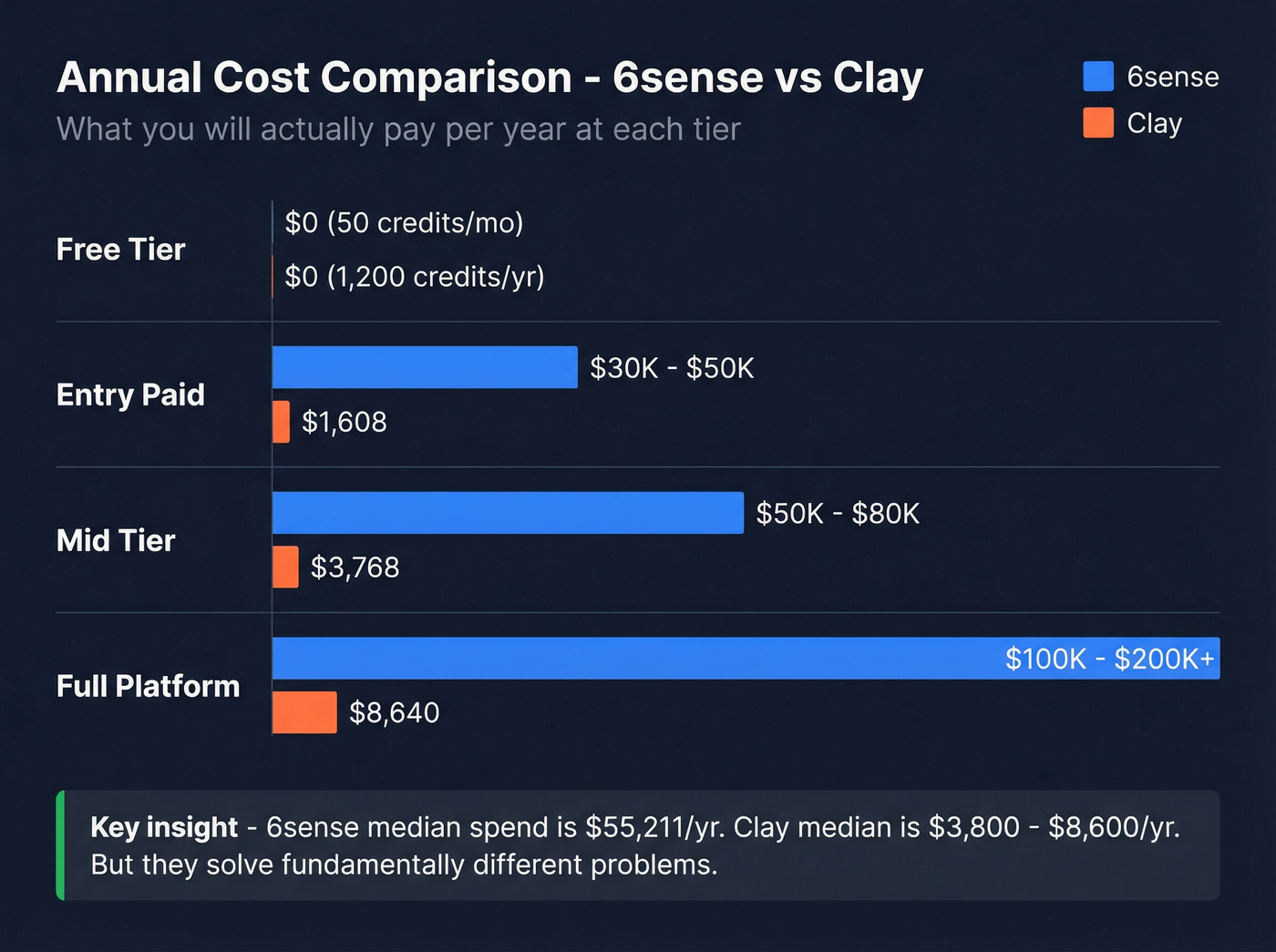
The Vendr median for 6sense lands around $55,211/year, and credits don't roll over - you're paying whether you use them or not.
Clay's pricing looks straightforward until you factor in credit variability. A basic email enrichment costs 2-3 credits, but a comprehensive profile build can burn 15-25 credits per prospect depending on which providers you chain together. A "Find Mobile Number" action costs 2 credits at baseline but jumps to 15 or 25 with premium providers like ContactOut or Datagma. That Explorer plan's 120K credits/year can disappear faster than you'd expect.
Clay's free tier of 1,200 credits per year translates to roughly 400-600 basic lookups. Enough to evaluate, not enough to run a pipeline.
Let's be honest: if your average contract value is under $20K, you almost certainly don't need 6sense. The ROI math doesn't work until you're closing deals large enough to justify $55K+ in tooling before a single rep touches the phone.

6sense charges $55K+ for account signals but won't hand you verified contacts. Clay orchestrates enrichment but can't guarantee deliverability. Prospeo gives you both - 143M+ verified emails at 98% accuracy, intent data across 15,000 Bombora topics, and a 7-day refresh cycle - starting at ~$0.01/email with no contract.
Get the contact data both tools are missing - free to start.
Data Quality Compared
6sense holds a 4.1/5 on G2 across 2,192 reviews - strong for enterprise ABM platforms. Its value is in identifying which accounts are in-market before they raise their hand. Asana reported 6QA opportunities averaging 2.5x larger and deals closing roughly 25% faster. Flexera saw +82% pipeline from high-intent accounts. Those are account-level signals, not person-level contact data - an important distinction that trips up a lot of buyers.
Clay's waterfall approach can hit 80%+ match rates for email discovery when properly configured, significantly better than the 40-50% you'd get from a single-source tool. Phone numbers are weaker, landing around 40-60% for direct dials. But Clay doesn't generate data. It orchestrates third-party providers, so output quality depends entirely on the sources you plug in.
The practitioner take across Reddit GTM communities is blunt: "6sense's intent is pretty solid but restricted to account level only. Clay does not have much of intent, enrichment is okay on it." That tracks with what we've seen. We've also watched teams burn through Clay's Explorer credits in under two months when running multi-provider waterfalls without monitoring spend.
Implementation and Time to Value
6sense demands a primary administrator and 4-8 weeks minimum. You'll install the WebTag across your properties, integrate your CRM and MAP, map and standardize fields, configure keywords and persona maps, then train your team through 6sense Academy. Skip 6sense if you don't have a RevOps person who can own this full-time during onboarding.
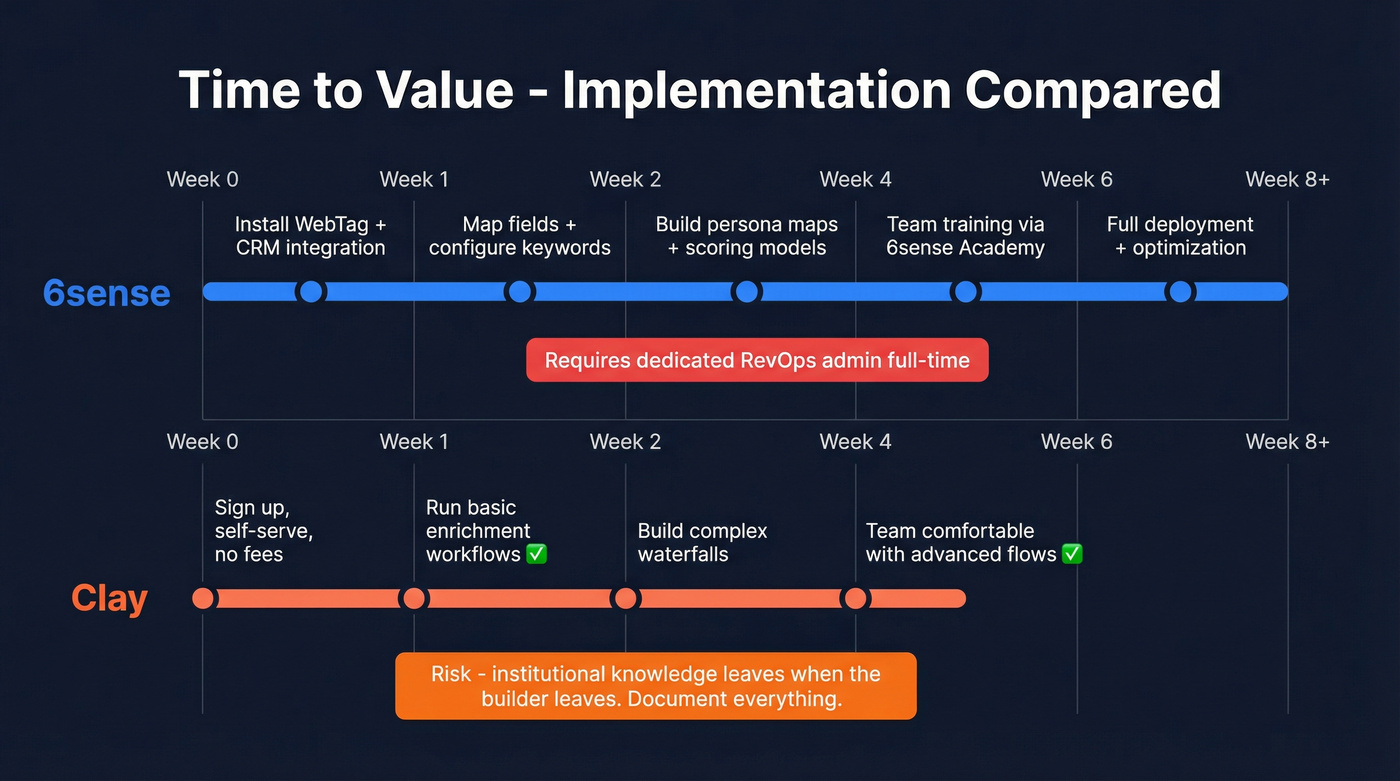
Clay is self-serve with no required implementation fees, so you can run basic enrichment workflows within days. But expect 4-6 weeks before your team feels comfortable building complex waterfalls. The real operational risk is less obvious: when the person who built your Clay workflows leaves, institutional knowledge walks out the door. Document everything from day one.
When to Choose Which
Choose 6sense if you're running enterprise ABM with 10+ person buying committees, your budget supports $55K+/year plus implementation, your stack centers on Salesforce and Marketo, and account-level intent signals at scale are the priority. 6sense's own research shows median enterprise deals running $300K-$400K - that's the deal size where their platform pays for itself.
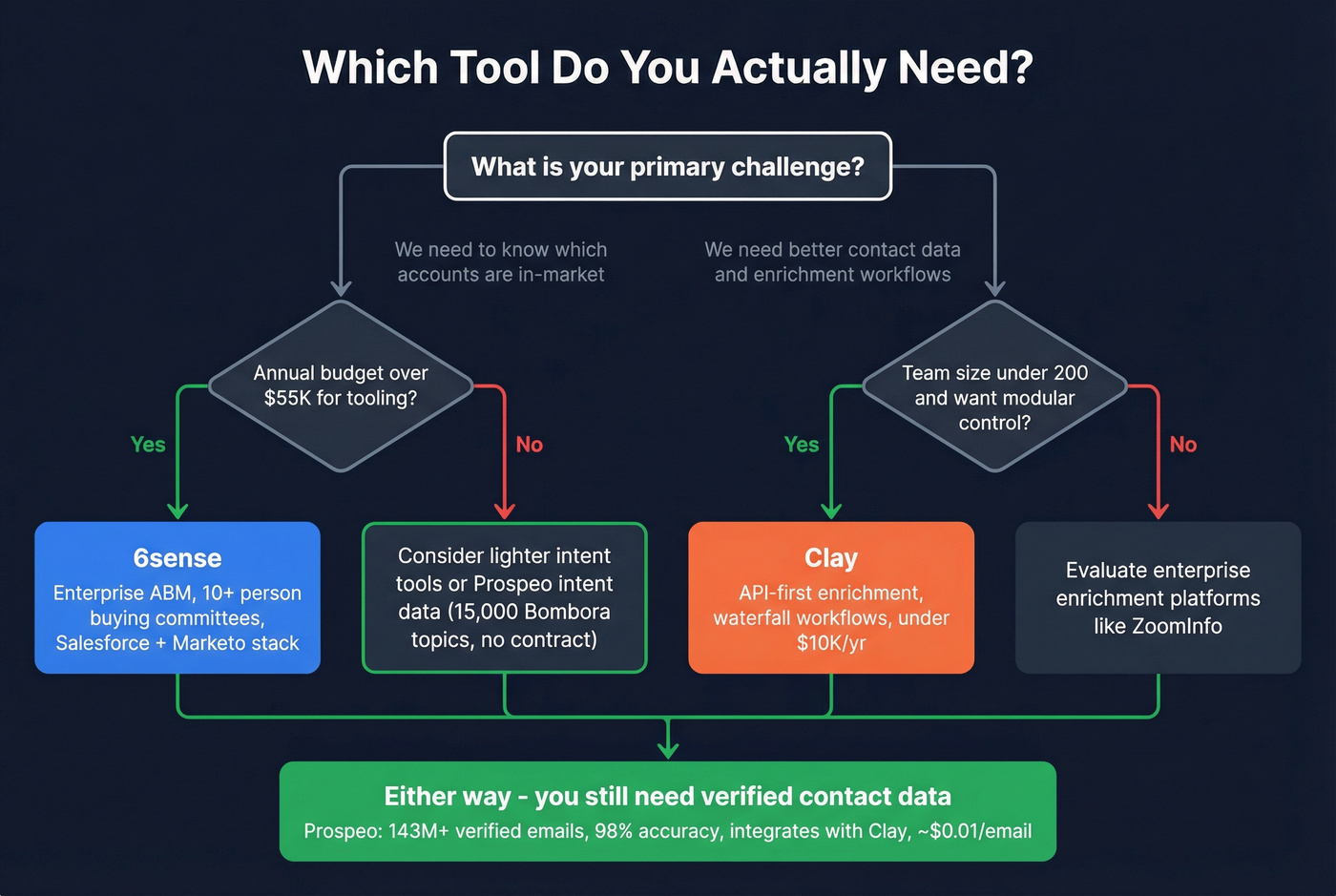
Choose Clay if flexible enrichment workflows matter more than intent, your team is under 200 people, your data tooling budget is under $10K/year, and you want API-first, build-your-own-stack flexibility. For teams that care about cost control and modularity over all-in-one orchestration, Clay is hard to beat.
What Neither Tool Solves
Here's the gap nobody talks about enough.
6sense tells you which accounts are in-market but doesn't hand you verified contact data for the people at those accounts. Clay orchestrates enrichment from third-party sources but can't guarantee what comes out is deliverable. You're not emailing someone who changed jobs six weeks ago - unless your data layer catches it.
In our experience, the missing piece for most teams isn't intent or enrichment orchestration. It's accurate, fresh contact data. Prospeo fills that gap with 143M+ verified emails at 98% accuracy and a 7-day data refresh cycle. It integrates natively with Clay as a verification source inside your waterfalls, and its intent data tracking across 15,000 Bombora topics gives you in-market signals without the six-figure commitment.

Clay users: Prospeo integrates natively into your waterfall as a verification layer. Every email that passes through hits 98% accuracy with 5-step verification, catch-all handling, and spam-trap removal. Stop burning credits on contacts that bounce.
Add Prospeo to your Clay workflow and kill your bounce rate today.
FAQ
Can I use 6sense and Clay together?
Yes - teams often pair them: 6sense identifies in-market accounts, Clay enriches the contacts. Budget both together and you're looking at $60K-$100K+/year minimum. Make sure the combined ROI justifies that before committing.
Does 6sense have a free plan?
6sense offers a free Sales Intelligence tier with 50 data credits per month, company and people search, alerts, and a Chrome extension. Paid plans require custom quotes and 12-24 month contracts.
Is comparing 6sense vs Clay the wrong question entirely?
For most teams, yes. They solve different problems. If you need intent signals for enterprise ABM, evaluate 6sense. If you need enrichment workflows, evaluate Clay. If you need verified contact data to actually reach people, start with a dedicated data platform - that's the foundation both tools depend on.