

Sales Accountability: The Operational Playbook Most Teams Are Missing
It's Thursday afternoon. You pull the pipeline report. Three reps - all hired in Q4, all through onboarding, all present for the "sales accountability matters" talk in January - show zero new opportunities created this week. Same story last week.
The talk didn't work because talks never do. Systems do.
What Accountability in Sales Actually Means
There's a critical distinction most managers miss: ownership versus compliance. Compliance means reps perform when watched. Ownership means reps track their own progress, identify gaps, and take initiative without a manager hovering over Slack.
91% of employees say holding others accountable is a top leadership development need, yet fewer than 1 in 5 managers do it consistently. That gap isn't a people problem. It's an infrastructure problem, and true team ownership can only emerge when the right systems are in place.
Why Accountability Systems Break Down
38% of sales leaders cite insufficient activity as the primary reason reps miss targets. Another 24% blame reps not following the sales process. But here's the thing most managers miss: accountability problems are almost always systems problems, not people problems.
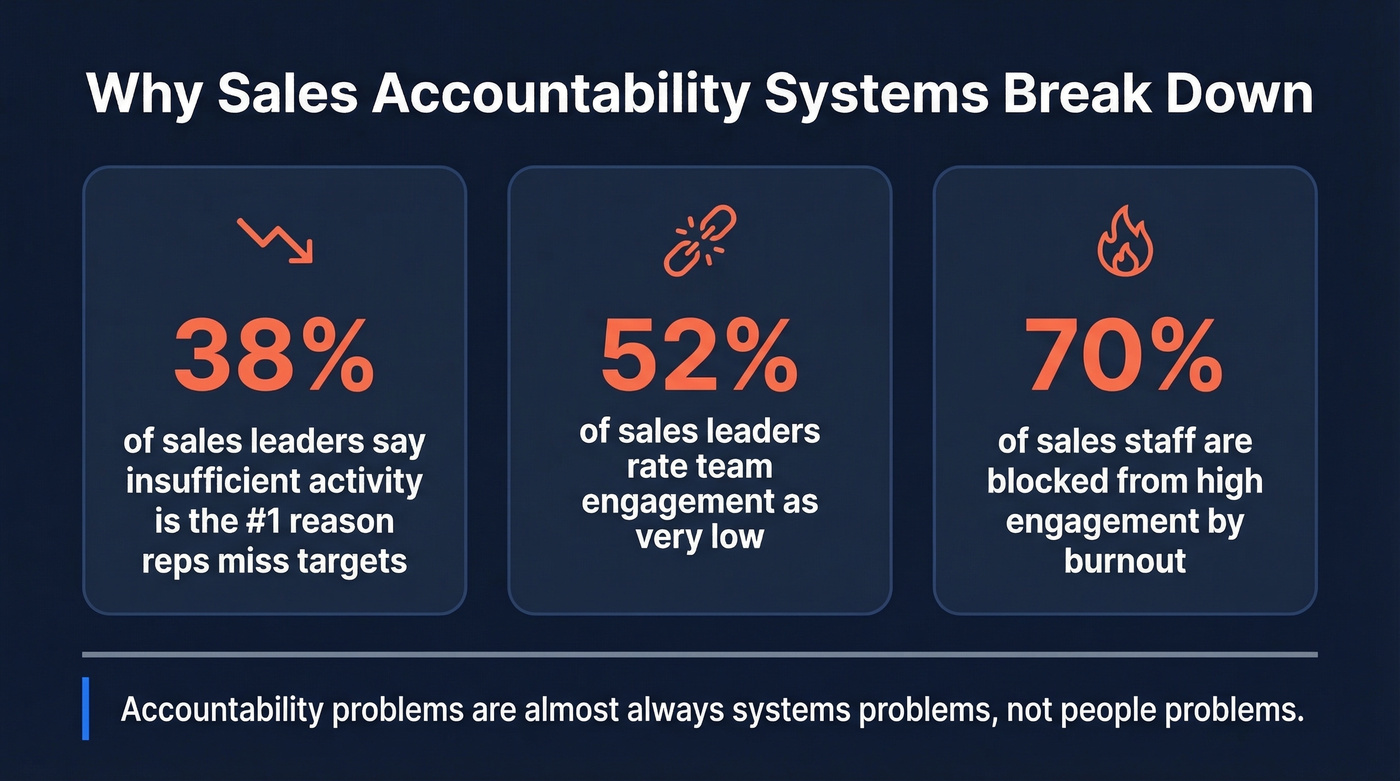
52% of sales leaders rate team engagement as "very low." 70% of sales staff are blocked from high engagement by burnout. Stack pressure on top of broken systems - bad data, unclear expectations, no coaching rhythm - and you don't get accountability. You get attrition.
The Five-Pillar Accountability Framework
1. Clear Expectations by Role
An SDR's job isn't the same as an AE's. SDRs own activity volume and meeting quality. AEs own pipeline progression and close rates. Managers own coaching cadence and forecast accuracy.
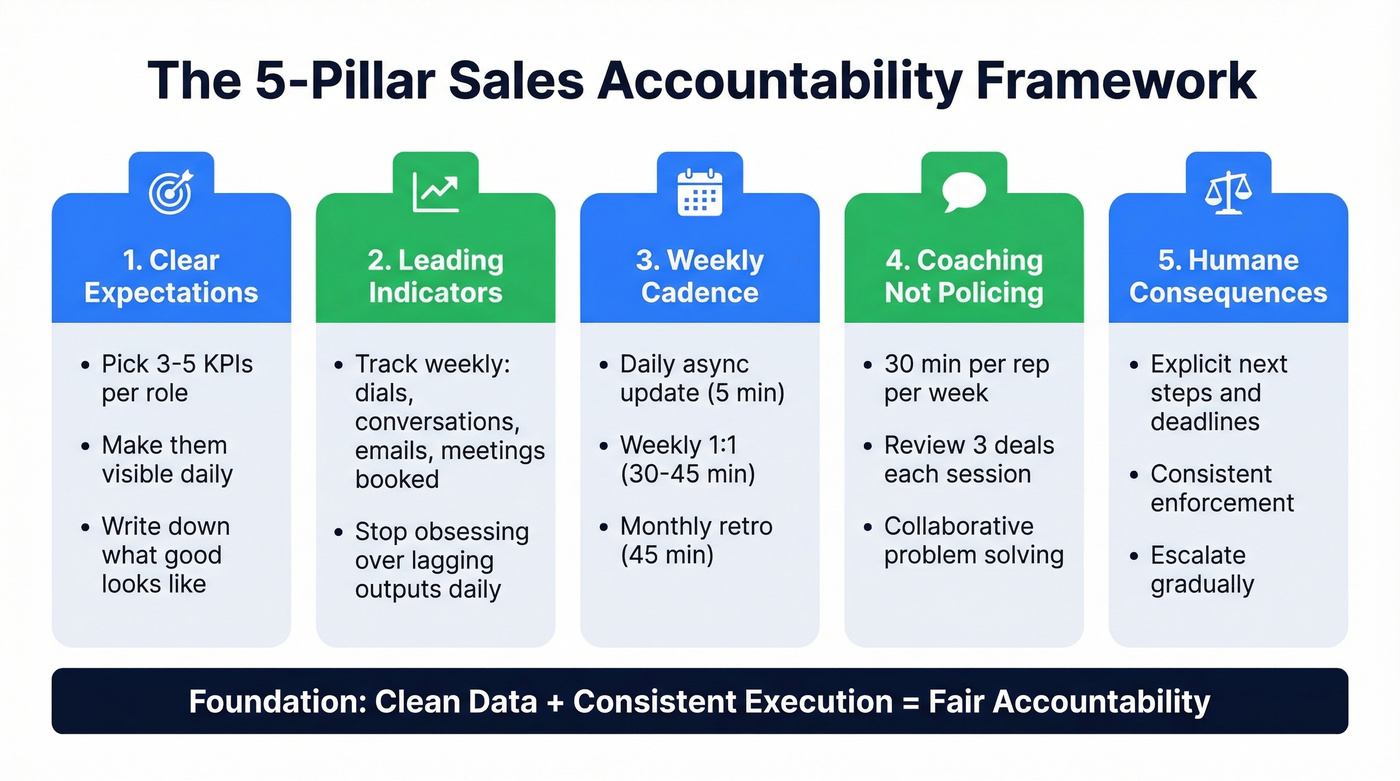
If you're tracking 15 KPIs per role, you're tracking zero. Pick 3-5 leading indicators per role and make them visible daily. Rep-level accountability starts with knowing exactly what "good" looks like for their specific seat - and that definition has to be written down, not assumed.
2. Leading Over Lagging Indicators
Track these weekly: dials, conversations, emails sent, meetings booked, new opportunities created. These are the inputs your reps control.
Stop obsessing over these daily: revenue, win rate, average deal size. These are lagging outputs that only move when leading indicators are healthy.
A solid SDR benchmark is around 50 dials per day. But volume alone tells you nothing. If a rep can't keep prospects past two minutes on a call, that's a coaching problem, not a discipline problem.
Only 18.7% of sales orgs achieve forecast accuracy of 75% or higher. When forecast accuracy is consistently weak, it's usually a leading-indicator tracking problem and a deal-quality problem, not a closing problem.
3. The Weekly Cadence
- Daily async update (five minutes max): Focus / Blocker / One Win
- Weekly 1:1 (30-45 min): 1 metric + 1 skill + 1 experiment + deal review
- Monthly retro (45 min): Stop / Start / Standardize, then update the playbook
The daily async keeps managers informed without interrupting flow. The weekly 1:1 is where real coaching happens - we've found it's the single highest-leverage meeting on any sales manager's calendar. The monthly retro prevents the system from going stale.
4. Coaching, Not Policing
Only 26% of reps receive weekly coaching, despite coaching driving 25% higher quota attainment and 30% more deals won. Block 30 minutes per rep per week. Review three deals: one at risk, one early stage, one near close. Ask these questions consistently:
- What's working right now in your pipeline?
- What specific actions have you taken on stalled deals?
- What support do you need from me this week?
These aren't performance interrogations. They're collaborative problem-solving sessions that keep ownership with the rep.
5. Consequences That Escalate Humanely
Accountability-focused leadership models end every conversation with explicit next steps, deadlines, and a shared definition of success. Inconsistent enforcement kills credibility faster than anything else. If one rep misses targets for three months with no conversation while another gets a PIP at month two, the entire team notices. And they remember.
On r/sales, reps consistently flag accountability tools that feel like surveillance - GPS tracking without privacy controls, activity monitoring with no context - as the fastest way to kill trust. Public leaderboards carry the same risk. They motivate top performers and crush everyone else. Use them only when territories and quotas are genuinely balanced.
Let's be honest: if your average deal size is under $10k and your cycle closes within a month, you probably don't need a complex accountability stack. A shared spreadsheet, a weekly 1:1, and clean data will outperform any enterprise platform. Complexity is not rigor.

Your accountability scorecard is only as honest as your data. When bounce rates sit above 5%, you're measuring data quality - not rep effort. Prospeo's 98% email accuracy and 7-day refresh cycle mean your leading indicators finally reflect what your team actually does.
Stop coaching reps for problems your data created.
The Weekly Accountability Scorecard
Pin this to your team's dashboard. In our experience, this is the single best tool for driving rep performance without micromanagement.
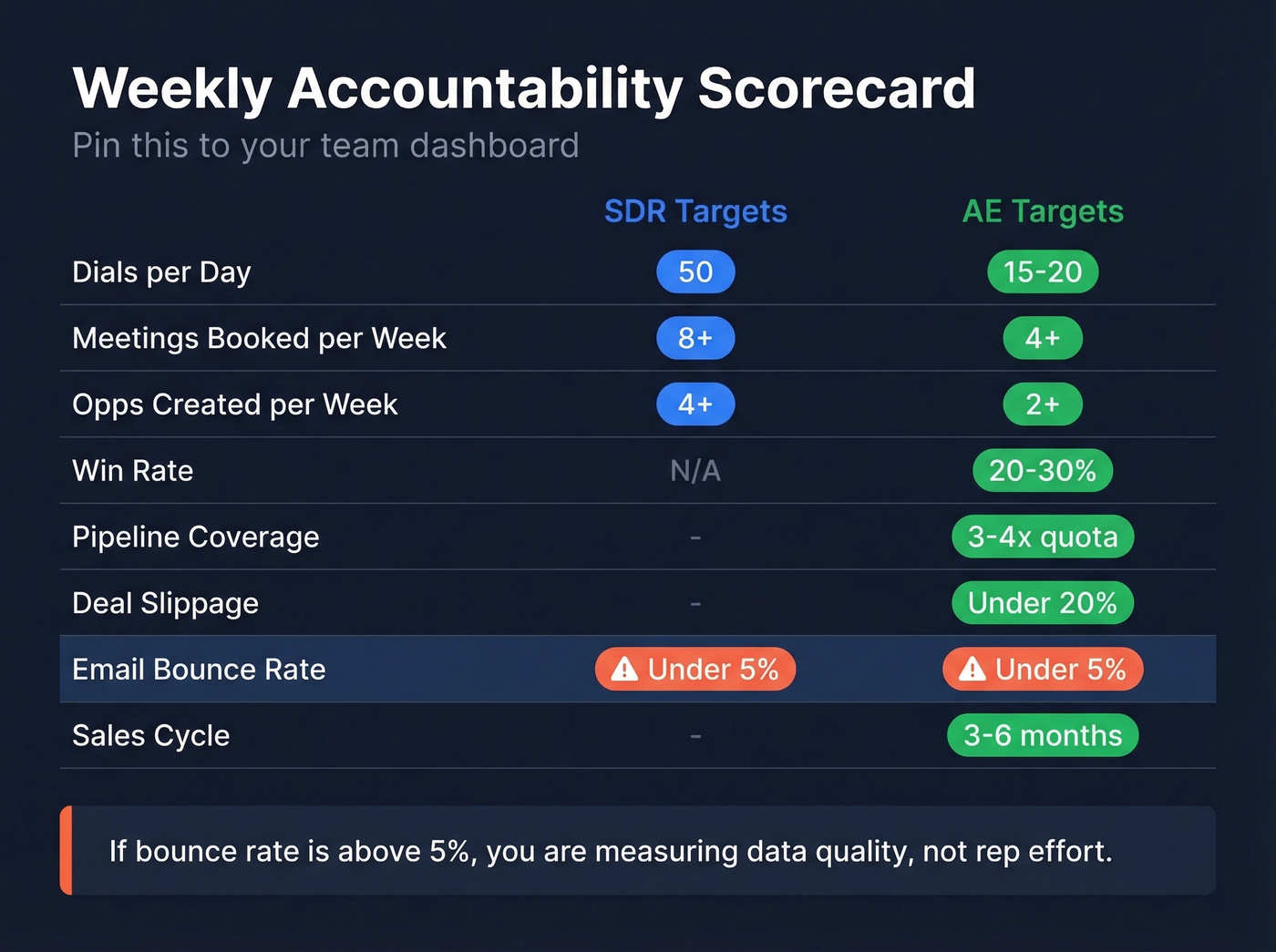
| Metric | SDR Target | AE Target |
|---|---|---|
| Dials/day | 50 | 15-20 |
| Meetings booked/wk | 8+ | 4+ |
| Opps created/wk | 4+ | 2+ |
| Win rate | N/A | 20-30% |
| Pipeline coverage | N/A | 3-4x quota |
| Deal slippage | N/A | <20% |
| Email bounce rate | <5% | <5% |
| Sales cycle | N/A | 3-6 mo (B2B) |
That email bounce rate row matters more than most managers realize. If bounce rate sits above 5%, data quality is usually the culprit. You can't hold someone accountable for activity metrics when a meaningful share of their emails never land.
The Data Quality Gap Nobody Talks About
We've seen this pattern across dozens of outbound teams: a top SDR makes 60 calls a day and books 8 meetings. A bottom SDR makes 60 calls and books zero. Before you coach the pitch, check the data. If one rep is working verified direct dials and the other is dialing switchboard numbers from a stale list, the accountability system is measuring noise, not effort.
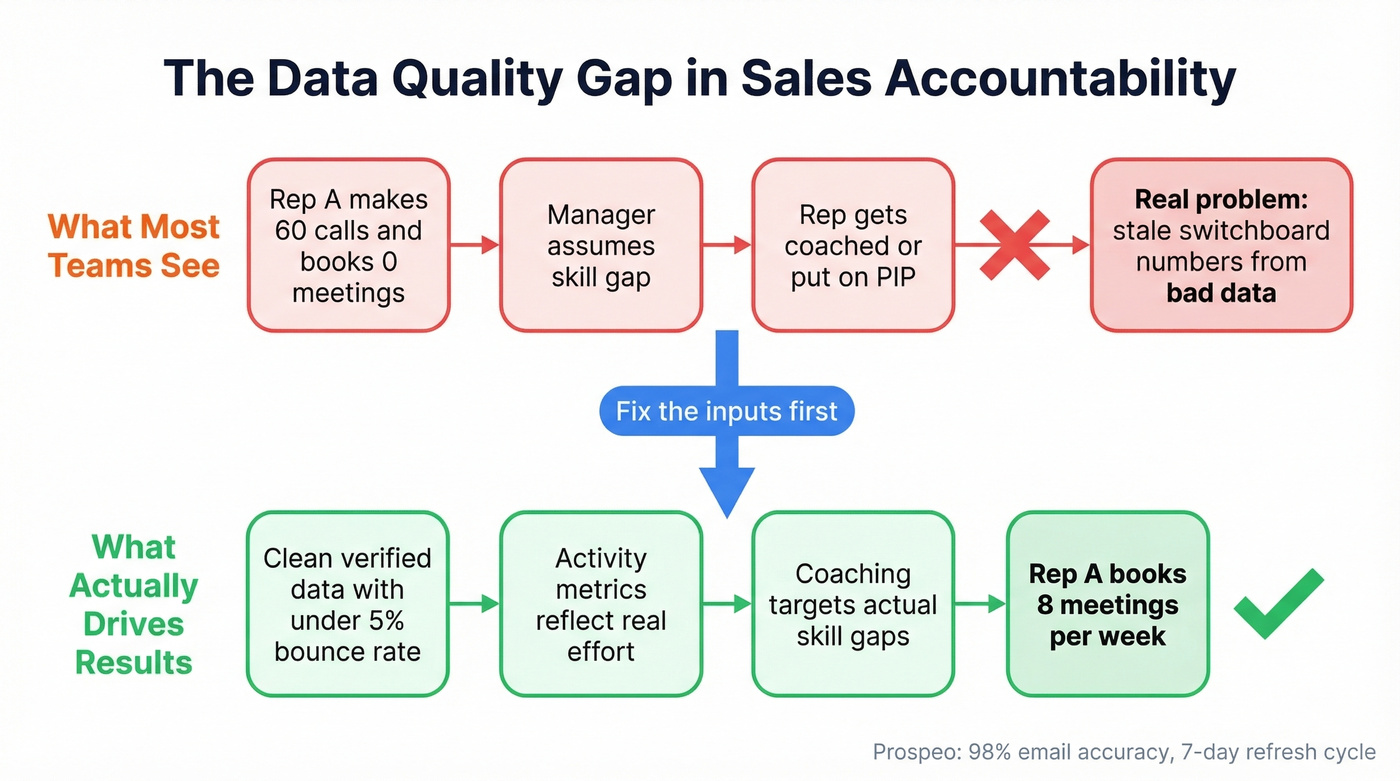
This is where most sales accountability frameworks have a blind spot. They assume the inputs - emails, phone numbers, contact data - are clean. They rarely are.
Prospeo closes this gap at the source. With 98% email accuracy and a 7-day data refresh cycle, your leading indicators actually tell the truth. Meritt saw their bounce rate drop from 35% to under 4% after switching, which meant their activity metrics finally reflected rep effort instead of data quality. When the inputs are clean, accountability becomes fair. And fair accountability is the only kind that sticks.

Skip This If...
Your team is under five reps and everyone's hitting quota. Don't build a framework for a problem you don't have. But the moment you start scaling - adding new hires, splitting territories, onboarding reps who didn't learn the motion from you directly - that's when the absence of a system becomes obvious fast.
I've watched teams go from five reps to twelve in a quarter and wonder why performance cratered. It wasn't the new hires. It was the lack of infrastructure to support them.
Making It Stick
The framework above isn't complicated. The hard part is consistency. Run the cadence for 90 days before you judge it. Adjust the scorecard targets quarterly based on actual data, not gut feel. And remember that the goal isn't catching people slacking - it's building an environment where good reps can prove they're good, and struggling reps get help before it's too late.
If you want a clean way to operationalize ramp expectations, pair this with a 30-60-90 day plan and keep the scorecard targets aligned to the ramp.
Meritt's SDRs tripled pipeline from $100K to $300K/week after their bounce rate dropped from 35% to under 4%. Fair accountability starts with verified contact data - 300M+ profiles, 125M+ direct dials, refreshed every 7 days. At $0.01 per email, clean inputs cost less than one missed meeting.
Make every dial and every email count toward real accountability.