

Sales Forecast vs Sales Goal: What's the Difference and Why It Matters
It's week three of the quarter. The VP asks for your forecast. Pipeline says $600K. The goal the board set? $1M. Now you're staring at a gap nobody wants to talk about - and half the room thinks "forecast" and "goal" mean the same thing.
They don't. And getting it wrong has real consequences for hiring plans, marketing budgets, and whether your CFO trusts a single number that comes out of the sales org.
The Quick Version
Sales goals are aspirational targets - where you want to go. Sales forecasts are data-driven predictions - where you're actually heading. If they're the same number, one of them is wrong.
The Core Difference
The goal is the destination. The forecast is the GPS telling you whether you'll arrive on time, late, or not at all.
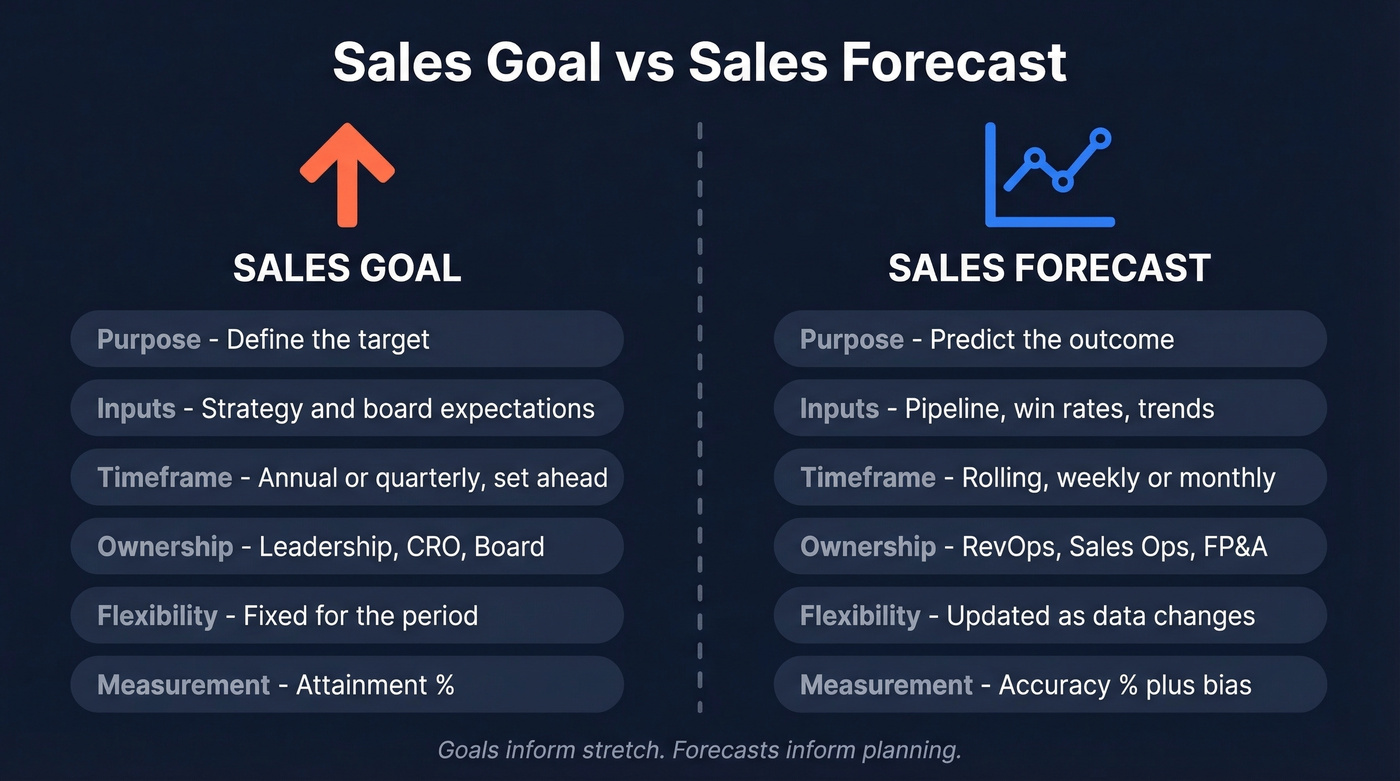
A sales goal comes from strategy, growth targets, and board expectations. It's aspirational by design. A sales forecast comes from pipeline data, historical win rates, and market signals - it's a prediction of actual outcomes based on current data and trends. One is set by ambition. The other is set by evidence.
The trouble starts when leadership treats them interchangeably. When a forecast miss gets the same reaction as a goal miss, reps learn to game the number. The forecast becomes political, not analytical.
| Dimension | Sales Goal | Sales Forecast |
|---|---|---|
| Purpose | Define the target | Predict the outcome |
| Inputs | Strategy, board expectations | Pipeline, win rates, trends |
| Timeframe | Annual or quarterly, set ahead | Rolling - weekly/monthly |
| Ownership | Leadership / CRO / Board | RevOps / Sales Ops / FP&A |
| Flexibility | Fixed for the period | Updated as data changes |
| Measurement | Attainment % | Accuracy % + bias |
Goals inform stretch. Forecasts inform planning. When leadership forces them to converge, you get sandbagging or happy ears - neither helps anyone make good decisions.
Quota, Target, Goal, Forecast - Clearing Up the Terms
Most orgs use these interchangeably. They shouldn't.
| Term | What It Means |
|---|---|
| Quota | Minimum to keep your job + earn base variable comp |
| Target | Number for ~95%+ of variable comp; accelerators above |
| Goal | Stretch aspiration above target |
| Forecast | Data-driven prediction of what will actually happen |
A healthy org should see 90%+ quota attainment. If only 60% of reps hit quota, the problem isn't the reps - quota-setting has become disconnected from pipeline reality. Many orgs set quarterly goals before the quarter starts, with monthly goals typically communicated two to four weeks ahead. When that timeline slips, forecasting breaks down before it even begins.

Your forecast-to-goal gap isn't just a methodology problem - it's a data problem. Deals built on stale emails and dead phone numbers inflate your pipeline without converting. Prospeo's 7-day data refresh and 98% email accuracy ensure every contact in your forecast is actually reachable.
Stop forecasting on phantom pipeline. Start with data that connects.
Why the Distinction Matters
Only 7% of sales orgs achieve 90%+ forecast accuracy. Meanwhile, 79% miss their forecast by more than 10%. That's not a rounding error - it's a planning crisis.
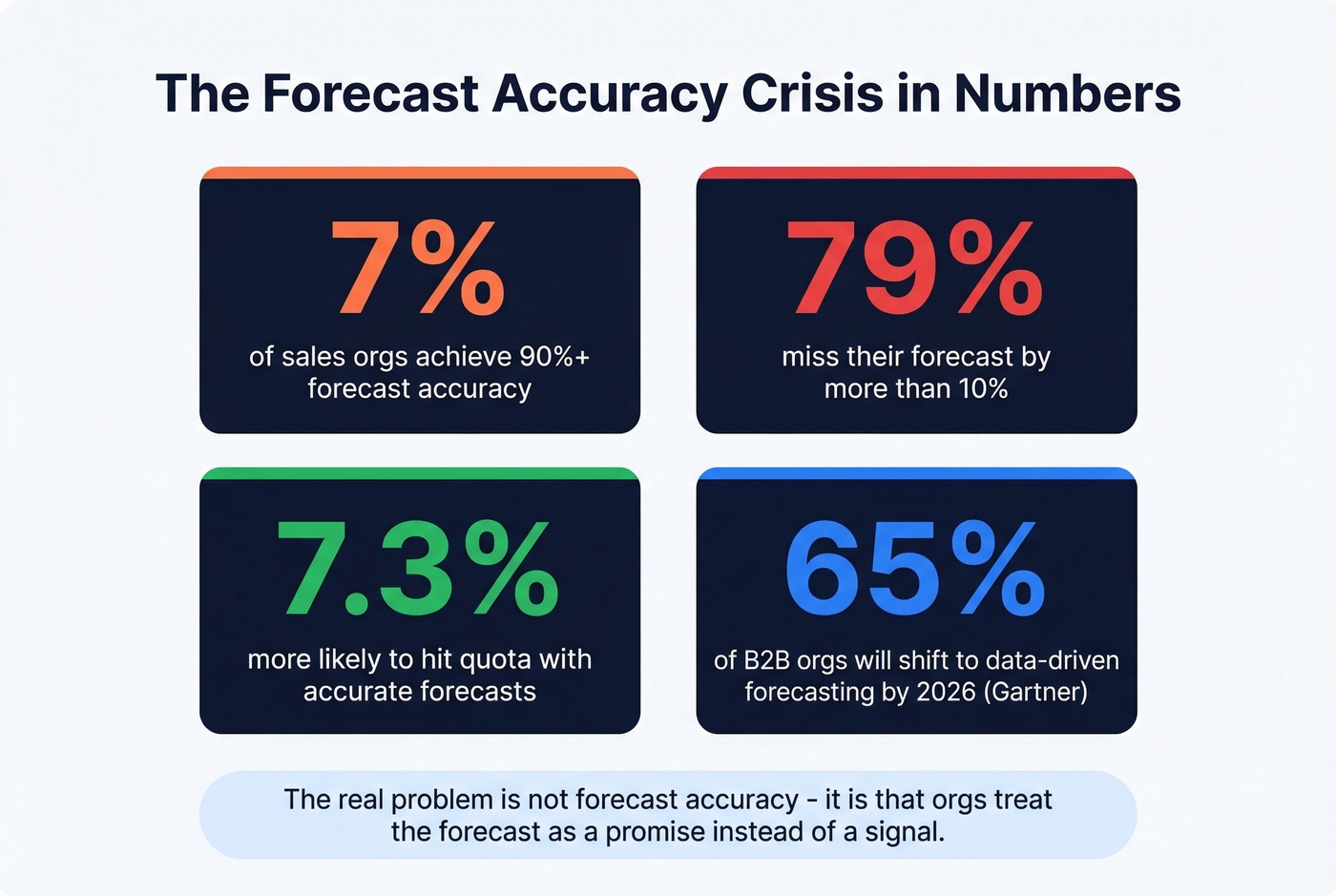
Companies with accurate forecasts are 7.3% more likely to hit quota and carry 15% less inventory on hand, according to the Sales Management Association and Aberdeen Group respectively. The upside of getting this right compounds across every function: finance plans better, marketing allocates better, hiring stays ahead instead of behind. Gartner projects that by 2026, 65% of B2B sales orgs will shift from intuition-based to data-driven forecasting. The ones that already have are pulling ahead.
The behavioral side is worse. When leadership treats the forecast as a commitment rather than a prediction, reps face pressure to close at any cost. Deal quality drops. Churn rises. On r/sales, a recurring frustration is committed deals getting bumped month after month - creating lumpy pipeline and late-night pressure from leadership. That's what happens when the forecast becomes a promise instead of a living prediction. The best reps start sandbagging to protect themselves, and now your forecast is biased low.
The real problem isn't forecast accuracy - it's that orgs treat the forecast as a promise instead of a signal.
When Forecast ≠ Goal: The Gap Playbook
Your forecast says $800K. Your goal is $1M. Now what?
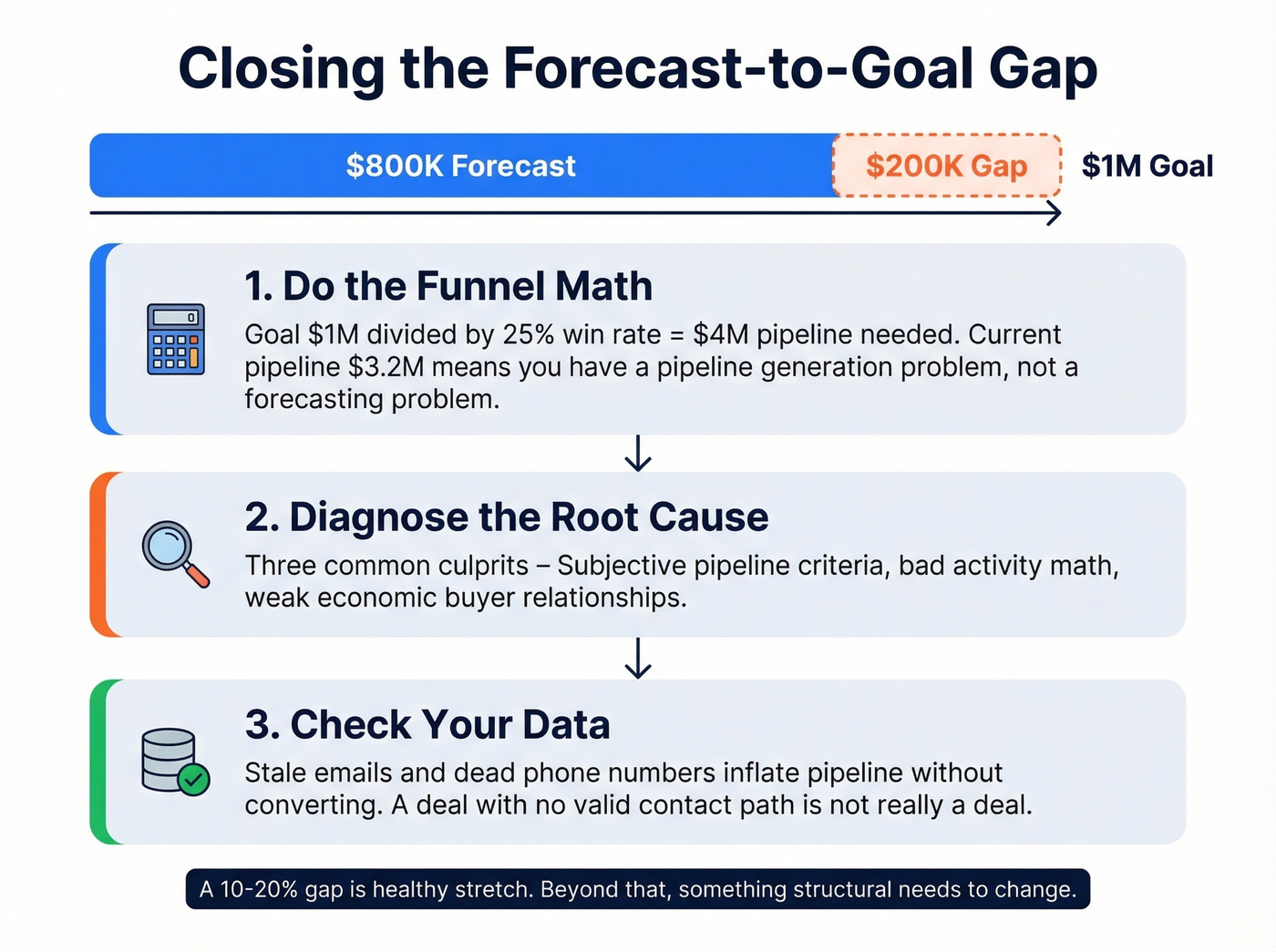
First, do the funnel math. If your goal is $1M and your average win rate is 25%, you need $4M in pipeline - that's the standard 3-4x pipeline coverage ratio. If your current pipeline is $3.2M, you don't have a forecasting problem. You have a pipeline generation problem. And here's the thing: if you improve win rate from 25% to 30%, your required pipeline drops from $4M to $3.3M - small improvements in conversion have outsized effects on the gap.
Second, diagnose the root cause. SBI Growth identifies three common culprits: subjective pipeline criteria where deals sit in stages they shouldn't be in, bad math where activity levels don't support the number, and weak relationships with no economic buyer engagement on key deals. In our experience, most forecast-to-goal gaps trace back to pipeline generation, not forecasting methodology.
Third, check your data. Your forecast is built on pipeline data, and if your contacts have bad emails or dead phone numbers, those deals are less likely to close but still inflate your forecast. We've seen teams using Prospeo's 7-day refresh cycle and 98% email accuracy catch stale records that were quietly dragging down forecast reliability - because a deal with no valid contact path isn't really a deal.
Many orgs set sales revenue goals 10-20% above the baseline forecast as a stretch convention. That gap is intentional and healthy. A gap beyond that range means something structural needs to change - more pipeline, better qualification, or an honest conversation about whether the goal was realistic in the first place.
If your manager hands you a goal on day one of the month with no pipeline data behind it, that's not goal-setting. It's wishful thinking.
How Accurate Should Your Forecast Be?
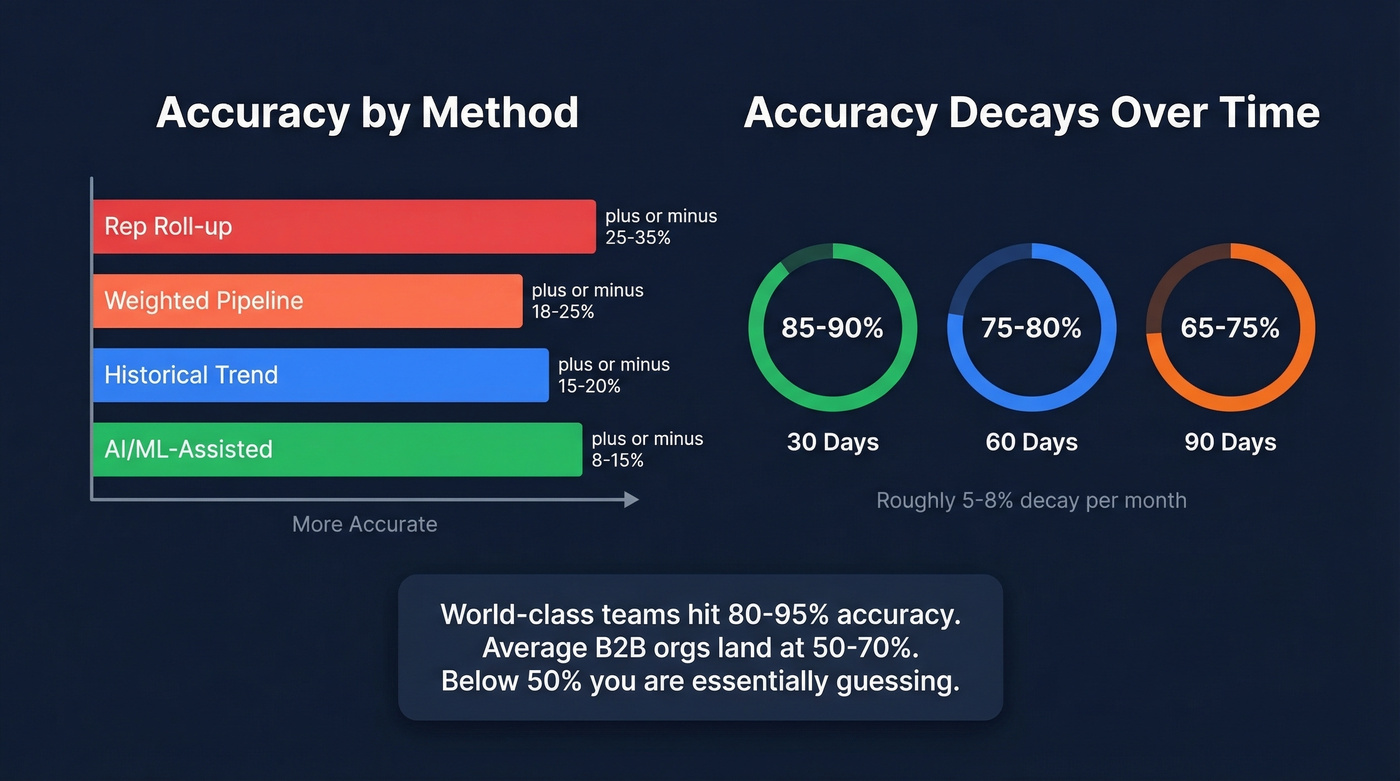
Weighted pipeline is the best starting point for most B2B teams. Rep roll-up is the least accurate method - and most companies still use it.
| Method | Typical Variance |
|---|---|
| Rep roll-up | ±25-35% |
| Weighted pipeline | ±18-25% |
| Historical trend | ±15-20% |
| AI/ML-assisted | ±8-15% |
Accuracy also decays with time:
| Forecast Horizon | Expected Accuracy |
|---|---|
| 30 days | 85-90% |
| 60 days | 75-80% |
| 90 days | 65-75% |
That's roughly 5-8% decay per month. A quarterly forecast left untouched is unreliable by month two. World-class teams hit 80-95% accuracy; average B2B orgs land at 50-70%. Below 50%? You're essentially guessing.
Use WAPE over MAPE. MAPE misleads when deal sizes vary significantly, which they do in most B2B pipelines. And track forecast bias separately - knowing whether you systematically over- or under-forecast is just as valuable as knowing your accuracy percentage. We've found that teams switching from rep roll-up to weighted pipeline see immediate accuracy improvements, sometimes 10+ percentage points in the first quarter.
Tracking Both in Practice
Two formulas worth pinning to your dashboard: Target Attainment % = (Actual Sales / Target) x 100, and Conversion Rate = (Closed Deals / Qualified Leads) x 100. The first tells you how close you are to the goal. The second tells you whether your forecast inputs are realistic.
Let's be honest about the tooling situation. The fact that most CRMs still can't show a clean cumulative goal-vs-forecast chart without a spreadsheet workaround tells you how far behind sales tooling really is. HubSpot community threads are full of users trying to get a basic goal line to render correctly on a forecast report - and failing. We've seen this across CRMs, not just HubSpot.
Keep it simple: weekly forecast reviews owned by RevOps, monthly goal check-ins owned by leadership. The forecast updates as pipeline moves. The goal stays fixed for the period. When they diverge, that's a conversation - not a crisis.
Here's my hot take: most teams don't have a forecasting problem. They have a goal-setting problem. Sales revenue goals get handed down from the board with no connection to pipeline reality, and then everyone panics when the forecast doesn't match. Start with the forecast. Build the goal from there. You'll sleep better.
Pipeline coverage drives forecast accuracy. If you need 4x pipeline to hit goal, every record matters. Prospeo gives you 300M+ verified profiles with 30+ filters - buyer intent, headcount growth, funding - so you build pipeline that actually converts at the win rates your forecast assumes.
Build the pipeline your forecast needs at $0.01 per verified email.
FAQ
Can a sales forecast and a sales goal ever be the same number?
Technically yes, but it usually means one is wrong. Goals should stretch beyond the forecast - most orgs set goals 10-20% above baseline. If they match exactly, either the goal isn't ambitious enough or the forecast is inflated to avoid a gap conversation.
How often should you update a sales forecast?
Weekly at minimum. Accuracy decays roughly 5-8% per month, so a quarterly forecast left untouched is unreliable by month two. The best teams update after every significant deal movement - stage changes, slipped close dates, new opportunities entering pipeline.
How does data quality affect forecast accuracy?
Directly. If contacts in your pipeline have outdated emails or wrong phone numbers, those deals are less likely to close but still inflate your forecast. Verifying contact data - keeping records on a weekly refresh cycle rather than letting them go stale for months - keeps your pipeline honest and your forecast grounded in reality.