

Quota Management: How to Set, Track, and Actually Hit Your Sales Targets
87% of sales leaders have no formal method for setting quotas. They eyeball it - pick a number that feels ambitious, slap it on a territory, and hope reps figure it out. Meanwhile, on r/sales, a rep posts about getting a $1.4M annual quota on a territory that produced $1M over six years. The comments are predictable: "You're being set up to fail."
That gap between how quota management should work and how it actually works is where most revenue plans break down. Let's fix it.
What Is Quota Management?
It's the process of setting, tracking, and achieving sales targets over defined periods. It covers everything from deciding what number each rep carries, to monitoring attainment in real time, to adjusting when the plan meets reality.
Done well, it turns compensation, territory design, and pipeline coverage into a predictable system. Done poorly - which is the norm - it's a spreadsheet exercise that disconnects leadership expectations from what reps can actually close.
One quick note: "quota management" also means something different in IT and cloud infrastructure, where it refers to managing storage limits and service quotas. If that's what you're after, we cover it [briefly later](#quota-management-in-it - cloud). Everything between here and there is about sales.
Types of Sales Quotas
Not all quotas measure the same thing, and picking the wrong type creates misaligned incentives fast.
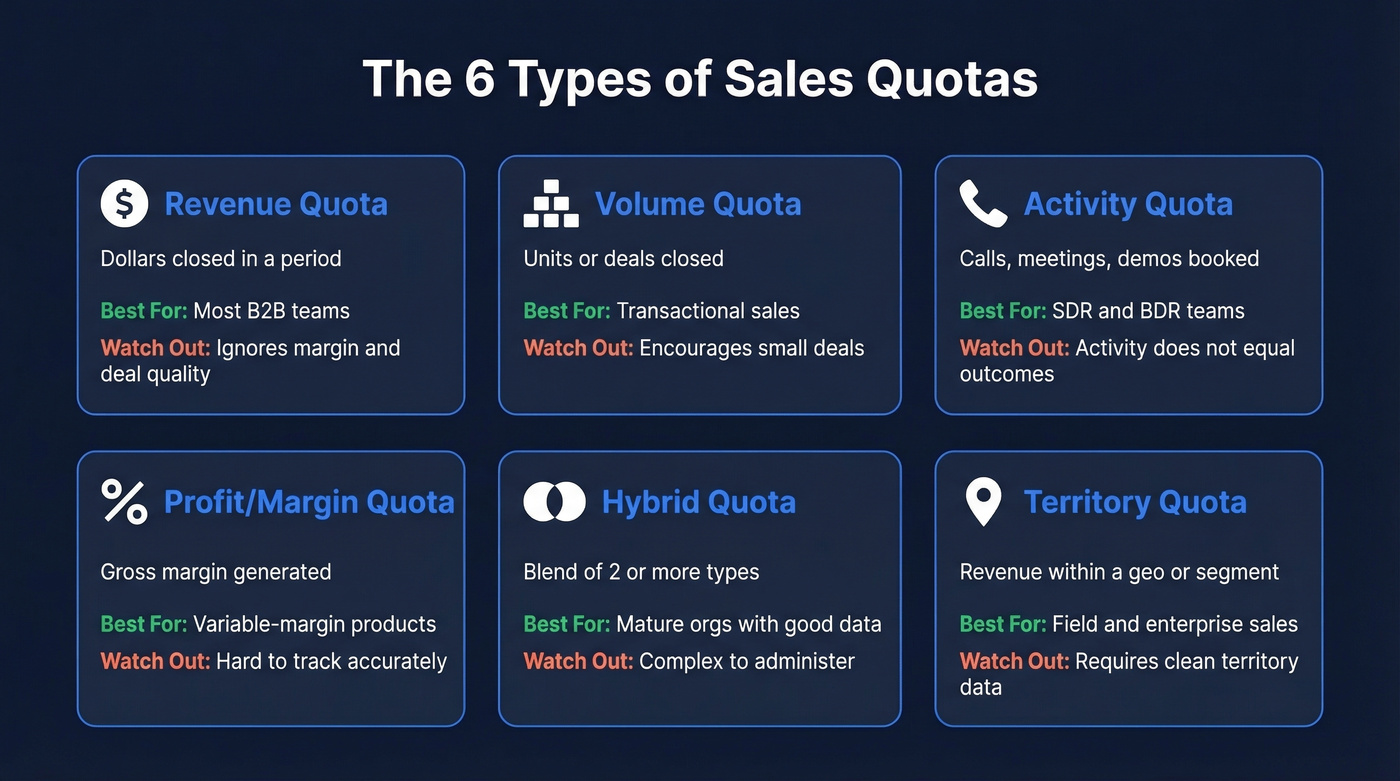
| Quota Type | What It Measures | Best For | Risk |
|---|---|---|---|
| Revenue | Dollars closed | Most B2B teams | Ignores margin, deal quality |
| Volume | Units or deals closed | Transactional sales | Encourages small deals |
| Activity | Calls, meetings, demos | SDR/BDR teams | Activity ≠ outcomes |
| Profit/Margin | Gross margin generated | Variable-margin sales | Hard to track accurately |
| Hybrid | Blend of 2+ types | Mature orgs with good data | Complex to administer |
| Territory | Revenue within a geo/segment | Field sales, enterprise | Requires clean territory data |
Revenue quotas dominate B2B SaaS for a reason - they're simple and directly tied to the number leadership cares about. But if your reps are closing lots of low-margin deals to hit a revenue number, a profit quota or hybrid model will serve you better.
Activity quotas work for SDR teams where the output is meetings, not revenue. The trap is treating activity as a proxy for performance when it's really just a proxy for effort. A rep who books 30 meetings that go nowhere isn't outperforming one who books 15 that convert.
How to Set Quotas That Reps Can Hit
The most common starting point is the OTE-to-quota ratio:
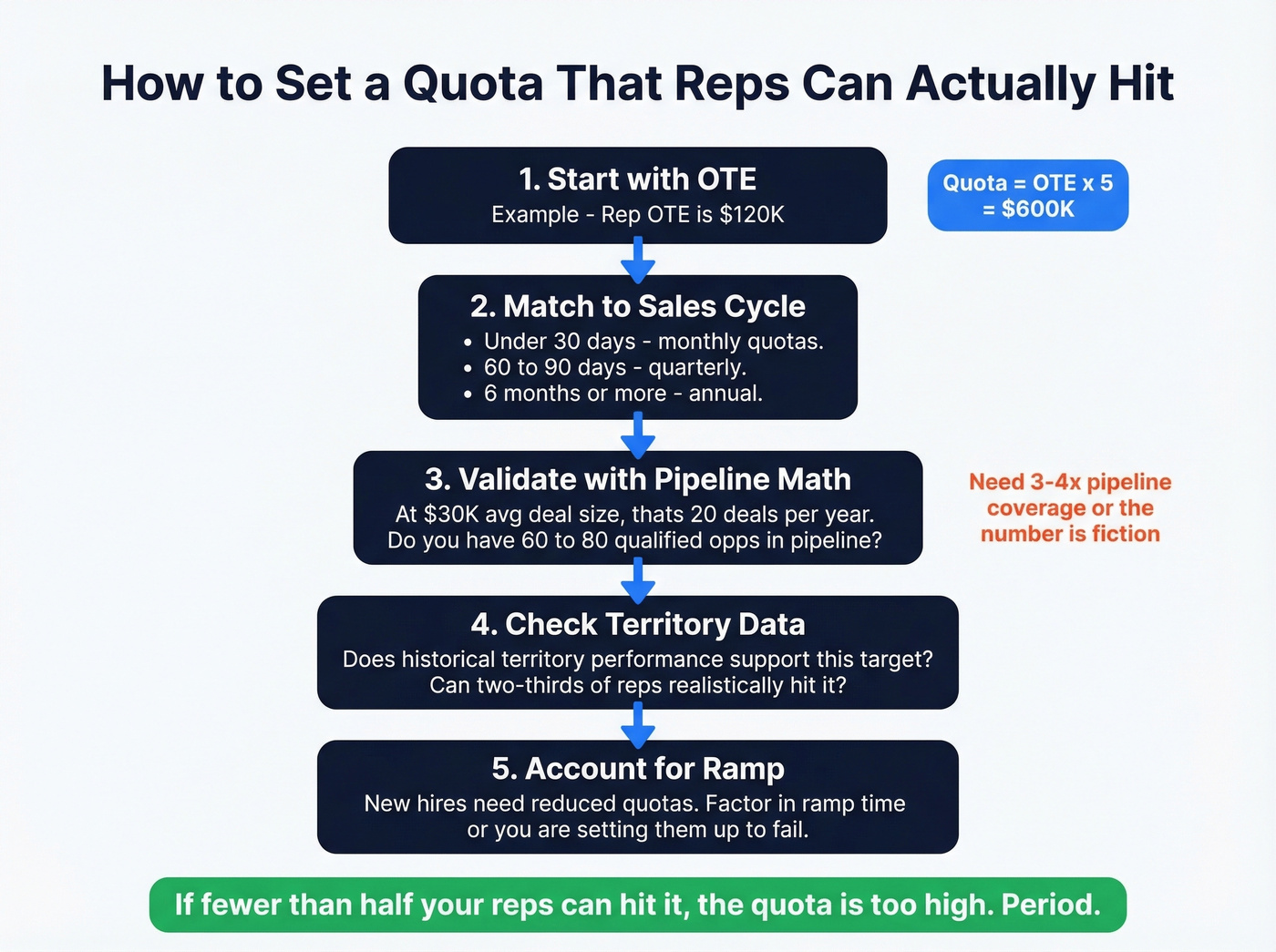
Quota = OTE x Multiplier
The sweet spot for most B2B organizations is a 4:1 to 6:1 ratio. In SaaS, 5x OTE is the default. Larger enterprises sometimes push to 8x, but that only works if your market, product, and pipeline support it.
Worked example: A rep with $120K OTE at a 5:1 ratio carries a $600K annual quota. If your average deal is $30K with a 90-day cycle, that's 20 deals per year, or roughly 5 per quarter. Does your pipeline support 3-4x that number in qualified opportunities? If not, the quota is aspirational fiction.
Match your quota period to your sales cycle. Monthly quotas work when cycles run under 30 days. Quarterly is the standard for most B2B teams with 60-90 day cycles. Annual quotas make sense for enterprise deals that take six months or longer to close.
Validation checklist before you finalize:
- Can roughly two-thirds of reps realistically hit this number?
- Does historical territory data support the target?
- Is pipeline coverage at 3-4x quota?
- Have you accounted for ramp time on new hires?
- Does the cost-of-sales math work at this quota level?
If you can't answer yes to the first question, your quota is too high. It doesn't matter how ambitious leadership wants to be - a number that fewer than half your reps can hit isn't a stretch goal. It's a retention problem.
Quota Attainment Benchmarks
The numbers are sobering. 76.6% of sellers missed quota in H1 2025, even after targets were lowered by 13.3% on average. Only 24.3% exceeded their yearly target.
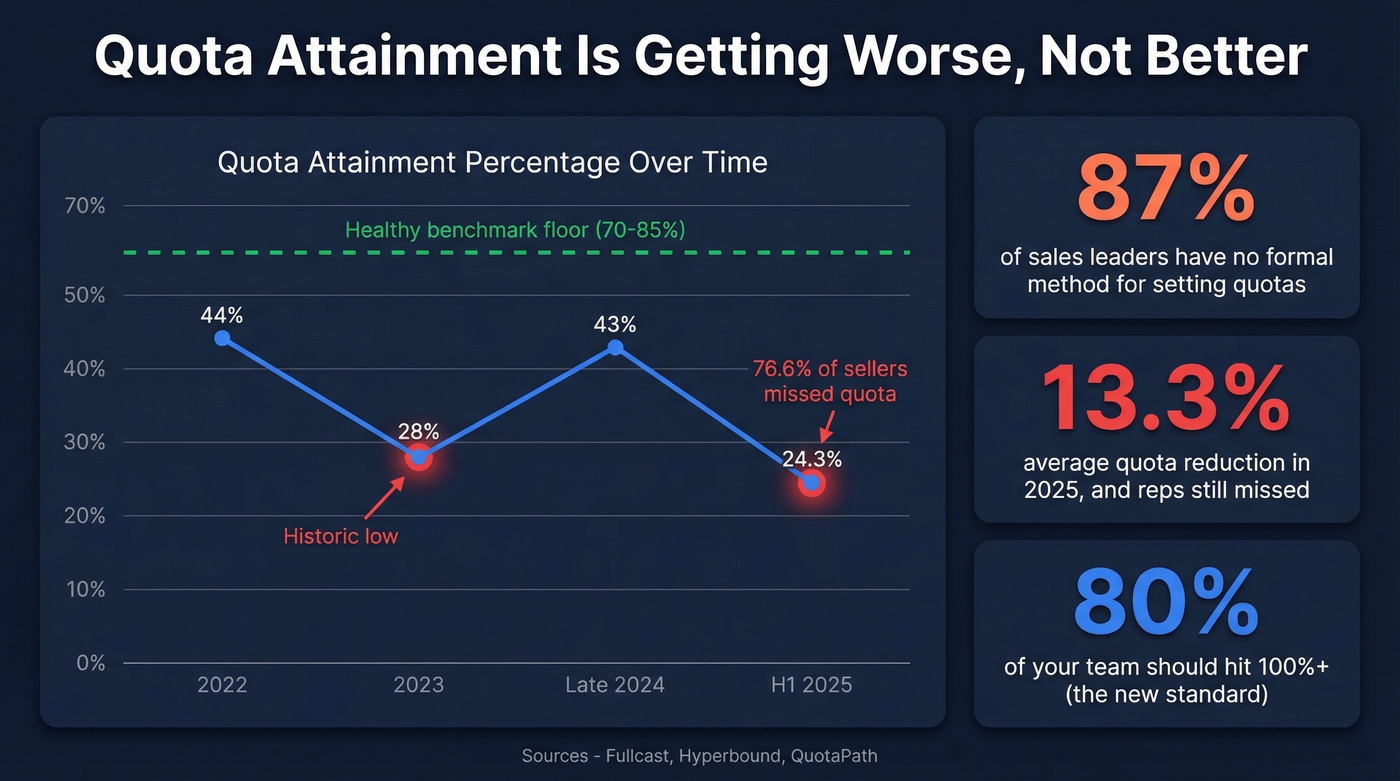
The trend line hasn't been kind either. Quota attainment dropped from 44% in 2022 to just 28% in 2023, before recovering to around 43% in late 2024. A SPOTIO survey of 452 field sales professionals tells the same story from the ground level: only about a third said 70%+ of their reps consistently hit quota, while another third said fewer than half did.
The healthy benchmark range for team-wide attainment is 70-85%. QuotaPath's CEO has pushed an even more aggressive standard - 80% of your team should hit 100%+ - arguing that anything less means your quotas are broken, not your reps. We think that's directionally right, even if it's aspirational for most orgs. When attainment dips below 50% for two consecutive periods, that's not a coaching problem. It's a structural problem with how you're setting targets, designing territories, or building pipeline.
Here's the thing: 59% of sales leaders track pipeline most closely to gauge quota performance, yet most can't get clean attainment data from their CRM. 69% use Salesforce for quota monitoring, and as one frustrated RevOps lead put it on r/salesforce, building a simple quota attainment report - closed-won revenue vs. targets per rep with a regional rollup - is "tough."

Universal underperformance starts with pipeline gaps, not bad reps. Prospeo gives your team 300M+ verified profiles with 30+ filters - buyer intent, headcount growth, technographics - so every rep has 3-4x pipeline coverage. At 98% email accuracy, reps connect instead of bouncing.
Fix the pipeline math and quota attainment follows.
Diagnosing Bad Quotas
Before you redesign your entire comp plan, run these three diagnostics.
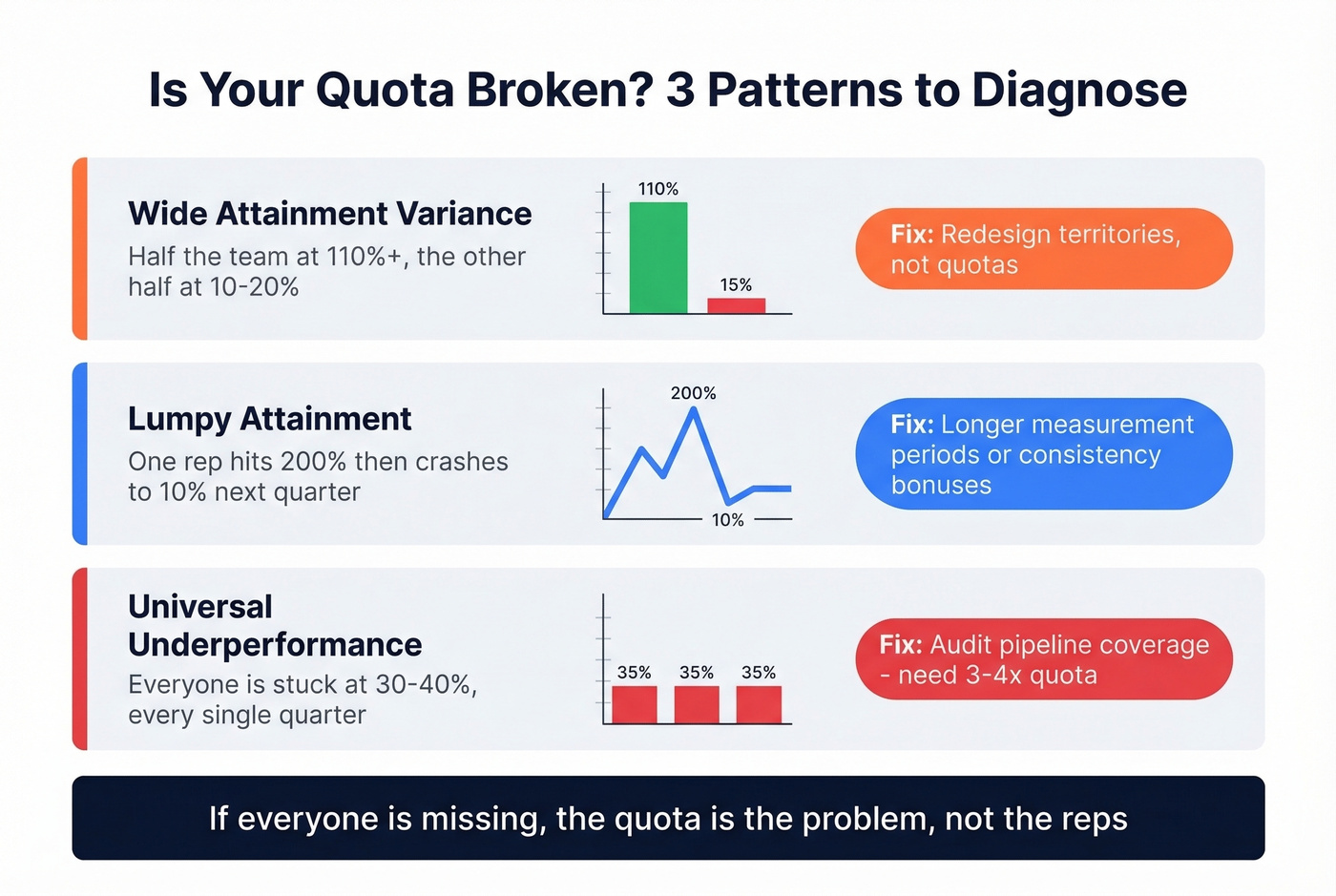
Wide attainment variance. Half your team is at 110%+ while the other half sits at 10-20%. This isn't a talent problem - it's a territory or segmentation problem. Some reps are sitting on gold mines while others are working barren ground. Fix the territory model before touching the quota number.
Lumpy attainment. A rep hits 200% one quarter, then 10% the next. This usually means your quota period doesn't match your sales cycle, or your comp plan rewards sandbagging. Consider longer measurement periods, consistency bonuses, or decelerators that smooth out the peaks and valleys.
Universal underperformance is the pattern that should scare you most. Everyone's at 30-40%, quarter after quarter. In our experience, this always has the same root cause - quotas set without any connection to territory potential. Start with pipeline coverage. If reps don't have 3-4x quota in qualified pipeline, no amount of coaching fixes the math.
Why Reps Miss Quota
No formal methodology. That 87% stat isn't just trivia - it explains why attainment has been declining industry-wide. When quotas are set by gut feel or by taking last year's number and adding 15%, you get targets that have no relationship to territory potential, market conditions, or pipeline reality. Documenting clear sales quota policies - how targets are calculated, when they're adjusted, and what triggers a mid-cycle revision - eliminates the ambiguity that breeds distrust between reps and leadership.
Territory misalignment. The r/sales anecdote about the $1.4M quota on a $1M territory isn't an outlier. We've seen this pattern repeatedly: leadership sets a top-down revenue target, divides it across headcount, and calls it a territory plan. That's not territory planning - that's arithmetic. Real territory design requires market data, account potential scoring, and historical performance analysis.
CRM reporting friction is the silent killer. When reps and managers can't see where they stand in real time, they can't course-correct. They find out they're behind at the end of the quarter, not the beginning. This is fixable, but most teams treat it as a "nice to have" instead of the operational emergency it actually is.
Bad Pipeline Data: The Upstream Bottleneck
Look, before you redesign your quota model, audit your pipeline data. If your bounce rate is above 5%, reps can't build enough pipeline to hit any number. They're spending hours on outreach that never reaches a human inbox.
This is also where multi-threading breaks down. Closed-won deals have roughly 2x as many buyer contacts as lost deals, and for deals over $50K, multi-threading boosts win rates by 130%. But you can't multi-thread into an account if you don't have verified contact data for multiple stakeholders. Prospeo's email finder verifies emails at 98% accuracy with a 7-day data refresh cycle, so reps spend time selling instead of chasing dead contacts. Snyk saw this firsthand: bounce rates dropped from 35-40% to under 5%, and AE-sourced pipeline jumped 180%.

Territory imbalance kills quota attainment faster than anything else. Prospeo's 30+ search filters let you segment by intent signals, company growth, funding, and department headcount - so you assign territories based on real opportunity, not guesswork. All at $0.01 per email.
Stop setting quotas on territories you can't actually size.
Quota Management Software in 2026
The sales planning software market was valued at $24.1B in 2025 and is projected to hit $79.3B by 2037. That growth reflects a real shift: teams are moving from spreadsheets and Salesforce reports to purpose-built tools.
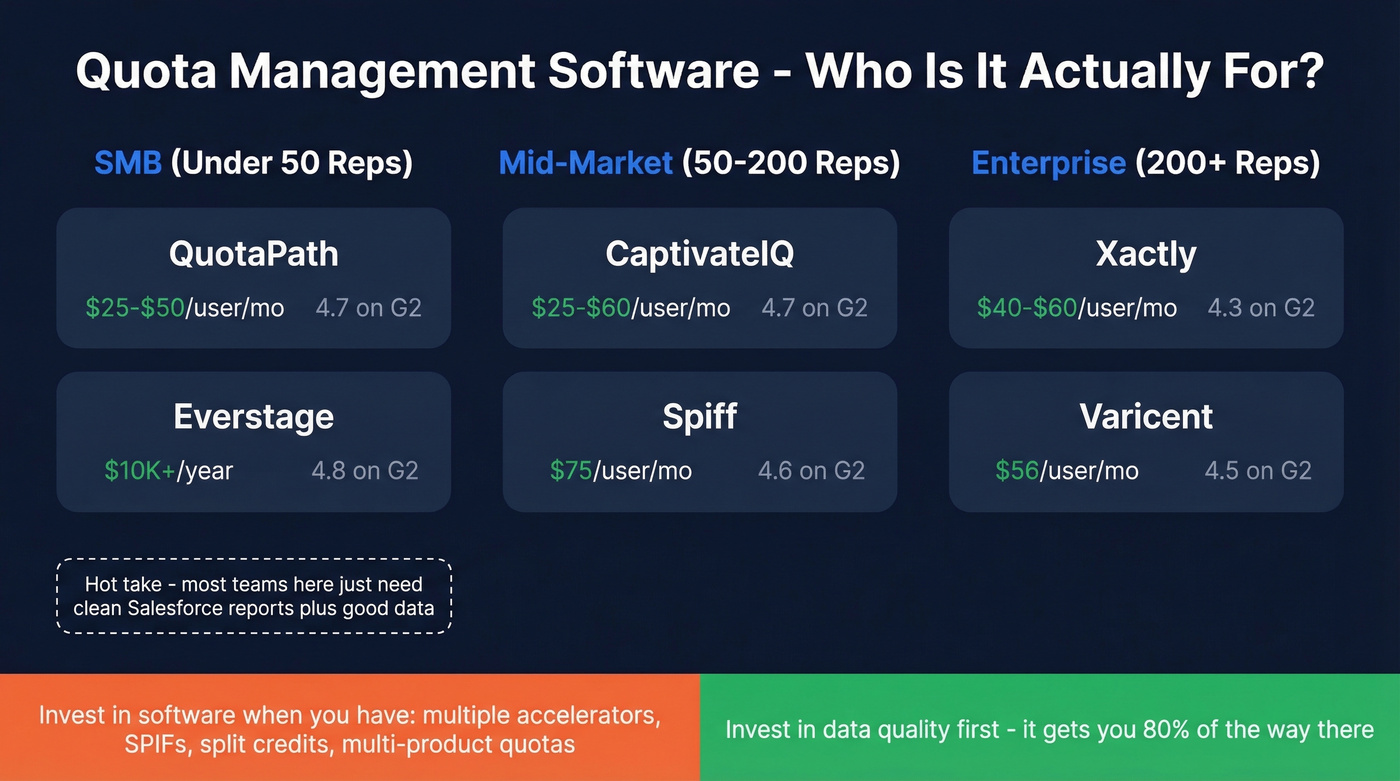
Our hot take: most teams under 50 reps don't need a dedicated SPM platform. A well-built Salesforce report plus clean pipeline data will get you 80% of the way there. The software becomes essential when comp plan complexity outgrows what a spreadsheet can model - multiple accelerators, SPIFs, split credits, multi-product quotas. If that's not you yet, invest in data quality first and save the $25-200/user/month.
For teams that do need purpose-built software, here's how the major players stack up:
| Tool | Best For | Pricing | G2 Rating |
|---|---|---|---|
| QuotaPath | SMB comp + quota tracking | $25-$50/user/month | 4.7 |
| CaptivateIQ | Mid-market comp modeling | $25-$60/user/month | 4.7 |
| Everstage | Growing teams, UX focus | $10,000+/year | 4.8 |
| Xactly | Enterprise SPM | $40-$60/user/month | 4.3 |
| Varicent | Complex comp plans | $56/user/month | 4.5 |
| Spiff | Real-time commission visibility | $75/user/month | 4.6 |
QuotaPath is the obvious starting point for SMB teams that need quota tracking without enterprise complexity. CaptivateIQ and Everstage compete for the mid-market, with Everstage earning the highest G2 rating in the category at 4.8. Xactly and Varicent own the enterprise tier - expect longer implementations and higher total cost. Skip Xactly if you're under 200 reps; the implementation overhead won't pay off.
None of these tools fix your data, though. If your CRM is full of bounced emails and disconnected numbers, no planning software will save you. Fix the inputs first.
If you're evaluating tooling beyond quota tracking, compare adjacent categories like sales forecasting solutions and sales pipeline benchmarks to sanity-check your targets.
Quota Management in IT & Cloud
If you landed here looking for storage or service quotas, here's the short version.
Windows file server quotas are managed through File Server Resource Manager (FSRM). Set hard limits to block writes at threshold, or soft limits that warn but allow overages. Best practice is multiple warning levels at 75%, 85%, and 95%. PowerShell's FSRM cmdlets (New-FsrmQuotaTemplate, Get-FsrmQuota) automate the pain away.
Cloud service quotas from AWS, GCP, and Azure are provider-imposed limits on API calls, instances, storage, or message throughput. The real risk isn't running out of space - it's hitting a quota you didn't know existed and having production break at 2 AM. Monitor proactively using CloudWatch, Prometheus, or your provider's native quota dashboards.
Kubernetes ResourceQuotas solve the noisy neighbor problem by preventing one workload from consuming all cluster resources. Set per-namespace limits on CPU, memory, and object counts, then pair them with LimitRanges to enforce per-pod defaults.
FAQ
What's a good quota attainment rate?
70-85% team-wide is the healthy benchmark for 2026. If fewer than half your reps hit quota for two consecutive periods, the target design is broken - not the team. Attainment below 50% signals structural issues with territories, pipeline coverage, or the methodology used to set the number.
What's the ideal quota-to-OTE ratio?
4:1 to 6:1 for most B2B organizations. In SaaS, 5x OTE is the most common starting point - a rep earning $120K OTE would carry a $600K quota. Larger enterprises push to 8x, but validate by checking whether roughly two-thirds of reps can realistically hit the number.
How does bad data affect quota attainment?
When 30-40% of emails bounce and phone numbers are disconnected, reps can't build enough pipeline to hit any target. Fixing data quality is often the single highest-leverage change a team can make. Snyk's AE-sourced pipeline jumped 180% after dropping bounce rates from 35-40% to under 5%.
What should sales quota policies include?
Effective policies document how targets are calculated, which data sources inform the number, how ramp quotas work for new hires, when mid-cycle adjustments are permitted, and what happens to quota credit on split deals or territory changes. Without written policies, target-setting becomes a black box that erodes rep trust and makes attrition predictable.