

The Best Sales Enablement Tools in 2026: Real Pricing, Real Opinions
Sales reps spend only 30% of their time actually selling. The rest vanishes into content hunting, CRM updates, and chasing prospects with bad contact data. Open G2 and you'll find 144 listings in the sales enablement category alone - a lot of vendors have merged, and many still won't tell you what they cost.
Here's the thing: most teams overbuy. They sign a $90K annual contract for a content platform when their real problem is that 35% of their outbound emails bounce. We've watched it happen over and over. Enablement starts with reaching the right people with accurate data - the content and coaching layer comes after.
These are the tools actually worth your budget, with real pricing and honest opinions on every one.
What Changed in 2026
The enablement market is consolidating at a pace that should make every buyer nervous. Seismic and Highspot - two major pure-play platforms - announced a definitive merger in February 2026. Showpad completed its merger with Bigtincan back in October 2025. And Gong, traditionally a conversation intelligence tool, expanded into what it's calling "full revenue enablement" in early 2026.
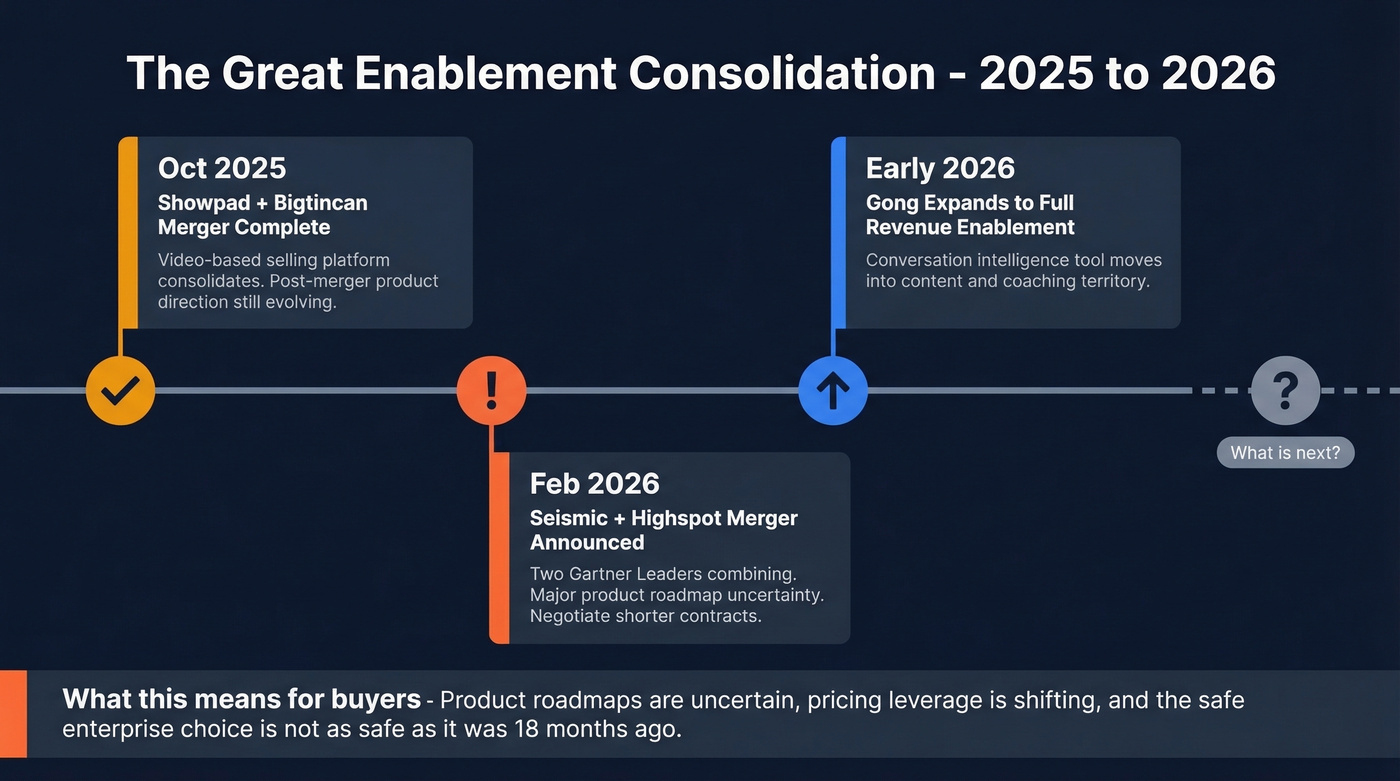
What does this mean for you? Product roadmaps are uncertain, pricing leverage is shifting, and the "safe" enterprise choice isn't as safe as it was 18 months ago.
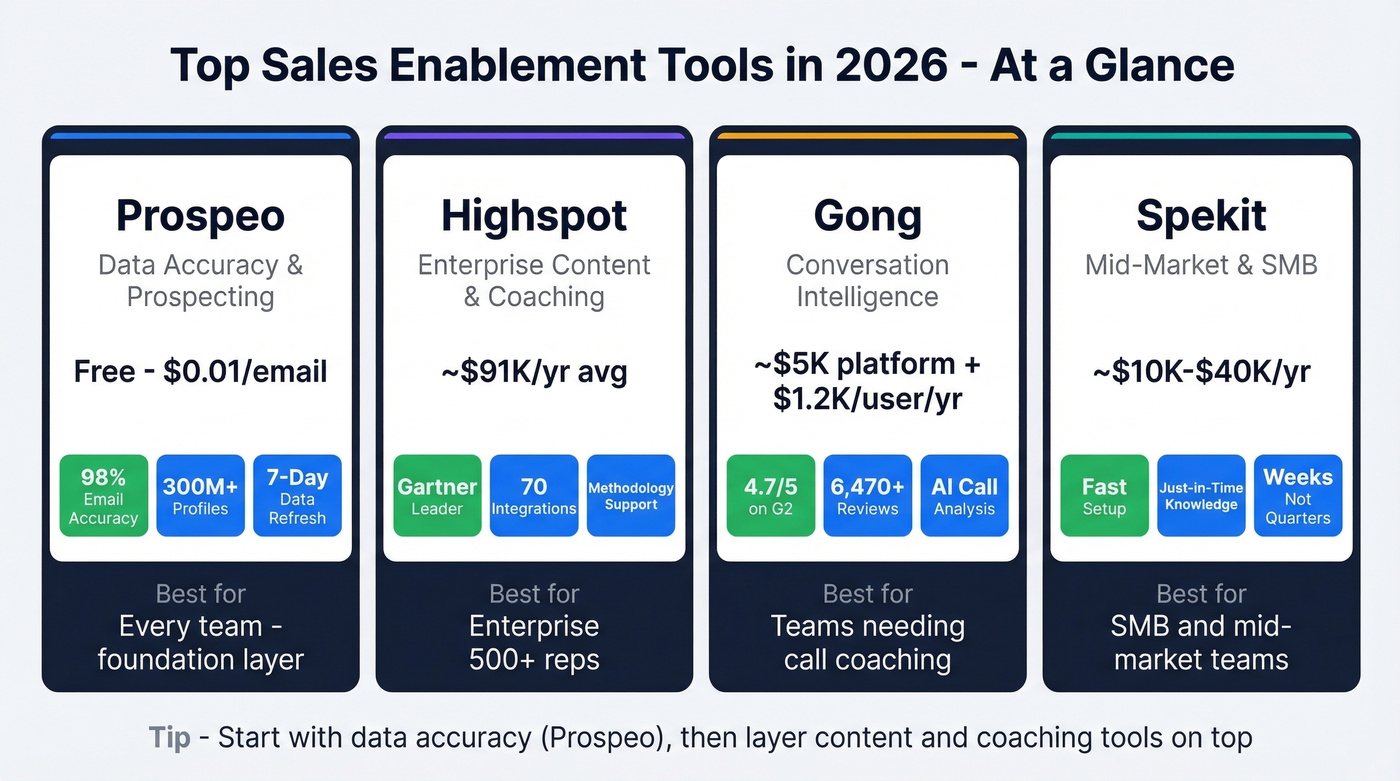
Our Picks (TL;DR)
| Tool | Best For | Starting Price | Key Strength |
|---|---|---|---|
| Prospeo | Data accuracy & prospecting | Free (75 emails/mo) | 98% email accuracy, 7-day refresh |
| Highspot | Content & coaching (enterprise) | ~$91K/yr avg | Gartner Leader, methodology support |
| Gong | Conversation intelligence | ~$5K platform + $1.2K/user/yr | 4.7/5 on G2, 6,470+ reviews |
| Spekit | Mid-market / SMB | ~$10K-$40K/yr | Just-in-time knowledge, fast setup |
What Is Sales Enablement Software?
Gong defines it well: software that centralizes content, training, and coaching "at the moment of need." G2's category requirements add analytics and CRM integration as mandatory features. The practical version? It's the layer between your strategy and your reps' daily execution - increasingly with AI embedded directly into workflows rather than bolted on as a separate feature.
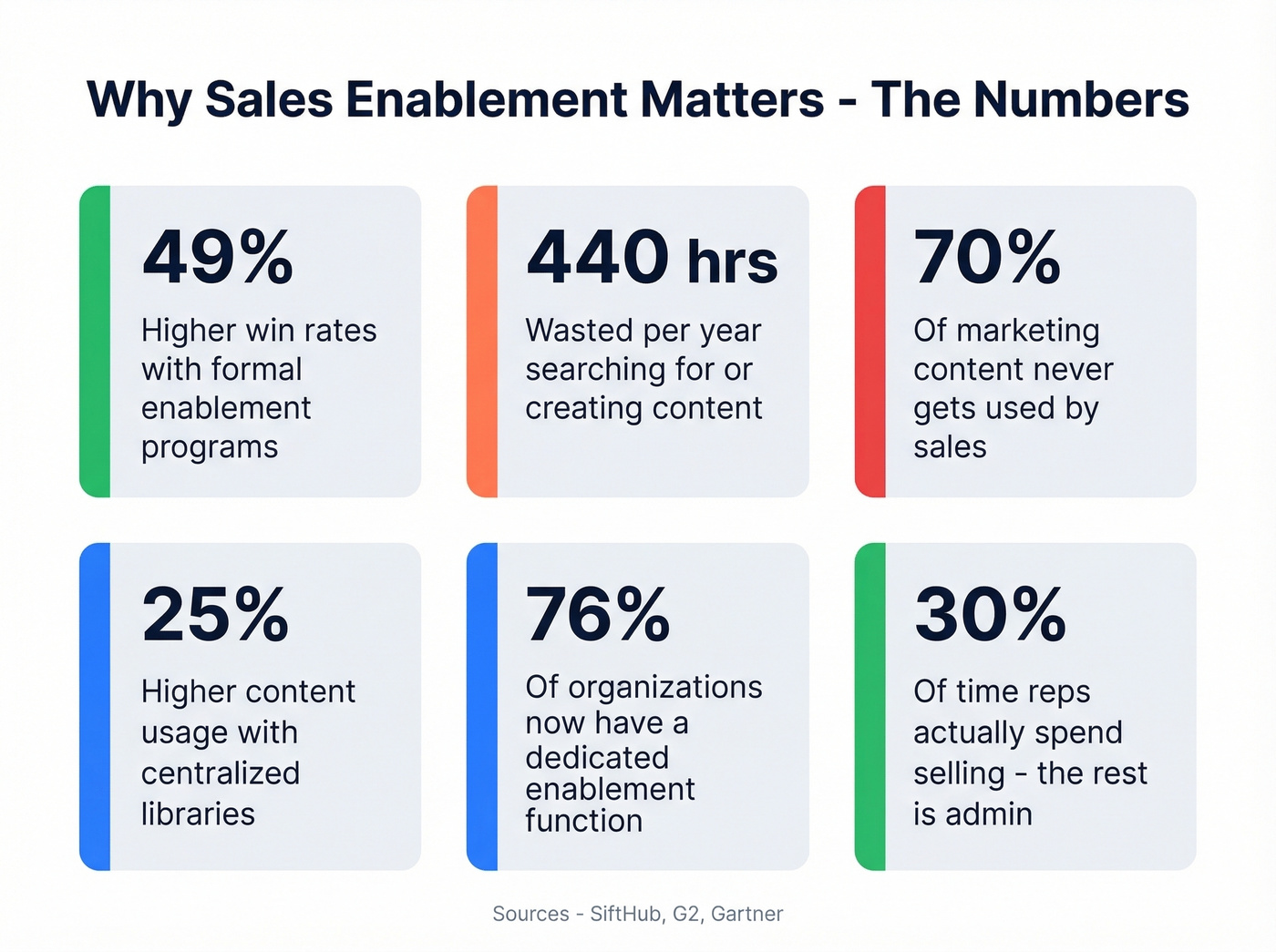
The numbers make the case. Companies with formal enablement programs see 49% higher win rates on forecasted deals. Revenue teams waste 440 hours per year - 11 full work weeks - searching for or creating content. Only 30% of marketing-created content actually gets used by sales, and organizations with centralized content libraries see 25% higher content usage. Meanwhile, 76% of organizations now have a dedicated enablement function.
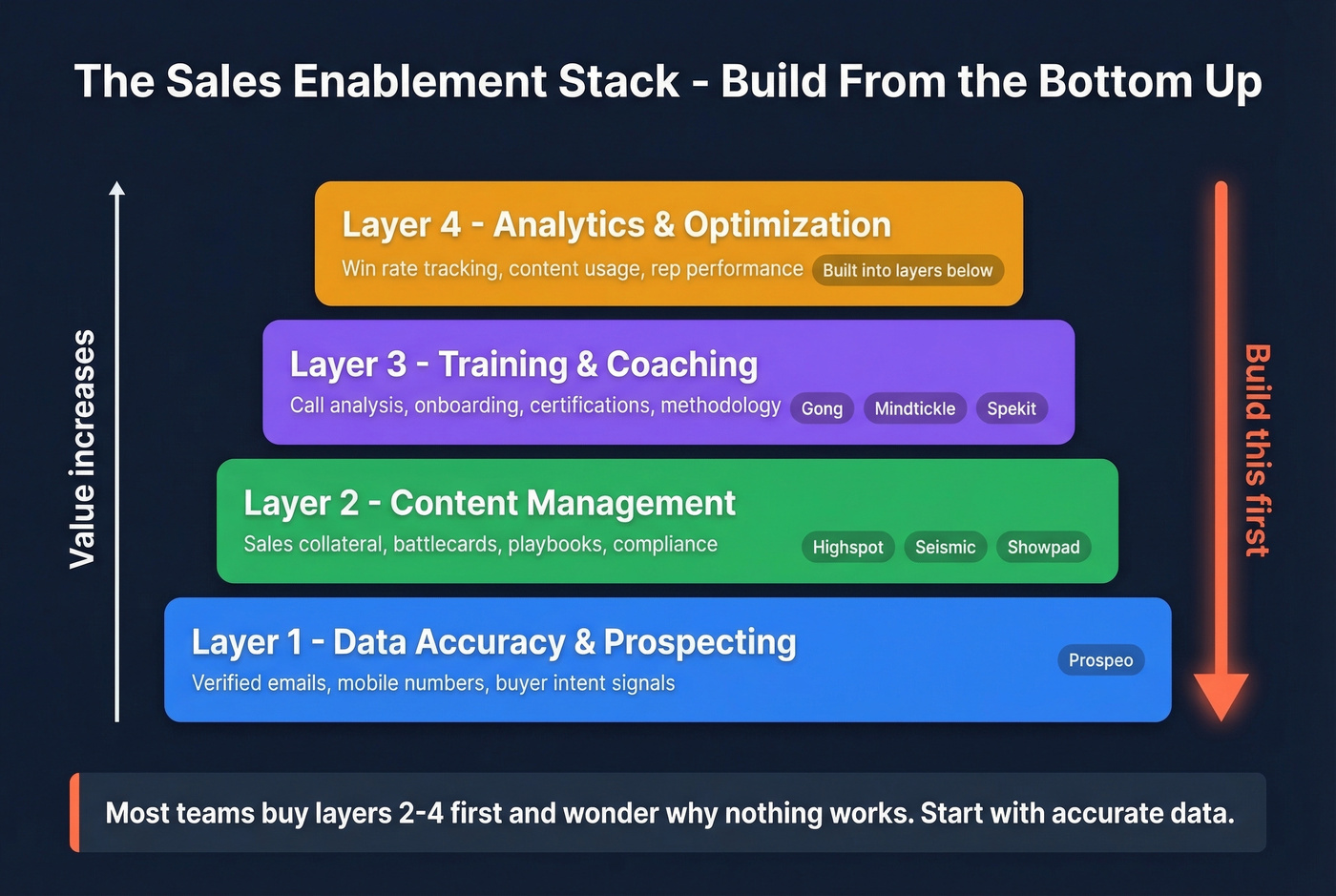
Enablement isn't one tool. It's a stack where data quality sits at the foundation. You need accurate contact information before any content platform, coaching tool, or analytics dashboard can deliver value. Above that, you layer content management, training, and performance analytics. Most teams buy the top layers first and wonder why nothing works.
The Best B2B Options in 2026
Prospeo - Best for Data Accuracy
The best enablement platform in the world can't help if 35% of your emails bounce. That's not hypothetical - it's what Meritt was experiencing before switching their data provider. After the switch, their bounce rate dropped to under 4% and pipeline tripled from $100K to $300K per week. (If bounce is your issue, start with email bounce rate benchmarks and fixes.)
Prospeo's database covers 300M+ professional profiles with 98% email accuracy, 143M+ verified emails, and 125M+ verified mobile numbers that hit a 30% pickup rate. The 7-day data refresh cycle is genuinely unusual - the industry average is six weeks, which means most databases serve you stale contacts by default. Search filters cover buyer intent across 15,000 topics, technographics, job changes, and headcount growth (more on firmographic and technographic data if you're building targeting rules).

The Chrome extension (40K+ users) pulls verified contacts from any website or CRM, and native integrations with Salesforce, HubSpot, Smartlead, Instantly, and Lemlist mean your data flows directly into your existing workflow. At roughly $0.01 per email with a free tier of 75 emails/month, it's the cheapest high-accuracy option available. Pair it with any content or coaching platform on this list. (If you're comparing providers, see our roundup of data enrichment services.)
Highspot - Best for Enterprise Content & Coaching
Use this if: You're an enterprise org running Challenger, Sandler, or another structured methodology and need a platform that enforces it. Highspot earned the top spot for Ability to Execute in the inaugural 2025 Gartner Magic Quadrant for Revenue Enablement Platforms. It supports 70 integrations, and CRM connectors don't cost extra - a meaningful differentiator when Seismic charges ~$69/user/year for its Salesforce connector.
Skip this if: You're budget-conscious or need to move fast. The average annual contract runs $91,460 based on 62 Vendr deals. No free plan, no free trial. Add-ons like Copilot and Advanced Analytics push costs higher. And with the Seismic merger announced in February 2026, there's real product roadmap uncertainty - push for shorter contract terms if you're evaluating now. (Negotiation tip: use an anchor in negotiation to set the pricing frame early.)

Gong - Conversation Intelligence Everyone Calls "Enablement"
Gong records, transcribes, and analyzes every sales conversation, then feeds insights into coaching workflows. With 6,470+ G2 reviews at 4.7/5, it's the most validated tool on this list by a wide margin.
Let's be honest: calling Gong "sales enablement" is a stretch. It's conversation intelligence that's critical to the enablement stack, but it won't manage your content library or onboard new reps. That said, if your coaching problem is that managers don't know what's happening on calls, nothing else comes close.
The pricing is where it gets painful. Gong charges a platform fee ($5K-$50K/year depending on team size), per-user licenses ($1,200-$3,000/user/year), and implementation fees ($15K-$65K+). A 20-person team can easily hit $50K+ in year one. Watch for auto-renewal uplifts of 5-15% and multi-year lock-ins - negotiate that cap before you sign.

Seismic - Best for Content Governance
Seismic is the "single source of truth" play. Content expiry and stale-dating features keep your library compliant - a real differentiator for regulated industries. 100+ integrations, strong search, and deep content automation. The Professional Edition lists at ~$630/user/year, with the Enterprise Premier tier running ~$494/user/year for larger deployments. Vendr data shows typical discounts of 32-68% for ~100 seats, climbing to 43-76% at 500+ seats. A 100-seat Professional deal lands around $42K/year instead of $63K list.
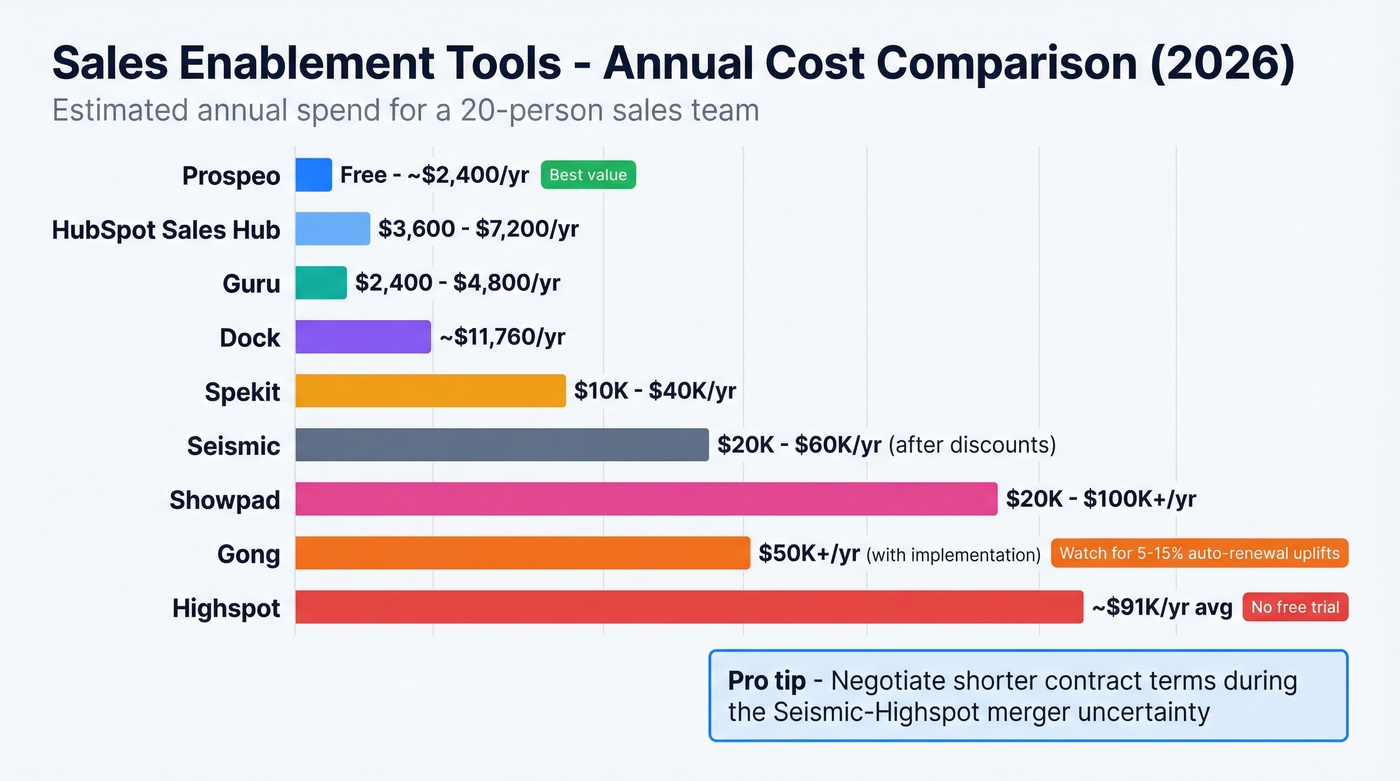
The downside? UX is "more complicated than it needs to be" - a consistent theme across user reviews. Emails sent through the system sometimes get flagged as spam. And the Seismic-Highspot merger creates real uncertainty about which product roadmap survives. Mid-market teams typically spend $20K-$60K/year; enterprise deals run $100K+.
Showpad - Best for Video-Based Selling
Showpad completed its merger with Bigtincan in October 2025. It's still one of the strongest options if you want enablement that leans into video-based selling and coaching: MeetingIQ adds conversation monitoring, and the content hub bridges the sales-marketing divide better than most competitors. Expect $20K-$100K+ per year depending on seats and modules. If your team relies on video demos and virtual selling, Showpad deserves a serious look - though the post-merger product direction is still taking shape. (If you're standardizing demos, a product demo checklist helps.)
Spekit - Mid-Market & SMB
Spekit delivers just-in-time knowledge directly in the tools your reps already use - contextual guidance that surfaces the right playbook at the right moment. Implementation typically takes weeks, not quarters, and annual costs run $10K-$40K. If you need enablement that doesn't take six months to implement and doesn't cost $90K, this is the answer. The trade-off is depth: you won't get the content governance, compliance workflows, or analytics that Seismic and Highspot provide.
Salesforce Sales Cloud - For Existing Salesforce Orgs
Salesforce isn't a dedicated enablement platform. But with 25,479 G2 reviews at 4.4/5, it's the CRM most enterprise teams already run. Pricing is commonly packaged across Starter, Professional, and Enterprise tiers at $25/$80/$165 per user/month. The enablement features you can build around Sales Cloud cover basic content sharing, pipeline analytics, and coaching workflows. If you're already paying for the Salesforce ecosystem, adding enablement capabilities costs less than bolting on a separate platform. Just don't expect the depth of a Highspot or Seismic. (If you're sanity-checking costs, see Salesforce pricing.)
HubSpot Sales Hub - Best Free Starting Point
HubSpot's free CRM plus Sales Hub starting at $15/user/month is a low-friction entry point for teams under 20 reps. Enablement depth is limited compared to dedicated platforms, but for early-stage teams that need basic content sharing and pipeline visibility without a five-figure contract, it's the obvious starting point. (If you're mapping options, here are more examples of a CRM.)
Guru - Knowledge Management
Guru offers a free tier with paid plans from ~$10/user/month. It's a knowledge base that surfaces answers directly in your workflow - Slack, browser, CRM. Not a full enablement platform, but it pairs beautifully with one. Teams using structured battlecards win 23% more competitive deals, and Guru is one of the best tools for making those battlecards findable. (If you're building those assets, start with sales battle cards.)
Dock - Digital Sales Rooms
Dock's paid plans from ~$49/user/month make it accessible for teams experimenting with buyer-facing deal rooms. Buyers spend only 17% of their time talking to sales - shared spaces where buyers and sellers collaborate on content, timelines, and stakeholders help you make that time count. Strong fit for complex enterprise sales cycles with multiple decision-makers. (More context: what a digital sales room is and why many fail.)
Mindtickle - Sales Readiness
Mindtickle focuses on onboarding, training, and certification - the "readiness" side of enablement. Estimated $20K-$100K+ per year, enterprise-oriented. If you're hiring 20+ reps per quarter and need structured onboarding with certification tracking, Mindtickle is purpose-built for that. For smaller teams, the investment is hard to justify. (If you're building onboarding, a 30-60-90 day plan for sales reps is a solid baseline.)
Honorable mentions: Allego, GTM Buddy, and Consensus all serve niche enablement use cases worth evaluating if the tools above don't fit your specific workflow.

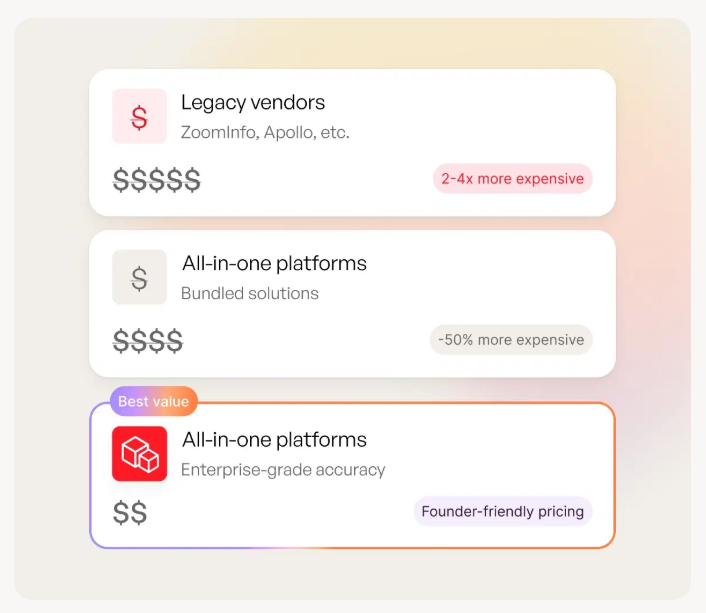
Sales enablement starts with reaching real people. If 35% of your outbound bounces, no content platform or coaching tool will save your pipeline. Prospeo delivers 98% email accuracy with a 7-day refresh cycle - so every tool above it in your stack actually works.
Stop enabling reps to email dead inboxes. Start with accurate data.
What These Tools Actually Cost
Every enterprise enablement vendor hiding pricing behind "contact sales" in 2026 is absurd. Here's what you'll actually pay, based on Vendr benchmarks, community discussions, and our own procurement experience.
| Tool | Starting Price | Typical Annual | Implementation | Free Plan? |
|---|---|---|---|---|
| HubSpot | $15/user/mo | $2K-$10K | Minimal | Yes |
| Guru | ~$10/user/mo | $3K-$15K | Minimal | Yes |
| Dock | ~$49/user/mo | $5K-$20K | Minimal | Yes |
| Spekit | ~$10K/yr | $10K-$40K | Weeks | No |
| Salesforce | $25/user/mo | $5K-$50K+ | Varies | No |
| Showpad | ~$20K/yr | $20K-$100K+ | 2-4 months | No |
| Seismic | ~$630/user/yr list | $20K-$120K+ | 2-3 months | No |
| Mindtickle | ~$20K/yr | $20K-$100K+ | 2-4 months | No |
| Highspot | ~$91K avg | $60K-$120K+ | 3-6 months | No |
| Gong | $5K platform fee | $30K-$150K+ | 4-16 weeks | No |
If you're paying list price for Seismic, you're overpaying - 32-68% discounts are standard, and 500+ seat deals see 43-76% off. Gong's auto-renewal uplifts of 5-15% mean your year-two cost is always higher than year one. Negotiate that cap upfront.
How to Choose by Team Size
SMB (under 50 reps) - Budget: ~$5K-$15K/year. Start with your CRM (HubSpot or Salesforce Starter), add a verified data layer for clean contact information, and layer in Guru or Spekit for knowledge management. You don't need a $90K content platform. You need clean data, a searchable knowledge base, and reps who can find what they need fast. (If you're building the top of funnel on a budget, see free lead generation tools.)
Mid-market (50-200 reps) - Budget: $30K-$80K/year. This is where a dedicated enablement platform starts making sense. Highspot or Showpad for content management, Prospeo for your prospecting foundation, and Gong if coaching is a priority. Implementation timelines run 4+ months - plan accordingly and staff an internal admin.
Enterprise (200+ reps) - Budget: $150K+/year. Full platform (Seismic or Highspot) plus Gong plus a data quality layer across the stack. The consensus on r/sales is that enterprise enablement rollouts take far longer than vendors promise - one user mentioned paying for a platform for three years without fully implementing it. Budget for implementation services ($10K-$65K+) and expect 12+ months to full rollout.
Here's our hot take: if your average deal size is under five figures, you probably don't need a six-figure enablement platform. A CRM, clean prospect data, and a knowledge base will get you 80% of the way there at 10% of the cost.
The Merger Problem
The Seismic-Highspot merger (February 2026) and the Showpad-Bigtincan merger (October 2025) have reshaped the market in ways that aren't fully resolved yet.
Product roadmap uncertainty is real. When two enterprise platforms merge, features get consolidated, deprecated, or rebranded. The combined Seismic-Highspot entity will eventually ship a unified product, but "eventually" could mean 18-24 months of transition. During that window, you're betting on a roadmap that doesn't exist yet.
The upside for buyers? Leverage. Vendors in merger transitions are more willing to negotiate on contract length, pricing, and terms. Push for one-year contracts instead of three. Push for price caps on renewals. Get written commitments on feature continuity for the specific capabilities you're buying.
For mid-market teams that don't need the full weight of an enterprise platform, this is a good moment to look at alternatives like Spekit or a modular stack - CRM plus data tool plus Guru - that doesn't lock you into a single vendor's uncertain future.
Implementation Mistakes That Kill ROI
SalesHood's research identifies the most common implementation failures, and we've seen every one of them in real deployments.
The first killer is skipping the needs assessment. Teams buy the "best" platform without defining what problem they're solving - start with the gap, not the vendor. Closely related: rushing vendor evaluation. A two-week eval for a $90K annual commitment is how you end up switching platforms in 18 months. Take the time to run a proper pilot with real reps and real content.
The second killer is underestimating adoption. The tool is only as good as rep buy-in. Without a VP-level champion, enablement becomes a "nice to have" that loses budget in the next cycle. And without a structured go-live plan, your new platform becomes another tool reps ignore - despite 84% of sales executives citing content search and utilization as the top productivity improvement area.
The third killer is ignoring the data foundation. A 35% bounce rate will destroy your enablement ROI faster than any content gap. Meritt's experience is instructive - they tripled pipeline not by buying a better content tool, but by fixing their prospect data first. That single change dropped their bounce rate from 35% to under 4% and tripled weekly pipeline from $100K to $300K.
Meritt tripled pipeline from $100K to $300K/week after fixing their data foundation. At $0.01 per email with 300M+ verified profiles, Prospeo costs less than one Highspot user license - and makes every other enablement tool in your stack perform better.
Layer enablement on data that's refreshed every 7 days, not every 6 weeks.
FAQ
What is sales enablement software?
Sales enablement software centralizes content, training, coaching, and analytics to help reps sell more effectively - it must integrate with your CRM to qualify as a true enablement platform. Gartner now calls the broader category "revenue enablement platforms," reflecting the expansion beyond just sales teams.
How much do these tools cost?
Mid-market teams typically spend $20K-$60K annually on a dedicated enablement platform, while enterprise deployments of Highspot or Seismic run $100K+. Free options exist - HubSpot, Guru, and Prospeo all offer free tiers - and implementation fees add $10K-$65K+ for enterprise rollouts.
Do small teams need a dedicated platform?
Not an enterprise one. Start with a CRM, a data tool for verified contacts, and a knowledge base like Guru. Add a dedicated enablement platform when you pass 50 reps and content management outgrows shared drives.
What's the difference between enablement and engagement?
Enablement covers content, training, and coaching - tools like Highspot and Seismic. Engagement covers outbound execution - email sequences, call cadences, multi-channel workflows - tools like Outreach and Salesloft. You need both layers, and they serve different functions in the revenue stack.
How long does implementation take?
SMB tools take days to weeks. Mid-market platforms like Spekit typically run a few weeks, while Showpad often takes 2-4 months. Enterprise deployments of Seismic or Highspot can stretch 6-12+ months with dedicated admin resources and $10K-$65K in implementation fees on top of technical setup.