

Sales Coaching Methods That Actually Move the Number
A RevOps lead we know ran a coaching audit last quarter - testing whether managers were using real sales coaching methods or just running pipeline reviews. Fourteen managers, one question: "Walk me through your last coaching session." Nine described pipeline reviews. Four described deal inspections. One described actually coaching a skill.
That's the gap this article closes.
What You Need (Quick Version)
One framework (GROW), one cadence (weekly 30-minute 1:1s using the 10/10/10 template below), and one behavior change per rep per week. That's 80% of effective coaching. The rest of this article gives you depth - frameworks, methodology-specific coaching, mistakes to avoid, and AI tools - but if you stop here and just do those three things consistently, you'll outperform the 55% of sales managers who've never been trained to coach at all.
Why Most Sales Coaching Fails
Here's the thing: a common complaint on r/sales about company "training" is that it's just recorded product demos made by marketing - not fundamentals, not skill development, not coaching. Reps sit through hour-long presentations nobody listens to, then get dropped into a disorganized knowledge base that's unusable on the job. That's not coaching. That's content delivery with a Salesforce login.
The numbers confirm the dysfunction: 55% of managers have never received coaching training, 63% of companies have no agreed-upon definition of what coaching even means, and only 25% can articulate what it should look like. Integrity Solutions calls this the "Law of Limited Performance" - reps gravitate toward whatever they believe their manager will accept. If the standard is "hit 80% of quota and don't cause problems," that becomes the ceiling. Only coaching breaks it.
52% of sales managers spend 0-4 hours per week coaching. The recommendation? Carve out six hours this week. The gap starts with managers who were promoted for closing deals, not developing people.
The Business Case for Coaching
Reps who have a highly effective coach produce 19% more sales toward goal (Corporate Executive Board). Teams receiving consistent coaching see 16.7% higher revenue growth, and 75% of reps who receive consistent coaching hit quota. Retention matters too - coaching drives roughly 20% higher annual retention, which at a ~$139k fully loaded cost per SDR means coaching pays for itself in avoided replacement costs alone.
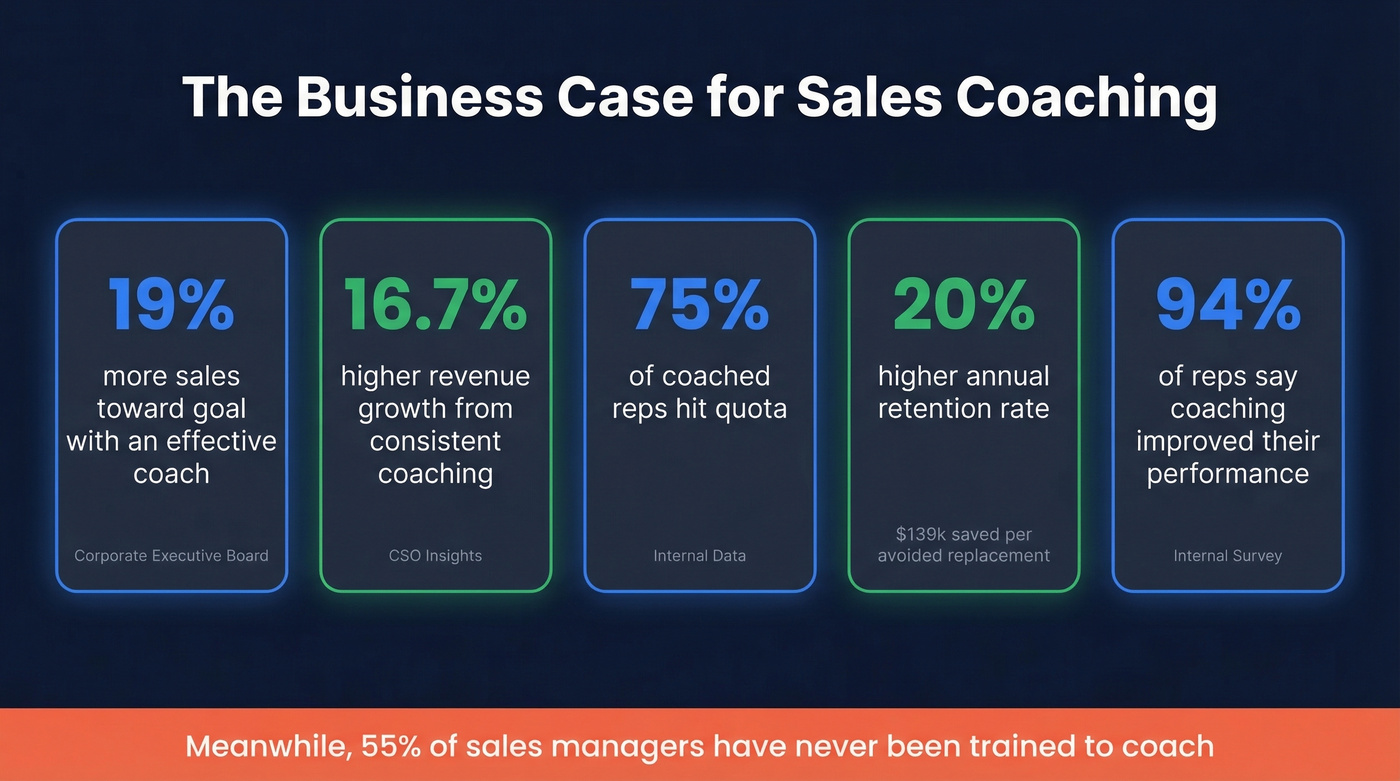
70% of training content is forgotten within a week. Coaching is what makes the other 30% stick. The 94% of reps who say coaching improved their performance aren't wrong - they're describing the only scalable way to turn knowledge into behavior. The global coaching industry hit $5.34B in 2026, with 87% of organizations reporting positive ROI. Coaching is the highest-leverage activity a frontline manager can do.
Sales Coaching vs. Sales Training
| Training | Coaching | |
|---|---|---|
| Format | Group, structured | 1:1, adaptive |
| Frequency | Quarterly / annual | Weekly |
| Focus | Knowledge transfer | Behavior change |
| Ownership | Enablement team | Frontline manager |
| Shelf life | 30% after one week | Compounds over time |
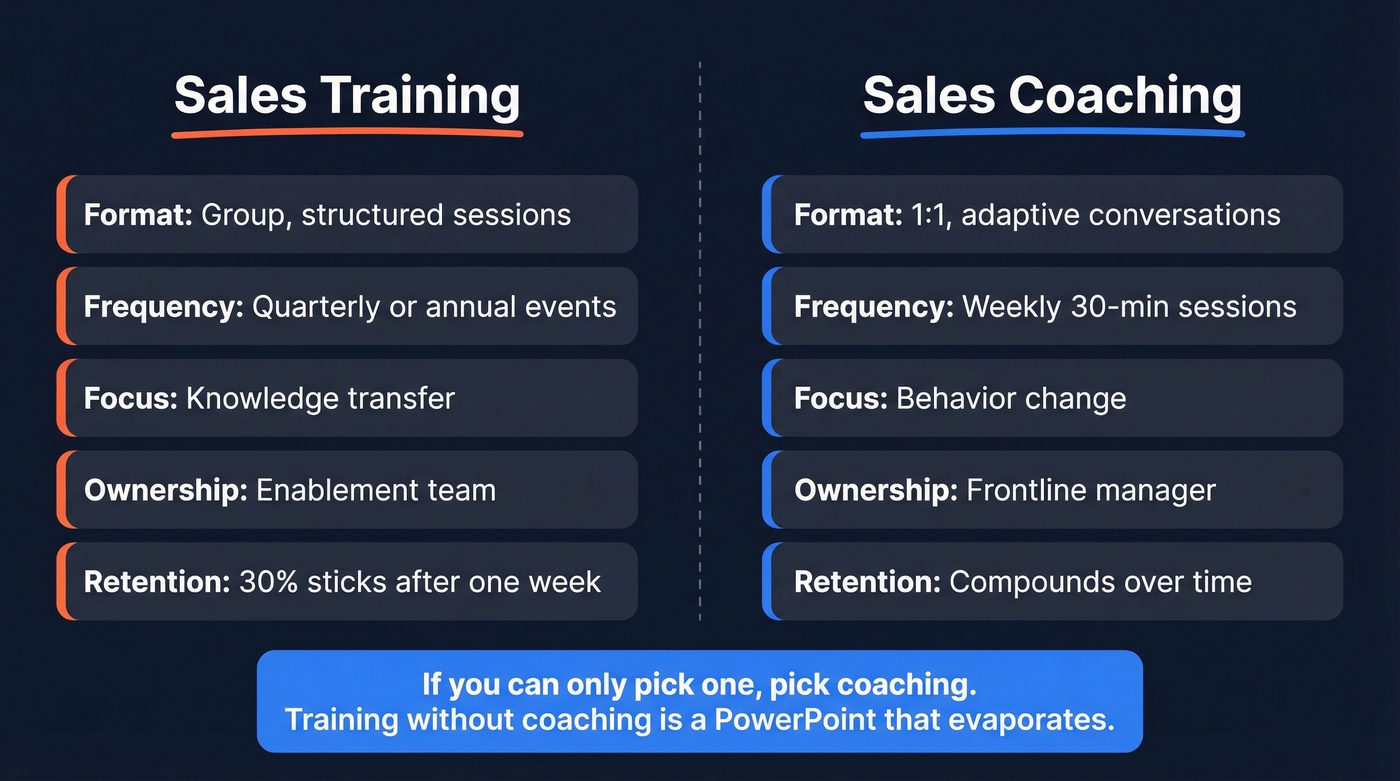
If you had to pick one, pick coaching. Training without coaching is a PowerPoint that evaporates. Coaching without training is slower but still builds skills.
7 Types That Actually Work
Effective coaching splits into two categories: strategic (how reps think about deals and territory) and tactical (how they execute specific skills). The best programs blend both.
Data-Driven Coaching
Pull up your CRM dashboard before every 1:1. Look at conversion rates between stages, not just pipeline totals. If a rep's discovery-to-demo rate is 40% while the team average is 65%, that's your coaching target for the week. One metric, one behavior, one improvement cycle.
Call Review (Game Tape)
Pick one call per rep per week. Listen together. Don't critique the whole thing - isolate one moment. "At 4:12, the prospect said 'we're evaluating options.' What did you hear? What could you have asked?" This is where coaching gets specific enough to change behavior.
If you want a more structured approach, run game film sessions with a simple rubric.
Role-Play
Most reps hate role-play because it's done badly - awkward, unrealistic, in front of the whole team. Do it 1:1 instead. Set up a specific scenario from a real deal. Three minutes, then debrief. AI roleplay tools like Hyperbound help, but a manager with a scenario and a timer works just as well. Of all the techniques we've tested, targeted role-play delivers the fastest skill transfer.
For ready-to-run prompts, use these role playing scenarios.
Deal Coaching
Different from pipeline review. Deal coaching means picking one active opportunity and working through it strategically: Who's the economic buyer? What's the decision process? Where are you weakest? This is where frameworks like MEDDIC become coaching tools, not just qualification checklists.
Peer Coaching
Pair your top performer with a mid-performer on a specific skill. The top rep teaches by articulating what they do instinctively, and the mid-performer gets a peer perspective that often lands differently than manager feedback. Rotate pairs monthly.
Recognition-Driven Coaching
Public recognition of specific behaviors - not just closed deals - reinforces what you're coaching. "Sarah asked the best discovery question I heard this week" is more powerful than "Sarah closed the biggest deal." Tie recognition to coached skills, not outcomes.
Strength-Based Coaching
Stop trying to fix every weakness. If a rep is exceptional at discovery but mediocre at closing, coach them to use that discovery strength to set up better closes. The Gallup StrengthsFinder tradition and positive psychology research both point the same direction: coaching to strengths produces faster improvement than fixing deficits. Adapting your style to each rep's strengths is what separates good managers from great ones.

Data-driven coaching only works if your CRM data is accurate. Prospeo enriches your pipeline with 98% verified emails, direct dials, and 50+ data points per contact - so when you coach reps on conversion rates, you're measuring skill, not bad data.
Stop coaching around bad data. Start coaching around real opportunities.
Sales Coaching Frameworks Worth Using
The GROW Model
Developed in the late 1980s by John Whitmore, Graham Alexander, and Alan Fine, GROW remains the most widely used coaching framework because it's simple enough for a 15-minute conversation and structured enough to produce real outcomes.
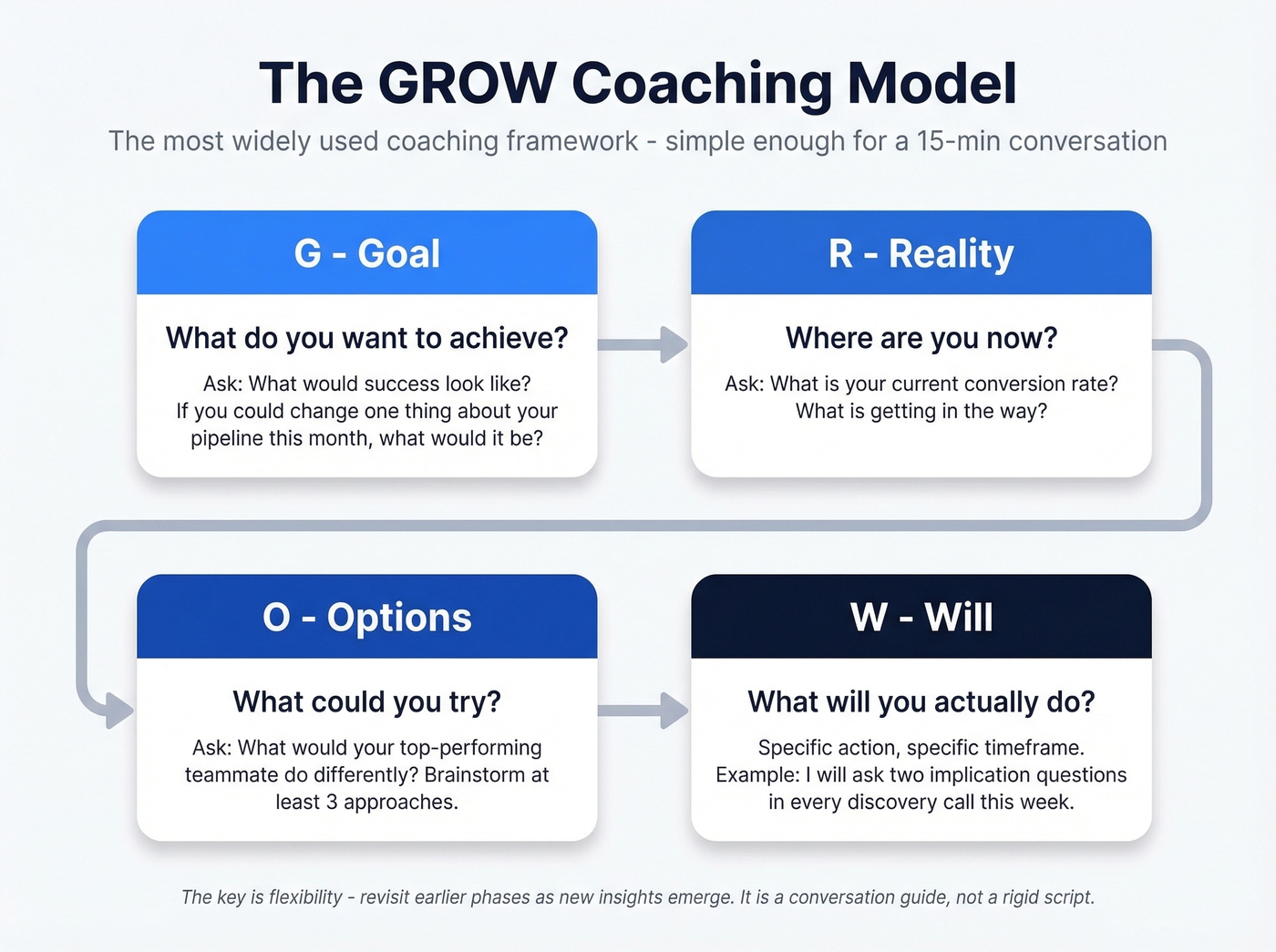
Goal: What do you want to achieve? Not "close more deals" - something specific. "Improve my discovery-to-demo conversion from 40% to 55%." Ask: What would success look like? If you could change one thing about your pipeline this month, what would it be?
Reality: Where are you now? This is where the rep self-diagnoses, which matters more than the manager diagnosing for them. Ask: What's your current conversion rate? What's getting in the way?
Options: What could you try? Brainstorm at least three approaches before committing. The manager's job here is to ask, not tell. Ask: What would your top-performing teammate do differently? What haven't you tried yet?
Will: What will you actually do? Specific action, specific timeframe. "I'll ask two implication questions in every discovery call this week and track them in my notes."
The key to GROW is flexibility - you can revisit earlier phases as new insights emerge. It's a conversation guide, not a rigid script.
The OSKAR Model
OSKAR (Outcome, Situation, Choices, Actions, Review) is GROW with an explicit review phase. If your rep tends to agree to action items and then forget them, OSKAR's built-in review loop helps. Use it when GROW feels too open-ended - it works best for reps who need more structured accountability.
The AOR Model
AOR (Activities, Objectives, Results) is the only coaching methodology designed specifically for sales. Start with the revenue target, reverse-engineer it into objectives like meetings booked and proposals sent, then break those into daily activities - 40 calls, 15 personalized emails, 5 social touches. It turns abstract quota numbers into concrete daily KPIs a rep can actually control. This is where the 19% mid-performer improvement stat comes from.
Coaching Inside Your Methodology
MEDDIC
Scenario: A $72k ARR partner-led deal is slipping. You walk through MEDDIC and find gaps - no access to the economic buyer, qualitative-only metrics, unknown decision process, and a champion who can't mobilize internally. The deal isn't dead, but it doesn't belong in the forecast either.
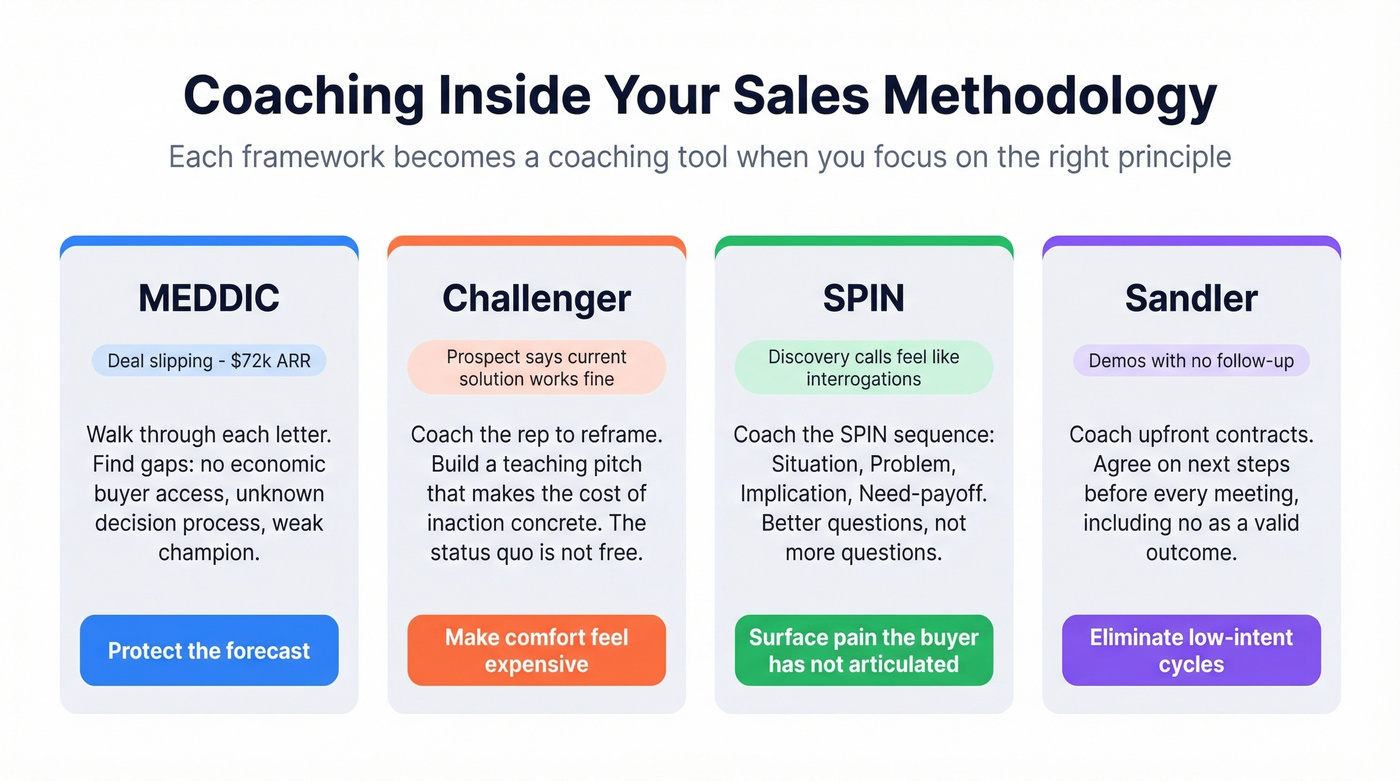
Principle: Protect the forecast. Expose weak deals before they surprise you at month-end.
Challenger
Scenario: A $350k opportunity is stalling because the prospect says their current solution "works fine." You coach the rep to reframe - build a teaching pitch that makes the cost of inaction concrete. The status quo isn't free; it's just invisible.
Principle: Make comfort feel expensive.
SPIN
Scenario: A rep is running discovery calls that feel like interrogations - rapid-fire questions with no depth. You coach them on SPIN's sequence: Situation, Problem, Implication, Need-payoff. The goal isn't more questions. It's better questions that surface pain the buyer hasn't fully internalized yet.
Principle: Highlight pain the buyer hasn't articulated to themselves.
Sandler
Scenario: A rep is running demos for prospects who never follow up. You coach them on upfront contracts - agreeing at the start of every meeting on what happens next, including "no" as a valid outcome. Fewer demos, faster decisions, zero ghosting.
Principle: Eliminate low-intent cycles before they consume your calendar.
The 10/10/10 Coaching Template
Most 1:1s are pipeline interrogation disguised as coaching. The manager asks "what's closing this month?" for 30 minutes, the rep feels defensive, and nothing changes. The fix is the 10/10/10 structure - 20% inspection, 80% coaching:
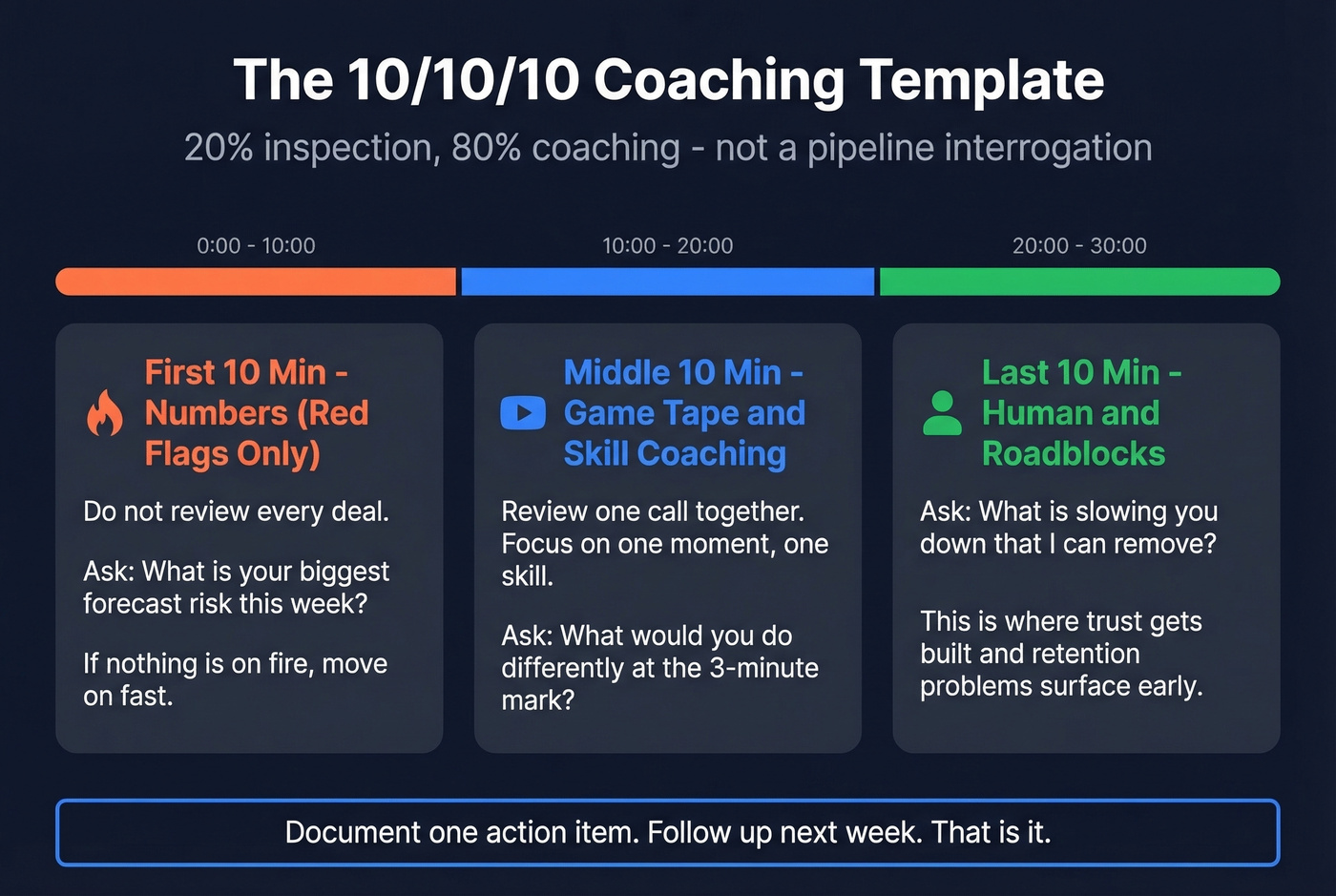
First 10 minutes - Numbers (red flags only). Don't review every deal. Ask: "What's your biggest forecast risk this week?" If nothing's on fire, move on fast.
Middle 10 minutes - Game tape / skill coaching. Review one call together. Focus on one moment, one skill. "What would you do differently at the 3-minute mark?" This is where small adjustments repeated weekly create lasting behavior change.
Last 10 minutes - Human / roadblocks. Ask: "What's slowing you down that I can remove?" This is where trust gets built - and where rep wellbeing surfaces before it becomes a retention problem.
Document one action item. Follow up next week. That's it.
5 Coaching Mistakes That Kill Performance
1. Pipeline interrogation disguised as coaching. If your 1:1 is 30 minutes of "what's closing?" you're inspecting, not coaching. The 10/10/10 template fixes this.
2. Coaching 12 things at once. One behavior per rep per week. Trying to fix discovery, closing, objection handling, and time management simultaneously guarantees none of them improve.
3. Only coaching low performers. The biggest ROI comes from coaching your middle 60%. Your bottom 10% need a performance plan, not coaching. Your top 10% are largely self-correcting. The middle is where that 19% improvement lives.
4. No follow-up. 59% of companies cite lack of accountability as the top barrier to effective training. If you don't follow up on last week's action item, you're signaling it didn't matter.
5. Accepting the "Law of Limited Performance." If you believe a rep has "reached their potential," you've set the ceiling. Raise the standard, coach to it, and watch what happens.
AI Sales Coaching Tools
The AI sales tools market hit $3B in 2025 and is growing ~13% annually. Teams using AI coaching see win rates improve by 32% and 50%+ faster time-to-proficiency. But let's be honest - strip away the marketing and these tools analyze conversations and surface patterns. That's valuable. It's not magic.
| Tool | Focus | Starting Price | Best For |
|---|---|---|---|
| Gong | Conversation intel | ~$1,200-1,600/user/yr | Enterprise (50+ reps) |
| Chorus (ZoomInfo) | Call recording | ~$100-150/user/mo | Mid-market on ZoomInfo |
| Highspot | Enablement + coaching | ~$50-80/user/mo | Content + coaching combo |
| Hyperbound | AI roleplay | From ~$40/user/mo | Practice-heavy cultures |
| Spekit | Just-in-time enablement | From ~$25/user/mo | Budget-conscious teams |
| Mindtickle | Readiness + coaching | Custom pricing | Enterprise enablement |
If you're evaluating platforms, start with a shortlist of sales enablement tools and map them to your coaching cadence.
I'll say it plainly: Gong at ~$1,200-1,600/user/year plus a platform fee is serious money. For a 20-rep team, that's easily $50k-$85k/year before you've coached a single call. If your average deal size is under $20k, skip Gong for now - start with your existing call recording tool and the 10/10/10 template. You'll get 80% of the value at 5% of the cost.
Measuring Coaching Impact
Track leading and lagging indicators. Leading indicators tell you if coaching is happening: session frequency, action item completion rate, call quality scores. Lagging indicators tell you if it's working: quota attainment, win rate, average deal size, ramp time, and retention.
If you need a clean measurement set, use these sales effectiveness metrics to avoid vanity reporting.
GreyScout cut rep ramp time from 8-10 weeks to 4 weeks by combining structured coaching with Prospeo's verified contact data - reps practiced on real conversations from day one instead of bouncing emails for their first month. That's the kind of compounding effect we've seen when coaching meets clean data: reps don't just know what to say, they have enough live conversations to practice saying it.
If session frequency is high but win rates aren't moving, you're coaching the wrong things. If win rates improve but sessions are inconsistent, you got lucky - and luck doesn't scale. The best sales coaching methods always include a measurement loop that connects coaching inputs to revenue outcomes.
Your reps can nail discovery, ace the role-play, and run a perfect GROW session - but none of it matters if they're emailing dead addresses. Prospeo's 7-day data refresh and 98% email accuracy mean coached behaviors actually reach decision-makers.
Make every coached rep dangerous by giving them data that connects.
FAQ
What's the difference between sales coaching and sales training?
Training delivers knowledge in a group setting; coaching is ongoing, individualized practice and feedback. Training is an event. Coaching is a habit. Teams that combine both see 16.7% higher revenue growth, but coaching prevents the 70% knowledge loss that follows any training session.
How often should managers coach reps?
Weekly 30-minute 1:1s at minimum. Consistency matters more than duration - a focused weekly session using the 10/10/10 template beats a sporadic monthly hour every time. Aim for six total coaching hours per week across your team.
Which coaching framework should I start with?
Start with GROW. It's the simplest, most widely validated model, and it forces you to ask questions instead of giving directives. Once you're comfortable, layer in AOR for sales-specific KPI coaching. Most managers see results within 3-4 weeks of consistent use.
How do I measure if coaching is actually working?
Track leading indicators like session frequency and action item completion alongside lagging indicators like quota attainment, win rate, and ramp time. If sessions happen weekly but win rates stall after 60 days, you're coaching the wrong skills. Expect measurable pipeline lift within one quarter of consistent execution.
What tools help scale coaching for remote teams?
Record every call with Gong or Chorus, review one per rep per week in your 1:1, and use async video feedback between sessions. For teams where reps struggle to fill their calendars with enough live conversations, clean contact data matters as much as the coaching tool itself - bounced emails and wrong numbers kill practice volume before coaching even starts.