

What Is a Sales Audit - and How to Run One That Actually Fixes Things
It's Q1 planning. The VP asks why the team hit 72% of quota. You open the CRM and realize nobody's audited the pipeline in 18 months. Meanwhile, nearly 84% of salespeople missed their targets last year. That's not a motivation problem - it's a visibility problem. Understanding what a sales audit is, and actually running one, is the first step toward fixing it.
A sales audit is a systematic review of your sales process, team performance, tools, and data against measurable benchmarks. This isn't a sales tax audit (that's a compliance exercise involving state revenue agencies). It's an operational audit of how your revenue engine actually works - and where it's leaking.
Quick version: A sales audit examines your entire revenue engine - process, people, tools, data - against benchmarks. Run one quarterly, annually at minimum. The highest-ROI starting point is auditing data quality first, because bad contact data poisons every metric downstream. Benchmarks worth knowing: 20-30% typical win rate, 2-5% lead-to-customer conversion, 84-day median sales cycle.
Why Sales Audits Matter
Most teams respond to missed targets by spending more on lead gen. That's backwards. An operational audit optimizes what you already have before you pour more money into the top of the funnel.
Companies with a formalized sales process generate up to 28% higher revenue, per Martal's summary of Harvard Business Review research. Yet 68% of salespeople don't follow a structured process. That gap means most teams are leaking revenue they've already paid to generate - and one practitioner on r/growmybusiness put it simply: the goal is to "convert leads that already show interest" rather than constantly chasing new ones.
Here's our honest take: if your average deal size is under $15k and your team is fewer than 10 reps, you probably don't need a $50k consulting engagement to audit your sales org. A spreadsheet, your CRM data, and two honest weeks of self-examination will get you 80% of the way there.
What a Sales Audit Covers
A thorough audit examines six categories. Skip any and you're grading an incomplete test.
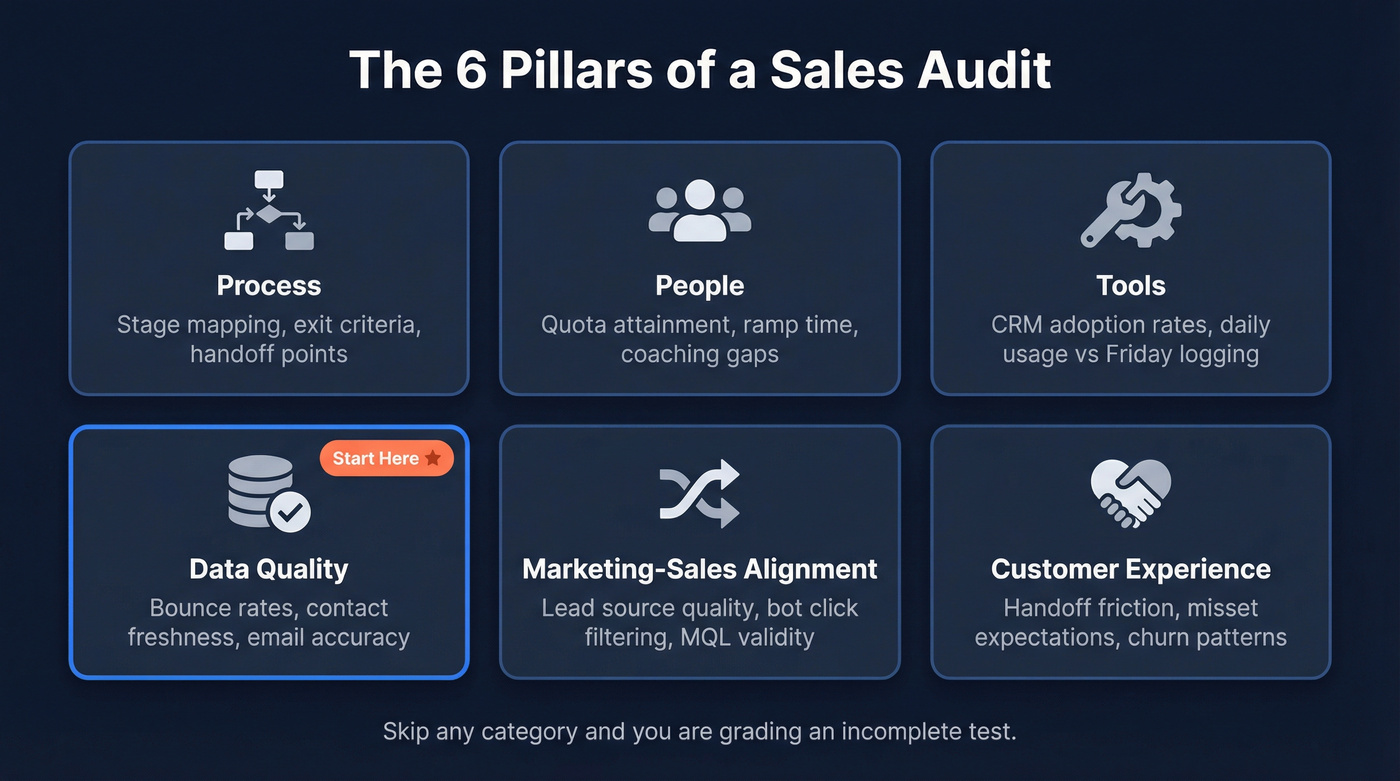
Process. Map every stage from lead to close. Document exit criteria, handoff points, and where deals stall. If reps can't articulate what moves a deal from Stage 2 to Stage 3, your process exists on paper only. (If you want a deeper framework, start with sales process basics.)
People. Evaluate rep performance against quota, activity metrics, and ramp time. Look for coaching gaps, not just performance gaps. The difference matters - a rep who's struggling because nobody taught them your discovery framework isn't a performance problem, it's a management one. (This is also where a solid 30-60-90 day plan helps.)
Tools. Are reps actually using the CRM daily, or logging retroactively on Fridays? Audit adoption rates, not just licenses purchased. If you're still debating platforms, see examples of a CRM.
Data quality. Your team sends 500 emails a day but books 3 meetings a week. Before blaming the messaging, check the data - how many of those emails actually reached a real inbox? This is where tools like Prospeo matter: 98% email accuracy and a 7-day data refresh cycle versus the 6-week industry average mean you're working with current, verified contacts instead of stale records. If your CRM is full of dead emails, every conversion metric downstream is fiction. (Related: email bounce rate benchmarks and fixes.)

Marketing-sales alignment. Audit lead source quality, not just volume. One practitioner who's audited 1,000+ marketing teams shared Q4 2025 bot-click minimums of 38% on Meta Instagram and 67% on Meta Audience Network. If marketing optimizes for CPL while a huge chunk of clicks are bots, your MQL numbers are meaningless. (If you need a shared language, align on lead generation metrics.)
Customer experience. Talk to CS. Post-sale friction - bad handoffs, misset expectations, churn patterns - often traces back to sales process failures an audit would've caught months earlier. (Tie this to churn analysis so you can quantify impact.)
How to Conduct a Sales Audit in 6 Steps
1. Define scope. Full funnel or one stage? Which team, geo, product line? A focused audit beats a sprawling one that never finishes. In our experience, a lightweight internal audit takes roughly 1-2 weeks; a full RevOps overhaul runs 4-8 weeks. If you're formalizing ownership, a RevOps Manager typically drives this.
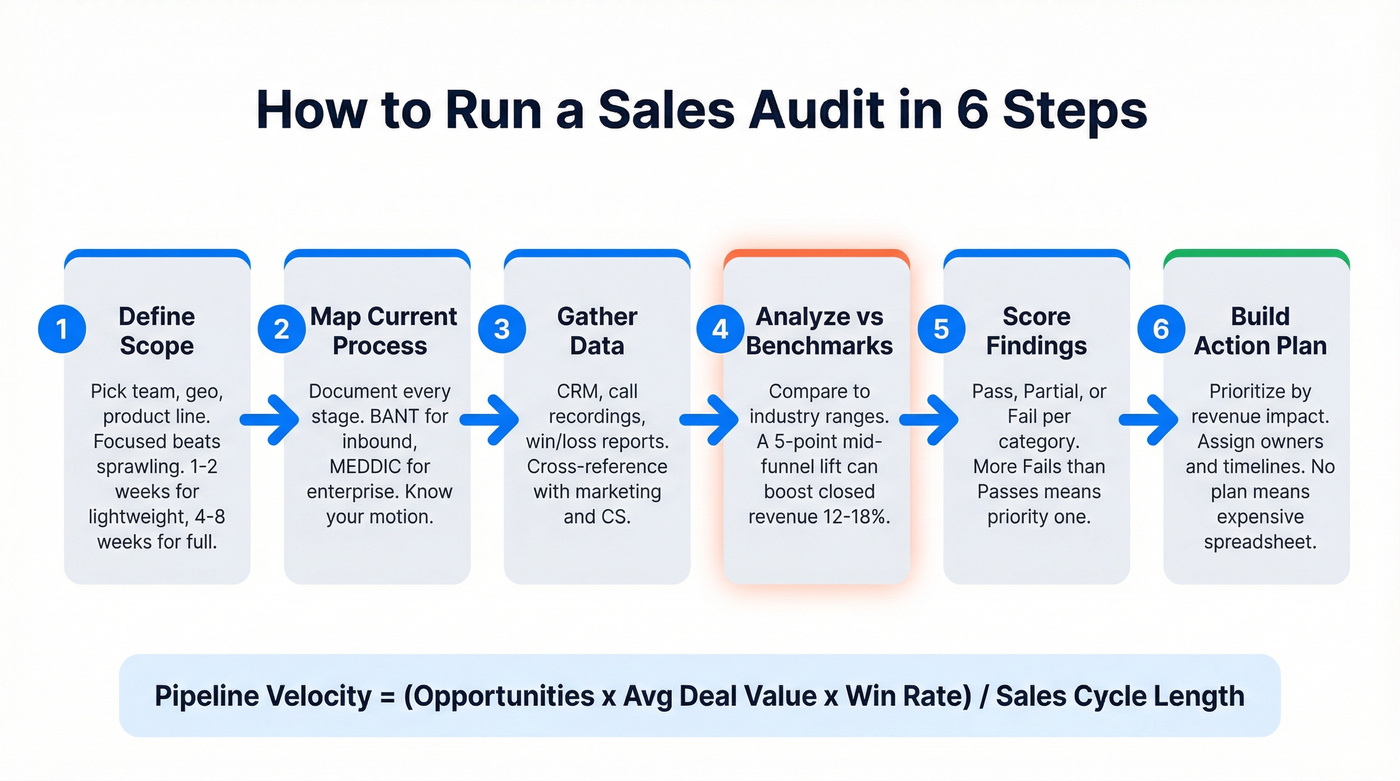
2. Map your current process. Document every stage, including qualification methodology. BANT works for inbound sorting. MEDDIC is for deal inspection on enterprise deals. Know which one fits your motion - if you're running $80k+ deals without MEDDIC, your pipeline is a wish list. (If you want to go deeper, use MEDDIC sales qualification.)
3. Gather data. Pull from your CRM, call recordings, win/loss reports, and activity logs. Cross-reference with marketing on lead source quality and with CS on post-sale friction. The best audits combine quantitative data with qualitative inputs like rep feedback and deal reviews, because numbers tell you what is broken while conversations tell you why. (For what to track, start with funnel metrics.)
4. Analyze against benchmarks. Every guide tells you to "analyze your metrics." Analyze them against what? This table is your answer key:
| Metric | SMB (<100) | Mid-Market (100-999) | Enterprise (1,000+) |
|---|---|---|---|
| Win rate | 30-40% | 25-35% | 20-25% |
| Lead to Customer | 3-5% | 2-4% | 1-3% |
| MQL to SQL | ~39% | ~35% | ~31% |
| Sales cycle | 46-75 days | ~84 days | 90-180 days |
Here's the thing: a 5-point lift in a single mid-funnel conversion stage can increase closed revenue by 12-18%. You don't need more leads. You need to stop losing the ones you have. (If you want more ranges, see sales pipeline benchmarks.)
Use the pipeline velocity formula to quantify throughput: (Opportunities x Avg Deal Value x Win Rate) / Sales Cycle Length. This single number tells you whether your engine is accelerating or stalling. (More on this in pipeline health.)
5. Score findings. Use Pass / Partial / Fail for each category. Any category with more Fails than Passes is your first priority.
6. Build an action plan. Prioritize by revenue impact, not by what's easiest. Assign owners and timelines. An audit without an action plan is just an expensive spreadsheet.

Your audit just flagged data quality. Now fix it. Prospeo's 98% email accuracy and 7-day refresh cycle mean your CRM stays current - not full of dead contacts that poison every conversion metric downstream.
Stop auditing bad data. Start with verified contacts at $0.01 each.
Sales Audit Checklist (Scored)
Use this checklist to score each item Pass, Partial, or Fail. Any category with more Fails than Passes is where you start.
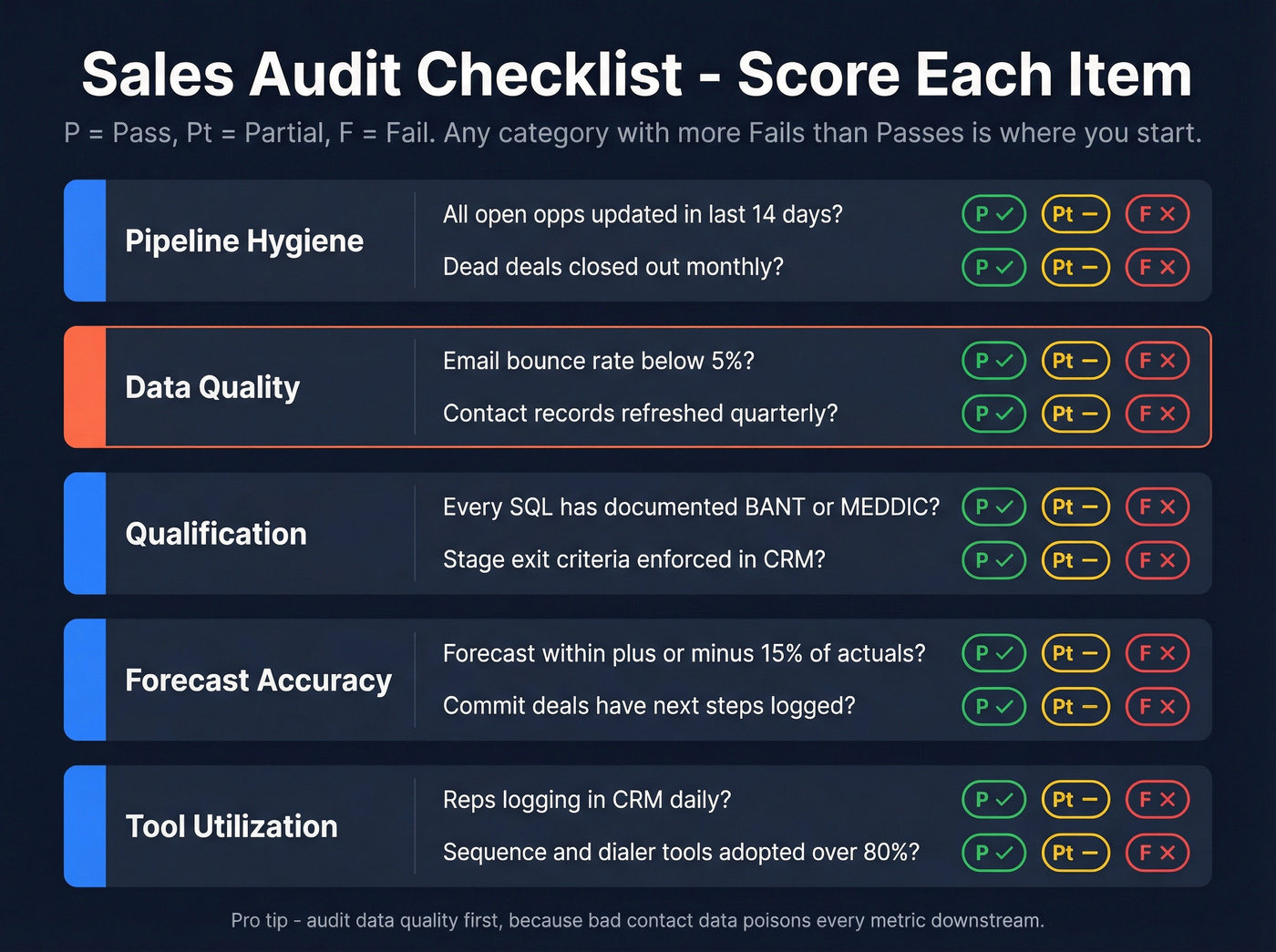
| Category | Question | Score |
|---|---|---|
| Pipeline Hygiene | All open opps updated in last 14 days? | P / Pt / F |
| Pipeline Hygiene | Dead deals closed out monthly? | P / Pt / F |
| Data Quality | Email bounce rate below 5%? | P / Pt / F |
| Data Quality | Contact records refreshed quarterly? | P / Pt / F |
| Qualification | Every SQL has documented BANT/MEDDIC? | P / Pt / F |
| Qualification | Stage exit criteria enforced in CRM? | P / Pt / F |
| Forecast Accuracy | Forecast within +/-15% of actuals? | P / Pt / F |
| Forecast Accuracy | Commit deals have next steps logged? | P / Pt / F |
| Tool Utilization | Reps logging in CRM daily? | P / Pt / F |
| Tool Utilization | Sequence/dialer tools adopted >80%? | P / Pt / F |
Common Pitfalls
Auditing manually without tooling. RevOps teams on r/SalesOperations flag that auditing process changes by hand is time-consuming and error-prone. Details get missed, especially during workflow updates.
No benchmarks to compare against. Without baseline ranges, you're grading a test without an answer key. Use the table above or pull from Alexander Group's benchmarking methodology.
Treating it as a one-time event. Annual is the bare minimum. Quarterly is where the value compounds. The best RevOps teams run lightweight monthly pipeline reviews and a full audit every quarter.
Ignoring data quality upstream. We've seen teams waste weeks analyzing metrics built on bad inputs. If even 10-15% of your emails bounce - well above the 5% threshold in the checklist - your conversion rates are fiction. Verify your contact data before drawing conclusions from funnel metrics. Skip this step and everything else you find in the audit is suspect.
Case Study: Apify's 130% Win Rate Lift
Apify, a company with roughly EUR 12.3M in revenue in 2024 and 15,000+ recurring customers, ran a structured sales audit in mid-2024. They found qualification gaps and inconsistent pipeline stages. Over 12 months, they implemented MEDDPICC-style qualification, milestone-based stages, and weekly deal reviews. Their win rate jumped from ~20% (H1 2024) to 46% (H1 2025) - a 130% improvement.
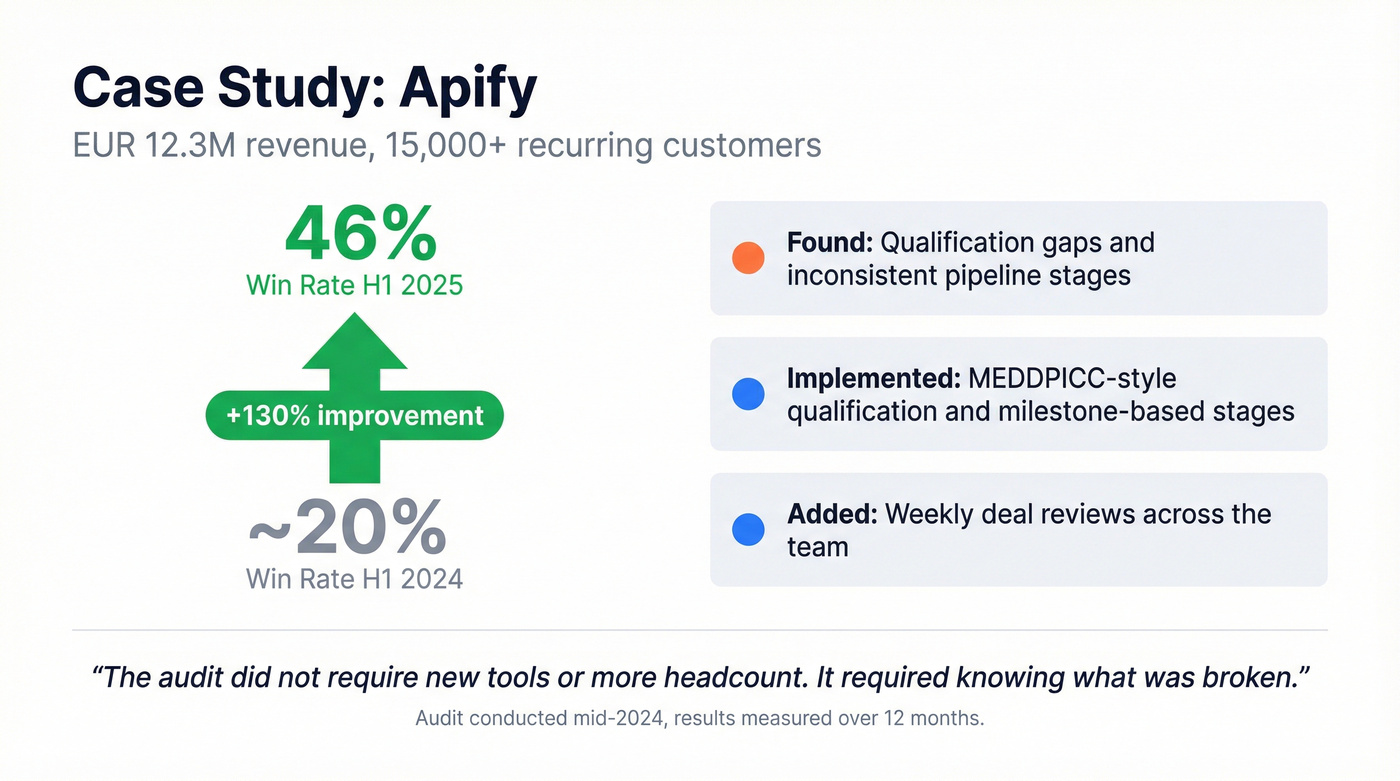
The audit didn't require new tools or more headcount. It required knowing what was broken.
We've seen similar patterns across smaller teams too. The audit itself isn't the hard part. The hard part is acting on what it reveals.
A sales audit without clean data is just paperwork. Prospeo enriches your CRM with 50+ data points per contact at a 92% match rate - so your pipeline metrics reflect reality, not stale records from six weeks ago.
Enrich your CRM and make every audit metric actually mean something.
FAQ
How often should you run a sales audit?
Quarterly delivers the most value; annual is the bare minimum. The best RevOps teams run lightweight monthly pipeline reviews alongside a full quarterly audit, catching drift before it compounds into missed targets.
What's the difference between a sales audit and a sales tax audit?
A sales audit reviews your process, team performance, and pipeline health to improve revenue outcomes. A sales tax audit is a government compliance review of tax collection accuracy - completely different exercises with different stakeholders.
How do you run an audit without expensive consultants?
You need your CRM data, a scored checklist like the one above for grading each category, and a data verification tool to confirm contact accuracy before analyzing conversion metrics. Conversation intelligence tools like Gong or Chorus help with the qualitative side. Follow the six steps outlined above and you can run a meaningful audit internally in one to two weeks.