

Pipeline Coaching: The Framework That Turns Reviews Into Revenue
A RevOps lead we know ran a pipeline review last quarter - 30 deals in 28 minutes. Every rep got the same two questions: "What stage is this?" and "When does it close?" Nothing changed. The pipeline looked identical the following week, minus two deals that went dark.
That's not pipeline coaching. That's attendance.
What You Need (Quick Version)
- Stop reviewing 30 deals in 30 minutes - pick 2-3 at-risk deals and go deep.
- Coach to behaviors (qualification rigor, advancing discipline), not results ("close more deals").
- Track four metrics: coverage ratio, stage conversion, velocity, win rate.
- Fix your data first - coaching can't save a pipeline built on bounced emails and disconnected numbers.
What Pipeline Coaching Actually Is
This discipline isn't the same as a pipeline review or deal coaching. These activities get conflated constantly, and the confusion is why most "coaching" sessions feel like CRM audits.
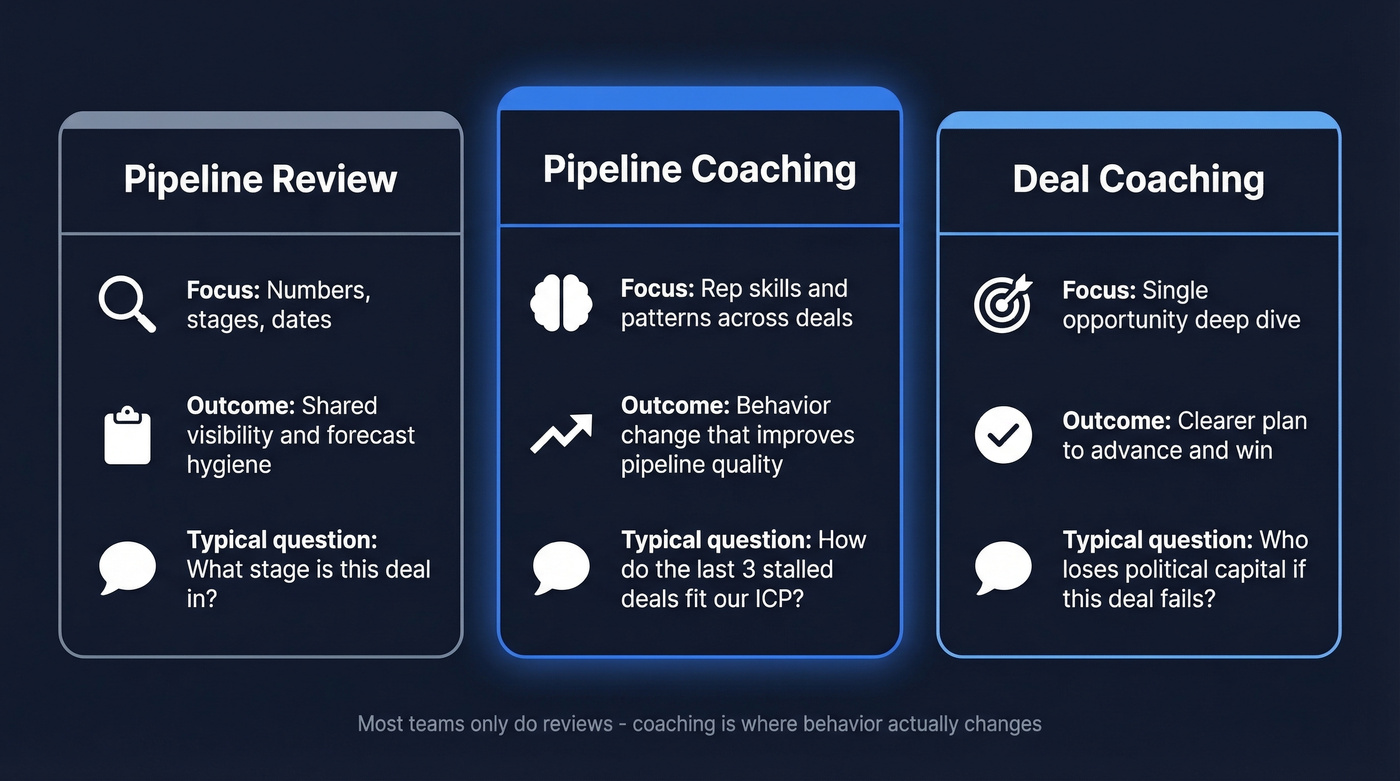
Here's the test: if you're asking "what stage is this?" - you're reviewing. If you're asking "how do the last three stalled deals fit our ICP?" - you're coaching sales reps on patterns that actually matter.
| Activity | Focus | Outcome |
|---|---|---|
| Pipeline review | Numbers, stages, dates | Shared visibility and forecast hygiene |
| Pipeline coaching | Rep skills, patterns across deals | Behavior change that improves pipeline quality |
| Deal coaching | Single opportunity | A clearer plan to advance and win the deal |
Pipeline coaching uses the pipeline as a lens to develop rep skills - qualification rigor, objection handling, commitment to concrete next steps - so the numbers change because the behaviors change. Deal coaching zooms into one opportunity. Reviews just inspect the spreadsheet.
Why It Matters
Coaching programs produce an 8% lift in team performance according to Gartner. Teams receiving consistent coaching see 16.7% higher revenue growth. And 75% of coached reps hit quota.
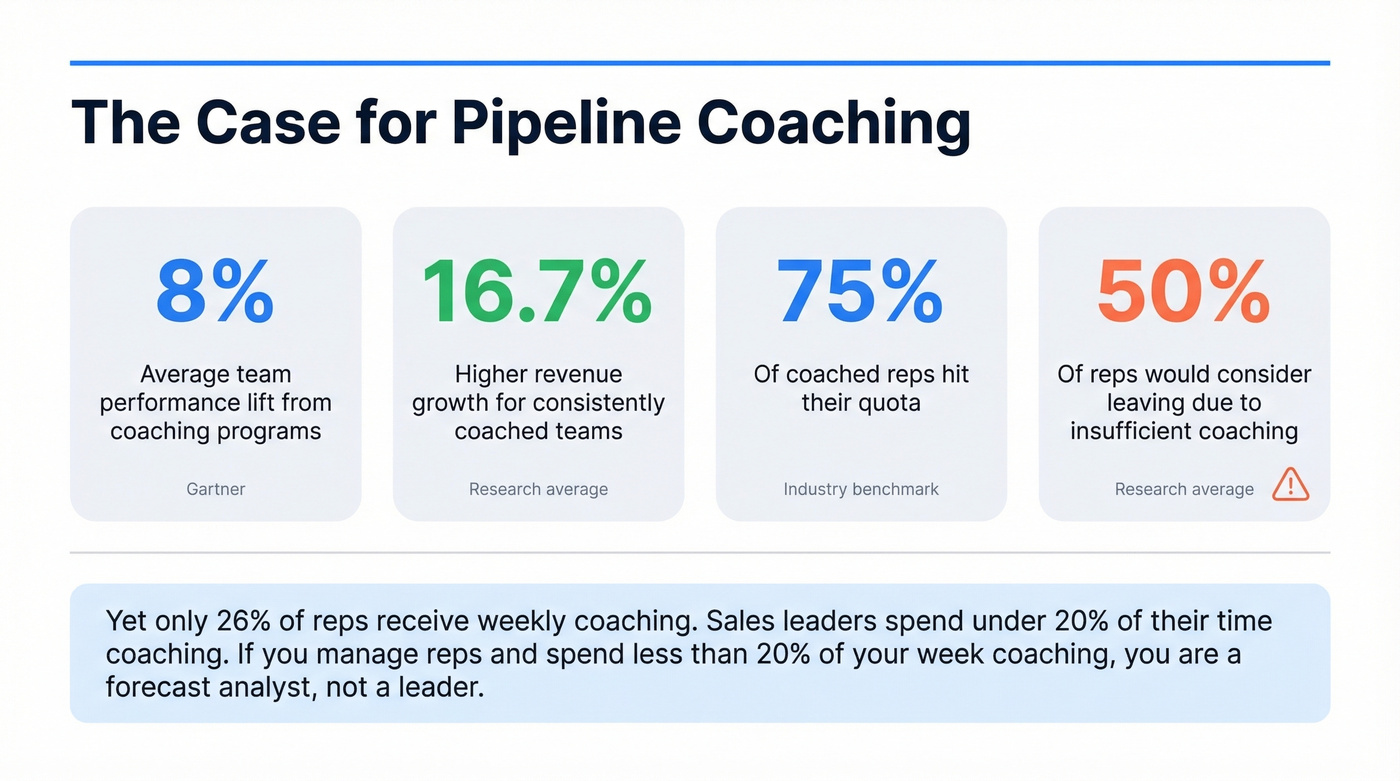
Yet only 26% of reps receive weekly coaching. Half say they'd consider leaving their role due to insufficient coaching - which means the retention cost of skipping it is real. The ROI is there, but most orgs leave it on the table because coaching feels less urgent than closing.
Here's the thing: pipeline coaching is the highest-leverage activity a sales manager can do, and it's the one they consistently deprioritize. CSO Insights research shows sales leaders spend under 20% of their time coaching. If you manage reps and spend less than 20% of your week in coaching sessions, you're a forecast analyst, not a leader.
The 4V Framework for Pipeline Health
Four dimensions tell you whether your pipeline is real or just a collection of hopeful CRM entries: Volume, Value, Coverage, and Velocity.
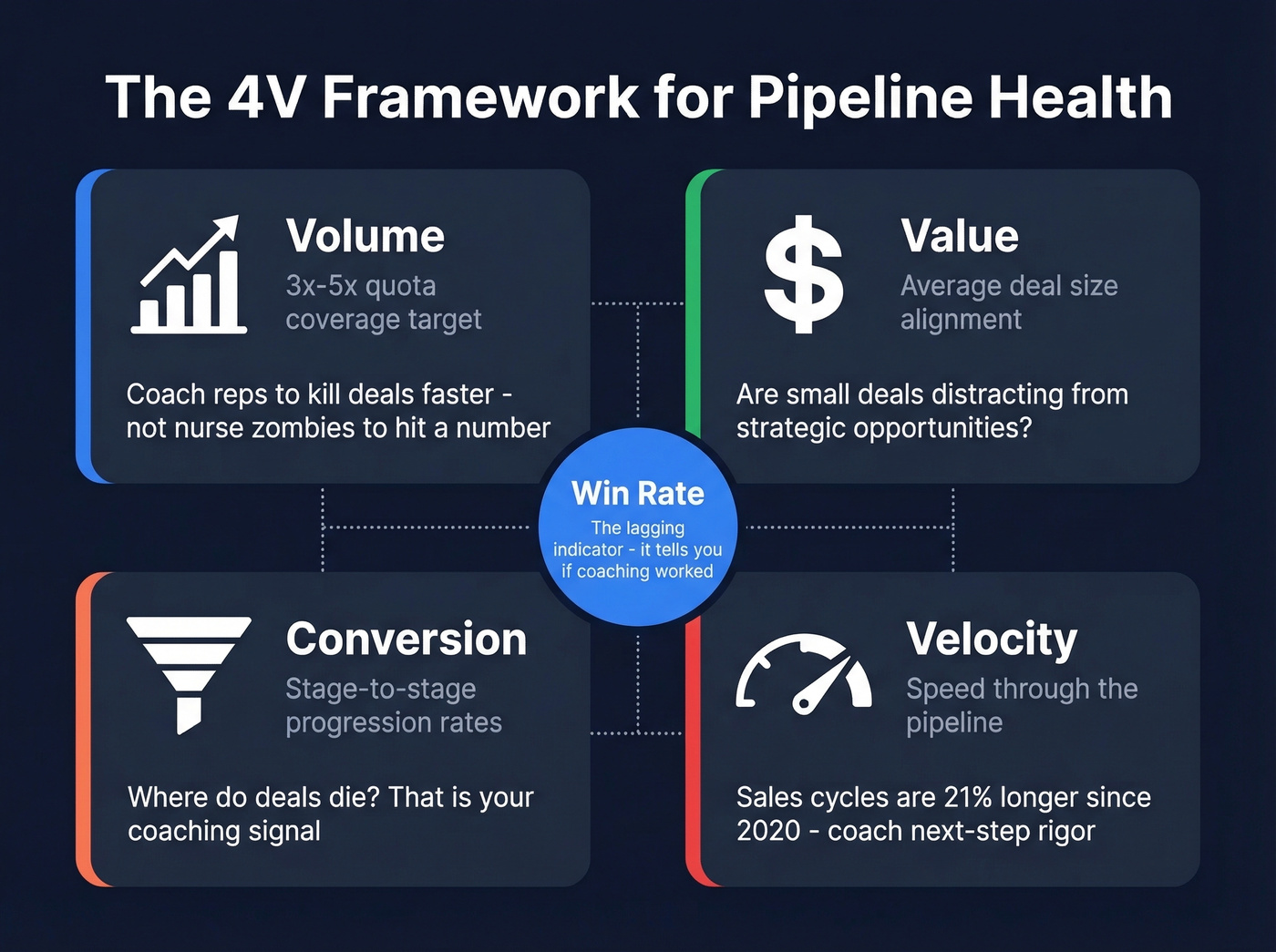
Coverage ratio is the one managers obsess over, and it's also the most gameable. Healthy pipelines run 3x-5x quota, but 3x coverage built on zombie deals is worse than 1.5x of qualified pipeline. Coach reps to kill deals faster instead of nursing them to hit a coverage target.
Value means average deal size. If your pipeline is stuffed with small deals that distract from strategic opportunities, that's a coaching conversation about qualification and ICP fit - not a volume problem.
Stage conversion rate reveals where deals die. If a large share stall at proposal, that's a coaching signal pointing to weak business-case building or missing champions. We've seen teams cut proposal-stage attrition by 30% just by coaching reps to confirm economic buyer access before sending a single slide.
Velocity is the silent killer. Sales cycles are 21% longer than in 2020. If yours are stretching further, coach to next-step rigor - every meeting ends with a specific, calendared commitment, not "let's circle back."
Win rate is the lagging indicator. It tells you coaching worked - or didn't.

You can't coach reps on pipeline quality when the pipeline is full of bounced emails and disconnected numbers. Prospeo gives you 98% verified emails and 125M+ mobile numbers with a 30% pickup rate - so every deal in your pipeline starts with a real conversation, not a dead end.
Stop coaching around bad data. Start with contacts that actually connect.
How Coaching Improves Forecasting
One underappreciated benefit of consistent coaching: your forecast gets dramatically more accurate.
When reps learn to qualify rigorously and kill zombie deals early, the pipeline they report reflects reality instead of optimism. Forecast accuracy improves because coached reps assign realistic close dates, flag risk earlier, and stop inflating stage probabilities to look busy. The 4V framework above doubles as a forecasting hygiene tool - if coverage, velocity, and conversion rates are healthy, your forecast almost takes care of itself.
Questions That Drive Real Coaching
The questions you ask determine whether you're coaching or just auditing. The consensus on r/sales threads about coaching is blunt: most sessions feel like CRM interrogations, and reps tune out within five minutes.
Questions to Stop Asking
Close dates, email follow-ups, stage labels, probability percentages - these are data traps with one-word answers that teach reps nothing. You can pull every one of them from your CRM before the meeting starts. Don't waste live coaching time on data retrieval.
Pipeline-Level Questions
These force reps to think about patterns, not individual data points:
- "Are you happy with your pipeline health - how would you like it different?"
- "Which opportunities aren't as promising as you thought?"
- "What happens if this large deal goes silent?"
- "Which stage is hardest to move deals through?"
We've watched teams get materially better stage conversion just by switching from 30-deal reviews to 3-deal deep dives. Depth beats breadth every time.
Deal-Level Questions
When you go deep on a specific deal, these surface real risk:
- Why buy now versus do nothing?
- Who loses political capital if this deal fails?
- What objection hasn't been said out loud yet?
- What's the definitive next step - a specific action with a date, not "follow up"?
- Why will this deal NOT close?
That last one is a presumptive question. It forces the rep to argue against their own optimism, which is where the real insight lives.
Extending Coaching Into Account Plans
Pipeline coaching naturally extends into account planning when reps manage multi-threaded, strategic deals. If a rep has three stalled opportunities at the same enterprise account, that's not three deal problems - it's an account strategy problem.
Use your coaching sessions to help reps map stakeholders, identify expansion paths, and align their pipeline activity with a coherent account plan instead of treating each opportunity in isolation. For teams that run named-account models, this is where coaching and strategy planning merge into the same conversation, and it's often the most productive 15 minutes of the week.
Mistakes That Kill Coaching Performance
1. Coaching too infrequently. Only 26% of reps get weekly coaching. Monthly isn't enough - by then, deals have already stalled or died. Weekly or bi-weekly is a strong operating rhythm for most frontline teams.
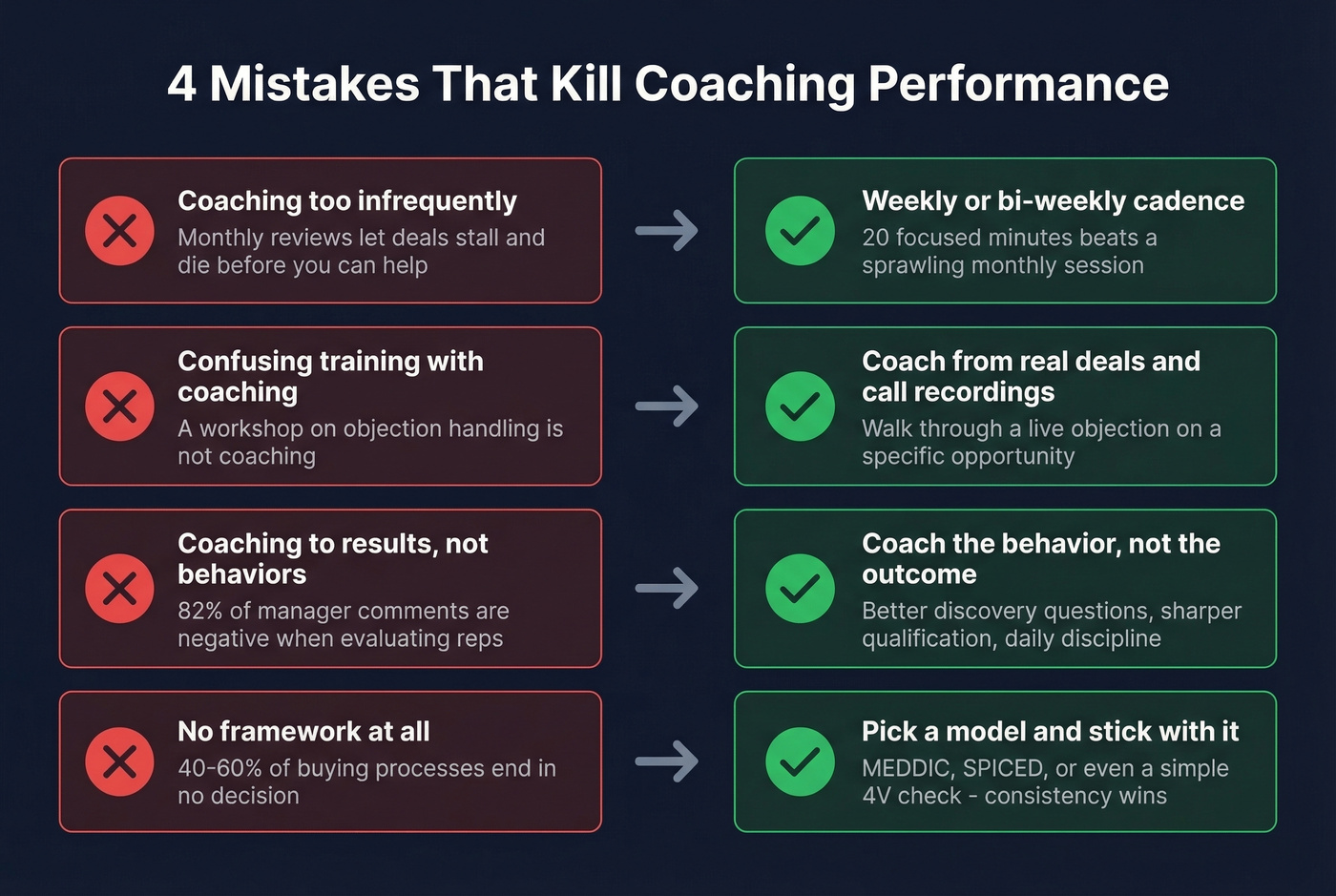
2. Confusing training with coaching. Training teaches skills. Coaching applies them to real deals in real time. A workshop on objection handling isn't coaching - walking through a live objection on a specific deal is. Sit in silently on calls or review recordings before sessions. Coach from evidence, not assumptions.
3. Coaching to results, not behaviors. "Close more deals" isn't coaching. One study found 82% of manager comments were negative when asked to evaluate reps. Coach the behavior - better discovery questions, sharper qualification, daily prospecting discipline - and the results follow.
4. No framework. Without structure, coaching devolves into storytelling. 40-60% of buying processes end in no decision, and about 60% of those stem from buyer indecision. A framework helps reps identify and address indecision early, instead of nursing zombie deals for months. Skip the ad hoc approach - pick a model (MEDDIC, SPICED, or even a simple pipeline health check) and stick with it.
Fix the Data Before You Coach
Let's be honest about something most coaching guides ignore entirely.
An SDR manager sits down for a coaching session. The rep has 200 leads in play, but only 40 converted to meetings. The manager starts coaching qualification skills - but the real problem is that emails are bouncing and phone numbers are disconnected. That's a data problem masquerading as a skills gap, and we've seen it derail coaching programs at companies of every size.

If your bounce rates are high, no amount of pipeline coaching will fix your conversion rates. Prospeo's 98% email accuracy and 7-day data refresh cycle ensure the pipeline your reps are working is actually real - not a spreadsheet full of dead contacts. Meritt saw their pipeline triple from $100K to $300K per week after switching, with bounce rates dropping from 35% to under 4%.
Coaching assumes the pipeline is real. Fix the data layer first, then coach the skills.
Zombie deals thrive on stale data. Prospeo refreshes every record on a 7-day cycle - 6x faster than the industry average - so your reps coach around live opportunities, not contacts who changed jobs six weeks ago. Coverage ratios mean nothing when half your pipeline is ghosts.
Kill zombie deals at the source. Get data that's refreshed weekly.
FAQ
How often should you do pipeline coaching?
Weekly or bi-weekly for frontline reps. Consistent cadence matters more than session length - a focused 20-minute session beats a sprawling monthly review. Teams that coach weekly see measurably higher quota attainment than those running monthly sessions.
What's the difference between pipeline coaching and a pipeline review?
A review inspects stages, close dates, and probabilities. Coaching develops rep skills - qualification, objection handling, deal advancement - that change those numbers. The best managers use coaching sessions to build lasting habits, not just update a spreadsheet.
How does data quality affect coaching outcomes?
Bad contact data creates phantom pipeline - deals built on bounced emails and disconnected numbers. When your reps are working verified contacts on a weekly refresh cycle, the pipeline reflects real opportunities worth coaching around rather than ghost leads inflating coverage ratios.
Can pipeline coaching improve forecast accuracy?
Yes - coached reps assign realistic close dates, flag risk earlier, and stop inflating stage probabilities. Organizations with consistent coaching cadences report significantly tighter forecast variance because the pipeline data reflects genuine buyer engagement, not rep optimism.