Gamification Lead Generation: What Works, What Fails, and What Vendors Won't Tell You
You ran a holiday spin-to-win campaign. 5,000 emails captured in 72 hours. Marketing high-fives all around - until you load that list into your sequencer and 40% bounce. Your sender reputation tanks, your domain gets flagged, and those 5,000 "leads" become a liability instead of pipeline.
The gamification lead generation market is racing toward $92.5 billion by 2030, up from $19.42 billion today. Over 70% of Global 2000 companies already use some form of gamification. Everyone's building quizzes, wheels, and scratch cards. Almost nobody's talking about what happens after the game ends - and that's where most campaigns quietly die.
The real challenge isn't capturing leads through gamified experiences. It's making them usable. Gamified forms incentivize throwaway emails, typos, and contest-only addresses at rates that would make your deliverability team weep. The companies winning with this strategy aren't the ones with the cleverest game mechanics - they're the ones who built a verification and enrichment layer between "lead captured" and "lead contacted."
The Quick Version
Before you get into psychology and tactics, here's the cheat sheet:
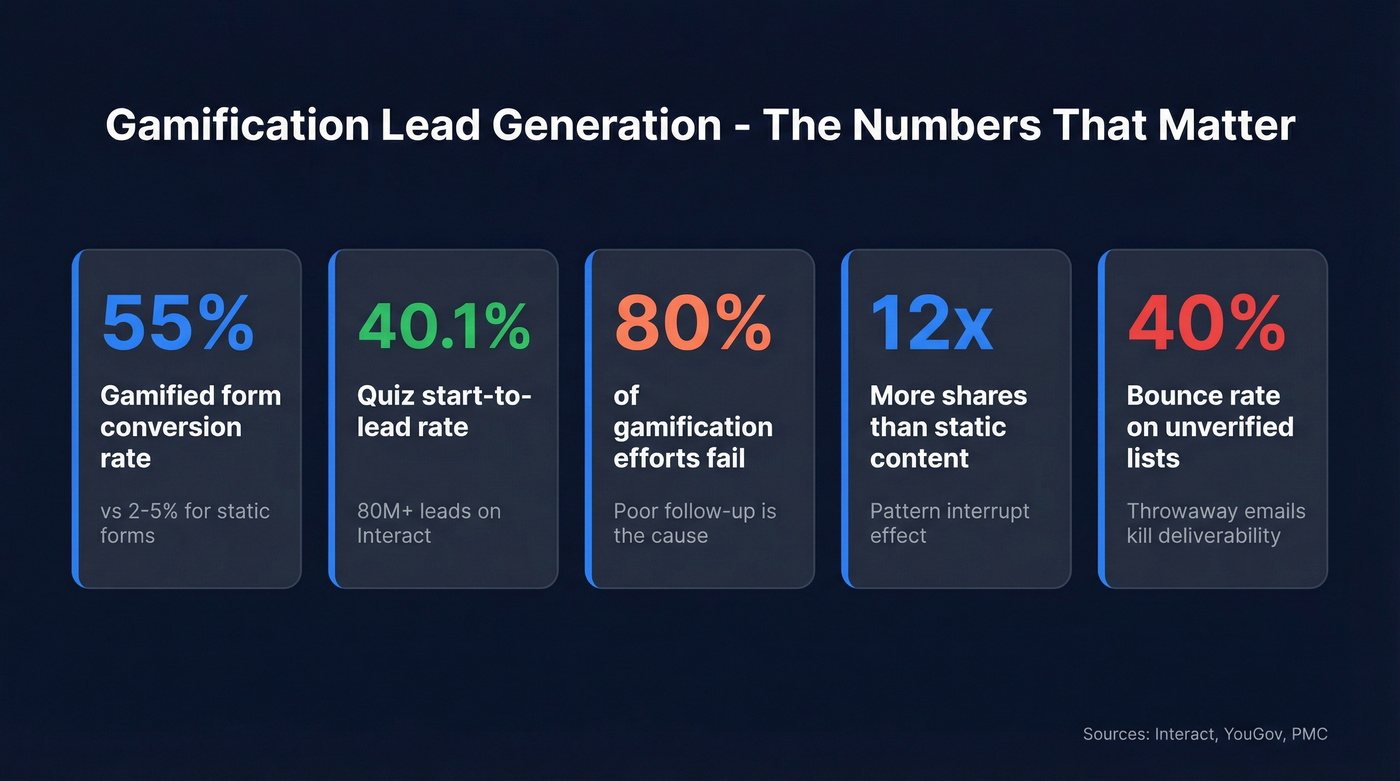
- Gamified lead capture converts 10-25x higher than static forms - 55% conversion rates vs. 2-5% for a standard email signup box.
- Quizzes are the highest-ROI mechanic - a 40.1% start-to-lead conversion rate across 80M+ leads generated through Interact's platform since 2013. Nothing else comes close.
- 80% of gamification efforts fail. Not because the game was bad - because the follow-up was nonexistent.
- Budget starting point: $33/mo. Faisco's Basic plan gets you 2,000 participants and 8 award types. Custom B2B builds run $10K-$25K.
- The step most teams skip: verify and enrich before outreach. Gamified forms attract throwaway emails at 2-3x the rate of gated content downloads. Clean the list before you touch it.
Why Gamification Works - The Psychology
Vendors will tell you gamification works because "people like games." That's like saying restaurants work because "people like food." The real answer is more specific - and more useful for designing campaigns that actually convert.
The Dopamine Anticipation Loop
Here's the thing most marketers get wrong: dopamine isn't a pleasure chemical. It's an anticipation chemical. The highest dopamine spikes happen before the reward, not during it. When someone sees a spin-to-win wheel, their brain enters a high-alert anticipation state before they ever click. That "maybe" factor - the uncertainty of what they'll get - is doing the heavy lifting.

This is why a scratch card revealing a 10% discount converts dramatically better than just showing the same 10% discount in a banner. The reward is identical. The neurochemistry isn't.
The Zeigarnik Effect (Why Progress Bars Work)
In 1927, psychologist Bluma Zeigarnik discovered that the brain remembers incomplete tasks far better than completed ones. A progress bar sitting at 90% is almost physically uncomfortable to leave unfinished.
Smart gamification designers exploit this by giving users "artificial advancement" - a first star or level just for showing up. That open loop creates a psychological itch that drives completion.
Variable Rewards and Loss Aversion
When users don't know exactly what they'll win, anticipation releases more dopamine than a fixed reward. Combine that with the endowment effect - people value things they've "earned" roughly 2x more than things they receive passively - and you've got a conversion machine.
A 10% discount won through a game converts far better than the same 10% discount offered in a popup. The user feels like they earned it. Loss aversion kicks in: abandoning that earned discount feels like losing something they already own.
Pattern Interrupt: Why Games Beat Banners
Your brain has learned to ignore banner ads - a phenomenon called banner blindness, studied for over two decades. But an interactive game element triggers a different neural pathway entirely. The brain recognizes it as a potential reward opportunity worth investigating.
Static content gets filtered. Interactive content gets attention.
Gamified content is shared 12x more than non-gamified content. That's not because people love your brand. It's because the game triggers a pattern interrupt strong enough to break through the noise.

Gamified campaigns capture thousands of emails fast - but 40% bounce rates destroy your sender reputation overnight. Prospeo's 5-step verification catches throwaway emails, spam traps, and typos before they touch your sequencer. 98% accuracy. $0.01 per email. Enrich every verified lead with 50+ data points so you know who's a buyer and who's a freebie hunter.
Verify and enrich your gamified leads before your domain pays the price.
Gamified Lead Capture Tactics That Actually Work
Not all mechanics are created equal. Here's what the data says about each one - and when to skip it.

Interactive Quizzes (The Highest-ROI Mechanic)
Quizzes are the workhorse of gamified lead gen. Interact's platform has generated 80M+ leads since 2013 with a consistent 40.1% start-to-lead conversion rate. Compare that to static forms at 2-3%, and you're looking at a 13-20x improvement.
Personality quizzes hit 60-80% completion rates - the highest of any quiz type. Assessment quizzes land at 45-65%. Knowledge quizzes at 40-65%.
Use this if: You need qualified leads with self-reported data (preferences, pain points, buying stage). The quiz answers are the qualification data.
Skip this if: Your audience is highly technical and would find a quiz patronizing. A VP of Engineering isn't taking "What Kind of DevOps Leader Are You?" seriously.
The most common reason quizzes fail? The topic isn't relevant to the audience. A SaaS company running a "Which Disney Princess Are You?" quiz will get completions and zero pipeline. Match the quiz to the buying journey.
Spin-to-Win Wheels and Scratch Cards
These are the flashiest mechanic - and the most dangerous if you get the prize logic wrong.
The Clermont Hotel Group ran an "unwrap the gift" promotion that hit a 78% conversion rate: 12,918 unique visitors, 10,064 entries. Staggering. But the key detail most people miss is that these campaigns work best when the reward is immediately redeemable and tied to a specific action (book a room, make a purchase). Extraco Bank used gamification mechanics to drive a 700% increase in customer acquisitions. That's not a typo.
Best for: B2C, time-bound promotions with a tightly controlled prize pool. Seasonal campaigns - Black Friday, holiday - are the sweet spot.
Worst for: B2B or anything premium. A YouGov survey found 40% of gamified ad viewers say the format feels "less premium." If you're selling $50K enterprise software, a spin-to-win wheel will undermine your positioning.
One Reddit practitioner tested no-form gamified pop-ups - play first, capture second. The engagement numbers were great. Revenue impact? Mediocre. Without requiring an email upfront, they got freebie hunters and zero remarketing capability. The lesson: let them play, but gate the reward behind an email.
Progress Bars and Multi-Step Forms
This is the subtlest gamification mechanic and the most universally applicable.
Multi-step forms convert 86% higher than traditional single-page forms. That's not a small lift - it's a fundamental redesign of how you capture information.
The psychology is simple: each step completed creates sunk-cost investment. Each remaining step creates Zeigarnik tension. By the time someone's on step 3 of 4, abandoning feels like wasting the effort they've already put in.
| Scenario | Verdict |
|---|---|
| You need more than name + email (company size, role, budget) | Multi-step form wins |
| Simple email capture only | Skip it - a progress bar on a single field looks silly |
| Long qualification forms scaring off prospects | Break into 3-4 steps, watch completion rates climb |
Gamified Referral Programs
Samsung Nation drove a 500% increase in customer product reviews and a 66% increase in site visits through gamified engagement. The mechanic: reward users for sharing, reviewing, and referring - not just buying.
A peer-reviewed study in the Italian Journal of Marketing found that social gamification actions (liking, sharing) increase both purchase frequency and spending. Newsletter subscriptions and product reviews shortened time between purchases but didn't increase revenue. And here's the kicker: adding items to a wish list was associated with lower purchase frequency and reduced spending.
Not all gamification actions are equal. Design your referral program around sharing mechanics, not passive actions.
Interactive Assessments (The B2B Play)
A data analytics platform created an interactive "data maturity assessment" and saw 58% more qualified leads, 72% higher engagement, and a 45% faster sales cycle. Autodesk used gamification to boost trial engagement by 40% and increase conversions by 15%.
Assessments work in B2B because they deliver professional value - the prospect gets a score, a benchmark, or a recommendation. The lead capture feels like a fair exchange, not a toll booth.
Gamified Surveys and Polls
The lightest-weight mechanic. Gamified surveys add progress indicators, instant results, and visual feedback to what would otherwise be a boring form. They won't deliver 55% conversion rates, but they'll outperform a standard "take our survey" link by 2-3x. Best use case: post-purchase feedback collection where you want high response rates and don't mind offering a small incentive.
B2B Gamification Lead Generation - The Overlooked Goldmine
Every article on this topic focuses on B2C. Spin-to-win wheels for e-commerce. Scratch cards for restaurants. Fine, but it ignores where the real money is.
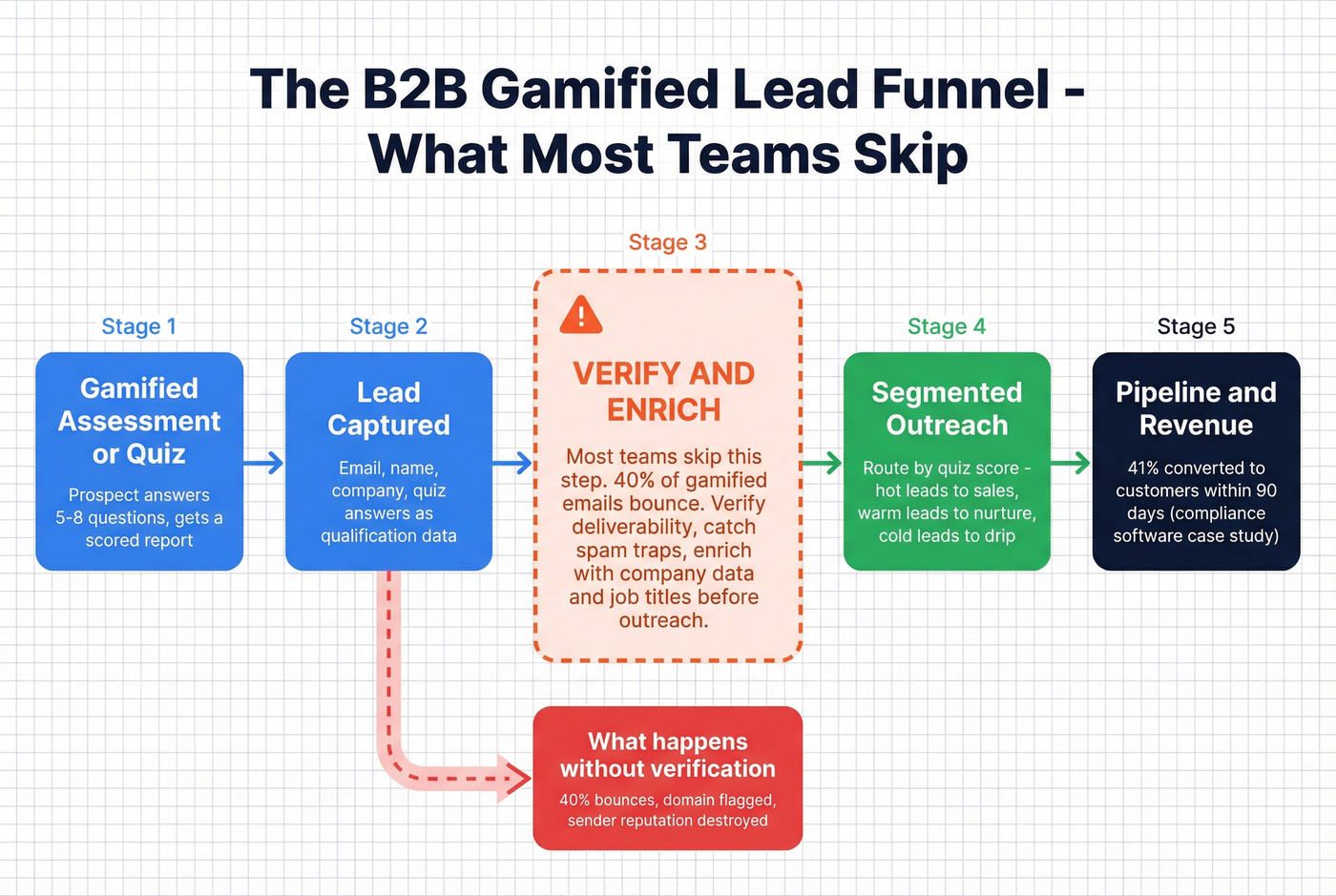
A compliance software company built a regulatory readiness simulator - a gamified assessment where prospects answered questions about their compliance posture and got a scored report. 63% of participants requested demos within two weeks, compared to 12% for traditional content. 41% converted to customers within 90 days.
That's not a marginal improvement. That's a fundamentally different funnel.
Look - most B2B companies don't need more leads. They need better leads. We've seen this pattern repeatedly: gamification delivers warmer prospects because people who invest time in an interactive assessment feel they've already begun working with the solution. They're better educated and more committed than traditional MQLs who downloaded a whitepaper they'll never read. Enterprise software companies using gamified onboarding see 65% faster time-to-productivity, and the same principle applies to pre-sale engagement.
Semrush ran a campaign combining a personality quiz, a mobile game, and a dedicated landing page with downloadable whitepapers. The campaign video pulled 2.7 million YouTube views with outstanding average watch times. More importantly, it drove registrations and subscriptions - not just engagement vanity metrics.
A few rules for B2B gamification that vendors won't emphasize:
Keep games simple. You're not building a console title. A 5-question assessment with a scored output beats an elaborate game that takes 20 minutes to complete.
Know your audience's age. Older leads prefer quizzes and puzzles over addictive online games. A Gen Z SDR might love a leaderboard. A 55-year-old CFO wants a maturity assessment with a PDF report.
The capture is only half the problem. You've got someone who took your quiz and gave you their work email. Great. But is that email valid? Do you have their direct dial? Their company size? Their tech stack? The gap between "someone took our quiz" and "we have a sales-ready contact" is where most B2B gamification campaigns stall. Pair your gamification platform with a data enrichment tool - upload your quiz respondents, get back enriched profiles with verified emails, direct dials, and 50+ data points you can actually route to sales.
When Gamification Backfires
Gartner's stat is sobering: 80% of gamification efforts fail. Not because gamification doesn't work - because most implementations are lazy, misaligned, or missing the follow-up entirely.
The Consumer Skepticism Problem
YouGov surveyed US adults and the numbers tell a split story. Among people who've seen gamified ads, 41% are more likely to click than on static ads, and 39% say they help with brand recall.
But 68% of those same viewers agree gamified ads can be misleading. 40% say they feel less premium. And across all consumers (not just those who've seen them), only 18% would prefer ads to be gamified - vs. 37% who actively wouldn't.
The generational divide matters: Gen Z has 38% exposure to gamified ads and 35% prefer them. Boomers? 14% exposure. If your audience skews older or professional, a spin-to-win wheel will actively damage your brand perception.
The Wealthsimple example is instructive. They used sweepstakes excitement to get users into the app, then used the "scratch" moment to cross-sell a managed investing product. Reddit's verdict? "Sleazy." The gamification felt like a bait-and-switch, and the brand took a hit in a community that matters to them.
Not All Gamification Actions Are Equal
That Springer study deserves a closer look. Social gamification actions - liking, sharing, referring - drive both purchase frequency and spending. But wish list actions actually decreased spending. Newsletter subscriptions shortened purchase cycles without increasing revenue.
The implication: if you're designing gamification mechanics, prioritize actions that create social commitment. A user who shares your quiz result has publicly associated themselves with your brand. A user who added something to a wish list has done the opposite - they've deferred a purchase decision.
Five Mistakes That Kill Campaigns
Based on RTM's analysis of failed promotions and what I've seen in practice:
Poor prize pool planning. If every spin wins a 5% discount, the game feels rigged. If the prizes are too generous, you attract freebie hunters and destroy margins. Optimize perceived odds - daily entries, converting losses into sweepstakes entries.
Misaligned timing. A gamified campaign needs a marketing calendar hook. Launching a scratch card promotion in February with no seasonal tie-in is a waste of budget.
Overcomplicated gameplay. If it takes more than 30 seconds to understand the rules, you've lost.
No marketing integration. The gamification platform sits in a silo. No CRM sync, no retargeting pixels, no email automation triggers. The leads go into a spreadsheet and die there.
Ignoring follow-up. This is the big one. You captured 5,000 emails and then... sent a generic "thanks for playing" email three days later. The window for conversion is hours, not days. Structured follow-up - email remarketing, retargeting, personalized offers based on game behavior - is what separates the 80% that fail from the 20% that print money.
Gamification Tools Compared - Features and Pricing (2026)
Here's what the market looks like right now.
| Tool | Free Tier | Paid Pricing | Best For | Entry Limits |
|---|---|---|---|---|
| BeeLiked | Yes (100 entries) | $50-$1,800/mo | Enterprise B2C | 100-100K+ |
| Scratcher | Yes (1K impressions) | ~$200-500/mo | Mid-market retail | Varies by plan |
| Faisco | Yes (200 participants) | $33-$58/mo | SMB, quick launch | 2K-unlimited |
| Drimify | No | ~$100-800/mo | Branded experiences | Tier-based |
| PlayAbly | No | $10K-$25K one-time | Custom B2B games | Unlimited |
| Interact | Freemium | ~$39/mo+ | Quiz-based lead gen | Unlimited |
Faisco is the obvious entry point for teams testing gamification for the first time - $33/mo gets you 2,000 participants and 8 award types, and campaigns launch in under 10 minutes. BeeLiked scales up to enterprise with that 55% average conversion rate across their client base, but you're paying $599/mo+ once you cross 10,000 entries.
Interact deserves special mention since it powers the quiz data cited throughout this article. Their freemium plan lets you build and publish quizzes with basic lead capture, and paid plans starting at ~$39/mo unlock integrations and advanced analytics. If quizzes are your primary mechanic, Interact is the most proven platform.
Drimify targets brands that want polished, custom-branded game experiences - think interactive advent calendars, branded memory games, and multi-stage campaigns. Pricing starts around $100/mo for basic templates and scales to $800/mo+ for white-label enterprise deployments.
PlayAbly is the custom route for B2B teams that want a branded assessment or simulator built from scratch. Expect $10K-$25K and a 4-8 week build cycle.
Now compare the cost per lead against traditional channels:
| Channel | Est. CPL |
|---|---|
| Gamified B2C | $2-10 |
| Gamified B2B | $15-50 |
| Google Ads | ~$70 |
| Affiliate Marketing | ~$73 |
| LinkedIn Ads | ~$110 |
| B2B SaaS Average | ~$188 |
The CPL advantage is real. Gamified B2C campaigns run 7-35x cheaper than Google Ads on a per-lead basis. Even gamified B2B at $15-50 undercuts LinkedIn Ads by 2-7x.
What Happens After the Game - Converting Gamified Leads to Revenue
Every competitor article on the SERP stops at "build a quiz, pick a platform, design a prize pool." Then they wave goodbye and wish you luck.
That's frustrating, because the "after the game" gap is where 80% of campaigns fail. Let's close it.
Step 1: Understand what you actually captured.
Gamified campaigns collect zero-party data - what Forrester defines as "data a customer intentionally and proactively shares." Quiz answers, assessment scores, product preferences - this is self-reported intent data that's GDPR and CCPA compliant by design because users willingly provided it. No cookies, no tracking, no consent headaches.
Step 2: Verify and enrich before you touch a single lead.
You just captured 5,000 leads from a gamified campaign. Before you email one of them, verify every address and enrich with direct dials and company data. Gamified forms attract throwaway addresses at 2-3x the rate of gated content downloads because the perceived reward incentivizes junk submissions.
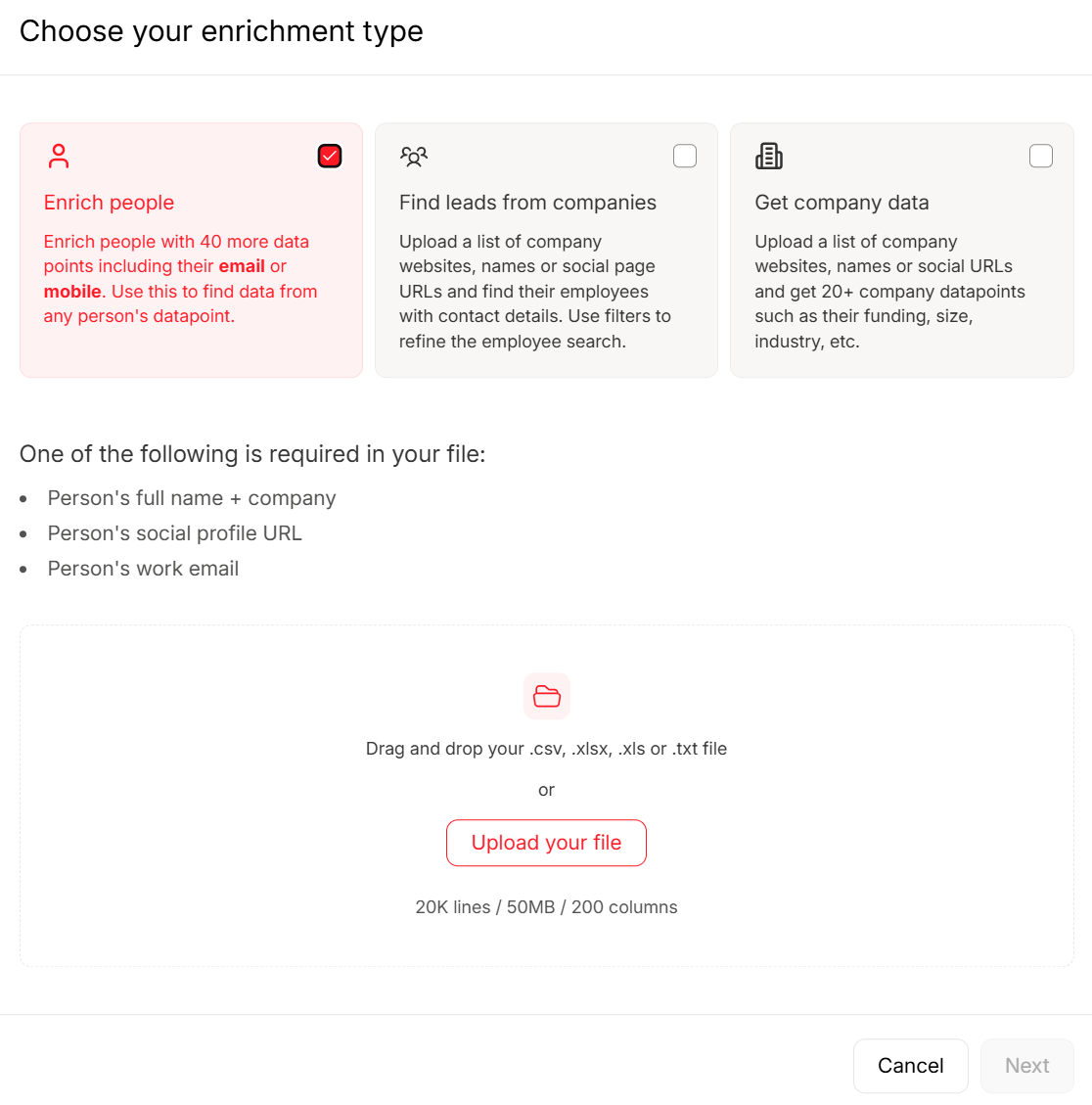
A 5-step verification process catches the 30-40% of emails that would otherwise bounce and destroy your sender reputation. Upload your CSV, get back verified emails with 50+ data points per contact - company size, tech stack, job title, direct dial - at 98% accuracy. At ~$0.01 per email, verifying a 5,000-lead list costs $50. One bounced campaign costs infinitely more.
Step 3: Score leads based on gamification engagement signals.
Not all quiz completions are equal. Someone who scored 90% on your maturity assessment and spent 4 minutes on it is a different lead than someone who clicked through in 30 seconds. Use completion time, score, and specific answers as lead scoring inputs.
Step 4: Design follow-up around social sharing.
Remember: social actions drive revenue. Your follow-up sequence should incentivize sharing quiz results, not just redeeming prizes. "Share your score and unlock a bonus resource" creates both social proof and viral distribution.
Step 5: Structured remarketing within hours, not days.
Email remarketing with personalized content based on game behavior, retargeting ads for non-converters, and personalized offers that reference specific quiz results or game outcomes. The window is 24-48 hours. After that, the dopamine fades and you're just another email.
If you're sending these leads through a sequencer, make sure your cold email outreach stack is deliverability-first, and keep an eye on email deliverability basics before you scale volume.
Also: if your first send spikes bounces, you’ll start seeing hard errors like 550 Recipient Rejected - fix list quality before you “fix copy.”
Finally, gamified lead capture dies in spreadsheets. Get the list into your CRM fast and clean - here’s how to import leads without breaking routing.
You ran the quiz. You captured the emails. Now 30% are catch-all domains and contest-only addresses. Prospeo handles catch-all verification, honeypot filtering, and spam-trap removal - then enriches matched contacts with job title, company size, intent signals, and direct dials. 92% API match rate across 300M+ profiles.
Turn gamified form fills into enriched, sequencer-ready pipeline in minutes.
FAQ
What's the average conversion rate for gamified lead generation?
Gamified promotions convert at 30-55% of visitors, compared to 2-5% for standard forms. Quizzes average a 40.1% start-to-lead conversion rate across 80M+ leads on Interact's platform. Spin-to-win mechanics can push higher - the Clermont Hotel Group hit 78% on an unwrap-the-gift campaign.
Does gamification work for B2B lead capture?
Yes - and it's underused. Interactive assessments generate 58% more qualified leads than static content. One compliance software company saw 63% demo request rates from a gamified simulator vs. 12% from traditional content. Focus on professional-value mechanics like maturity scores and ROI calculators rather than spin-to-win wheels.
How much does a gamified lead gen campaign cost?
Self-serve platforms range from free to $58/mo (Faisco), while custom B2B builds run $10K-$25K. Cost per lead lands at $2-10 for B2C and $15-50 for B2B - well below the $188 B2B SaaS average and 2-7x cheaper than LinkedIn Ads.
Why do most gamification campaigns fail?
80% fail due to poor prize planning, overcomplicated gameplay, and - most critically - no follow-up after capture. The game is rarely the problem. Teams that skip email verification, lead scoring, and structured remarketing within 24-48 hours lose the conversion window entirely.