Free Email Verifier Online - Which Tools Actually Work in 2026?
You just uploaded 2,000 contacts to your sequencer, hit send, and watched 340 of them bounce. Your sender reputation tanks, your domain gets flagged, and the "verified" list you paid for turns out to be garbage. 64.6% of businesses say deliverability issues have directly impacted their revenue - and the root cause is almost always bad data entering the pipeline unchecked.
Here's the thing: only 23.6% of teams verify their lists before every campaign. The rest are gambling with their domain reputation every time they press send. You don't need to spend thousands to fix this. There are genuinely useful free online email verification tools, but their accuracy varies wildly, and the "99% accuracy" claims plastered across every landing page are mostly fiction.
Let's break down what actually works, what the benchmarks say, and which free tools deserve your time.
Quick Picks
Need a fast answer? Four picks based on real testing:
- Best free allowance for casual use: Emailable - 250 free verifications/month, no credit card required
- Best budget bulk option: EmailListVerify - $24 per 10,000 verifications, cheapest at scale
- Best-reviewed overall: Bouncer - Capterra 4.9 (233 reviews), G2 4.8 (232 reviews), SOC 2 + GDPR compliant
How Online Email Verification Works
Every email verifier - free or paid - runs the same basic pipeline. The difference is how well each tool handles edge cases.
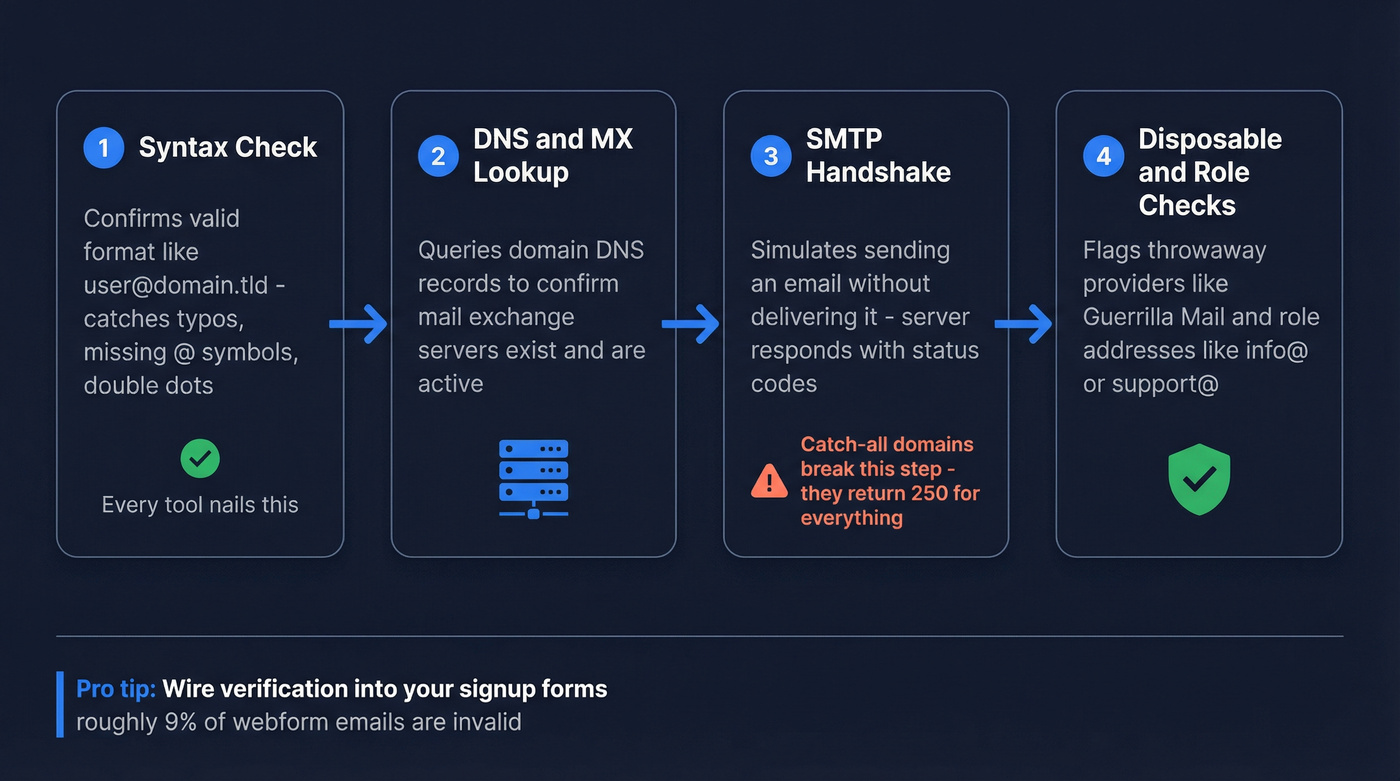
Syntax check. The tool confirms the email follows a valid format (user@domain.tld). This catches typos like missing @ symbols or double dots. Every tool nails this step.
DNS and MX record lookup. The verifier queries the domain's DNS records to confirm it exists and has mail exchange records pointing to an active mail server. No MX record means the domain can't receive email. Instant invalid.
SMTP handshake. This is where it gets interesting. The tool initiates a connection with the mail server and simulates sending an email without actually delivering one. The server responds with a status code: 250 means accepted, 550 means the mailbox doesn't exist, and 450 means a temporary issue like greylisting. The catch? A 250 response doesn't guarantee the mailbox is real - catch-all domains return 250 for everything, which creates the single biggest accuracy problem in the industry.
Disposable and role-based checks. The tool cross-references the address against databases of known throwaway providers like Guerrilla Mail and Mailinator, and flags role-based addresses like info@ or support@ that aren't tied to a specific person.
One angle most guides skip: real-time API verification at signup. Instead of cleaning lists after the fact, you can wire a verification tool into your webforms to reject bad emails before they enter your CRM. Roughly 9% of emails entered on webforms are invalid, so this prevents bad data from compounding in the first place.
The distinction between "verification" and "validation" matters too. Validation checks format and standards compliance. Verification goes further - it confirms whether the mailbox actually exists and can receive mail. For cold outreach, you need verification. Validation alone won't save your sender reputation.
What "99% Accuracy" Really Means
Every email checker claims 98-99% accuracy. An independent benchmark testing 15 verifiers against ~3,000 real business emails plus 300 known invalids tells a very different story:
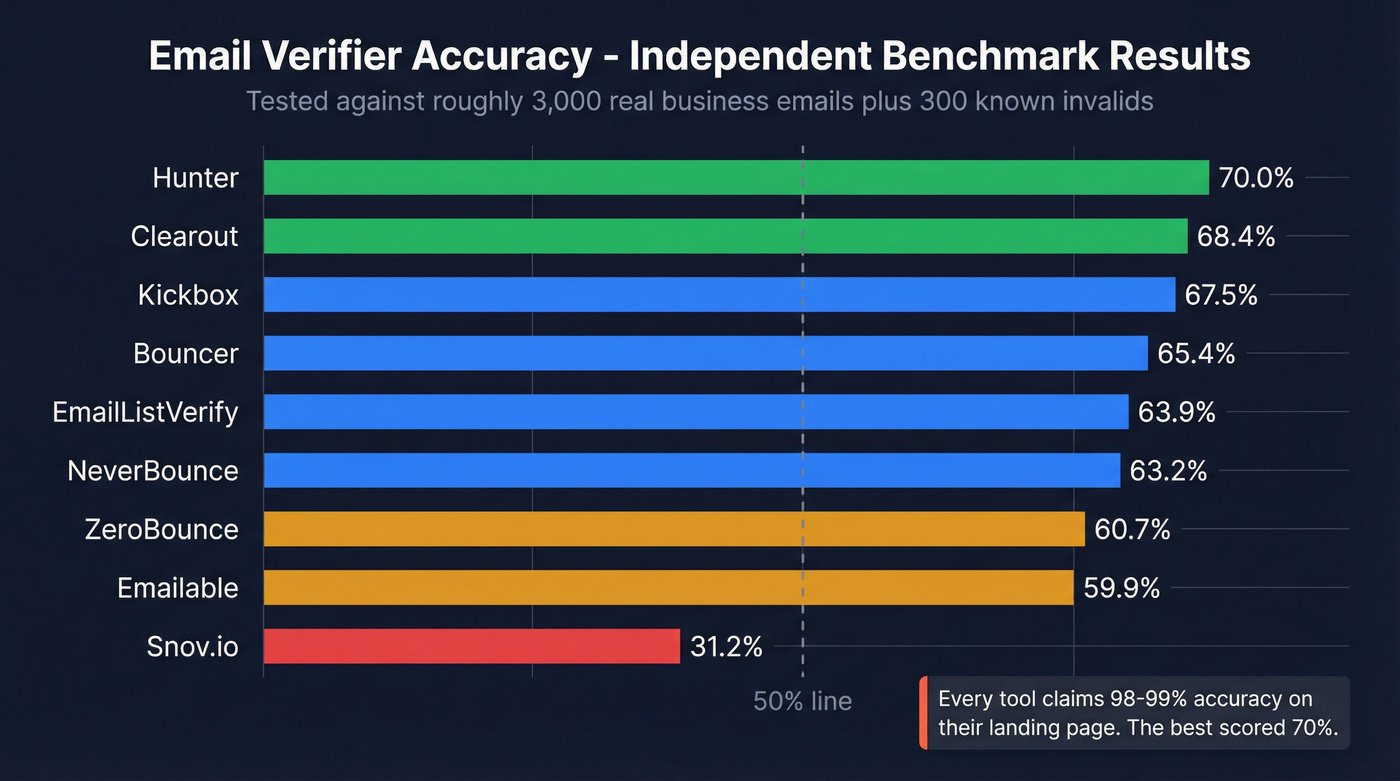
| Tool | Overall Accuracy |
|---|---|
| Hunter | 70.0% |
| Clearout | 68.4% |
| Kickbox | 67.5% |
| Bouncer | 65.4% |
| EmailListVerify | 63.9% |
| NeverBounce | 63.2% |
| ZeroBounce | 60.7% |
| Emailable | 59.9% |
| Snov.io | 31.2% |
The best tool scored 70%. Most landed in the 50-65% range. Snov.io came in at a brutal 31.2%.
A methodology caveat: these tests ran through Clay integrations using Clay's default settings, and the dataset was based on email activity observed on the testing platform, which likely advantages the test creator's own tool. But even accounting for that bias, the gap between marketing claims and real-world performance is enormous.
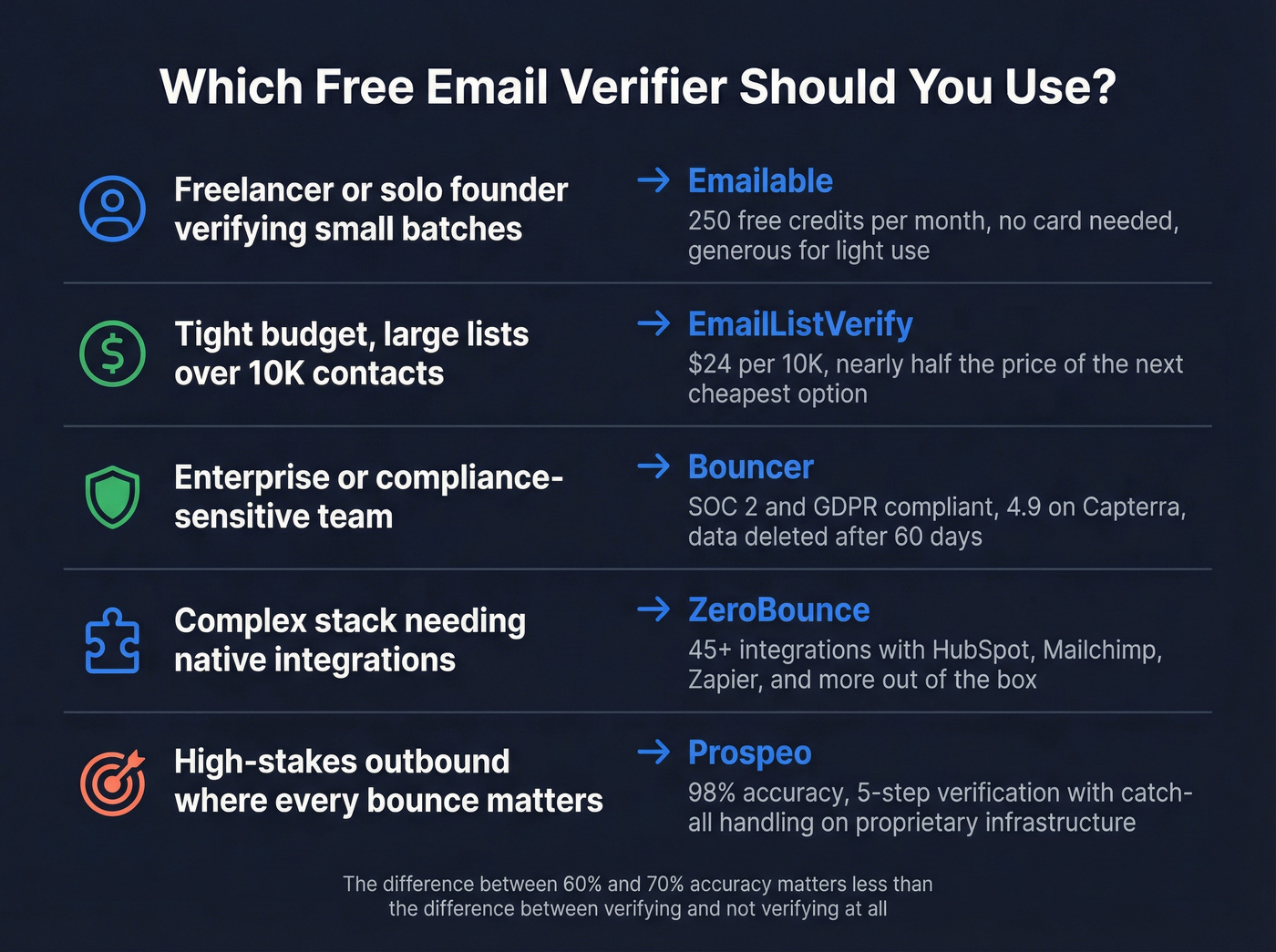
Our honest take: most teams don't need the "best" verifier. They need any verifier used consistently. The difference between 60% and 70% accuracy matters far less than the difference between verifying and not verifying at all. That said, if you're running outbound with deal sizes above $10K and every bounced email risks burning a high-value domain, accuracy becomes non-negotiable.

The best-performing free verifier in that benchmark scored 70%. Prospeo's 5-step verification - with catch-all handling, spam-trap removal, and honeypot filtering - delivers 98% accuracy on proprietary infrastructure. No third-party dependencies, no shared rate limits. 75 free verifications every month, no credit card required.
Stop gambling your domain reputation on 60% accuracy tools.
Best Free Email Verification Tools Compared
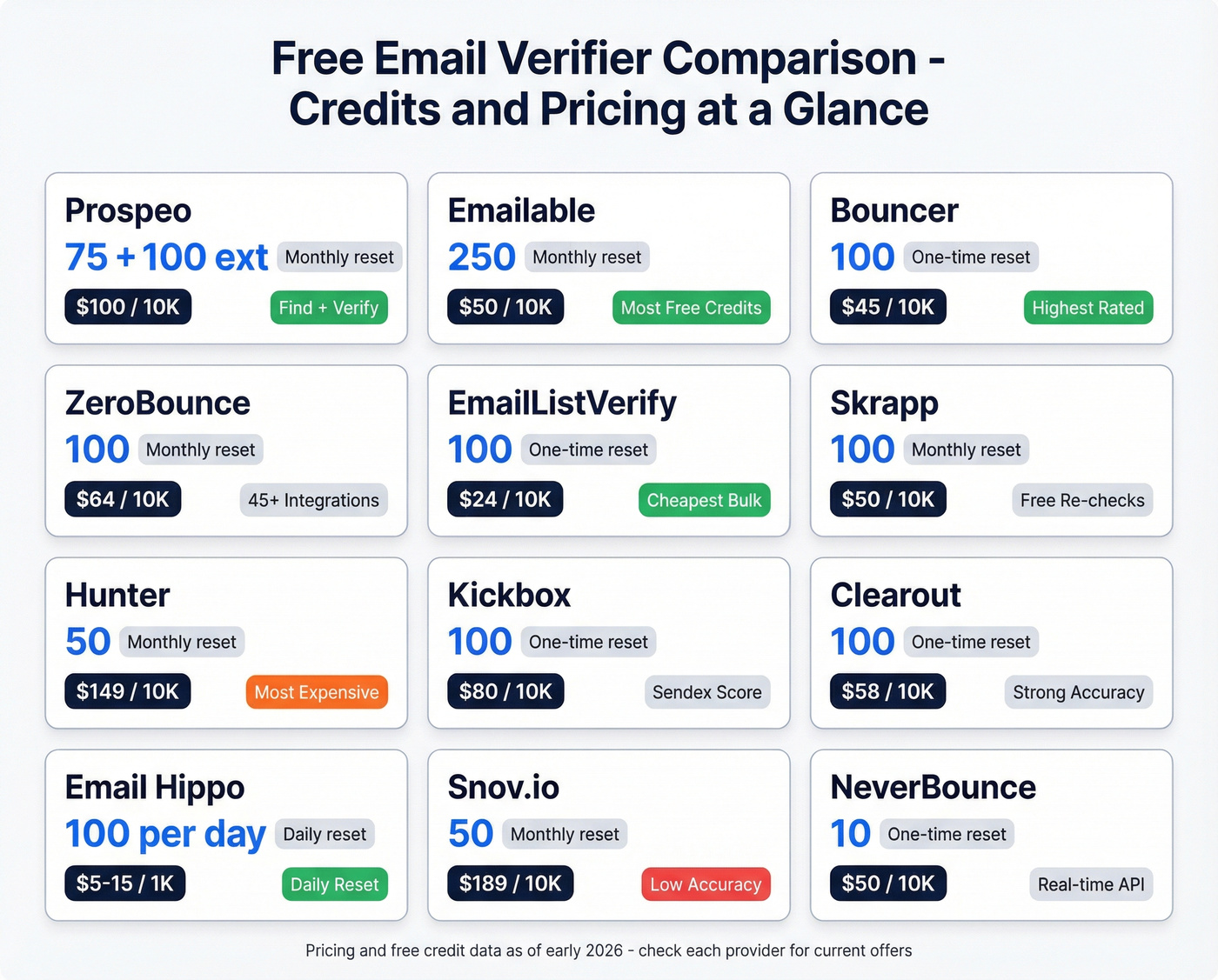
| Tool | Free Credits | Reset | Price/10K | Key Strength |
|---|---|---|---|---|
| Prospeo | 75 + 100 ext. | Monthly | ~$100/10K | Find + verify, catch-all |
| Emailable | 250 | Monthly | ~$50 | Largest free allowance |
| Bouncer | 100 | One-time | ~$45 | Highest user ratings |
| ZeroBounce | 100 | Monthly | ~$64 | 45+ integrations |
| EmailListVerify | 100 | One-time | ~$24 | Cheapest bulk pricing |
| Skrapp | 100 | Monthly | ~$50 | Re-checks free |
| Hunter | 50 | Monthly | ~$149 | Also an email finder |
| Kickbox | 100 | One-time | ~$80 | Sendex score |
| Clearout | 100 | One-time | ~$58 | Strong benchmark score |
| Email Hippo | 100/day | Daily | ~$5-15/1K | Generous daily reset |
| Snov.io | 50 | Monthly | ~$189 | Multi-tool platform |
| NeverBounce | 10 | One-time | ~$50 | Real-time API |
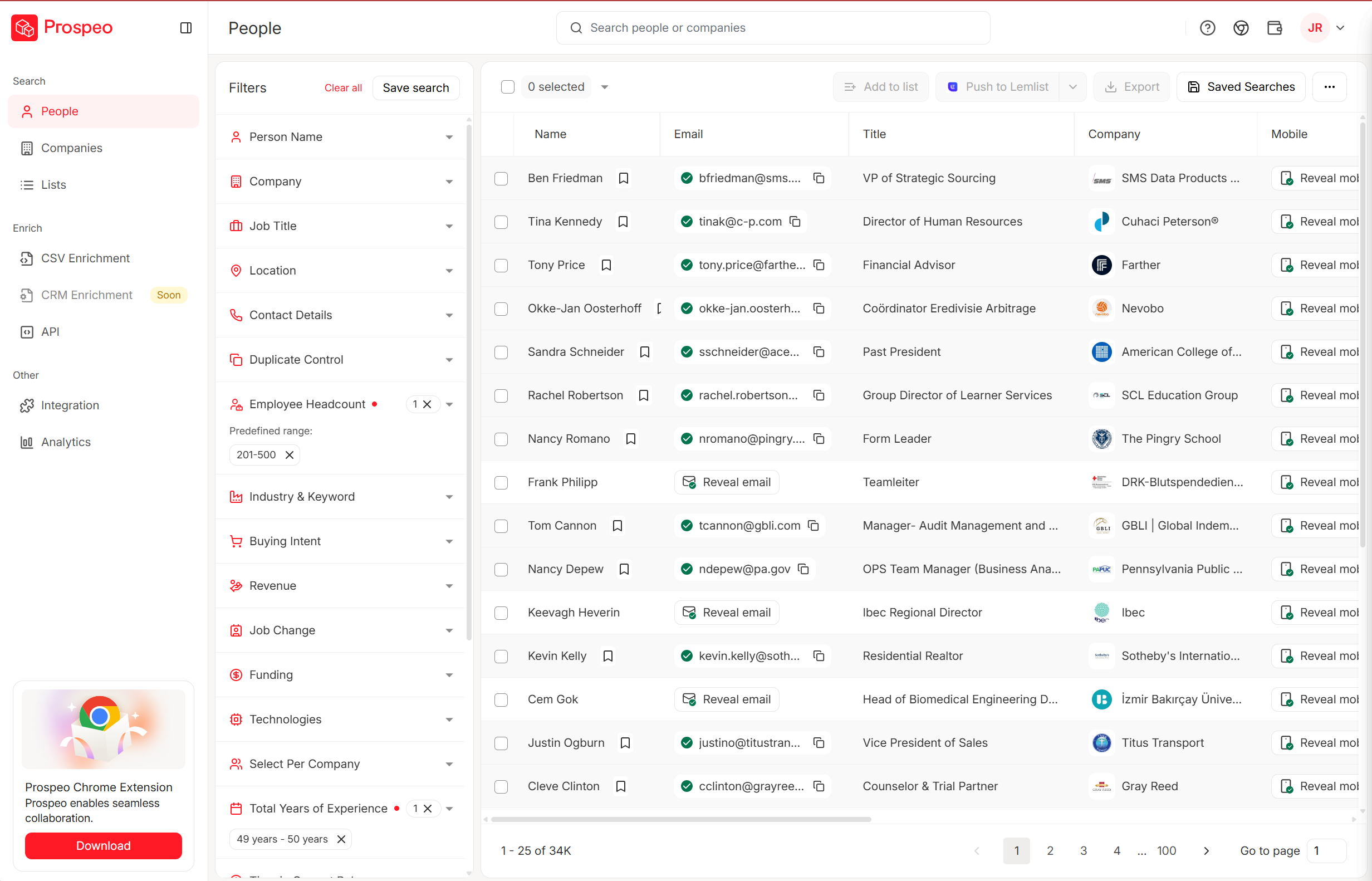
Prospeo
Use this if you need more than just a checker. Prospeo finds and verifies emails in a single workflow - search 300M+ professional profiles with 30+ filters, get verified results, and push them straight to your sequencer. The 5-step verification process includes catch-all handling, spam-trap removal, and honeypot filtering, all on proprietary infrastructure. You get 75 free emails plus 100 Chrome extension credits every month.
Even for one-off verification, the 98% accuracy makes it the most reliable option on this list. And because it doesn't rely on third-party email providers, the verification engine isn't subject to the same rate-limiting and data-sharing issues that plague tools built on shared infrastructure.
Bouncer
Bouncer is the safe pick. Capterra 4.9 with 233 reviews, G2 4.8 with 232 reviews - one of the highest-rated verifiers you'll find anywhere. SOC 2 and GDPR compliant with data deleted after 60 days, and $45 per 10,000 verifications is competitive for the quality.
The tradeoff: 100 free credits are one-time only with no monthly reset, and it scored 65.4% in the benchmark - solid but not top-tier. There's no email finding capability; it's purely verification. For compliance-conscious teams that need a verifier they can trust with sensitive data, the SOC 2 certification and 60-day deletion policy matter more than saving $20 on bulk pricing.
ZeroBounce
ZeroBounce is the integration king. G2 4.7 with 515 reviews and Capterra 4.7 with 458 reviews - one of the most-reviewed verifiers in the space. 100 free validations monthly with a proper reset, 45 direct integrations covering most CRMs and ESPs, and pay-as-you-go starting at $20 for 2,000 credits.
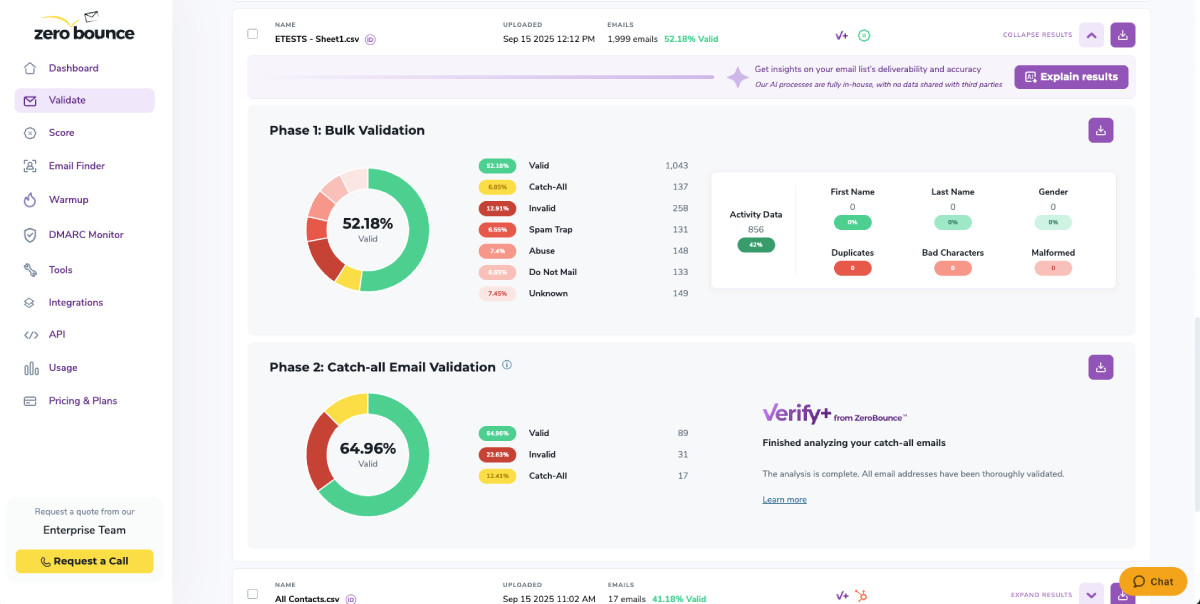
The downsides: $64 per 10,000 is pricier than Bouncer or EmailListVerify, it scored 60.7% in the benchmark, and the sheer number of add-on products can make pricing confusing. But if your stack is complex and you need your verifier to plug directly into HubSpot, Mailchimp, Zapier, and 40+ other tools without custom API work, ZeroBounce is the path of least resistance.
EmailListVerify
Use this if you're verifying large lists on a tight budget. At $24 per 10,000 verifications, it's the cheapest bulk option by a wide margin - nearly half the price of Bouncer and a third of ZeroBounce.
Skip this if accuracy is your top priority. It scored 63.9% in the benchmark, which is respectable but not leading. For high-stakes outbound where every bounce hurts your domain, pair it with a second verifier or use something more accurate from the start.
Emailable
The most generous free tier on this list. 250 free verifications per month, resetting monthly, is roughly 2.5x what most competitors offer. Great for freelancers, early-stage founders, or anyone verifying small batches regularly. Check their best practices guide for tips on maximizing results.
The honest tradeoff is accuracy. Emailable scored 59.9% in the benchmark, placing it in the bottom half. For low-stakes email marketing, that's fine. For cold outbound to enterprise prospects, you'll want something sharper.
Hunter
Hunter scored 70% in the benchmark - the highest, though the methodology favors their own tool. 50 free verifications per month, and their verification guide is genuinely one of the best educational resources in the space.
The dealbreaker for most teams is price. At $149 per 10,000, Hunter is 6x more expensive than EmailListVerify. You're paying for the finder, not the verifier. If you're already in Hunter's ecosystem, the combined workflow makes sense. Otherwise, there are better options for verification alone.
Other Tools Worth Knowing
Skrapp has a unique credit policy: re-checking an email you've already verified doesn't consume additional credits. 100 free credits monthly, solid for steady moderate-volume checking.
Kickbox offers 100 free one-time credits at $80/10K. Its standout feature is the Sendex deliverability score, which rates email quality beyond simple valid/invalid. Scored 67.5% in the benchmark - third overall.
Clearout is underrated. 100 free one-time credits, $58/10K, and it scored 68.4% in the benchmark - second overall. Deserves more attention than it gets.
Email Hippo gives 100 free verifications per day with a daily reset - potentially 3,000/month if you're patient. The daily refresh is uniquely generous.
Verifalia handles one-off checks fine, but there's no bulk capability, no educational content, and no ecosystem around it. For anything beyond a single-email check, the tools above are better options.
Snov.io gives 50 free credits per month at $189/10K. Expensive. Scored just 31.2% in the benchmark, and it doesn't verify emails from catch-all domains. Hard to recommend for verification alone.
NeverBounce offers just 10 free credits - barely enough to test. Pricing is reasonable at ~$50/10K with a solid real-time API, but the free tier is essentially useless.
The Catch-All Problem
This is the single biggest gap in email verification, and most free tools handle it poorly or not at all.
A catch-all domain is configured to accept emails sent to any address, whether the mailbox exists or not. The mail server returns SMTP 250 for everything, so verifiers can't distinguish real mailboxes from dead ones. Analysis of 2,572 addresses found that 38% of email domains are configured as accept-all. That's not a niche edge case - it's over a third of the B2B email landscape you're prospecting into.
The risk is real. In testing, sending to 100 accept-all addresses produced a 27% bounce rate versus just 1% for verified-valid addresses. That's 27x more likely to bounce. In our experience, catch-all results are the single biggest source of unexpected bounces on otherwise "clean" lists, and they can account for up to 30% of a typical B2B list.
Here's how to handle catch-all results:
- Don't discard them automatically. Some are real, active mailboxes.
- Don't treat them as valid either. Quarantine them into a separate segment.
- Test in micro-batches. Send to 10-20 catch-all addresses at a time and monitor bounces.
- Cap catch-all addresses at 2-5% of any campaign. This keeps your overall bounce rate under the 2% threshold that ESPs use as a red flag.
Tools like Snov.io skip catch-all domains entirely and return them as unverifiable. That difference matters when a third of your list is catch-all.
What Each Status Means
Every verifier returns status codes, but the labels vary. Here's a universal decoder:
| Status | What It Means | Action |
|---|---|---|
| Valid | Mailbox confirmed active | Send confidently |
| Invalid | Mailbox doesn't exist (SMTP 550) | Suppress immediately |
| Catch-All | Domain accepts everything | Quarantine; micro-batch test; cap at 2-5% |
| Unknown | Temporary error or greylisting | Re-verify in 24-48 hours; suppress if still unknown |
| Role-Based | Generic address (info@, support@) | Avoid for cold outreach; OK for marketing |
| Disposable | Temporary/throwaway address | Suppress - will bounce or go inactive |
Even "valid" emails can bounce due to full inboxes, recently deactivated accounts, or intermittent server issues. Verification reduces risk dramatically, but it doesn't eliminate it. The industry benchmark is to keep hard bounces under 1% - if you're hitting that after verification, your tool is doing its job.
When Free Isn't Enough
Free tiers are built for testing, not scaling. The signals it's time to upgrade are straightforward:
You're verifying more than 500 emails per month consistently. You need API access or bulk CSV upload. Catch-all results are eating a significant chunk of your list. Or you're juggling two separate tools for finding and verifying emails when one workflow would cut your process in half.
When you're ready to scale, paid verification plans start as low as $24/10K at EmailListVerify for pure verification. For the combined find-and-verify workflow with catch-all handling and native integrations with Salesforce, HubSpot, Lemlist, Instantly, and Clay, Prospeo's pricing starts at ~$0.01 per email with no contracts.
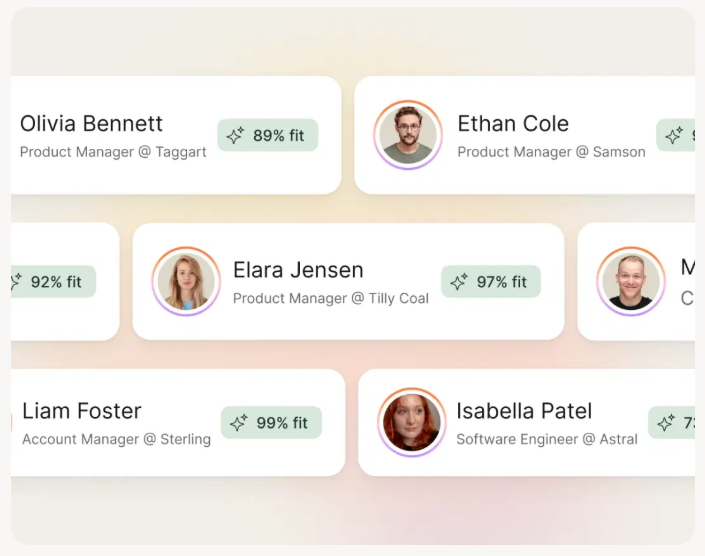
Most free email verifiers only check addresses you already have. Prospeo finds and verifies emails in one step - search 300M+ profiles with 30+ filters, get 98% accurate results, and push them straight to your sequencer. All data refreshed every 7 days, not the 6-week industry average.
Find, verify, and send - without switching between three different tools.
FAQ
Which free online email verifier is the most accurate?
Independent testing shows real-world accuracy ranges from 31% to 70% across leading verifiers - far below the 98-99% every tool claims. Prospeo's proprietary 5-step process delivers 98% accuracy across 143M+ verified emails, including catch-all handling. Free tiers use the same engine as paid plans, so the limitation is volume, not quality.
How many emails can I verify for free?
Emailable offers 250 free verifications per month - the most generous allowance. Most tools provide 50-100 free credits. Email Hippo gives 100 per day with a daily reset, totaling up to 3,000/month if you're patient. NeverBounce gives just 10 free credits, barely enough to evaluate the tool.
What should I do with catch-all results?
Don't send to them blindly. Catch-all emails bounce at 27x the rate of verified-valid addresses. Quarantine them into a separate segment, test in micro-batches of 10-20, and cap catch-all addresses at 2-5% of any campaign to protect your sender reputation.
Can I verify emails in bulk for free?
Free tiers usually cap you at 50-250 credits per day or month - not enough for real bulk work. For lists of 500+ emails, you'll need a paid plan. EmailListVerify is the cheapest at $24 per 10,000 verifications.
Do free email verifiers store my data?
Assume they log submitted emails unless the tool explicitly states otherwise. Look for SOC 2 or GDPR compliance badges and published data retention policies. Bouncer deletes all verification data after 60 days and holds both SOC 2 and GDPR certifications. Prospeo is also GDPR compliant with opt-out enforced globally.