The Best Free Email List Cleaners in 2026: What They Actually Check (And What They Don't)
You just exported 5,000 contacts from a trade show and your marketing team wants to blast them tomorrow. You search for a free email list cleaner, find one, and discover the "free tier" is 100 emails - 2% of your list. Useless. Email databases degrade by roughly 22.5% per year, which means a chunk of those contacts are already dead, and sending to them will torch your sender reputation. We tested 10 free tools to find out what each one actually checks, where the free tiers cap out, and which ones deserve your time.
Our Picks (TL;DR)
Best for verification accuracy - Prospeo. Five-step verification (syntax, domain, SMTP, catch-all domains handling, spam-trap removal) with 98% email accuracy. 75 free emails/month plus 100 Chrome extension credits, ongoing, no credit card.
Best for a quick, free clean right now - Maildiver. No signup, no credit card, no limits beyond a 6MB file cap. Upload a CSV and get cleaned results immediately.
Best for integrations - Clearout. 100 free credits that never expire, connects to HubSpot and Mailchimp out of the box, and ISO/SOC 2 Type II certified. Solid for teams already running marketing automation.
What Free Cleaners Actually Do
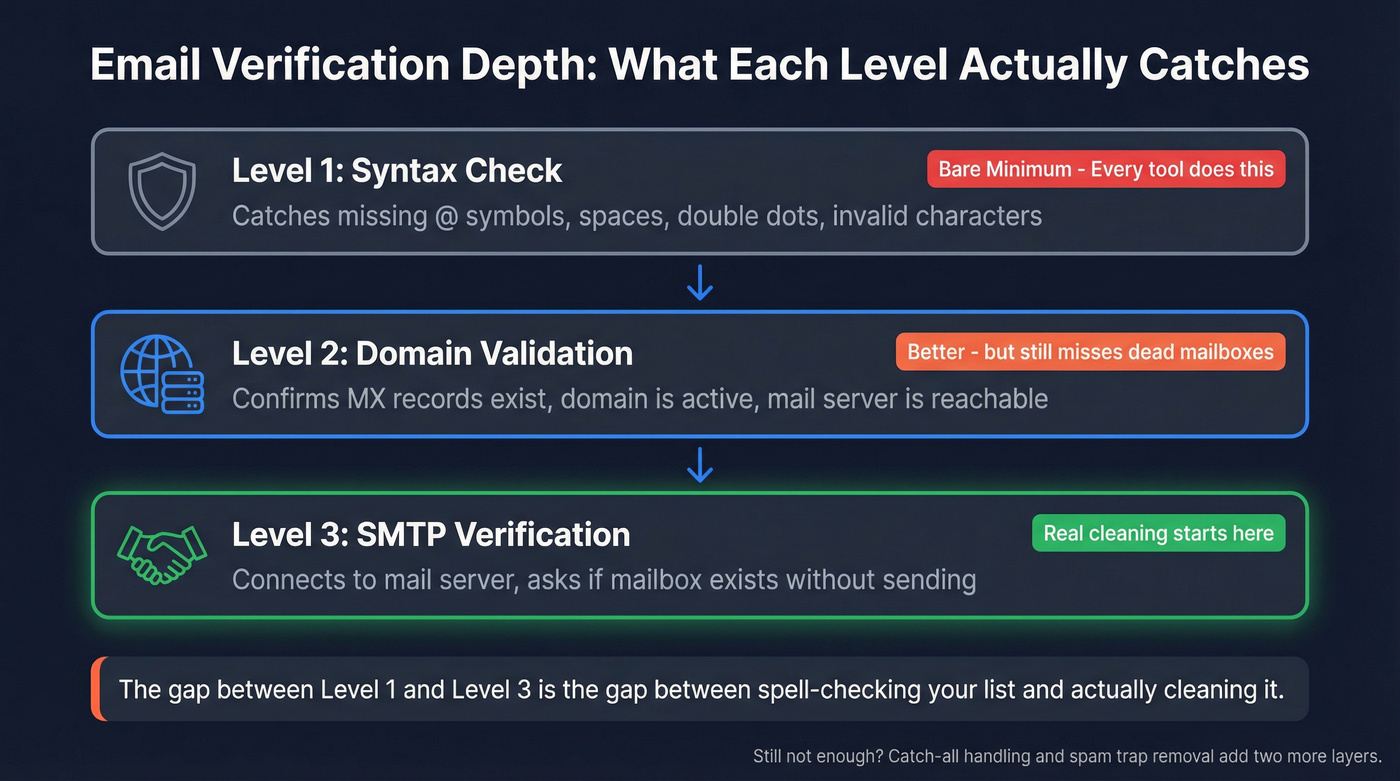
Not all verification is equal. Many tools focus on one or two of three core checks, and the gap between them is the gap between spell-checking your list and actually cleaning it.
| Level | What It Checks | What It Misses |
|---|---|---|
| Syntax | Format, @ symbol, invalid chars | Everything else |
| Domain | MX records, domain exists | Whether the mailbox exists |
| SMTP | Mailbox existence via server handshake | Catch-all domains, disabled VRFY servers |
Syntax validation catches typos - missing @ symbols, spaces, double dots. It's the bare minimum and every tool does it. Domain validation goes further by confirming the domain has active mail exchange (MX) records. A perfectly formatted email at a domain with no mail server is still worthless.
SMTP verification is where things get interesting. The tool connects to the recipient's mail server and asks "does this mailbox exist?" without actually sending a message. The problem: many servers respond with "252 - send some mail, I'll try my best" instead of a definitive yes or no. And catch-all domains accept mail to any address, valid or not, so a basic SMTP pass doesn't always mean "real inbox."
Snov.io published a vendor-run bake-off where they tested 9 verifiers using 600 known-valid emails and 600 intentionally invalid ones. In that same write-up, Kickbox banned their account mid-test. The takeaway: self-reported accuracy numbers are marketing. Verification depth is what actually matters.
Here's the thing - if your cleaner only checks syntax and domain formatting, you're spell-checking your list, not cleaning it. The tools that handle catch-all domains and filter spam traps are doing fundamentally different work.
Free Tiers Compared Side by Side
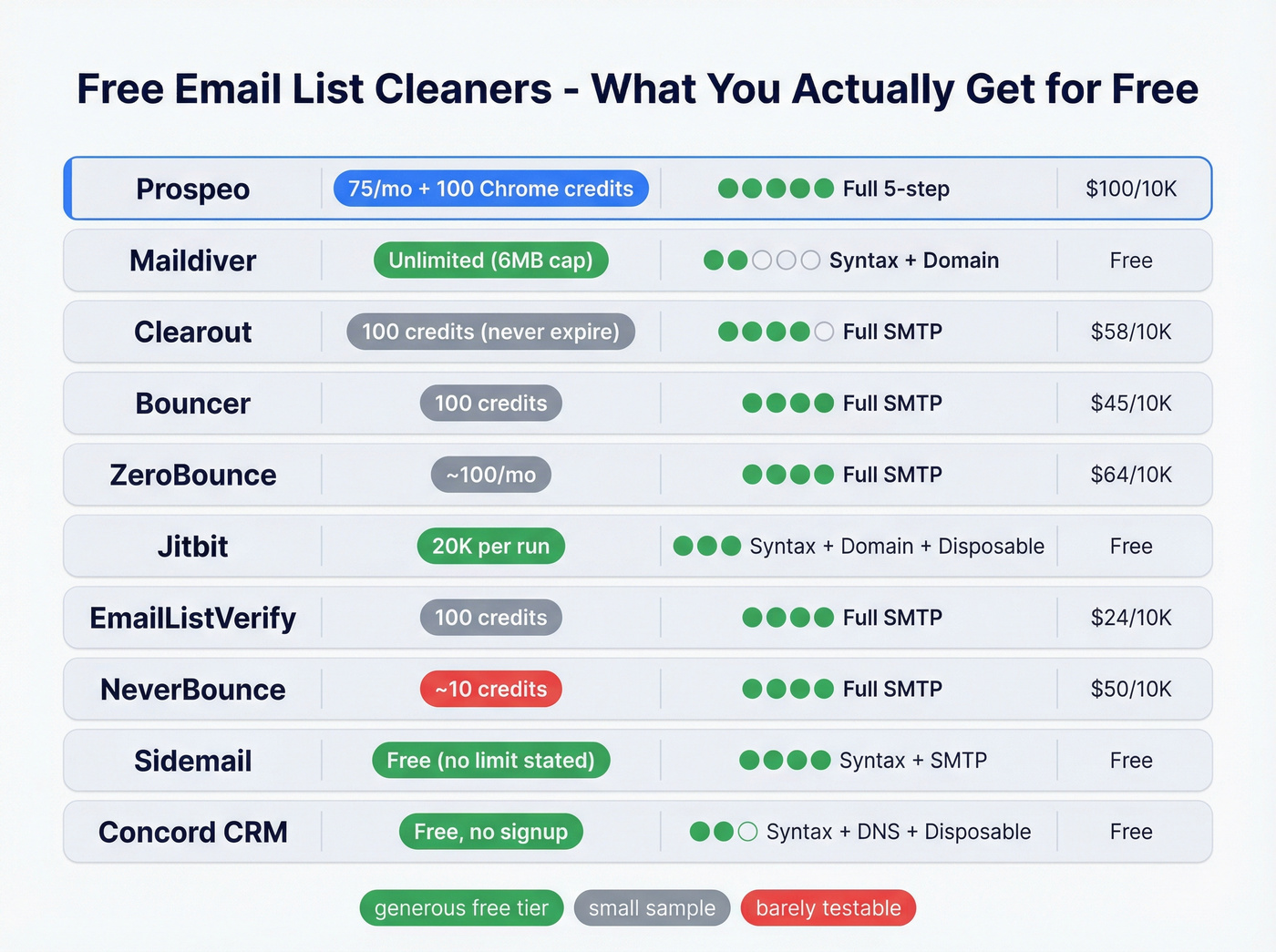
A lot of "free" cleaners are really 100-email demos. Only a few tools are effectively unlimited for free, and even then there's usually a cap like file size or per-run limits. Here's how all 10 stack up:
| Tool | Free Tier | Depth | Accuracy | $/10K |
|---|---|---|---|---|
| Prospeo | 75/mo + 100 Chrome | Full 5-step | 98% | ~$100 |
| Maildiver | Unlimited (6MB cap) | Syntax + domain | Not public | Free |
| Clearout | 100 (never expire) | Full SMTP | 99% | $58 |
| Bouncer | 100 credits | Full SMTP | 99%+ | $45 |
| ZeroBounce | ~100/mo | Full SMTP | 99% | $64 |
| Jitbit | Unlimited (20K/run) | Syntax + domain + disposable + dedupe | Not public | Free |
| EmailListVerify | 100 credits | Full SMTP | 97% | $24 |
| NeverBounce | ~10 credits | Full SMTP | 97% | $50 |
| Sidemail | Free (no limit stated) | Syntax + domain + SMTP + disposable | Not public | Free |
| Concord CRM | Free, no signup | Syntax + DNS + disposable + dedupe | Not public | Free |
Accuracy figures are self-reported by vendors or pulled from third-party comparison tables. Verification depth is based on each tool's documentation.

Most free cleaners check syntax and domain - then stop. Prospeo's 5-step verification handles catch-all domains, spam traps, and honeypots before you ever hit send. 98% accuracy, 7-day data refresh, 75 free emails/month.
Skip the cleaning step entirely - start with emails that are already verified.
The Best Free Email List Cleaners
Prospeo
Prospeo isn't just a list cleaner - it's a sales prospecting platform that gives you pre-verified emails so you spend less time scrubbing contacts after the fact. The verification process runs five steps: syntax, domain, SMTP handshake, catch-all handling, and spam-trap/honeypot removal. That last part matters more than most people realize. Spam traps don't bounce. They silently destroy your email deliverability and sender reputation.
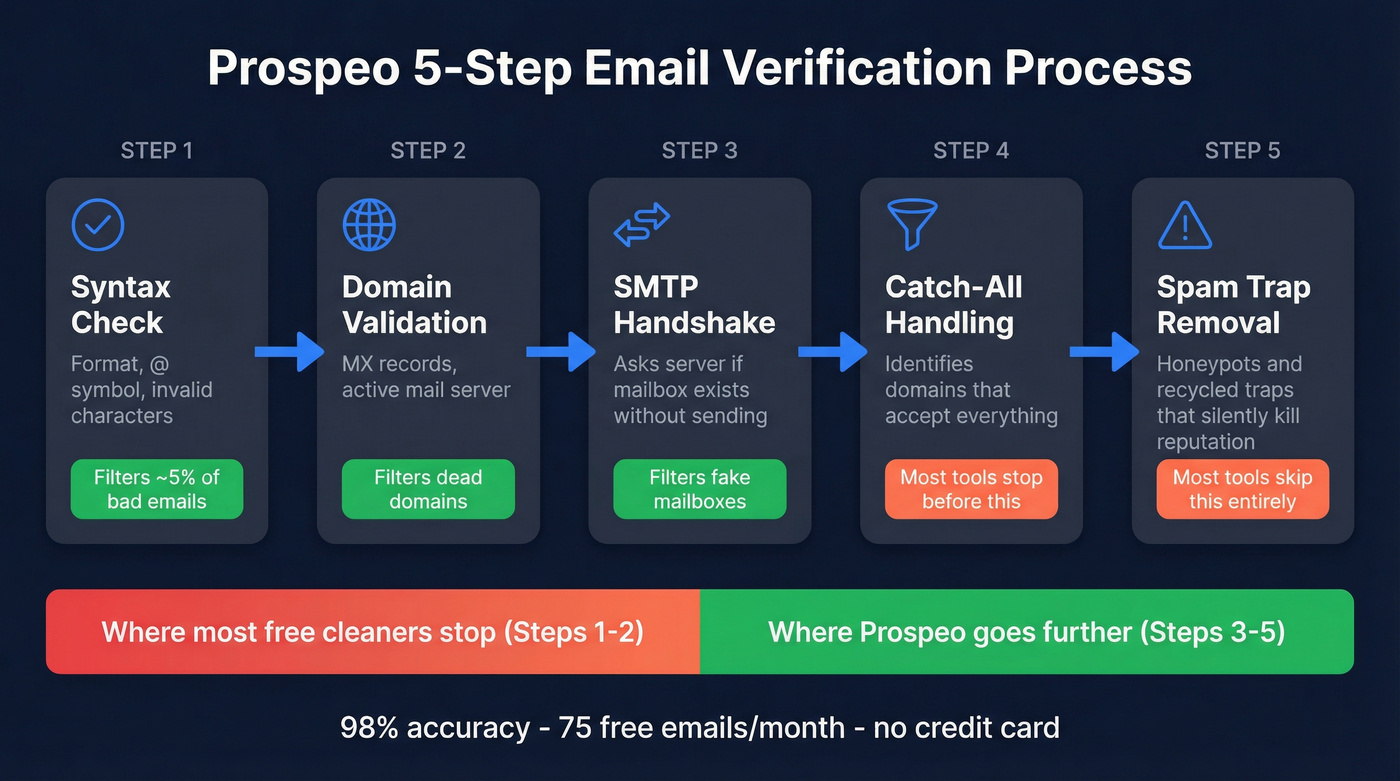
The database covers 300M+ professional profiles with 143M+ verified emails, all refreshed on a 7-day cycle. Compare that to the industry-average 6 weeks and you'll see why teams using stale databases end up cleaning lists constantly. Meritt dropped their bounce rate from 35% to under 4% after switching, and Stack Optimize maintains 94%+ deliverability with under 3% bounce across all their clients - zero domain flags.
The free tier gives you 75 verified emails plus 100 Chrome extension credits per month, ongoing, no credit card required. Paid plans start at $39/mo. If your workflow is "find contacts, then verify them," this collapses both steps into one, which is genuinely a different approach than running a separate cleaner after the fact.
Your list degrades 22.5% per year. Free cleaners patch the problem - Prospeo prevents it. 143M+ pre-verified emails refreshed every 7 days, not every 6 weeks. Stack Optimize runs under 3% bounce with zero domain flags.
Trade your list cleaner for a database that doesn't need one.
Maildiver
If you need to clean your list in the next five minutes without creating an account, Maildiver is the answer. No registration, no credit card, no per-email limits - just a 6MB file size cap. Upload a CSV, and it spits back cleaned results immediately. Processing happens in the browser, which is a nice privacy touch.
Maildiver's validation is RFC 5321 compliant and checks email format, domain structure, and length limits. It also removes duplicates and standardizes formatting like trimming whitespace and converting emails to lowercase. The trade-off is real, though: no integrations, no API, no catch-all detection, and no way to automate recurring cleans. For a one-time scrub of a trade show list or an inherited database, it's hard to beat. For ongoing list hygiene, you'll outgrow it fast.
Clearout
Clearout hits a sweet spot for teams that need integrations with their existing marketing stack. The 100 free credits never expire and roll over - a genuinely generous policy when most competitors reset monthly. It connects to 38 platforms including HubSpot and Mailchimp, and it carries ISO and SOC 2 Type II certification plus GDPR compliance.
The 100-credit free tier is small, but it's a real ongoing benefit, not a one-time demo disguised as a free plan. When you upgrade, expect $58 per 10K verifications. Skip Clearout if you need a large free batch - 100 credits won't dent a 5,000-row export.
Bouncer
Use this if you want one of the highest-rated verification tools on third-party review sites. Bouncer carries a 4.9 on Capterra (233 reviews) and 4.8 on G2 (232 reviews) - among the best scores in the category. Processing runs at 180K emails/hour with 99%+ self-reported accuracy and 16 integrations.
Skip this if you need a meaningful free tier. The 100 free credits are a sample, not a plan. Paid pricing lands at $45 per 10K with volume discounts. Bouncer is really a paid tool that lets you test-drive 100 emails before committing.
ZeroBounce
ZeroBounce is a common enterprise pick, and the integration count explains why - 45 platforms, from CRMs to ESPs to marketing automation. You get roughly 100 free credits per month, 99% self-reported accuracy, and processing at 133K emails per hour. At $64 per 10K, it's one of the pricier options here. The free tier is just 100 emails - enough to test, not enough to clean.
Jitbit
Pros: 20,000-email-per-run limit - one of the most generous single-run allowances of any free bulk verification tool. No signup. Most processing happens in your browser. It cleans typos, duplicates, malformed addresses, non-existing domains, invalid MX records, disposable mailboxes, and even obvious gibberish entries.
Cons: No integrations, no API, and it's still a one-off workflow (paste/upload, clean, export).
Verdict: Great as a fast, free pre-scrub before importing into a full verifier or your ESP. We've used it as a first pass on messy lists before running them through a deeper tool, and it catches the obvious junk quickly.
EmailListVerify
At $24 per 10K verifications, EmailListVerify costs less than half of what ZeroBounce charges. The 100 free credits let you test, and 97% self-reported accuracy is respectable. The trade-off shows up in integrations - only 11, the fewest of any paid tool here. If your workflow is "upload CSV, download results," that won't matter. If you need HubSpot or Salesforce sync, look elsewhere.
Quick Takes: The Rest
NeverBounce is a paid tool that happens to have a free sample. The ~10 free credits barely let you test the interface, let alone clean a list. Processing is listed at 100K emails/hour with 22 integrations, and pricing sits at $50 per 10K. Not worth it unless your team is already locked in.
Sidemail lets you upload a CSV and returns per-email checks like No Typo, Not Disposable, Has MX, and SMTP Passed, plus a fail reason when an email doesn't pass. Useful for quick list checks, and it includes SMTP in its results.
Concord CRM runs completely free with no signup, and most processing happens in your browser so email lists never reach their server. It filters invalid, duplicate, and inactive emails with regex validation, common domain typo checking (with automatic corrections), disposable email blacklist checks, DNS records verification, and duplicate removal.
Why a Clean Email List Matters
Your ESP just flagged a 6% bounce rate and you're one bad send away from landing in spam. That's not hypothetical - it's what happens when list hygiene falls off the priority list.
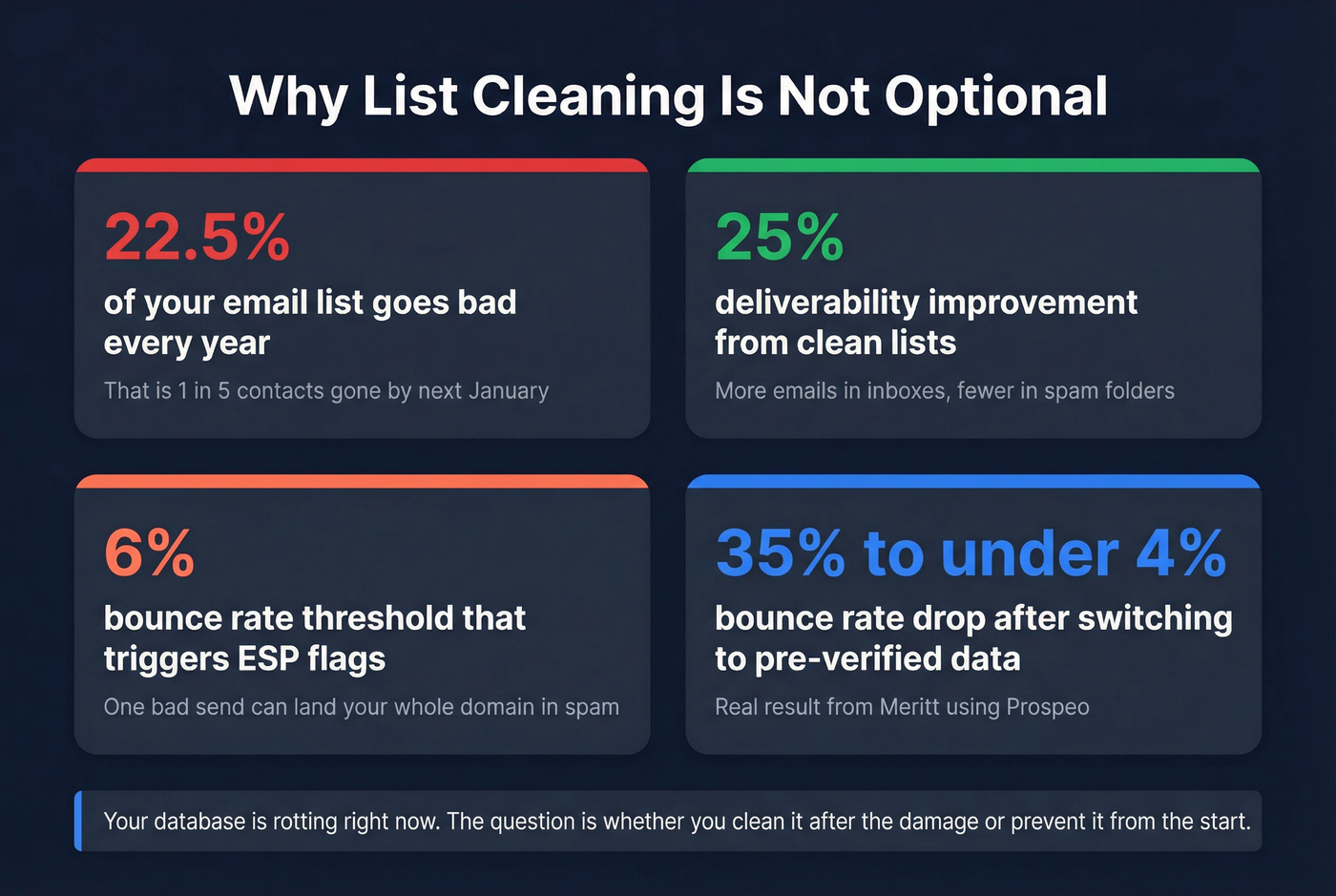
The numbers are stark. Clean lists improve deliverability by up to 25% and boost open rates by 5-15%. Click-through rates jump 10-20%, and spam complaints drop by up to 40%. Those aren't marginal gains - they're the difference between campaigns that work and campaigns that get throttled.
Here's where your industry stacks up on average bounce rates:
| Industry | Avg. Bounce Rate |
|---|---|
| Ecommerce | 0.19% |
| IT/Software | 0.90% |
| Financial Services | 1.20% |
| Real Estate | 1.40% |
| Manufacturing | 2.20% |
Keep hard bounces below 1% and spam complaints below 0.3%. Anything above a 5% bounce rate is a red flag that demands immediate attention. Many ESPs will throttle or suspend accounts that consistently exceed these thresholds, and once your domain reputation tanks, rebuilding it takes months of careful warm-up sends and suppression work that nobody wants to do.
Let's be honest: if your deals average under $15K and you're sending fewer than 5,000 emails a month, you don't need a $64/10K enterprise verifier. A free tool like Maildiver for batch cleans, paired with a verified-at-source platform for ongoing prospecting, will get you 90% of the way there at zero cost.
How Often to Clean Your List
You don't need 10 email list cleaners. You need one good verifier and a cleaning schedule. With 22.5% annual list decay, a list that was perfect in January is missing nearly a quarter of its valid addresses by December.
Clean every 3-6 months at minimum. Clean immediately after importing new contacts, and always before any large campaign send. Suppress persistent soft bounces after 3-5 events, and monitor bounces and complaints weekly.
The teams that get burned aren't the ones using bad tools - they're the ones who verified once and assumed the list stayed clean. It doesn't.
FAQ
What's a catch-all email and should I remove it?
A catch-all domain accepts mail to any address - valid or not - so verification tools can't confirm whether the specific mailbox exists. Don't delete catch-all results; send to them cautiously in small batches and monitor bounces. If a batch bounces above 5%, suppress that domain.
Is a free email list cleaner enough for real campaigns?
For lists under 1,000 emails, free cleaners handle the job well. For larger lists or ongoing outreach, you'll hit free-tier caps fast. Budget $24-$64 per 10,000 verifications for a paid tool, or use a platform that pre-verifies emails at collection so you skip the cleanup step entirely.
What's the difference between verification and validation?
Validation covers formatting and domain-level checks (syntax, MX records), while verification includes SMTP-level mailbox confirmation. You want both - syntax-only checking misses dead mailboxes, and SMTP-only checking won't catch formatting errors that prevent delivery.
Can I clean my list without uploading it to a third party?
Jitbit and Concord CRM process most emails entirely in your browser, so data never leaves your machine. The trade-off is fewer automation options - no API, no integrations. For full SMTP verification with privacy guarantees, look for GDPR-compliant tools with DPAs available on request.
How long does bulk verification take?
Most paid tools process 100K-180K emails per hour, so a 10,000-email list finishes in about 3-6 minutes. Free browser-based tools vary more depending on list size and your connection speed, especially above 5,000 rows.