How to Master Sales: Benchmarks, Scripts, and a 90-Day Plan Most Reps Never Get
It's Q3. You're at 40% of quota. Your manager keeps saying "trust the process," but the process is a recycled slide deck from 2019 and a CRM full of stale contacts. If you want to master sales, skip the motivational fluff. You need benchmarks, scripts, and a 90-day plan with actual numbers attached.
What You Need (Quick Version)
- Pick one methodology - SPIN for complex B2B, Challenger for disruption selling - and commit. Methodology-hopping is why most reps plateau.
- Fix your prospecting data before optimizing your pitch. Bad emails and disconnected numbers kill pipeline silently. A 35% bounce rate doesn't just waste sends - it tanks your domain reputation.
- Speed wins. Deals closed within 50 days have a 47% win rate; after that, you're looking at ~20%.
- Personalize cold emails with signals. Reply rates jump from 1-3% (generic) to 15-25% (signal-based). The gap is enormous. (If you need a framework, start with signal-based targeting.)
- Partner with AI. Sellers who do are 3.7x more likely to hit quota. That's not a marginal edge - it's a different game entirely.
The State of Selling in 2026
Reps using 2020 playbooks are essentially cold-calling with a rotary phone. Staying current isn't optional anymore - it's survival. If you're rebuilding your motion, align it with current B2B sales trends and outbound sales trends.
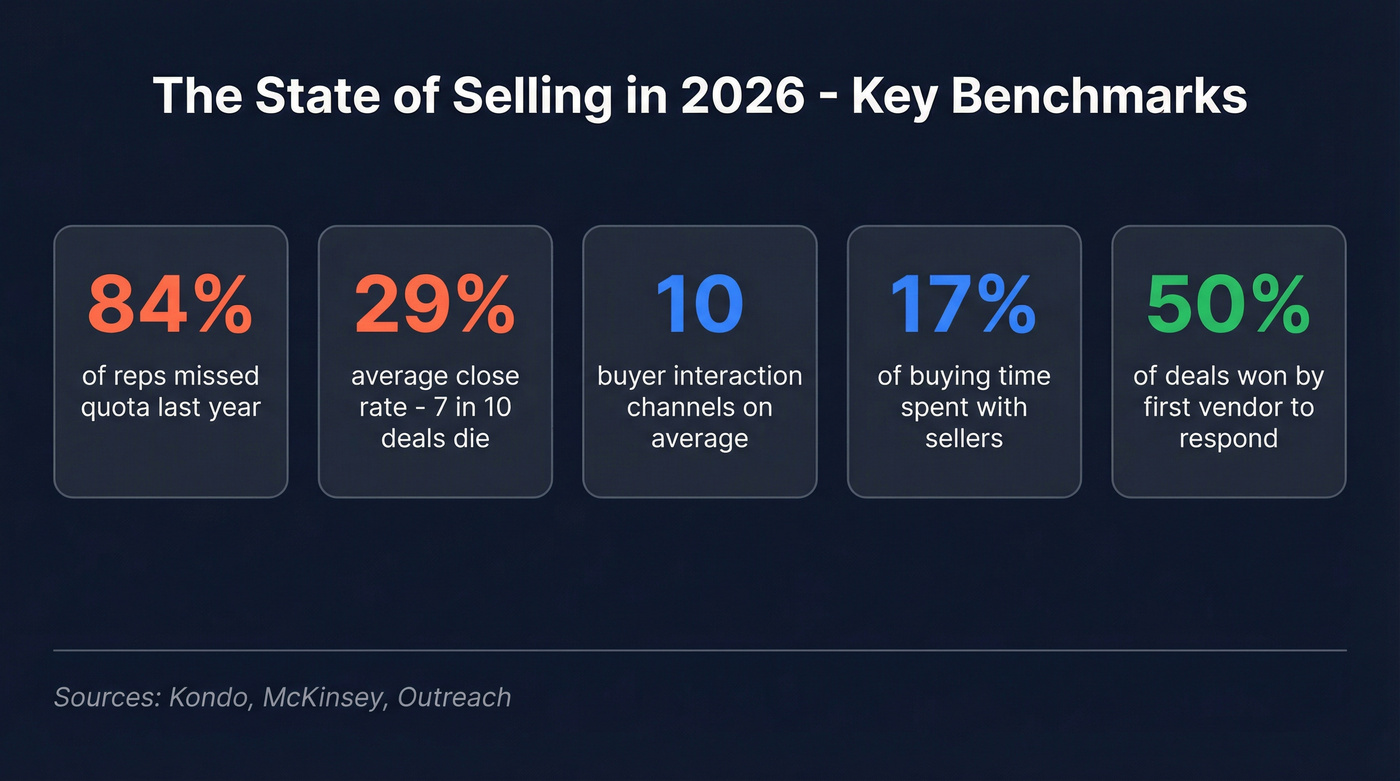
84% of reps missed quota last year. 67% don't expect to hit it this year. That's not a slump - it's a structural failure in how most teams sell. Buyers now use ~10 interaction channels on average, up from 5 in 2016, and they spend just 17% of their total buying time meeting with potential suppliers. 80% of B2B interactions happen in digital channels, 33% of all buyers prefer a completely seller-free experience, and 90% of companies plan to stick with hybrid models that drive up to 50% higher revenue growth.
| Metric | Number | What It Means |
|---|---|---|
| Average close rate | 29% | ~7 in 10 deals die |
| Average win rate | ~21% | Even lower by some measures |
| Deals stalled (past year) | 89% | Nearly every buyer hit pause |
| Buying committee size | ~7 people | You're selling to a group |
| First vendor to respond | 50% of deals | Speed is a strategy |
The McKinsey "rule of thirds" still holds: at any stage, a third of buyers prefer in-person, a third prefer remote, and a third want digital self-serve. If you're only working one channel, you're ignoring two-thirds of your buyers.
7 Competencies That Drive Sales Mastery
Sales excellence isn't a personality trait. It's a set of measurable competencies - skills and applied practices that determine how effectively you plan, engage buyers, manage deals, and convert. Every one of them is learnable. Most reps only develop two or three and wonder why they plateau.
Prospecting and Pipeline Building
Nothing else matters if your pipeline is empty. You can be the best closer on the floor, but if you're working 12 opportunities instead of 40, the math doesn't work. If you want a repeatable system, build an outbound sales engine and stick to it.
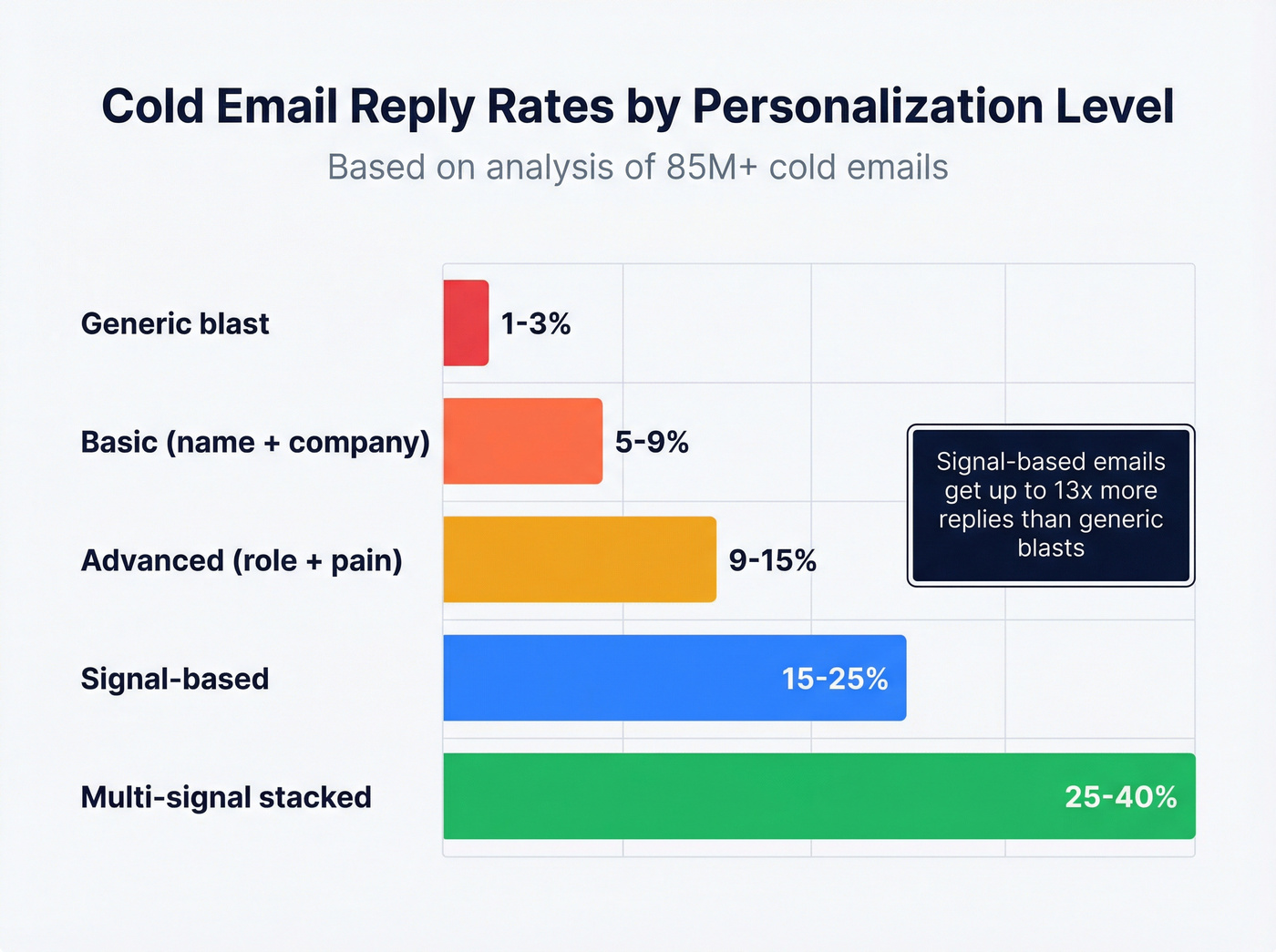
An analysis of 85M+ cold emails by Gong and 30 Minutes to President's Club found the average cold email reply rate sits at 3.43%. Here's how personalization changes things:
| Personalization Level | Reply Rate | Example |
|---|---|---|
| None (generic blast) | 1-3% | Same template, 1,000 sends |
| Basic (name + company) | 5-9% | "Hey {first_name} at {company}" |
| Advanced (role + pain) | 9-15% | References specific challenge |
| Signal-based | 15-25% | Triggered by job change, funding |
| Multi-signal stacked | 25-40% | Combines 2-3 intent signals |
Smaller campaigns of 50 or fewer recipients average a 5.8% response rate. Blast 500+ people with the same message and you're down to 2.1%. Multi-channel sequences - email plus phone plus social - can 2x your outbound meetings. One more tactical detail: timeline-based CTAs ("Do you have 15 minutes this Thursday?") achieve a 2.34% meeting rate versus 0.69% for problem-based CTAs. Specificity converts.
But before you optimize subject lines, fix your data. A beautifully personalized email that bounces is worse than a generic one that lands - it damages your domain reputation and tanks deliverability for your entire team. If you’re troubleshooting bounces, start with the basics of a hard bounce and work backward into list quality.
Here's a signal-based cold email template that actually works:
Subject: [Company]'s [specific initiative]
Hi {first_name},
Saw that {company} just [signal: raised Series B / opened a new office / hired 3 SDRs last month]. When teams hit that stage, the most common bottleneck we see is [specific pain tied to signal].
{Customer name} was in a similar spot - they [specific result with number, e.g., "cut ramp time from 10 weeks to 4"].
Worth a 15-minute call Thursday or Friday to see if that's relevant?
Every line earns the next. The signal proves you did your homework. The pain point is specific. The proof point is concrete. The CTA is time-bound. (For more variations, keep a swipe file of outreach email templates.)

Discovery and Qualification
Poor discovery is the single biggest source of bloated forecasts and wasted pipeline. You think you have $2M in Stage 3. You actually have $600K of real opportunities and $1.4M of deals where the prospect was being polite. If you want to tighten this up, use a consistent lead qualification framework.
BANT (Budget, Authority, Need, Timing) works for transactional and mid-market deals. Does the prospect have money, can they sign, do they need this, and is the timing right? Run through all four in discovery and you'll kill dead deals faster.
MEDDPICC (Metrics, Economic Buyer, Decision Criteria, Decision Process, Paper Process, Identify Pain, Champion, Competition) is built for enterprise complexity. When you're selling into buying committees of 7+ people, you need that structure. There's no shortcut around it.
A discovery opener that sets the right tone:
"I've done some homework on {company}, but I'd rather hear it from you. What's driving the urgency to look at this now - and what happens if you don't solve it this quarter?"
That opener signals preparation, hands control to the buyer, and immediately surfaces urgency and cost of inaction. From there, map the committee ("Who else weighs in on this?"), quantify the gap ("What does this cost you monthly?"), and separate real urgency from polite interest.
We've seen teams cut their pipeline by 40% after implementing rigorous qualification - and close more revenue. Fewer deals, better deals.
Sales Methodology Execution
There are dozens of methodologies. You need one. Pick it based on your selling motion, not based on which book your VP read last quarter.
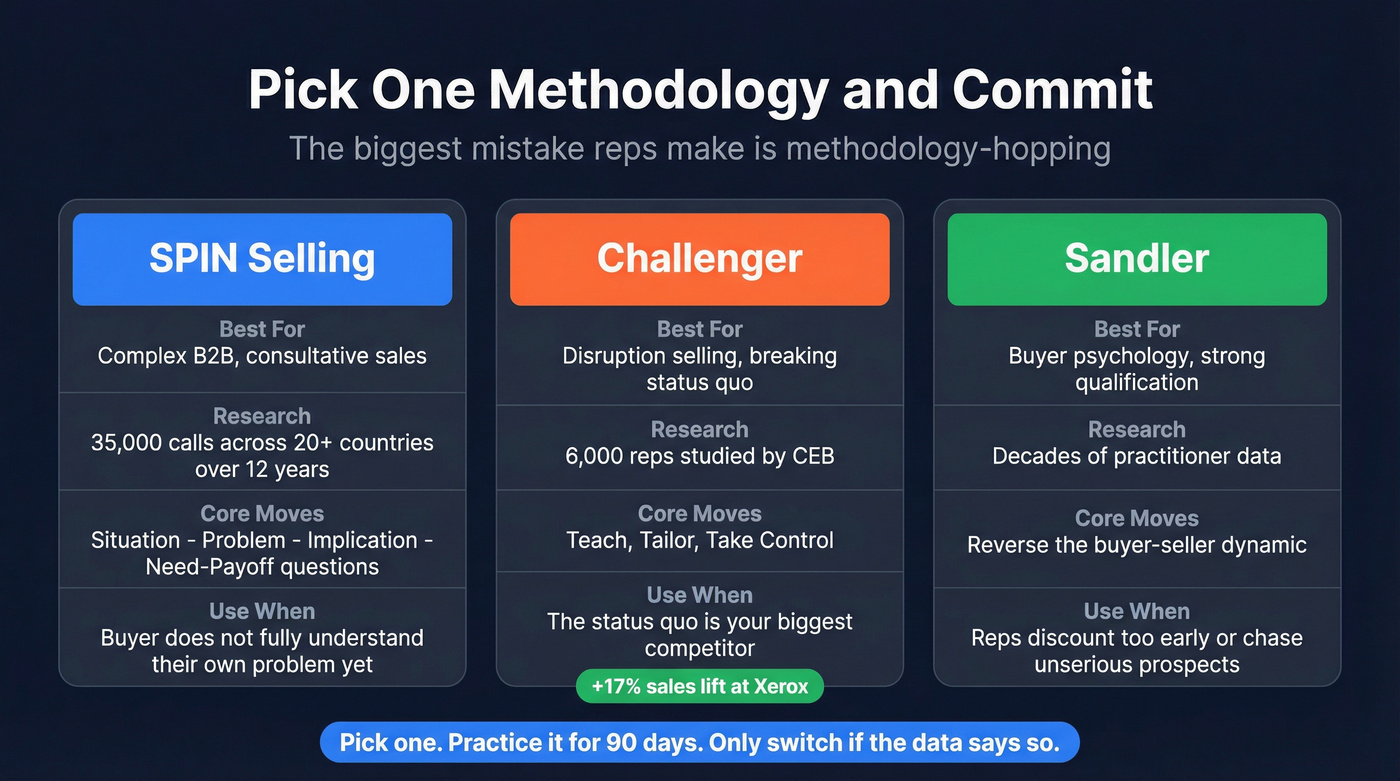
| Methodology | Best For | Research Basis | Core Moves |
|---|---|---|---|
| SPIN Selling | Complex B2B, consultative | 35K calls, 20+ countries, 12 yrs | S -> P -> I -> N-P questions |
| Challenger | Disruption, status quo | 6,000 reps (CEB research) | Teach, Tailor, Take Control |
| Sandler | Buyer psychology, qualification | Decades of practitioner data | Reverse buyer-seller dynamic |
SPIN works when the buyer doesn't fully understand their problem yet. The implication and need-payoff questions help the buyer articulate the cost of inaction before you ever pitch. Rackham's dataset is one of the most rigorous research foundations behind any selling methodology.
Challenger wins when the status quo is your biggest competitor. Xerox saw a 17% increase in sales and $65M in contract value after implementing it. Top performers don't just build relationships - they constructively challenge the buyer's thinking.
Sandler flips the traditional dynamic. Instead of the rep chasing the buyer, the buyer qualifies themselves. Particularly effective for reps who discount too early or chase prospects who were never serious.
Here's the thing: it doesn't matter which one you pick nearly as much as whether you actually commit. Methodology-hopping - trying SPIN for a quarter, switching to Challenger, dabbling in Sandler - is the single most common reason reps plateau. Pick one, practice it for 90 days, and only switch if the data says it's not working.
Objection Handling
Most reps treat objections as obstacles. They're buying signals. A prospect who says "it's too expensive" is telling you they see value but need help justifying the spend. A prospect who says "we're not interested" and hangs up isn't objecting - they're obstructing. Big difference.
An objection maps to Budget, Authority, Need, or Timing - dig deeper. An obstruction is an excuse to end the conversation - qualify out or try a different channel.
Two scripts that work:
Price objection: "That's fair - let's talk about the outcomes that would make this feel worthwhile. If we could [specific result], what would that be worth to your team over 12 months?"
Competitor comparison: "Totally get it - [competitor] is solid. The teams that choose us usually care most about [specific differentiator]. Is that relevant to your situation?"
The goal isn't to "overcome" the objection. It's to understand what's actually blocking the deal and address it honestly.
Closing and Deal Velocity
The data on deal velocity is unambiguous. Opportunities closed within 50 days show a 47% win rate. After that threshold, win rates drop to ~20% or lower. Every week a deal sits past the 50-day mark, it's decaying. If you’re trying to shorten cycles, focus on sales cycle acceleration and remove friction early.
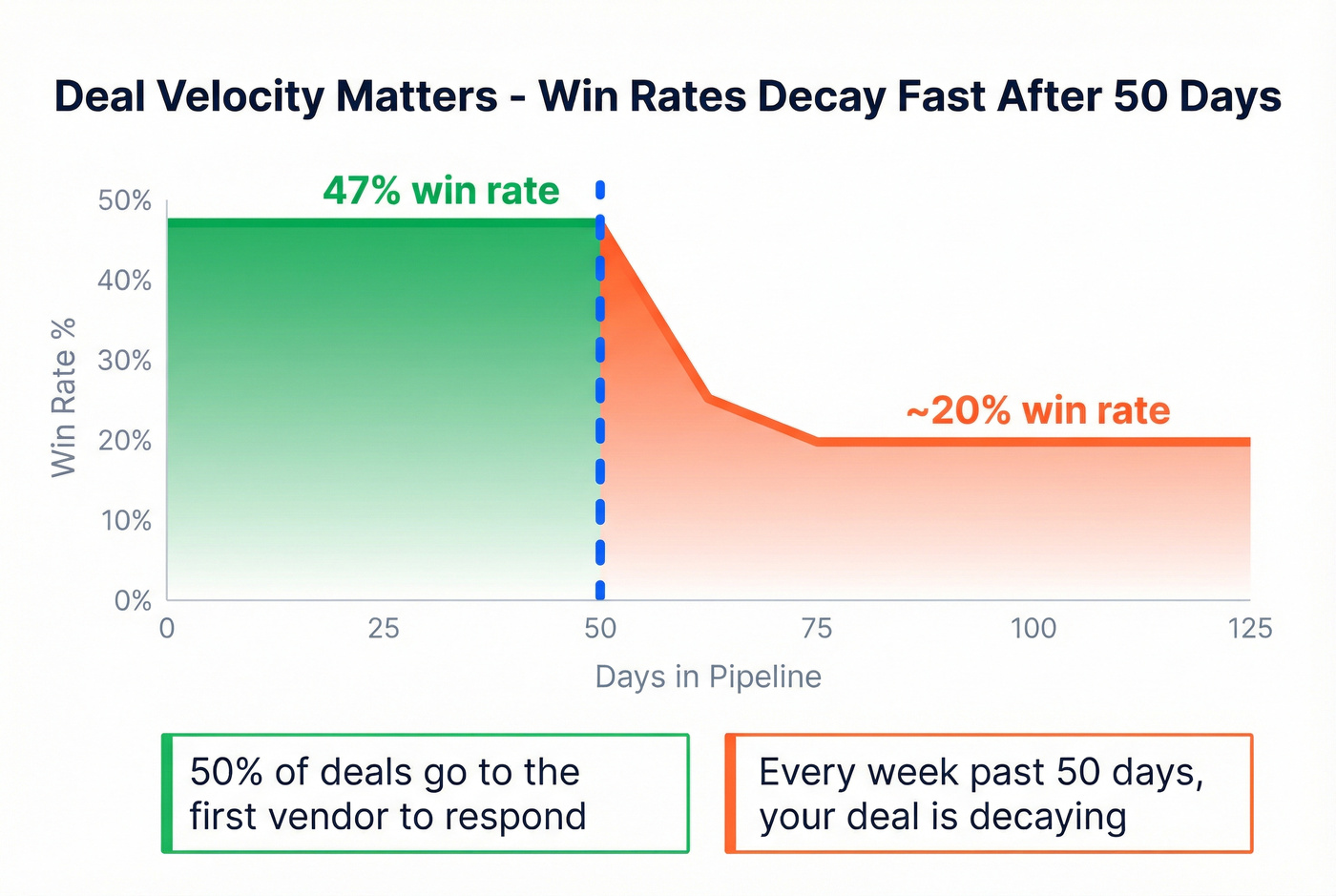
50% of deals go to the first vendor to respond. That stat alone should change how you prioritize your day. 34% of revenue teams report average cycles of 1-2 quarters - if yours is longer, ask why. Common culprits: stakeholders discovered late, poor qualification letting dead deals linger, and slow internal approvals on your side.
Compress your cycle by front-loading discovery, multi-threading into the buying committee early, and setting mutual action plans with specific dates. Deals without a next step on the calendar are deals that stall.
Follow-Up and Account Management
The follow-up data is counterintuitive. Your first follow-up email boosts reply rates by 49%. Your second adds just 3%. Your third actually decreases your reply chance by 30%.
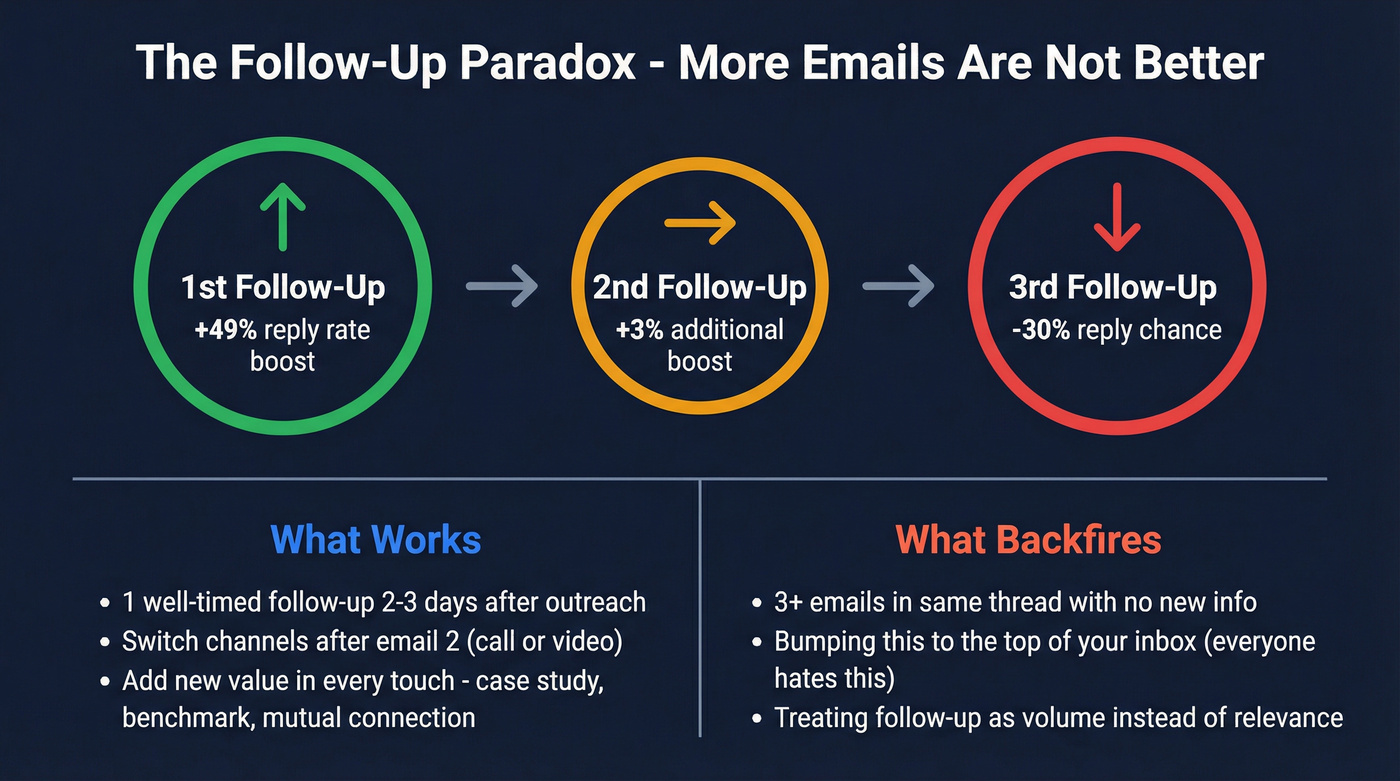
What works: one well-timed follow-up 2-3 days after initial outreach, switching channels after email #2 (a phone call or brief video message breaks the pattern), and adding new value in each touch - a relevant case study, a benchmark, a mutual connection - rather than "just checking in." Complex deals need 5-12 touchpoints spread across multiple channels, but each one has to earn its place. If you want a tighter system, use an SDR follow-up strategy.
What backfires: three or more emails in the same thread with no new information, "bumping this to the top of your inbox" (everyone hates this), and treating follow-up as a volume game rather than a relevance game. The best account managers treat every touch as a content delivery mechanism. Every message adds something the buyer didn't have before.
AI as Your Sales Multiplier
HubSpot data shows AI usage among reps rising from 24% in 2023 to 43% in 2024, but here's the gap that matters: only 19% of reps actually use AI features built into their tools. The difference between "experimenting with AI" and "partnering with AI" is where quota attainment lives. Sellers who effectively partner with AI are 3.7x more likely to meet quota. Teams using AI are 1.3x more likely to see revenue growth.
Signal-qualified leads show 47% better conversion, 43% larger deal sizes, and 38% more closed deals per quarter. If you’re operationalizing this, start with AI lead qualification and build from there.
Let's be honest - reps spend roughly a third of their time actually selling. The other two-thirds goes to research, data entry, admin, and internal meetings. AI reclaims that time. 45% of teams have already adopted a hybrid AI-SDR model, and the AI SDR market is projected to hit $15.01B by 2030. The reps who'll thrive aren't the ones who resist AI - they're the ones who use it for the tedious work (research, personalization, data cleanup) so they can spend more time on the human work: discovery, negotiation, relationship building.

Signal-based emails only work when they land. A 35% bounce rate doesn't just waste sends - it tanks your domain and kills deliverability for your entire team. Prospeo's 98% email accuracy and 7-day data refresh mean every personalized email you craft actually reaches the inbox.
Stop perfecting emails that bounce. Start with data that delivers.
The Data Problem Nobody Talks About
Your SDR manager just told you half the phone numbers in your list are disconnected. Your last email sequence bounced at 35%. Your domain reputation is cratering, and now even the good emails are landing in spam.
This isn't a prospecting problem - it's a data problem, and it's the silent killer of sales performance.
A 35% bounce rate doesn't just waste sends. It triggers spam filters, damages your sender reputation, and tanks deliverability for your entire team. Google and Yahoo now enforce strict requirements: SPF, DKIM, and DMARC authentication, one-click unsubscribe, spam complaint rates under 0.3%, and bounce rates under 2%. Miss those thresholds and your outbound engine stalls. We've watched teams burn through three email domains in a single quarter because they skipped verification - a frustrating, entirely preventable disaster. If you need the technical checklist, start with SPF, DKIM, and DMARC.
Snyk ran into this exact problem - 50 AEs prospecting 4-6 hours per week with bounce rates of 35-40%. After fixing their data foundation with Prospeo's 5-step verification process (catch-all handling, spam-trap removal, honeypot filtering, and a 7-day refresh cycle), bounce rates dropped to under 5%, AE-sourced pipeline jumped 180%, and they were generating 200+ new opportunities per month. Everything downstream depends on clean, verified data.

Your 90-day plan needs pipeline volume to work. Prospeo gives you 300M+ profiles with 30+ filters - buyer intent, job changes, funding, technographics - so you can build signal-rich prospect lists in minutes, not hours. At $0.01 per email, scaling outbound doesn't break the budget.
Build a 40-opportunity pipeline this week for less than a coffee.
A 90-Day Plan to Build Real Sales Skills
Weeks 1-4: Foundation
Pick your methodology - SPIN or Challenger, commit to one. Read the book. Set up your core stack: a CRM (HubSpot's free tier works), a verified data platform for accurate emails and direct dials, and a sequencing tool like Instantly or Smartlead. Spend this month learning your ICP, building your first targeted list, and writing your initial sequences. Week 4 target: 30+ qualified opportunities in pipeline. (If you’re choosing vendors, compare sales prospecting platforms before you commit.)
Weeks 5-8: Execution
Establish a daily prospecting cadence - 100 dials per day for 30 days straight. Run weekly role-play drills with a partner covering discovery calls, objection handling, and closing. Track your reply rates, connect rates, and meetings booked. Don't optimize yet - build volume and collect data. Week 8 target: 5+ meetings per week.
Weeks 9-12: Optimization
Analyze your win/loss patterns. Which industries convert? Which titles respond? What objections keep recurring? Refine your messaging based on actual data, not gut feel. Scale what works and kill what doesn't. Week 12 target: 2+ closed deals.
Stop reading sales books and start making calls. Reps spend 5+ hours per week on training and skill-building, but only a third of their time actually selling. In our experience, 100 real conversations teach more than 100 hours of theory. Read one book in month one, then close the books and open the dialer.
Books That Actually Move Numbers
SPIN Selling by Neil Rackham - the gold standard for complex B2B, built on 35,000 calls across 12 years.
The Challenger Sale by Dixon and Adamson - essential if your biggest competitor is the status quo.
Never Split the Difference by Chris Voss - negotiation tactics from a former FBI hostage negotiator that translate directly to deal-making.
Gap Selling by Keenan - problem-centric selling that forces you to quantify the buyer's gap. Skip this one if you're brand new; it hits harder after you've run 50+ discovery calls and have real patterns to map against.
The Sandler Rules by David Mattson - buyer psychology and the art of reversing the traditional dynamic.
FAQ
How long does it take to master sales?
Most reps see measurable improvement within 90 days of deliberate practice - daily prospecting, weekly role-play, and consistent methodology application. True mastery, meaning consistently exceeding quota across different market conditions, typically takes 3-5 years of active selling. There aren't shortcuts, but there are accelerants: structured practice, real-time coaching, and high call volume compress the learning curve significantly.
What's the single most important skill to develop?
Prospecting. You can't close deals you don't have. Reps who build consistent pipeline through verified outreach and multi-channel sequences outperform those who rely on inbound alone. Everything else - discovery, closing, objection handling - depends on having enough at-bats.
Can you learn to sell without prior experience?
Yes. Selling is a set of measurable competencies, not an innate personality trait. Research-backed methodologies like SPIN Selling and Challenger provide structured frameworks anyone can learn. The key is volume: 100 conversations teach more than 100 hours of theory.
What tools do you need to get started?
A CRM (HubSpot's free tier works), a data platform for verified emails and direct dials, and a sequencing tool for multi-channel outreach. Start simple - 45% of sales professionals say they're overwhelmed by their tool stack. Three tools, used well, beat ten tools used poorly.