7 Outbound Sales Trends Reshaping B2B Prospecting in 2026
Last month, a VP forwarded our team a LinkedIn post declaring outbound is dead. The comments were split - half agreeing, half posting pipeline screenshots. Here's what's actually happening: lazy outbound is dead. The channel itself is producing more pipeline than ever for teams willing to adapt. The latest outbound sales trends point in one direction - smarter targeting, cleaner data, and fewer but better touches.
52% of outbound marketers say their strategies aren't effective, yet 80% of closed deals still require five or more touches. The channel works. The execution doesn't. What we're seeing isn't the death of outbound - it's a redefinition of the discipline that rewards precision over volume.
Three investments matter most right now:
- Verified data with a 7-day refresh cycle - stale contacts tank deliverability before your copy gets a chance (see B2B contact data decay)
- Email authentication infrastructure - SPF, DKIM, and DMARC are table stakes (use this email deliverability checklist)
- Signal and intent layering - targeting buying signals instead of static lists (start with intent signals)
2026 Outbound Benchmarks
| Metric | Benchmark |
|---|---|
| Cold email reply rate | 1-5% |
| Cold call success rate | 2.3% |
| Multichannel lift vs single | 287% |
| Pipeline coverage target | 3:1 |
| Base connect rate | 5-15% |
| Connect rate (3+ attempts) | 60%+ |
| Rep time actually selling | 28% |
| Deals needing 5+ touches | 80% |
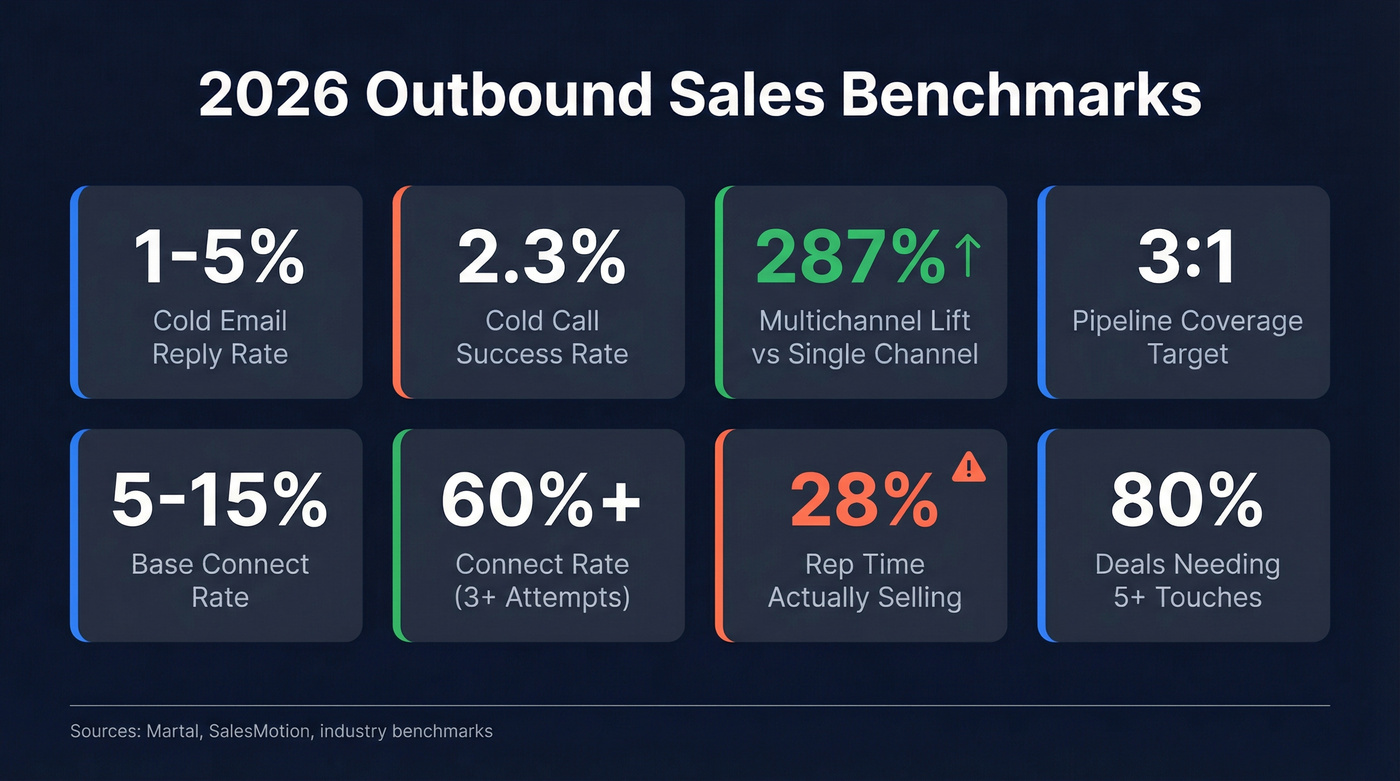
That 287% multichannel lift should jump out. Single-channel outbound isn't suboptimal - it's leaving the majority of potential responses on the table.
7 Trends Defining B2B Outbound in 2026
AI Is Directing Strategy, Not Writing Emails
The AI conversation in sales has matured past "will it write my emails?" 81% of sales teams have implemented or are experimenting with AI - 41% at full implementation, 40% still testing. Teams using AI are 1.3x more likely to see revenue growth.
If you're building your stack now, map this to your AI for B2B outreach workflow first.
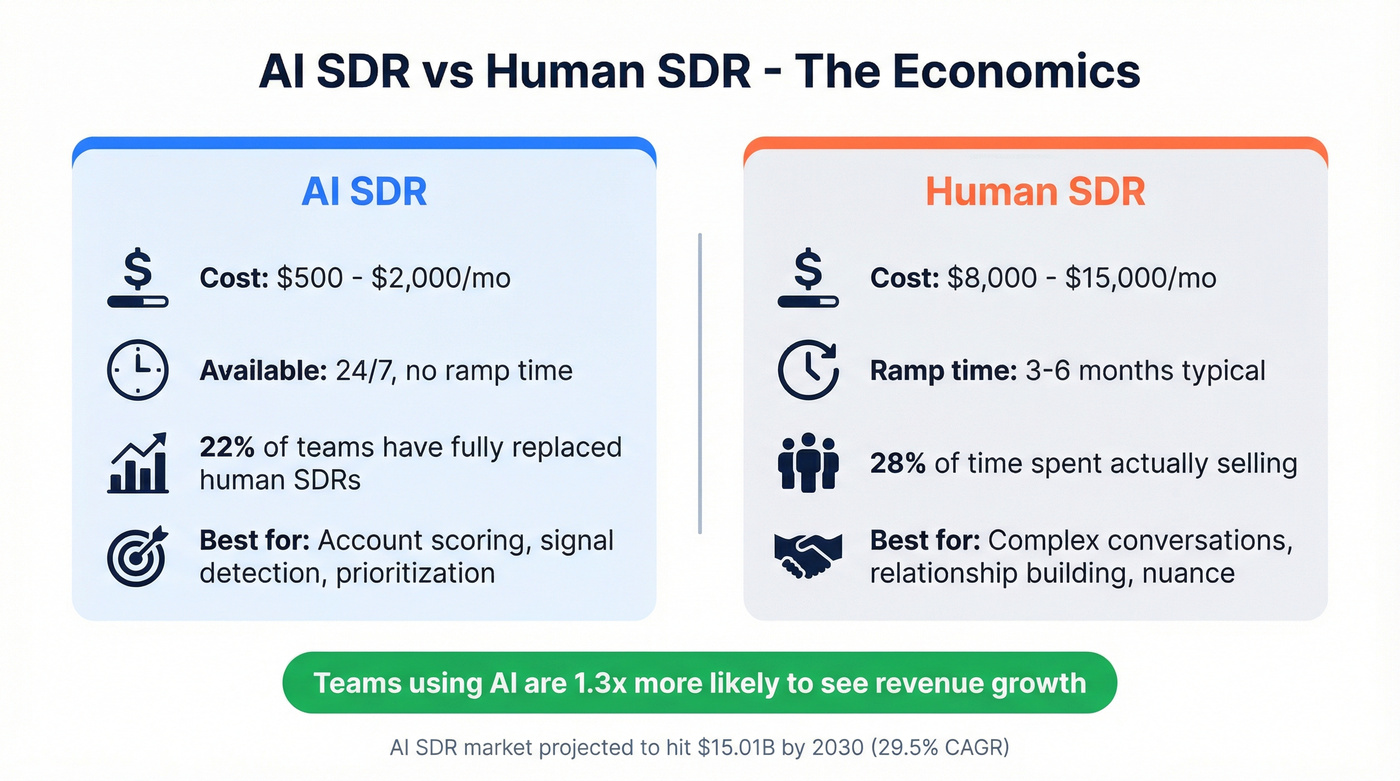
But the real shift isn't AI-generated copy. It's AI-directed strategy. The AI SDR market is projected to hit $15.01B by 2030 at a 29.5% CAGR, and 22% of teams have fully replaced human SDRs with AI. The economics are hard to ignore: an AI SDR runs $500-$2,000/mo versus a fully loaded human SDR at $8k-$15k/mo.
The teams getting results use AI to identify which accounts to pursue, when to reach out, and which signals indicate buying intent. The volume play is dead. The intelligence play is just getting started. If you're not sure where to begin, feed your CRM activity data into an AI scoring model before investing in a full AI SDR platform - that alone will sharpen your targeting (more on AI lead qualification).
Email Authentication Became a Gatekeeper
There's an enforcement timeline every outbound team needs to know:
- Feb 2024: Google and Yahoo require SPF, DKIM, and DMARC for bulk senders
- May 2025: Microsoft follows suit
- Sept 2025: La Poste enforces the same standards
Non-compliant emails get rejected or routed to spam. No exceptions. Only [16% of domains](https://www.validity.com/blog/dmarc-adoption-a-deep-dive-into-the-current-state-of-email-authentication/) have implemented DMARC - the vast majority are vulnerable to delivery failures right now.
For properly authenticated emails, inbox placement runs about 87.2% on Google and 75.6% on Microsoft. Without authentication, you're gambling with every send. Implementation takes 6-8 weeks, so if you haven't started, you're already behind (follow a SPF, DKIM, DMARC explained guide).
One thing that doesn't get enough attention: verified data is your first line of deliverability defense. Bounced emails damage sender reputation faster than missing DMARC records. A verified data provider with a 7-day refresh cycle means fewer bounces hitting your domain before authentication even enters the equation (see hard bounce).
Signal-Driven Targeting Replaced Spray-and-Pray
Only 25% of B2B companies use intent or signal tools. That gap is enormous - signal-qualified leads convert 47% better, close 43% larger deals, and generate 38% more closed deals per quarter.
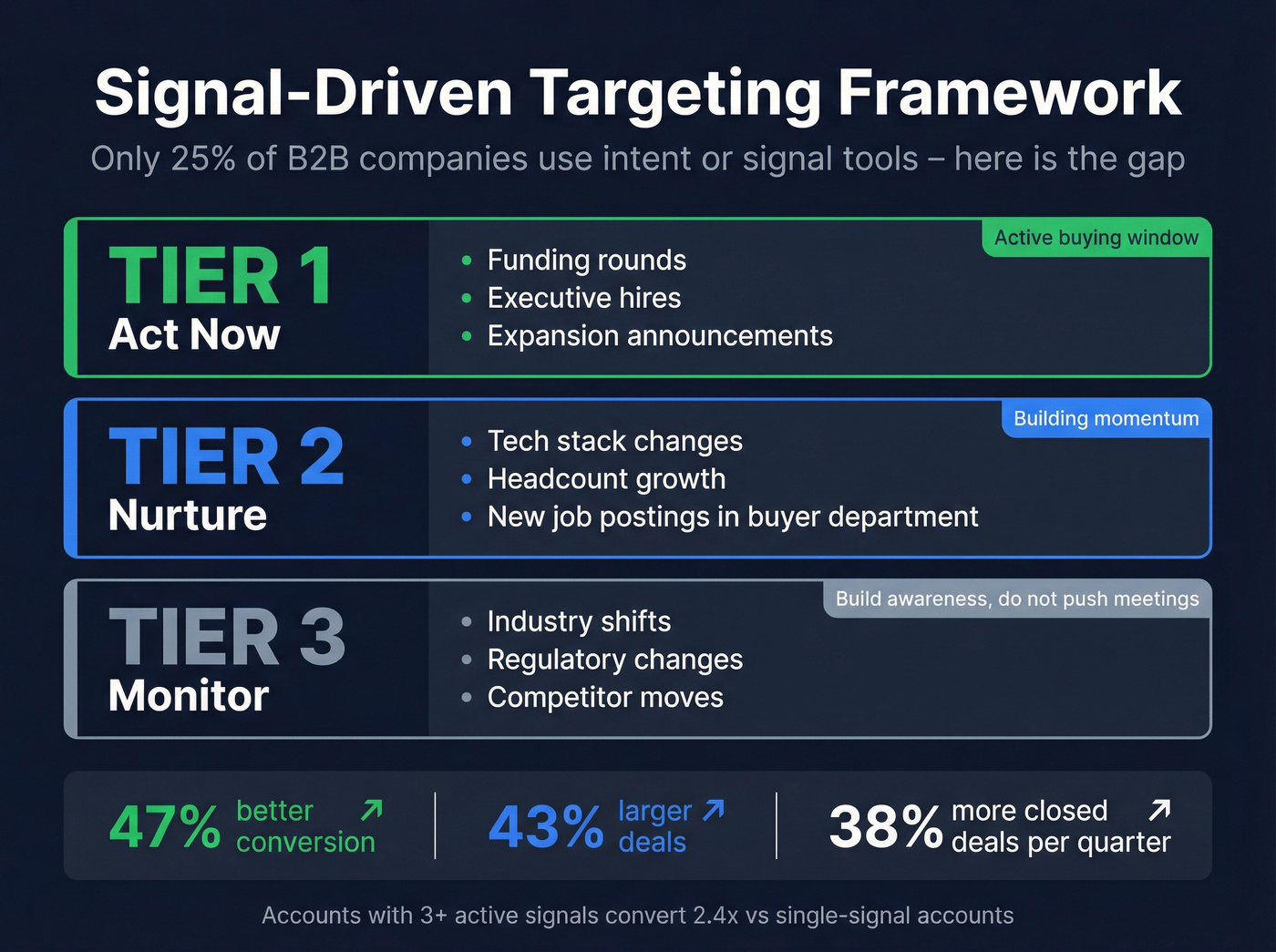
Here's a practical tiering framework we've seen work well:
- Tier 1 - Act now: Funding rounds, executive hires, expansion announcements. Active buying windows.
- Tier 2 - Nurture: Tech stack changes, headcount growth, new job postings in your buyer's department.
- Tier 3 - Monitor: Industry shifts, regulatory changes, competitor moves. Build awareness, don't push meetings.
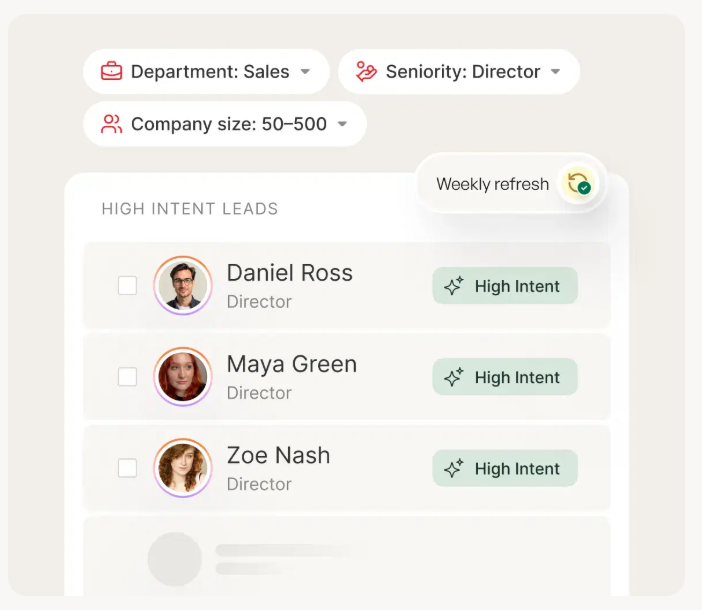
Teams that cut research time by 40-60% through signal automation aren't just faster - they're reaching prospects at the right moment. Accounts with three or more active signals convert 2.4x versus single-signal accounts. Prospeo tracks 15,000 intent topics via Bombora, so you can layer buyer intent with technographic and headcount-growth filters to surface accounts showing real purchase signals - not just firmographic matches (use a signal-based outbound system).
AI Personalization Fatigue Is Real
Look, buyers can smell AI-generated personalization from a mile away. The {{first_name}}, I-saw-your-company-just-raised approach worked for about six months. Now it's noise. The consensus on r/sales backs this up - threads about "obvious AI outreach" have become a weekly fixture, and the frustration is palpable on both sides.
The fix isn't abandoning personalization - it's stacking relevance layers. Instead of one surface-level observation, combine two or three: pair a recent event like funding or a product launch with a tool gap you can solve, reference a role-specific KPI alongside a similar-company challenge you've addressed, or match a job posting signal with a mini case study from their industry (see personalization in outbound sales).
Signal-personalized outreach achieves 15-25% reply rates versus 3-5% for generic cold email. That's a 5x difference driven entirely by relevance depth, not send volume.
Data Quality Is the Real Competitive Moat
This is the unsexy trend that determines everything downstream. The industry average refresh cycle is six weeks. By the time most databases update, a significant chunk of your list is already stale.
Stale data doesn't just mean missed contacts. It means bounced emails that damage your sender reputation, which tanks deliverability for every future campaign. It compounds (build a CRM hygiene habit).

Hot take: If you're selling deals under $25k, data quality matters more to you than to enterprise teams, not less. Enterprise reps can afford a few bad dials. When you're running lean sequences at scale, a 25% bounce rate doesn't just waste sends - it burns your domain for months.
The proof points back this up. Snyk's team of 50 AEs went from a 35-40% bounce rate to under 5% after switching to a 7-day refresh cycle, with AE-sourced pipeline up 180% and 200+ new opportunities per month. Meritt tripled pipeline from $100K to $300K per week, with bounce rates dropping from 35% to under 4% and connect rates 3x-ing to 20-25%. Those aren't marginal improvements - they're fundamentally different outbound operations.
Multichannel Outreach Is Mandatory
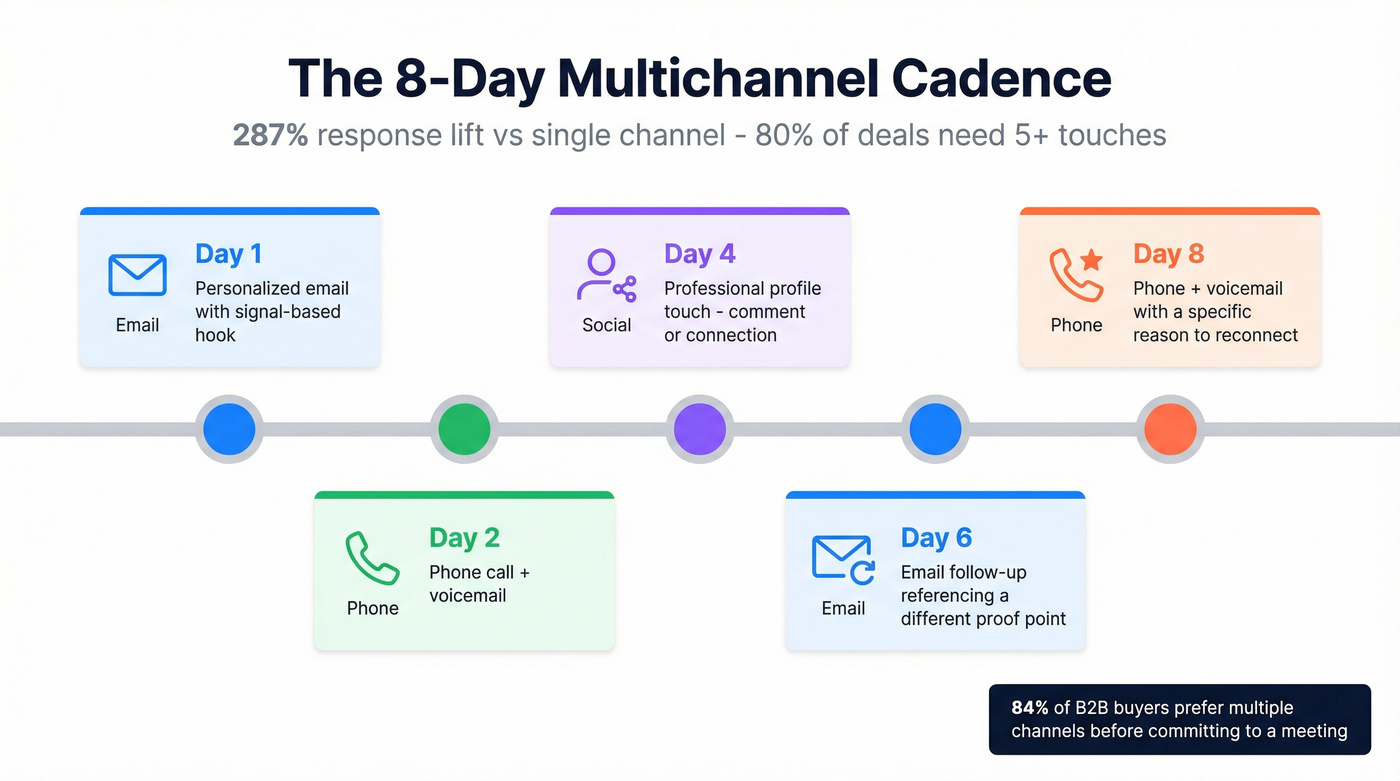
The 287% response lift from multichannel outreach versus single-channel is the difference between a pipeline that works and one that doesn't. 80% of deals require five or more touches, yet 44% of reps give up after one.
That math doesn't work.
84% of B2B buyers prefer engaging via multiple channels before committing to a meeting, and Consensus data shows prospects who view 9+ demos are 8-10x more likely to close - with product experiences uncovering 4+ stakeholders on average. Neither email nor phone alone will cut it.
Here's a sample 8-day cadence that works:
- Day 1: Personalized email with signal-based hook
- Day 2: Phone call + voicemail
- Day 4: Professional profile touch (comment or connection)
- Day 6: Email follow-up referencing a different proof point
- Day 8: Phone + voicemail with a specific reason to reconnect
Multichannel often doubles operational costs compared to single-channel. But when response rates nearly triple, the cost per qualified conversation drops dramatically. We've tested this internally - the ROI math holds even at modest deal sizes (see AI multi-channel prospecting).
Outbound Economics Are Being Recalculated
The average cost per qualified B2B appointment runs $550-$1,700. Pay-per-appointment models range $50-$500. Reliable data research adds 20-40% to total campaign cost. Here's what the tool stack looks like:
| Component | Typical Cost |
|---|---|
| AI SDR tooling | $500-$2,000/mo |
| Human SDR (loaded) | $8k-$15k/mo |
| Apollo (data) | ~$49/mo per user |
| ZoomInfo (data) | $15k+/yr |
| Conversica (AI) | ~$1,500/mo |
| Prospeo (data) | ~$0.01/email |
When you're paying $0.01 per verified email versus $1+ per lead through legacy platforms, the savings compound across every campaign. We've seen teams waste months optimizing copy and sequences when the real problem was a 25% bounce rate from bad data. Fix the data first. The economics of everything else improve downstream. And if your stack has more than four tools touching the same workflow, consolidate - fewer tools with tighter integration beats a bloated stack every time (use a B2B sales stack blueprint).

Signal-driven targeting only works when the data underneath is fresh. Prospeo refreshes every 7 days, tracks 15,000 intent topics via Bombora, and delivers 98% email accuracy - so your signals actually reach real inboxes.
Stop targeting the right accounts with the wrong data.
The Outbound Maturity Curve
Not every team needs to implement all seven trends at once. Think of it as a maturity curve.
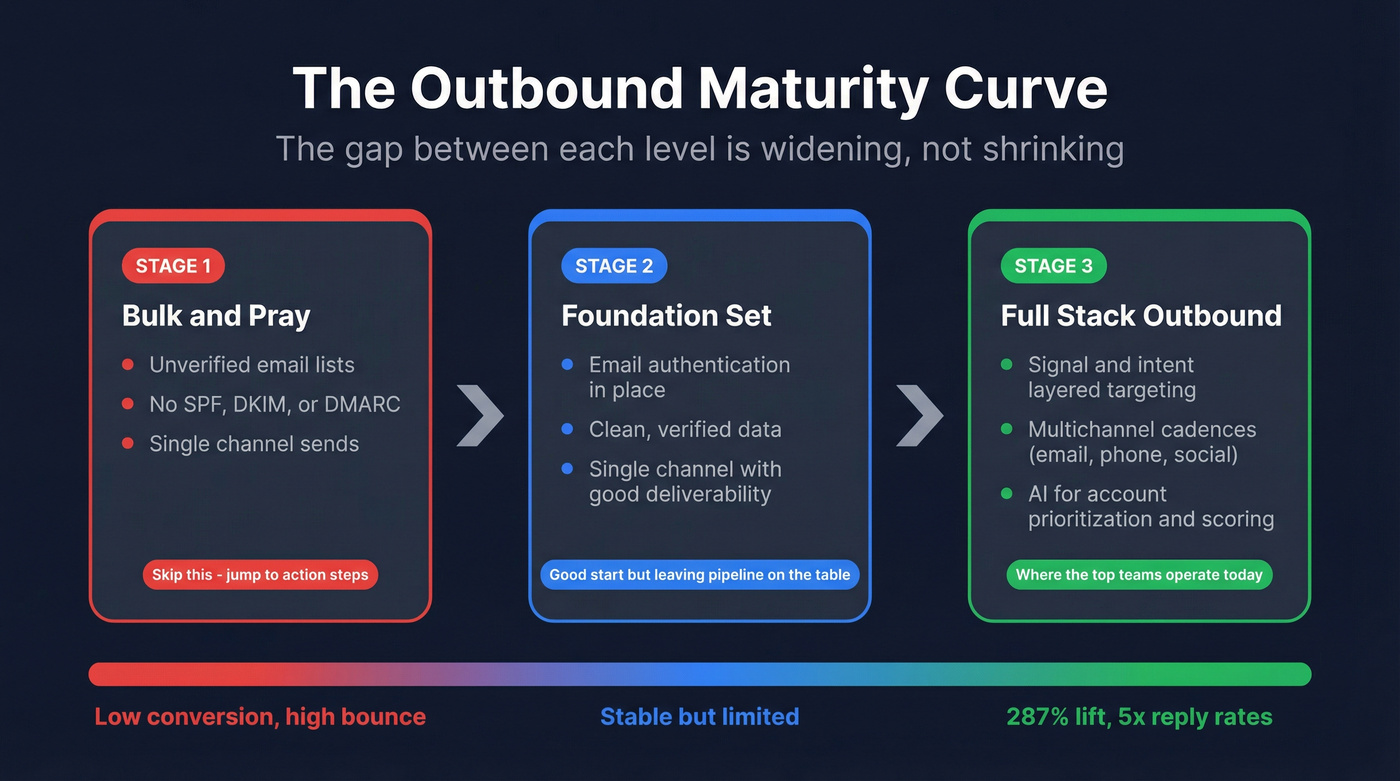
Stage one teams are still sending bulk emails from unverified lists with no authentication - skip this if that's you and jump straight to the action steps below. Stage two teams have authentication and clean data but rely on a single channel. Stage three teams layer signals, run multichannel cadences, and use AI for account prioritization. The future of B2B prospecting belongs to teams that reach stage three, and the benchmarks above show the gap between each level is widening, not shrinking.
What to Do Next
Five steps, in priority order:
- Audit email authentication. Check SPF, DKIM, and DMARC records for every sending domain. If you aren't compliant, start the 6-8 week implementation now.
- Audit data freshness. Pull bounce rates from your last 30 days of sends. If you're above 5%, your data provider is the problem (run a prospect data accuracy check).
- Layer intent signals into ICP targeting. Even basic signals - funding, hiring, tech stack changes - dramatically improve conversion over static lists.
- Qualify before you sequence. Before sending any outreach, verify each message combines a trigger event, a role-specific insight, and a proof point. If you can't identify all three, the account isn't ready.
- Measure cost per qualified meeting. Sends, opens, and clicks are vanity metrics. Meetings booked per dollar spent is the only number that matters.
These outbound sales trends aren't predictions - they're already separating the teams building pipeline from the ones complaining that outbound doesn't work. The playbook has changed. The teams that adapt fastest win.
Snyk cut bounce rates from 35-40% to under 5% and added 200+ opportunities per month. Meritt tripled pipeline to $300K/week. The difference wasn't better copy - it was a 7-day refresh cycle at $0.01 per email.
Your 2026 outbound strategy is only as good as your data freshness.
FAQ
What are the biggest outbound sales trends in 2026?
AI-directed targeting, email authentication enforcement, signal-driven prospecting, and data quality as a competitive moat define 2026. Multichannel outreach lifting response rates 287% over single-channel is the standout benchmark - teams still running email-only are leaving the majority of replies on the table.
What's changed about cold email deliverability?
Google, Yahoo, and Microsoft now require SPF, DKIM, and DMARC for bulk senders - non-compliant emails get rejected outright. Only 16% of domains comply. Pair authentication with a verified data provider offering 98% accuracy and a 7-day refresh to keep bounce rates under 5% and protect sender reputation.
How much does a qualified outbound meeting cost?
The average runs $550-$1,700 per qualified B2B appointment. Data quality and targeting precision are the biggest cost levers - bad data inflates spend by 20-40% through wasted sends and compounding sender-reputation damage.
Are AI SDRs replacing human reps?
About 22% of teams have fully replaced human SDRs with AI at $500-$2,000/mo versus $8k-$15k/mo loaded cost. Most run a hybrid model - AI handles research, signal detection, and initial outreach while humans own discovery calls and closing conversations.
What tools do outbound teams need in 2026?
A verified data provider with weekly refresh, email authentication infrastructure, a sequencing tool like Outreach or Instantly, and intent data for signal-based targeting. Consolidate where possible - fewer tools with tighter integration beats a bloated stack.