How to Build a Sales Cadence That Actually Gets Replies
A RevOps lead we work with ran a 12-touch sales cadence last quarter across 500 accounts. Solid messaging, tight timing, good channel mix. The result? 180 bounced emails, a tanked sender domain, and a pipeline that went backward. The cadence design was fine. The contact data underneath it was garbage.
That's the part most cadence guides skip. Structure matters, but data matters more. Here's how to get both right.
What Is a Sales Cadence?
A sales cadence is a predefined sequence of outreach touchpoints - emails, calls, social touches, videos - spread across set intervals designed to move a prospect toward a conversation. If you've heard "sales sequence," it's the same thing. "Cadence" emphasizes timing and rhythm; "sequence" emphasizes the order. Both replace the "I'll follow up when I remember" approach that kills most pipelines.
Simple in theory. Execution is where teams fall apart.
Why Structured Outreach Matters in 2026
Buyers don't wait for your SDR to call. A 6sense study of 2,509 B2B buyers found that 69% of purchase decisions are made before a buyer ever talks to a sales rep, and 81% already have a preferred vendor at first contact.
The buying committee keeps growing, too. Forrester puts the average B2B deal at 13 stakeholders across multiple departments, each consuming information through different channels. McKinsey's B2B Pulse research shows buyers engage across an average of 10 channels during their journey, and systematic sales engagement processes drive 10-20% pipeline improvements.
A structured cadence is the only way to systematically reach multiple stakeholders across multiple channels without dropping balls. And yet, 50% of companies don't offer their salespeople formal sales training. Half the reps running sequences are winging it.
The Cadence Framework
Touches and Timing
The sweet spot is 8-12 touchpoints over 17-21 days. Start with 1-2 days between early touches when momentum is highest, then expand to 3+ days as the cadence progresses. RAIN Group research shows it takes 8 touches on average to book a meeting, yet most reps quit at touch 4-5.
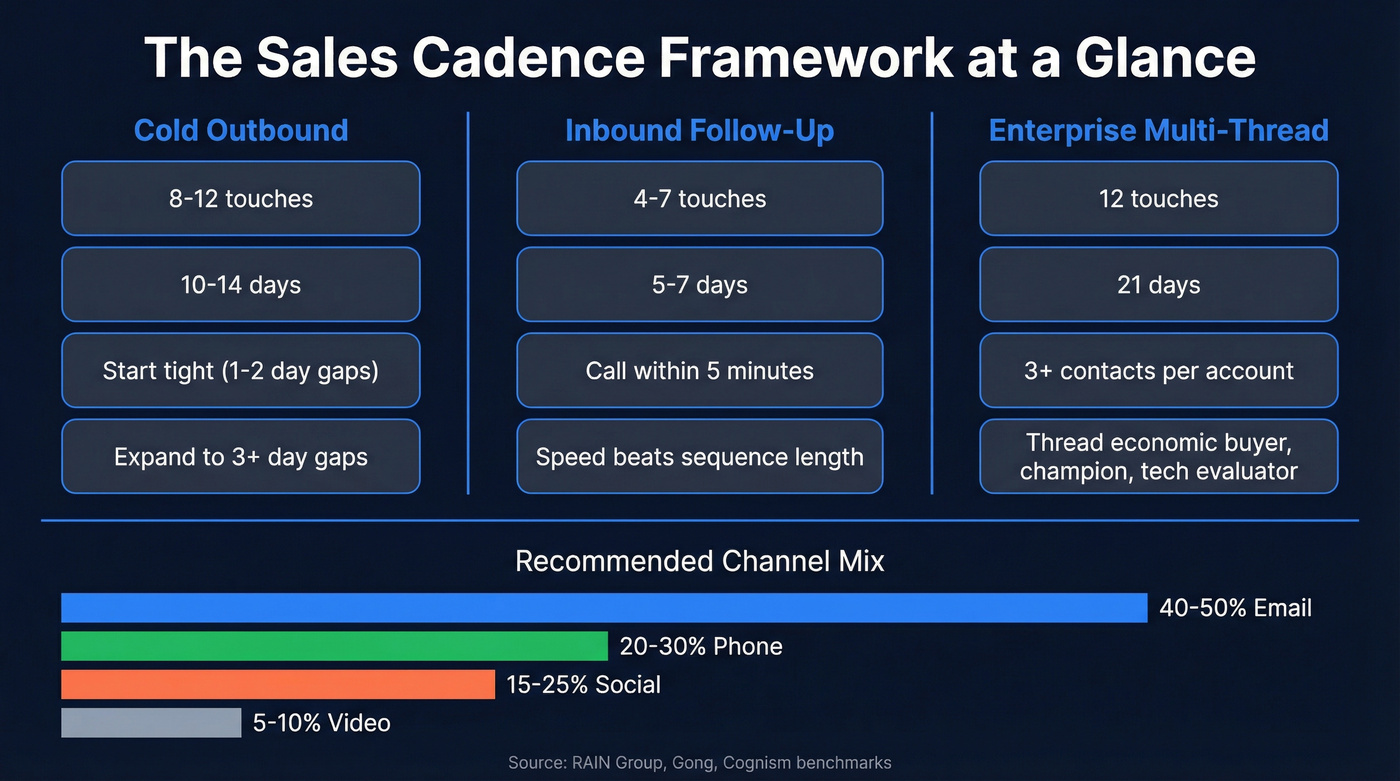
For cold outbound, a tighter window works better - 7-10 touches over 10-14 days. Warm or inbound leads need less pressure: 4-7 touches within about a week. Match intensity to intent. A demo request deserves a same-day call. A cold prospect needs a longer runway.
A practical default for email timing is 9-11 AM local time. Late afternoon can also work well when prospects are clearing their inbox before signing off.
Channel Mix
Email-only cadences are dead. Gong found that leaving a voicemail doubles email reply rates, pushing them from 2.73% to 5.87%. That single data point should end the "should I call?" debate permanently.
| Channel | % of Touches |
|---|---|
| 40-50% | |
| Phone | 20-30% |
| LinkedIn/Social | 15-25% |
| Video | 5-10% |
Save video for later in the cadence, after you've seen engagement signals like an email open or a profile view. Leading with video to a cold prospect wastes production effort.
One counterintuitive tactic from Cognism's data: blank connection requests on LinkedIn actually get higher acceptance rates than those with a note. The personalization comes in the follow-up message, not the connection request itself.
Regional Nuances
Not every market responds the same way. Cold calling is more effective and culturally accepted in the US. EMEA and APAC prospects generally need fewer touchpoints. The "triple-touch Day 1" approach - email, call, and social all on the first day - can feel intrusive in DACH markets.
Keep emails short regardless of region. Cognism's data suggests 75-100 words is the sweet spot, with 75 being optimal. If your SDRs are writing 200-word first touches, they're losing people by sentence three.
Entrance and Exit Criteria
A cadence without entrance and exit rules creates chaos. Define who enters: ICP-matched prospects, inbound form fills, intent signal triggers, or event attendees. Be specific - "all leads" isn't criteria, it's a prayer.
Exit criteria matter just as much. Pull a prospect out when they reply (positive or negative), book a meeting, bounce, unsubscribe, or engage meaningfully on social. We've seen teams leave booked prospects in active cadences, sending them "just checking in" emails the day before a scheduled demo. Embarrassing and entirely avoidable.
Sales Cadence Templates That Work
Cold Outbound (8 Touches, 12 Days)
Before Day 1, verify your list. High bounce rates will destroy your domain reputation faster than any bad subject line.
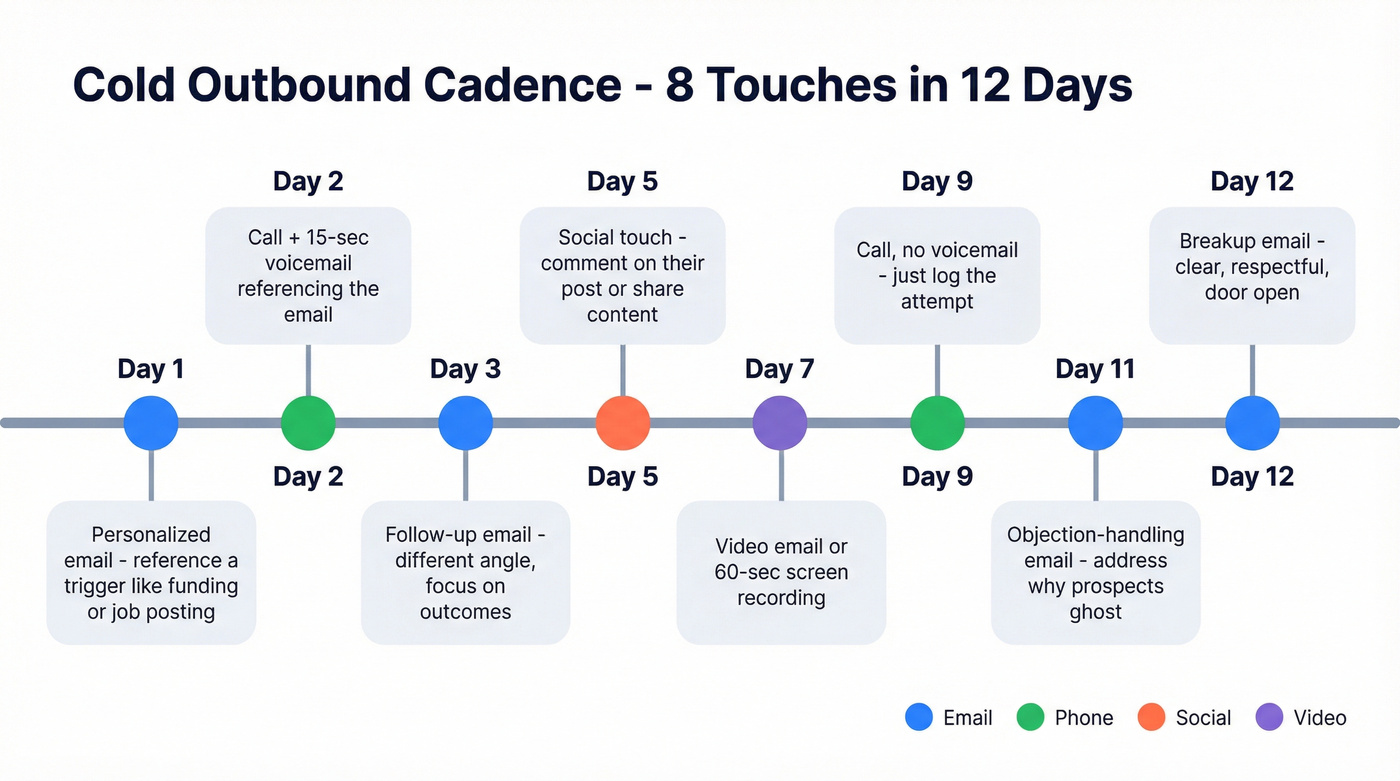
- Day 1 - Personalized email referencing a specific trigger: funding round, job posting, product launch
- Day 2 - Call + 15-second voicemail referencing the email
- Day 3 - Follow-up email with a different angle, focused on outcomes
- Day 5 - Social touch tied to a real signal - comment on their post or share relevant content
- Day 7 - Video email or 60-second screen recording
- Day 9 - Call, no voicemail - just log the attempt
- Day 11 - Objection-handling email addressing the most common reason prospects don't reply
- Day 12 - Breakup email that's clear, respectful, and leaves the door open
Inbound Follow-Up (5 Touches, 7 Days)
Inbound leads have intent. Speed matters more than sequence length.
Call within 5 minutes of the form fill on Day 1. Follow with a recap email on Day 2 that includes a specific next step - not a vague "let me know." Day 3, connect on social with a brief personalized note. Day 5, send a value-add email with a case study or benchmark. Day 7, close with a breakup email and a clear CTA.
Enterprise Multi-Thread (12 Touches, 21 Days)
With 13 stakeholders per deal, single-threading kills enterprise deals. This cadence targets 3+ contacts per account simultaneously: the economic buyer, the champion, and the technical evaluator.
- Days 1-3 - Personalized emails to each contact with different angles, plus a call to the economic buyer
- Days 5-8 - Social touches across all contacts, a case study email to the technical evaluator, and a call to the champion
- Days 10-14 - Video email to the economic buyer, a shared resource to all three, and a call to the technical evaluator
- Days 16-21 - Social engagement, a final value email to the economic buyer, and a breakup to the champion (they're most likely to re-engage)
Re-Engagement (4 Touches, 14 Days)
For stale leads who went dark, this cadence runs light and trigger-based. Open with an email tied to something new - a product feature, industry news, or their company in the press. Five days later, engage on social by liking or commenting on their recent post. On Day 10, send a pure value-add email with zero ask. Close on Day 14 with a low-friction CTA like "worth a 10-minute revisit?"
In our experience, the Day 10 no-ask email generates more replies than any other touch in this sequence because it rebuilds trust without pressure.

180 bounced emails from 500 accounts isn't a cadence problem - it's a data problem. Prospeo's 5-step verification delivers 98% email accuracy with a 7-day refresh cycle, so your 12-touch sequence actually reaches real inboxes instead of destroying your sender domain.
Stop burning cadences on bad data. Verify before you send.
Benchmarks to Measure Against
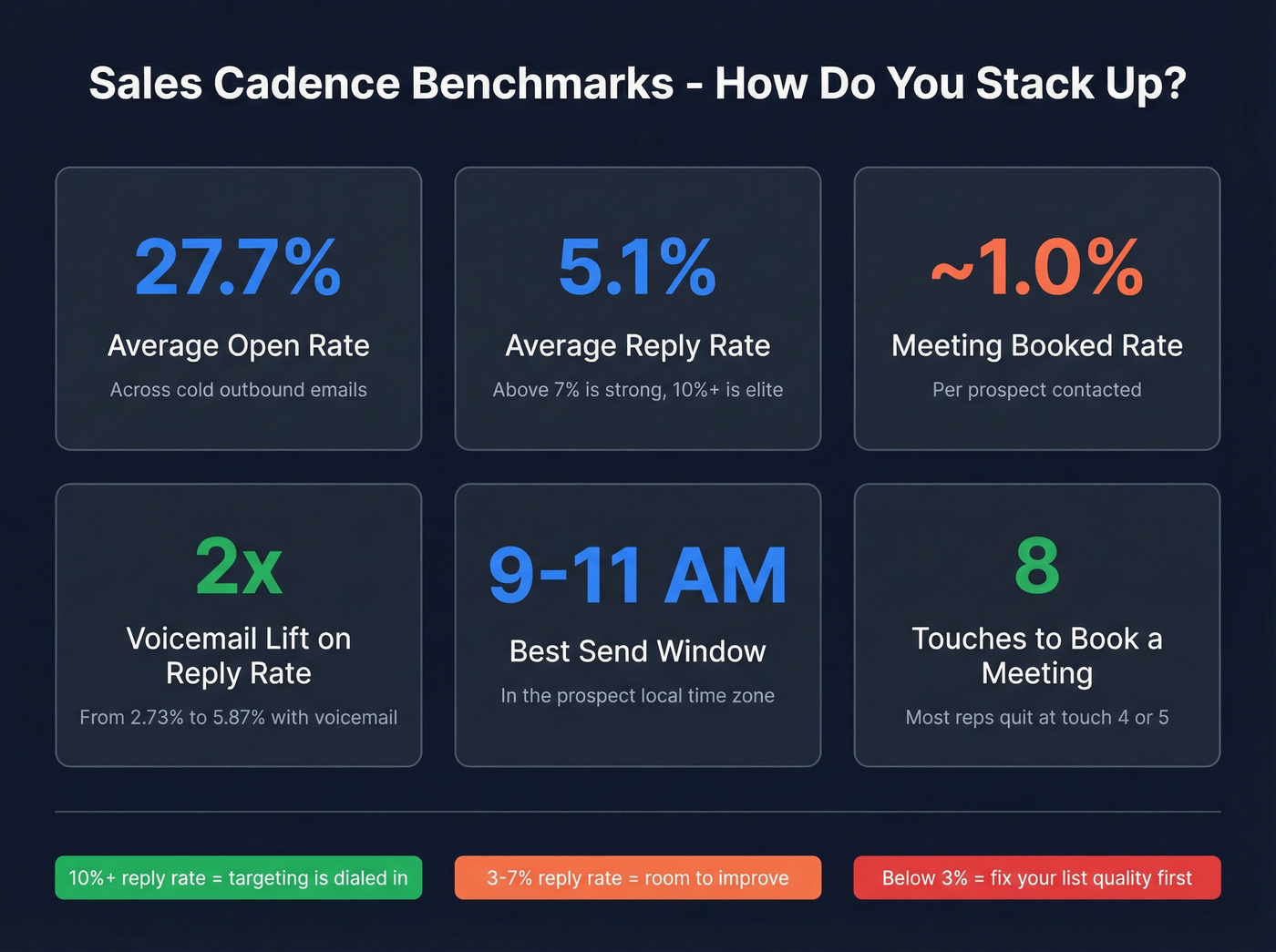
Here's what the latest benchmark data shows. If you're above these numbers, you're outperforming most teams. If you're below, your cadence design or data quality needs work.
| Metric | Benchmark |
|---|---|
| Open rate | 27.7% |
| Reply rate | 5.1% |
| Meeting-booked rate | ~1.0% |
| Voicemail lift | 2x email reply rate |
| Best send window | 9-11 AM local time |
| Early touch spacing | 1-2 days |
| Late touch spacing | 3+ days |
Anything above a 7% reply rate is strong. If you're hitting 10%+, your targeting and messaging are dialed in. Below 3% means something structural needs fixing - and nine times out of ten, it's list quality, not copy.
Mistakes That Kill Pipeline
Over 90% of sales emails get ignored. Most of that isn't bad luck - it's avoidable mistakes.
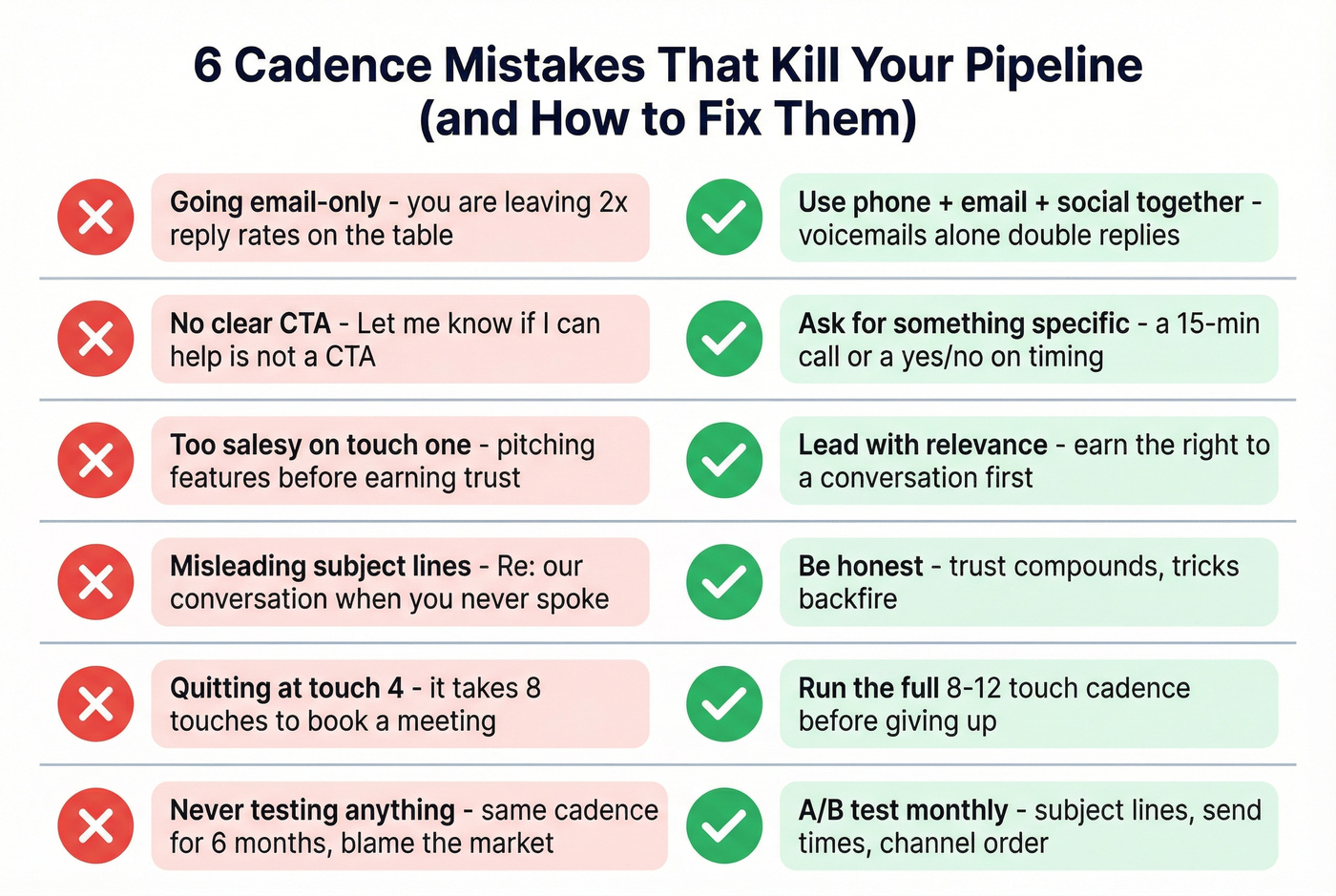
Going email-only. Multichannel isn't optional. Phone plus email plus social outperforms email-only every time. Voicemails alone double your reply rates.
No clear CTA. "Let me know if I can help" isn't a CTA. Ask for something specific: a 15-minute call, a reply with their biggest challenge, a yes/no on timing.
Too salesy on touch one. Your first email shouldn't pitch. It should earn the right to a conversation. Lead with relevance, not features.
Misleading subject lines. "Re: our conversation" when you've never spoken is a trust-killer. It gets opens, but it tanks reply rates and your reputation. The consensus on r/sales is that these tactics poison the well for everyone - and they're right.
Pulling prospects out too early. It takes 8 touches to book a meeting. If your cadence stops at 4, you're quitting before the game starts.
Never testing anything. A cadence isn't a "build once" asset. A/B test subject lines, send times, channel order, and the number of touches. Review performance monthly, swap out underperforming emails, and test new angles. We've watched teams run the same cadence for six months without changing a word, then blame "the market" for declining reply rates.
Ignoring deliverability infrastructure. Set up SPF, DKIM, and DMARC before you send a single email. Warm up new sending domains gradually over 2-3 weeks. Skip this and your cadence lands in spam regardless of how good the copy is.
The Data Problem Most Teams Ignore
Here's the thing: most cadence advice focuses on the wrong layer entirely. Teams spend weeks perfecting subject lines and A/B testing send times while sitting on a contact list where a huge chunk of the emails will bounce. Fix the data first. If you're running outbound, bad data costs you more pipeline than bad messaging ever will.
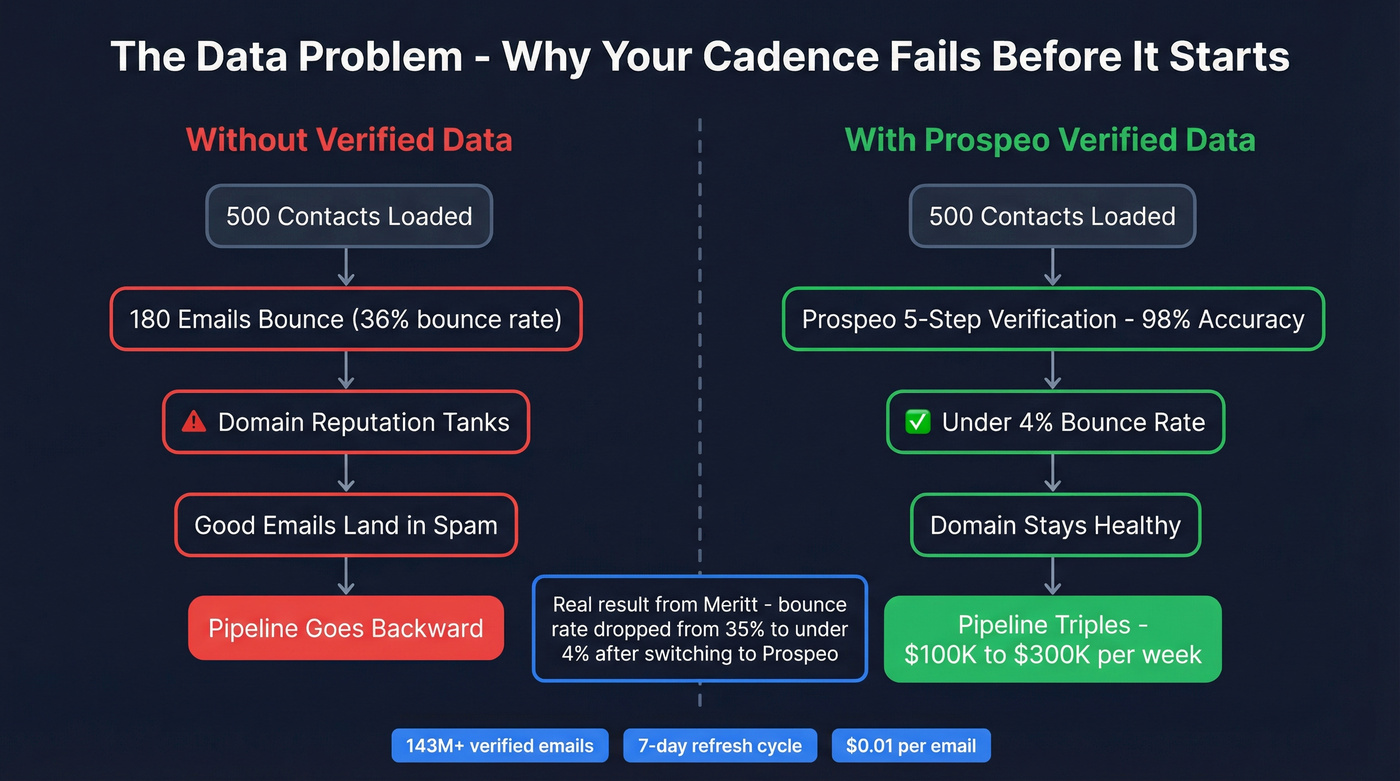
Your SDR runs a 500-contact cadence and 180 emails bounce. Your domain reputation drops. Now even the good emails land in spam. The cadence wasn't the problem - the list was.
Prospeo solves this at the source. With 143M+ verified emails, a proprietary email-finding infrastructure, and 98% accuracy on a 7-day refresh cycle, it catches bad data before it reaches your sequences. Real results: Meritt went from a 35% bounce rate to under 4%, and their pipeline tripled from $100K to $300K per week.
The cadence tool handles the sequence. The data layer handles everything feeding it.
Multi-threading 3+ contacts per enterprise account means you need accurate emails and direct dials for every stakeholder. Prospeo gives you 143M+ verified emails and 125M+ mobile numbers with a 30% pickup rate - at $0.01 per email, not $1.
Reach every stakeholder in the buying committee on the first attempt.
Best Tools for Running Cadences
Outreach and Salesloft are powerful platforms, but they're often more than smaller teams need - and the learning curve alone can cost you a quarter of productivity.
| Tool | Best For | Starting Price | G2 Rating |
|---|---|---|---|
| Prospeo | Data verification | Free; ~$0.01/email | - |
| Instantly | SMB sequencing | $37/mo | 4.8/5 |
| Reply | Mid-market sequences | $89/user/mo | - |
| HubSpot Sales Hub | CRM + cadence | Free; Pro $100/mo | 4.4/5 |
| Salesloft | Mid-market/enterprise | ~$75-125/user/mo | - |
| Outreach | Enterprise | ~$100-150/user/mo | 4.3/5 |
SMBs should start with Instantly or Reply for sequencing. Mid-market teams that want CRM integration should look at HubSpot or Salesloft. Enterprise orgs with dedicated RevOps can justify Outreach's complexity. Regardless of which tool you pick, pairing it with verified data is what separates high-performing cadences from ones that stall out.
If you're evaluating sequencing platforms, start with a shortlist of cold email marketing tools and then map your stack to your B2B sales stack requirements.
AI and the Future of Cadences
The biggest shift happening right now isn't a new channel - it's AI dynamically adjusting cadences based on engagement signals. Tools like Reply.io are building agentic workflows where AI handles lead discovery, generates personalized messaging, adjusts timing based on opens and clicks, and manages replies.
Trigger-based timing is outperforming calendar-based scheduling. Instead of "send email on Day 3," the best cadences fire touches when a prospect visits your pricing page, opens a competitor's case study, or gets promoted. The sales cadence of 2026 isn't a fixed schedule - it's a responsive system that adapts in real time.
If you want to go deeper on this, see AI in Sales Cadences and AI Sales Outreach Automation.
FAQ
What's the difference between a sales cadence and a sales sequence?
They're the same thing. "Cadence" emphasizes timing and rhythm between touchpoints, while "sequence" emphasizes the order of steps. Both describe a structured series of outreach activities designed to move a prospect toward a conversation. Use whichever term your team prefers.
How many touchpoints should a cadence have?
Eight to twelve for cold outbound, four to seven for warm inbound. It takes 8 touches on average to book a meeting, yet most reps quit at touch 4-5. Fewer than 8 steps means you're leaving meetings on the table.
What's a good reply rate for cold outbound?
The latest benchmark is 5.1% reply rate and 27.7% open rate. Anything above 7% is strong. Consistently hitting 10%+ means your targeting and messaging are well-calibrated. Below 3% usually points to a list quality problem - verify your contacts before blaming copy.
Should I include phone calls in my outreach?
Yes. Gong found that leaving a voicemail doubles email reply rates, pushing them from 2.73% to 5.87%. Phone-heavy cadences outperform email-only across the board, especially for enterprise deals where you need to reach multiple stakeholders.
How do I keep outbound emails from landing in spam?
Start with verified contact data - bounced emails destroy sender reputation faster than anything else. Set up SPF, DKIM, and DMARC authentication, warm up new sending domains gradually over 2-3 weeks, keep email volume consistent, and avoid spam-trigger words in subject lines. Deliverability is a system, not a single fix.