Cold Calling for Recruitment: The Data-Driven Playbook for 2026
Cold calling for recruitment still works - but only if the data feeding your dials is clean. Phone numbers decay, carriers reassign digits, and dead lines can wreck an entire call block. The problem isn't your pitch. It's everything that happens before you open your mouth.
Three things move the needle fastest:
- Fix your data first. Bad numbers kill call blocks before you speak. If half your dials hit disconnected lines, no script saves you. (If you want the benchmarks behind this, start with contact data decay.)
- Use a permission-based opener. It converts at 11.18% - about 5x the rate of "Did I catch you at a bad time?" (More frameworks: cold calling advice.)
- Calling alone won't cut it. Pair email with social touches for a ~25% reply-rate lift over email-only outreach, then layer calls on top to turn replies into real conversations. (See: AI in sales cadences.)
Why Recruiting Cold Calls Still Work
Here's the thing: 70% of the global workforce is passive talent. These people aren't actively applying or replying to outreach. But they will pick up the phone - especially if the number looks local and the first ten seconds are compelling.
The phone isn't dead. Lazy dialing is dead. Recruiters who call without research, read from a generic script, and hang up after one "not interested" are the ones who think phones don't work anymore. Meanwhile, recruiters who treat calling as a precision tool book screens at rates that email can't touch. (If you need a broader baseline, use this B2B cold calling guide.)
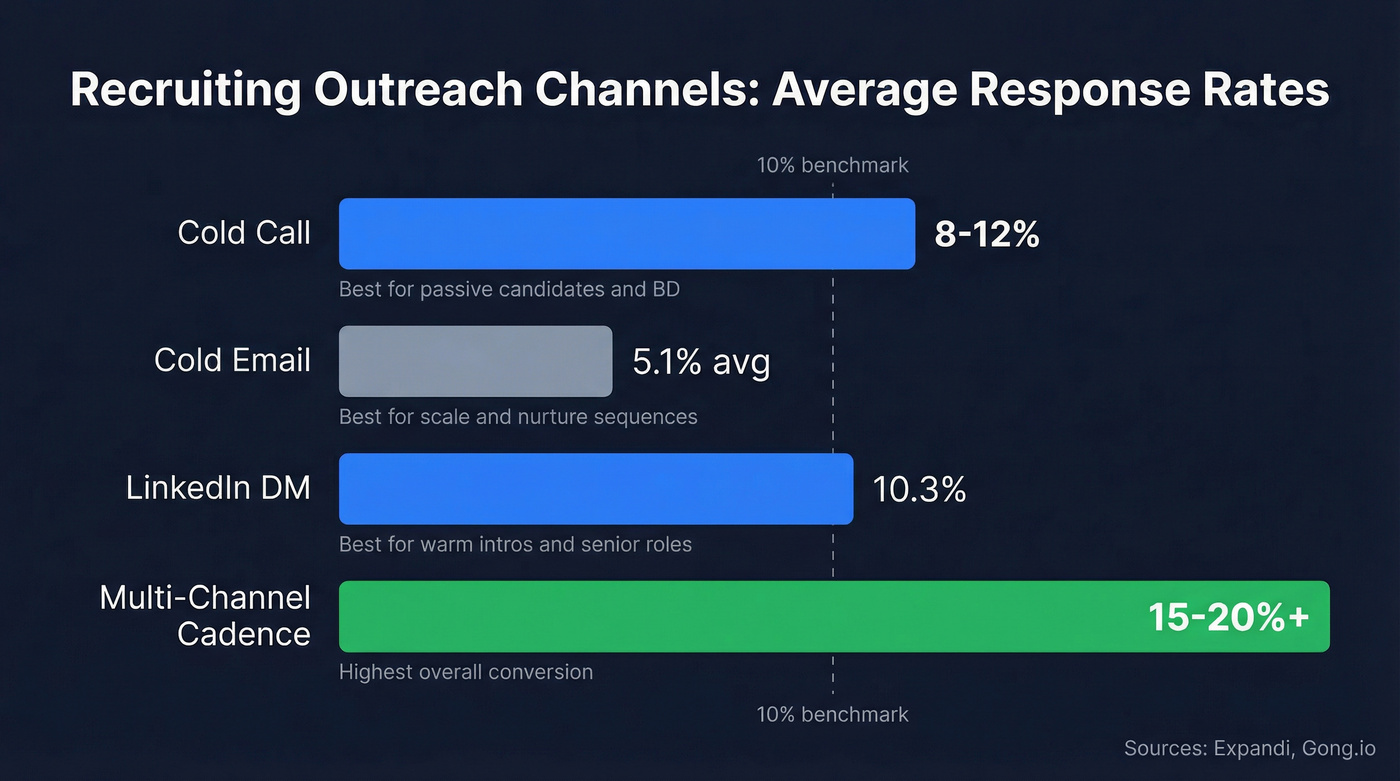
| Channel | Avg. Response Rate | Best For |
|---|---|---|
| Cold call | 8-12% | Passive candidates, BD |
| Cold email | 5.1% avg (mass cold email often lands under 1%) | Scale, nurture sequences |
| LinkedIn DM | 10.3% | Warm intros, senior roles |
| Multi-channel | ~15-20%+ | Highest overall conversion |
Cold calls deliver the highest per-touch conversion when you actually connect. The challenge is connecting - which brings us to the real bottleneck.
Fix Your Data Before You Dial
If you're dialing 80 numbers and connecting with 5, your data is the problem. Not your energy, not your script, not the market.
Phone numbers decay fast. People change jobs, get new numbers, and carriers reassign digits constantly. The FCC's Reassigned Numbers Database exists as a safe-harbor mechanism to help callers avoid dialing reassigned numbers - and calling one can trigger TCPA liability. For recruiters running 50+ dials a day, bad data doesn't just waste time. It creates legal exposure. (Related: phone validator.)
We've seen this play out repeatedly on our team: a recruiter burns through a two-hour call block, connects with three people, and blames the market. The real culprit was a stale list. Prospeo's mobile finder covers 125M+ verified mobile numbers with a 30% pickup rate - roughly 2.5x what legacy providers deliver. Every record refreshes on a 7-day cycle, so you're not dialing numbers from six months ago. The Chrome extension finds verified emails and phone numbers from professional profiles, company websites, and CRMs in one click, so your call blocks are built on numbers that actually connect. (If you're cleaning lists inside your CRM, use a CRM hygiene workflow.)
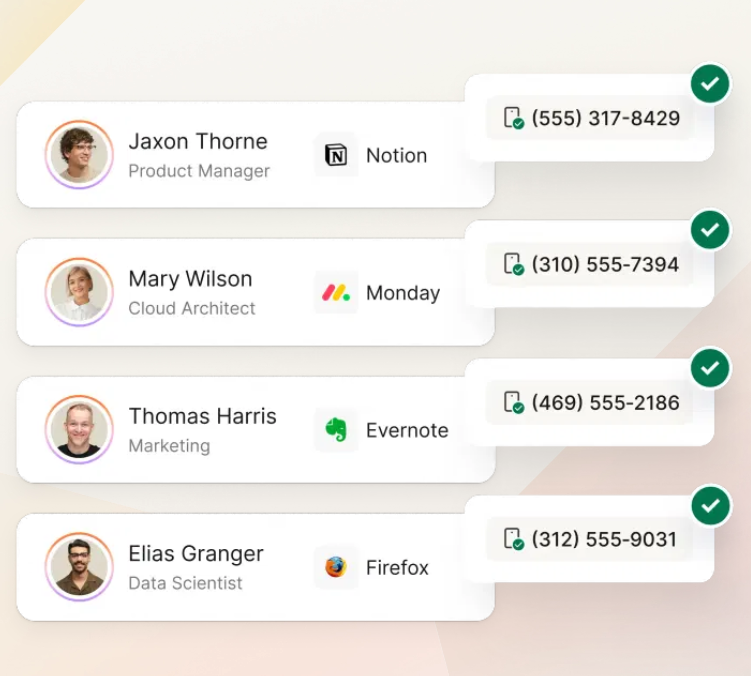

Your recruiters are dialing numbers that went stale weeks ago. Prospeo's 125M+ verified mobiles refresh every 7 days - not every 6 weeks like legacy providers. That's a 30% pickup rate vs. the 12% industry average. At $0.10 per mobile, one connected call pays for hundreds of lookups.
Fix your data and watch your connect rate double overnight.
Openers That Convert (Backed by 300M+ Calls)
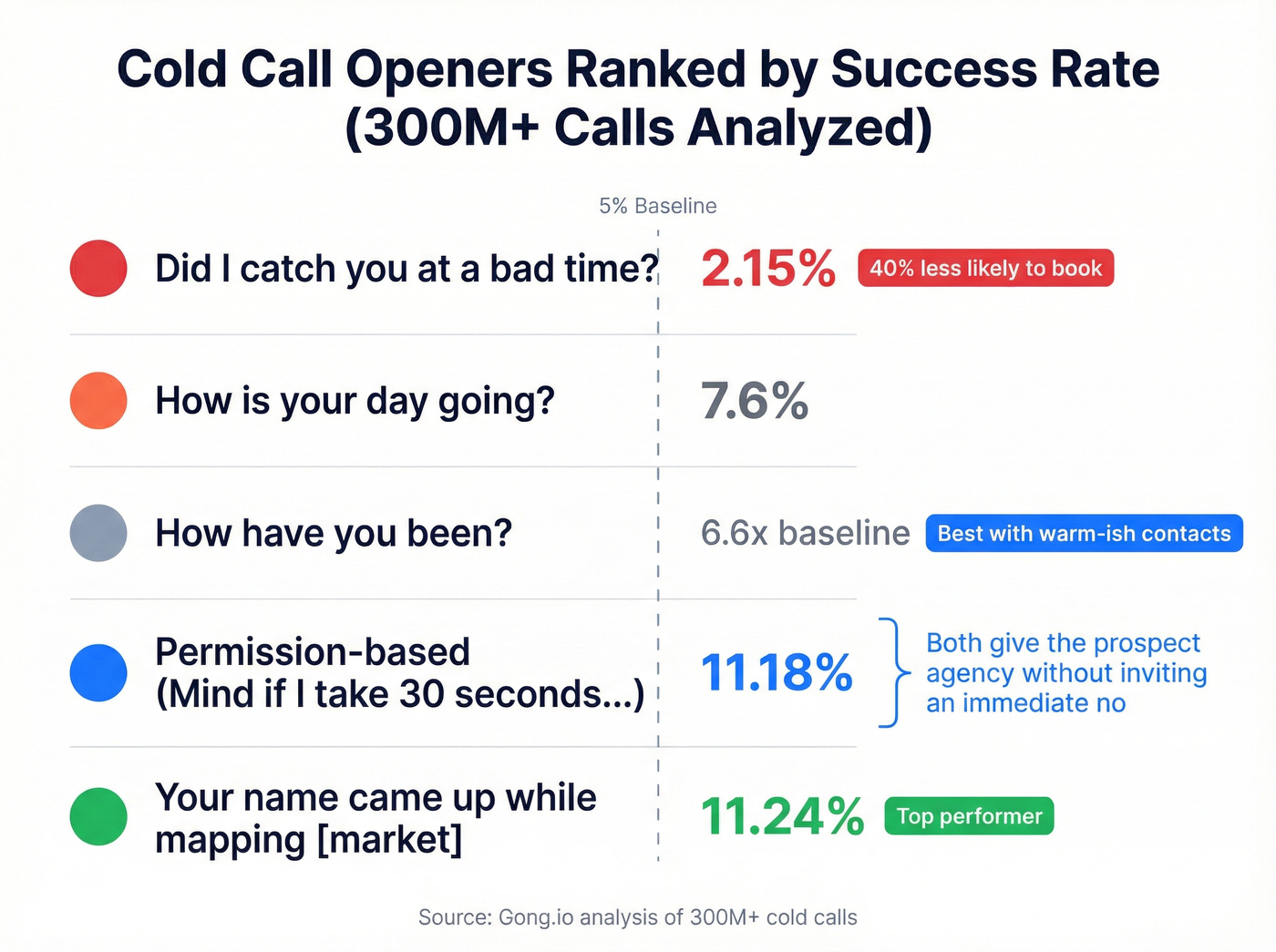
Gong analyzed 300M+ cold calls and ranked openers by success rate. I've watched recruiters transform their connect-to-screen ratios just by changing their first sentence. (For more on what to say and what to avoid, see sales pitch opening lines.)
| Opener | Success Rate | Recruiter Translation |
|---|---|---|
| "Did I catch you at a bad time?" | 2.15% (40% less likely to book a meeting) | Kill this forever |
| "How's your day going?" | 7.6% | Serviceable - try "How's the week going so far?" for a warmer feel |
| "How've you been?" | 6.6x higher than baseline | Pattern interrupt - works best with warm-ish contacts |
| Permission-based | 11.18% | "Mind if I take 30 seconds to explain why I'm calling?" |
| "Heard the name tossed around" | 11.24% | "Your name came up when I was mapping the [function] market in [city]" |
The top openers share one principle: they give the prospect agency without inviting an immediate "no." "Did I catch you at a bad time?" practically begs someone to hang up. A permission-based opener acknowledges the interruption while keeping momentum.
For recruiters, the framework translates cleanly. Lead with context - why you're calling this specific person, not just anyone. Own the interruption. Then ask permission to continue:
"Hey Sarah, this is [name] from [firm]. Your name came up while I was mapping product leaders in the fintech space - mind if I take 30 seconds to explain why I reached out?"
That's not a script you read. It's a structure you internalize. The specificity ("product leaders in fintech") is what separates a 2% opener from an 11% opener.
How to Structure a Recruiting Call
Successful cold calls last roughly twice as long as unsuccessful ones. That doesn't mean you should ramble - it means you need to earn more time by being relevant. Gong's data shows winning reps deliver monologues averaging 53 seconds versus 25 seconds on failed calls. Longer monologues work because they're substantive, not because they're long. (If you want a tighter prep system, use a pre call research checklist.)
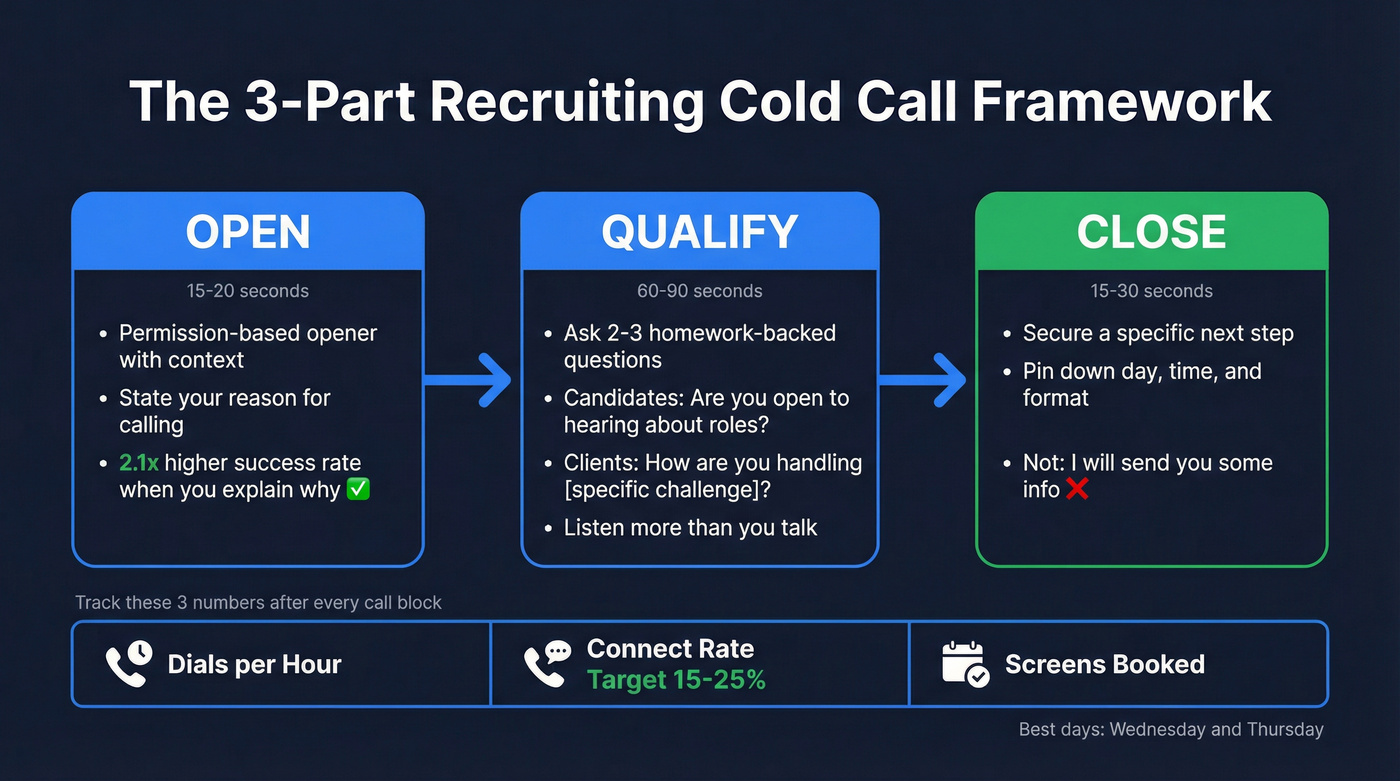
Here's a three-part framework for both candidate and client calls:
1. Open (15-20 seconds). Use a permission-based opener with context. State your reason for calling - this alone yields a 2.1x higher success rate. "I'm calling because we just placed three senior engineers at [company type] and your background is exactly what these hiring managers are asking for."
2. Qualify (60-90 seconds). Ask two or three questions that show you've done homework. For candidates: "Are you open to hearing about roles, or are you locked in for the next year?" For clients: "How are you handling [specific hiring challenge] right now?" Listen more than you talk here. (More: cold call qualifying questions.)
3. Close (15-30 seconds). Secure a specific next step. Not "I'll send you some info" - that's where deals go to die. Get commitment to a concrete action: "Can we do a 15-minute call Thursday at 2 PM so I can walk you through the role details?" Pin down the day, the time, and the format. (If this is a weak spot, read how to end a sales call.)
Track three numbers after every call block: dials per hour, connect rate (target 15-25%), and screens booked. If your connect rate is below 10%, fix your data before changing your script.
Best days to call? Wednesday and Thursday consistently outperform the rest of the week. Avoid Monday mornings and Friday afternoons. And always check the candidate's local time zone - calling a West Coast candidate at 8 AM Eastern is a 5 AM wake-up call.
Multi-channel recruiting cadences only work when every channel has clean data behind it. Prospeo gives you verified emails (98% accuracy), direct dials (125M+ mobiles), and 30+ filters to target passive candidates by job function, company size, and tech stack - all from one platform.
Build call blocks that actually connect - 75 free emails and 100 extension credits to start.
Scripts for Candidates and Clients
The Passive Candidate
"Hi [Name], this is [Your Name] with [Firm]. Your name came up while I was mapping [function] talent in [market]. I'm working with a [company type] building out their [team], and your [specific skill] background is exactly what they need. Not asking you to job hunt - just curious if you'd be open to a quick conversation about what they're building."
Referral-Based Call
You already have an advantage here - use the referral name in your first breath.
"Hi [Name], [Referrer] suggested I reach out - they mentioned you'd be a great person to talk to about [topic/role area]. I'm working on a [brief role description] and wanted to get your take, even if it's not for you personally. Do you have two minutes?"
The referral name buys you an extra 30 seconds of attention. Front-load it.
Getting Past the Gatekeeper
Most recruiters treat gatekeepers as obstacles. That's backwards - they're the fastest path to the direct line if you're collaborative instead of combative. (More scripts: what to say to get past the gatekeeper.)
"Hi, this is [Your Name] from [Firm]. I'm trying to reach [Decision Maker] regarding their [department] hiring - could you point me to the best way to connect? I'm happy to send a brief email first if that's easier."
Offering to email first often gets you the direct number anyway.
Client Decision-Maker
A strong staffing sales script leads with evidence, not a pitch:
"Hi [Name], this is [Your Name] with [Firm]. I noticed you've had [specific role] open for [timeframe] - I specialize in [function] hiring in [industry] and just placed someone similar at [comparable company]. Worth a 10-minute call to see if I can shorten your timeline?"
Lead with evidence that you understand their problem and have solved it before. That's what earns the meeting.
Voicemail (Under 20 Seconds)
"Hi [Name], this is [Your Name] from [Firm]. I'm reaching out about a [function] role that matches your background - my number is [number], or I'll follow up by email tomorrow."
Keep voicemails under 20 seconds. State your name, the reason, and one callback hook. That's it.
Objection Handling
Every recruiter hears the same four objections. Having a framework - not a memorized rebuttal - makes the difference. (If you want a deeper system, use handling sales objections with curiosity.)
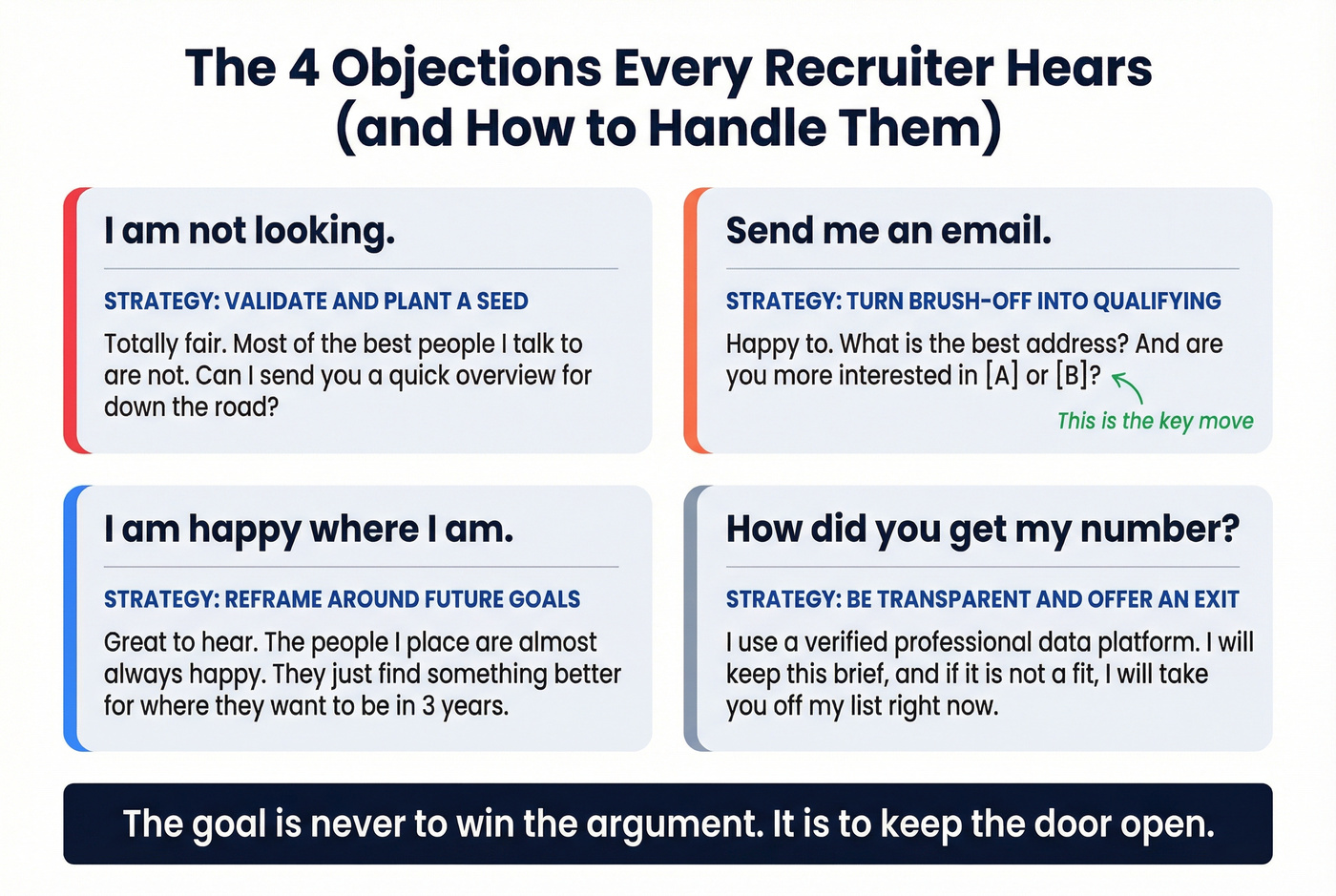
"I'm not looking." "Totally fair - most of the best people I talk to aren't. I just wanted to share what [company type] is building in case it's worth a conversation down the road. Can I send you a quick overview?"
"Send me an email." "Happy to - what's the best address? And just so I send something relevant, are you more interested in [aspect A] or [aspect B]?" This turns a brush-off into a qualifying question.
"I'm happy where I am." "Great to hear. The people I place are almost always happy where they are - they just find something that's a better fit for where they want to be in three years. Worth 10 minutes to see if this is one of those?"
"How did you get my number?" "I use a verified professional data platform. I know cold calls aren't everyone's favorite, so I'll keep this brief. If it's not a fit, I'll take you off my list right now."
Mistakes That Kill Your Pipeline
Not preparing before dialing. Spending 90 seconds reviewing someone's background before calling them isn't optional. Check their current role, tenure, and any recent company news. Build a 3-bullet cheat sheet for every call in your block.
Selling features instead of value. "This role offers competitive comp and great benefits" tells a passive candidate nothing. Lead with what makes the opportunity different - the team they'd join, the problem they'd solve, the trajectory it opens.
Ending without a commitment. "I'll send you some info" is where pipeline goes to die. Propose a specific day and time for a follow-up. "Can we do 15 minutes on Thursday at 3?" forces a yes or a real objection.
Sounding like every other recruiter. If your opening could come from any recruiter at any firm, you haven't differentiated. Reference something specific - a project they led, a company milestone, a mutual connection. That's what earns you the second minute of the call.
Build a Multi-Channel Cadence
Recruiting calls work best when they're not the only thing you're doing. Combining email with social touches delivers a roughly 25% lift in reply rates versus email-only outreach. In staffing, it can take 20 to 50 touches to convert a cold lead into a client. That's not a typo - it's why single-channel recruiters burn out. (If you want templates, start with a sales cadence example.)
Let's be honest: if your average placement fee is under $15k, you probably don't need a $30k/year tech stack. What you need is verified data and a disciplined cadence. Most recruiters over-invest in tools and under-invest in reps.
A 5-day cadence that works for both candidate and client outreach:
- Day 1: Cold call. Leave a voicemail if no answer.
- Day 2: Personalized email referencing the voicemail. Under 100 words. (Use these outreach email templates.)
- Day 3: Social touch - connect request with a short note or engage with their content.
- Day 4: Second call attempt + voicemail with new information ("I just placed someone at [company] and thought of you").
- Day 5: Follow-up email with a specific ask ("Worth 10 minutes on Tuesday?").
After a live conversation, follow up within 24 hours - anything longer and the momentum dies. Connect rate matters more than dial count. Fifty well-researched dials at 20% connect rate will always beat 100 blind dials at 5%.
To power this cadence, you need more than phone numbers. Prospeo's enrichment API returns 50+ data points per contact at a 92% match rate - verified emails, direct dials, and company intel - so every touch in your sequence hits a verified channel, not a guess.
Compliance for Recruiters (2026)
TCPA class action filings are up 95% year-over-year, with 1,052 filed in just the first half of 2025. Recruiters aren't exempt. Skip this section at your own risk.
- Calling hours: 8 a.m. to 9 p.m. in the recipient's local time zone. No exceptions.
- DNC screening: Screen your lists against the National Do Not Call Registry. Federal fines run up to $53,088 per violation.
- Opt-out window: Honor opt-outs within 10 business days. Recipients can revoke consent via text, email, voicemail, or verbally.
- TCPA penalties: $500 per violation, up to $1,500 for willful violations. These stack fast.
- AI-generated voices: The FCC classifies AI voices as "artificial voices" under TCPA. If you're using any AI calling tool, it needs the same consent framework as a prerecorded message. (More: AI cold calling.)
- Call recording: Some states require all-party consent. The safest approach is disclosing at the start: "This call may be recorded for quality purposes."
- International recruiting: If you're calling candidates in the EU, GDPR applies. Make sure you have a lawful basis for processing, honor data subject rights, and be ready for breach notification within 72 hours.
FAQ
How many cold calls should a recruiter make per day?
Aim for 40-80 dials depending on whether you're agency or in-house. The metric that matters is connect rate - target 15-25%. Fifty well-researched dials at 20% connect rate beats 100 blind dials at 5% every time.
What's the best time to cold call candidates?
Wednesday and Thursday consistently outperform other weekdays. Late morning (10-12) and late afternoon (4-6) are the sweet spots. Avoid Monday mornings and Friday afternoons - pickup rates drop significantly during both windows.
Is cold calling legal for recruiters?
Yes, but TCPA rules apply in full. Screen against the National DNC Registry, honor opt-outs within 10 business days, call only between 8 a.m. and 9 p.m. local time, and never use AI-generated voices without proper consent. Fines reach $1,500 per willful violation.
Does cold calling work better than email for recruiting?
Cold calls average 8-12% response rates versus roughly 5% for email. The best results come from combining both in a multi-channel cadence - calls create urgency while emails provide detail and a paper trail the candidate can revisit on their own time.
Block two hours tomorrow morning. Verify your numbers. Use a permission-based opener. That's the entire formula for effective cold calling for recruitment - the rest is reps.