The Predictable Revenue Email Template: Original, Why It's Failing, and How to Fix It
You read Predictable Revenue, highlighted the referral-request template, pasted it into your sequencer, and got a 2% reply rate. Maybe worse. The framework Aaron Ross built is still brilliant - route around gatekeepers by asking executives to point you to the right person. But the word-for-word template from 2011 doesn't survive a 2026 inbox.
The original template below still works as a framework. Three upgrades make it work today: context lines, signal-based personalization, and a real follow-up sequence. None of it matters if your emails bounce, so verify your list before you send.
The Original Cold Calling 2.0 Template
Here's the exact email from the Cold Calling 2.0 template doc published by Predictable Revenue:
Subject: Can you point me in the right direction?
[firstname],
I'm sorry to trouble you. Would you be so kind as to tell me who is responsible for [insert your biggest pain point here that resonates with your ideal customer; OR insert function like 'sales' or 'recruiting'] and how I might get in touch with them?
Thank you, Marylou Tyler
That's it. Incredibly short, deliberately vague. And it worked - this approach helped triple Salesforce.com's lead generation production in 90 days. One practitioner emailed the CEO of HP using this exact method, and a Director called back within 10 minutes.
The psychology is worth understanding. The email is short, which means low commitment to read. The referral request is an ego stroke - you're asking the exec to be helpful, not to buy something. And the deliberate vagueness forces a response rather than a dismissal, because the exec can't evaluate a pitch that isn't there.
The doc itself frames this as a starting point, not a silver bullet: "Send out 20... see what happens... tweak and make better... go to step 2." That iterative advice is the part most people skip.
Why This Template Stopped Working
Everyone debates whether the referral-request framework "still works." That's the wrong question. The Cold Calling 2.0 doc tells you to send 20, see what happens, and iterate. The problem is most teams never iterate - they copy-paste and pray.
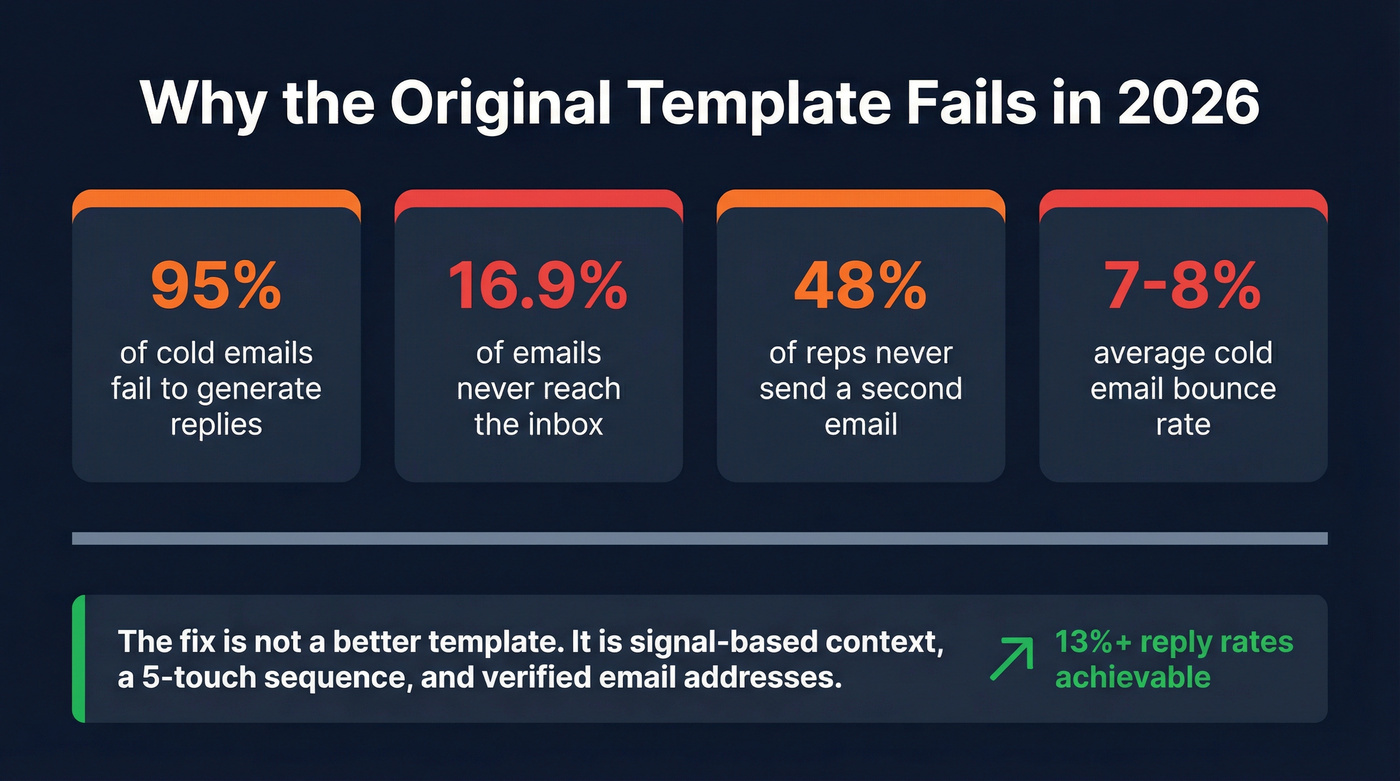
About 95% of cold emails fail to generate replies. The average reply rate sits around 5.1%, and 16.9% of emails never reach the inbox at all.
Template fatigue is real. When a successful template gets widely copy-pasted, prospects end up seeing the same few patterns over and over until they're invisible. LevelingUp's critique of the no-context version nails the core issue: "Where is the context? Why would anyone... forward this e-mail on?"
Here's the thing: 48% of reps never send a second email. So the template gets one shot, with zero context, into a crowded inbox - and then nothing. The framework isn't broken. The execution is.
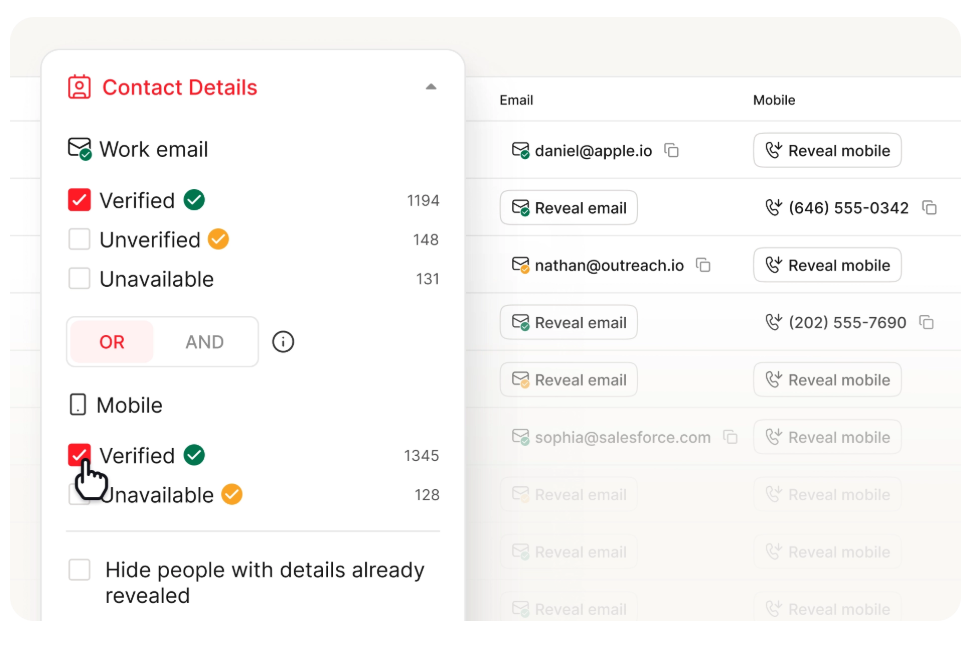

Signal-based personalization only works if you have the signals. Prospeo's 30+ search filters - including buyer intent across 15,000 topics, technographics, job changes, and funding events - give you the exact trigger lines that turn a generic referral request into a reply-worthy email. At 98% email accuracy, your sequence actually lands.
Stop guessing at triggers. Build signal-rich lists in minutes.
The 2026 Modernized Version
Here's the original side-by-side with a version that keeps the referral-request framework but adds what 2026 inboxes demand.
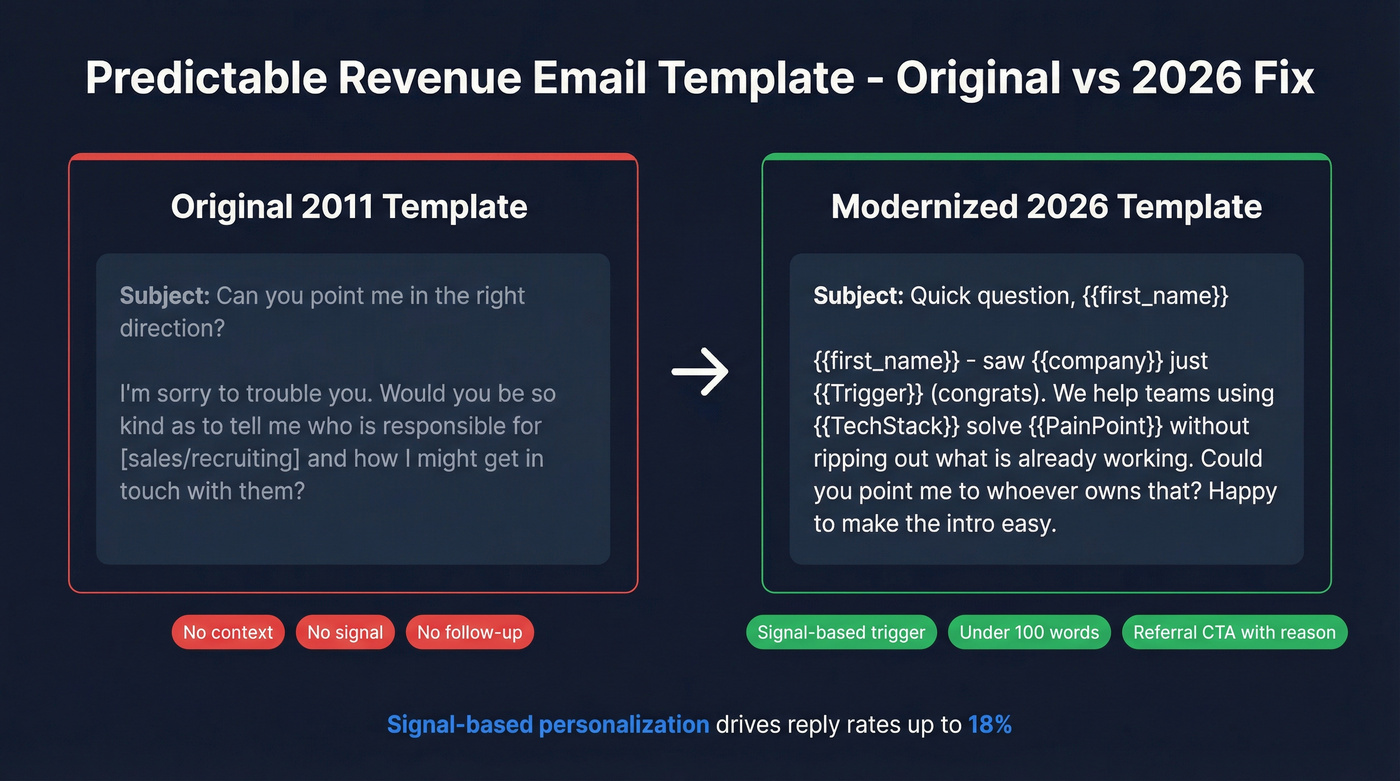
Original:
Subject: Can you point me in the right direction? {{first_name}}, I'm sorry to trouble you. Would you be so kind as to tell me who is responsible for [sales/recruiting]...
Modernized:
Subject: Quick question, {{first_name}} {{first_name}} - saw {{company}} just {{Trigger}} (congrats). We help teams using {{TechStack}} solve {{PainPoint}} without ripping out what's already working. Could you point me to whoever owns that? Happy to make the intro easy.
A concrete fill-in: "Saw Acme just raised a Series B" or "Noticed you're hiring 3 SDRs on your careers page." That's the trigger. It takes 30 seconds to find and it's the difference between a reply and the trash folder.
Three changes make the difference:
- A context line tied to a real signal - a funding round, a job posting, a tech-stack change. Personalization beyond first name and company drives reply rates up to 18%.
- The email stays under 100 words. Short still wins.
- The CTA is still a referral request, but it gives the exec a reason to forward it.
We've found that for higher-volume sends, persona-based variants work better than one generic template for every title - a VP Sales version emphasizing pipeline, a CTO version emphasizing integration complexity. The extra 15 minutes of writing pays for itself in replies.
If your brand allows it, humor in the subject line can push reply rates to 28%. That's not a typo. If you want examples that don't feel try-hard, pull from a tested list of humor in the subject line.
Segment your list by one useful signal: tech stack, fresh job posts, or funding events. Use dynamic variables like {{PainPoint}}, {{TechStack}}, and {{Trigger}} in your sequencer. Even scheduling sends at 6-7am local time can move the needle (see 6-7am local time). Prospeo's intent data - tracking 15,000 topics via Bombora - lets you layer buyer-intent signals directly into your segmentation so every trigger line references something the prospect actually cares about right now (more on buyer-intent signals).
The Full Follow-Up Sequence
The referral request is email one. Here's a five-touch sequence structure, plus a benchmark: one 5-step cold email sequence produced an 83% open rate and 13% response rate - a 333% increase from a 3% baseline.
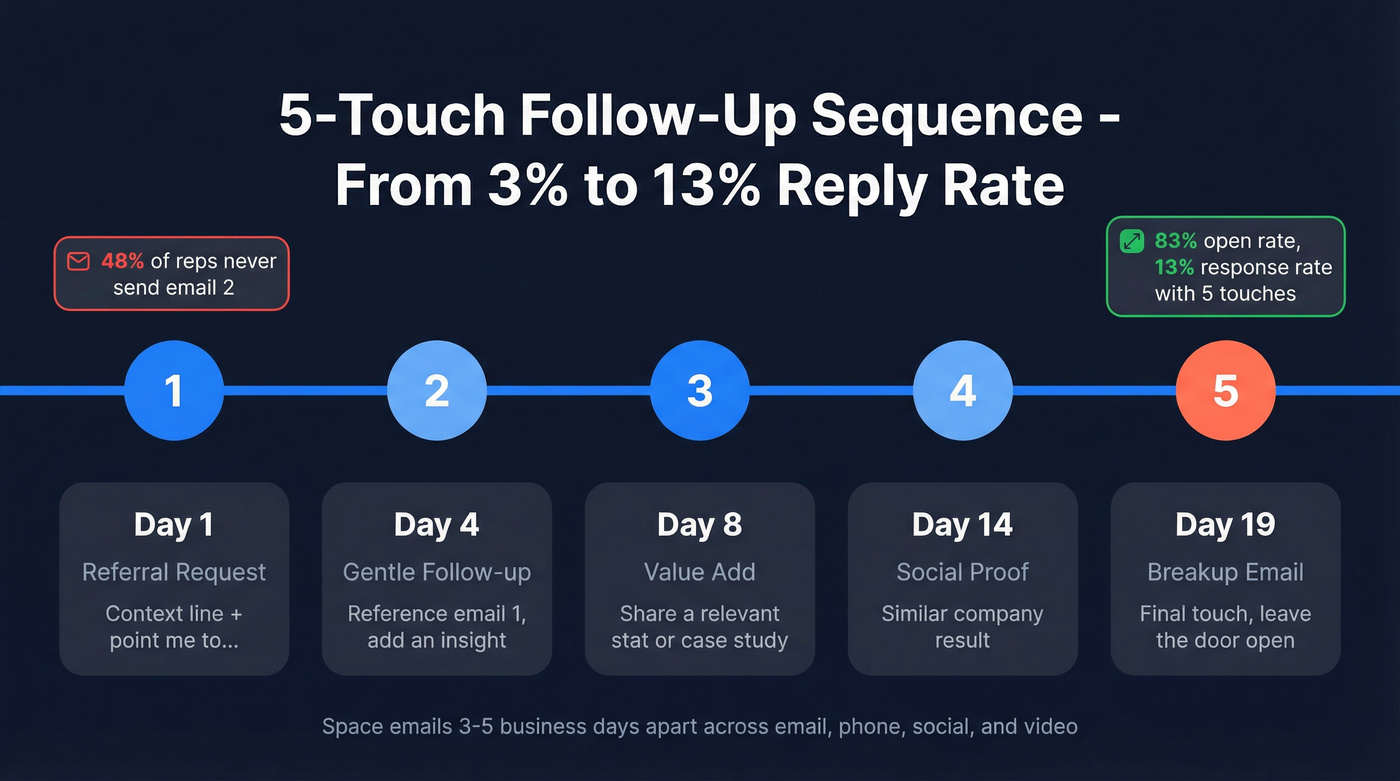
| Day | Purpose | Key Element | |
|---|---|---|---|
| 1 | Day 1 | Referral request | Context + "point me to..." |
| 2 | Day 4 | Gentle follow-up | Reference email 1, add insight |
| 3 | Day 8 | Value add | Share a relevant stat or case |
| 4 | Day 14 | Social proof | Similar company's result |
| 5 | Day 19 | Breakup | Final touch, leave door open |
The cadence sweet spot is 17-21 days across channels: email, phone, social, and video. Space emails 3-5 business days apart. Don't front-load - the breakup email on day 19 often gets the highest reply rate because it removes pressure.
Most teams stop early, which is why the template gets judged on a single touch. The follow-up sequence isn't optional. It's where the responses come from. If you need more structures like this, start with a proven five-touch sequence and then refine your follow-up strategy.
Let's be honest about what we see in our own outbound: the teams that hit 13%+ reply rates aren't using better templates. They're sending five touches instead of one, and they're sending to verified addresses instead of guessing. That combination matters more than any subject-line hack.
Deliverability Checklist Before You Send
Your template and sequence are ready. Bad data is the last thing standing between you and replies. One great template with proper deliverability outperforms a swipe file of 40 templates sent from a burned domain.
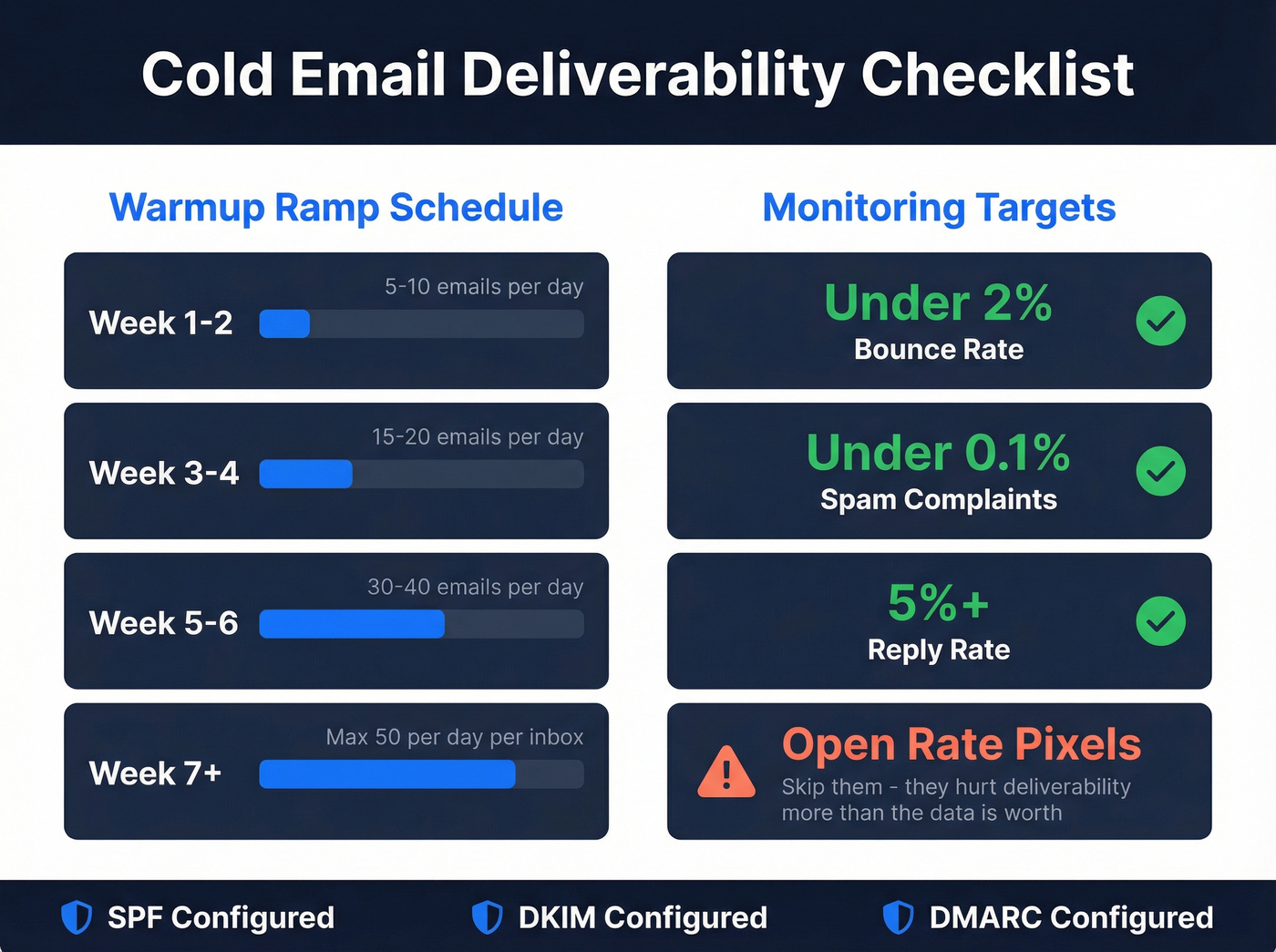
Skip this section if your bounce rate is already under 2% and your authentication is locked down. For everyone else - and that's most teams we talk to - this is where the real gains hide.
Authentication is non-negotiable. SPF, DKIM, and DMARC must be configured on every sending domain. If you're not sure whether they are, they probably aren't. Check before you write another word of copy (use this deliverability checklist and the deeper SPF, DKIM, and DMARC setup guide).
Warmup ramp:
| Week | Daily Volume |
|---|---|
| 1-2 | 5-10/day |
| 3-4 | 15-20/day |
| 5-6 | 30-40/day |
| 7+ | Max 50/day per inbox |
Monitoring targets: Bounce rate under 2%. Spam complaints under 0.1%. Reply rate 5%+. Avoid open-rate tracking pixels - they hurt deliverability more than the data is worth (details: open-rate tracking pixels).
Verify before you send. The average cold email bounce rate runs 7-8%, and that's enough to torch your domain reputation. Prospeo's 5-step verification with catch-all handling and spam-trap removal keeps bounce rates under 3%. If you're comparing options, start with these email validators and email checker tools before you commit. Stack Optimize scaled to $1M ARR on Prospeo-verified lists, holding sub-3% bounce rates and 94%+ deliverability across every client campaign. The free tier gives you 75 email verifications per month - enough to test before you scale.

You just built a five-touch sequence designed for 13%+ reply rates. Now send it to addresses that actually exist. Teams switching to Prospeo cut bounce rates from 35%+ to under 4% - because every email passes 5-step verification with catch-all handling and spam-trap removal. At $0.01 per email, bad data is a choice.
One bounced email kills your domain. Verify before you send.
FAQ
Does the referral-request framework still work in 2026?
The framework works; the word-for-word 2011 copy doesn't. Add a context line tied to a real signal, personalize beyond first name and company, and follow up at least five times over 17-21 days. Teams hitting 13%+ response rates use the structure - not the exact words from the book.
What reply rate should I expect from cold emails?
Industry average is around 5.1%. With signal-based personalization and a multi-step sequence, 13-18% is achievable. Single-touch, no-context emails land closer to 1-3%, which is why the original template underperforms when used as-is without a follow-up cadence.
How do I stop my cold emails from bouncing?
Verify every email address before sending. A 5-step verification process - including catch-all handling and spam-trap removal - delivers 98% accuracy at roughly $0.01 per lead. Pair verification with SPF/DKIM/DMARC authentication and a proper warmup ramp, and you'll keep bounce rates under 3% from day one.