Holiday Sales Objections: The Data-Backed Playbook for Closing Deals When Prospects Stall
It's December 3rd. You're staring at a pipeline that looked healthy in October. Now half your deals have the same note in the CRM: "Prospect asked to reconnect after the holidays." Your VP just sent the "Q4 Push" email - the one with the motivational quote and the bolded revenue number. And you're doing math on which deals can actually close before the 20th.
Holiday sales objections are the #1 pipeline killer in Q4, but most of them aren't real objections at all. Sign rates drop 78% during Christmas week. Only 28% of sales teams believe they'll hit 100% of Q4 quota. And roughly 30-40% of Q4 pipeline slips to Q1 every single year.
The macro picture isn't helping either - December 2025 retail sales came in flat against a 0.4% expected gain, and consumer spending dropped 5% on average for the first time since 2020. Budget caution is bleeding from B2C into B2B, giving every prospect one more reason to stall.
Here's the thing: most of those deals don't slip because of the holidays. They slip because reps accept stalls as objections and agree to call back in January - where the deal quietly dies.
If You Only Do Three Things
- Use the 30-second diagnostic on every stall. When a prospect says "call me after the holidays," respond with: "When I call you after the holidays, what happens next?" Their answer tells you everything. Non-committal response = they're blowing you off. Specific next step = real delay.

Multi-thread every deal before Thanksgiving. Never depend on one contact. If your champion goes on PTO December 18th and you don't know anyone else in the account, that deal is dead until mid-January at best. (If you want a deeper system, see multi-thread and ABM multi-threading.)
Send the "use it or lose it" email to every prospect with remaining budget. The majority of enterprise organizations operate with annual budgets. Unspent dollars get reallocated - not rolled over. December is your window.
Now let's get into the full playbook.
Why "Call Me After the Holidays" Is a Stall, Not an Objection
Sales trainer Jeffrey Gitomer draws a critical distinction: "Call me after the holidays" isn't an objection. It's a stall. Stalls are twice as bad as objections because you have to dance around them AND still find the real reason the prospect isn't buying.

An objection gives you something to work with. "Your price is too high" - that's a negotiation. "We're evaluating a competitor" - that's a competitive play. But "call me after the holidays" gives you nothing. It's a polite exit with a built-in excuse that's socially impossible to challenge.
Roughly 90% of prospects who say "call me after the holidays" still don't buy when you call back. Ninety percent. That's not a delay - it's a death sentence for your deal. As one r/sales commenter put it: prospects who say "let me think about it" then disappear entirely are the bane of Q4.
The reason is simple. 60% of customers say "no" four times before saying "yes." But 44% of reps give up after just one touch. When a prospect says "call me in January," most reps mark it in the CRM, set a reminder, and move on. They've given the prospect exactly what they wanted: space to forget about you.
The "call me after the holidays" objection is a sales skills problem, not a calendar problem. (If you want more scripts beyond Q4, see objection handling.)
The Psychology Behind Holiday Stalls
Understanding why prospects stall during the holidays isn't academic - it changes how you respond. Three cognitive biases do most of the damage:

Loss aversion. People fear losses approximately twice as much as they value equivalent gains. Your prospect isn't weighing the upside of your solution against the cost. They're weighing the risk of making a bad decision - and doing nothing feels safer. During the holidays, when mental bandwidth is already stretched, "do nothing" becomes even more attractive.
Status quo bias. Humans prefer their current state over change, even when change would clearly benefit them. Your prospect has survived this long without your product. Another month won't kill them. At least, that's what their brain tells them.
Subconscious decision-making. Harvard Business Review research shows 95% of purchasing decisions happen subconsciously before the logical brain justifies them. When a prospect says "I need to think about it," they've often already decided - they just haven't admitted it to themselves yet.
Andy Preston, who trained as a professional buyer before becoming a sales trainer, confirms what you probably suspect: decision makers use holiday objections because they work. Salespeople accept them. They're socially acceptable. And the more "new business" the conversation is - the less rapport you've built - the higher the likelihood you're being fobbed off.
The 77% of B2B buyers who say their last purchase was "very difficult and complex" aren't lying. Buying is hard. The holidays give them permission to stop trying. Your job is to make continuing easier than stopping. (For a buying-committee lens, read B2B decision making.)

Multi-threading is the #1 defense against holiday stalls - but you can't multi-thread without verified contact data. Prospeo gives you 300M+ profiles with 125M+ direct dials and 98% email accuracy, so when your champion goes on PTO December 18th, you already have three other contacts in the account.
Don't let a single vacation kill your Q4 deal.
The 30-Second Diagnostic: Real Delay or Blow-Off?
Not every holiday stall is a blow-off. Some prospects genuinely can't move forward until January. The trick is figuring out which bucket you're in - fast.

Bucket 1 - Real delay: Your prospect gives a specific reason (colleague on PTO, budget locked until fiscal year, board approval needed in January). Set a specific follow-up date, confirm what happens when you reconnect, and multi-thread in the meantime.
Bucket 2 - Blow-off: Your prospect is vague, seems eager to end the call, or can't articulate what changes in January.
The diagnostic question that separates the two: "When I call you after the holidays, what happens next?"
If they say "we move forward" or "we place the order" - Bucket 1. Lock down the date and keep nurturing.
If they give a non-committal answer - "we'll see" or "we can discuss it then" - Bucket 2. Here's your recovery script:
"I'm happy to call you back after the holidays. Here's my concern - maybe I didn't do a good enough job understanding your needs. Would it be OK if I ask you one or two quick questions just to confirm it would make sense for us to schedule a follow-up?"
This works because it takes the pressure off the prospect and puts it on you. You're not challenging their excuse. You're admitting you might have missed something. That's disarming - and it reopens the conversation.
The 7 Year-End Objections You'll Hear (And Exactly What to Say)
"Call me after the holidays"
This is the most common holiday stall. You need multiple scripts because you'll hear it dozens of times between Thanksgiving and New Year's.
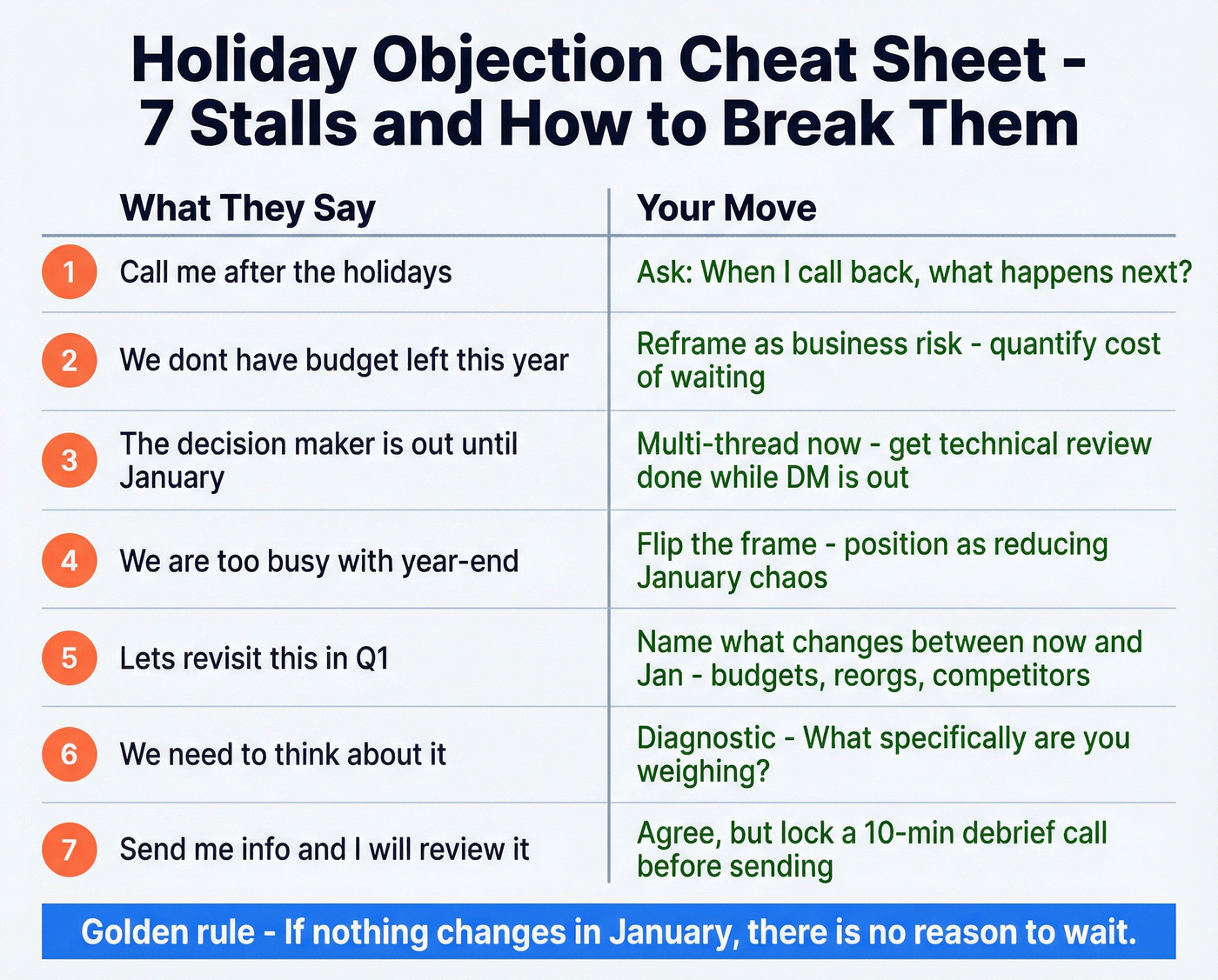
Script 1 - The Diagnostic:
"Absolutely. When I call you after the holidays, what happens next?"
Forces specificity. Vague answers reveal blow-offs. Specific answers reveal real timelines.
Script 2 - The Corner:
"I completely understand. Quick question - what will be different after the holidays?"
Exploits status quo bias. If nothing changes in January, there's no reason to wait. The prospect has to either name a real blocker or admit there isn't one.
Script 3 - The Humor Play:
"I've had so many clients hit me with the 'after the holidays' line that I'm completely booked until mid-August! How about we grab 15 minutes this week instead?"
Pattern interrupt. Humor disarms the social script the prospect is running. It also subtly communicates that you're in demand - which triggers scarcity bias.
Script 4 - The Pink Elephant:
"I'll be honest - most companies put this off until January. The ones that don't get a six-week head start on everyone else. Which camp do you want to be in?"
Naming the objection before the prospect doubles down on it strips it of power. You're not fighting the stall - you're reframing it as a competitive disadvantage.
"We don't have budget left this year"
The budget objection feels final, but it rarely is. One of the best budget-locked responses I've seen in a practitioner community scored 9/10 from peers:
"I hear you - budgets are locked. Just so I'm clear, if this problem compounds like it has, we're looking at [X hours lost / $Y revenue impact] by next quarter. Is there usually a process for surfacing that kind of operational risk to leadership now, or would it make sense for us to map out the cost together so you're ready when budget opens up?"
Why it works: Reframes from a budget conversation to a business risk conversation. Loss aversion makes the cost of inaction feel twice as heavy as the cost of action. You're not pushing - you're helping them build an internal case.
Backup approach: Ask whether they have leftover budget for a pilot or planning phase. Some companies use a small portion of remaining funds now, then roll into full implementation in Q1.
"The decision maker is out until January"
This one's often legitimate - key stakeholders do go dark between Thanksgiving and New Year's. But it doesn't have to kill your deal.
"Totally understand - [DM name] deserves the break. While they're out, would it make sense for me to connect with [other stakeholder / their team] to get the technical review done? That way when [DM name] is back, we're ready to move instead of starting over."
Turns a blocker into an accelerator. You're using the DM's absence to multi-thread - which is exactly what you should've done earlier.
"We're too busy with year-end"
Every company is busy at year-end. That's precisely why this objection is so effective - it's always true.
The busy objection isn't about capacity. It's about perceived effort. Your prospect assumes engaging with you adds to their December workload. Your job is to flip that frame - position your solution as something that reduces January chaos, not something that adds to the present load.
"I completely get it - year-end is chaos. That's actually why I'm reaching out now. If we can get the groundwork done this week, you won't be starting from scratch in January when everyone else is also trying to catch up. Would a 15-minute call Thursday work?"
"Let's revisit this in Q1"
Here's what can happen between now and January:
- Budgets get cut or reallocated
- Layoffs or reorgs shuffle priorities
- Your champion leaves for a new role
- A competitor closes the deal first
- New leadership changes direction
- The pain you're solving gets normalized
Script:
"Happy to revisit in Q1. My only concern - and I've seen this play out - is that a lot changes between now and January. If this problem is costing you [specific cost] per month, that's [specific cost x 2] by the time we reconnect. What if we locked in terms now with a Q1 start date? That way you're protected either way."
Quantifies the cost of delay in concrete terms. Loss aversion does the rest.
"We need to think about it"
The best tactic here is preventive - what I call "dropping the cat in the punch bowl." Before the prospect can say "let me think about it," you say:
"At the end of our conversation, if you're tempted to say you want to think it over, is it OK if I take that as you not wanting to hurt my feelings, and we can just put you down as a 'no'?"
Bold? Yes. But it eliminates the escape hatch before the prospect reaches for it, and it forces honesty.
If they've already said it, don't accept the vague version:
"Completely fair. What specifically do you need to think through? If it's [common concern], I can get you [specific resource] today so you're not stuck waiting."
"We're in a budget freeze"
Budget freezes are real, but they're not always as frozen as they sound. Instead of a single script, give the prospect options:
- Split the order across Q4 and Q1
- Start with a pilot at a fraction of the cost
- Lock in December pricing with Q1 delivery
"A few of our clients in similar situations have found creative ways to move forward. Would any of those work for your finance team?"
The pilot approach is especially effective because it reduces perceived risk - which directly counters loss aversion.
The Use-It-or-Lose-It Budget Play
The majority of enterprise organizations operate with annual budgets. Unspent dollars don't roll over - they get reallocated. This creates a narrow window in December where prospects with remaining budget are actually motivated to spend.
Here's your checklist:
- Identify prospects with fiscal year-end in December. Not all companies operate on a calendar fiscal year. Confirm before you pitch urgency that doesn't apply.
- Lead with ROI, not discounts. Highlight what the prospect gains by investing now - not what they save. "Invest $15K now, generate $60K in pipeline by March" beats "10% off if you sign by December 20th."
- Use the tax deduction angle. For US-based prospects, December purchases can reduce taxable income for the current year. It's not the primary motivator, but it's useful ammunition for finance teams who need one more reason to approve.
- Countdown to capacity, not calendar. "We can guarantee Q1 implementation if you sign by December 15th. After that, you're looking at a February start" creates real urgency without feeling manufactured.
The key insight: you're not pressuring the prospect. You're helping them use money they'll lose anyway.
Frame it that way.
How to Handle Deals When the Decision Maker Is on PTO
40-60% of B2B decision makers take at least a week off between Thanksgiving and New Year's. If your deal depends on one person and that person is in Cabo, you've got a problem. But it's a problem you should've solved in November.
Multi-threading isn't optional - it's the single biggest predictor of whether a deal survives the holidays. The concept is simple: never let a deal depend on a single contact.
- Start early. From the first discovery call, ask your champion to invite colleagues. "Would it make sense to have [technical lead / finance contact] join our next call?"
- Use the DM's absence strategically. "While you're recharging, would it be helpful if I connected with [other stakeholder] to get the technical review done? That way we're ready to move when you're back."
- Soft-launch with other stakeholders. Other stakeholders often feel more comfortable giving honest feedback when the boss isn't on the call.
You need verified contact data for the rest of the buying committee - fast. Prospeo's 300M+ professional profiles with 98% email accuracy let you find verified emails and direct dials for any stakeholder in seconds, so you're not waiting until January for one person to check their inbox. (Related: key decision makers and B2B phone number.)
Pipeline Triage for December:
| Tier | Deal Profile | Energy % | Holiday Action |
|---|---|---|---|
| Tier 1 | Realistic Q4 closes | 60% | Sign by Dec 19; multi-thread hard |
| Tier 2 | Q1 pipeline builders | 30% | Nurture with templates; book Jan meetings |
| Tier 3 | Long shots | 10% | Light-touch only; don't waste December |
The biggest mistake I see: reps spreading energy equally across all deals in December. Tier 1 deals need disproportionate attention. Tier 3 deals need a template and a January reminder. That's it. (If you’re diagnosing why deals slip, see sales pipeline challenges.)
Holiday Email Templates That Actually Get Replies
Copy-paste ready. Customize the bracketed sections and send.
The Pre-Holiday Check-In (Early December)
Subject: Quick question before the holiday rush, [First Name]
Hi [First Name],
We talked in [month] about [specific pain point]. I wanted to check in before the holidays because two things are true right now:
- Your team is still dealing with [pain point], and that cost compounds every month.
- January is going to be packed - everyone who delayed in December will be competing for the same resources.
Would it make sense to grab 15 minutes this week to map out a plan?
[Your name]
The "Use It or Lose It" Nudge (Mid-December)
Subject: [First Name], quick budget question before Dec 18
Hi [First Name],
Straight to it: if your team has remaining budget that needs to be allocated before fiscal year-end, we can lock in [specific offer] by December 18th with implementation starting January 6th. That means you use this year's budget on a solution that starts delivering ROI in Q1.
[One specific ROI data point: "Companies like [similar company] saw [specific result] within 90 days."]
If budget isn't the issue, ignore this. But if it is - let's talk before Thursday.
[Your name]
The Post-Holiday Re-Engagement (January 2-6)
Subject: Picking up where we left off, [First Name]
Hi [First Name],
Happy New Year. I haven't heard back since our [month] conversation about [specific topic], which usually means one of three things:
- The timing wasn't right in December.
- You've already solved the problem another way.
- You got buried and this fell off the radar.
If it's #1 or #3, I'd love to reconnect this week. 15 minutes - Tuesday or Wednesday work?
[Your name]
The Breakup Email (January 14+)
Subject: Should I close your file?
Hi [First Name],
I've reached out a few times and haven't heard back. No hard feelings - I'm going to close out your file so I'm not cluttering your inbox.
One last thought: [one-sentence reminder of the specific value you discussed]. If that's still a priority, I'm here.
[Your name]
Preventing Holiday Objections Before They Start
The VP of Sales "Q4 Push" email hits inboxes every November. But by the time you're scrambling in December, you've already lost. The best reps prevent Q4 stalls - they don't just handle them.
Prevention is the most obvious, most powerful, and least used sales technique.
October:
- Set January price increases now. Announce them to active prospects. "Our pricing goes up 10-15% on January 1st" creates real urgency that doesn't feel manufactured - because it isn't. (Use a proven framework: price increase email best practices.)
- Multi-thread every deal in your pipeline. If you're single-threaded on any account, fix it before Thanksgiving.
November:
- Start urgency messaging in early November, not December. Proactively name the elephant: "Most companies put this off until January. The ones that don't get a six-week head start."
- Book December meetings now. Don't wait until December to ask for December time.
- Go multichannel. Multichannel outreach (email + phone + social) increases response rates by 287% versus single-channel. 80% of sales require 5+ touches, yet 44% of reps give up after one. Don't be that rep. (More on structuring touches: SDR cadence best practices.)
- Before the holiday rush, run your Q4 prospect list through a verification tool like Prospeo. Real-time verification catches invalid emails, spam traps, and disconnected numbers on a 7-day refresh cycle - so you're not burning January calling ghosts. (SOP: verify an email address.)
Early December (1st-19th):
- Front-load all signing activity to December 1-19. Connected prospects convert at higher rates in December because there's less competition for their attention.
- Send the "use it or lose it" email to every prospect with remaining budget.
- Create a holiday special or limited-time offer. Not a desperate discount - a genuine incentive like priority onboarding or extended terms.
December 20-31:
Here's my hot take: stop trying to close new deals in the last two weeks of December. The sign rate data is brutal - 78% drop during Christmas week. Instead, use this time to build Q1 pipeline. Research accounts. Write personalized first-touch emails. Set up January sequences. The most common question in sales communities every December is "Do you just stop cold outreach and wait until January?" The answer: stop closing, start building. The reps who come back on January 2nd with a loaded pipeline will outsell the ones who spent December 26th leaving voicemails that nobody returned.
90% of "call me after the holidays" prospects never buy. The ones who do? You reached the right stakeholders with verified data. Prospeo refreshes every 7 days - not 6 weeks - so your January callbacks hit live inboxes, not bounced addresses.
Start January with data that actually connects you to real buyers.
FAQ
Should I keep cold calling during the holidays?
Yes - front-load activity to December 1-19. Your competitors have given up, so connected prospects are more relaxed and more willing to talk. Shift to pipeline building December 20-31 when sign rates drop 78%.
What's the biggest mistake reps make with holiday sales objections?
Accepting the stall at face value. Use the 30-second diagnostic - "When I call you after the holidays, what happens next?" - to separate real delays from blow-offs before you agree to call back. 90% of prospects who say this never buy.
How do I handle "we don't have budget" at year-end?
Reframe from budget to business risk. Quantify the cost of inaction - e.g., "$12K/month in lost productivity" - then explore pilot programs, split payments across Q4/Q1, or locking December pricing with January delivery.
When should I start preparing for Q4 objections?
October. Set January price increases, multi-thread every deal, and build urgency through November. By December, you're managing stalls you could've prevented - and 30-40% of pipeline that slips to Q1 proves most teams start too late.
How do I reach other stakeholders when my main contact is on PTO?
Multi-thread early by inviting colleagues to discovery calls throughout the sales process. If you're already single-threaded, use a B2B data platform to find verified emails and direct dials for other stakeholders - so the deal doesn't stall on one person's vacation.