Internal Champion: How to Find, Qualify, and Enable the Person Who Wins Your Deal
You're 11 weeks into a deal. Six calls, two demos, a custom ROI deck. Then your contact says, "I need to loop in a few more people." That's the moment you realize you don't have an internal champion - you have a friendly contact. And friendly contacts don't close deals.
An internal champion is the person inside your buyer's org who spends political capital to push your deal forward. They're not the decision-maker - they're the one who convinces the decision-maker. What follows is a qualification scorecard to separate real champions from people who just take your meetings, a 5-asset enablement toolkit so your champion can sell when you're not in the room, and a defensive playbook for when they go quiet.
If you only do one thing after reading this, stop single-threading your deals through one person.
What Is an Internal Champion?
Most reps think they have a champion. They don't.
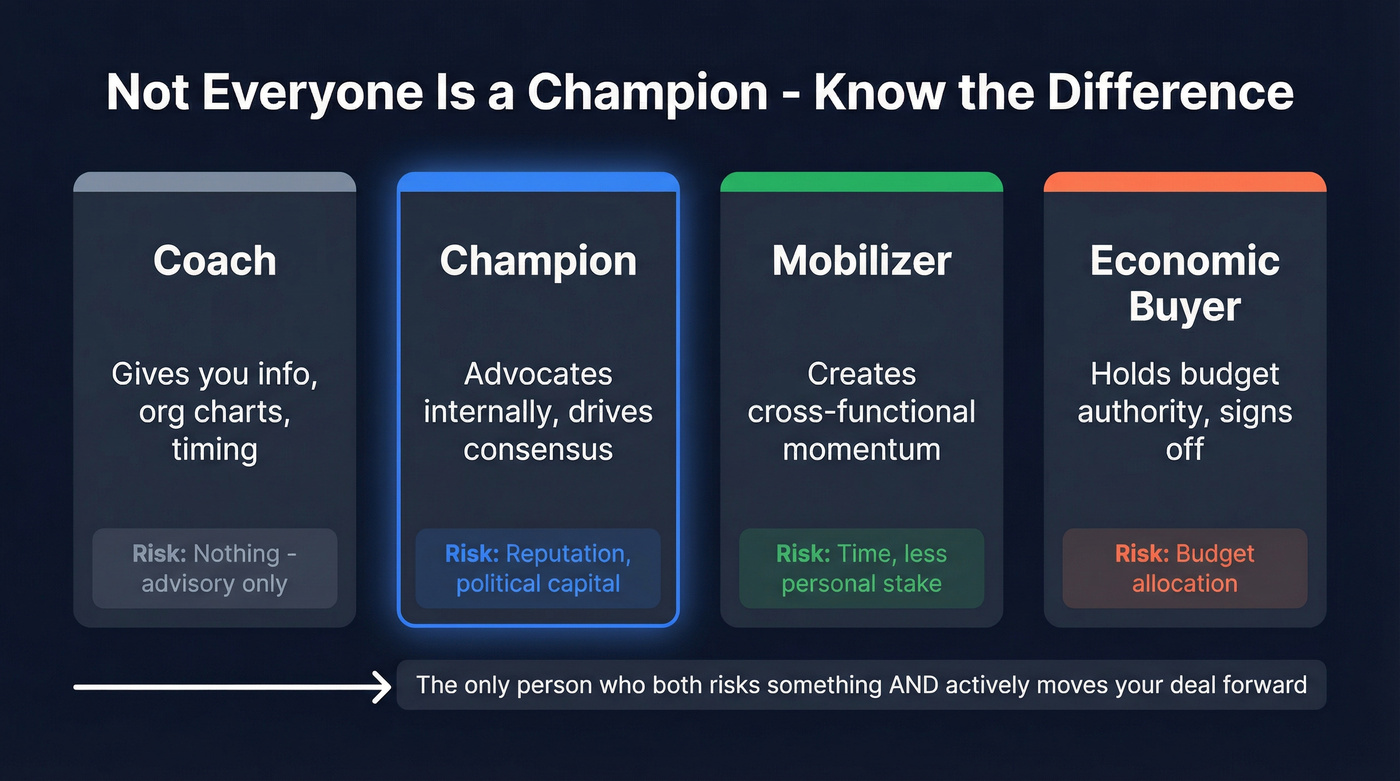
A true champion meets three criteria simultaneously: they benefit from your solution personally or professionally, they have genuine influence inside the organization, and they're willing to spend political capital to advocate for you. Remove any one of those three and you've got something else - a coach, a mobilizer, or just someone who liked your product demo.
| Role | What They Do | What They Risk |
|---|---|---|
| Coach | Gives you info, org charts, timing | Nothing - advisory only |
| Champion | Advocates internally, drives consensus | Reputation, political capital |
| Mobilizer | Creates cross-functional momentum | Time, with less personal stake |
| Economic Buyer | Holds budget authority, signs off | Budget allocation |
The champion is the only person on this list who both risks something and actively works to move your deal forward. Coaches are helpful. Champions are essential.
Why Champions Matter in B2B Sales
B2B buying committees have ballooned. The average purchase now involves 13 stakeholders, with roughly 89% of decisions crossing multiple departments. Gartner puts the typical buying group at 6-10 decision-makers, each bringing 4-5 pieces of independent research to the table. Your reps get about 17% of the buyer's total purchase time - split across every vendor in the evaluation.
And 41% of buyers already have a preferred vendor before formal evaluation begins. Your champion is how you become that vendor.
The consequences are predictable: 86% of B2B purchases stall at some point. Even when deals close, 81% of buyers end up disappointed with their vendor - often because the person who understood the real need wasn't driving the final decision. Champion-led deals close 2-3x more frequently than unchampioned opportunities and move roughly 35% faster through the pipeline.
Here's the thing: in complex B2B, your champion is the buying experience when you're not in the room.
Where Champions Fit in MEDDIC
MEDDIC - Metrics, Economic Buyer, Decision Criteria, Decision Process, Identify Pain, Champion - was developed by John McMahon at PTC in 1996. It helped PTC grow from $300M to $1B in sales and remains one of the most widely used qualification frameworks for complex deals. The modern evolution, MEDDPICC, adds Paper Process and Competition to the original six elements.
Of all eight MEDDPICC elements, Champion is one of the most predictive of deal outcomes. You can nail Metrics, map the Decision Process perfectly, and identify Pain with surgical precision - but without someone inside the account converting that information into internal action, it's just a well-documented loss.
We've seen this play out dozens of times: a deal with perfect MEDDIC scores except Champion ends up in "closed-lost" because nobody was fighting for it internally. Map each MEDDPICC element to a CRM field so reps track champion status alongside deal stage - not in their heads.
How to Identify a Champion
Stop looking at the top of the org chart. The VP who took your first meeting isn't your champion - they're evaluating. Your champion is more likely the director or senior manager who feels the pain daily, has credibility with peers, and whose career trajectory improves if your solution works.
Look for three overlapping traits:
Enthusiasm with specificity. They don't just say "this looks great." They say "this would fix the reporting bottleneck that's costing us two days every month." Specificity signals they've already started building the internal case.
Organizational influence. Can they convene a meeting with stakeholders from other departments? Do people return their Slack messages? Influence isn't about title - it's about whether others act on their recommendations.
Skin in the game. Their success is tied to your solution's success. Maybe they own the KPI your product improves, or they're leading the initiative your tool supports.
The red flag to watch for: the "professional meeting attender." They show up to every call, ask good questions, nod enthusiastically - and have zero ability to move anything forward internally. We've all wasted quarters on these people.
Three discovery questions that reveal champion potential:
- "If this project gets approved, who's responsible for making it successful?"
- "What happens to your team's goals if this doesn't move forward?"
- "Who else needs to be convinced, and what would convince them?"
The third question is the tell. A real champion already knows the answer. A friendly contact says "let me think about that."
Knowing what a champion looks like is step one. Reaching them directly is step two. Prospeo's B2B database lets you search across 300M+ profiles using 30+ filters - department, seniority, job change signals, headcount growth - to find verified emails and mobile numbers for the specific person you need, without waiting on an introduction that never comes.


Your champion scored a 5 on Influence - but you can't reach them because your contact won't make the intro. Prospeo's B2B database gives you direct access to 300M+ profiles with 98% email accuracy and 125M+ verified mobiles, filtered by department, seniority, and job change signals.
Skip the gatekeeper. Reach your champion directly at $0.01 per verified email.
The Champion Scorecard
Not every champion candidate is equal. Score yours across five dimensions, each rated 1-5:
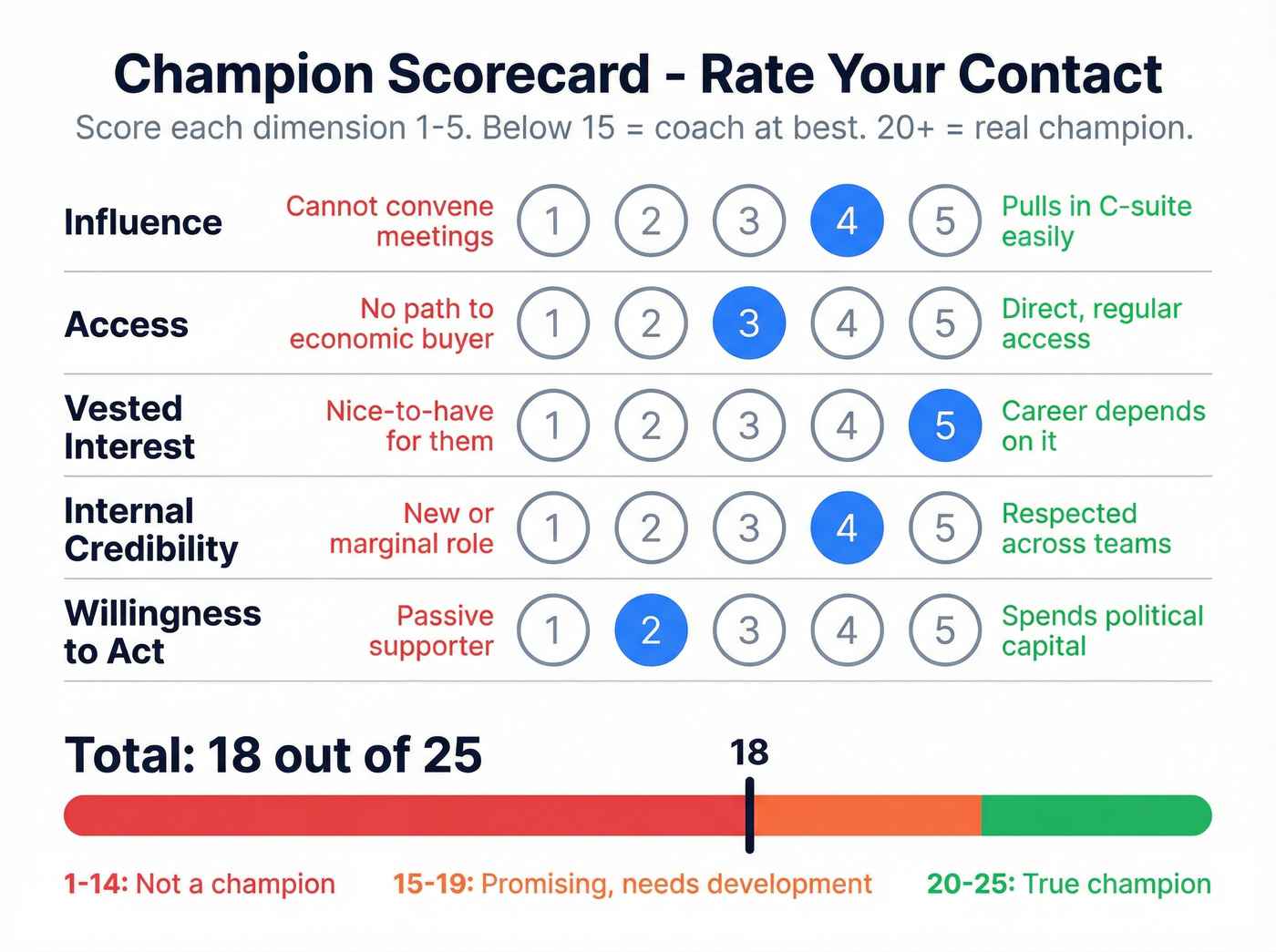
| Criterion | Score 1 (Weak) | Score 5 (Strong) |
|---|---|---|
| Influence | Can't convene meetings | Pulls in C-suite easily |
| Access | No path to economic buyer | Direct, regular access |
| Vested Interest | Nice-to-have for them | Career depends on it |
| Internal Credibility | New or marginal role | Respected across teams |
| Willingness to Act | Passive supporter | Spends political capital |
A score of 20+ means you've got a real champion. Below 15, you've got a coach at best.
Let's go back to that 11-week deal. Your contact just said they need to "loop in a few more people." That's a score of 1 on Influence and probably a 2 on Access. You don't have a champion - you have a bottleneck. Time to find the real one.
The Champion Enablement Toolkit
Your champion just came out of a budget meeting where the CFO asked "why do we need this?" - and they didn't have an answer. That's your fault, not theirs.
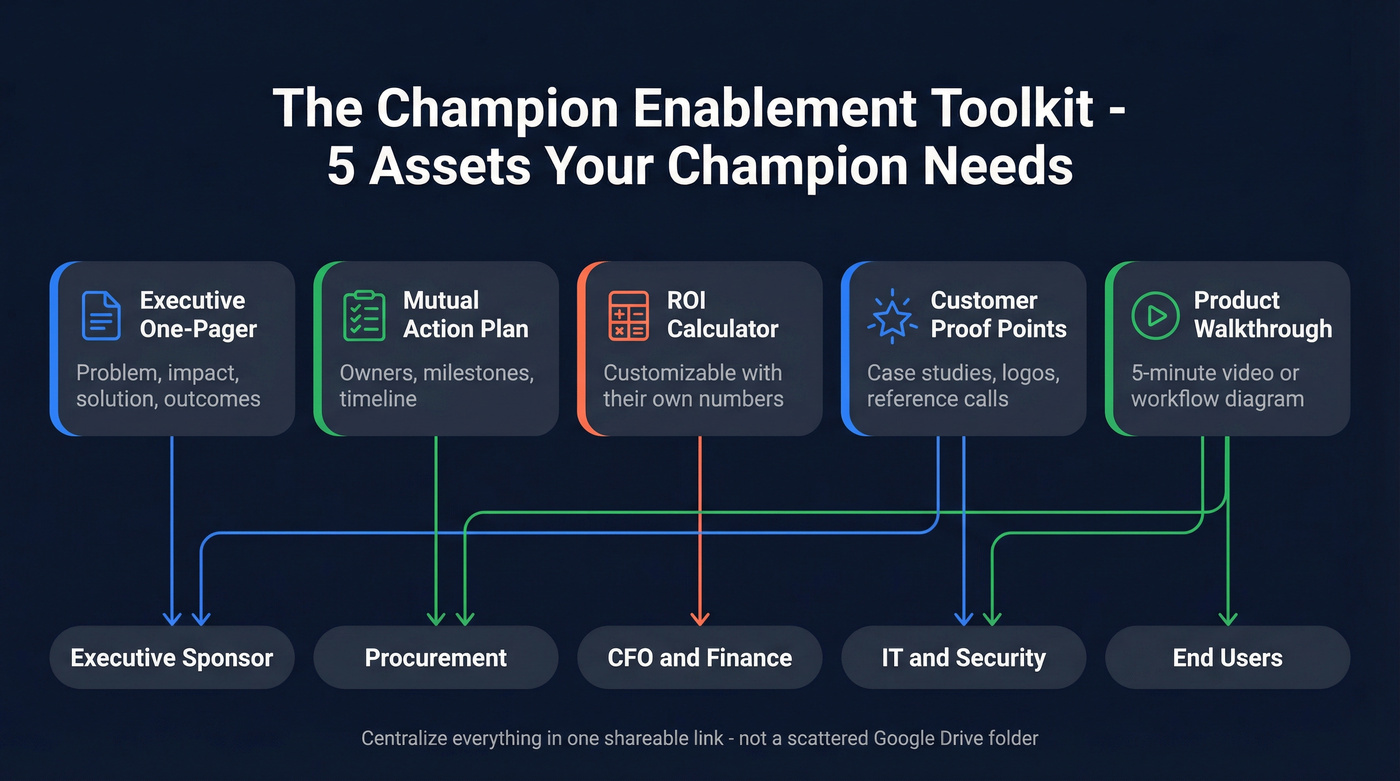
Every champion needs five assets:
- Executive summary one-pager - problem, impact, solution, outcomes. One page, not your 40-slide deck.
- Mutual action plan - owners, milestones, timeline. This gives your champion a script for "what happens next."
- ROI calculator - ideally one they can customize with their own numbers. CFOs trust their own math more than yours.
- Customer proof points - case studies, logos, reference calls. "Who else like us has done this?" is the question your champion will hear most.
- Product walkthrough - short video or workflow diagram a technical evaluator can review in 5 minutes.
| Stakeholder | Primary Asset | Why |
|---|---|---|
| CFO / Finance | ROI calculator | They need numbers |
| IT / Security | Compliance docs | They need risk mitigation |
| End users | Product walkthrough | They need to see the workflow |
| Executive sponsor | One-pager | They need the 60-second pitch |
| Procurement | Mutual action plan | They need process clarity |
The PreSales Collective - a 20,000+ member community of technical sellers - consistently emphasizes the same point: champions need ROI-focused language and simple, reusable assets. Centralize everything in one place your champion can share. A scattered Google Drive folder isn't enablement - it's homework.
Why Champions Go Quiet
Your champion went quiet after the internal review. They didn't lose interest - they got outgunned internally and you didn't arm them for the fight. On r/sales and other sales communities, the phrase "went dark after the internal meeting" is practically a meme, and it almost always means the same thing.
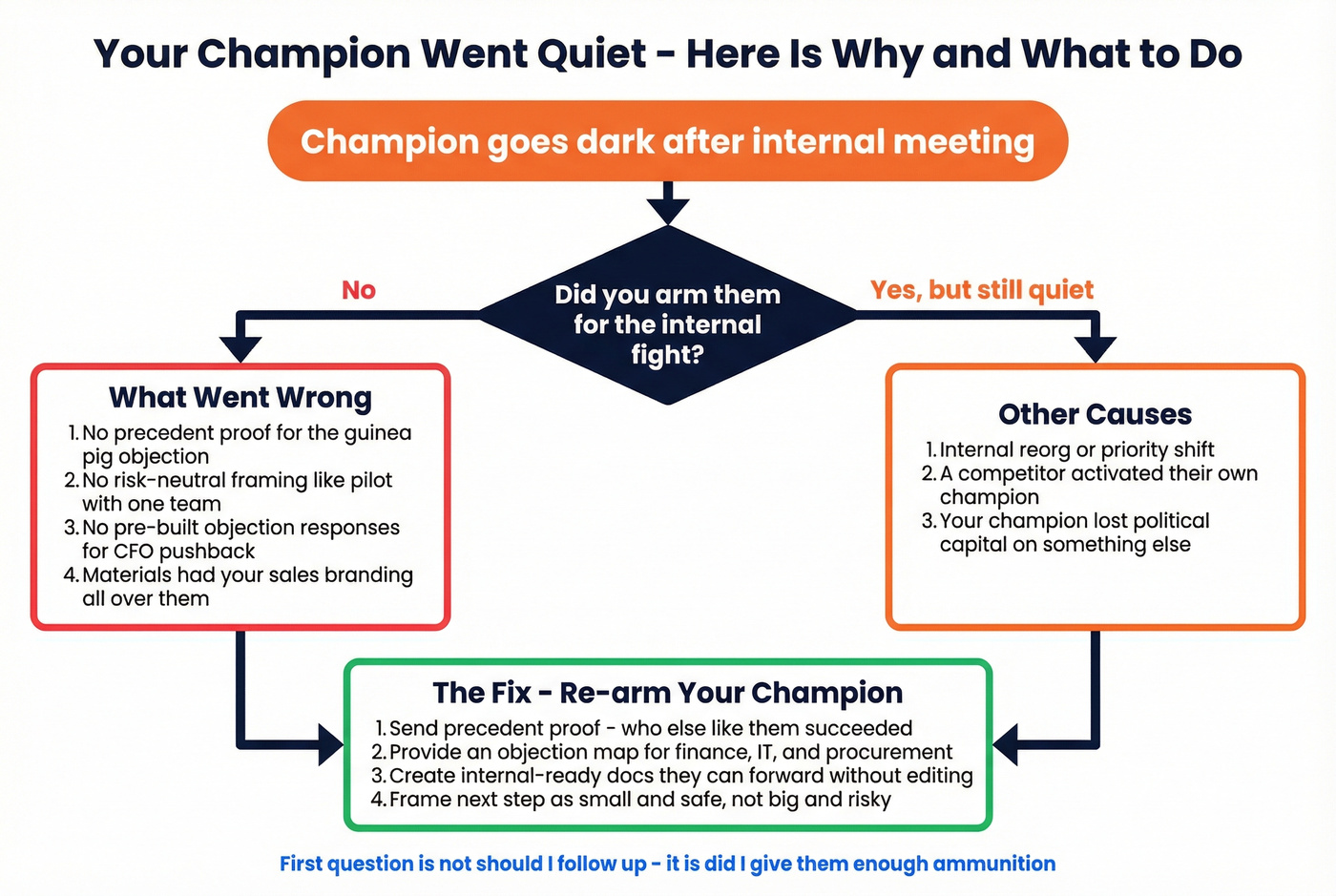
Belief doesn't win. Protection does. Champions stall because of personal and professional risk, not lack of enthusiasm. When the internal pressure exceeds the defensibility you've given them, they retreat. Your champion needs defensive assets, not just offensive ones:
Precedent proof. "Who else like us has done this, and what happened?" This neutralizes the "we'd be the guinea pig" objection.
Risk-neutral narratives. Frame adoption as incremental and safe. "Pilot with one team" beats "company-wide rollout" every time.
Objection maps. Pre-built responses for IT, procurement, finance, and leadership pushback. Your champion shouldn't have to improvise against a CFO who's killed three similar projects this quarter. (If you want a tighter system for this, start with types of objections.)
Internal-ready materials. Assets they can forward without rewriting. If it has your sales deck branding plastered all over it, they won't share it.
If your champion goes dark, the first question isn't "should I follow up?" It's "did I give them enough ammunition to survive the internal fight?"
Building a Champion Network
Single-threading is the #1 reason enterprise deals die. One champion gets promoted, goes on leave, or loses an internal battle - and your deal evaporates overnight.
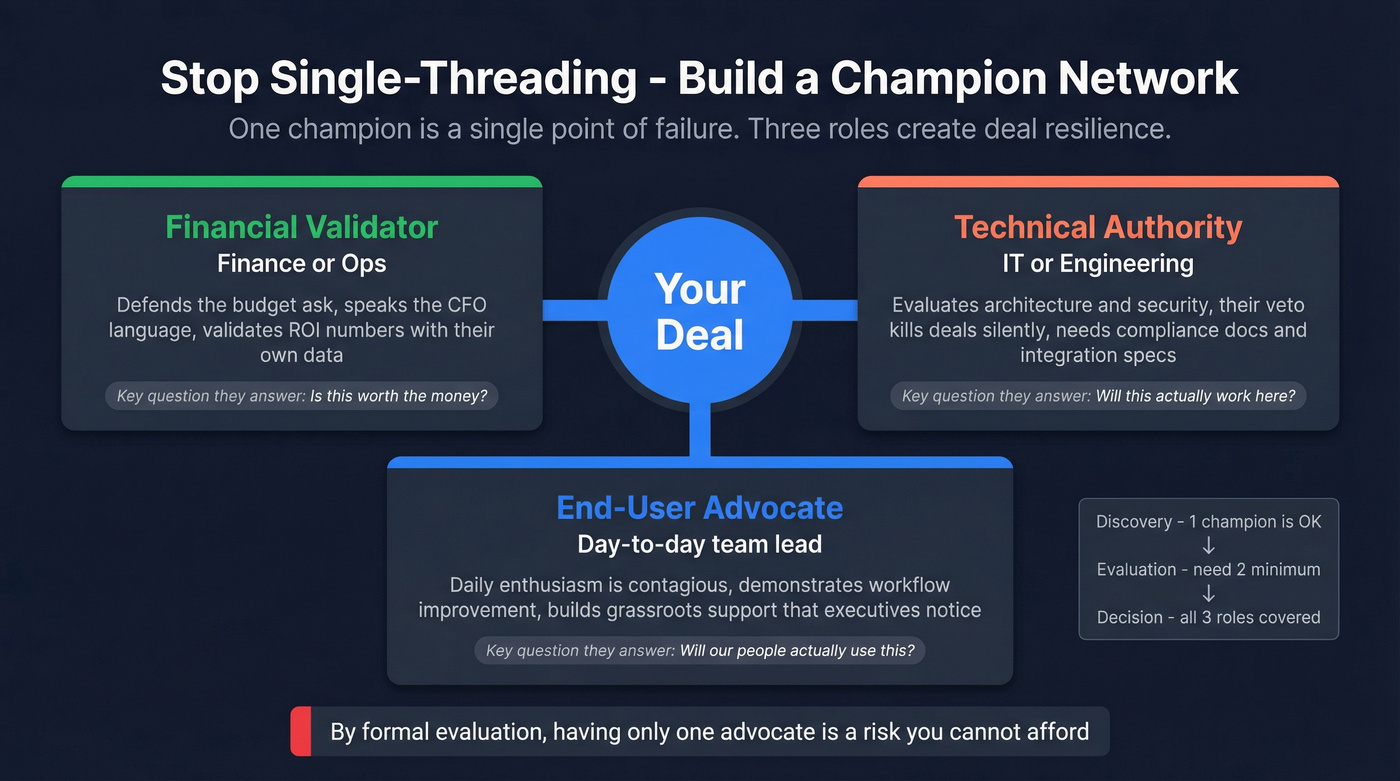
Build a champion network with role-based coverage: a Financial Validator in finance or ops who can defend the budget ask, a Technical Authority who evaluates architecture and security (their veto kills deals silently), and an End-User Advocate whose daily enthusiasm is contagious in ways executive sponsorship isn't. You don't need all three from day one, but by formal evaluation, having only one advocate is a single point of failure you can't afford.
Champions don't replace your direct access to the economic buyer - they create the conditions for that conversation to go well. If you're relying on your champion to do all the internal selling while you wait, you've outsourced your deal. The best reps use champions to open doors, then walk through them personally.
One contrarian move we've seen work: your best second champion is often someone who initially pushed back. A skeptic who converts becomes your most credible internal voice, because the rest of the buying committee watched them change their mind.
If you're struggling to keep coverage across stakeholders, build a simple account qualification checklist and treat champion depth as a required field.
86% of B2B deals stall - usually because reps are single-threaded through a friendly contact, not a real champion. Prospeo lets you multi-thread every deal by finding verified contact data for every stakeholder on the buying committee, refreshed every 7 days so you're never working with stale data.
Map the entire buying committee before your competitor finds one contact.
FAQ
What's the difference between an internal champion and an economic buyer?
The champion builds consensus and handles objections so that when the deal reaches the economic buyer, it's already a "yes." The economic buyer holds budget authority and signs the contract - but rarely does the internal selling. Think of the champion as the campaign manager and the economic buyer as the voter who casts the deciding ballot.
How do you test if someone is really your champion?
Give them a small ask - an internal introduction or sharing a one-pager with their team. If they follow through unprompted within 48 hours, they're real. If they stall or say "let me check" and never circle back, they're a friendly contact. Track completion rate on these micro-asks in your CRM.
How do I find my champion's direct contact info?
Use a B2B data platform - search by role, department, and seniority within the target account to get verified emails and mobile numbers. With 98% email accuracy and a 7-day data refresh cycle, you can reach your likely champion directly without waiting on an introduction that never materializes.
What's the biggest mistake reps make with champions?
Assuming the relationship is enough. Champion enablement requires ongoing effort - arming them with updated assets, prepping them for objections, and coaching them through each stage of the buying process. Reps who treat champion management as a one-time event instead of a continuous effort are the ones whose deals stall at 80% complete.