

How to Generate More Pipeline Using Technographics and Intent Data
You renewed the intent data platform. $80K. Marketing ran the playbook - syndicated content, display ads, ABM campaigns targeting "in-market" accounts. Six months later, the pipeline sourced report shows zero meetings from intent-driven outreach. The data was there. The activation wasn't.
That gap between buying intent data and actually generating pipeline from it is where most programs die. Buyers complete 60-90% of their journey before ever talking to a vendor, which means the signal window is narrow and execution has to be precise.
Here's the thing: technographics tell you who could buy. Intent tells you who's buying now. Layer both on a tight ICP to cut your addressable list by 80%+ and focus reps on accounts that actually convert. Separate fit from intent into a two-axis scoring model - an A95 account gets immediate outreach, a C25 goes to nurture. And you don't need a $50K intent platform to start.
The Activation Gap
Most intent program failures aren't data problems. They're workflow problems.
Marketing buys the tool, builds audience segments, and hands sales a list of "in-market accounts" with no contacts, no context, and no routing logic. Reps glance at it, shrug, and go back to their existing pipeline. The data rots. We've seen this pattern at companies spending six figures on intent tools that generate exactly zero attributable pipeline - not because the signals were wrong, but because nobody built the bridge between signal and action.
Without a clear strategy connecting signal to rep behavior, even the best tools become expensive shelfware.
Technographics and Intent Data Explained
The technographics market grew from $367M in 2020 to over $1.17B by 2025, and companies using intent tools report a 96% success rate. That "success" stat is doing heavy lifting, though - most of the value concentrates in teams that actually operationalize the data.
Technographic data maps the technology stack a company uses - CRM, marketing automation, CMS, plugins, programming languages. The average company runs 100+ software applications, so the targeting surface area is enormous. The most valuable signal? Migration timing. When a company is transitioning away from a tool, budget is already allocated and a decision is in motion.
Intent data captures behavioral signals suggesting a company is actively researching a solution category. First-party intent tracks activity on your own properties - website visits, pricing page views. Third-party intent aggregates research behavior across publisher networks and review sites.
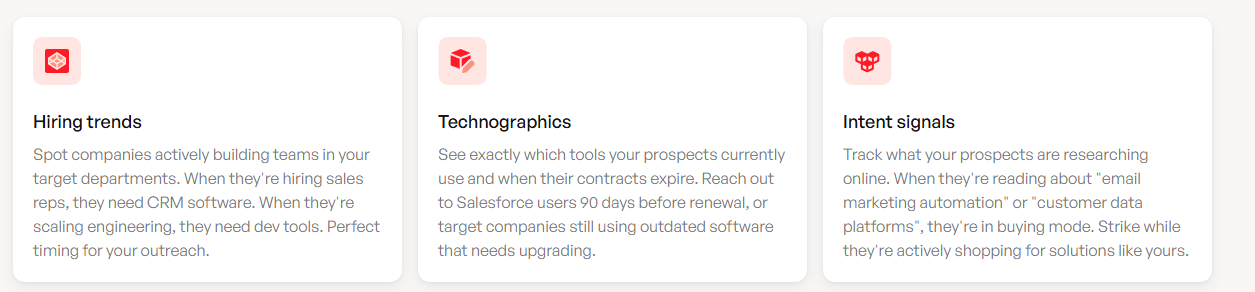
The critical gap most teams miss: the majority of third-party providers deliver account-level signals - "Company X is researching CRM software" - without telling you who at that company is doing the research. Contact-level intent is rarer and far more actionable.
Why Combining Both Multiplies Pipeline
Technographics without intent is just a filter. Intent without technographics is noise. The compounding effect happens when you layer both.
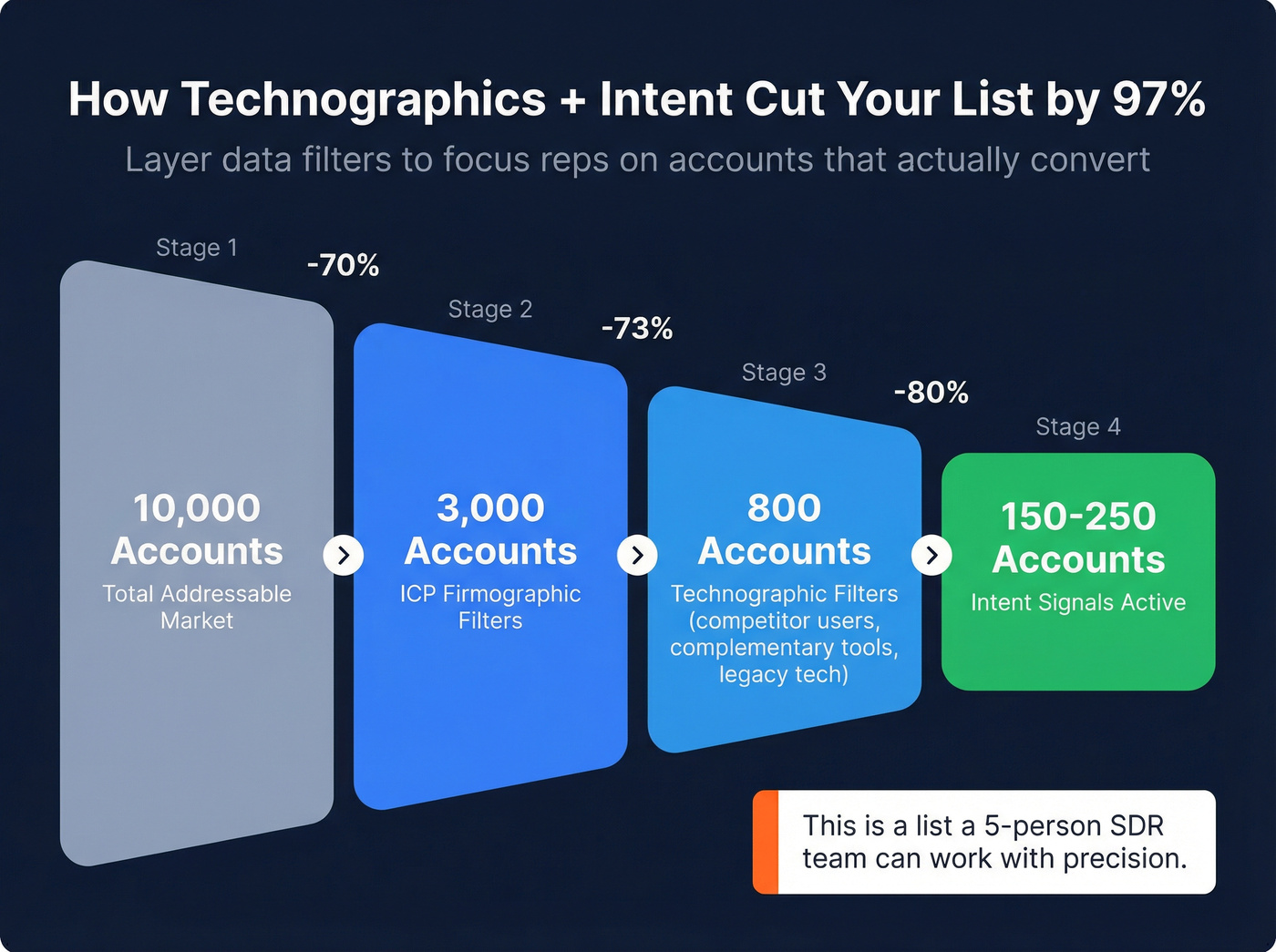
Let's walk through the math. Start with 10,000 accounts in your TAM. Apply ICP firmographic filters and you're down to ~3,000. Layer technographic filters - companies using a competitor's product or a complementary tool - and you're at ~800. Add intent signals for accounts actively researching your category, and your actionable list drops to 150-250 accounts. That's a list a five-person SDR team can work with precision instead of spraying emails into the void.
The benchmarks back this up: campaigns using technographic targeting see 28% higher conversion rates, companies incorporating technographics into their GTM are 50% more likely to exceed revenue goals, and intent-based campaigns show 220% higher CTR versus traditional targeting. Combine the two and you're compounding lift across the entire funnel.
If your average deal size sits below $10K annually, you probably don't need a six-figure intent platform. The ROI math just doesn't work. A self-serve tool with intent signals and verified contacts will outperform an enterprise platform your team never fully activates.
The Pipeline Math
Before you build the playbook, understand where the funnel leaks. Baseline B2B benchmarks to calibrate against:
| Stage | Conversion Rate | Notes |
|---|---|---|
| Lead to MQL | 35-45% | ICP + tech fit filters here |
| MQL to SQL | ~15% | Biggest leak - intent helps most |
| SQL to Opportunity | 25-30% | Qualification quality matters |
| Opp to Closed-Won | 6-9% | Multi-threaded selling |
| Overall Lead to Customer | 1.5-2.5% | Median: 2.9% |
In our experience, the MQL to SQL stage is where intent programs either prove their value or die. That ~15% conversion rate means 85% of "qualified" leads never become real sales conversations. With buying committees averaging 13 decision-makers, the problem isn't just lead quality - it's reaching the right people at the right accounts at the right time.

Stop stitching together separate intent, technographic, and contact tools. Prospeo combines 15,000 Bombora intent topics, Wappalyzer technographics, and 143M+ verified emails in a single search - refreshed every 7 days, not 6 weeks. At $0.01/email, the ROI math works even for sub-$10K deals.
Turn technographic fit + buying intent into booked meetings this week.
Step-by-Step Playbook
Define a Quantifiable ICP
Don't say "mid-market SaaS companies." Say "B2B SaaS, 200-2,000 employees, using Salesforce CRM and either HubSpot or Marketo, headquartered in North America or Western Europe." The more specific your ICP, the more powerful every downstream filter becomes.
Layer Technographic Filters
The biggest mistake here is filtering too broadly. Look for companies using a competitor's product - that's a displacement opportunity. Or a complementary tool in your ecosystem - an integration play. Or legacy technology in your category - a modernization play.
76% of prospects say customized communications drive consideration, and nothing personalizes outreach like referencing the exact tools a prospect already uses. "I noticed you're running Marketo alongside a custom-built attribution model" hits differently than "I help marketing teams like yours."
Add Intent Signals and Verified Contacts
Layer intent on top of your technographic-filtered list to identify which accounts are actively in-market. Choose topics carefully - broad topics like "digital transformation" match half the Fortune 500 and generate false positives, while specific topics like "Salesforce CPQ migration" surface real buying signals.
Prospeo bundles 15,000 intent topics via Bombora with technographic filters powered by Wappalyzer and live job posting signals, refreshed on a 7-day cycle versus the 6-week industry average. You get intent signals and verified contacts from the same search - no stitching together separate tools. One customer, Meritt, tripled weekly pipeline from $100K to $300K after switching to this workflow.

Calibrate your thresholds. Not every intent signal deserves rep attention. Set a baseline surge score and only surface accounts that exceed it meaningfully. First-party signals are more accurate but lower volume; third-party signals offer broader coverage but more noise. The best programs blend both.
Build a Two-Axis Scoring Model
An A95 account - perfect ICP fit, high intent surge - gets immediate rep outreach. A C25 - marginal fit, low intent - goes into a nurture sequence. That's the whole framework: fit grade on one axis, intent score on the other.
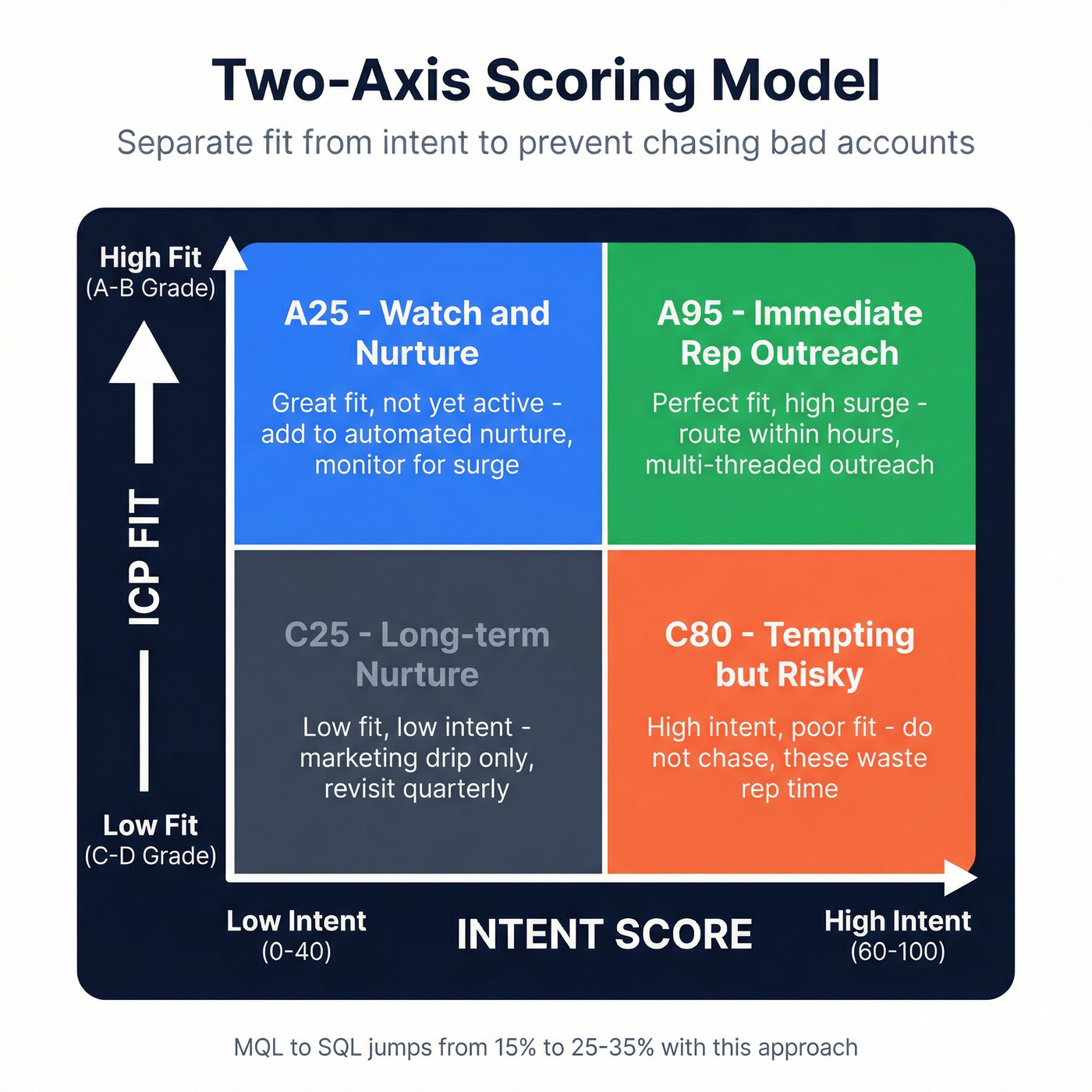
This two-axis model outperforms single-score systems because it prevents the classic mistake of chasing high-intent accounts that are terrible fits. A startup with 5 employees surging on your category keywords isn't a real opportunity if your minimum deal size is $50K. Using this approach, typical MQL to SQL benchmarks jump to 25-35%, and high-alignment teams target 40-50%.
Activate in Sales Workflows
The best scoring model is useless if reps don't act on it. Build dynamic books that continuously shift account assignments toward high-fit, in-market accounts. When an A-grade account surges above your threshold, it should land in a rep's queue within hours - not days.

Outbound sequences typically require 8-18 touches before a prospect responds. Intent data doesn't eliminate that - it ensures those touches go to accounts actually in a buying cycle. Route high-priority accounts immediately, arm reps with technographic and intent context in the CRM record itself, and build closed-loop reporting to measure which signals predict pipeline.
What Intent Data Costs in 2026
Pricing is where most teams get sticker shock. Budget 15-25% above license cost for implementation overhead.
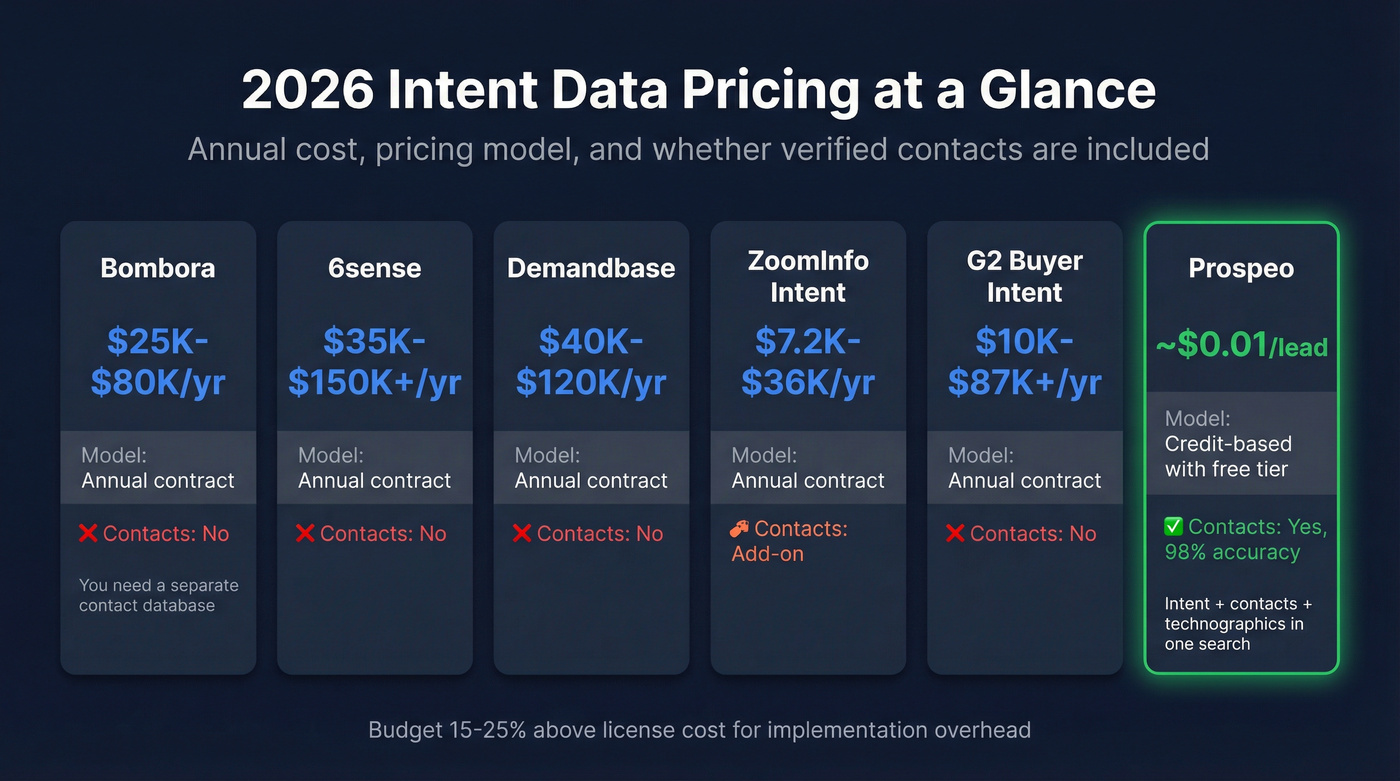
| Tool | Annual Cost | Model | Verified Contacts? |
|---|---|---|---|
| Bombora | $25K-$80K | Annual contract | No |
| 6sense | $35K-$150K+ | Annual contract | No |
| Demandbase | $40K-$120K | Annual contract | No |
| ZoomInfo Intent | $7.2K-$36K | Annual contract | Add-on |
| G2 Buyer Intent | $10K-$87K+ | Annual contract | No |
| Prospeo | ~$0.01/lead | Credit-based, free tier | Yes - 98% accuracy |
Most enterprise platforms require separate contact databases to action their signals. That means you're paying for intent and a data provider and integration work to stitch them together. Credit-based tools that bundle contacts with signals collapse that stack entirely.
Why Most Programs Fail
Four failure modes kill intent programs before they generate pipeline.
Noisy intent topics. "Cloud computing" matches everyone. Pick topics that indicate real purchase intent - "Salesforce to HubSpot migration" beats "CRM software" every time. The consensus on r/sales is that most teams pick topics that are way too broad, then blame the data when results are garbage.
No ICP alignment. A surging account outside your ICP is a distraction, not an opportunity. Always filter intent through fit first.
Marketing buys, sales ignores. Intent signals need to flow into rep workflows automatically with actionable contact data attached - not arrive as a monthly spreadsheet that nobody opens. If your activation requires a rep to log into a separate platform, check a dashboard, and manually cross-reference contacts, it won't happen.
Stale contact data. You identify 500 in-market accounts, but 200 have no contacts and 150 have bounced emails. A 7-day refresh cycle versus the industry-standard 6 weeks is the difference between catching a buyer mid-evaluation and emailing someone who changed jobs two months ago.
Skip the enterprise intent platform entirely if your team doesn't have a RevOps person who can build the routing logic and CRM integrations. Without that operational layer, you're buying a dashboard nobody uses.
Compliance Guardrails
GDPR fines reach EUR 20M or 4% of global annual revenue, and California's B2B exemption under CCPA expired January 1, 2023. This isn't optional.
Establish a lawful basis for processing - legitimate interest is most common for B2B prospecting, but document your balancing test. Enforce purpose limitation, honor opt-out requests within two business days, and maintain audit trails. If your data provider can't explain their compliance framework in plain language, that's a red flag.
The article's math showed how layering technographics and intent cuts 10,000 accounts to 250. Prospeo's 30+ filters - including tech stack, intent signals, headcount growth, and job changes - do exactly that. Then you get 98% accurate emails and verified mobiles for the right contacts, not just account names.
Get contact-level intent data, not just account-level guesses.
FAQ
Technographic vs. Firmographic Data?
Firmographics describe who a company is - industry, revenue, headcount. Technographics describe how they operate - their CRM, marketing tools, infrastructure. Technographics give you the product-market fit signal firmographics can't. Use both together for the strongest ICP definition.
Can Small Teams Afford Intent Data?
Yes. Enterprise platforms start at $25K+/year, but credit-based tools bundle intent signals with verified contacts starting from a free tier - roughly $0.01 per lead on paid plans. For teams with deal sizes under $15K, self-serve pricing delivers better ROI than annual contracts every time.
How Often Should Intent Data Refresh?
Weekly is the gold standard. A 6-week-old signal often points to an account that's already signed a contract with your competitor. Mid-market buying cycles can close in 30-45 days, so stale data means missed windows.
How Do You Measure Pipeline Impact From Intent Signals?
Track MQL to SQL conversion by intent score, pipeline sourced from high-intent vs. cold accounts, win rate by scoring tier, and time-to-opportunity. If A95 accounts aren't converting at 2-3x your baseline, recalibrate your topics or thresholds - the signals are telling you something about your ICP definition, not just your data quality.