

Infofree vs Salesgenie: Are You Paying Twice for the Same Data?
Comparing Infofree and Salesgenie is like comparing two flip phones connected to the same cell tower. Both tools serve up business and consumer lists, and both have interfaces that feel like they predate modern CRM workflows. The real question isn't which is better - it's whether either one solves the problem you actually have.
One note up front: Salesgenie is a Data Axle product (now marketed as Data Axle Genie), but we haven't found a credible source confirming that Infofree uses Data Axle's underlying database. So this comparison focuses on what we can verify: pricing mechanics, contracts, and what reviewers complain about.
30-Second Verdict
Pick Salesgenie if you want better support, a larger business database, and a free way to explore it before committing. It earns a 4.3/5 on G2 with 314 reviews - that's real volume.
Pick Infofree only if you need the absolute cheapest entry point and can live with a 100-download monthly cap and a 2.9/5 G2 rating from 20 reviews.
Skip both if your actual problem is bounced emails and disconnected numbers. Switching list providers rarely fixes stale records by itself. Every disconnected number wastes 2+ minutes of rep time - multiply that across hundreds of dials and you're bleeding hours weekly.
Side-by-Side Comparison
| Feature | Infofree | Salesgenie | Prospeo |
|---|---|---|---|
| Starting price | $69-$99/mo (varies by package) | $99/mo starting; many teams land ~$149/mo for business access | ~$0.01/email, free tier |
| Businesses | 14M+ | 19.5M+ | 300M+ profiles |
| Consumer records | 260M+ | 255M+ | B2B-focused |
| G2 rating | 2.9/5 (20 reviews) | 4.3/5 (314 reviews) | - |
| Export limits | 100/user/mo; $1 per additional download | Credit-based | Unlimited |
| Contract | 30-day money-back guarantee | 12-month initial term | No contract |
| Free trial | Conflicting listings online | Yes (no card upfront) | Yes (75 emails/mo) |
| Data refresh | Not disclosed | Weekly | Every 7 days |
| Email verification | Not highlighted | Not included in lower tiers | 98% accuracy, built-in |

Do They Use the Same Database?
Salesgenie is clearly tied to Data Axle: Infogroup rebranded as Data Axle in 2020, and Salesgenie is now marketed as Data Axle Genie across most of their properties.
What we can't confirm is the stronger claim people often make - that Infofree and Salesgenie are "the same database" or that switching between them means you're buying identical records twice.
Here's what we can say:
- Salesgenie advertises 19.5M businesses and 255M consumers, with weekly updates.
- Infofree listings cite 14M+ businesses and 260M+ people, plus strict export limits.
So even if there's overlap in the real world, the safer way to evaluate these tools is by pricing structure, export mechanics, contract terms, and support. Those are the differences that'll hit your team every day.
Let's be honest: for most outbound teams in 2026, this debate is the wrong debate entirely. The gap between legacy list providers and modern verified-data platforms is so wide that choosing between these two is like arguing over which fax machine has better resolution.

Infofree caps you at 100 exports/month. Salesgenie locks you into a 12-month contract. Prospeo gives you unlimited exports, 98% verified emails, and 125M+ mobile numbers - refreshed every 7 days, not whenever a legacy provider gets around to it. No contracts. No setup fees. Starts free.
Stop paying twice for the same stale data.
Pricing Breakdown
What Infofree Actually Costs
Infofree's pricing is a mess of conflicting signals. SaaSworthy lists it at $99/mo with a $99 setup fee on monthly plans, while other aggregator listings show $69/mo as a starting point. The annual option runs $999/yr ($799/user/year for additional seats).
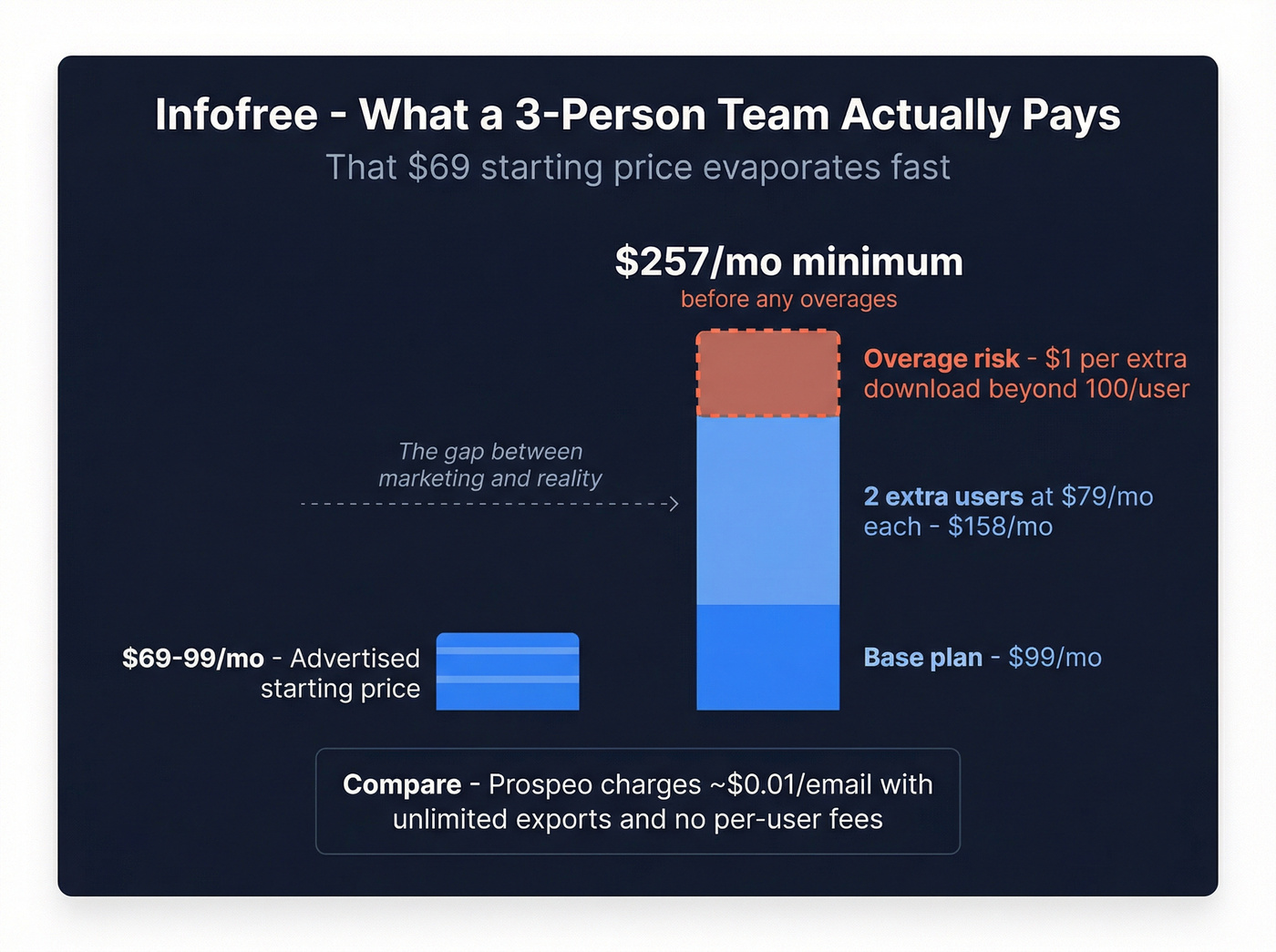
The real cost trap is the export cap. You get 100 downloads per user per month. Every additional name costs $1. Additional users run $79/mo each.
Here's what that looks like for a small team:
- Base plan: $99/mo
- Two additional users: 2 x $79/mo = $158/mo
- Total for 3 users, before overages: $257/mo
- If your team exports beyond the included 100 downloads per user, overages stack at $1 per extra record
That $69 starting price? It evaporates fast.
What Salesgenie Actually Costs
Salesgenie's official pricing starts at $99/mo on a 12-month initial subscription. After that first year, it renews month-to-month and you can cancel anytime.
Multiple third-party pricing grids commonly show $149/mo as the practical entry point for business access, with Team packaging around $299/mo for up to 5 users. The $99/mo tier exists, but many teams end up paying closer to $149 once they're buying what they actually need.
Data Quality: Where Both Struggle
Infofree
The reviews paint a rough picture. Trustpilot complaints include "bait and switched" billing practices and unexpected charges. One user on SoftwareFinder flagged that they couldn't export entries from the CRM at all - a fundamental limitation for a lead database. The G2 score of 2.9/5 from just 20 reviews tells you most users don't feel strongly enough to leave positive feedback.

Fair credit: some users praise the filtering interface and 24/7 access. But the billing complaints are a pattern, not isolated incidents.
Salesgenie
Salesgenie fares better on customer service - dedicated account specialists and support are a consistent positive in reviews, and the 4.3/5 G2 rating with 314 reviews is legitimate social proof. That said, the complaints center on the exact problem you'd expect from a legacy database: outdated email addresses, missing phone numbers, and disconnected contacts. As far back as 2018, a TrustRadius reviewer noted "few if any direct phone numbers and limited emails" for B2B use cases.
If you're running outbound sequences, that's a dealbreaker.
What to Use When Neither Delivers
Here's the thing: if you've been going back and forth between these two list providers and the real issue is that neither gives you accurate, fresh contact data, the gap is obvious. We've tested both legacy list providers and modern platforms side by side, and the difference in bounce rates alone is staggering.

Prospeo covers 300M+ professional profiles with 98% email accuracy and 125M+ verified mobile numbers. The data refreshes every 7 days, compared to the industry average of roughly 6 weeks and Infofree's undisclosed refresh cycle. Verification is built in - no extra cost, no separate tool to clean your lists before loading them into a sequencer.

Pricing is self-serve and transparent: roughly $0.01 per verified email, with a free tier that includes 75 emails and 100 Chrome extension credits per month. No 12-month lock-in, no setup fees. And with 30+ search filters - including buyer intent powered by Bombora, technographics, and headcount growth signals - you're not just getting a list. You're getting a list that's actually targetable.
One of our customers, Meritt, tripled their pipeline from $100K to $300K/week after switching from a legacy provider, dropping their bounce rate from 35% to under 4%. That's the kind of gap we're talking about.
Meritt dropped their bounce rate from 35% to under 4% and tripled pipeline to $300K/week after ditching legacy list providers for Prospeo. With 30+ filters - including buyer intent, technographics, and headcount growth - you're not just getting names. You're getting contacts that actually pick up.
Replace disconnected numbers with 125M+ verified mobiles.
FAQ
Is Infofree the Same as Salesgenie?
Not the same product. Salesgenie is a Data Axle product (often marketed as Data Axle Genie), while no available source confirms Infofree runs on the same underlying database. The biggest confirmed differences are pricing structure, export limits (100/mo on Infofree vs. credit-based on Salesgenie), contract terms, and support quality.
Which Is Cheaper for Small Teams?
Infofree starts lower at $69-$99/mo versus Salesgenie's $99/mo entry point, but Infofree caps downloads at 100/month per user and charges $1 per extra name. For teams pulling more than a few hundred leads monthly, Salesgenie's credit model or Prospeo's $0.01/email pricing with no export caps will cost less at scale.