

Appointment Setters: What They Do, What They Cost, and How to Get Them Right
Your reps made 80 dials yesterday and booked zero meetings. The AEs are complaining about garbage leads. The founder is asking why pipeline is flat when headcount went up. The problem isn't effort - it's the system around the effort. Appointment setters solve this when the infrastructure around them is right. Here's how to build an appointment setting function that actually produces revenue.
What You Need (Quick Version)
An appointment setter is an entry-level sales role focused on one thing: booking qualified meetings for your closers. They research, they call, they email, they qualify, they book. They don't run demos. They don't negotiate pricing.
What you should expect to pay: ~$29K-$70K base salary for in-house setters, with ZipRecruiter distributions showing a similar mid-range and higher top-end outliers. If you outsource, the average cost per qualified B2B appointment runs $550-$1,700. That's not a typo - complex B2B meetings are expensive to generate.
The one thing most teams get wrong: bad contact data. Between 30-50% of B2B records go stale within a year. Your setters are burning dials on people who changed jobs last quarter, and you're blaming them for low conversion rates. (If you want the deeper breakdown, see our guide on B2B records go stale.)
Three tools you need to start:
- CRM - HubSpot's free tier works for getting started. Pipedrive starts at $14/user/mo for teams that want a cleaner pipeline view.
- Verified contact data - Prospeo gives you 98% email accuracy and verified mobile numbers, with a free tier to start. (More on choosing tools in our roundup of sales prospecting platforms.)
- Dialer - Orum, PhoneBurner, or JustCall for parallel dialing. If you're dialing a lot, it helps to understand dynamic dialer options and tradeoffs.
Get those three right and a single setter can outperform a team of four working off spreadsheets and guesswork.
What Does an Appointment Setter Do?
Here's what a typical day looks like. Your setter arrives at 8:30, spends 30 minutes reviewing their target list and prepping personalized notes. By 9:00, they're on the phones. Between calls, they're sending short, direct emails and following up on yesterday's warm responses. (If you want a tighter routine, use a pre call research checklist.)
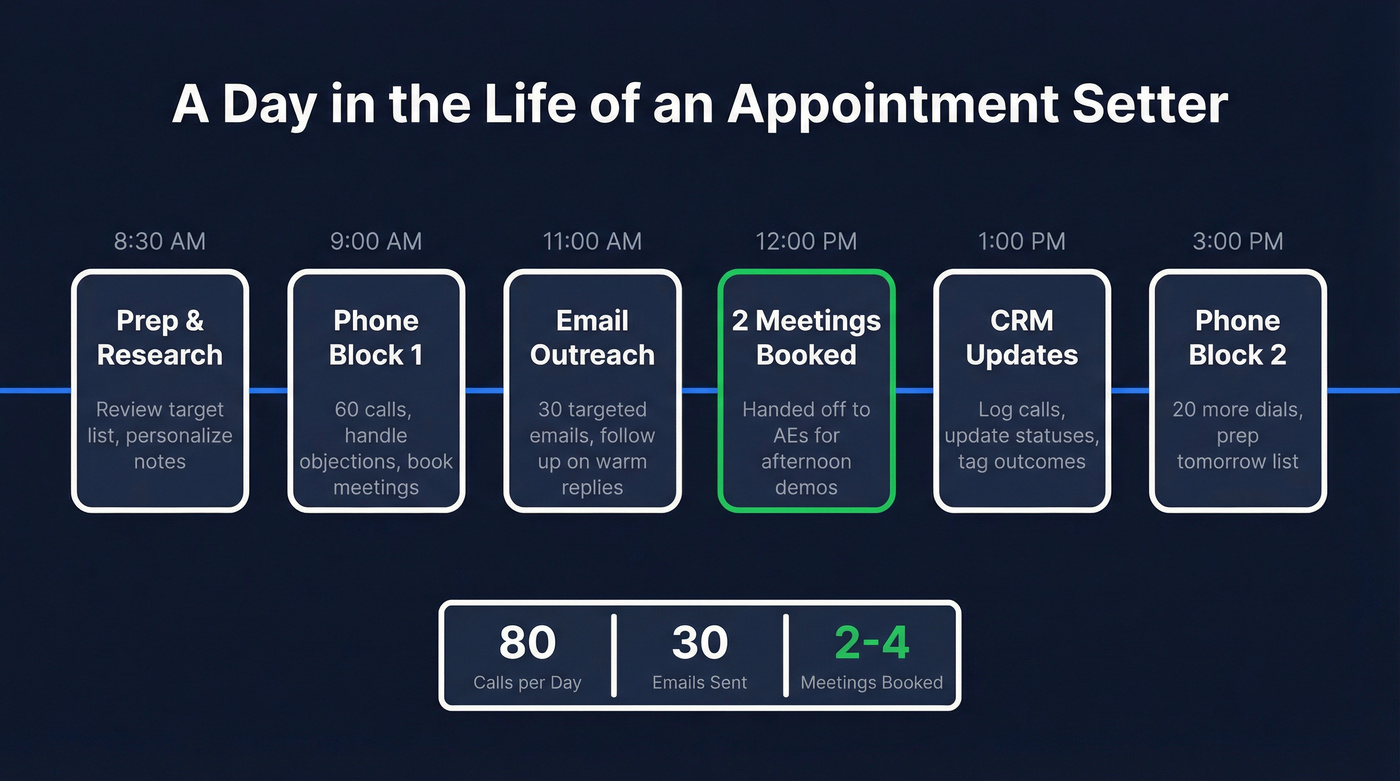
By noon, they've made 60 calls, sent 30 emails, and booked two meetings for the afternoon AE block. After lunch, they update the CRM, prep for tomorrow's list, and squeeze in another 20 dials before end of day. It's repetitive work - and that repetition is exactly what makes it effective.
The role exists to solve a specific problem: your closers shouldn't be prospecting. Every hour an AE spends cold calling is an hour they're not running demos, handling objections, or closing deals. A good setter frees up roughly 20 hours per week for your revenue-generating reps. That's half a workweek reclaimed for the people who actually move deals forward.
The benchmarks are straightforward. Expect a 2-5% appointment conversion rate across outbound touches and 20-40 qualified meetings per month from a ramped setter. If your team is consistently below those numbers, the issue is almost always data quality or targeting - not hustle. (For a full playbook, see our B2B cold calling guide.)
These reps sit at the very top of the funnel. They don't run discovery. They don't demo. They qualify against your ICP criteria, book the meeting, and hand off cleanly. The simplicity of the role is what makes it scalable.
Setter vs SDR vs BDR
The titles get used interchangeably, and honestly, only about 25% of companies maintain strict separation between inbound and outbound teams. But the distinctions matter when you're designing comp plans and setting expectations.
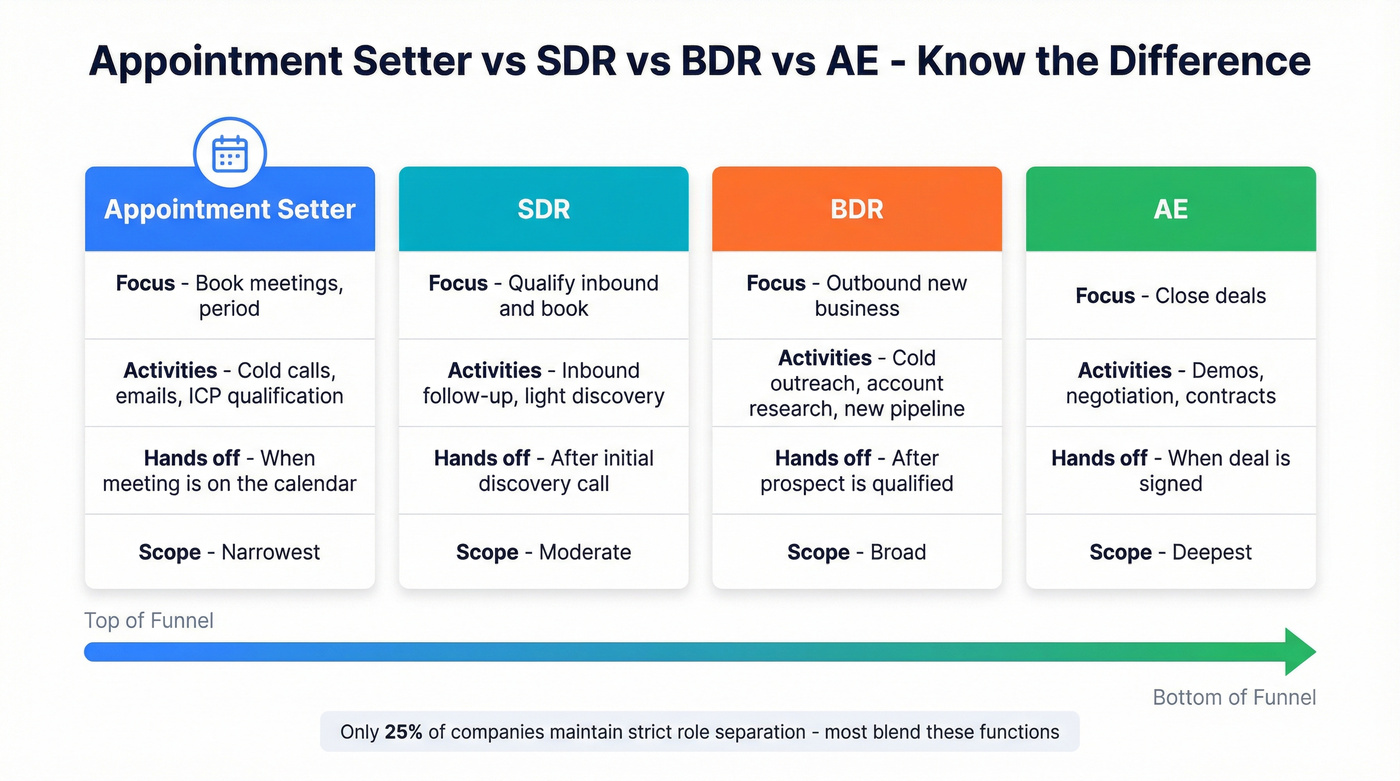
| Role | Primary Focus | Typical Activities | Hands Off When |
|---|---|---|---|
| Appointment Setter | Book meetings | Calls, emails, qualify against ICP | Meeting is confirmed on calendar |
| SDR | Qualify inbound + book | Inbound follow-up, light discovery | After initial discovery call |
| BDR | Outbound new business | Cold outreach, account research, new pipeline | After prospect is qualified and interested |
| AE | Close deals | Demos, negotiation, contracts | Deal is signed |
If you're hiring your first outbound rep, call them an appointment setter. The title sets the right expectation - book meetings, nothing else. You can always expand the role later, but starting with a narrow scope means faster ramp and clearer accountability. (If you’re defining the role formally, our SDR job meaning guide can help.)
In practice, most companies blend these roles. Your sales appointment setter might do light discovery. Your "BDR" might handle some inbound overflow. The labels matter less than the workflow - what matters is that someone owns top-of-funnel and someone else owns closing. Some teams also split the function further by dedicating an inbound appointment setter to handle demo requests and marketing-qualified leads, while outbound reps focus purely on cold prospecting.
A few numbers worth knowing: average SDR tenure is about 1.5 years, ramp time runs 3+ months, and roughly 63% of SDRs hit quota. That last number means more than a third of your team is underperforming at any given time. The ramp period is where most of the waste happens - you're paying full salary for someone who won't be productive for a quarter. (To reduce that waste, build a real BDR performance management system.)
This is why the "just hire two SDRs" advice is more expensive than it sounds. By the time you account for ramp, turnover, and the inevitable mis-hires, you've spent six figures before seeing a single qualified meeting.
How Appointment Setters Get Paid
Compensation is where most hiring managers either overpay for mediocrity or underpay and wonder why they can't retain anyone.
Base salary ranges from ~$29,250 to $70,000 annually, with the average hourly rate sitting around $18.75. For SDR-level roles with more responsibility, OTE runs $60,000-$125,000. Senior SDRs in high-cost markets can push $100K-$175K total comp.
The base-to-variable split typically falls between 50-80% base. Commission models break down across four main structures:
| Model | Range | Best For |
|---|---|---|
| Commission-only | $15-$100/appt | Freelancers, agencies |
| Flat-fee qualified | $25-$75/appt | In-house teams, clear ICP |
| Tiered | $30/$40/$50 per 10/20/20+ | Motivating volume |
| Team bonuses | $500-$2,000/mo | Collaborative cultures |
Here's the thing: commission-only is a red flag for B2B appointment setting. It attracts people who'll book anything that breathes just to hit their number. Your AEs end up sitting through meetings with unqualified prospects, and pipeline quality craters. If you're hiring in-house, pay a real base and use commissions to reward quality - meetings that show, meetings that convert, meetings that close.
The tiered model works well for teams that want to push volume without sacrificing quality. Set the first tier at your baseline expectation - say, 10 qualified meetings - then accelerate the payout above that. It rewards your best performers without overpaying for average output.
The Real Cost of Appointment Setting
In-House Costs
The true annual cost of an in-house setter runs about $88,600+ when you factor in everything.
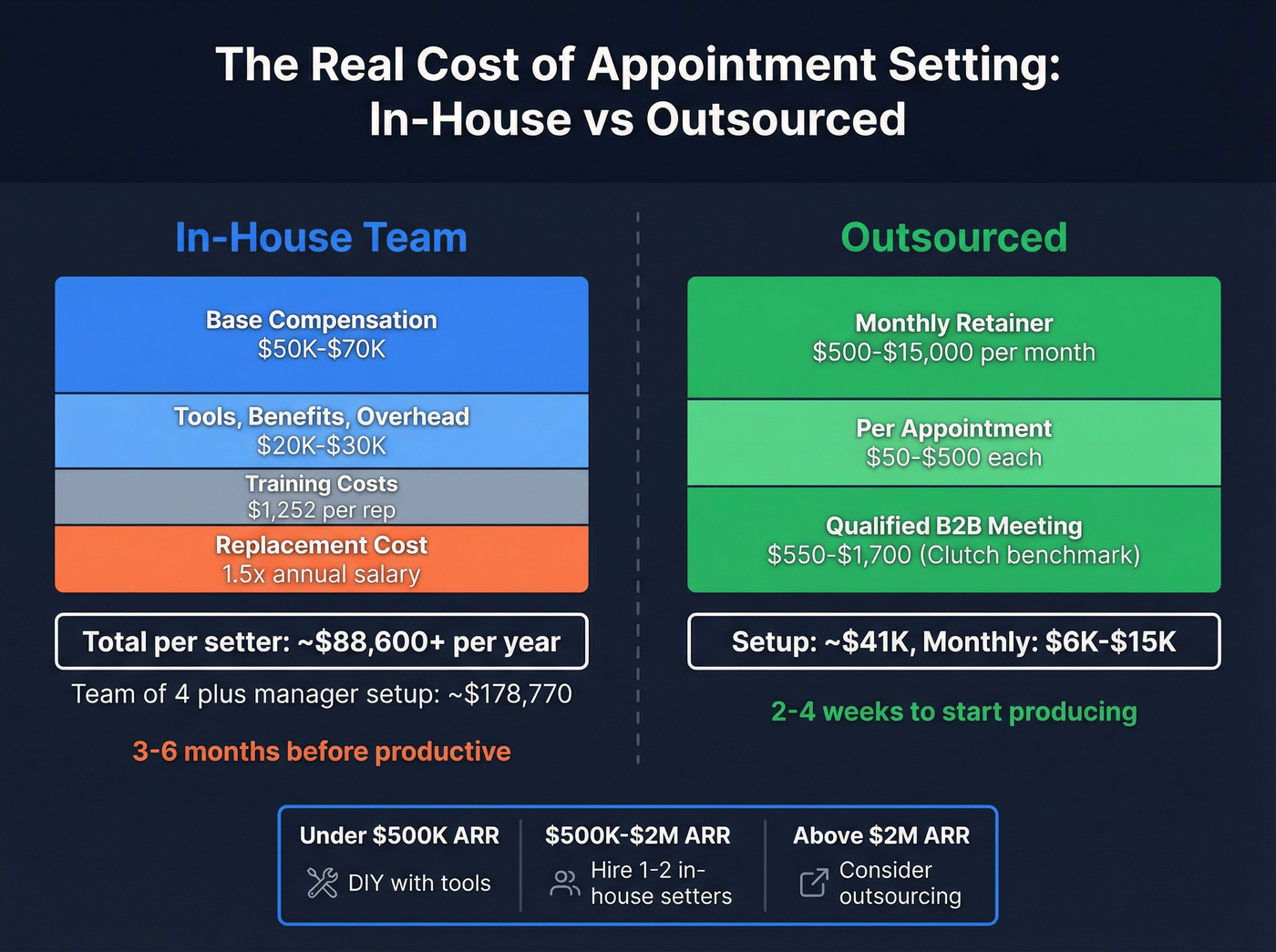
Start with $50K-$70K in base compensation for a setter/SDR-type outbound rep. Add $20K-$30K for tools, benefits, and overhead: CRM seats, dialer licenses, data subscriptions, health insurance, office space. Then add roughly $1,252 in training costs per employee. And if you need to replace someone? Budget 1.5x their annual salary for the recruiting, onboarding, and productivity gap.
Scale that to a real team - four setters plus a manager - and your setup cost hits approximately $178,770. Monthly run rate for that team lands between $20K-$30K. That's real money, and it doesn't include the 3-6 months of ramp time before anyone is fully productive.
Outsourced Costs
Outsourcing flips the cost structure. Retainers typically run $500-$15,000 per month depending on scope and volume. Pay-per-appointment models range from $50-$500 per meeting, with the Clutch benchmark for qualified B2B appointments sitting at $550-$1,700.
The upside is speed. Outsourced teams can start producing in 2-4 weeks versus the 3-6 months it takes to hire, onboard, and ramp in-house. Forrester research indicates outsourcing cuts costs by roughly 30% compared to building internally - though that number depends heavily on your deal size and sales cycle. (If you’re deciding between functions, see appointment setting vs lead generation.)
In-House vs Outsourced Comparison
| Factor | In-House | Outsourced | Best For |
|---|---|---|---|
| Setup cost | ~$178K (team of 4+mgr) | ~$41K setup fees | Outsourced (faster start) |
| Monthly cost | $20K-$30K | $6K-$15K | Outsourced (lower burn) |
| Time to start | 3-6 months | 2-4 weeks | Outsourced (speed wins) |
| Cost per qualified lead | $250-$800+ | $150-$600 | Outsourced (at scale) |
| Control level | High | Medium | In-house (quality control) |
| Product knowledge | Deep | Shallow | In-house (complex products) |
Our take on when each path makes sense: if you're under $500K ARR, do it yourself with tools. You need the feedback loop of hearing prospects say no - that's how you refine your ICP and messaging. Between $500K and $2M, hire one or two dedicated setters in-house. You've got enough pipeline data to train them properly. Above $2M with a proven playbook? That's when outsourcing starts to make economic sense, because you're scaling a system that already works rather than building one from scratch.
If your average contract value sits below five figures, you probably can't afford outsourced appointment setting. At $550-$1,700 per meeting and a 20-30% close rate, you'd need to close 2-3 meetings just to cover the cost of generating them. Build in-house, invest in good data, and keep the unit economics tight. (This is also where data quality becomes a revenue lever, not an ops chore.)

You read it above: 30-50% of B2B records go stale every year. That means your setters are burning half their dials on dead numbers and bounced emails. Prospeo refreshes data every 7 days - not every 6 weeks - and delivers 98% email accuracy with 125M+ verified mobile numbers.
Stop blaming your setters for bad data. Fix the data.
KPIs and Benchmarks
"100 calls a day" isn't a strategy. It's a vanity metric that tells you nothing about whether your appointment setting function is actually working. Here's what to track instead:
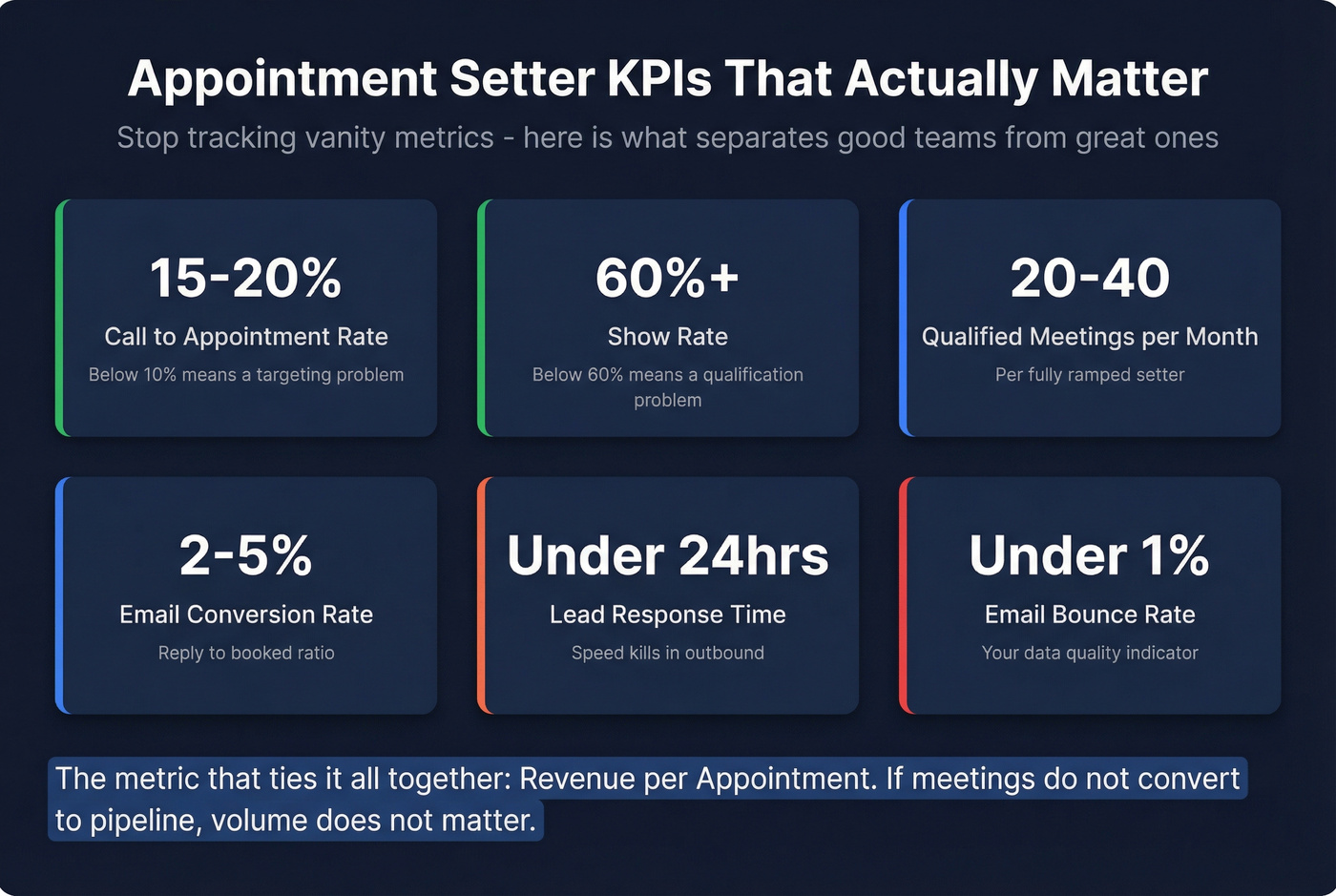
| KPI | Benchmark | Why It Matters |
|---|---|---|
| Call-to-appointment rate | 15-20% | Below 10% = targeting issue |
| Show rate | 60%+ | Below 60% = qualification issue |
| Qualified meetings/month | 20-40 | Per ramped setter |
| Email conversion rate | 2-5% | Reply-to-booked ratio |
| Lead response time | Under 24 hours | Speed kills in outbound |
| Bounce rate | Under 1% | Data quality indicator |
| Cost per appointment | Track monthly | Trend matters more than absolute |
Revenue per appointment is the metric that ties everything together. If your setters book 30 meetings a month but only 3 convert to pipeline, you don't have a volume problem - you have a quality problem. In our experience, the teams that obsess over pipeline velocity - how fast deals move from booked meeting to closed-won - consistently outperform teams that only track raw meeting counts. (If you’re diagnosing why pipeline is flat, start with these sales pipeline challenges.)
Companies that define clear appointment setting processes see 40% higher lead-to-opportunity conversion. That's not about having a fancier CRM. It's about having clear ICP criteria, consistent qualification questions, and a handoff process that doesn't lose context between the setter and the AE.
Scripts That Actually Book Meetings
Cold Call Opener
The framework is simple: opening hook, value prop, qualifying questions, clear CTA.
"Hi [Name], this is [Your Name] with [Company]. I'll be brief - in just three minutes, I want to share something we're doing with [similar companies/role] that's cutting their [specific pain point] by [specific result]. Does that sound fair?"
The "three-minute" time-box works because it lowers resistance. You're not asking for a 30-minute meeting - you're asking for permission to be relevant. We've tested this against open-ended openers and the time-boxed version converts at roughly 2x the rate. If the prospect says yes, you've earned the right to ask two or three qualifying questions.
The coaching principle that matters most: speak as little as possible. The more your prospect talks, the better your qualification data and the higher your booking rate.
Gatekeeper Script
Gatekeepers aren't obstacles - they're routing systems. Treat them that way.
"Hi, this is [Your Name] calling for [Prospect Name]. Could you put me through?"
Keep it short. Don't explain why you're calling. Don't pitch the gatekeeper. If they ask what it's regarding:
"I'm following up on something [Prospect Name] will want to see regarding [industry-specific topic]. They'll know what it's about."
For referred leads, name-drop immediately: "Hi, [Referrer Name] suggested I reach out to [Prospect] about [topic]. Could you connect me?"
Objection Handling
"I don't have time right now."
"Totally understand - when's a better time this week? I only need three minutes. Would Thursday at 10 or Friday at 2 work better?"
"I'm not interested."
"Fair enough. Most of the [role] I talk to say the same thing until they hear how [Company X] solved [specific problem]. Can I send you a one-paragraph email with the details? If it's not relevant, I won't follow up."
Internal coaching check for vague meeting goals: before every dial, your setter should complete this sentence: "The reason [Prospect] should meet with us is ___." If they can't fill it in, they're not ready to call. "I'd love to chat" books fewer meetings than "I want to show you how [Company X] cut their outbound cost per meeting by 40% - takes 15 minutes."
Email Template
Subject: [First Name], quick question about [specific pain]
Hi [First Name],
[One sentence about the problem they likely have.]
We helped [similar company] [specific result] in [timeframe].
Worth 15 minutes Thursday at 2 PM to see if we can do the same for [their company]?
[Your Name]
Keep it under 80 words. One problem, one proof point, one specific time slot. The two-time-option CTA - "Thursday 10 AM or Friday 2 PM?" - consistently outperforms open-ended "let me know when works." (For more options, see these outreach email templates.)
The Multi-Channel Cadence
Single-channel outreach is dead. 84% of B2B buyers prefer engaging through multiple channels before committing to a meeting, and multi-channel sequences produce up to 2.5x higher response rates than phone or email alone.
Here's a cadence that works across 14-21 days:
| Day | Channel | Action |
|---|---|---|
| 1 | Personalized cold email | |
| 2 | Phone | Call + voicemail |
| 4 | Follow-up with value add | |
| 6 | Social | Connect + comment on content |
| 8 | Phone | Second call attempt |
| 10 | Case study or proof point | |
| 14 | Phone | Final call + breakup email |
| 21 | "Closing the loop" email |
Most conversions happen after 5+ follow-ups, yet most reps give up after two or three touches. The 8-12 touch cadence isn't aggressive - it's necessary.
One critical detail on email volume: don't send more than 30 emails per inbox per day if you want to preserve deliverability. Scale by adding inboxes and domains, not by blasting 100 emails from a single address. Run your list through a verification tool before launching any sequence - one bad batch can tank your domain reputation for weeks. We've seen teams maintain 94%+ deliverability with bounce under 3% and zero domain flags by running verified data through their outbound campaigns.
Mistakes That Kill Your Pipeline
1. Poor targeting. Calling companies that aren't a fit is the most expensive mistake in appointment setting. Every dial to a wrong-fit prospect costs time, burns rep morale, and produces meetings that waste your AE's calendar. Define your ICP before you hire a single setter.
2. Bad contact data. Between 30-50% of B2B records go stale within a year - people change jobs, companies get acquired, phone numbers get reassigned. Bad data doesn't just reduce connect rates; it adds 20-40% to your campaign cost. Before your setters make a single call, verify the list. Prospeo's 7-day data refresh cycle and 5-step verification process - including catch-all handling, spam-trap removal, and honeypot filtering - keep bounce rates under 1% where they belong.
3. Generic messaging. "I'd love to learn more about your business" isn't a reason to take a meeting. Every outreach touch should reference something specific - their industry, their tech stack, a recent trigger event. Personalization doesn't mean writing a novel. It means proving you did five minutes of research. (If you want a system for this, use our personalization in outbound sales framework.)
4. Pitching too early. Your setter's job is to book a meeting, not to sell the product. The moment they start explaining features on a cold call, they've lost control of the conversation. Ask questions. Listen. Book.
5. Vague meeting goals. "Let's hop on a call" is the weakest CTA in sales. Every meeting request needs a specific agenda and a specific value promise. "I'll show you how [Company X] cut their cost per meeting by 40% - takes 15 minutes" gives the prospect a reason to show up.
6. Weak handoffs to AEs. Your setter books a great meeting. The AE shows up cold, asks the same qualifying questions again, and the prospect checks out. The consensus on r/sales is that this is the single biggest source of friction between setters and closers - whether in-house or outsourced. Build a handoff template: prospect name, company, pain points discussed, why they agreed to meet, and any objections raised. Five fields. Takes 90 seconds.
7. No no-show recovery plan. No-shows happen. The question is whether you have a system to recover them. Send a reminder 24 hours before and 1 hour before. If they don't show, send a same-day "sorry we missed you" email with a one-click reschedule link. Follow up with a call the next day. We've seen teams recover 30-40% of no-shows with a simple three-touch recovery sequence.
The Tool Stack
Contact Data & Verification
This is the layer that makes or breaks everything else. Your CRM is useless with bad data in it. Your sequences are useless if emails bounce. Your dialers are useless if phone numbers are disconnected. (If you’re evaluating vendors, start with our list of email ID validators.)
Prospeo covers 300M+ professional profiles with 143M+ verified emails and 125M+ verified mobile numbers. The mobile numbers carry a 30% pickup rate - which matters when your setters are making 60+ dials a day. The 5-step verification process handles catch-all domains, removes spam traps, and filters honeypots, so your bounce rate stays under 1%. Native integrations to Salesforce, HubSpot, Instantly, Smartlead, and Lemlist mean verified contacts flow directly into your sequences without manual CSV exports.

On pricing: ZoomInfo charges roughly $1/lead with annual contracts starting around $15K/year. Prospeo runs about $0.01 per email with no contracts. The free tier gives you 75 emails and 100 Chrome extension credits per month. For a team burning through hundreds of contacts per week, that's a 90%+ cost reduction with higher accuracy.
CRM
Your CRM is the system of record. It doesn't need to be fancy - it needs pipeline visibility, activity tracking, and integration with your sequencing tools.
| CRM | Starting Price | Best For |
|---|---|---|
| HubSpot | Free (paid from ~$20/seat/mo) | Teams wanting a massive integration ecosystem |
| Pipedrive | $14/user/mo | Sales-first teams that want visual pipeline management |
| Nutshell | $13/mo (Pro at $42/mo) | Small teams wanting simplicity without the learning curve |
HubSpot is the default for a reason - the free tier is genuinely useful and most tools integrate natively. Pipedrive is the better choice if your setters live in the pipeline view all day. Skip Nutshell if you're planning to scale past 15 reps; it starts to feel cramped.
Sequencing & Email
For cold email sequences, the three tools worth evaluating are Instantly, Smartlead, and Lemlist. All three handle multi-inbox sending, email warm-up, and sequence automation. Instantly tends to win on price for high-volume senders, starting around $30/mo. Smartlead is stronger for agencies managing multiple client inboxes, starting around $39/mo. Lemlist adds more personalization features like dynamic images and landing pages, starting around $32/mo. (If you’re building your stack, compare cold email marketing tools.)
Email warm-up is non-negotiable. Don't launch cold sequences from a fresh domain - you'll land in spam within a week. Warm up for at least 2-3 weeks before sending any outbound volume.
Dialers
Orum is the power dialer of choice for high-volume teams. Parallel dialing means your setters spend more time talking and less time listening to rings. Expect to pay $200-$300/user/mo for Orum's full feature set. PhoneBurner runs around $127/user/mo and JustCall starts at $19/user/mo - both solid depending on your volume needs and budget. If your setters are making fewer than 50 dials a day, JustCall is plenty. Above that, Orum pays for itself in time saved.
Scheduling
Calendly's free tier handles basic meeting scheduling, with paid plans from ~$10/user/mo for team features. Chili Piper, starting around $30/user/mo, adds intelligent routing - if you have multiple AEs covering different territories or segments, Chili Piper makes sure the meeting lands on the right calendar automatically. For teams with more than three AEs, the routing alone justifies the cost.
A ramped setter booking 20-40 meetings per month needs a pipeline of accurate contacts to work through. Prospeo's 300M+ profiles with 30+ filters - buyer intent, job changes, headcount growth - let your setters spend time selling, not researching. At $0.01 per email, it costs less than a single wasted dial.
Give your setters the list they deserve for a penny per lead.
Hire, Outsource, or Go Virtual?
Most appointment setting guides are written by agencies trying to sell you their services. That's why they all conclude with "outsourcing is the smart move." Let's be more honest about this.
Path 1: DIY with tools (under $500K ARR). You're founder-led. You need to hear the market directly. Buy a CRM, get verified contact data, set up a dialer, and do the outreach yourself or with one part-time setter. Total tool cost: $100-$300/mo. You'll learn more about your ICP in one month of cold calling than any outsourced agency will teach you in six.
Path 2: Hire 1-2 in-house setters ($500K-$2M ARR). You've got a proven ICP and a repeatable message. Now you need dedicated humans running the playbook. Hire for coachability over experience - a smart, persistent person with good tools will outperform an experienced setter working off a bad list every time. Budget $90K-$120K per setter fully loaded.
Path 3: Outsource or hire a virtual appointment setter ($2M+ ARR with a proven playbook). You've got a playbook that works. You know your conversion rates. You need to scale faster than you can hire. Outsourcing makes sense here because you're handing off a defined system, not asking an agency to figure out your market for you. A virtual appointment setter - whether through an agency or a freelance contractor - can ramp in weeks rather than months, provided you give them a clear script, verified data, and defined qualification criteria. (If you’re operationalizing this, start with an appointment setting campaign playbook.)
Some agencies claim 40-60% faster pipeline growth compared to in-house teams. Ask them for the denominator. If they're comparing against companies with no outbound function at all, that number is meaningless.
The most common complaints from sales teams who've tried outsourcing are poor qualification, calendar stuffing with unqualified meetings, and weak handoff notes that leave AEs flying blind. If you go the outsourced route, demand weekly call recordings, shared CRM access, and a clear disqualification framework. Otherwise you're paying $1,000+ per meeting for your AEs to babysit bad leads.
The right answer depends on your stage, your deal size, and how much you need to own the customer conversation.
FAQ
What does an appointment setter do?
An appointment setter researches prospects, makes 50-80 calls and sends 30+ emails daily, qualifies leads against ICP criteria, and books meetings for AEs. The best ones spend more time on research and personalization than raw dial volume - quality targeting beats brute-force calling every time.
How much do appointment setters make?
Entry-level base salary ranges from ~$29,250-$70,000 per year depending on market and experience. With commissions of $15-$100 per qualified meeting and bonuses, OTE can reach $60,000-$125,000 for experienced reps in SDR-level roles.
Appointment setter vs SDR - what's the difference?
Appointment setters focus purely on booking meetings and hand off before discovery. SDRs often run initial discovery calls and qualify deeper before passing to an AE. In practice, only about 25% of companies maintain strict role separation between the two titles.
Is outsourced appointment setting worth it?
Outsourced meetings cost $550-$1,700 each per Clutch benchmarks. If your average deal exceeds $50K, the math works. For smaller deal sizes, in-house setters with verified data are more cost-effective - you'll spend less per meeting and maintain tighter quality control.
How many appointments should a setter book per month?
The benchmark is 20-40 qualified meetings per month from a ramped rep, with a 15-20% call-to-appointment rate. If your team is consistently below that, the problem is usually data quality or targeting - fix the inputs before you pressure the reps.